









Pour obtenir la résidence permanente à Chypre, vous devez investir au moins 300 000 € et être en mesure de justifier d’au moins 50 000 € de revenus annuels hors de Chypre.
Les demandes de résidence permanente à Chypre sont examinées dans un délai d’environ 9 mois ; vous pouvez obtenir ce statut conjointement avec votre famille.
Découvrez l’ensemble des conditions de la résidence permanente à Chypre par investissement et le profil des personnes auxquelles elle s’adresse.
Pourquoi Chypre est-elle attractive pour les investisseurs ?
Chypre est une destination prisée pour l’immigration ou l’obtention d’une solution de sécurité pour la famille auprès des familles fortunées, des entrepreneurs et des investisseurs. L’île est déjà membre de l’Union européenne, mais ne fait pas encore partie de l’espace Schengen ; une demande d’adhésion est toujours en instance.
Le pays offre un niveau de vie élevé, des soins de santé de haute qualité et un enseignement de haut niveau, incluant plusieurs écoles britanniques.
Au cours de la dernière décennie, Chypre a enregistré une forte croissance économique, ce qui la situe parmi les économies européennes à la croissance la plus rapide ces dernières années.
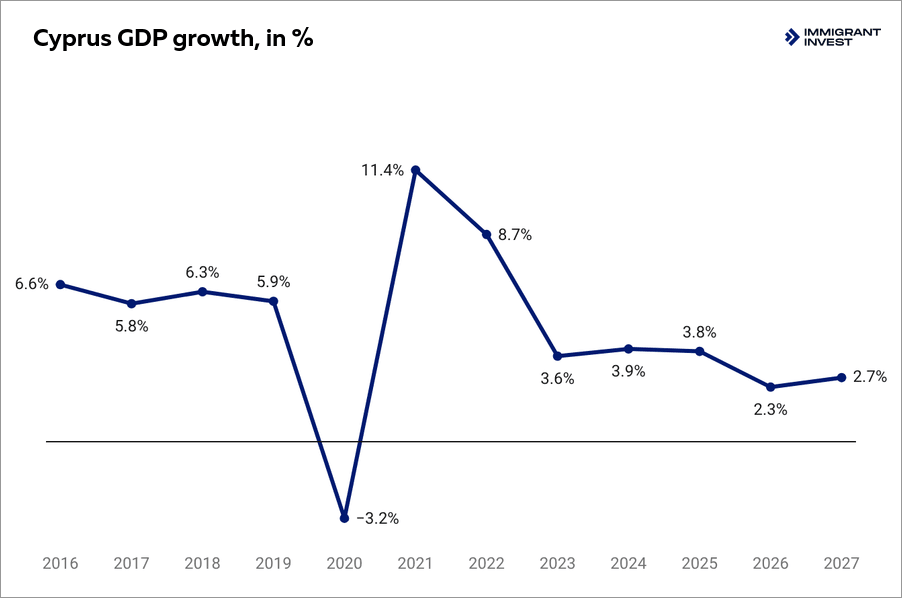
La croissance réelle du PIB concerne la période 2016—2025[1]Source : Banque mondiale — Données sur le PIB de Chypre et les chiffres projetés concernent 2026—2027[2]Source : Commission européenne — Prévisions économiques pour Chypre
La résidence permanente par investissement présente un grand intérêt pour les investisseurs pour de nombreuses raisons :
- Durée de validité indéfinie du statut.
- Aucune condition de présence physique. Il suffit, après l’acceptation de la demande, de se rendre dans le pays pour enregistrer les données biométriques et de visiter l’île une fois tous les 2 ans.
- Délai de traitement rapide de plus de 9 mois au lieu de 5 ans de résidence dans le pays.
- Inclusion des membres de la famille.
- Inutile de connaître le grec pour obtenir la résidence permanente par investissement. De plus, pour la vie quotidienne, l’anglais suffit : 80 % de la population parle anglais.
- Voie vers la citoyenneté chypriote 8 ans après la réception de la résidence permanente[3]Source : Ministère de l'Intérieur de Chypre : Acquisition de la citoyenneté chypriote par naturalisation. Avec un passeport du pays, vous pouvez voyager sans visa dans 178 pays, y compris dans l’Union européenne et au Royaume-Uni.
- Chypre n’applique pas de droits de succession, et les résidents fiscaux éligibles non domiciliés sont exonérés de la Contribution spéciale pour la défense sur les dividendes et les intérêts.
- Les prix de l’immobilier résidentiel à Chypre ont augmenté de 7,1 % sur un an au quatrième trimestre 2025, avec une hausse de 9,6 % pour les appartements[4]Source : Banque centrale de Chypre — Indice des prix de l'immobilier résidentiel, T4 2025, ce qui fait de l’immobilier un investissement avantageux à long terme.
- Un environnement favorable aux affaires, avec un taux d’impôt sur les sociétés de 15 % et la possibilité pour les investisseurs éligibles à la résidence permanente d’investir dans des entreprises chypriotes et de les gérer.
- Les résidents permanents éligibles ont accès au système général de santé de Chypre et bénéficient de services médicaux gratuits.
Ces avantages font de Chypre l’une des destinations les plus attractives de l’Union européenne pour s’installer : le pays est agréable aussi bien pour y vivre que pour y exercer une activité commerciale.

Plus de 10 000 investisseurs nous font confiance
Vérifiez votre éligibilité à la résidence permanente de Chypre
Quelles sont les conditions requises pour les demandeurs souhaitant obtenir la résidence permanente à Chypre ?
Investir de l’argent ne suffit pas pour obtenir le statut : le demandeur doit également prouver la légalité de l’origine des fonds, justifier de revenus suffisants et disposer d’une adresse de résidence enregistrée à Chypre.
Pour le demandeur principal
Conditions applicables aux investisseurs lors de la demande :
- casier judiciaire vierge ;
- aucune sanction, restriction ou interdiction d’entrée dans les pays de l’UE et au Royaume-Uni ;
- source de revenus légitime ;
- réputation personnelle et professionnelle irréprochable ;
- revenu annuel à partir de 50 000 € par an hors de Chypre ; pour chaque demandeur supplémentaire, le revenu exigé augmente de 15 000 € pour le conjoint et de 10 000 € pour chaque enfant.
Les investisseurs doivent avoir une adresse enregistrée à Chypre. Si le demandeur investit dans un bien immobilier commercial ou dans des titres locaux, il doit tout de même acheter ou louer un bien immobilier résidentiel. Il n’y a pas de condition de coût minimum pour ce logement.
Il n’est pas nécessaire de résider en permanence à Chypre, bien que, pour maintenir leur statut de résidence permanente, les investisseurs doivent se rendre sur l’île au moins une fois tous les deux ans. Dans le cas contraire, le statut peut être annulé. Toutefois, l’obtention d’un permis de séjour dans un autre pays est interdite par les conditions du programme.
La résidence permanente à Chypre est valable à vie. Pour maintenir leur statut chaque année, les résidents doivent prouver la même source de revenus, conserver leurs investissements et renouveler leur assurance médicale. Chaque année, chaque membre de la famille âgé de plus de 18 ans doit renouveler son certificat de casier judiciaire.
Pour les membres de la famille
Aux côtés de l’investisseur, la résidence permanente à Chypre peut être obtenue par :
- le conjoint ;
- les enfants de moins de 18 ans ;
- les enfants étudiants non mariés de moins de 25 ans qui sont financièrement dépendants du demandeur principal ;
- les enfants de tout âge présentant un handicap physique ou mental.
Un enfant majeur et financièrement indépendant peut être inclus dans la demande, mais un montant supplémentaire de 300 000 € devra être ajouté au montant de l’investissement, et l’enfant devra justifier d’un revenu annuel d’au moins 30 000 €.

Quelles sont les options d’investissement pour obtenir la résidence permanente à Chypre ?
Un investisseur peut obtenir la résidence permanente à Chypre en investissant au moins 300 000 € dans l’une des options suivantes :
- bien immobilier résidentiel ;
- bien immobilier commercial ;
- actions d’entreprises chypriotes ;
- parts de fonds d’investissement chypriotes.
Achat d’un bien immobilier résidentiel
L’achat immobilier est le moyen le plus populaire d’obtenir la résidence permanente à Chypre.
Un investisseur peut acheter un ou deux biens immobiliers neufs d’une valeur combinée d’au moins 300 000 € hors TVA. Le taux normal de TVA est de 19 %, mais un taux réduit de 5 % s’applique lorsque le bien constitue l’unique résidence de l’acheteur et qu’il est destiné à un usage personnel. Au niveau d’investissement minimum, cette TVA réduite s’élève à 15 000 €.
Seuls les biens neufs sont éligibles à la résidence permanente. La revente n’est pas autorisée. Si deux biens sont achetés, ils peuvent provenir de promoteurs différents.
L’achat peut être effectué au nom de l’investisseur ou par l’intermédiaire d’une société enregistrée au nom de l’investisseur ou de son conjoint, à condition que l’un d’eux soit l’unique propriétaire de cette société.
Le bien immobilier doit rester la propriété de l’investisseur pendant toute la durée de son statut de résident. Il ne peut être vendu qu’après l’octroi de la citoyenneté. Si l’investisseur décide de vendre plus tôt, il doit acheter un autre bien de valeur égale ou supérieure.
Exemples de villas à Chypre


Chypre, Paphos
1 607 000 € — 2 239 000 €
Comfortable and stylish villas, Konia, Paphos
 452 m² — 630 m²
 4
4  4
4 
Chypre, Paphos
425 000 € — 575 000 €
Stylish villas with traditional elements, Pegeia, Paphos
118 m² — 155 m²3 3 
Chypre, Limassol
26 670 000 €+
Elegant and stylish villa, Agios Tychonas, Limassol
1 213 m²5 5 Achat d’un bien immobilier commercial
Au lieu d’un bien résidentiel, un investisseur peut acheter un ou deux biens immobiliers commerciaux pour un montant total d’au moins 300 000 € plus une TVA de 19 %, soit au moins 57 000 €.
Les biens immobiliers commerciaux peuvent être achetés sur les marchés primaire et secondaire. Les bureaux, les magasins, les hôtels ou une combinaison de ceux-ci sont éligibles.
Calcul complet des coûts pour la résidence permanente à Chypre dans le cadre de l’option d’achat immobilier

Achat d’actions de sociétés
Les demandeurs peuvent investir 300 000 € dans des actions de sociétés chypriotes. La société doit être enregistrée et physiquement présente à Chypre et employer au moins 5 personnes.
Les titulaires de la résidence permanente dans la catégorie investissement ne peuvent pas travailler comme salariés dans ces entreprises. Cependant, ils peuvent agir en qualité d’actionnaires ou d’administrateurs et percevoir des dividendes plutôt qu’un salaire.
Achat de parts de fonds d’investissement chypriotes
L’investisseur peut acheter des parts ou des actions de fonds réglementés par la Cyprus Securities and Exchange Commission pour un montant d’au moins 300 000 €.
Les structures de fonds autorisées sont :
- Fonds d’investissement alternatif, FIA (AIF) ;
- FIA à nombre limité de personnes, FIA AIFLNP ;
- Fonds d’investissement alternatif enregistré, RAIF.

Obtenez votre estimation personnalisée des coûts pour la résidence permanente de Chypre
Marché immobilier chypriote : vue d’ensemble
Le marché immobilier à Chypre continue de manifester une croissance soutenue, étayée par une demande solide, des prix en hausse et un vif intérêt de la part des investisseurs.
Au premier trimestre 2026, le nombre de contrats de vente immobilière a augmenté de 13,8 % sur un an pour atteindre 4 709, sous l’impulsion principale d’acheteurs étrangers, dont les acquisitions ont progressé de 22,3 % pour s’établir à 2 044 contrats[5]Source : Cyprus Mail — Les ventes immobilières les plus importantes à Chypre dépassent 286 millions d'euros au premier semestre 2026.
Les prix des logements sont restés soutenus : l’indice des prix de l’immobilier résidentiel de la Banque centrale s’est apprécié de 7,5 % sur un an, les prix des appartements progressant de 10,8 % et ceux des maisons de 3,0 %[6]Source : Banque centrale de Chypre — Indice des prix de l'immobilier résidentiel, T1 2026.
Dynamique régionale
La croissance des prix et le comportement du marché varient considérablement selon les grands districts chypriotes.
Limassol demeure le marché haut de gamme par excellence. La ville domine le segment supérieur du secteur : sur les 50 transactions immobilières à plus forte valeur au premier semestre 2026, six des dix plus importantes transactions ont été réalisées à Limassol, y compris la plus importante vente unique du semestre[5]Source : Cyprus Mail — Les ventes immobilières les plus importantes à Chypre dépassent 286 millions d'euros au premier semestre 2026. Les prix des résidences de vacances y ont progressé le plus rapidement de tous les districts[7]Source : RICS Cyprus Property Index avec KPMG à Chypre, T1 2026.
Limassol affiche également les loyers les plus élevés : un appartement de 3 chambres au centre-ville se loue environ 2 378 € par mois[8]Source : Numbeo — Coût de la vie à Limassol.
Paphos offre un attrait marqué pour le cadre de vie et les résidences secondaires, représentant trois des dix transactions les plus élevées au S1 2026, et continue d’attirer les investisseurs à la recherche de potentiel locatif touristique[5]Source : Cyprus Mail — Les ventes immobilières les plus importantes à Chypre dépassent 286 millions d'euros au premier semestre 2026.
Larnaca reste un marché comparativement orienté vers le bon rapport qualité-prix ; le district n’a enregistré qu’une seule des dix transactions les plus importantes au S1 2026[5]Source : Cyprus Mail — Les ventes immobilières les plus importantes à Chypre dépassent 286 millions d'euros au premier semestre 2026. Bien que son segment locatif de vacances n’ait enregistré aucune croissance trimestrielle sur cette période, ce qui indique une dynamique plus modérée qu’à Limassol ou Paphos[7]Source : RICS Cyprus Property Index avec KPMG à Chypre, T1 2026.
Nicosie affiche une croissance plus régulière, tirée par la demande intérieure, avec des prix d’entrée et des loyers généralement inférieurs à ceux des districts côtiers — un appartement équivalent de 3 chambres dans le centre se loue environ 1 526 € par mois[9]Source : Numbeo — Coût de la vie à Nicosie.
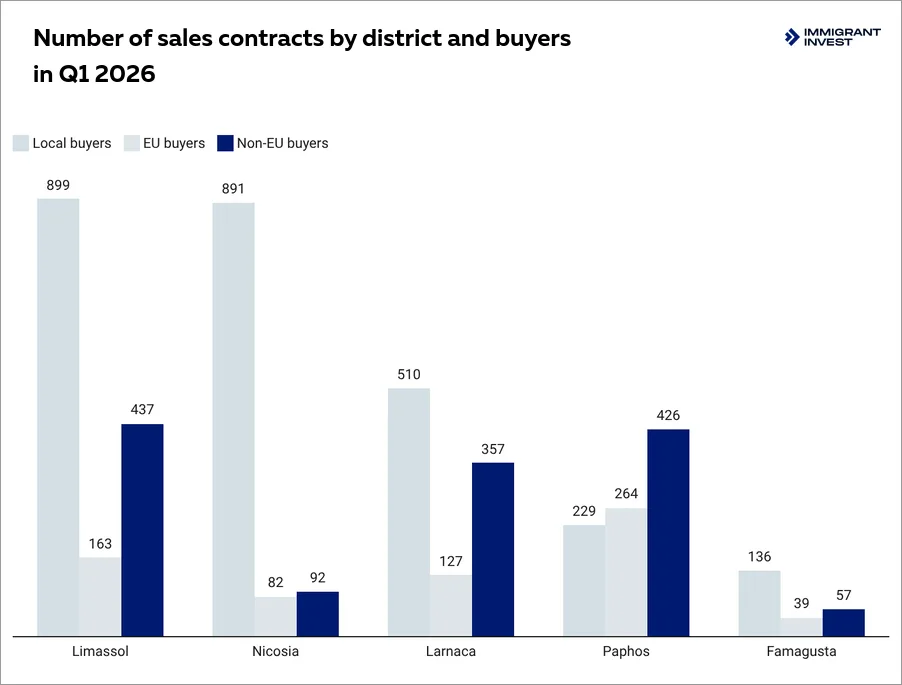
Source : Banque centrale de Chypre — Indice des prix de l’immobilier résidentiel, T1 2026
Perspectives de l’offre et de la demande
8 978 de nouveaux logements ont été autorisés entre janvier et mai 2026, soit une hausse de 63,7 % sur un an. 3 650 permis de construire ont été délivrés au cours de cette même période[10]Source : Service statistique de Chypre — Permis de construire, 2026.
Les investisseurs achètent le plus souvent des terrains pour la construction d’appartements de luxe et d’hôtels, tandis que la demande de bureaux augmente également au fur et à mesure que des entreprises internationales ouvrent des bureaux de représentation sur l’île[5]Source : Cyprus Mail — Les ventes immobilières les plus importantes à Chypre dépassent 286 millions d'euros au premier semestre 2026.
Fiscalité pour l’achat immobilier
Lors de l’achat d’un bien immobilier à Chypre, les taxes et frais dépendent du statut du bien, neuf ou en revente.
Pour les logements neufs soumis à la TVA, le taux normal est de 19 %. Un taux réduit de TVA de 5 % peut s’appliquer aux résidences principales éligibles[11]Source : Département fiscal de Chypre — TVA réduite à 5 %.
Pour les biens en revente, non soumis à la TVA, les acheteurs s’acquittent des droits de transfert de propriété auprès du Département du Cadastre et de l’Arpentage. Ils sont calculés sur la valeur marchande du bien selon un barème progressif :
- jusqu’à 85 000 € — 3 % ;
- de 85 000 à 170 000 € — 5 % ;
- plus de 170 000 € — 8 %.
Aucun droit de transfert n’est payable lorsque la TVA s’applique. Dans les autres cas, le droit de transfert calculé fait actuellement l’objet d’une réduction de 50 %[12]Source : Département du Cadastre et de l'Arpentage — Droits et frais.
Les honoraires juridiques et professionnels, y compris les coûts d’avocat, ne sont pas fixés par la loi et varient en fonction du prestataire.
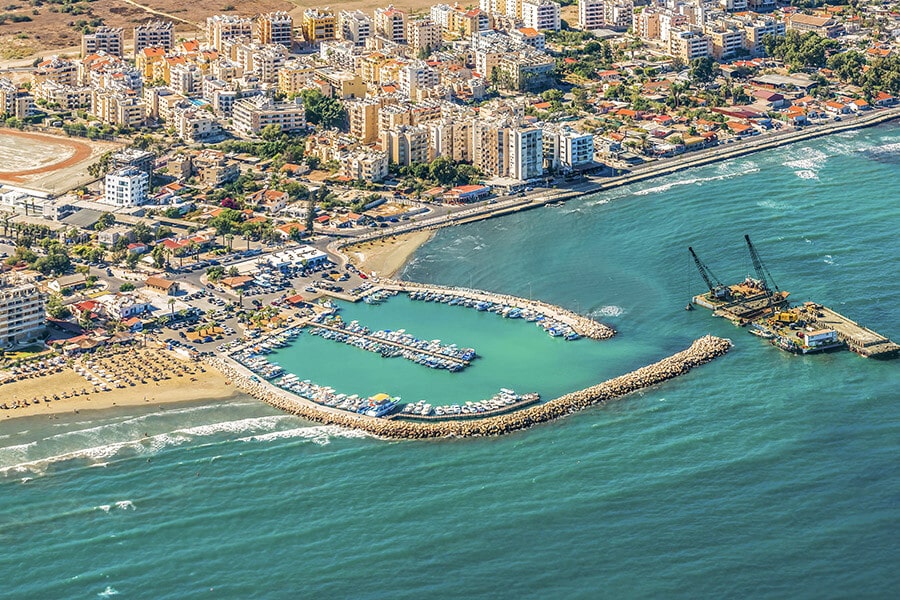
Les appartements haut de gamme en bord de mer à Limassol peuvent atteindre 8 000 € par m², reflétant une forte demande dans le secteur du luxe
Comment sécuriser votre investissement immobilier ?
L’achat d’un bien immobilier à Chypre nécessite une vérification juridique rigoureuse. L’île utilise un système mixte dans lequel les titres de propriété ne sont pas toujours délivrés au moment de l’achat, en particulier pour les projets neufs. Une vérification d’usage adéquate protège l’investisseur contre les risques liés à la construction, les passifs cachés et les litiges futurs.
Comprendre le rôle du titre de propriété
Le titre de propriété est le document officiel attestant la propriété foncière ou immobilière à Chypre. Il confirme :
- le propriétaire légal du bien ;
- les limites et la superficie du terrain ou du bien ;
- l’absence ou la présence de charges, d’hypothèques ou de recours judiciaires ;
- la conformité légale de la construction et son inspection par les autorités.
Lorsqu’un bien est neuf et encore en construction, les titres de propriété individuels ne sont délivrés qu’une fois le projet entièrement achevé et certifié par les autorités. Jusqu’à cette date, les acheteurs s’appuient sur un contrat de vente enregistré au Cadastre, qui offre une protection solide bien que différente.
Utiliser les outils de protection juridique
Le droit chypriote prévoit plusieurs garanties pour les acheteurs immobiliers.
Comptes séquestres. Les paiements peuvent être conservés sur un compte séquestre par un avocat ou un fiduciaire agréé et ne libérés que lorsque les étapes convenues sont atteintes. Cela évite les paiements prématurés et protège les acheteurs si le promoteur ne remplit pas ses obligations.
Lettres de mainlevée bancaire. Si le terrain ou le projet fait l’objet d’une hypothèque, l’acheteur doit obtenir une lettre de mainlevée de la banque. Cela garantit que la banque libère le bien acheté des dettes du promoteur, permettant le transfert du titre de propriété libre de toute charge.
Enregistrement du contrat de vente. L’enregistrement du contrat de vente auprès du Cadastre chypriote préserve les droits de l’acheteur avant la délivrance du titre de propriété. Une fois enregistré, le bien est réservé au nom de l’acheteur, ne peut être revendu ou utilisé comme garantie par le promoteur, et confère à l’acheteur une protection juridique opposable, notamment lors d’achats sur plan.
Vérifier le promoteur
Avant de signer un accord, les investisseurs doivent s’assurer que le promoteur est parfaitement en règle et financièrement stable. Une vérification standard comprend :
- la vérification des licences et permis du promoteur ;
- la confirmation que les permis d’urbanisme et de construire correspondent au bien vendu ;
- l’examen des antécédents et des projets passés du promoteur ;
- l’assurance qu’il n’existe aucune hypothèque, instance judiciaire ou privilège sur le terrain ;
- l’évaluation de l’historique des délais de délivrance des titres de propriété par le promoteur.
L’avocat doit obtenir ces informations de manière indépendante auprès du Cadastre, de l’Autorité de l’urbanisme et des institutions financières concernées.
Effectuer un contrôle approfondi du bien
Après la vérification réussie du promoteur, il est essentiel de s’assurer du statut irréprochable du bien choisi. Le processus comprend les étapes suivantes :
- Recherche de titre au Cadastre. Confirmer l’existence d’un titre de propriété distinct, le propriétaire enregistré, les limites ainsi que les éventuelles hypothèques, privilèges ou charges.
- Vérification des permis d’urbanisme et de construire. Vérifier le permis d’urbanisme, le permis de construire et le certificat d’approbation finale. Cette étape est cruciale si le titre de propriété n’a pas encore été délivré.
- Inspection technique. Cette étape est facultative mais courante. Faire appel à un expert pour vérifier la structure, l’humidité, la plomberie, les matériaux et la performance énergétique.
- Examen des dettes et obligations. S’assurer que le vendeur ou le promoteur n’a pas de prêts, taxes, factures de services publics ou redevances municipales impayés liés au bien.
Une fois le bien validé par la vérification diligente, l’avocat rédige et contrôle le contrat de vente, fixant le calendrier de paiement, la date de livraison, les pénalités, les garanties et les conditions convenues. Ensuite, le contrat est signé et déposé au Cadastre, ce qui sécurise les droits de l’acheteur.
À la suite des vérifications finales, le Cadastre procède au transfert et délivre le titre au nouveau propriétaire.
Quels sont les pièges classiques lors de l’achat d’un bien immobilier et comment les éviter ?
L’achat d’un bien immobilier à Chypre est généralement simple, mais les mêmes problèmes réapparaissent régulièrement lors de transactions mal préparées.
Tous les risques peuvent être décelés à l’avance au moyen d’une recherche juridique complète auprès du Cadastre et d’une vérification des documents d’urbanisme et de construction par un avocat expérimenté. L’équipe d’Immigrant Invest compte des juristes chevronnés, parfaitement spécialistes de la législation chypriote et du marché immobilier.
Permis d’urbanisme et de construire non vérifiés
Si un bien présente des permis d’urbanisme et de construire manquants ou irréguliers, la construction peut être partiellement illégale ou non conforme. Cela peut retarder la délivrance du certificat final d’approbation et, par conséquent, du titre de propriété. Dans certains cas, la régularisation des irrégularités nécessite des corrections coûteuses ou des autorisations supplémentaires.
Pour éviter cette erreur, faites vérifier l’ensemble des permis directement auprès des Autorités de l’urbanisme et de la construction par un avocat expérimenté. Assurez-vous que le projet dispose d’un permis d’urbanisme, d'un permis de construire et, le cas échéant, d’un certificat d’approbation ou d’achèvement valides.
Hypothèques existantes ou prêts du promoteur sur le terrain
Si le terrain ou le projet fait l’objet d’une hypothèque, la créance de la banque peut primer sur les droits de l’acheteur. En cas de défaillance du promoteur, la banque peut exécuter l’hypothèque, ce qui risque de compromettre le transfert du titre de propriété.
Pour éviter cette erreur, votre avocat doit effectuer une recherche au Cadastre pour confirmer les charges et demander une lettre de mainlevée bancaire. La mainlevée garantit que la banque libérera votre bien spécifique de l’hypothèque une fois les conditions contractuelles remplies.
Défaut d’enregistrement du contrat de vente
Si le contrat de vente n’est pas déposé au Cadastre dans les délais légaux, l’acheteur ne dispose d’aucun droit opposable sur le bien. Le promoteur peut revendre le bien ou l’utiliser comme garantie sans le consentement de l’acheteur.
Pour éviter cette erreur, veillez à ce que le contrat de vente signé soit déposé rapidement au Cadastre. L’enregistrement du contrat protège l’acheteur jusqu’à la délivrance du titre de propriété, empêchant toute revente ou charge par le vendeur.
Paiement de sommes importantes avant l’achèvement de la vérification diligente
Payer des acomptes ou la totalité du prix avant d’avoir effectué les vérifications juridiques expose l’acheteur à une perte financière si le projet est retardé, non conforme ou contesté.
Pour éviter cette erreur, utilisez des mécanismes de compte séquestre pour des paiements échelonnés liés à l’avancement des travaux ou à des étapes documentaires. Ne transférez les fonds qu’après la réalisation complète de la vérification diligente juridique et la signature d’un contrat solide déposé au Cadastre.
Retards ou complications dans la délivrance des titres de propriété
Certains projets, en particulier les constructions neuves, peuvent connaître des retards dans l’obtention des certificats finaux nécessaires à la délivrance des titres de propriété individuels. Cela limite le contrôle de l’acheteur et peut restreindre une vente ou un refinancement futurs.
Pour éviter cette erreur, choisissez des promoteurs réputés ayant des antécédents de délivrance ponctuelle des titres de propriété. Demandez à votre avocat de vérifier l’historique de conformité et les délais du projet. Enregistrez votre contrat afin de garantir vos droits jusqu’à la délivrance du titre.
Vices cachés ou problèmes de qualité de construction
Les logements neufs peuvent présenter des défauts de finition, et les biens en revente peuvent contenir des vices structuraux ou techniques invisibles lors d’une visite simple. La réparation de ces problèmes peut s’avérer coûteuse et prendre du temps.
Pour éviter cette erreur, faites réaliser une expertise technique indépendante avant l’achat. Insérez des clauses contractuelles claires relatives aux normes d’achèvement, aux recours et aux garanties. Inspectez le bien avant le paiement final.
Achat auprès de vendeurs inexpérimentés, offshore ou sans licence
Des vendeurs non fiables peuvent fournir une documentation incomplète, faire des promesses irréalistes ou ne pas respecter les termes du contrat. Cela augmente les risques juridiques et financiers.
Pour éviter cette erreur, ne travaillez qu’avec des promoteurs agréés, des agents fonciers enregistrés et des avocats locaux indépendants. Vérifiez les antécédents du vendeur, sa situation financière et ses réalisations passées.
Comment obtenir la résidence permanente à Chypre par investissement ?
La procédure d’obtention de la résidence permanente par investissement peut être effectuée en quasi-totalité à distance. Les demandeurs se rendent à Chypre uniquement pour faire enregistrer leurs données biométriques.
D’après l’expérience d’Immigrant Invest, l’obtention de la résidence permanente requiert un délai de 9 mois et plus.
1 jour
Vérification diligente préliminaire
Immigrant Invest réalise une vérification diligente préliminaire pour identifier toute circonstance susceptible d’empêcher le demandeur de participer au programme sélectionné.
Une fois la vérification conclue avec succès, Immigrant Invest établit un contrat de prestation de services pour assurer la suite de l’accompagnement.
La procédure est strictement confidentielle.
Immigrant Invest réalise une vérification diligente préliminaire pour identifier toute circonstance susceptible d’empêcher le demandeur de participer au programme sélectionné.
Une fois la vérification conclue avec succès, Immigrant Invest établit un contrat de prestation de services pour assurer la suite de l’accompagnement.
La procédure est strictement confidentielle.
2+ semaines
Préparation des documents
Après avoir réussi la vérification diligente, nous commençons à réunir les documents nécessaires à la demande. Une fois l’ensemble des documents prêt, nous les traduisons, les faisons apostiller et les remettons à notre agent à Chypre.
Après avoir réussi la vérification diligente, nous commençons à réunir les documents nécessaires à la demande. Une fois l’ensemble des documents prêt, nous les traduisons, les faisons apostiller et les remettons à notre agent à Chypre.
1+ mois
Respect de la condition d’investissement
L’investisseur choisit l’une des options d’investissement. S’il achète un bien immobilier, il verse au moins 200 000 € au promoteur. Les documents relatifs au bien ou les contrats de vente doivent être soumis au Cadastre de Chypre.
Immigrant Invest vous accompagne dans le choix du bien, la rédaction du contrat de vente et la réalisation de la transaction.
L’investisseur choisit l’une des options d’investissement. S’il achète un bien immobilier, il verse au moins 200 000 € au promoteur. Les documents relatifs au bien ou les contrats de vente doivent être soumis au Cadastre de Chypre.
Immigrant Invest vous accompagne dans le choix du bien, la rédaction du contrat de vente et la réalisation de la transaction.
3—6 mois
Dépôt et traitement de la demande
Les juristes d’Immigrant Invest soumettent une demande auprès du Département du registre civil et de la migration.
Lors du dépôt, des frais de 500 € seront facturés pour les conjoints et les enfants de moins de 18 ans. Pour les enfants de moins de 25 ans, un montant supplémentaire de 500 € par personne doit être réglé. Des frais d’enregistrement de 70 € par personne s’appliquent également.
Le Département de la migration examine la demande et la transmet au secrétaire du ministère de l’Intérieur, qui prendra une décision dans un délai de deux mois.
Les juristes d’Immigrant Invest soumettent une demande auprès du Département du registre civil et de la migration.
Lors du dépôt, des frais de 500 € seront facturés pour les conjoints et les enfants de moins de 18 ans. Pour les enfants de moins de 25 ans, un montant supplémentaire de 500 € par personne doit être réglé. Des frais d’enregistrement de 70 € par personne s’appliquent également.
Le Département de la migration examine la demande et la transmet au secrétaire du ministère de l’Intérieur, qui prendra une décision dans un délai de deux mois.
1 jour
Enregistrement biométrique
Une fois la demande acceptée, l’investisseur et les membres de sa famille figurant sur la demande se rendent à Chypre afin de fournir leurs données biométriques.
Les juristes d’Immigrant Invest organisent les rendez-vous au préalable et vous aident à obtenir le visa requis pour le voyage.
Une fois la demande acceptée, l’investisseur et les membres de sa famille figurant sur la demande se rendent à Chypre afin de fournir leurs données biométriques.
Les juristes d’Immigrant Invest organisent les rendez-vous au préalable et vous aident à obtenir le visa requis pour le voyage.
Jusqu’à 1,5 mois
Délivrance des cartes de séjour permanent
Les cartes de séjour permanent sont délivrées dans un délai de 40 jours à compter du dépôt des données biométriques. Les investisseurs doivent récupérer en personne leurs cartes auprès du Département de l’état civil et des migrations.
Les cartes de séjour permanent sont délivrées dans un délai de 40 jours à compter du dépôt des données biométriques. Les investisseurs doivent récupérer en personne leurs cartes auprès du Département de l’état civil et des migrations.
Quels documents sont requis pour demander la résidence permanente à Chypre ?
Les juristes d’Immigrant Invest vous apportent leur assistance pour la collecte et la préparation de l’ensemble des documents, y compris la traduction et l’apostille, le renseignement et le dépôt des demandes, ainsi que la rédaction de déclarations sous serment en vue de la soumission des documents à distance.
Liste de contrôle des documents requis
Niveau de complétude du dossier
0/12
Étape initiale. Des pièces essentielles sont encore manquantes ; la demande ne peut pas être déposée avant que le dossier ne soit complet.
Obtenez une liste personnalisée de documents adaptée à votre situation spécifique, afin que rien ne soit oublié avant le dépôt de la demande
Quelles taxes acquittent les titulaires de la résidence permanente à Chypre ?
Chypre propose un régime fiscal compétitif au sein de l’Union européenne. Les non-résidents fiscaux ne sont généralement imposés que sur leurs revenus de source chypriote, tandis que les résidents fiscaux chypriotes sont en principe imposés sur l’ensemble de leurs revenus mondiaux, sous réserve des exonérations applicables et des conventions de double imposition.
Résidence fiscale
Les personnes physiques peuvent devenir résidents fiscaux de Chypre soit en vertu de la règle des 183 jours, soit en vertu de la règle des 60 jours.
En vertu de la règle des 60 jours, la personne doit remplir toutes les conditions applicables, notamment :
- séjourner au moins 60 jours à Chypre ;
- ne pas passer plus de 183 jours dans un autre pays ;
- disposer d’un logement permanent à Chypre ;
- y exercer une activité commerciale, un emploi ou y occuper une fonction de direction.
Fiscalité des personnes physiques
Les résidents fiscaux de Chypre s’acquittent de l’impôt sur le revenu sur l’ensemble de leurs revenus, y compris leurs revenus mondiaux, ainsi que d’autres catégories de taxes.
L’impôt sur le revenu des personnes physiques est prélevé aux taux de :
- 0 % — pour un revenu annuel jusqu’à 22 000 € ;
- 20 % — de 22 001 à 32 000 € ;
- 25 % — de 32 001 à 42 000 € ;
- 30 % — de 42 001 à 72 000 € ;
- 35 % — au-delà de 72 000 €[13]Source : Département fiscal de Chypre — Tranches de l'impôt sur le revenu des personnes physiques.
Les plus-values issues de la cession de titres éligibles sont généralement exonérées d’impôt.
La taxe foncière annuelle a été supprimée en 2017[14]Source : Données officielles du département fiscal de Chypre confirmant la suppression de la taxe foncière.
Lors de la revente d’un bien immobilier chypriote, vous devez vous acquitter de l’impôt sur les plus-values au taux de 20 % sur la différence entre le prix de vente et le prix d’achat[15]Source : Département fiscal de Chypre — Impôt sur les plus-values immobilières.
Les résidents sont également soumis à une contribution spéciale pour la défense. La Contribution spéciale pour la défense peut s’appliquer aux dividendes et intérêts perçus par des résidents fiscaux domiciliés à Chypre. À compter de 2026, le taux général de cette contribution sur les dividendes s’élève à 5 %, tandis que la contribution sur les revenus locatifs a été supprimée[16]Source : Département fiscal de Chypre — Contribution spéciale pour la défense.
Un régime spécial s’applique aux retraités — 5 % du montant des pensions étrangères perçues lorsque celles-ci dépassent 5 000 € par an à compter de 2026[17]Source : Département fiscal de Chypre — Pensions étrangères.
Fiscalité des sociétés
Chypre affiche l’un des taux d’impôt sur les sociétés les plus bas de l’Union européenne : les sociétés résidentes sont imposées sur leurs revenus mondiaux au taux de 15 %[18]Source : · Département fiscal de Chypre — Taux de l'impôt sur les sociétés. L’entreprise ne paye pas d’impôt si elle perçoit des revenus sous forme de dividendes, d’intérêts d'écarts de change, d’opérations sur titres ou provenant d’une succursale étrangère d’une société chypriote.
Chypre propose en outre des incitations fiscales pour la propriété intellectuelle éligible, notamment une exonération à hauteur de 80 % des bénéfices nets éligibles issus de la PI[19]Source : Ministère des Finances — Incitations fiscales.
Plus de 10 000 investisseurs nous font confiance
Réglez vos obligations fiscales avant que cela ne devienne un problème
Quelles sont les voies non liées à l’investissement pour obtenir la résidence permanente à Chypre ?
L’investissement constitue la voie accélérée vers la résidence permanente et la démarche la plus accessible à Chypre, mais ce n’est pas la seule. Les ressortissants de pays non membres de l’UE peuvent également être éligibles au titre de la catégorie F sur la base de revenus étrangers stables ou obtenir le statut de résident de longue durée après 5 ans de résidence légale et continue.
Option de la catégorie F pour les personnes financièrement indépendantes
La catégorie F représente la voie traditionnelle de résidence permanente à Chypre pour les ressortissants non communautaires en mesure de justifier d’un revenu annuel stable provenant de l’étranger et n’ayant pas l’intention de travailler dans le pays.
Ce revenu doit provenir de l’extérieur de Chypre — par exemple, sous forme de pensions, de dividendes ou de revenus locatifs. Le seuil minimum s’élève à 9 568 € pour le demandeur principal, auquel s’ajoutent au moins 4 613 € pour chaque personne à charge.
Les demandeurs doivent également disposer d’un logement adapté à Chypre. La réglementation autorise aussi bien l’achat que la location à long terme d’un bien immobilier.
Comparaison entre la résidence permanente par investissement et l’option de la catégorie F
Résidence légale de longue durée
La résidence permanente par naturalisation peut être obtenue par les personnes titulaires d’un permis de séjour à Chypre depuis plus de 5 ans. Les demandeurs doivent également satisfaire aux conditions suivantes :
- présenter une preuve de logement à Chypre — acheté ou loué ;
- détenir une assurance maladie couvrant l’ensemble des risques à Chypre ;
- réussir un examen de langue grecque de niveau A2 ;
- réussir un examen portant sur la réalité politique et sociale contemporaine de Chypre ;
- présenter un casier judiciaire vierge, attesté par la police chypriote et les autorités du pays d’origine ;
- déposer le formulaire de demande complété, accompagné des actes d’état civil, traduits et certifiés si nécessaire.
Les frais de dossier s’élèvent à 30 €, et le délai officiel de traitement est d’environ 6 à 12 mois[20]Source : Département des migrations de Chypre — Statut de résident de longue durée.
Certaines périodes ne sont pas prises en compte dans le calcul des 5 ans, notamment les périodes d’études ou de formation professionnelle, la protection temporaire ou non internationale, ainsi que la durée d’instruction d’une demande d’asile[20]Source : Département des migrations de Chypre — Statut de résident de longue durée.
Une fois accordé, le statut de résident de longue durée n’expire pas, bien que la carte de séjour elle-même doive être renouvelée tous les 5 ans. Ses titulaires bénéficient du droit de travailler à Chypre sans permis de travail distinct, de l’accès à l’enseignement public et aux soins de santé dans les mêmes conditions que les citoyens chypriotes, le statut constituant une étape intermédiaire préalable à une demande ultérieure de citoyenneté.
La résidence permanente au titre du regroupement familial s’adresse aux personnes dont l’époux ou l’épouse possède la citoyenneté chypriote. Dans ce cas, un permis de séjour temporaire est d’abord délivré, puis, après 5 ans de vie dans le pays, il est possible de faire évoluer le statut vers une résidence permanente.
Comment obtenir la citoyenneté chypriote ?
Les citoyens chypriotes sont également citoyens de l’UE et disposent du droit de vivre, de travailler et d’étudier dans toute l’Union européenne. Chypre autorise la plurinationalité, bien que les demandeurs doivent également vérifier si leur pays d’origine leur permet de conserver leur nationalité existante.
De 2013 à 2020, Chypre a proposé un programme de citoyenneté par investissement à partir de 2 200 000 € sur 5 ans. Mais depuis novembre 2020, le programme de citoyenneté par investissement a été supprimé.
Aujourd’hui, les ressortissants étrangers sans origines chypriotes peuvent prétendre à la citoyenneté chypriote principalement par naturalisation ou par mariage ou partenariat civil avec un citoyen chypriote.
Naturalisation
Pour une naturalisation standard, un demandeur doit généralement justifier d’au moins 7 ans de résidence légale au cours des 10 années précédentes, suivis de 12 mois de résidence légale continue immédiatement avant le dépôt de la demande. Des absences cumulées allant jusqu’à 90 jours au cours de cette dernière période sont tolérées.
Les demandeurs doivent également remplir des conditions complémentaires, notamment :
- une maîtrise de la langue grecque de niveau B1 ;
- une connaissance suffisante de la réalité politique et sociale de Chypre ;
- une bonne moralité ;
- un logement adapté ;
- des ressources financières stables et régulières[21]Source : Ministère de l'Intérieur — Citoyenneté par naturalisation.
Certains salariés hautement qualifiés d’entreprises éligibles peuvent bénéficier de durées de résidence réduites, en sus des 12 mois de résidence légale continue précédant la demande :
- 4 ans avec un niveau A2 de maîtrise de la langue grecque ;
- 3 ans avec un niveau B1 de maîtrise de la langue grecque[21]Source : Ministère de l'Intérieur — Citoyenneté par naturalisation.
Mariage
Le conjoint ou partenaire civil étranger d’un citoyen chypriote peut demander la citoyenneté après 3 ans de mariage ou de partenariat civil.
Pour les couples résidant à Chypre, leur résidence dans le pays au cours des 3 ans précédant la demande doit totaliser au moins 2 ans. Les couples résidant en permanence à l’étranger peuvent également être éligibles après 3 ans de mariage ou de partenariat civil[22]Source : Ministère de l'Intérieur — Citoyenneté en raison d'un mariage ou d'un partenariat civil.
Comparaison : résidence permanente à Chypre vs. citoyenneté
À qui profite la résidence permanente à Chypre par investissement ?
La résidence permanente à Chypre est obtenue principalement pour bénéficier d’avantages fiscaux lors d’investissements et d’activités commerciales. Ce statut n’a pas pour objet principal de faciliter les déplacements sans visa. Pour se rendre dans les pays de l’espace Schengen, il convient de solliciter un visa, qui bénéficie toutefois d’une procédure accélérée.
Chypre constitue également une excellente destination pour les personnes à la recherche d’un cadre de vie paisible et confortable en Méditerranée. Le pays connaît un développement dynamique et l’île bénéficie d’un climat doux avec un ensoleillement tout au long de l’année.
Éléments clés à retenir sur la résidence permanente chypriote par investissement
- Les ressortissants de pays non membres de l’UE peuvent obtenir la résidence permanente à Chypre en investissant au moins 300 000 € dans l’économie du pays.
- L’acquisition de biens immobiliers représente l’option la plus fréquente pour les investisseurs, le marché immobilier chypriote demeurant solide et dynamique.
- Pour être éligible à la résidence permanente chypriote par investissement, l’investisseur doit n’avoir aucun casier judiciaire, faire l’objet d’aucune sanction, restriction ni interdiction d’entrée dans les pays de l’UE et au Royaume-Uni, disposer de sources de revenus légitimes, jouir d’une réputation personnelle et professionnelle irréprochable et justifier d’un revenu annuel supérieur à 50 000 € par an hors de Chypre.
- La procédure d’obtention de la résidence permanente à Chypre par investissement s’étend sur 9 mois et plus. Les investisseurs doivent se rendre une fois dans le pays pour l’enregistrement de leurs données biométriques.
- La résidence permanente par investissement ouvre la voie vers la citoyenneté chypriote après 8 ans.
Immigrant Invest est un agent agréé pour les programmes de citoyenneté et de résidence par investissement dans l’UE, les Caraïbes, l’Asie et le Moyen-Orient. Profitez de nos 15 ans d’expertise internationale — prenez rendez-vous avec nos experts en programmes d’investissement.

 Plus de 10 000 investisseurs nous font confiance