








The United States issues immigrant visas for those relocating permanently and non-immigrant visas for temporary stays — tourism, business, study, work, or investment. Citizens of 42 countries can skip the visa altogether under the Visa Waiver Program.
This guide explains the main visa types, how to apply for the one you need, who qualifies to travel visa-free, and the options open to investors, including the EB-5 route to a Green Card.
Types of US visas and their main requirements
There are immigrant and non-immigrant visas in the USA:
- Immigrant visas are obtained by foreigners who will move to the USA and have grounds for getting residence in the country.
- Non-immigrant visas are issued for temporary stays, for example tourism, business, study, exchange programmes, medical treatment, temporary work, or transit.
Immigrant visas
US immigrant visas are issued under several categories, including family-based immigration, employment-based immigration, adoption, special immigrant categories, and the Diversity Visa programme. In many categories, applicants need a qualifying petition, a current priority date, and successful consular processing[1]Source: All migration routes are described on the Travel.State.Gov website..
A foreign investor may qualify under the EB-5 Immigrant Investor Program by investing at least $800,000 in a targeted employment area or infrastructure project, or at least $1,050,000 in another qualifying US commercial enterprise. The investment must generally create or preserve at least 10 permanent full-time jobs for qualified US workers[2]Source: EB-5 visa terms are available on the USCIS website..
Non-immigrant visas
A non-immigrant visa allows a temporary stay in the United States for a specific purpose. Applicants must also satisfy the consular officer that they intend to return home afterwards.
The B-1/B-2 visitor visa is one of the most common US non-immigrant visas.
The B-1 category is intended for temporary business trips, such as consultations with business partners, attending professional, scientific, educational, or business events, negotiating contracts, or settling an estate.
The B-2 category is used for tourism, visiting friends or relatives, medical treatment, participation in social events, unpaid amateur participation in sports or cultural events, and short recreational courses that do not count towards a degree.
In practice the two are usually issued together as a B-1/B-2 visa.
A visa's validity is the window in which you may travel to a US port of entry, not the length of stay. The authorised period of stay is decided on arrival by a Customs and Border Protection officer and recorded on Form I-94 — up to 6 months for B-1/B-2 holders[3]Source: Visitor Visa terms are described on the Travel.State.Gov website..
Students usually apply for an F or M visa. The F visa is used for academic study, including universities, colleges, private secondary schools, and language training programmes. The M visa is intended for vocational or other non-academic study.
Before applying, the student must be accepted by a SEVP-approved school and receive Form I-20[4]Source: Student Visa terms are described on the Travel.State.Gov website..
The J visa is issued to exchange visitors who take part in approved exchange programmes. These may include student exchange, teaching, research, professor or scholar programmes, au pair programmes, and other cultural or educational exchanges.
Applicants must be accepted into an approved exchange programme and entered into SEVIS before applying[5]Source: Exchange Visitor Visa terms are described on the Travel.State.Gov website..
Temporary work visas include H, L, O, P, Q, and R categories. They are used by different groups of applicants, including specialty occupation workers, intracompany transferees, people with extraordinary ability, athletes, artists and entertainers, cultural exchange visitors, and religious workers.
Many temporary work visa categories require an approved petition from USCIS before the applicant can apply for a visa at a US embassy or consulate[6]Source: Temporary Worker Visas terms are described on the Travel.State.Gov website..
The E-2 treaty investor visa is available to nationals of countries that have a qualifying treaty with the United States[7]Source: Treaty countries are listed on the US Department of State website.. It allows an investor to come to the US to develop and direct a business in which they have invested, or are actively in the process of investing, a substantial amount of capital.
Grenadian citizens may apply for the E-2 treaty investor visa to run a business in the US because Grenada has held an E-2 treaty with the United States since 1989. However, under the 2022 AMIGOS Act, anyone who acquired treaty nationality through a citizenship-by-investment programme such as Grenada's must have resided there for at least 3 years before applying for the E-2 visa[8]Source: E-2 Visa terms are described on the USCIS website..
The E-2 visa does not directly lead to a Green Card, but it can be extended if the investor continues to meet the visa requirements.
Step-by-step procedure for obtaining a non-immigrant US visa
The procedure for obtaining a US non-immigrant visa depends on the visa category and the US embassy or consulate where the applicant applies. The order of steps and local appointment rules may vary, so applicants should always check the instructions of the relevant embassy or consulate.
Choose where to apply
Applicants should generally schedule their visa interview at the US embassy or consulate in their country of residence or nationality. Applicants applying outside their country of residence or nationality may face longer waiting times and may find it harder to prove eligibility.
Before applying, applicants should check the official interview wait times and the website of the chosen embassy or consulate[9]Source: Visa wait times per location with timeframes for the next available appointment for an interview..
Applicants should generally schedule their visa interview at the US embassy or consulate in their country of residence or nationality. Applicants applying outside their country of residence or nationality may face longer waiting times and may find it harder to prove eligibility.
Before applying, applicants should check the official interview wait times and the website of the chosen embassy or consulate[9]Source: Visa wait times per location with timeframes for the next available appointment for an interview..
Complete the DS-160 form
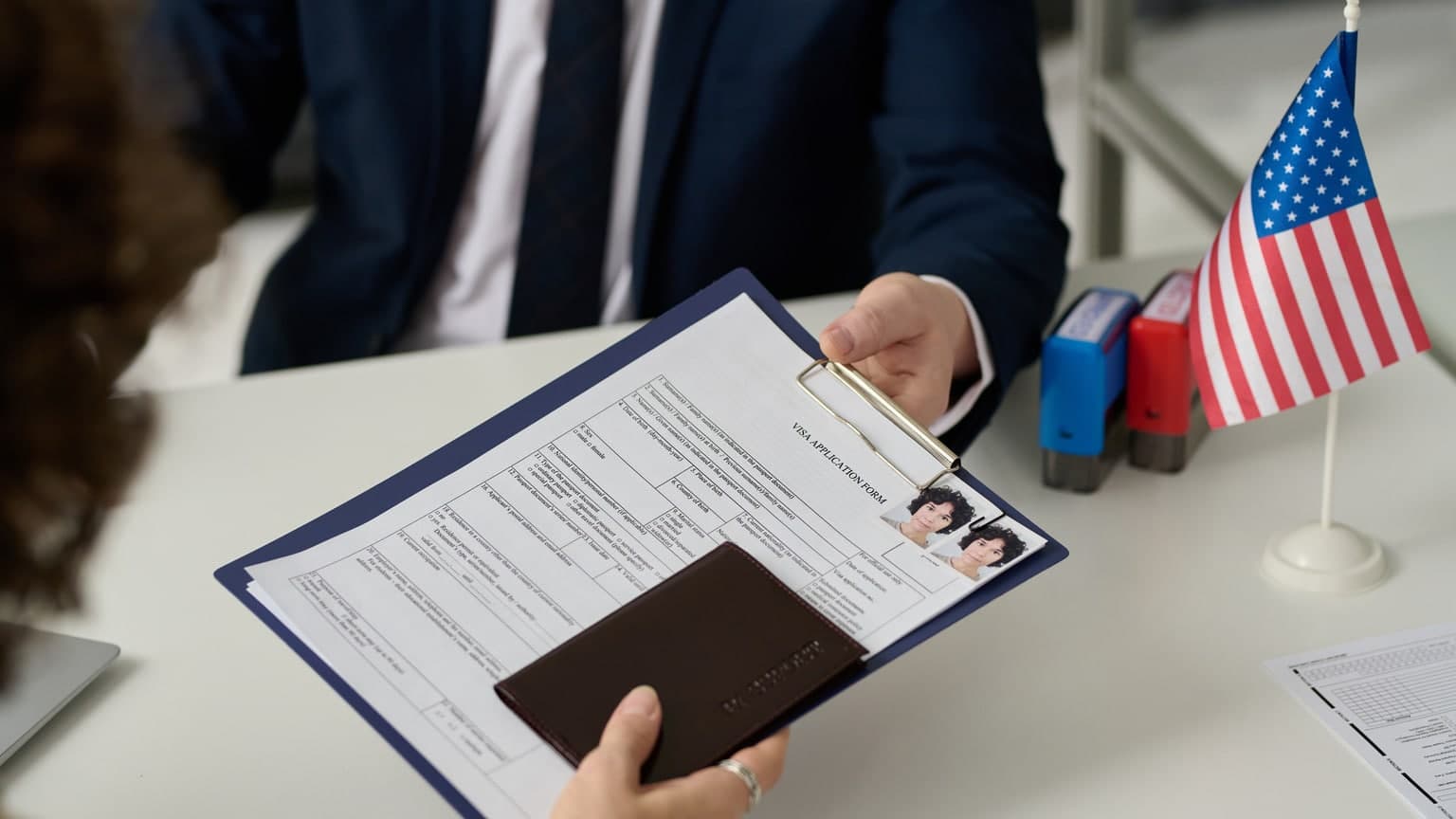
The applicant completes Form DS-160, Online Nonimmigrant Visa Application, on the Consular Electronic Application Center website[10]Source: DS-160 online application form.. The form is submitted electronically and is used by the consular officer to process the visa application.
After submitting the DS-160, the applicant prints the confirmation page with the barcode and brings it to the visa interview.
The applicant completes Form DS-160, Online Nonimmigrant Visa Application, on the Consular Electronic Application Center website[10]Source: DS-160 online application form.. The form is submitted electronically and is used by the consular officer to process the visa application.
After submitting the DS-160, the applicant prints the confirmation page with the barcode and brings it to the visa interview.
Create an account in the official visa appointment system
After submitting the DS-160, the applicant creates an account in the official appointment system used by the selected US embassy or consulate. The platform differs by country. Some locations use ustraveldocs, some use ais.usvisa-info.com, and others may use a different authorised system.
If the applicant later decides to apply at another embassy or consulate, they should check whether the appointment profile and fee can be transferred. In many cases, this is not possible.
After submitting the DS-160, the applicant creates an account in the official appointment system used by the selected US embassy or consulate. The platform differs by country. Some locations use ustraveldocs, some use ais.usvisa-info.com, and others may use a different authorised system.
If the applicant later decides to apply at another embassy or consulate, they should check whether the appointment profile and fee can be transferred. In many cases, this is not possible.
Pay the visa application fee
The applicant pays the non-refundable visa application fee according to the instructions in the appointment system. The fee is payable whether or not the visa is issued.
The fee amount depends on the visa type:
- B-1/B-2 — $185[3]Source: Visitor Visa terms are described on the Travel.State.Gov website.;
- F and M — $185[4]Source: Student Visa terms are described on the Travel.State.Gov website.;
- J — $185 is standard, although some US government-sponsored exchange programmes are exempt from this fee[5]Source: Exchange Visitor Visa terms are described on the Travel.State.Gov website.;
- H, L, O, P, Q, and R — $205[6]Source: Temporary Worker Visas terms are described on the Travel.State.Gov website.;
- E-2 — $315[8]Source: E-2 Visa terms are described on the USCIS website..
The applicant pays the non-refundable visa application fee according to the instructions in the appointment system. The fee is payable whether or not the visa is issued.
The fee amount depends on the visa type:
- B-1/B-2 — $185[3]Source: Visitor Visa terms are described on the Travel.State.Gov website.;
- F and M — $185[4]Source: Student Visa terms are described on the Travel.State.Gov website.;
- J — $185 is standard, although some US government-sponsored exchange programmes are exempt from this fee[5]Source: Exchange Visitor Visa terms are described on the Travel.State.Gov website.;
- H, L, O, P, Q, and R — $205[6]Source: Temporary Worker Visas terms are described on the Travel.State.Gov website.;
- E-2 — $315[8]Source: E-2 Visa terms are described on the USCIS website..
Schedule a visa interview
The applicant schedules the first available interview appointment through the official appointment system for the chosen embassy or consulate. To schedule an appointment, applicants usually need their passport number, the DS-160 confirmation barcode, and payment receipt information.
The applicant schedules the first available interview appointment through the official appointment system for the chosen embassy or consulate. To schedule an appointment, applicants usually need their passport number, the DS-160 confirmation barcode, and payment receipt information.
Prepare documents
Before the interview, the applicant prepares the documents required for the visa category and supporting evidence for the purpose of travel. Documents are usually brought to the interview, not sent to the embassy in advance, unless the local embassy or appointment system gives different instructions.
Before the interview, the applicant prepares the documents required for the visa category and supporting evidence for the purpose of travel. Documents are usually brought to the interview, not sent to the embassy in advance, unless the local embassy or appointment system gives different instructions.
Attend the interview
The applicant attends the interview with the required documents. The basic documents usually include a valid passport, the DS-160 confirmation page, the appointment confirmation letter, and a visa photo if the photo was not uploaded successfully or if the embassy requires a printed photo. Previous passports may also be useful, especially if they contain previous US visas or travel history.
The applicant attends the interview with the required documents. The basic documents usually include a valid passport, the DS-160 confirmation page, the appointment confirmation letter, and a visa photo if the photo was not uploaded successfully or if the embassy requires a printed photo. Previous passports may also be useful, especially if they contain previous US visas or travel history.
Provide fingerprints
Digital fingerprint scans are usually taken as part of the visa application process. A consular officer may also require additional information or administrative processing before making a final decision.
Digital fingerprint scans are usually taken as part of the visa application process. A consular officer may also require additional information or administrative processing before making a final decision.
Receive the passport
After the interview, the applicant can check the visa application status on ceac.state.gov.
If the visa is approved, the passport is usually returned with the visa by courier or through an authorised pick-up location, depending on local procedures.
After the interview, the applicant can check the visa application status on ceac.state.gov.
If the visa is approved, the passport is usually returned with the visa by courier or through an authorised pick-up location, depending on local procedures.
How and where to schedule a visa interview
Applicants for a US non-immigrant visa should generally schedule their interview at the US embassy or consulate in their country of residence or nationality.
Applicants with dual citizenship or residence status should usually apply in the country where they are a citizen or resident. If they apply based on residence, they should be ready to prove their legal status and ties to that country, such as residence documents, employment, study, family ties, housing, or other evidence showing that they live there.
Nationals of countries where the United States does not conduct routine visa operations must apply at a designated embassy or consulate, unless they reside in another country.
Applicants can check estimated interview wait times on travel.state.gov. These estimates vary by location, visa category, workload, staffing, and season. They are updated regularly but do not guarantee that an appointment will be available within a specific period[9]Source: Visa wait times per location with timeframes for the next available appointment for an interview..
Embassies and consulates also release additional appointment slots from time to time, so applicants may be able to reschedule to an earlier date if one becomes available.

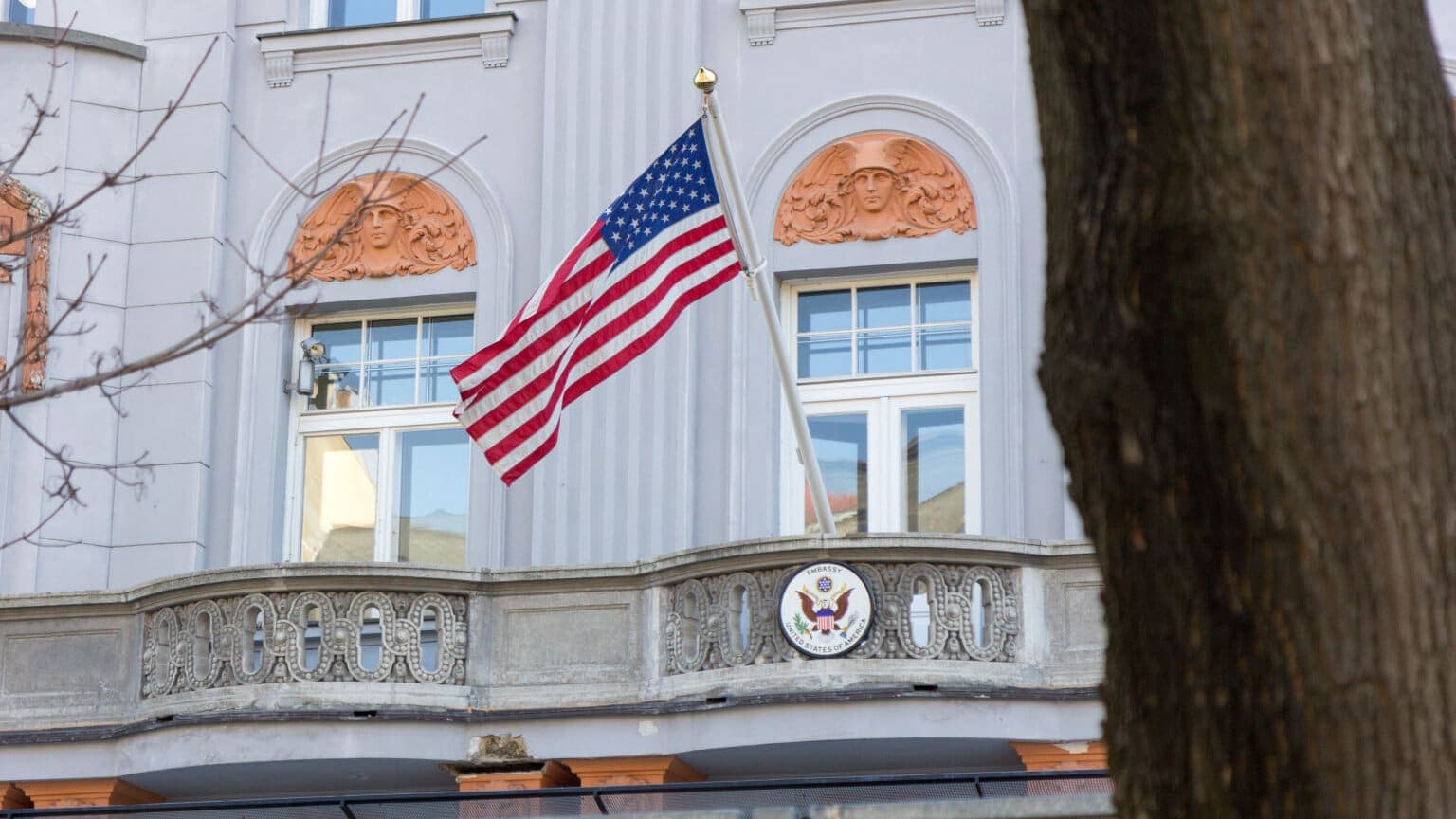
The US embassy in Prague. Only EU citizens and residents and their close relatives are able to enter the Czech Republic for an interview
Who can get a US non-immigrant visa without an interview
Some applicants for US non-immigrant visas may qualify for an interview waiver[11]Source: Interview waiver eligibility after September 18th, 2025.. This means that the applicant can submit documents for consular review without attending a visa interview in person. However, an interview waiver is never guaranteed: a consular officer may still require the applicant to attend an interview.
Special visa categories. Applicants may be eligible for an interview waiver if they are applying for certain diplomatic, official, or international organisation visa categories, such as A, some C-3, G, NATO, or TECRO E-1 visas.
Applicants renewing a B-1, B-2, or B-1/B-2 visitor visa may also qualify for an interview waiver. To be eligible, they must renew the visa within 12 months of the previous visa’s expiry. The previous visa must have been issued for full validity, and the applicant must have been at least 18 years old when it was issued.
Some applicants renewing an H-2A visa may also qualify if they renew within 12 months of the previous visa’s expiry, the previous visa was issued for full validity, and the applicant was at least 18 years old when it was issued.
Additional compliance rules. In addition, applicants must usually apply in their country of nationality or usual residence. They must have no visa refusal unless the refusal was later overcome or waived, and they must have no apparent or potential ineligibility.
To apply without an interview, the applicant completes the DS-160 form, pays the visa application fee, and follows the instructions in the official appointment system for the embassy or consulate where they apply.
If the system confirms interview waiver eligibility, the applicant receives instructions on how and where to submit the passport and supporting documents. The document delivery procedure depends on the country and may involve a courier service, a visa application centre, or another authorised document collection point.
Documents required for a US non-immigrant visa
All applicants usually complete the DS-160 online application form. Other documents may be similar but hugely depend on the visa type.
DS-160 form
All applicants complete the DS-160 form online and in English only. The form is submitted electronically and is used by the consular officer to process the visa application[10]Source: DS-160 online application form..
After submitting the form, the applicant prints the DS-160 confirmation page and brings it to the visa interview.
Standard documents
The basic documents for a US non-immigrant visa interview usually include:
- passport valid for at least 6 months beyond the intended stay in the United States, unless an exemption applies;
- DS-160 confirmation page;
- appointment confirmation letter;
- US visa photo that meets official requirements, if the photo was not successfully uploaded with the DS-160 or if the embassy or consulate asks for a printed photo;
- previous passports, if available, especially if they contain previous US visas or travel history;
- travel itinerary, if already arranged;
- documents showing the purpose of the trip;
- documents showing that the applicant has strong ties outside the United States and intends to leave after a temporary stay;
- financial documents showing that the applicant can pay for the trip, such as bank statements, tax documents, proof of property, business ownership, or other assets;
- for employees, a letter from the employer confirming the position, salary, length of employment, approved leave, or the purpose of a business trip;
- for students, proof of current studies, if relevant.
Additional documents
Additional documents depend on the visa category, the applicant’s situation, and the instructions of the US embassy or consulate where the application is submitted.
For a B-2 visa for medical treatment, applicants should provide[3]Source: Visitor Visa terms are described on the Travel.State.Gov website.:
- letter from their attending physician explaining the diagnosis, the condition, and the reason for treatment in the United States;
- letter from a US doctor or medical facility confirming the planned treatment, estimated duration, and cost;
- proof that the treatment, travel, and living expenses can be paid.
For an F or M student visa, applicants must provide[4]Source: Student Visa terms are described on the Travel.State.Gov website.:
- Form I-20 issued by the SEVP-approved school;
- education documents, such as school certificates, diplomas, exam results, transcripts;
- proof of English-language ability, if relevant.
For a J exchange visitor visa, applicants must provide[5]Source: Exchange Visitor Visa terms are described on the Travel.State.Gov website.:
- Form DS-2019 issued by the approved exchange programme sponsor;
- education documents, diplomas, transcripts, and English-language certificates.
For temporary work visas, such as H, L, O, P, Q, and R visas, many applicants need[6]Source: Temporary Worker Visas terms are described on the Travel.State.Gov website.:
- approved Form I-129 petition from USCIS before applying for the visa;
- Form I-797 approval notice;
- documents confirming professional qualifications, diplomas;
- employment letters from current and previous employers;
- payslips;
- CV.
Travel to the USA for Caribbean and Vanuatu nationals
Citizens of Antigua and Barbuda, Dominica, Grenada, Saint Kitts and Nevis, Saint Lucia, and Vanuatu generally need a visa to travel to the United States.
Terms for citizens of Caribbean countries
Eligibility. The B-1/B-2 is the standard US visitor visa for business and tourism, and the terms now depend heavily on which Caribbean passport you hold.
Citizens of St Kitts and Nevis, St Lucia, and Grenada receive the most generous terms — a 10-year, multiple-entry visa. Antigua and Barbuda and Dominica lost these terms in early 2026: their citizens now receive a B-1/B-2 capped at 3 months and a single entry[12]Source: US visa terms per country are published on the US Department of State website..
Application process. For citizens and residents of Antigua and Barbuda, Dominica, Grenada, Saint Kitts and Nevis, and Saint Lucia, US visa services are handled by the US Embassy in Bridgetown, Barbados. Applicants must schedule an appointment before visiting the consular section.
Caribbean citizens who legally reside in another country may usually apply there, but they should check the rules of the specific embassy or consulate before booking. Applicants who apply outside their country of residence or nationality may face longer waits and may find it harder to prove eligibility.
Nationals of Grenada, Antigua and Barbuda, and Dominica must post a visa bond before a B-1/B-2 can be issued, regardless of where they apply — an amount of up to $15,000, set by the consular officer at interview[12]Source: US visa terms per country are published on the US Department of State website..
US non-immigrant visitor visa terms for Caribbean citizens

Country

B-1/B-2 visa terms
10 years, multiple entry
$5—15k visa bond
No
Dec 2025 travel ban
No


Country

B-1/B-2 visa terms
3 months, single entry
$5—15k visa bond
Yes
Dec 2025 travel ban
Yes, but visas issued before Dec 31st, 2025, honoured

Country | B-1/B-2 visa terms | $5—15k visa bond | Dec 2025 travel ban |
|---|---|---|---|
10 years, multiple entry | No | No | |
10 years, multiple entry | No | No | |
10 years, multiple entry | Yes | No | |
3 months, single entry | Yes | Yes, but visas issued before Dec 31st, 2025, honoured | |
3 months, single entry | Yes | Yes |
Terms for Vanuatu citizens
Eligibility. In mid-2025, the US reduced the Vanuatu B-1/B-2 visa to 3 months' validity and a single entry, down from the 5-year, multiple-entry visa issued before[12]Source: US visa terms per country are published on the US Department of State website..
Application process. Vanuatu citizens should apply for US visas at the US Embassy in Port Moresby, Papua New Guinea, unless they legally reside in another country. To enter Papua New Guinea, Vanuatu citizens receive a visa upon arrival for up to 60 days.
From January 21st, 2026, Vanuatu nationals approved for a B-1/B-2 may also be required to post a bond of $5,000, $10,000, or $15,000[12]Source: US visa terms per country are published on the US Department of State website..

EB-5 immigrant visa for investors
Investors may qualify for the EB-5 Immigrant Investor Program. EB-5 allows eligible investors, their spouses, and unmarried children under 21 to apply for lawful permanent residence in the US, commonly known as a Green Card.
The EB-5 category receives 7.1% of all employment-based immigrant visas. This gives the category about 13,200 new visas for the fiscal year. Of these, 8,980 are newly allocated to the unreserved EB-5 category, while 4,266 are newly allocated to reserved EB-5 categories: rural areas, high-unemployment areas, and infrastructure projects[13]Source: Annual limits for 2026 are published on the US Department of State website..
Requirements for visa applicants
To become eligible for an EB-5 visa, an investor should:
- be over 18 years old, have legal income, and have no criminal record;
- invest in a US company. The investment amount is $800,000 for Targeted Employment Areas or $1,050,000 in other regions;
- make sure an investment goes to a commercial enterprise;
- create 10 jobs for qualified professionals, excluding the investor and their relatives;
- participate in company management[2]Source: EB-5 visa terms are available on the USCIS website..
Regional centres
Investors may invest directly in their own EB-5 business or through a USCIS-designated regional centre. Centres often work in Targeted Employment Areas, so the investment is $800,000.
Regional centres pool EB-5 capital for projects intended to promote economic growth. A regional centre investment does not remove the EB-5 job creation requirement, but investors may rely on direct, indirect, and induced job creation calculated under accepted economic models.
Investment through a regional centre allows an investor to receive passive income of 0.25—2% per annum and return the money invested in five years or more. It often comes in commercial real estate like hotels, retail, or office buildings. Because of these benefits, many foreign investors apply for an EB-5 visa via this option.
Process
The EB-5 process usually starts with choosing a qualifying project and documenting the investment and lawful source of funds.
An investor files Form I-526. After petition approval, an investor outside the United States applies for an EB-5 immigrant visa through the Department of State. An investor already lawfully present in the US may be able to apply for adjustment of status with Form I-485.
Upon admission to the United States with an EB-5 immigrant visa, or upon approval of adjustment of status, the investor and eligible family members receive conditional permanent residence for 2 years.
The investor must file Form I-829 to remove the conditions on permanent residence within the 90-day period before the second anniversary of becoming a conditional permanent resident. If USCIS approves Form I-829, the conditions are removed for the investor and included dependants[14]Source: The EB-5 visa process is described on the USCIS website..
After 5 years as lawful permanent residents, EB-5 investors and their family members may be eligible to apply for US citizenship by naturalisation, provided they meet all requirements.

How to travel to the USA visa-free
Citizens of 42 countries can enter the United States without a visa for up to 90 days under the US Visa Waiver Program[15]Source: The list of countries under the Visa Waiver Program is published on the US Homeland Security Website.. Most EU citizens qualify, with the exceptions of Bulgaria, Romania, and Cyprus, whose nationals still need a visa.
A visa-free trip must match the purposes of a B-1/B-2 visitor visa: tourism, business meetings, or medical treatment. Studying or working in the US is not permitted — both require the relevant visa.
Before travelling, every visa-free visitor must obtain authorisation through the Electronic System for Travel Authorization, ESTA. You apply on the official ESTA website, complete a short form, and pay a $40.27 fee[16]Source: The ESTA website has all the terms and online application procedure..
An approved ESTA allows unlimited entries, each stay of up to 90 days, and is valid for 2 years or until the passport expires.
To qualify for an ESTA, a traveller must:
- hold a biometric passport with an electronic chip;
- have no criminal record and no prior refusal of a US visa or entry;
- not have travelled to Iran, Iraq, North Korea, Syria, Sudan, Libya, Somalia, or Yemen since March 1st, 2011;
- be travelling only for tourism, business, or transit;
- hold a return or onward ticket as proof of timely departure.
Key thoughts about US visas
- US visas split into two types: immigrant visas for those relocating permanently, and non-immigrant visas for temporary stays such as tourism, business, study, work, or investment.
- Citizens of 42 countries can skip the visa entirely under the Visa Waiver Program, travelling for up to 90 days with an approved ESTA. The trip must match B-1/B-2 purposes — studying or working still requires the relevant visa.
- Most non-immigrant applicants follow the same core route: complete the DS-160, pay the fee, and attend an interview at the embassy or consulate in their country of residence or nationality.
- The EB-5 Immigrant Investor Program offers a route to a Green Card, requiring an investment of $800,000 in a targeted employment area or $1,050,000 elsewhere, plus the creation of at least 10 jobs.
- St Kitts and Nevis, St Lucia, and Grenada citizens can receive a 10-year, multiple-entry B-1/B-2 visa, while some other nationalities face shorter validity, single entry, or a visa bond.
Immigrant Invest is a licensed agent for citizenship and residence by investment programs in the EU, the Caribbean, Asia, and the Middle East. Take advantage of our global 15-year expertise — schedule a meeting with our investment programs experts.


 Trusted by 10,000+ investors