









Citizenship by investment is a global migration sector that affects government revenue, international compliance standards, and personal mobility planning.
In 2026, the market continues to change. Caribbean nations and Vanuatu have introduced biometrics, new programmes have appeared in Africa and the Pacific, and European institutions have increased scrutiny of investment migration routes.
This review examines the main citizenship by investment trends in 2026: new programmes, closed or revised routes, price changes, compliance rules, applicant demand, and the outlook for 2027.
Citizenship by investment market in 2026
Citizenship and residence by investment programmes have grown into a significant part of the global investment migration sector.
Official EU research has estimated that EU investment migration paths generated more than €21.8 billion for participating countries[1]European Parliament, Avenues for EU action on citizenship and residence by investment schemes, 2021., while the IMF notes that there is no comprehensive global database tracking the total number of people who obtain citizenship or residence through these programmes[2]International Monetary Fund, Residence and Citizenship by Investment: Implications for Revenue, Inequality, and Governance, IMF Working Paper, 2025..
This means citizenship by investment should not be treated as a narrow wealth-planning instrument. It now sits at the intersection of sovereign finance, cross-border tax planning, family security, compliance risk, and long-term mobility strategy.
Millionaire migration also supports demand. According to Immigrant Invest’s internal flow, thousands of HNWIs plan to relocate in 2026. Not all of them apply for citizenship by investment; many use residence programmes, corporate relocation, ancestry routes, or family-based naturalisation. However, the same trend increases interest in alternative citizenship and residence options
New citizenship by investment programmes in 2026
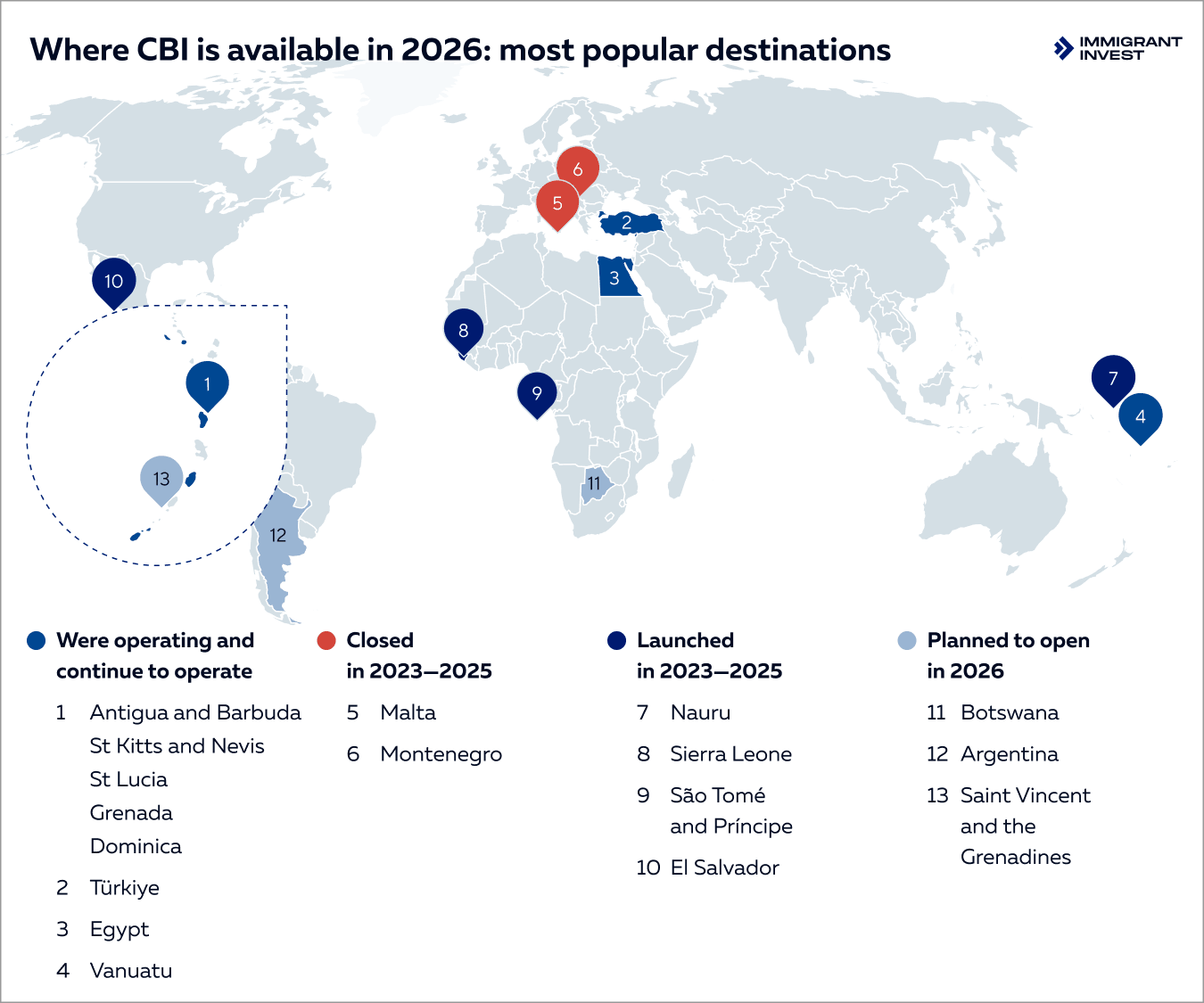
The citizenship by investment market is no longer concentrated only in the Caribbean. Countries in Africa, Asia, and the Pacific have entered the sector or announced plans to do so.
New programmes usually compete on price. Some of them offer lower thresholds than Caribbean countries, where coordinated minimum investment requirements have increased the entry cost.
São Tomé and Príncipe citizenship by investment
São Tomé and Príncipe launched its citizenship by investment programme on August 1st, 2025, under Decree-Law 07/2025. Applications opened in September 2025[3]São Tomé Decree-Law 07/2025 — Official Gazette, Republic of São Tomé and Príncipe, August 2025. Programme statistics, including 98 applications and 27 approvals, are based on CIU official reporting..
By January 2026, the country had received 98 applications by investors of 27 nationalities. The authorities had approved 27 applications and granted the first citizenships within 5 months of accepting applications[3]São Tomé Decree-Law 07/2025 — Official Gazette, Republic of São Tomé and Príncipe, August 2025. Programme statistics, including 98 applications and 27 approvals, are based on CIU official reporting..
The average processing time was 2.5 months. The fastest case took 1 month. For comparison, Caribbean citizenship by investment programmes usually take 4—6 months, provided the documents are submitted on time and the authorities do not request additional information.
The programme has attracted applicants in Europe, Asia, the Middle East, Africa, and the Americas. This shows that demand is not limited to one source market[3]São Tomé Decree-Law 07/2025 — Official Gazette, Republic of São Tomé and Príncipe, August 2025. Programme statistics, including 98 applications and 27 approvals, are based on CIU official reporting..
The minimum contribution is $90,000 for a single applicant. The same threshold applies to a family of four[3]São Tomé Decree-Law 07/2025 — Official Gazette, Republic of São Tomé and Príncipe, August 2025. Programme statistics, including 98 applications and 27 approvals, are based on CIU official reporting.. This creates a lower price point than Caribbean programmes can currently offer.

Lyle Julien,
Investment programmes expert
The main question is whether São Tomé and Príncipe can maintain low pricing and strict Due Diligence standards at the same time. The programme is still new, so its long-term reputation and international acceptance remain difficult to assess.
Nauru citizenship by investment
Nauru’s Economic and Climate Resilience Citizenship Programme entered 2026 with promotional pricing.
A single applicant can apply with a contribution of $90,000 under the temporary reduction. The standard minimum contribution is $115,000. The $25,000 reduction took effect on February 3rd, 2026, and is expected to expire on June 30th, 2026[4]Nauru Economic and Climate Resilience Citizenship Programme. Promotional pricing. Discount of $25,000 effective February 3rd, 2026, expiry June 30th, 2026; standard rate $115,000..
Nauru offers citizenship without a physical residence requirement. Processing usually takes 3—4 months, provided the applicant passes Due Diligence and submits all documents correctly.
Nauru citizenship provides visa-free or visa-on-arrival access to about 87 destinations. This limits its appeal for applicants who mainly seek wider travel freedom. Caribbean passports usually provide access to more countries.
However, Nauru may suit investors who need citizenship diversification outside the Caribbean and the European Union.
Botswana citizenship by investment proposal
Botswana’s Impact Investment Programme is one of the most discussed planned citizenship by investment routes.
The proposed minimum investment is $75,000. If launched, it may become one of the world’s most affordable citizenship by investment programmes. It would also be the first such route offered by a stable African country with a strong rule-of-law reputation.
The programme received 464 pre-registrations by applicants in 77 countries within its first week[5]Citizenship Amendment Bill passed Parliament on December 17th, 2025, according to Daily News Botswana. Dual citizenship legislative amendment targeted for November 2026.. The proposed investment areas include housing, renewable energy, tourism, and mining diversification.
However, Botswana has not yet launched the CBI programme. The main obstacle is the country’s current restriction on dual citizenship. Parliament must amend the Citizenship Act before applications can be accepted[5]Citizenship Amendment Bill passed Parliament on December 17th, 2025, according to Daily News Botswana. Dual citizenship legislative amendment targeted for November 2026..
As of mid-2026, the amendment had not yet passed, so the initial Q1 2026 launch window has shifted. November 2026 is cited as a key milestone, when the citizenship law may be amended to allow dual nationality[5]Citizenship Amendment Bill passed Parliament on December 17th, 2025, according to Daily News Botswana. Dual citizenship legislative amendment targeted for November 2026..
Investors who follow the Botswana programme should monitor legislative developments rather than rely on marketing announcements.
Other emerging citizenship and residence routes
Several other countries have proposed, launched, or maintained investment migration frameworks.
Sierra Leone grants passports in exchange for investment of at least $140,000. The investor makes a non-refundable contribution to a government fund. For family members included in the application, an additional contribution starts from $10,000.
El Salvador launched the Freedom Visa in 2023. It offers a residence route with a possible path to citizenship. At this stage, it remains closer to residence by investment than direct citizenship by investment.
North Macedonia offers citizenship by investment with a minimum contribution of €200,000 and an estimated timeline of 5 months. The programme is operational but attracts limited public attention.
Jordan and Egypt also maintain citizenship by investment frameworks. The minimum thresholds are $750,000 in Jordan and $250,000 in Egypt. Applicant volumes remain modest compared with the Caribbean.
Argentina is preparing to launch Latin America’s first citizenship by investment programme. The programme may start in Q3 2026, with a minimum investment threshold of $500,000. Argentina has already appointed the Executive Director of the Citizenship by Investment Agency[6]Boletín Oficial de la República Argentina. “Agencia de Programas de Ciudadanía por Inversión — Decreto 285/2026.”.
St Vincent and the Grenadines announced plans to launch a citizenship by investment programme in 2026. Specific conditions have not yet been published. If launched, the country will become the sixth in the Caribbean to offer citizenship by investment in the economy.
Lyle Julien,
Investment programmes expert
The IMF has expressed concern over the St Vincent and the Grenadines’ plans to introduce the programme[7]One News SVG. “IMF Raises Red Flags Over Citizenship-by-Investment Programme.” April 28th, 2026.. Due to strong competition in the Caribbean, expected revenues are likely to be modest and may not provide significant support to the national economy.
Regulatory tightening in Caribbean citizenship by investment
Caribbean citizenship by investment programmes face stronger international pressure. The European Union, the OECD, and FATF have focused on programme integrity, Due Diligence, and security risks.
One of the main regulatory trends in 2026 is the move towards physical presence requirements. Citizenship by investment is becoming less remote and more compliance-driven.
St Kitts and Nevis citizenship by investment reforms
On January 8th, 2026, St Kitts and Nevis announced two important reforms.
The first reform is mandatory biometric data collection. Applicants must provide fingerprints and facial recognition data. The new biometric passport system became active on April 14th, 2026[8]Government website of St Kitts and Nevis answers frequently asked questions about the implementation of biometric procedures — dated May 1st, 2026.
St Kitts and Nevis updated the FAQ section on its official programme website on May 1st, 2026[9]St Kitts and Nevis CBI Unit — biometric data collection and physical presence requirements announced.. The update confirms that citizenship by investment applicants can now submit biometric data at an authorised centre in Istanbul.
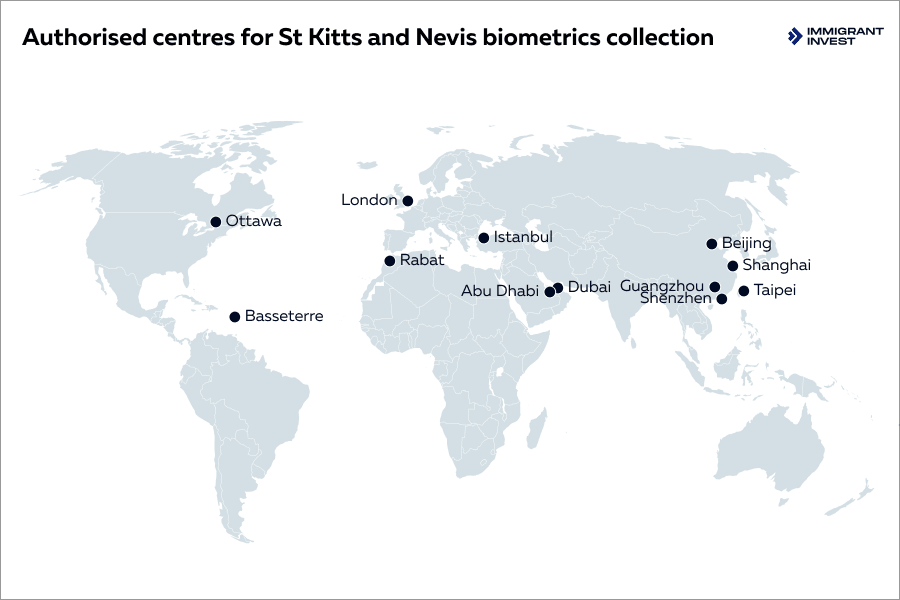
The new centre in Türkiye will make the process easier for investors in Europe and nearby regions. Earlier, applicants could provide biometrics only at approved centres in St Kitts and Nevis or at consulates in London, Abu Dhabi, Ottawa, Taipei, and Rabat.
The second reform is a physical presence requirement. Applicants must demonstrate physical presence in St Kitts and Nevis. The exact thresholds are still subject to implementing regulations.
These changes are important because St Kitts and Nevis runs the world’s oldest citizenship by investment programme, established in 1984. Its reforms often influence the wider Caribbean market.
Caribbean passports face tighter visa rules
Visa-free access for some Caribbean passports has come under pressure.
The United States has tightened access for some Caribbean passports through its visa bond pilot programme. According to the US Department of State, nationals travelling on passports issued by Antigua and Barbuda, Dominica, and Grenada who are otherwise eligible for a B-1/B-2 visitor visa must post a bond of $5,000, $10,000, or $15,000, with the amount set at the visa interview[10]US Department of State, Countries Subject to Visa Bonds, last updated May 13th, 2026..
The bond must be paid through the US Treasury’s Pay.gov system only after a consular officer instructs the applicant to do so, and it does not guarantee visa issuance[10]US Department of State, Countries Subject to Visa Bonds, last updated May 13th, 2026..
The State Department’s temporary final rule links the programme to countries with high overstay rates, deficient screening and vetting information, or citizenship by investment programmes where citizenship can be obtained without a residency requirement[11]US Federal Register, Visas: Visa Bond Pilot Program, August 5th, 2025..
The UK introduced a visa requirement for nationals of Trinidad and Tobago in March 2025, citing a rise in asylum claims. The country joined Jamaica and Dominica among Commonwealth Caribbean states whose citizens need a visitor visa for the UK[11]US Federal Register, Visas: Visa Bond Pilot Program, August 5th, 2025..
Dominica lost UK visa-free access earlier, in July 2023. The UK Home Office linked the decision partly to concerns over the country’s citizenship by investment programme, including security risks[12]The Guardian. “Trinidad and Tobago calls new UK visa requirement ‘disproportionate’.”.
The UK also introduced visitor and transit visa requirements for nationals of St Lucia in March 2026. The official explanation referred to border-management concerns and a rise in asylum claims[13]UK Government. “Explanatory Memorandum to the Statement of Changes in Immigration Rules HC 1715.”; UK Government. “Explanatory Memorandum to the Statement of Changes in the Immigration Rules HC 1691.”.
These cases show that visa-free access is not permanent. Countries that run citizenship by investment programmes face closer scrutiny from the UK, the EU, and other major travel destinations.
Caribbean-wide coordination
The five Caribbean citizenship by investment countries are St Kitts and Nevis, Dominica, Grenada, Antigua and Barbuda, and St Lucia.
These countries have already coordinated minimum pricing. They are also moving towards common standards for Due Diligence and physical presence. Caribbean programmes are becoming more regulated and less transactional.
Physical presence will become a new compliance trend
A planned 30-day physical presence requirement across Caribbean citizenship by investment programmes has been formally delayed until mid-2026. One reason for the delay was the dissolution of St Lucia’s Parliament and the subsequent elections.
Even with the delay, the direction is clear: Caribbean CBI programmes are moving towards stricter post-approval obligations.
Lyle Julien,
Investment programmes expert
Physical presence requirements, biometric data collection, and closer monitoring of applicants are likely to become part of the new compliance standard. For investors, this means that citizenship by investment will require more planning after approval, not only during the application process.
Grenada citizenship by investment and the 30-day rule
Grenada will introduce a more specific physical presence requirement.
The new rules are expected to come into force between April and June 2026. Investors and their families will be required to spend at least 30 days in Grenada within the first 5 years after receiving citizenship[14]Grenada Investment Migration Agency — 30-day physical presence requirement, April—June 2026 implementation..
The main applicant will need to spend at least 5 days in the country within 12 months of receiving citizenship. The remaining 25 days may be distributed among family members over the following 4 years. Grenada will also introduce biometric data collection[14]Grenada Investment Migration Agency — 30-day physical presence requirement, April—June 2026 implementation..
The 30-day requirement will remain modest. In practical terms, it will equal about 6 days a year over 5 years. However, it will change the planning process for applicants, especially families with children, business obligations, or complex travel schedules.
Demand for citizenship by investment in 2026
Demand for citizenship by investment is shaped by political uncertainty, tax planning, capital mobility, education planning, and family security. In 2025—2026, the largest demand shift came from the United States.
US citizens as a growing applicant group
The United States became one of the largest source markets for citizenship by investment applications.
Political concerns are one reason for this increase. The return of the Trump administration in January 2025 was followed by executive actions that caused concern among some groups of Americans.
However, political motives are not the only factor. Applicants also consider travel freedom, tax planning flexibility, possible capital controls, business access, and children’s education.
Citizenship by investment is becoming part of mainstream financial planning for some American families. It is no longer only a product for ultra-high-net-worth individuals.
Dual citizenship has also become more politically sensitive in the US. The Exclusive Citizenship Act of 2025, introduced by Senator Bernie Moreno, would require US citizens to renounce additional nationalities within 1 year[15]Exclusive Citizenship Act of 2025, S. __, introduced by Senator Moreno — moreno.senate.gov press release; full text PDF. Bill not enacted as of April 2026..
Legal experts and public polling suggest that the bill is unlikely to pass. A YouGov poll found that 21% of Americans view dual citizenship negatively[16]Spring 2025 survey on American dual citizenship attitudes. YouGov poll — 21% of Americans view dual citizenship negatively, YouGov, December 2025.. However, the bill’s introduction shows that dual citizenship is now part of the political debate.
Middle East and South Asia demand
The Gulf states continue to generate demand for investment migration. Research on the Gulf describes the region as an important market for citizenship and residence by investment, with demand linked to mobility, security, and long-term wealth planning[17]Brandeis University, Crown Center for Middle East Studies, Golden Passports and Golden Visas in the Gulf, February 2025..
Dubai has also become a major regional base for private wealth and advisory services. DIFC describes Dubai as a leading financial hub for the Middle East, Africa, and South Asia, and reports that its family wealth ecosystem includes more than 1,289 family-related entities[18]Dubai International Financial Centre, DIFC report: High-net-worth-individuals with USD 87trn in wealth are reshaping global investment priorities, February 2026.. This supports the wider advisory infrastructure around cross-border wealth, residence, and citizenship planning.
Indian high-net-worth individuals remain an important applicant group, but their decisions are more complex.
India does not allow dual citizenship: Indian citizens who acquire a foreign nationality are required to renounce Indian citizenship and surrender their Indian passports[19]Embassy of India, Copenhagen, Renunciation of Indian Nationality/Citizenship.. As a result, citizenship by investment is not only a mobility decision for Indian applicants, but also a legal and personal status decision.
The main motives among Indian applicants include international business needs, children’s education, wealth and tax planning, and long-term mobility.
Official Indian sources generally describe the reasons for renunciation as “personal,” while Indian financial media and migration coverage identify global mobility, business planning, and family considerations as key drivers[20]Ministry of External Affairs, Government of India, Question No. 4048: Renunciation of Indian Citizenship; Economic Times, Why HNIs from India are exploring residence-through-investment programmes overseas..
Lyle Julien,
Investment programmes expert
Chinese applicants remain an important source market. They often face capital controls and use Hong Kong or offshore structures for planning. Early data from the São Tomé and Príncipe programme suggests that Chinese demand extends quickly to new programmes[1]European Parliament, Avenues for EU action on citizenship and residence by investment schemes, 2021..
Citizenship by investment pricing trends
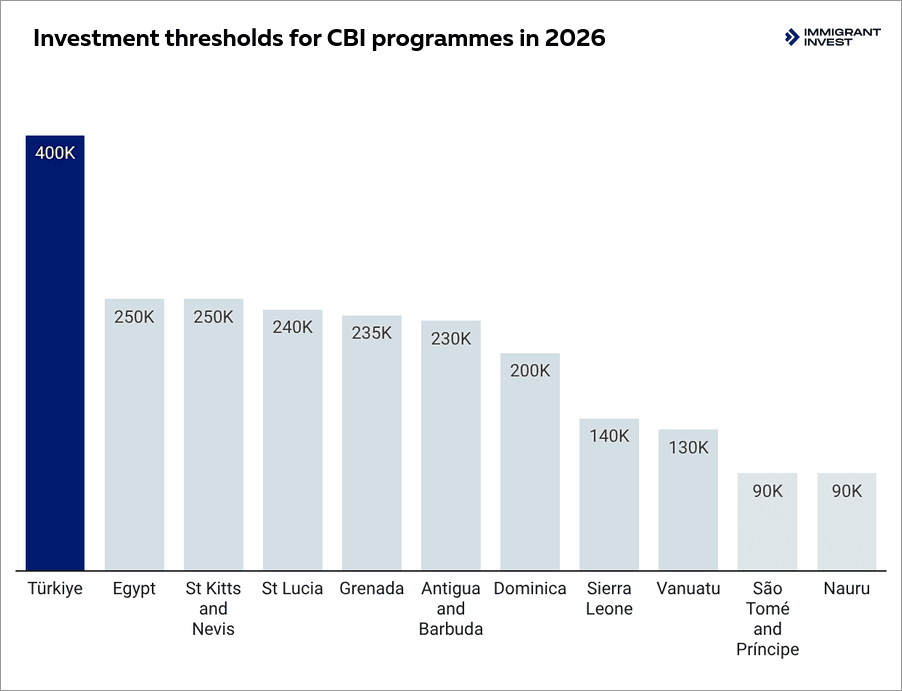
Pricing is one of the most important citizenship by investment trends in 2026. The market is splitting into two segments. Established Caribbean programmes now require higher contributions. Newer programmes in Africa and the Pacific compete with lower thresholds.
Caribbean minimum investment thresholds
The era of sub-$100,000 Caribbean citizenship has ended.
The 2024 Memorandum of Agreement created a coordinated pricing floor for Caribbean citizenship by investment programmes. In 2026, the most affordable Caribbean contribution route is Grenada, with a minimum contribution of $235,000 for a single applicant or a family of up to four.
The true cost is higher than the minimum contribution. Applicants also pay Due Diligence fees, processing fees, passport fees, legal fees, and document costs.
New budget segment
The lower-cost segment has moved outside the Caribbean.
The main budget options in 2026 are:
- Botswana citizenship by investment proposal — $75,000 minimum, provided the dual citizenship legislation passes.
- São Tomé and Príncipe citizenship by investment — $90,000, including a family of four.
- Nauru citizenship by investment — $90,000 promotional contribution, which is expected to return to $115,000 after June 30th, 2026.
These programmes may attract investors who focus on price. However, lower thresholds come with additional questions. Applicants need to consider passport strength, banking acceptance, international reputation, programme stability, and possible future scrutiny.
Some of the CBI programmes may attract investors who focus on price. However, lower thresholds come with additional questions. Applicants need to consider passport strength, banking acceptance, international reputation, programme stability, and possible future scrutiny.
True cost and headline cost
The difference between minimum investment and true cost remains a major transparency issue.
The minimum investment is the amount shown in programme brochures and marketing materials. The true cost is the amount an applicant actually pays.
The true cost may include:
- Due Diligence fees;
- government processing fees;
- legal and professional fees;
- document translation and authentication;
- passport and naturalisation certificate fees;
- bank transfer and administrative costs.
Total costs may exceed minimum investment thresholds by $15,000—100,000+, depending on the programme and the number of family members included.
Risks of citizenship by investment in 2026
Citizenship by investment can offer mobility, diversification, and family planning advantages. But every programme has risks and limitations.
Main risks
Programme conditions may change. Governments can raise minimum investment thresholds, add residence requirements, revise Due Diligence rules, or close a route.
Visa-free access may change. A passport may gain or lose visa-free destinations because of diplomatic decisions, security concerns, or international agreements.
Processing is not guaranteed. Government authorities may request additional documents, extend review periods, or reject an application after Due Diligence.
Investment value may fluctuate. Real estate and fund options depend on market conditions. Applicants should not treat returns or resale prospects as guaranteed.
Tax obligations remain. A second citizenship does not automatically change tax residence. Applicants remain responsible for complying with the laws of their countries of citizenship, residence, and tax residence.
Dual citizenship rules differ by country. Some countries restrict or prohibit multiple citizenship. Applicants should check whether their current country of citizenship allows them to obtain another passport.
Compliance standards are becoming stricter. Programmes may introduce biometric data collection, physical presence requirements, and additional checks.
Applicants should evaluate not only cost and timeline but also legal certainty, Due Diligence standards, tax consequences, and long-term reputation.
Unauthorised price reductions and agent misconduct
Applicants should be cautious of offers below the official statutory minimums or arrangements presented as “special” reduced-price routes. Caribbean governments have started taking enforcement action against this practice.
In Grenada, the Investment Migration Agency suspended applications connected to a marketing agent and an approved project after finding owner-financing and illegal price reductions that it said violated the programme’s legal and regulatory framework[21]Investment Migration Agency Grenada, Circular No. 3 of 2025: Notification of Disciplinary Actions — Owner-Financing Activities Leading to Illegal Discounting Related to Grenada’s Citizenship by Investment Programme, March 21st, 2025..
In St Kitts and Nevis, the government revoked citizenship from 13 individuals and their dependants for failure to pay the statutory minimum investment, and the Citizenship by Investment Unit permanently blacklisted two international marketing agents for marketing the programme below the statutory minimum and misleading clients[22]St. Kitts and Nevis Information Service, Firm Actions Taken by Government and CIU to Protect CBI Programme, April 7th, 2025..
Applicants should therefore verify all offers through official channels and authorised agents. A lower unofficial price can create serious consequences, including application rejection, loss of citizenship, loss of funds, or involvement in regulatory investigations.
Citizenship by investment outlook for 2027
The citizenship by investment market is expected to become more expensive, more regulated, and more geographically diverse in 2027.
1. Caribbean prices may continue to rise. The coordinated pricing floor has changed the market baseline. Caribbean countries are likely to focus on quality, Due Diligence, and reputation rather than price competition. Minimum thresholds of $250,000 may become common across the region.
2. At least one African programme may become operational. Botswana is the leading candidate if the country amends its citizenship legislation. Kenya, Tanzania, and Rwanda have also explored citizenship or residence by investment frameworks.
3. Visa scrutiny may expand. Caribbean passports holders have already faced visa restrictions from the UK, and the US has introduced visa bond requirements for some countries. This suggests that the main risk may be gradual pressure on the travel privileges attached to citizenship obtained by investment.
4. US demand may continue to grow. Political polarisation and the 2026 US midterm election cycle may support further demand for second citizenship and residence options. Marketing may increasingly target American professionals rather than only ultra-high-net-worth families.
5. Interactive tools may become more important. Cost calculators, eligibility quizzes, and programme comparison tools may become a key way for advisory firms to build trust and attract qualified applicants.
About the authors



Sources
- 1.
European Parliament, Avenues for EU action on citizenship and residence by investment schemes, 2021.
- 2.
International Monetary Fund, Residence and Citizenship by Investment: Implications for Revenue, Inequality, and Governance, IMF Working Paper, 2025.
- 3.
São Tomé Decree-Law 07/2025 — Official Gazette, Republic of São Tomé and Príncipe, August 2025. Programme statistics, including 98 applications and 27 approvals, are based on CIU official reporting.
- 4.
Nauru Economic and Climate Resilience Citizenship Programme. Promotional pricing. Discount of $25,000 effective February 3rd, 2026, expiry June 30th, 2026; standard rate $115,000.
- 5.
Citizenship Amendment Bill passed Parliament on December 17th, 2025, according to Daily News Botswana. Dual citizenship legislative amendment targeted for November 2026.
- 6.
Boletín Oficial de la República Argentina. “Agencia de Programas de Ciudadanía por Inversión — Decreto 285/2026.”
- 7.
One News SVG. “IMF Raises Red Flags Over Citizenship-by-Investment Programme.” April 28th, 2026.
- 8.
Government website of St Kitts and Nevis answers frequently asked questions about the implementation of biometric procedures — dated May 1st, 2026
- 9.
St Kitts and Nevis CBI Unit — biometric data collection and physical presence requirements announced.
- 10.
US Department of State, Countries Subject to Visa Bonds, last updated May 13th, 2026.
- 11.
US Federal Register, Visas: Visa Bond Pilot Program, August 5th, 2025.
- 12.
The Guardian. “Trinidad and Tobago calls new UK visa requirement ‘disproportionate’.”
- 13.
UK Government. “Explanatory Memorandum to the Statement of Changes in Immigration Rules HC 1715.”; UK Government. “Explanatory Memorandum to the Statement of Changes in the Immigration Rules HC 1691.”
- 14.
Grenada Investment Migration Agency — 30-day physical presence requirement, April—June 2026 implementation.
- 15.
Exclusive Citizenship Act of 2025, S. __, introduced by Senator Moreno — moreno.senate.gov press release; full text PDF. Bill not enacted as of April 2026.
- 16.
Spring 2025 survey on American dual citizenship attitudes. YouGov poll — 21% of Americans view dual citizenship negatively, YouGov, December 2025.
- 17.
Brandeis University, Crown Center for Middle East Studies, Golden Passports and Golden Visas in the Gulf, February 2025.
- 18.
Dubai International Financial Centre, DIFC report: High-net-worth-individuals with USD 87trn in wealth are reshaping global investment priorities, February 2026.
- 19.
Embassy of India, Copenhagen, Renunciation of Indian Nationality/Citizenship.
- 20.
Ministry of External Affairs, Government of India, Question No. 4048: Renunciation of Indian Citizenship; Economic Times, Why HNIs from India are exploring residence-through-investment programmes overseas.
- 21.
Investment Migration Agency Grenada, Circular No. 3 of 2025: Notification of Disciplinary Actions — Owner-Financing Activities Leading to Illegal Discounting Related to Grenada’s Citizenship by Investment Programme, March 21st, 2025.
- 22.
St. Kitts and Nevis Information Service, Firm Actions Taken by Government and CIU to Protect CBI Programme, April 7th, 2025.