








At first glance, the Greece Golden Visa and the Italy Investor Visa appear remarkably similar. Both programmes start from an investment of €250,000 and provide residence rights in a EU country. In practice, however, they are designed for different types of investors.
This comparison explains how the two programmes differ in terms of benefits, requirements, investments, application timelines, all-in costs, tax exposure, and preferential tax regimes.
What are the Italy and Greece Golden Visa programmes?
Italy and Greece Golden Visas allow non-EU nationals to obtain residence by investment. The minimum threshold is similar, starting from €250,000, but the programmes follow different models.
The Greece Golden Visa is based on Article 20B of Law 4251/2014 and administered by the Ministry of Migration and Asylum[1]Source: Ministry of Migration and Asylum — Golden Visa. Real estate remains the programme's main investment route, although investors may also qualify through selected financial instruments, including investment funds and government bonds.
The Italy Investor Visa is regulated by Article 26-bis of Legislative Decree 286/1998 and administered through a dedicated Investor Visa Committee[2]Source: Ministry of Enterprises and Made in Italy — What is Investor Visa for Italy?. The programme focuses on financial investments and is one of the few in Europe to offer a residence route through investment in innovative startups.
Processing takes at least 4 months in both countries. Italy grants a 2-year permit, while Greece issues a 5-year permit; both are renewable and may lead to permanent residence and citizenship.
Trusted by 10,000+ investors
Check your eligibility for the Greece Golden Visa
What are the benefits of the Italy and Greece Golden Visa programmes?
Italy and Greece Golden Visas can become a way to keep Europe close without putting life on hold. The programmes create a comfortable margin of freedom: easier travel, a secure EU fallback, and the option to turn a Mediterranean address into something more permanent later.
1. Secure Plan B in the EU
European residence gives Golden Visa investors and their families a reliable safeguard in a politically stable region with strong legal systems, developed infrastructure, and high standards of living.
A Golden Visa can stay quietly in the background until needed. The permit may be a strategic reserve: a way to protect family interests, relocate if necessary, and respond confidently when circumstances change.
2. Easy travel throughout Schengen Area for business and leisure
A residence permit in Italy or Greece allows investors to stay without limit in the country that issued it and travel visa-free across the Schengen Area for up to 90 days in any 180-day period.
Schengen mobility makes Europe far easier to navigate: business meetings in Paris, school visits in Switzerland, weekends in Spain, or family holidays on the Côte d’Azur can be arranged without repeated visa applications.
3. No relocation requirement
Italy and Greece do not require Golden Visa investors to move permanently to keep their residence status.
Investors can continue living and working elsewhere while keeping European residence as a long-term asset. This gives them access to Europe today and the option to make it home tomorrow.
4. Mediterranean lifestyle with a slower pace of life
Italy and Greece share the Mediterranean way of life: long meals with family and friends, lively town squares, fresh local food, and a climate that encourages people to spend time outdoors year-round.
Italy offers a more polished version of Mediterranean living, with an elegant balance between cities, seaside resorts, and mountain landscapes. Home to the world’s largest number of UNESCO World Heritage Sites, the country also stands out for its art, architecture, and culture[3]Source: UNESCO — Italy. Fine dining, design, fashion, opera, wine regions, and ski resorts give Italian life a distinctly refined feel.
Greece moves at a gentler pace. Daily life is centred around the sea, neighbourhood cafés, open-air tavernas, local markets, and evening walks along the waterfront. Island-hopping, sailing, swimming, ancient ruins, village festivals, and long dinners outdoors make leisure feel like a natural part of the week rather than a rare escape.

5. New business opportunities
Italy Golden Visa holders can run a business in the country, which makes the programme useful for commercial expansion. Golden Visa holders in Greece can hold a share in a local business without active involvement.
Tourism is a shared advantage. Italy welcomed around 185 million tourists in 2025, while Greece received about 38 million international visitors[5]Source: Italian Ministry of the Interior and Bank of Greece. Steady demand can support opportunities in hospitality, rentals, restaurants, leisure, wellness, and real estate.
Italy also stands out for scale. As the EU’s 3rd largest economy, the country offers a large domestic market, mature supply chains, and strong export sectors, from pharmaceuticals and agri-food to fashion, design, wine, and luxury goods[6]Source: Italian Trade Zone — Italy is industrious.
Greece offers a more agile entry point into Southern Europe. The country is especially attractive for yachting, logistics, renewable energy, ports, property rentals, and services for international residents.
6. Access to European healthcare and education
Residence in Italy and Greece can give families access to public healthcare, while Golden Visa holders usually need to keep private health insurance. Private cover adds comfort: shorter waiting times, private clinics, English-speaking doctors, and wider treatment options.
Children can attend public schools free of charge, though lessons are taught in Italian or Greek. International schools are the more familiar option for many expat families, with annual fees often ranging from several thousand euros to over €20,000.
Public universities are comparatively affordable: around €900—4,000 a year in Italy and often less in Greece. 15 Italian and 2 Greek universities rank among the world’s top 500 higher education institutions[7]Source: QS World University rankings 2027.
7. Route to permanent residence and citizenship
Italy and Greece Golden Visas can become a path to a more settled future in the EU. Permanent residence is available after 5 years in both countries, giving Golden Visa holders greater freedom: they can keep living in Italy or Greece without being tied to the original investment.
Citizenship may follow later: after another 2 years in Greece and another 5 years in Italy. An EU passport expands visa-free travel and gives the holder the full rights of an EU citizen, including the right to live, work, study, and do business across the region.
Italy vs Greek Golden Visa at a glance

Greece and Italy Golden Visa investment routes compared
Italy and Greece offer fundamentally different asset classes. Italy is more business-driven, while Greece offers a wider set of options led by real estate. Choosing between them is as much a question of investment preference as it is an immigration decision.
Common investment options: business and bonds
Italy and Greece both offer two comparable investment paths: business investment and government bonds.
Business. Under the Greece and Italy Golden Visa programmes, the minimum investment threshold starts at €400,000 in Greece and €500,000 in Italy.
Italy allows investors to acquire corporate bonds or shares in an Italian company, while Greece offers several corporate investment routes, including capital contribution of:
- at least €400,000 to a Greek company;
- at least €500,000 to a Real Estate Investment Company investing exclusively in Greece.
Greece also permits investments of at least €500,000 in a closed-end venture capital company or fund focused exclusively on Greek businesses.
Bonds. This route is more expensive in Italy: investors must buy at least €2,000,000 in Italian government bonds.
Greece sets a lower threshold of €500,000 for government bonds, provided they have at least 3 years of remaining maturity and are purchased through a Greek credit institution, which also acts as custodian.
Italy Golden Visa unique options: the startup advantage
Italy offers two routes that do not have direct equivalents in the Greek Golden Visa programme: investment in an innovative startup and a philanthropic donation.
Innovative startup. The minimum investment is €250,000 in an innovative startup registered in the Italian Business Register. This is Italy’s most distinctive route: it opens residence through participation in a young, innovation-driven company, allowing investors to back early-stage growth in one of the EU’s strongest economies.
Italian startups remain a higher-risk option, but the market is becoming more active. In the first half of 2025, the number of venture capital transactions involving Italian startups and scaleups increased by 18.9% year on year[8]Source: Intesa SanPaolo — Venture capital in Italy 2025. Across 2025, investments in Italian startups and innovative companies exceeded €1.7 billion across 436 rounds, making it one of the strongest years on record[9]Source: Italian Tech Alliance — Venture Capital Report 2025.
Philanthropic donation. The minimum contribution is €1,000,000 to a public-interest project in Italy.
Eligible areas include culture, education, immigration management, scientific research, and conservation of cultural heritage. The donation route is non-refundable, but it may suit investors who want their residence application to support a visible social, cultural, or research initiative.

Trusted by 10,000+ investors
Check your eligibility for the Italy Golden Visa
Greece Golden Visa unique options: the property-led route
Greece remains one of Europe’s strongest property-led Golden Visa programmes. Real estate is the central option, with the required investment depending on the property’s location and type.
The standard real estate thresholds are:
- €800,000 — for properties in Attica, including Athens, Thessaloniki, Mykonos, Santorini, and islands with more than 3,100 inhabitants;
- €400,000 — for properties in the remaining regions of mainland Greece and other islands;
- €250,000 — for properties converted from commercial to residential use, as well as listed or heritage buildings undergoing full restoration or reconstruction.
For the €800,000 and €400,000 tiers, the main premises must have a minimum floor area of 120 m².
Greece Golden Visa holders can rent out their property long-term. Average gross residential yields stand at around 4.5%, while selected Athens districts can reach almost 7%.
Investors cannot rent the property out on a short-term basis, sublet it, or use it as a registered business office. A violation may lead to residence permit revocation and a €50,000 fine.
Greece also offers financial-asset options for investors who prefer not to buy real estate. These include:
- €350,000 — units or shares in a mutual fund established in Greece or another EU member state and investing exclusively in Greece;
- €350,000 — units or shares in an alternative investment fund established in Greece or another EU member state and investing exclusively in Greece;
- €500,000 — a fixed-term deposit in a Greek credit institution, held for at least 1 year with automatic renewal.
The financial routes give Greece a property-free alternative, but the programme’s distinctive strength remains real estate: a clear pathway for investors who want residence together with a tangible asset in the Mediterranean.
Examples of real estate in Greece


Greece, Athens
€720,000+
Cosy and stylish apartments in modern style, Glyfada, Athens
 98 m²
98 m² 2
2  2
2 
Greece, Athens
€1,185,000+
Luxury apartments, Varkiza, Athens
207 m²4 4 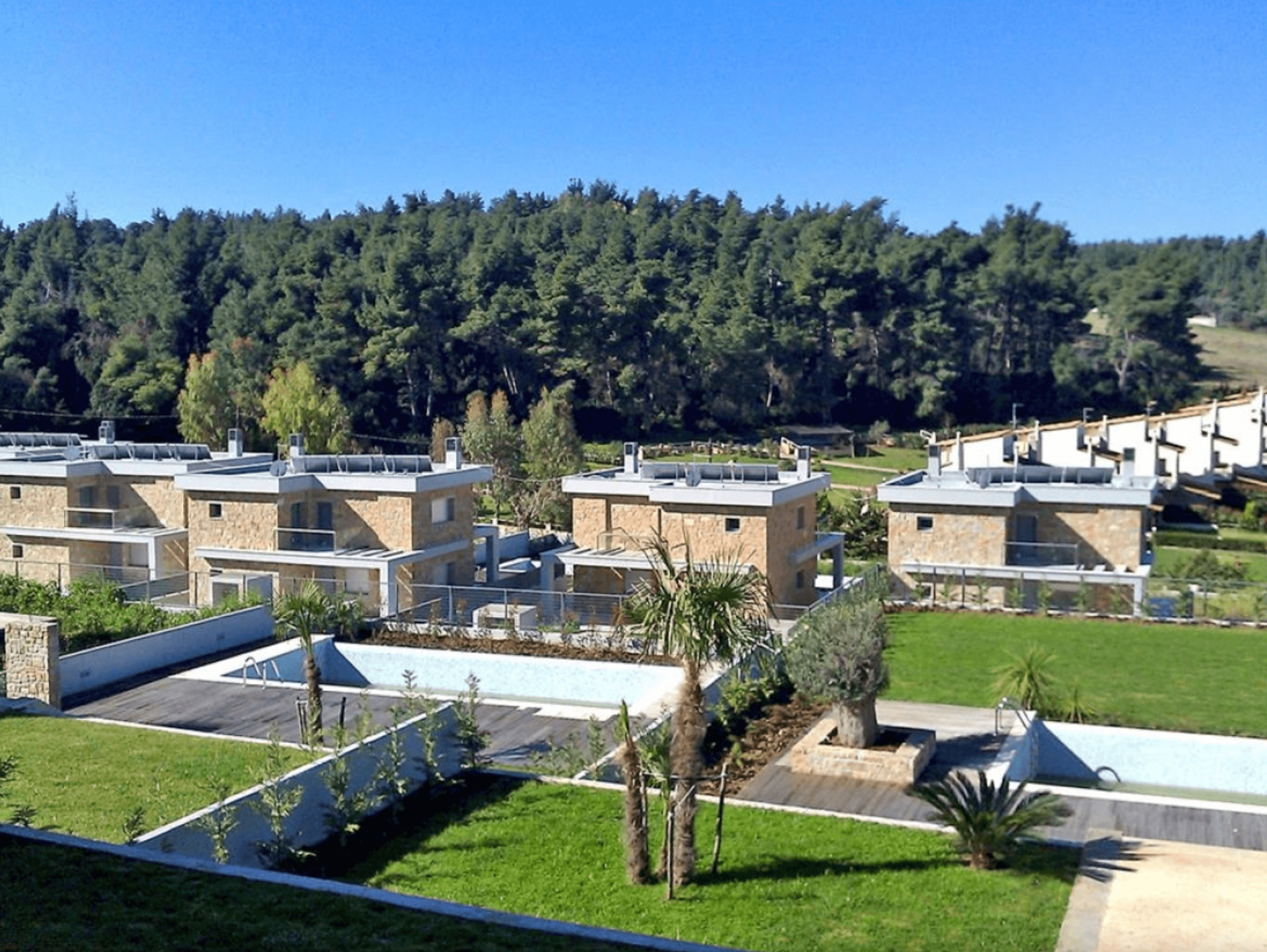
Greece, Kassandra
€505,000+
Modern villa, Sani, Kassandra
170 m²4 3 Italy and Greece Golden Visa requirements: who is eligible for each programme?
Eligibility for the Italy and Greece Golden Visas starts with the investor, but the real value of both programmes also lies in family inclusion. Spouses, children, and parents may join the application, though requirements between countries vary.
Investor
Both the Greece and Italy Golden Visa programmes set similar baseline requirements for applicants. The investor must:
- be a non-EU, non-EEA, and non-Swiss national;
- be at least 18 years old;
- have a clean criminal record, confirmed by a certificate from the country of residence or citizenship;
- hold valid health insurance covering the country of investment;
- provide clear evidence of the source of funds and source of wealth, including documents proving the lawful origin of assets;
- show that the investment funds come from outside the destination country;
- not be subject to an active travel ban or EU sanctions.
Family
Family eligibility differs between the Italy and Greece Golden Visas. Both allow investors to include close relatives, but Greece offers broader rules for partners, adult children, and parents.
Spouse or partner. Italy allows the inclusion of an officially married spouse. Greece is more flexible: a spouse or partner may qualify, including in same-sex couples. Unmarried partners must have a cohabitation agreement registered and signed in Greece.
Children. Italy allows the inclusion of children under 18. Adult children may qualify only if they are financially dependent on the investor because of a health condition causing total disability.
Greece allows unmarried children under 21 to be included.
Parents. Italy allows parents only if they are financially dependent on the investor and meet additional conditions. Parents must either have no other children in their country of origin, or, if they are over 65, their other children must be unable to support them for documented, serious health reasons.
Greece is simpler: parents may be included without age limit and proving financial dependence.

Mohamed Zakaria,
Senior Investment Migration Expert
Greece offers an additional advantage for children of real estate investors. Children who first enter the country as dependants under the property owner’s residence permit receive a family reunification residence permit valid until they turn 21.
After turning 21, children may extend their stay until the age of 24. The renewed 3-year permit also gives them access to the Greek labour market.
All-in costs beyond the headline Greece and Italy Golden Visa minimum
The minimum investment is only part of the total Italy and Greece Golden Visas cost. Applicants should also budget for government fees, transaction expenses, insurance, document preparation, and other administrative charges.
Investment-related expenses
In Italy, investors choosing the innovative startup route must also consider a subscription fee of €12,200.
In Greece, taxes and transaction costs associated with purchasing property amount to around 5.5% of the property’s value, starting at approximately €13,750 for the €250,000 route.
Application and residence permit fees
In Italy, the residence permit fee amounts to:
- €3,406 for the main applicant;
- €567 for each dependant aged 18 or over;
- €313 for each dependant under 18.
In Greece, the application fee is €2,000 for the main applicant and €150 for each adult family member.
Additional expenses
Both programmes require private health insurance for the full validity period of the residence permit. Premiums start at around €300 per person per year, bringing the minimum cost to approximately €600 for a 2-year permit in Italy and €1,500 for a 5-year permit in Greece.
Applicants in both countries should also budget around €2,000 for document translation, certification, and legalisation. In Italy, further administrative expenses include a power of attorney from €605 and at least €781 for obtaining a tax identification number and digital signature used during the online application process.
Minimum Italy vs Greece Golden Visa cost by family size
Documents required for the Italy and Greece Golden Visas
A well-prepared document pack can make the Italy or Greece Golden Visa process smoother, faster, and more predictable. Before applying, investors need to confirm their identity, prove the lawful origin of their capital, and show that the selected investment meets the programme rules.
Universal documents for both programmes
The following documents are required regardless of the Golden Visa programme:
- valid passport with at least 6 months’ validity beyond the intended stay;
- criminal record certificate from the country of citizenship and all countries of residence in the last 5 years;
- apostilled or legalised civil and official documents, where required;
- certified translations into Italian or Greek, depending on the programme;
- proof of valid private health insurance covering the country of residence;
- source-of-funds and source-of-wealth documents, such as bank statements, tax returns, wealth declarations, and proof of asset ownership;
- disclosure of any court judgments, bankruptcies, or regulatory actions affecting the applicant’s financial history.
Italy and Greece programme-specific additions
Investment-related documents are required for both programmes, but the exact pack depends on the chosen route.
For Italy, investors need documents confirming the selected investment, such as an investment commitment, term sheet, or proof of the route. Startup investors also need confirmation that the company is registered in the Italian Business Register as an innovative startup.
For Greece, the document pack depends more heavily on the asset type. Property buyers must provide:
- Greek tax number;
- property Due Diligence documents;
- notarised purchase contract;
- proof of registration with the National Land Registry.
Financial-asset investors need a subscription agreement or investment confirmation from the fund, real estate investment company, bank, or institution.
A Greek bank account is often required for investment-related transactions. Non-EU applicants should allow extra time for bank KYC checks.
Additional details for US and UK applicants
US applicants should plan 8—16 weeks for document preparation. US documents may require a state-level apostille for state-issued documents and a federal apostille from the US Department of State for federally issued documents.
US citizens should also assess whether the investment or any related foreign accounts trigger FBAR or FATCA reporting. A CPA or tax attorney may need to confirm the treatment of Italian or Greek accounts, fund units, deposits, or other reportable assets.
UK applicants should plan 6—12 weeks for document preparation. UK-issued documents require an apostille from the FCDO under the Hague Convention.
Apostille processing in both countries can take around 3—6 weeks, and longer during peak periods.

How to obtain the Italy and Greece Golden Visas: step-by-step application process
The Italy and Greece Golden Visa processes follow different logic mainly because the investment is fulfilled at different stages. In Greece, investors complete the investment before applying for residence; in Italy, the investor first receives approval, then transfers the funds after entering the country.
Each programme also has its own administrative checkpoint. Greece applicants must obtain a tax number, while Italy investors need a special clearance certificate, the Nulla Osta, confirming that there are no obstacles to issuing the Investor Visa.
Based on Immigrant Invest’s experience, the Italy Golden Visa and Greece’s financial-asset routes take at least 4 months. The Greece property route usually takes longer, from around 6 months, because the investor must complete the purchase and registration.
1 day
Preliminary Due Diligence
Preliminary Due Diligence is an Immigrant Invest internal stage. A certified Compliance Anti-Money Laundering Officer checks the investor against international databases to reduce the risk of refusal.
The check is mandatory and fully confidential. Immigrant Invest signs a contract only after successful results. If risks appear, the team proposes solutions, such as preparing additional documents or choosing another programme. Only a passport is required at this stage.
Preliminary Due Diligence is an Immigrant Invest internal stage. A certified Compliance Anti-Money Laundering Officer checks the investor against international databases to reduce the risk of refusal.
The check is mandatory and fully confidential. Immigrant Invest signs a contract only after successful results. If risks appear, the team proposes solutions, such as preparing additional documents or choosing another programme. Only a passport is required at this stage.
Up to 2 weeks
Preparation and submission of initial documents
Lawyers prepare a tailored document checklist, help with translations and notarisation, and complete the required application forms for both programmes.
For the Greece Golden Visa, lawyers also help select property that matches the investor’s goals and preferences. Immigrant Invest works with trusted Greek developers and offers access to a database of over 300 units.
For the Italy Golden Visa, the investor applies for a Nulla Osta, a certificate confirming that there are no obstacles to obtaining an Investor Visa. The certificate allows the investor to apply for an entry visa within 6 months
Lawyers prepare a tailored document checklist, help with translations and notarisation, and complete the required application forms for both programmes.
For the Greece Golden Visa, lawyers also help select property that matches the investor’s goals and preferences. Immigrant Invest works with trusted Greek developers and offers access to a database of over 300 units.
For the Italy Golden Visa, the investor applies for a Nulla Osta, a certificate confirming that there are no obstacles to obtaining an Investor Visa. The certificate allows the investor to apply for an entry visa within 6 months
Up to 3 months in Italy; up to 1 week in Greece
Pre-application setup
Italy requires an additional review after the Nulla Osta application is submitted. The online portal forwards the file to the local Prefettura, based on the address where the applicant plans to reside in Italy. The Prefettura has up to 90 days to review the application and complete the process.
Greece requires investors to obtain a tax number for major transactions, including property purchase. A lawyer submits the application and supporting documents for tax registration. A tax number is usually issued within 3 to 7 working days.
Italy requires an additional review after the Nulla Osta application is submitted. The online portal forwards the file to the local Prefettura, based on the address where the applicant plans to reside in Italy. The Prefettura has up to 90 days to review the application and complete the process.
Greece requires investors to obtain a tax number for major transactions, including property purchase. A lawyer submits the application and supporting documents for tax registration. A tax number is usually issued within 3 to 7 working days.
1+ months
Fulfilling the investment condition — for the Greece Golden Visa
The investment fulfilment at this stage applies specifically to the Greece Golden Visa. The investor first signs a preliminary purchase agreement and deposits 10% of the property price.
The purchase agreement may be signed by the investor personally or by a lawyer under a power of attorney. After signing, the lawyer submits the agreement for registration with the Land Registry and the Cadastre and obtains a registration certificate.
The investment fulfilment at this stage applies specifically to the Greece Golden Visa. The investor first signs a preliminary purchase agreement and deposits 10% of the property price.
The purchase agreement may be signed by the investor personally or by a lawyer under a power of attorney. After signing, the lawyer submits the agreement for registration with the Land Registry and the Cadastre and obtains a registration certificate.
Up to 4 months in Italy; up to 6 months in Greece
Visa or residence application
Italy Golden Visa applicants must apply for an Investor Visa at the Italian consulate in their country within 6 months of receiving the Nulla Osta. The maximum review period is 120 days, although in practice visas are often approved within 10 to 20 days from submission.
Greece Golden Visa documents are submitted online through the official website of the Greek migration service. Around 1 week after submission, the applicant receives a certificate allowing them to stay in Greece for 1 year while the residence permit application is reviewed.
Greece Golden Visa applicants then submit biometrics. Appointment booking usually becomes available 1 to 2 weeks after the residence application is filed. Travel to Greece may require:
- tourist visa if the investor has purchased property;
- national D visa if the investment was made under another option.
Biometrics must be submitted within 6 months of the residence application date and before the 1-year certificate expires
Italy Golden Visa applicants must apply for an Investor Visa at the Italian consulate in their country within 6 months of receiving the Nulla Osta. The maximum review period is 120 days, although in practice visas are often approved within 10 to 20 days from submission.
Greece Golden Visa documents are submitted online through the official website of the Greek migration service. Around 1 week after submission, the applicant receives a certificate allowing them to stay in Greece for 1 year while the residence permit application is reviewed.
Greece Golden Visa applicants then submit biometrics. Appointment booking usually becomes available 1 to 2 weeks after the residence application is filed. Travel to Greece may require:
- tourist visa if the investor has purchased property;
- national D visa if the investment was made under another option.
Biometrics must be submitted within 6 months of the residence application date and before the 1-year certificate expires
Within 8 day
Investing and applying for a residence permit — for the Italy Golden Visa
The Investor Visa issued by the Italian consulate is valid for 2 years. During this period, the holder must enter Italy and apply for a residence permit.
After arrival in Italy, the investor:
- submits the residence permit application in person at the Questura within 8 days;
- transfers the investment within 3 months, depending on the chosen route.
The Investor Visa issued by the Italian consulate is valid for 2 years. During this period, the holder must enter Italy and apply for a residence permit.
After arrival in Italy, the investor:
- submits the residence permit application in person at the Questura within 8 days;
- transfers the investment within 3 months, depending on the chosen route.
30+ days in Italy; 3+ months in Greece
Residence permit card issuance
In Italy, the Questura reviews the residence permit application. If additional information is needed, the investor has 30 days to provide it. After approval, residence permit cards are issued to the investor and family members.
For Greece Golden Visa applicants, the residence permit card may be collected personally by the investor or by an authorised lawyer. To receive the card, the investor’s international passport must be presented, and the residence permit application certificate is returned.
In Italy, the Questura reviews the residence permit application. If additional information is needed, the investor has 30 days to provide it. After approval, residence permit cards are issued to the investor and family members.
For Greece Golden Visa applicants, the residence permit card may be collected personally by the investor or by an authorised lawyer. To receive the card, the investor’s international passport must be presented, and the residence permit application certificate is returned.
After 2 years in Italy; after 5 years in Greece
Renewal of the residence permit
The initial residence permit is valid for 2 years in Italy and 5 years in Greece, renewed for another 3 and 5 years respectively, provided the investment is retained.
The renewal process follows the same main stages as the first application: documents are prepared and submitted, biometrics are provided, and a new residence permit card is issued.
The initial residence permit is valid for 2 years in Italy and 5 years in Greece, renewed for another 3 and 5 years respectively, provided the investment is retained.
The renewal process follows the same main stages as the first application: documents are prepared and submitted, biometrics are provided, and a new residence permit card is issued.
Stay rules, work rights, and citizenship path under the Italy and Greece Golden Visas
Italy and Greece Golden Visa's practical differences appear later — in how investors may work, whether they actually need to live in the country, and what steps are required before citizenship becomes realistic.
Minimum stay to keep the permit
Italy and Greece do not set an annual stay requirement for Golden Visa renewal. Investors may keep residence without relocating, provided the investment remains valid and renewal documents are submitted on time.
Citizenship follows a different logic. Years of simply holding a Golden Visa do not usually count in a meaningful way unless the investor actually lives in the country and builds legal, continuous residence there.
Work rights
Italy gives Investor Visa residence permit holders broad work rights. The investor may work as an employee, run a business, or act as a self-employed professional.
Greece is more restrictive. Golden Visa holders cannot take paid employment in Greece by default and need a separate work authorisation or another residence status for dependent employment. They may own a business or hold shares in a Greek company, but cannot work for or actively manage that company.
Citizenship pathway
Greece offers a shorter citizenship timeline, but the path is not automatic. Investors must first move from a Golden Visa to long-term residence, which becomes available after 5 years of actual stay in the country. Absences should not exceed 6 months in a row or 10 months in total over the 5 years.
Greek citizenship may then become available after another 2 years of residence, bringing the total timeline to 7 years. Applicants must also prove knowledge of the Greek language at B1 level, economic and social integration, and the ability to participate in political life[10]Source: Ministry of the Interior — General Secretariat for Citizenship and Certificate of Adequacy of Knowledge for Naturalisation exams.
Italy sets a longer route. Non-EU nationals become eligible for citizenship after 10 years of lawful, continuous residence. Applicants must also prove B1-level Italian, sufficient income, and an uninterrupted residence history[11]Source: Ministry of the Interior — Italian citizenship. Obtaining permanent residence is not a prerequisite for naturalisation.
Tax exposure for Italy and Greece Golden Visa holders
Holding a Greece Golden Visa or Italy Investor Visa does not automatically make an investor a tax resident. Tax residence begins when one spends at least 183 days a year in the country, or makes it their habitual home — the place where their main personal, family, and economic interests are centred.
Once an investor becomes a tax resident, worldwide income becomes taxable in that country. Tax brackets differ between Italy and Greece, but both countries offer special tax regimes that can significantly reduce tax exposure for wealthy foreign residents.
Taxation
Personal income tax is levied within progressive brackets in both countries, rising with income. In Greece, the rates are as follows:
- up to €10,000 — 9%;
- €10,001—20,000 — 22%;
- €20,001—30,000 — 28%;
- €30,001—40,000 — 36%;
- over €40,000 — 44%[12]Source: Independent Authority for Public Revenue — Income categories and income taxation in Greece.
Italy has fewer brackets:
- €0—28,000 → 23%;
- €28,001—50,000 → 33%;
- €50,000+ → 43%.
However, additional regional and municipal surcharges increase the effective tax rate in Italy:
- regional tax → 1.23 to 3.33%;
- municipal tax → 0 to 0.9%[13]Source: Agenzia delle Entrate — Personal income tax, regional taxes, and municipal taxes.
Capital gains. Italy taxes capital gains from financial investments at 26%, while Greece applies a 15% rate.
Dividend tax. Dividends received by individual tax residents are taxed at 26% in Italy and 5% in Greece.
Property transfer tax. Italy charges 9% on residential property purchases from private sellers. Purchases from developers are subject to 10% VAT, or 22% VAT for luxury properties[14]Source: Italian National Council of Notaries — Property acquisition taxes.
Greece levies approximately 3.09% including the municipal levy on the property's taxable value[15]Source: Independent Authority for Public Revenue — Useful tax guide for Greeks abroad and Non-residents.
Property tax. In Italy, annual property tax on second homes and investment property is charged at 0.86—1.06% of the taxable cadastral value[16]Source: Agenzia delle Entrate — Annual property tax. Primary residences are exempt, except luxury properties, which are taxed at a base rate of 0.5%[17]Source: Agenzia delle Entrate — Annual property tax for luxury primary residences.
In Greece, the annual property tax varies depending on the property’s tax zone value, location, size, age, and other characteristics. A progressive surcharge of 0.3—1% may apply when the owner’s total real estate value exceeds €500,000[18]Source: Greek Ministry of Economy and Finance — ENFIA.
Inheritance and gift tax. Italy applies rates of 4—8%, depending on the relationship between the donor or deceased person and the beneficiary[19]Source: Agenzia delle Entrate — Taxation of inheritance and gifts. In Greece, rates range from 1 to 40%, also depending on the relationship and the value of the transferred assets[20]Source: Independent Authority for Public Revenue — Taxation of inheritance and gifts.
Special flat-tax regimes for new residents in Italy and Greece
Both Italy and Greece offer preferential tax regimes for wealthy individuals who transfer their tax residence to the country. These regimes can be used instead of standard progressive taxation on foreign-source income, such as overseas dividends, interest, capital gains, rental income and other income earned outside the country.
The two regimes follow a similar principle: the taxpayer pays a fixed annual amount on foreign income, regardless of how much they earn. However, the tax rates, eligibility conditions and residence requirements differ considerably.
In Greece, new tax residents can pay a flat annual tax of €100,000 on all foreign-source income, irrespective of the amount earned[21]Source: Greek Independent Authority for Public Revenue — Tax incentives in order to attract new tax residents. Family members may be included for an additional €20,000 per person per year. The regime is available for up to 15 years.
To qualify, applicants must not have been Greek tax residents for at least 7 of the previous 8 tax years and must invest at least €500,000 in Greek real estate, companies, or securities. Golden Visa holders are an exception and may qualify based on their €250,000 investment.
In Italy, new tax residents can pay a flat annual tax of €300,000 on all foreign-source income, regardless of the amount earned[22]Source: Agenzia Entrate — Neo residenti: Regime opzionale. The regime can be extended to family members for an additional €50,000 per person per year and may also be used for up to 15 years.
To qualify, an applicant must not have been an Italian tax resident for at least 9 of the previous 10 tax years. Income earned in Italy remains subject to standard Italian taxes.
Mohamed Zakaria,
Senior Investment Migration Expert
Greece’s regime is €200,000 cheaper per year for a single taxpayer, as the annual charge is €100,000 compared with €300,000 in Italy. Over the maximum 15-year period, the total flat-tax cost is €1.5 million in Greece and €4.5 million in Italy, creating a difference of €3 million.
Italy’s regime may suit investors with substantial foreign assets and complex international estates. During the regime, inheritance and gift tax applies only to assets located in Italy, which can make the country attractive to individuals planning transfers of significant wealth held abroad.
Important note for US citizens
US citizens remain subject to US taxation on their worldwide income regardless of where they live. Obtaining residence in Italy or Greece, or opting into either country’s flat-tax regime, does not remove their US federal tax obligations.
US citizens must continue reporting foreign financial accounts and assets:
- FBAR reporting[23]Source: IRS — Report of Foreign Bank and Financial Accounts. FinCEN Form 114 must be filed electronically when the combined value of foreign financial accounts exceeds $10,000 at any point during the calendar year. The filing deadline is April 15th of the following year, with an automatic extension to October 15th.
- FATCA reporting. Form 8938 may also be required if specified foreign financial assets exceed the relevant threshold. The limits vary by filing status and place of residence, ranging from $50,000 for a single taxpayer living in the US to $600,000 for a married couple living abroad[24]Source: IRS — Instructions for Form 8938.
US citizens can use several provisions to reduce double taxation. One is the Foreign Earned Income Exclusion, which allows eligible individuals to exclude up to $132,900 of foreign employment income for the 2026 tax year if they meet either the physical presence test or the bona fide residence test[25]Source: IRS — Figuring the foreign earned income exclusion.
The US also has income tax treaties with both Italy and Greece. These treaties help reduce double taxation by allocating taxing rights between the countries and allowing relief, such as foreign tax credits[26]Source: IRS — United States income tax treaties.
Risks and pitfalls of the Italy and Greece Golden Visas
Both Greece and Italy Golden Visa programmes are well established, but investors can still encounter legal, financial, and practical issues if they choose the wrong investment or underestimate the programme requirements. Most problems can be avoided through careful Due Diligence and professional advice before applying.
Policy risks
Golden Visa rules and related tax incentives can change after an investor begins planning. For example, Greece raised its minimum property investment from €250,000 to as much as €800,000 in prime locations in 2024, showing how quickly eligibility conditions can tighten.
Italy Investor Visa thresholds have remained comparatively stable, but its flat-tax regime for new residents has been revised several times, including increases in the annual charge. Investors should therefore assess both current programme terms and the risk of future changes rather than assuming that today’s conditions will remain available.
Greece: property-related risks
The property route is the most popular option under the Greek Golden Visa, but it also creates the highest number of issues:
- Not every €250,000 property qualifies. Conversion projects must have received the required conversion licence before the Golden Visa application is submitted. Properties awaiting approval are not eligible.
- Minimum size requirements are easy to overlook. Properties purchased under the €400,000 and €800,000 investment thresholds must have a minimum floor area of 120 m², excluding many city-centre apartments.
- Legal defects can delay or prevent approval. Title disputes, unauthorised building works, planning violations, and other encumbrances may only become apparent during detailed legal and technical due diligence.
- Off-plan projects involve additional risks. Construction delays, changes to approved plans, or developer insolvency can affect both the investment and the residence application.
- Investment must be maintained. Selling the property before purchasing another one may interrupt eligibility for permit renewal.
- Short-term rentals are restricted. Investors cannot personally operate Airbnb-style rentals of their property. Breaching the rules may result in permit revocation and a €50,000 fine.

Trusted by 10,000+ investors
Your shortcut to Greece residency: top properties from €250k
Italy: choosing the wrong investment
The investment options under the Italy Golden Visa differ significantly in terms of risk:
- Innovative startups carry the greatest commercial risk. The business may underperform or fail, and the invested capital can be lost.
- Government bonds are the lowest-risk option, while the donation route is irreversible because the contribution is non-refundable.
Careful route selection allows investors to balance residence goals with their preferred level of capital security, liquidity, and potential return.
Greece: work restriction
The Greece Golden Visa does not grant the right to work as an employee or be self-employed in Greece. Investors who plan to take a local job or actively manage a Greek company may need a different residence or work permit.
For this reason, the programme is better suited to applicants who want residence and travel benefits rather than access to the Greek labour market.
Italy: application risk
Italy’s application process involves several strict deadlines. Once the Nulla Osta is granted, the investor has 6 months to apply for a visa. After entering Italy, they must submit the residence permit application within 8 days and make the investment within 3 months. Missing a deadline can cause delays, increase costs, or require part of the application process to be repeated.
Citizenship by naturalisation misconception
A common misconception is that simply holding a Golden Visa for several years automatically leads to citizenship. In both Greece and Italy, naturalisation depends on genuine residence, physical presence, and integration rather than permit ownership alone. Investors who use the programme mainly for travel flexibility may therefore find that their years of residence do not count towards citizenship.
Universal mistakes for US and UK applicants
Applicants from both the US and the UK might underestimate how much preparation the process requires. Source-of-funds checks and KYC documents can take 4—12 weeks to complete, while apostilles and certified translations should be arranged before the application begins.
Another common mistake is treating a residence permit as equivalent to tax residence. The two are separate, so applicants should obtain local tax advice before choosing a programme.
US citizens also need to assess how the Italian or Greek flat-tax regime will interact with US taxation on worldwide income before making a final decision.

Trusted by 10,000+ investors
Sort out your tax obligations before it becomes a problem
How Immigrant Invest helps with the Italy and Greece Golden Visas
With 20 years of experience and more than 10,000 clients, Immigrant Invest supports investors throughout the Italy Investor Visa and Greece Golden Visa processes.
The main services we provide include:
- Preliminary compliance checks. Specialists assess eligibility, source of funds and potential compliance risks before the client commits capital.
- Investment Due Diligence. Italian investment instruments and Greek properties are checked for programme eligibility and legal risks.
- Transparent cost planning. Clients receive a detailed breakdown of government fees, legal costs, and other expenses.
- Application management. Immigrant Invest coordinates documents, deadlines, remote procedures, and residence permit applications.
- Family and source-of-funds planning. Specialists assess dependant eligibility and prepare the financial evidence required for the application.
- Tax coordination. The team works with tax advisers to help clients understand tax residence, flat-tax regimes, and cross-border obligations.
- Post-approval support. Assistance continues after the residence permit is issued and may include visa applications, relocation, travel planning, housing, driving licence matters, permit renewals, and long-term planning towards permanent residence or citizenship.
Professional support helps investors avoid unsuitable investments, incomplete documents, missed deadlines, and non-compliant structures.
Italy vs Greece Golden Visa: which programme matches your immigration goals?
- Real estate investment. Investors can buy a home for personal use from €400,000 and obtain residence permit in Greece, while the programme’s minimum investment of €250,000 applies to conversion and restoration projects.
- Broader family inclusion. Greece allows investors to include a spouse, children under 21, and parents, without requiring the parents to prove financial dependence.
- Business opportunities. Italy may be the stronger choice for entrepreneurs. It is the EU’s 3rd largest economy and the only programme of the two to offer a startup route from €250,000.
- Work and business rights. Italy gives the investor and eligible family members unrestricted access to employment and business activity.
- Tax optimisation. Greece taxes foreign-source income under its non-dom regime at €100,000 a year, compared with €300,000 in Italy.
- Flexible Plan B. Both visas suit investors seeking an alternative residence without immediate relocation, as neither requires permanent living in the country to maintain the permit.
Immigrant Invest is a licensed agent for citizenship and residence by investment programs in the EU, the Caribbean, Asia, and the Middle East. Take advantage of our global 15-year expertise — schedule a meeting with our investment programs experts.