









Portugal Golden Visa: Deconstructing a Decade of Socio-Economic Impact
28 September, 2026This report was prepared by Immigrant Invest to provide an analytical overview of Portugal’s residency by investment. It examines the Golden Visa’s development from its launch in 2012 through 2026, focusing on regulatory changes, economic and social impacts, and the current policy framework.
Executive summary
Portugal introduced its residence by investment programme, or Autorização de Residência para Atividade de Investimento, often called the Golden Visa, in October 2012 during a deep economic crisis that followed the sovereign debt crisis.
The country’s construction sector had collapsed, and the government aimed to attract foreign investment to support economic recovery. Buying property quickly became the most popular option for investors. In its first 10 years, the Golden Visa brought in more than €7.3 billion in investment, about 88% of which went into real estate[1].
Most of the investment was concentrated in Lisbon, Porto, and the Algarve. While it helped revive the property market, it also coincided with sharp increases in house prices and rents. This led to growing public debate about housing affordability and concerns that foreign investment was contributing to gentrification in major cities.
In response to increasing political and social pressure, the government introduced several reforms. The first major change, implemented in 2022, limited new residential property investments to inland areas and the autonomous regions, excluding Lisbon, Porto, and other high-demand coastal zones.
A more significant reform followed in October 2023 with the ‘Mais Habitação’ law, Lei n.º 56/2023[12]. This legislation removed real estate purchases and large capital transfers as eligible investment options for new applicants.
The Golden Visa was redirected toward investments considered more beneficial for the economy, such as funding for research and development, cultural heritage projects, investment funds that do not involve property, and business investments that create jobs.
At the same time, the programme’s administration changed. In late 2023, Portugal dissolved its immigration and borders service, known as SEF at the time. Responsibility for immigration administration, including the Golden Visa, was transferred to a new body: the Agency for Integration, Migration and Asylum, or AIMA. The goal was to separate administrative tasks from law-enforcement duties and improve migration management.
When AIMA took over, it inherited a backlog of more than 50,000 pending ARI-related applications and launched a large operation to process them[1]. In 2024, its first full year of operation, AIMA issued 2,081 residence permits to main investors and 2,909 permits to their family members. These included both new applications under the updated rules and older cases from the backlog[1].
Portugal’s Golden Visa has therefore shifted significantly since its launch. By removing the property investment route, the government has aligned the Golden Visa more closely with recommendations from organisations such as the EU and OECD, which have warned about the risks of linking residency to housing markets.
As a result, its direct impact on Portugal’s housing market is now minimal, while its success will depend on whether these new investment channels deliver clear economic benefits.
Methodology
In this report, Immigrant Invest presents an analytical review of Portugal’s residency by investment, officially called the Autorização de Residência para Atividade de Investimento and widely known as the Golden Visa[2]. We examine how the programme has developed from its launch in 2012 to its current form in 2026.
Our goal is not only to describe but also to analyse the Golden Visa’s evolution and impacts using available data and policy developments. We look at how the rules have changed over time, what economic and social effects the programme has had, and how political debates have shaped its reform. The report therefore provides an evidence-based assessment of the Golden Visa’s trajectory.
Our analysis focuses on several key questions. This report looks at the Golden Visa from several angles. In particular, it covers the following:
- impact of the 2008—2012 economic crisis on the creation of the Golden Visa and its original aims;
- changes in the legal framework, investment levels, and investor profiles over time;
- measurable economic effects, including capital inflows, real estate market impacts, and tax revenues;
- social and political consequences, especially in relation to housing affordability, which became a major issue in public debate;
- regulatory tightening between 2020 and 2023, culminating in the ‘Mais Habitação’ law, and its impact on the programme;
- comparison of Portugal’s approach with other investor residence routes in the European Union, along with the programme’s current status and possible future direction under the new administrative and legal framework.
Data sources and credibility guardrails
This report is based only on reliable, publicly available sources. We used official statistics and reports from Portuguese government institutions, including the AIMA, the former SEF, the National Institute of Statistics INE, and the Banco de Portugal[1].
Our legal analysis relies on legislation published in the Diário da República, Portugal’s official government gazette[3].
To understand the wider policy context, we also reviewed publications and reports from international organisations such as the European Commission, the OECD, and the International Monetary Fund.
Limitations and data discontinuities
An important limitation of this report is a break in the data caused by the transfer of responsibility from SEF to AIMA in late 2023. Because of this change, data for 2023 and 2024 cannot be compared directly in a simple year-by-year way. AIMA’s early figures reflect not only new applications and approvals, but also the processing of a large backlog inherited from SEF[4].
Another limitation is that, at the time of writing, public reports did not provide a full breakdown of 2024 Golden Visa approvals by nationality or by type of investment. For that reason, our analysis of the most recent period focuses mainly on broader overall trends rather than detailed category-level patterns.
Economic context in 2008—2012
Portugal entered this period under severe economic strain. Growth stalled, private investment weakened, and public finances came under pressure. The crisis then deepened after the global financial shock and the euro area debt crisis. These conditions set the stage for rising unemployment and a prolonged investment slowdown.
Investment drought and unemployment spike
Between 2008 and 2012, Portugal went through a deep economic crisis, including two periods of recession and a sharp rise in unemployment.
After little to no growth in 2008, the economy shrank by 2.9% in 2009[5]. It recovered only slightly in 2010, when GDP grew by 1.9%, but then fell back into recession: GDP declined by 1.6% in 2011 and by a much steeper 3.2% in 2012[5]. Much of this downturn was caused by a collapse in domestic demand, especially investment.
Overall, Portugal’s GDP fell by about 10% between late 2007 and late 2012[5].

Pedro Barata,
Head of Portuguese office
The social effects were also serious. Unemployment more than doubled over this period, rising from 7.8% in the fourth quarter of 2008 to 16.7% in the fourth quarter of 2012. This reflected major job losses across the economy[5].
Construction and housing market collapse
The construction sector was hit harder than any other part of the economy. Its output fell year after year: by 4.9% in 2008, 10.7% in 2009, 5.4% in 2010, 9.7% in 2011, and 15.8% in 2012[37]. By the end of this period, construction activity was about 44% below its 1999 peak[38].
This collapse had especially serious consequences because construction employs large numbers of workers. In big construction companies alone, employment fell by about 29% between 2008 and 2012[38].
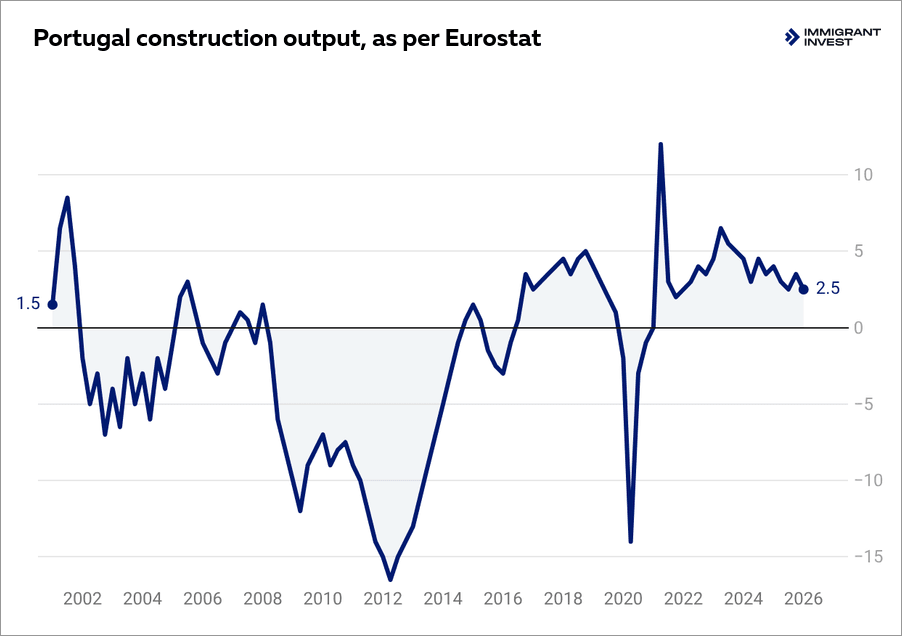
The crisis worsened as investment in construction dropped sharply, falling by 18.1% in 2012, while public investment fell by around 31% the same year because of government spending cuts[37]. As a result, the housing market was left in very poor condition, with too many properties on the market and prices continuing to fall
Fiscal pressure and IMF programme
Portugal’s public finances came under severe pressure during the crisis years. Eurostat data show that the general government deficit widened from 3.6% of GDP in 2008 to 10.2% in 2009 and remained very high at 9.8% in 2010[39]. Over the same period, public debt rose sharply, increasing from 71.7% of GDP in 2008 to 108.1% in 2011[39].
As the wider euro area debt crisis intensified, investor confidence in Portugal weakened and sovereign borrowing costs surged. The European Stability Mechanism notes that Portuguese 10-year bond yields rose above 10% by mid-2011, sharply increasing the government’s cost of borrowing[41].
Pedro Barata,
Head of Portuguese office
In 2011, Portugal had to request financial assistance from the European Union and the International Monetary Fund. The rescue programme came with strict conditions: the government had to reduce spending, raise taxes, reduce debt in the banking sector, and implement structural economic reforms.
While these measures were intended to restore financial stability, they also reduced economic activity in the short term and deepened the recession. With tight limits on public spending, the government had little ability to stimulate the economy through traditional fiscal measures.
Policy rationale for the residency by investment
Portugal launched its residency by investment in October 2012 as a practical response to the economic crisis and the strict limits imposed by the IMF bailout programme. At the time, the government had very little room to increase spending, banks were lending less, and the housing market was in serious decline.
The Golden Visa was designed to bring foreign money into the country without adding pressure to the state budget or increasing public debt. By encouraging foreign investment, especially in property, the government hoped to reduce the oversupply of housing, support prices, and help revive the struggling construction sector.
It also fitted into wider housing reforms already underway, including the 2012 New Urban Lease Act[42] and measures to encourage urban renewal. In addition, the money brought in through the Golden Visa provided an important source of foreign capital for the economy.
Other options, such as a large public investment initiative, were not realistic because Portugal was bound by strict bailout conditions. In that context, residence by investment became one of the few tools the government could use to attract capital quickly while still complying with fiscal consolidation rules.
Launch of the Golden Visa
Portugal launched the Golden Visa in 2012 to attract foreign capital during a period of economic weakness. The government aimed to support recovery, boost investment, and strengthen confidence in the economy.
Legislative framework and policy objectives
The legal basis for Portugal’s residency by investment was created by Law No. 29/2012 of 9 August 2012[6]. This law amended the existing Aliens Act Law No. 23/2007 by adding a new provision — Article 90-A — which established the rules for granting residence permits to non-EU nationals who make qualifying investments in Portugal[6].
The main policy goal was to attract foreign capital to support the country’s economic recovery after the sovereign debt crisis. The programme was implemented through ministerial order Despacho No. 11820-A/2012, which took effect on October 8th, 2012 and defined the specific investment requirements.
Pedro Barata,
Head of Portuguese office
One important feature was that applicants did not need to obtain a standard residence visa before applying for the permit. Later, in 2015, the rules were formally incorporated into Portugal’s main immigration regulation through Decreto Regulamentar No. 15-A/2015.
Early investment requirements
At the start, the Golden Visa offered three main investment options. Applicants could transfer at least €1 million to Portugal, create at least 30 jobs, or buy real estate worth at least €500,000[7]. The job creation requirement was later reduced and standardised to 10 jobs.
The original residency rules also required investors to spend a relatively limited amount of time in Portugal: 30 days during the first year and 60 days over each following two-year renewal period. In 2015, these rules became even more flexible.
Under Decreto Regulamentar No. 15-A/2015, the minimum stay was reduced to just 7 days in the first year and 14 days in each later 2-year period. This made the Golden Visa much more attractive to international investors, as it allowed them to keep their residence status with only brief visits to Portugal.
Early Golden Visa phase: 2012—2016
The Golden Visa expanded quickly in its first years. Portugal used it to attract foreign capital at a time of weak domestic investment. Early demand showed strong interest from non-EU investors. By 2016, the Golden Visa had become a visible part of the country’s investment policy.
Investment inflows and early economic impact
During its early years, the Golden Visa grew steadily. Although the available context does not include full annual data for 2012 to 2015, the figures for 2016 show how large the programme had become by the end of this first phase. In 2016, Portugal’s immigration authorities, then SEF, approved 1,414 Golden Visa applications[8].
As a result, 1,172 first residence permits were issued to main investors, while another 2,000 permits were granted to family members through family reunification[8]. In the same year, the Golden Visa attracted €874.44 million in investment, showing its strong ability to bring foreign capital into Portugal[9].
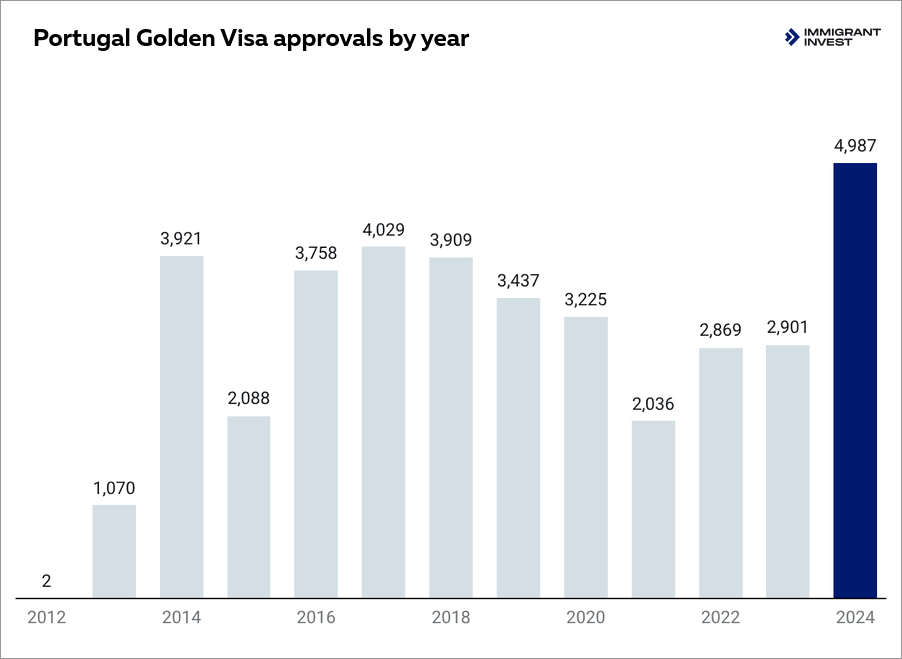
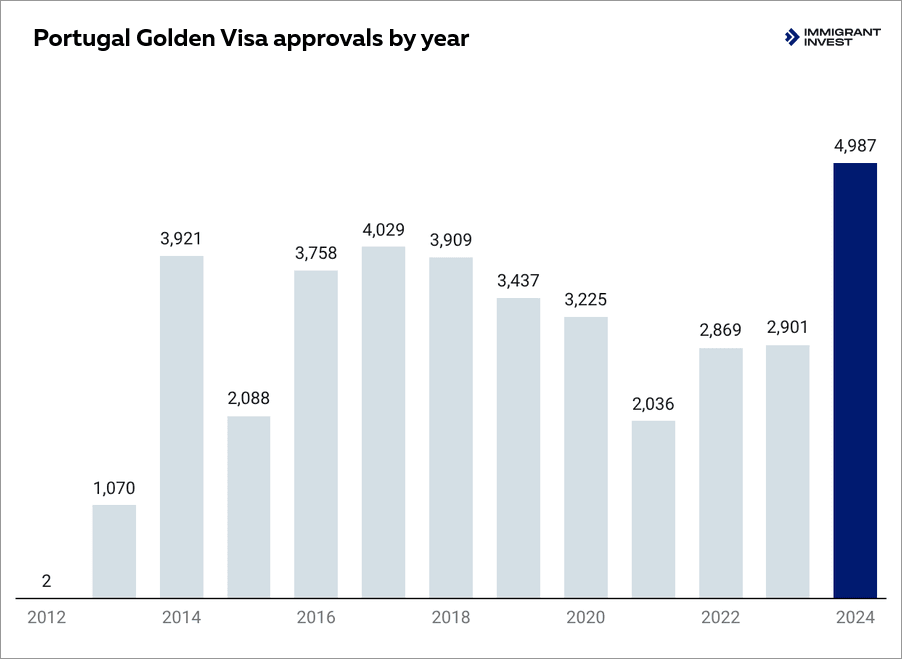
Annual number of approved Portugal Golden Visa applications, 2012—2024. The data show an initial growth phase, peaking in 2017—2018, followed by a gradual decline during 2019—2021 and a subsequent recovery. The sharp increase in 2024 likely reflects the clearance of accumulated backlogs rather than a proportional rise in new applications
Role of real estate and nationalities of investors
The early years of the Golden Visa were shaped by two clear patterns: most investors chose the real estate option, and Chinese nationals made up the largest group of applicants.
In 2016, 1,329 out of 1,414 approved applications were linked to property purchases, which meant real estate accounted for 94% of all approvals[10]. It also represented the vast majority of the money invested: €787.45 million out of the yearly total, or 90.1%[11].
The other routes were used far less often. The capital transfer option accounted for 84 applications, while only one permit was issued through the job creation route.
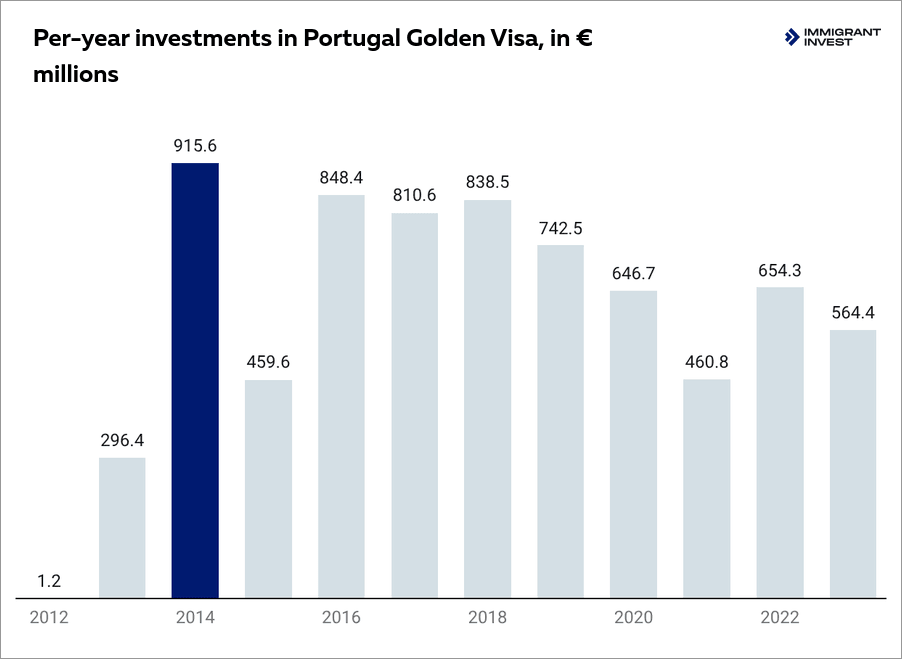
Portugal’s Golden Visa programme saw its peak momentum in the mid-2010s, with investment volumes surging rapidly after launch and reaching a high of €915.6 million in 2014. This spike reflects the programme’s early reliance on real estate and strong demand from foreign investors, particularly from China
Chinese investors were by far the largest nationality group. In 2016, 848 main applicants came from China[10]. They were followed by Brazil with 142, South Africa with 62, Russia with 51, and Jordan with 35. This shows that the Golden Visa was especially attractive in China during its early phase, although interest was also beginning to spread to other countries.
Expansion and market impact: 2016—2021
This period marked the Golden Visa’s peak influence on the property market. Foreign capital kept flowing into Portuguese real estate, while housing demand remained strong in the country’s most popular urban and coastal areas.
Housing price growth and foreign capital inflows
Between 2016 and 2021, housing prices in Portugal rose steadily and then even faster. According to the National Institute of Statistics, average house prices increased by 7.1% in 2016 and by about 9.6% in 2019[12]. Prices continued to rise even during the pandemic, increasing by 8.4% in 2020. In 2021, the market accelerated again, with average annual growth reaching 9.4% and year-on-year growth peaking at 11.6% in the fourth quarter[13].
By 2021, the national median price of housing had reached €1,297 per square metre[14]. Prices were much higher in some regions, especially the Algarve at €2,000 per square metre, the Lisbon Metropolitan Area at €1,813, and the Porto Metropolitan Area at €1,370[14].
Rents followed a similar pattern. The median rent for new contracts rose by 10.8% in 2019 and by 7.7% in 2021, reaching €6.04 per square metre[14].
Pedro Barata,
Head of Portuguese office
The market was also very active. In 2019, 181,478 homes were sold, with a total value of €25.6 billion[14]. In 2021, the number of sales was slightly lower, at 165,682, but the total value increased sharply to €28.1 billion, up 31.1% from 2020. This shows that rising prices, rather than a higher number of transactions, were driving market growth[14].
Concentration in Lisbon and Porto and urban transformation
Investment and housing pressure was heavily concentrated in Portugal’s coastal and metropolitan areas, especially Lisbon, Porto, and the Algarve. Official SEF data for 2021 showed that 66.8% of all foreign residents in Portugal were registered in the districts of Lisbon, Faro, and Setúbal[14]. This matched housing market data from INE, which showed that property prices were highest in these same areas[14].
This concentration was also reflected in visible changes to major cities. In the years before 2020, Lisbon and Porto saw a rapid increase in short-term rentals, which added pressure to the supply of housing for local residents and was associated with gentrification in historic neighbourhoods. The Golden Visa reinforced this trend by directing foreign capital into property markets that were already under strong pressure and going through major urban change.
Political debate
As house prices and rents kept rising, public and political criticism of the Golden Visa also grew. Because 87% to 95% of approvals were linked to property investment, the programme became closely associated with the housing affordability crisis.
Although Golden Visa investment made up only a small share of Portugal’s overall real estate market, it was heavily concentrated in the most expensive urban areas. This led to a widespread view that the Golden Visa was pushing prices even higher and contributing to the displacement of local residents.
Pressure increased steadily, especially from municipal leaders in Lisbon and Porto. Over time, this helped drive a series of stricter rules and, eventually, the major ‘Mais Habitação’ reform in 2023, which ended the real estate route for new applicants[12].
Housing affordability crisis and policy reaction
Housing costs became one of Portugal’s most sensitive social issues during this period. Rising prices and rents increased pressure on households, especially in major cities. As public concern grew, the Golden Visa faced closer political scrutiny. The Golden Visa was increasingly seen as part of a wider housing policy problem.
Rising rents and local political pressure
Portugal’s housing affordability crisis became much more severe in the late 2010s and after the pandemic, as rents and property prices rose faster than incomes. According to INE, the national median rent for new leases reached €7.97 per square metre in 2024.
In Lisbon and Porto, rents were much higher, at €15.93 and €12.58 per square metre respectively[15]. The upward trend continued into early 2025, with rents still showing double-digit annual growth.
Although median disposable income rose by 14% in 2024 to €14,465 a year, housing remained unaffordable for many households. Eurostat data for 2024 showed that 30.3% of tenants paying market rent in Portugal were overburdened by housing costs, meaning they spent more than 40% of their disposable income on housing[16].
Local political leaders in the areas under the greatest housing pressure were among the strongest critics of the Golden Visa. In 2019, Porto’s mayor, Rui Moreira, said that golden visas were contributing to ‘artificial inflation of prices’ and to the ‘Luxembourgisation’ of the economy[17].
In November 2022, the Lisbon Municipal Assembly passed a resolution supporting the end of the Golden Visa nationwide, arguing that it encouraged speculative investment[18].
The national government also openly recognised the problem. When it announced plans in 2020 to limit the geographical scope of the programme from 2022 onward, the ruling Socialist Party said the goal was to reduce housing market pressure in the metropolitan areas of Lisbon and Porto[19].
Policy debates within Portugal and EU
The housing crisis became a major political issue in Portugal, with growing public pressure for action. A Eurobarometer survey published in July 2025 showed that 30% of respondents in Portugal saw housing and better energy efficiency as priorities for future EU investment, underlining how prominent the issue had become.
Pedro Barata,
Head of Portuguese office
This public concern fed directly into political debate. The ‘Mais Habitação’ package, which included the removal of the Golden Visa real estate option, became one of the most contested housing measures in parliament.
In the final vote, the ruling Socialist Party supported the package, while major opposition parties — including PSD, Chega, IL, PCP, and BE — voted against it. The disagreement was not only about the Golden Visa itself, but also about other controversial housing measures in the same package, such as tighter rules for short-term rentals.
Portugal’s decision to tighten the Golden Visa rules also came at a time of growing international scrutiny of residency by investment policies. In 2019, the European Commission published an important report warning about risks such as money laundering, tax evasion, and security concerns. In March 2022, it went further by recommending much stricter checks for these programmes and calling on EU countries to suspend permits for Russian and Belarusian nationals[20].
The European Parliament supported tougher EU-level controls as well. At the same time, the OECD and the Financial Action Task Force warned that such Golden Visas could be used to avoid international tax transparency rules. The IMF also pointed to reputational risks and possible economic side effects, including pressure on housing markets.
Against this background, Portugal’s reforms were part of a wider European shift. The country’s tougher rules reflected both domestic political pressure and a broader move across Europe toward stricter oversight and reduced reliance on property-based investment routes.
Regulatory tightening: 2020—2023
Portugal began to tighten the Golden Visa as criticism of its housing effects grew. The government sought to reduce pressure on major residential markets without ending the Golden Visa at once.
Geographical restrictions
The first major tightening of the Golden Visa came through Decree-Law No. 14/2021, published in February 2021 and applied from January 1st, 2022[21]. This reform greatly narrowed the areas where property purchases could qualify for the visa.
Under the new rules, residential real estate investment counted only if the property was located in the autonomous regions of the Azores or Madeira, or in officially designated inland areas of Portugal[21]. These areas are listed in Portaria No. 208/2017 and include 165 municipalities and 73 parishes. In practice, this meant that new residential property investments in Lisbon, Porto, and most of the Algarve coast no longer qualified.
The same reform also raised the minimum amount required for some other investment options. For example, the capital transfer route was increased from €1 million to €1.5 million[21].
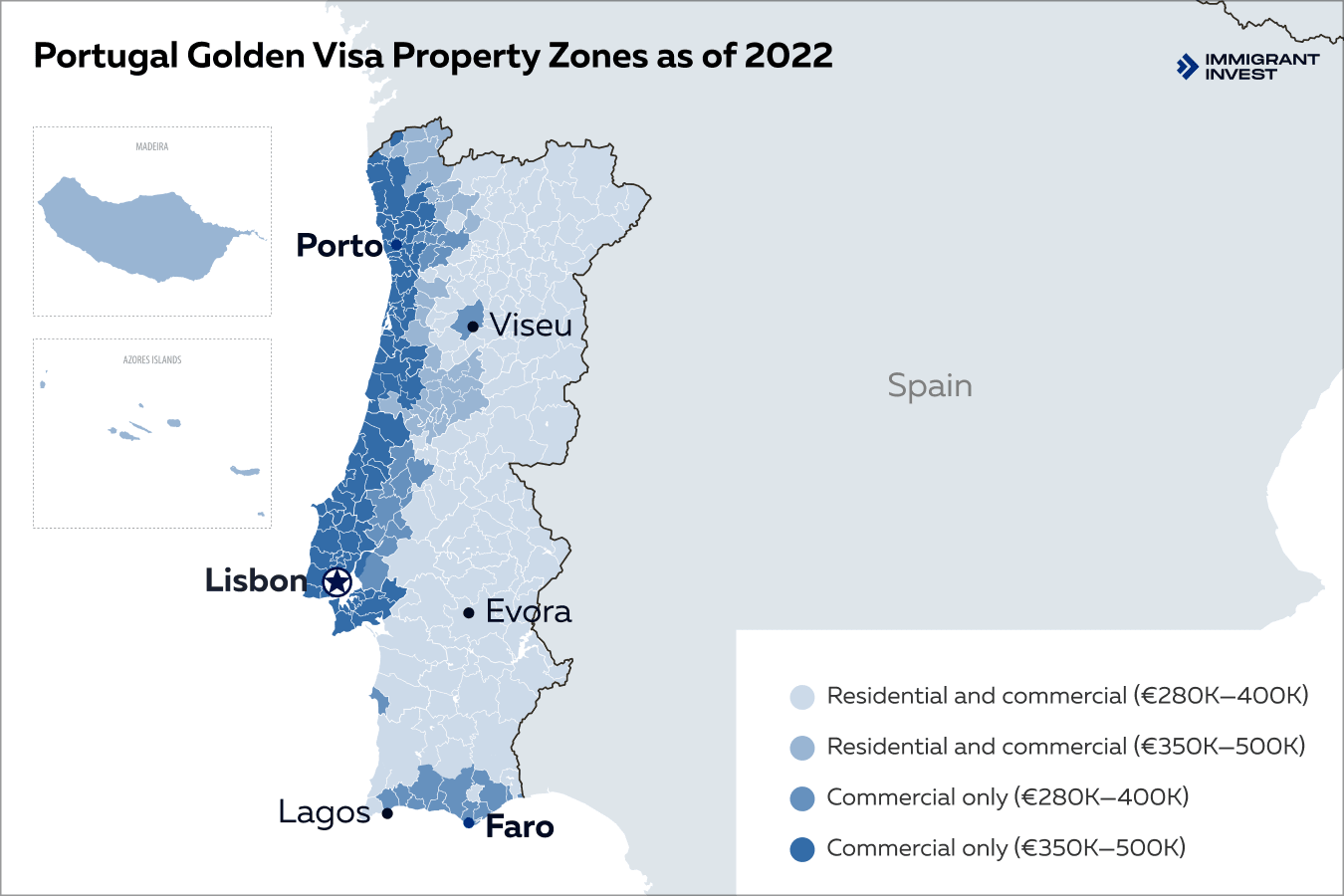
Spatial delineation of real-estate investment eligibility under Portugal’s Golden Visa framework in 2022, reflecting the policy shift that channelled foreign capital away from high-pressure coastal housing markets and towards lower-density inland territories and the autonomous regions
Removal of real estate option and ‘Mais Habitação’ reform
The most significant reform came with the ‘Mais Habitação’ legislative package, adopted as Law No. 56/2023 on October 6th, 2023 and entering into force the next day[22]. This law introduced the biggest changes to the Golden Visa since its creation.
Chapter V of the law ended new applications for the Golden Visa’s most widely used investment routes. Article 42 specified that new applications would no longer be accepted for three options:
- capital transfers of €1.5 million or more;
- purchase of real estate worth at least €500,000;
- purchase and renovation of property worth at least €350,000.
The reform also created a clear separation between the Golden Visa and the property market. Article 44 amended the main immigration law to state that the remaining eligible investments — such as those in funds or businesses — cannot be used, directly or indirectly, for real estate investment. As a result, property investment is no longer a pathway for new applicants under the Golden Visa.
Political motivations
The official reasons for tightening the Golden Visa between 2020 and 2023 focused mainly on the housing affordability crisis and the need to reduce speculative pressure in the property market.
The 2020 State Budget made clear that the goal was to encourage investment in inland areas and limit property investment in major metropolitan markets. The preamble to Decree-Law No. 14/2021 said the purpose was to direct the Golden Visa mainly toward inland territories, job creation, urban renewal, and cultural heritage.
The reasoning behind the final reform in 2023 was even more explicit. The stated aim of the ‘Mais Habitação’ law was to introduce measures that would help guarantee more housing. The law specifically included the end of residence permits linked to real estate investment as one of those measures, directly connecting the restriction of the Golden Visa to the government’s broader housing policy[22].
Statistics and trends: 2012—2024
The Golden Visa became one of Portugal’s largest residence by investment channels over this period. It attracted significant capital and drew thousands of main applicants and family members.
Number of permits issued and investment volumes
From the launch of the Golden Visa in October 2012 to July 2023, Portugal attracted a total of €7.21 billion through this residency by investment route[8].
Over that period, 12,497 residence permits were granted to main investors, and another 20,169 were issued to family members by family reunification.
By the end of 2024, the total number of permits granted to both investors and relatives had reached at least about 38,000. We calculated this figure by combining official SEF data up to the end of 2021, the net increase recorded between January 2022 and July 2023, and AIMA’s full-year figures for 2024
The Golden Visa went through clear stages of growth, peak activity, and decline, shaped by policy changes and outside events.
After its launch, it expanded quickly, with investment reaching its highest levels in the years before the pandemic. In 2018, for example, 3,909 permits were issued to main investors, bringing in €838.5 million. The pandemic then slowed activity. In 2021, 2,036 investor permits were issued, with total investment falling to €460.8 million.
The programme recovered in 2022, when 2,869 investor permits were granted. In 2023, the number rose to 2,901. This was likely because many applicants tried to apply before the October 2023 legal changes, which ended the real estate route for new applicants. In 2024, under the new rules and under AIMA’s administration, 4,987 investor permits were granted[23].
Family reunification figures also changed noticeably. In 2024, 2,909 permits were issued to family members, compared with 1,554 in 2023[23]. In our view, this increase mainly reflects AIMA’s effort to process the backlog it inherited, rather than a sudden rise in new family applications.
Nationality distribution and sector allocation
The Golden Visa has changed fundamentally over time. For more than a decade, real estate was the main investment route.
In 2018, property purchases accounted for 90.9% of all investment under the Golden Visa, and in 2021 they still made up 88.9%[8]. This changed completely in October 2023, when the ‘Mais Habitação’ law removed property-based options for new applicants. As a result, all 2,081 investor permits granted in 2024 were issued through other routes, such as investment funds, contributions to research, or business capitalisation[8].
The profile of investors by nationality has also changed significantly. Chinese nationals remain the largest group overall, with 5,374 permits granted by July 2023. However, their share of new approvals has fallen sharply over time, from almost 75% in 2015 to 16.6% in 2022[24].
At the same time, investors from other countries have become more important. The biggest change came from the United States, which became the leading nationality among new applicants in 2022 with 216 permits, slightly ahead of China with 213. Brazil, Türkiye, and South Africa have also remained among the main source countries for investors.
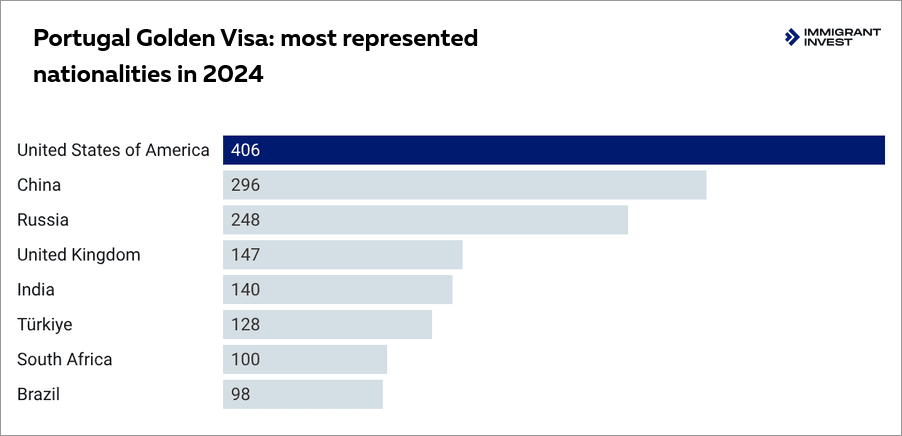
Distribution of residence permits granted under investment-based migration visas, disaggregated by applicants’ nationality. The data indicate a pronounced concentration among applicants from the United States, China, and Russia, followed by a secondary tier comprising the United Kingdom and India, with comparatively lower representation from Türkiye, South Africa, and Brazil
To complement official statistics, let us consider internal data reflecting actual investor behaviour and demand patterns observed by Immigrant Invest.
According to Immigrant Invest website analytics and client enquiries over the period from November 18th, 2024, to March 9th, 2026, the top 10 countries showing the highest interest in Portugal’s Golden Visa are:
- United States,
- United Kingdom,
- Canada,
- Portugal,
- India,
- United Arab Emirates,
- Nigeria,
- Australia,
- Türkiye,
- Germany.
This dataset provides a practical counterpoint to government-issued figures. While official data reflect completed residence permits, Immigrant Invest’s internal metrics capture earlier stages of the decision-making process, including initial interest, research behaviour, and consultation requests.
A comparison of the two datasets reveals several notable patterns:
- The United States and the United Kingdom appear prominently in both approved permits and early-stage interest, which indicates a stable and mature investor pipeline.
- Emerging markets such as Nigeria and the United Arab Emirates show high engagement at the enquiry stage, despite lower representation in approval statistics, suggesting latent demand that may convert into future applications.
- Portugal appears in the top 10, reflecting domestic interest often linked to tax planning, internal relocation, or status optimisation strategies.
Pending applications
A major problem for the Golden Visa has been the large administrative backlog.
When responsibility was transferred from SEF to the new Agency for Integration, Migration and Asylum in late 2023, the number of pending Golden Visa-related applications — including those from main investors and their family members — was officially described as ‘more than 50,000[23].’ An AIMA official confirmed this figure again in early 2025, showing that the backlog was even larger than some earlier public estimates had suggested.
To deal with this, the authorities set up a special mission structure in 2024, often described as a ‘mega-operation.’ Although this effort mainly targeted other types of immigration cases, AIMA’s 2024 report made clear that it also began processing the large Golden Visa backlog.
We see the effect of this in the 2024 figures. That year, 2,909 permits were issued to family members, a high number that reflects the effort to clear older pending cases rather than only new applications[23].
Economic impact assessment
The Golden Visa affected the property market in uneven ways. Its national share was modest, but its local impact was stronger. The Golden Visa added demand in places with limited housing supply.
Real estate market effects
The Golden Visa had a noticeable impact on Portugal’s property market, but that impact was concentrated in specific areas rather than spread evenly across the whole country. Between 2012 and 2023, its direct share of the national real estate market was relatively small, estimated at about 2.1%. Even so, it played a much bigger role in high-demand locations such as Lisbon, Porto, and the Algarve, where housing supply was already under pressure.
In these areas, the Golden Visa added demand to markets that were already expensive and highly competitive. This helped push prices higher, especially in the premium segment. Official data for 2016 to 2021 shows steady and accelerating growth in both house prices and rents.
Average annual house price growth rose from 7.1% in 2016 to 9.4% in 2021, with even stronger growth in metropolitan areas[25]. Rents followed a similar pattern, with median rents for new contracts rising by 10.8% in 2019 and 7.7% in 2021[25].
The Golden Visa contributed directly to this trend because, in its early years, more than 90% of Golden Visa investment went into real estate. Foreign buyers, including Golden Visa applicants, also tended to buy more expensive properties than domestic buyers. In 2024, for example, the average transaction value for a non-EU buyer was €421,730, compared with €207,230 for the overall domestic average.
This concentration in higher-value property markets likely added to the price pressure already felt by local residents. It also helps explain why local politicians argued that the programme was inflating prices and worsening housing affordability. These concerns became one of the main reasons why Portugal ended the real estate route for new Golden Visa applicants in October 2023.
Capital inflows and construction sector recovery
The Golden Visa was an important source of foreign investment for Portugal. From its launch in October 2012 to September 2023, it brought in about €7.32 billion[26]. Most of this money — around €6.45 billion, or 88% — went into real estate[26].
This inflow was especially important in the years after the 2008—2012 economic crisis, when domestic demand was weak and bank lending had fallen sharply. The programme helped bring liquidity back into the property market at a time when other sources of investment were limited.
Its effect on the wider construction sector, however, seems to have been much smaller. One part of the Golden Visa supported property renovation and rehabilitation, attracting a total of €671 million. This was important for some urban renewal projects, especially in historic city centres, but it represented only about €50 million to €70 million a year over the period. Compared with the size of Portugal’s construction sector as a whole — for example, €12.7 billion in building works in 2024 — this was less than 1% a year.
In other words, the Golden Visa played a meaningful role in supporting property transactions and some local redevelopment, but its direct effect on construction activity and employment at national level was limited.
Pedro Barata,
Head of Portuguese office
After the 2023 reforms removed the property option, the nature of investment changed completely. All 2,081 Golden Visa permits issued in 2024 were granted through non-property routes such as investment funds and research contributions[27]. This marked a fundamental shift in where programme-related capital was being directed.
Fiscal impact
The Golden Visa also brought in substantial tax revenue, mainly through taxes linked to property purchases. Based on the €6.45 billion invested in real estate between 2012 and September 2023, the total revenue raised was significant[26].
The property transfer tax, IMT, is estimated to have brought municipalities about €331 million. Stamp duty on property transactions likely generated another €51.6 million for the state. In addition, the €671 million invested through the property rehabilitation route produced VAT revenue on construction materials and services. Depending on the tax rate applied, this is estimated at between €40 million and €154 million.
The Golden Visa also created an ongoing source of local tax revenue. Because many of the properties bought under the programme were high-value assets, they added to the annual property tax base, IMI, especially in the high-demand areas where these purchases were concentrated. This gave municipalities a continuing stream of revenue beyond the one-off taxes paid at the time of purchase.
Regional development
The Golden Visa had a very uneven regional impact, with most investment going to Portugal’s coastal and metropolitan areas rather than to less developed parts of the country. In practice, the main beneficiaries were Lisbon, Porto, and the Algarve.
Data from 2021 showed that 66.8% of all foreign residents in Portugal were registered in the coastal districts of Lisbon, Faro, and Setúbal, and Golden Visa investment followed a similar pattern[28].
This concentration widened regional imbalances and did little to support development in inland areas. In response, the government introduced Decree-Law No. 14/2021, which took effect on January 1st, 2022. Under this reform, residential property investments qualified for the Golden Visa only if they were made in the autonomous regions of the Azores and Madeira or in officially designated inland territories[28].
The stated purpose of this change was to promote more balanced territorial development, support urban renewal and cultural heritage in less developed areas, and redirect investment away from overheated coastal markets. This was the first major step in reshaping the Golden Visa before the property route was removed completely in 2023[22].
Since the 2023 reform, one possible future direction would be a more targeted version of the programme that channels non-property investment more actively into inland regions or specific economic sectors.
Social and political consequences
The Golden Visa’s effects went beyond investment figures and property sales. It became linked to wider concerns about housing access, inequality, and changes in urban life. As rents rose and neighbourhoods changed, public support weakened.
Housing affordability and public opinion
The Golden Visa is closely linked to declining housing affordability and major changes in city neighbourhoods, especially because it directed billions of euros into property in the most desirable urban areas.
During the programme’s main growth period from 2016 to 2021, rents rose faster than wages, putting increasing pressure on households. By 2024, Eurostat data showed that 30.3% of tenants paying market rent in Portugal were overburdened by housing costs, meaning they spent more than 40% of their income on housing[29].
This pressure was also connected to the growing ‘touristification’ of historic city centres. The process was driven not only by the Golden Visa but also by the rapid expansion of short-term rentals, known in Portugal as Alojamento Local, or AL. In Lisbon, the connection was especially clear. A municipal regulation adopted in 2025 stated that AL accounted for 67% of tourist accommodation and had created serious imbalances[30].
In the central parish of Santa Maria Maior, the scale was particularly striking: the number of AL properties reached 66.9% of the number of permanent homes[30]. In practice, this meant that more and more housing was being used for tourism instead of long-term residents.
As a result, many neighbourhoods lost part of their residential character, long-term residents were pushed out, and the social fabric of historic areas changed significantly. These effects became one of the main reasons for the growing political backlash against the Golden Visa.
As housing became less affordable, the Golden Visa was increasingly seen by the public and the media as part of the problem. In practice, it represented only a small share of the overall property market. However, because it was highly visible and closely linked to luxury real estate, it became a powerful symbol of a housing market that many people felt was serving foreign investors rather than local residents.
This public concern became increasingly clear over time. A Eurobarometer survey published in July 2025 found that 30% of respondents in Portugal saw housing as a priority area for future EU investment, showing how politically important the issue had become.
Media coverage also often repeated statements from public officials who linked the Golden Visa to problems in the housing market. For example, Porto’s mayor, Rui Moreira, said that Golden Visas were causing ‘artificial inflation’ in property prices and creating a kind of tax haven effect[19].
As this view spread in both Portuguese and international media, the Golden Visa came to be seen not only as an economic policy tool but also as a source of social tension. This helped create the political climate in which reform became increasingly difficult to avoid.
Parliamentary debates and local government positions
Political pressure to change the Golden Visa gradually led to a broad consensus against its real estate component.
Local authorities in the cities most affected by rising housing costs were among the strongest critics. The Lisbon Municipal Assembly passed resolutions calling for the Golden Visa to be ended at national level, while Porto’s mayor repeatedly spoke out against it[18].
The national government, led by the Socialist Party, responded step by step. It first introduced geographical restrictions in 2022 to reduce pressure on the housing markets in Lisbon and Porto[19]. It then went further in 2023 by advancing the ‘Mais Habitação’ legislative package, which fully removed the property route from the Golden Visa[19].
The final parliamentary vote showed a clear political divide. The Socialist Party voted in favour, while most opposition parties — including PSD, Chega, IL, PCP, and BE — voted against the package, although not always for the same reasons.
At the European level, pressure was also increasing. The European Commission and the European Parliament had already raised concerns about investor residence programmes, pointing to risks such as money laundering and weak links between investors and the host country.
Later, the European Commissioner for Housing identified Portugal as one of the EU countries most affected by the housing crisis. This reinforced the concerns raised inside Portugal and strengthened the political case for reform.
Current state of the Golden Visa: 2024—2026
After the 2023 reform, Portugal sharply narrowed the Golden Visa’s scope. The Golden Visano no longer supports investment in residential property or unrestricted capital transfers. Its purpose is now more targeted and selective.
Existing investment routes
Following the ‘Mais Habitação’ reform as of Law No. 56/2023, which took effect on October 7th, 2023, property purchases and large unrestricted capital transfers are no longer accepted under Portugal’s Golden Visa for new applicants[36].
Today, the Golden Visa is limited to non-property investment options. The main routes currently available are as follows.
Job creation. Applicants can qualify by creating at least 10 jobs in Portugal. Applicants can qualify by investing at least €500,000 in a company registered in Portugal and creating at least 5 permanent jobs.
They can also qualify by investing the same amount into an existing Portuguese company. In that case, they must either create at least 5 permanent jobs or keep at least 10 jobs in place, with at least 5 of them being permanent, for at least 3 years.
Scientific research. Applicants can invest at least €500,000 in research activities carried out by public or private institutions that are part of Portugal’s national scientific and technological system.
Support for culture and heritage. Applicants can invest at least €250,000 in artistic production or in the preservation and restoration of Portugal’s cultural heritage.
Investment funds not linked to real estate. Applicants can invest at least €500,000 in Portuguese investment funds, but these funds cannot be focused on real estate. They must have a maturity of at least 5 years at the time of investment, and at least 60% of their portfolio must be invested in companies headquartered in Portugal.
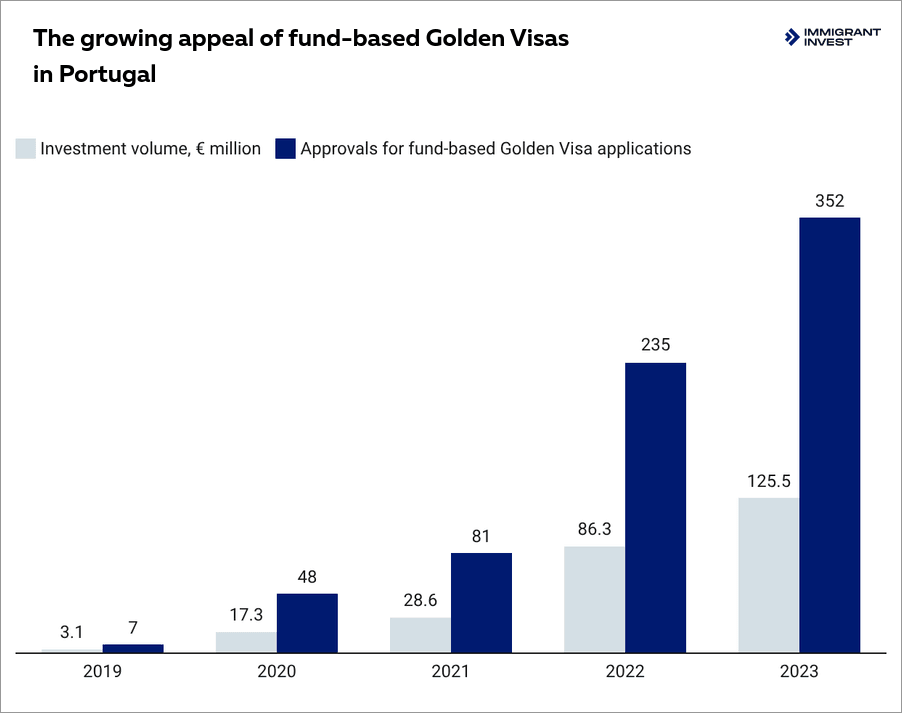
The chart shows a steady rise in both capital inflows and the number of approved applications under the fund-based route. Investment volumes increased from €3.1 million in 2019 to €125.5 million in 2023, while approvals grew from 7 to 352 over the same period.
Business investment and job creation. Applicants can invest at least €500,000 to set up a company in Portugal and create at least 5 permanent jobs. The same amount can also be used to strengthen the capital of an existing Portuguese company, as long as this leads to the creation or maintenance of jobs, with at least 5 permanent positions kept for a minimum of 3 years.
A key rule now applies across the whole Golden Visa: none of these investment routes may be used, directly or indirectly, for real estate investment[36]. In all cases, the investment must be maintained for at least 5 years.
Administrative reforms
A major reform of Portugal’s migration and border system was introduced by Decree-Law No. 41/2023, which took effect on October 29th, 2023[37]. This reform abolished the Immigration and Borders Service, known as SEF, and divided its responsibilities among several different bodies.
The most important change for the Golden Visa was the creation of AIMA, the Agency for Integration, Migration and Asylum. AIMA became responsible for the administrative side of immigration, including residence permit applications, asylum procedures, and integration policy. This means that AIMA now manages and decides Golden Visa applications. It also took over all pending administrative files from SEF, including the large backlog of Golden Visa cases[37].
Another part of the reform involved the Institute of Registries and Notary, or IRN. IRN took over the front-office services for issuing and renewing residence permits and Portuguese passports for foreign nationals. In practice, IRN handles in-person appointments and the collection of biometric data for renewals, while AIMA keeps the authority to make the final decisions.
SEF’s policing and border-control powers were also reassigned. The National Republican Guard, or GNR, became responsible for surveillance at land and maritime borders. The Public Security Police, or PSP, took over airport border control and the removal of foreign nationals. The Judicial Police, or PJ, became responsible for investigating illegal immigration and human trafficking.
To coordinate all these bodies, Portugal also created a new unit within the internal security system: the Borders and Foreigners Coordination Unit, known as UCFE. Its role is to manage shared databases and act as a central coordination point between the different authorities[37].
Application and renewal process
The Golden Visa application and renewal process has changed significantly in recent years and is now much more digital.
For new applications, the process starts online through AIMA’s official Golden Visa portal. Applicants first complete a pre-registration and then upload the required documents. These include standard personal documents, such as a passport, proof of legal entry into Portugal, criminal record certificates, health insurance, and proof of tax compliance, as well as documents showing that the qualifying investment has been made.
After uploading the documents, the applicant must generate and pay the analysis fee.
Once AIMA checks and accepts the file, the applicant is invited to book a single in-person appointment at a Loja AIMA service desk. At this appointment, biometric data such as a photograph and fingerprints are collected, and the original documents are presented. Under the legal rules, AIMA has 90 days to make a decision after all required information has been submitted[38].
The renewal process has also been simplified, mainly to deal with the large number of existing permit holders.
One route is through AIMA’s online renewals portal, launched in mid-2025. This allows applicants to submit their renewal request and pay the fees digitally. The system has been introduced gradually, starting with permits that expire later. In-person appointments are required only when new biometric data must be collected[39].
The other route is through in-person appointments at selected IRN offices. This option has mainly been used for groups whose permits expired earlier. In these cases, either AIMA’s special task force or IRN contacts eligible permit holders to arrange an appointment. Even when the renewal is submitted through IRN, the final decision still belongs to AIMA[39].
Backlog and processing performance
The transfer from SEF to AIMA exposed serious administrative strain. Thousands of pending cases had built up under the previous system. This weakened the Golden Visa’s efficiency and damaged trust in processing timelines.
Backlog scale and composition
When AIMA was created in October 2023, it took over a very large backlog of pending cases from the former SEF. Official statements and AIMA’s 2024 report show that there were more than 50,000 pending ARI-related applications, including both main investors and their family members[1]. This number is higher than some earlier public estimates and shows how serious the administrative backlog had become.
Most of these pending cases appear to involve family members rather than main applicants. This can be seen in the 2024 figures. That year, permits issued through family reunification made up about 58.3% of all ARI-related approvals, while permits for main investors accounted for 41.7%[1].
In practical terms, this suggests that each main investor application is often linked to more than one family member application, which helps explain why the backlog grew so large and why processing it has been such a major challenge.
Processing performance and mega-operation
In 2024, its first full year of work, AIMA granted 4,990 ARI-related residence permits. Of these, 2,081 were issued to main investors and 2,909 to their family members[1].
Given that the backlog was officially described as more than 50,000 applications, this level of output suggests that, without further action, clearing all pending cases would take several years. At this pace, AIMA would process less than 10% of the backlog in one year.
To speed things up, the Portuguese government created a special task force through Resolution of the Council of Ministers No. 87/2024. This large recovery operation began work in September 2024. Its first priority was a much bigger backlog of more than 400,000 pending immigration expressions of interest in other categories, but AIMA’s 2024 report confirms that it also started dealing with the more than 50,000 pending applications[1].
The operation brought in substantial resources, including 25 centres, more than 300 mediators, and about 660 legal professionals. According to AIMA, this increased the agency’s overall service capacity sevenfold and made the Golden Visa backlog part of a much broader national effort to reduce long-standing delays[1].
Official statements on processing times
AIMA did not publish official average or median processing times for Golden Visa applications in its 2024 report. However, the agency has publicly committed to reducing delays.
In its 2025 Activities and Budget Plan, AIMA introduced formal performance indicators to measure progress in cutting backlogs. These include one indicator for Golden Visa applications and another for family reunification cases. Both are part of a wider objective to shorten waiting times across the migration system[43].
At the same time, delays led to a growing number of lawsuits against AIMA. Golden Visa applicants have gone to court to force decisions on long-pending files. In 2024, reports said that at least 35 investors sued AIMA over excessive delays, with some waiting more than four years for their residence permits[44].
After the legislation was amended, the number of new lawsuits against AIMA fell by 78%[45]. In October, administrative courts received 11,724 cases; in November, 3,471; in December, 3,432; and in January, 2,582. Earlier, the courts had been receiving as many as 20,000 claims in a 30-day period[45].
Even so, more than 100,000 cases remain pending, which forced the courts to open an extraordinary recruitment procedure for judges[45]. The drop in lawsuits is linked to amendments that entered into force on October 23rd, 2025. These introduced two key changes: claimants must now prove the urgency of the case, and the procedure is no longer free of charge, with average court fees of about €600[46].
Pedro Barata,
Head of Portuguese office
For new applications, AIMA has said that the target decision period is 90 days after the in-person biometric appointment. For older pending cases, the agency has introduced a chronological system for scheduling appointments, with the aim of making the process more predictable for applicants who have already been waiting for a long time[1].
After the law was changed, the number of new lawsuits against AIMA fell by 78%. According to data cited from the Conselho Superior dos Tribunais Administrativos e Fiscais, 11,724 cases entered the administrative courts in October, 3,471 in November, 3,432 in December, and 2,582 in January. Previously, the courts had been receiving as many as 20,000 claims in a 30-day period.
Even so, more than 100,000 cases remained pending, which forced the judicial system to open an emergency nationwide competition with 50 positions and later deploy a special team of judges to deal with the backlog. In January 2026, DN reported about 124,793 pending cases against AIMA, and the CSTAF confirmed an urgent national procedure with 50 temporary judicial posts to accelerate decisions. In March 2026, reporting on the CSTAF measure said a special team of 28 judges was being mobilised to tackle the accumulated caseload.
The drop in new lawsuits has been linked to amendments that entered into force on October 23rd, 2025. These introduced two key changes: claimants must now prove the urgency of the case, and the procedure is no longer free of charge, with court costs averaging around €600.
Legal and jurisprudential landscape
The Golden Visa’s legal basis changed sharply after the 2023 reform. Portugal kept the Golden Visa in place but removed its best-known investment routes.
Statutory framework post-2023
The legal framework of the Golden Visa changed fundamentally with Law No. 56/2023 of 6 October, widely known as the ‘Mais Habitação’ law. The most important changes were set out in Chapter V, Articles 42, 43, and 44[36].
Article 42 ended new Golden Visa applications through the most popular former routes. From October 7th, 2023, new applicants could no longer qualify through a capital transfer of €1.5 million or more, or through the purchase of real estate, including both the €500,000 route and the €350,000 property renovation route[36].
Article 43 introduced transitional rules to protect applications already in the system. It states that Golden Visa applications for approval or renewal submitted before the law took effect remain valid and must continue to be processed. This also applies to cases that were still at an early stage of review in municipal councils.
Once approved or renewed, the permits are reclassified as a special residence permit for immigrant entrepreneurs. However, they keep one of the main advantages of the original Golden Visa: the low minimum stay requirement of 7 days in the first year and 14 days in each following two-year period. The law also says that the investment must be confirmed as suitable for an entrepreneurial project by the relevant public bodies, such as AICEP or IAPMEI[36].
Article 44 formally amended the Aliens Act by removing the legal provisions linked to the investment routes that were abolished. It also added a new rule making clear that the remaining eligible investments, such as funds, research, or cultural support, cannot be used directly or indirectly for real estate investment[36].
Administrative practice and digitalisation
Since the transition from SEF to AIMA, administrative practices around the Golden Visa have changed noticeably, mainly because the authorities needed to deal with a very large backlog of cases. One of the most important changes has been a strong move toward digital processing, especially for renewal[36].
In 2025—2026, AIMA introduced a fully online renewal platform called the Portal de Renovações. Through this system, applicants can submit renewal requests and pay the required fees digitally. In-person appointments are now required only when new biometric data must be collected. This digital-first approach is intended to speed up the processing of the large number of pending renewals from the transitional period while also reducing administrative workload and improving efficiency.
For pending initial applications, the system now combines digital case management with investment checks carried out by specialised public agencies, as required under Law No. 56/2023. This creates a structured process for reaching final decisions on older applications.
Overall, this approach allows AIMA to process the large backlog of cases without reopening the property investment routes that were abolished. So far, the courts have generally supported this transitional framework, as long as the authorities continue to respect applicants’ procedural rights[36].
Economic scenarios and policy options: 2026—2030
Portugal’s Golden Visa now stands at a turning point. The post-2023 model is narrower, more selective, and less tied to the housing market. Future policy will depend on how well this system performs in practice. The key question is whether Portugal prioritises stability, tighter control, or a new form of expansion.
Scenario modelling
We see three main directions in which the Golden Visa could develop, all based on the post-October 2023 framework, which no longer allows property investment[44].
Continuation of the current model. Under this approach, Portugal would keep the existing non-property routes — such as investment funds, research, cultural support, and job creation — without introducing annual limits. The main priority would be stability and smoother administration under AIMA.
Further tightening. In this scenario, Portugal could introduce an annual limit on the number of main applicants, for example around 1,000 to 1,200 approvals a year. It could also set an end date for the Golden Visa, such as 2030, and apply stricter checks on applicants’ source of funds. Rules for investment funds could also become tighter, especially in response to evolving EU anti-money-laundering requirements.
More targeted redesign. In this case, the ban on property investment would remain, but the government could adjust the Golden Visa to direct investment more clearly toward inland areas and priority sectors such as deep tech or cultural heritage. This could involve lower investment thresholds, faster processing, or even joint investment with public bodies[44].
Projected impacts
The effects would differ a lot depending on which path Portugal chooses, although the direct impact on housing demand would stay close to zero in all three cases because property investment is no longer allowed.
If the current model continues, annual capital inflows would likely remain relatively stable, at about €0.76 billion to €1.21 billion a year, with around 1,900 to 2,200 applications annually.
If the rules become stricter, the Golden Visa would probably shrink. In that case, annual inflows could fall to roughly €0.32 billion to €0.66 billion, while application numbers could decline by 40% to 60%, to around 800 to 1,200 a year.
If the Golden Visa is redesigned in a more targeted way, the outcome could be more positive. Annual inflows might rise to about €0.74 billion to €1.40 billion, and application volumes could increase by 10% to 30%, reaching around 2,100 to 2,800 a year.
Revenue from application fees would likely follow the same pattern. It could be as low as about €8 million a year under a stricter model, or rise to around €40 million a year under a successful targeted redesign[26].
Political feasibility analysis
The political chances of each scenario depend mainly on two factors: Portugal’s domestic housing priorities and continued scrutiny from the EU.
In our view, keeping the current model is the most likely option. It fits with the 2023 ‘Mais Habitação’ reform and also responds to EU concerns about the risks of linking residency by investment to the property market.
A stricter version of the Golden Visa also appears politically possible. This would match the cautious approach taken by the European Commission and the European Parliament. The main drawback would be economic: Portugal would receive less foreign capital and lower fee income.
As of April 2026, Portugal’s nationality rules have also become a more important part of the wider political context.
Parliament has approved a new nationality law that would lengthen the residence period required for naturalisation to 10 years for citizens of non-EU and non-Portuguese-speaking countries and to 7 years for EU and Portuguese-speaking-country citizens. The approved text also says that the qualifying period will run from the date of issuance of the first residence permit, not from the date of application.
The parliamentary decree still had to complete the final legislative steps before taking effect, including presidential promulgation or another constitutional review, and publication in Diário da República. Extending the timeline to 7 or 10 years weakens this benefit and could reduce demand, especially among investors primarily seeking an EU passport rather than residence.
Pedro Barata,
Head of Portuguese office
A more targeted redesign seems possible, but less certain. It could still fit within the EU’s position as long as no property element returns, even indirectly by investment funds.
However, inside Portugal, support for this approach would likely depend on clear proof that it brings real benefits to inland regions or priority sectors, while also keeping strong safeguards in place to avoid fresh controversy[44].
Conclusions and key findings
Portugal’s residence by investment changed between 2012 and 2026. It evolved with economic needs and political pressure. The Golden Visa began during a severe economic crisis. It aimed to attract foreign capital quickly. It brought over €7.3 billion into the economy[26].
Most investment went into real estate assets. This focus shaped market outcomes in key regions. The Golden Visa formed a small market share overall. It was about 2% by value. Its impact was strong in Lisbon, Porto, and Algarve.
The analysis highlights three main points:
- The Golden Visa had a localised market impact. Demand rose in already expensive areas. Prices and rents increased in those markets. Housing affordability worsened for many residents.
- Housing affordability became a political priority. Pressure came from cities and civil groups. The government changed rules in response. Reforms started in 2022 with location limits. The 2023 law removed real estate investments[21].
- The Golden Visa’s nature changed after reforms. Property investment was fully removed. The focus shifted to productive investment routes. This aligns with EU and OECD guidance.
By 2026, the Golden Visa is more focused. It centres on non-property investment routes. These include funds, research, culture, and business projects. Some routes support job creation. Administration moved from SEF to AIMA.
AIMA continues to process a large application backlog. The transition aims to improve efficiency over time. The Golden Visa now has clearer governance structures. It also has stronger safeguards.
Portugal’s case shows a key policy lesson. Poor design can create housing market distortions. Careful planning helps avoid such effects. Any immigration programmes need regular review and adjustment. Investment should target productive sectors.
The Golden Visa is now more limited and targeted. Its housing market impact is minimal today. Future success depends on investment quality. It should support innovation and employment growth. It should also support cultural development.
Portugal’s approach shows policy can adapt over time. Investment migration can shift in purpose. It can move from broad capital inflows. It can target long-term economic development instead.
Sources
- AIMA. Golden Visa– Autorização de residência para investimento (Art. 90.º-A).
- AIMA. Relatório de Migrações e Asilo 2024.
- AIMA.Golden Visastatistics document.
- AIMA. O Portal das Renovações já está disponível.
- Almedina. Decreto-Lei n.º 41/2023 de 2 de junho — Artigo 1.º (Objeto).
- Assembleia Municipal de Lisboa. Documentos oficiais.
- AVM Advogados. Decreto-Lei n.º 14/2021 — Alterações ao regime do Golden Visa.
- Banco de Portugal. Money laundering and terrorist financing.
- Banco de Portugal. Output and unemployment, Portugal, 2008—2012.
- Banco de Portugal. Instrução n.º 2/2021.
- Diário da República. Lei n.º 23/2007, de 4 de julho.
- Diário da República. Lei n.º 56/2023, de 6 de outubro.
- Eurostat. Housing cost overburden rate by tenure status.
- Eurostat. House price index, quarterly data.
- European Parliament. Citizenship and residence by investment schemes.
- European Parliament. Aspects of golden passport and visa schemes in the EU.
- Host Wise. Lisbon short-term rental regulations: Complete guide.
- ILO NATLEX. Lei n.º 56/2023, de 6 de outubro.
- INE: Statistics Portugal. Estatísticas da Construção e Habitação 2021.
- INE: Statistics Portugal. A renda mediana de novos contratos de arrendamento.
- INE: Statistics Portugal. Press release 645841595.
- Imojuris. Novas regras dos Vistos Gold excluem investimento residencial em Lisboa e Porto.
- Justiça.gov.pt. Guia do Registo Central do Beneficiário Efetivo (RCBE).
- KPMG. Spain Golden Visa cancelled.
- OECD. Residence and citizenship by investment schemes.
- OECD. OECD Economic Surveys: Portugal 2026.
- Público. AIMA concluiu 250 mil processos administrativos num ano.
- Público. PS reserva vistos gold por investimento imobiliário ao interior e regiões autónomas.
- Recipp. Chinese immigration in Portugal: Cultural integration.
- SEF. Golden Residence Permit Programme.
- SEF. Autorização de residência para investimento:Golden Visa statistics, September 2023.
- SEF. Autorização de residência para investimento:Golden Visa Statistics, February 2023.
- SEF. Autorização de residência para investimento:Golden Visa Statistics, March 2023.
- SEF. Autorização de residência para investimento:Golden Visa Statistics, August 2023.
- SEFSTAT. Relatório de Imigração, Fronteiras e Asilo 2016.
- The Golden Portugal. Relatório oficial AIMA 2024: O boom da imigração em Portugal.
- Correia, Leonida. Macroeconomics and the Construction Sector: Evidence from Portugal. Athens Journal of Business Economics, Athens Institute for Education and Research ATINER.
- Eurostat. Construction production index, Portugal.
- Eurostat. Government deficit and debt. Eurostat News Release, October 22nd, 2012.
- European Stability Mechanism. The crisis spreads to Portugal: a second call for aid. Safeguarding the euro.
- European Central Bank. Long-term interest rate statistics for EU Member States. ECB statistics.
- Lei n.º 31/2012, de 14 de agosto. Procede à revisão do regime jurídico do arrendamento urbano, alterando o Código Civil, o Código de Processo Civil e a Lei n.º 6/2006, de 27 de fevereiro. Diário da República, 1.ª série, n.º 157, 2012.
- AIMA, Plano de Atividades 2025 / QUAR 2025 — official performance indicators for reducing pending ARI and family reunification cases.
- Schengen.News, 35 Golden Visa Investors Sue Portugal’s AIMA Amid Excessive Permit Delays.
- Diário de Notícias, Processos contra a AIMA descem 78% após mudança na lei, mas ainda são milhares.
- Executive Digest, report on the October 23rd legislative change introducing the urgency requirement and court fees.