








Obtaining citizenship is divided into legal and "working" ways. Fraudsters offer to buy a passport in violation of the laws of several states at once. This is fraught with trouble from large fines and a ban on entry into the EU countries to criminal liability and compromising evidence, which is at their disposal.
We will tell you how to get a passport without consequences and how not to accidentally entrust your money and reputation to scammers.
Ways to get a second passport offered by scammers
Scammers offer to become citizens of another country quickly and bypass the law. Most often they promise to help obtain a passport of Romania, Hungary, Czech Republic and Greece. If the standard procedure for obtaining citizenship takes months or years, scammers guarantee that their client will receive status in just a few months.
Fraudsters hint at connections with influential people, promise to bribe officials or forge records in the archives. These methods do not work and can bring about big trouble.
States are tightening the rules and more carefully monitoring the procedure for obtaining citizenship every year. For example, 370 criminal cases were opened in Hungary due to falsification of documents when applying for citizenship in 2020.
Typically, scammers use one of three schemes: identity falsification with a fake passport or fake ID, non-existent relatives, or a fictitious marriage with a fake marriage certificate. We will explain how activities like making fake passports are dangerous.
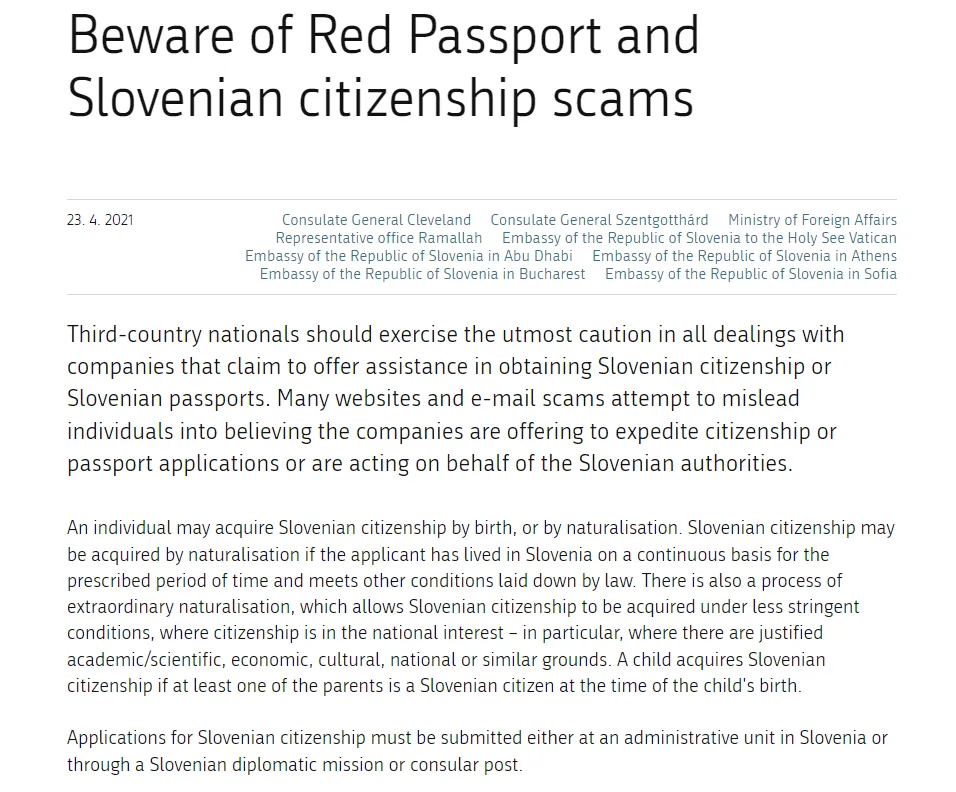
The Slovenian public services website warns of increased cases of fraud
Identity falsification
The company finds local residents who are ready to “sell their identity”. A figurehead submits documents for a passport. But a client of the company comes instead to submit biometrics or fingerprints and photographs.
Deception is revealed when checking or when a person begins to use the document. This leads to administrative or criminal liability.
Fictitious marriage
Each country establishes its own procedure for obtaining a passport for those who marry its citizen. Most often, obtaining citizenship will not work right away: you will need to live together in the country from one to several years, pass an exam on knowledge of the language and history, and confirm integration into society.
For example, in order to apply for citizenship in Germany, you need to be married for 3 years. Officials check whether the spouses really live together and lead a common life. If the deception is revealed, the marriage is annulled and the violator can be deported from the country.
In most cases, detours to citizenship lead to loss of time and money, and in the worst case, to criminal liability and the loss of the ability to travel to the European Union. For example, in Romania, falsification of documents can result in up to 3 years in prison.
Legal ways to get a second passport
Citizenship can only be obtained in a legal way: for example, by confirming kinship with EU citizens, going through the naturalisation process after obtaining a residence permit, or investing in the country's economy.
The required package of documents, cost and terms depend on the legislation of a particular country.
Second passport by investment
In some countries, there are government programmes for obtaining a residence permit or citizenship for investors. To participate in such a programme, it is necessary to invest in real estate, funds, the preservation of cultural heritage or open a business in the country and create jobs
Citizenship in the Caribbean allows you to enter the Schengen countries and the UK without a visa, while Dominica, Antigua and Barbuda, and Grenada passports also give you visa-free entry into China.
It is possible to get a second passport in the Caribbean countries within 4—8 months under the investment programme. You can get a Vanuatu or São Tomé and Príncipe passport even faster: on average, the procedure takes 2+ months.
The minimum investment amount is $90,000 in São Tomé and Príncipe, $130,000 in Vanuatu, and $200,000 in the Caribbean. In some cases, investments can be returned after 3—7 years.
Depending on the specific country, the parents, spouses, children and in some cases brothers or sisters can also acquire citizenship with the applicant.
Most popular citizenship by investment programmes

Country

Investment
$90,000+
Timeframe
2+ months
Eligible relatives
Spouses, children under 30, parents and grandparents over 55
Country

Investment
$130,000+
Timeframe
2+ months
Eligible relatives
Spouses, children under 25, parents over 50
Country

Investment
$250,000+
Timeframe
4+ months
Eligible relatives
Spouses, children under 25, parents over 55
Country

Investment
$235,000+
Timeframe
8+ months
Eligible relatives
Spouses, children under 30, siblings over 18, parents and grandparents
Country

Investment
$240,000+
Timeframe
6+ months
Eligible relatives
Spouses, children under 30, siblings under 18, parents over 55
Country

Investment
$230,000+
Timeframe
6+ months
Eligible relatives
Spouses, children under 30, siblings, parents and grandparents over 55
Country

Investment
$200,000+
Timeframe
6+ months
Eligible relatives
Spouses, children under 30, parents and grandparents over 65
Country | Investment | Timeframe | Eligible relatives |
|---|---|---|---|
$90,000+ | 2+ months | Spouses, children under 30, parents and grandparents over 55 | |
$130,000+ | 2+ months | Spouses, children under 25, parents over 50 | |
$250,000+ | 4+ months | Spouses, children under 25, parents over 55 | |
$235,000+ | 8+ months | Spouses, children under 30, siblings over 18, parents and grandparents | |
$240,000+ | 6+ months | Spouses, children under 30, siblings under 18, parents over 55 | |
$230,000+ | 6+ months | Spouses, children under 30, siblings, parents and grandparents over 55 | |
$200,000+ | 6+ months | Spouses, children under 30, parents and grandparents over 65 |
In most cases, citizenship in a Caribbean country does not require permanent residence there, which means that it is not necessary to move. However, you can freely travel and go to the country at any time.
All documents for citizenship can be submitted online, there is no need to personally go to the country.
All main applicants and their family members aged 16+ must undergo Due Diligence.
Second passport by ancestry
In many countries, it is possible to acquire citizenship by descent: if the applicant’s parents or grandparents have the citizenship of the country. To do this, you must confirm the relationship. Most often, you will need the original birth certificate and a copy of the relative's passport.
Each country has its own conditions: some states allow citizenship only to children and grandchildren, while others allow great-grandchildren and more distant relatives.
Countries that allow citizenship by descent, for example, are:
 Bulgaria — grandchildren and great-grandchildren;
 Greece — grandchildren and great-grandchildren;
 Hungary — grandchildren, great-grandchildren and other generations;
 Latvia — grandchildren, great-grandchildren and other generations;
 Poland — grandchildren, great-grandchildren and other generations;
 Portugal — grandchildren.
Second passport by marriage
You can get a country's passport after marriage with a citizen of the country. Terms and conditions vary from state to state.
For example, the spouse of a Portuguese citizen can acquire Portuguese citizenship after only 3 years of marriage. To do this, you need to confirm cohabitation, connection with Portuguese society through work, property or study and demonstrate basic knowledge of the Portuguese language.
Second passport by naturalisation
If you live in the country officially for a long time, for example, going to work or for study, you can obtain citizenship by naturalisation.
Naturalisation usually occurs in several stages. First, the applicant receives a visa, then a temporary residence permit. After that, they can get permanent residence, and then citizenship.
The grounds for obtaining a residence permit are different:
- study at a local university;
- working for a company or volunteering for charitable organisations;
- marriage to a citizen of the country;
- investment in real estate, the economy or business in a European country.
Main ideas on how to get second citizenship
- Scammers offer illegal shortcuts to obtain a second passport, often promising fast results in EU countries such as Romania, Hungary, the Czech Republic and Greece.
- Common fraud schemes include identity falsification, fake relatives, and fictitious marriages.
- Illegal routes can result in prison terms, including up to 3 years in Romania for document falsification. Buying a passport on the black market risks fines, entry bans and criminal prosecution.
- Citizenship can only be obtained legally, through ancestry, naturalisation or investment.
Immigrant Invest is a licensed agent for citizenship and residence by investment programs in the EU, the Caribbean, Asia, and the Middle East. Take advantage of our global 15-year expertise — schedule a meeting with our investment programs experts.