










Does obtaining EU citizenship or residence automatically mean paying taxes in the EU? Not necessarily. An EU passport provides the freedom to live and work across member states, while a residence permit grants the right to stay in a particular country. Neither automatically establishes tax residence.
Tax obligations depend on where a person actually lives, how much time they spend in a country, and where their personal and economic ties are concentrated.
This article explores how EU citizenship, legal residence, and tax residence interact, compares personal income tax rates across all 27 EU countries, and explains how investors and new residents can benefit from preferential tax regimes while planning their path to citizenship.
What is the difference between EU citizenship, residence, and tax residence?
EU citizenship, legal residence, and tax residence are three distinct legal statuses. Citizenship establishes your nationality and associated rights, legal residence defines where you are permitted to live, and tax residence governs where you are treated as a resident for tax purposes.
EU citizenship comes with nationality in one of the EU's 27 member states. It grants the right to live, work, and study across the EU, alongside freedom of movement, voting rights, and consular protection. Citizenship is a permanent status and does not depend on where you spend most of the year[1]Source: European Commission — EU Citizenship Rights.
Legal residence allows individuals to live in a country without holding its citizenship. Non-EU nationals can obtain residence permits through employment, education, family reunification, or dedicated routes for digital nomads and financially independent individuals, as well as investment programmes, often called Golden Visas.
Depending on the country, permits may be valid for 1 to 5 years, with options for renewal or permanent residence. Legal residence can also provide a pathway to citizenship through naturalisation, typically after several years of residence. Applicants need to meet requirements relating to residence duration, language proficiency, civic knowledge, and criminal record.
Tax residence is independent of both citizenship and immigration status. It is determined under national tax laws, based on physical presence, permanent home, family connections, and economic ties[2]Source: OECD — Model Tax Convention, Article 4.
Holding an EU passport or residence permit does not automatically make someone a tax resident of that country. For example, an investor may hold Portuguese, Greek, Maltese, or Cypriot residence rights while remaining tax resident elsewhere, provided they do not live permanently in the country where they hold residence and do not otherwise meet its tax residence criteria.
EU citizenship vs. residence vs. tax residence

What are the personal income tax rates across EU countries?
Personal income tax rates vary significantly across the EU, from 10% flat taxes in Bulgaria and Romania to progressive rates exceeding 50% in some countries[3]Source: Tax Foundation — Top Personal Income Tax Rates in Europe. Each country sets its own tax brackets, allowances, and deductions, which affect how much individuals ultimately pay.
In countries with progressive taxation, higher rates apply only to income above specific thresholds, not to total earnings. Some countries, including Spain, Denmark, and Sweden, do not have a single nationwide combined tax scale, as regional or municipal taxes vary by location. The actual tax burden also depends on available deductions and tax credits.
The table below compares personal income tax rates and basic tax-free allowances across all 27 EU member states, ranked from the lowest to the highest top tax rate. It covers standard taxation before special regimes for new residents or other preferential arrangements are applied. Social security contributions are excluded from the comparison.
EU countries: personal income tax rates and tax-free allowances
How is tax residence determined across EU countries?
Each EU country has its own rules for determining tax residence. Most consider how many days a person spends in the country and where their personal and economic life is centred. Meeting either the physical-presence threshold or other domestic residence criteria can trigger tax residence, even without citizenship or a residence permit.
183-day rule in practice
In many EU countries, spending more than 183 days in a calendar year can trigger tax residence. This is roughly half the year, but the exact threshold, counting method, and assessment period vary by country[4]Source: European Commission — Income taxes abroad.
When calculating days of presence, several details matter:
- Arrival and departure days. Some countries count both as days of presence, even if only a few hours are spent there.
- Short visits. Weekends, holidays, and business trips may all count towards the total.
- Assessment period. Some countries use the calendar year, while others apply a tax year or a rolling 12-month period.
- Temporary absences. Certain countries may count short absences or apply special rules for travel and exceptional circumstances.
Cyprus is a notable exception, offering an alternative 60-day tax residence rule for individuals who meet specific conditions relating to accommodation, employment or business activity, and time spent in other countries.
Keeping accurate travel records is essential, especially for individuals who regularly move between countries. The 183-day threshold is also not a universal safe harbour: tax residence may arise with fewer days of presence if other domestic criteria are met.
Centre of vital interests and other factors
Physical presence is only one part of the assessment. Tax authorities may also examine where an individual's personal and economic life is primarily based, including:
- Permanent home: where accommodation is available for regular use.
- Family ties: where a spouse, children, or other close family members live.
- Economic interests: where the individual works, manages businesses, or maintains significant financial connections.
- Personal connections: where everyday activities and social relationships are centred.
No single factor necessarily determines the outcome. Authorities assess the overall circumstances, meaning that owning an apartment or maintaining a bank account alone does not establish or exclude tax residence.
Treaty tie-breaker rules for dual residence
An individual can qualify as a tax resident of two countries simultaneously under their domestic laws. Where an applicable double taxation treaty follows the OECD Model Tax Convention, tie-breaker rules determine which country treats the individual as a resident for tax purposes[5]Source: OECD — Model Tax Convention on Income and on Capital.
The rules apply in the following order:
- Permanent home: where is a permanent home available?
- Centre of vital interests: where are personal and economic ties strongest?
- Habitual abode: where does the individual usually spend time?
- Nationality: of which country is the individual a citizen?
If these criteria do not provide a clear answer, the tax authorities of the two countries must seek a mutual agreement. Even when treaty residence is established, tax obligations may remain in the other country. Individuals with homes, businesses, or family connections across multiple jurisdictions should maintain accurate records of their travel and personal ties.
What special tax regimes exist for new EU residents?
Moving to the EU does not necessarily mean paying standard income tax rates. Several countries offer special regimes that allow new residents to reduce their tax burden through fixed annual payments, preferential rates, or exemptions on foreign income.
The incentives cater to different profiles: Greece and Italy attract wealthy investors, Cyprus and Malta offer non-dom statuses, while Portugal and the Netherlands target skilled professionals. The potential tax savings can be substantial, but eligibility depends on income sources, previous tax residence, and other country-specific requirements.
Greece: flat tax regime for new residents
Greece offers new tax residents a special regime with a fixed annual tax of €100,000 on foreign-source income, regardless of the amount earned abroad. Greek-source income remains subject to ordinary income tax rates.
To qualify, applicants must not have been Greek tax residents for at least 7 of the previous 8 years. They must also invest at least €500,000 in Greek assets, such as real estate, businesses, or securities. Holders of Greece Golden Visa residence permits are exempt from meeting this investment requirement[6]Source: Greek Independent Authority for Public Revenue — Tax incentives for new residents.
The regime is available for up to 15 years. Eligible family members can also benefit from the regime for an additional €20,000 per person annually.
Greece: 7% tax regime for foreign pensioners
Greece also offers a preferential regime for foreign pensioners who transfer their tax residence to the country. Individuals pay a flat 7% tax on their foreign-source income, including pensions and other eligible income earned abroad, for up to 15 tax years. Greek-source income remains subject to ordinary taxation.
To qualify, applicants must receive a pension from abroad and must not have been Greek tax residents for at least 5 of the previous 6 years. They must also transfer their tax residence from a country that has an administrative tax cooperation agreement with Greece[6]Source: Greek Independent Authority for Public Revenue — Tax incentives for new residents.
Greece: 50% income tax exemption for employees and entrepreneurs
Greece also offers new tax residents a 50% income tax exemption on employment and business income earned in the country. The benefit applies for up to 7 tax years, with the remaining income taxed at standard rates.
To qualify, applicants must not have been Greek tax residents for at least 5 of the previous 6 years. They must relocate from a country with a tax cooperation agreement with Greece, take up employment or start a business in the country, and commit to staying for at least 2 years[6]Source: Greek Independent Authority for Public Revenue — Tax incentives for new residents.

According to Greece’s tax authority, 4,566 people benefited from the country’s three special tax regimes between 2020 and 2024[7]Source: Hellenic Parliament — Official AADE data
Italy: flat tax regime for new residents
Italy allows new tax residents to pay a fixed annual tax of €300,000 on foreign-source income, regardless of the total amount earned abroad. Italian-source income remains subject to ordinary taxation.
To qualify, applicants must transfer their tax residence to Italy and must not have been Italian tax residents for at least 9 of the previous 10 years.
The regime is available for up to 15 years and can be extended to eligible family members for an additional €50,000 per person annually[8]Source: Agenzia delle Entrate — Flat tax on foreign-source income for new Italian tax residents.
The €300,000 rate applies to individuals relocating from January 1st, 2026. Those who qualified under earlier rules may retain the lower annual tax applicable when they relocated.
Cyprus: non-dom tax regime
Cyprus offers favourable tax treatment to residents with non-domiciled status[9]Source: Cyprus Tax Department — Tax residency and domicile. They are exempt from Special Defence Contribution on dividend and interest income, making the regime particularly attractive to investors with international portfolios. Employment and business income remains subject to standard progressive income tax rates of up to 35%.
To benefit, individuals must establish tax residence in Cyprus and qualify for non-dom status. Cyprus offers two ways to become a tax resident: spending more than 183 days in the country or qualifying under the 60-day rule. The latter requires individuals to:
- Spend at least 60 days in Cyprus during the tax year.
- Spend no more than 183 days in any other single country.
- Own or rent a permanent home in Cyprus.
- Conduct business, work, or hold a company position in Cyprus, with the relevant activity maintained throughout the tax year.
Non-dom benefits last for up to 17 years of Cyprus tax residence. Under the 2026 reforms, eligible long-term residents can extend the favourable treatment for up to 2 additional 5-year periods by paying €250,000 for each period.
Malta: non-dom tax status
Malta offers remittance-based taxation to residents who are not domiciled in the country. Domicile refers to a person's permanent home, which is legally distinct from tax residence. Non-dom residents can benefit from favourable treatment of foreign income and capital gains:
- Foreign income kept abroad is not taxed in Malta.
- Foreign income transferred to Malta is taxed at ordinary personal income tax rates of up to 35%.
- Foreign capital gains are not taxed in Malta, even if transferred to the country.
- Malta-source income remains subject to ordinary taxation.
Non-dom residents with foreign income of at least €35,000 annually are subject to a minimum annual tax of €5,000, with exceptions for beneficiaries of certain special tax programmes[10]Source: Malta Tax and Customs Administration — Remittance basis of taxation.

Malta also offers digital nomads a flat 10% tax rate instead of up to 35%, but its Nomad Residence Permit does not lead to citizenship
Spain: special tax regime for digital nomads
Spain offers a preferential tax regime known as the Beckham Law, which allows new residents to pay a flat 24% income tax on earnings of up to €600,000 annually. Income above this threshold is taxed at 47%. The regime applies for 6 years.
To qualify, applicants must not have been Spanish tax residents during the previous 5 tax years[11]Source: Spanish Tax Agency — Special tax regime for relocated workers. The regime is available to several categories of individuals relocating to Spain:
- Digital nomads working remotely for foreign employers.
- Employees hired by Spanish companies or transferred to Spain by foreign employers.
- Company directors appointed to manage Spanish companies.
- Entrepreneurs establishing innovative businesses in Spain.
- Highly qualified professionals working for eligible startups or carrying out qualifying training, research, development, or innovation activities.
Portugal: IFICI tax regime for highly-qualified professionals
Portugal offers the Tax Incentive for Scientific Research and Innovation, IFICI. It allows residents to pay a flat 20% income tax on eligible employment and self-employment income, instead of the standard progressive rates of up to 48%.
The regime also provides exemptions on most foreign-source income, including dividends, interest, rental income, and capital gains. Foreign pensions and income from certain blacklisted jurisdictions are excluded from these exemptions. Tax benefits are available for up to 10 years[12]Source: Diário da República — Article 58-A of the Tax Benefits Statute.
To qualify, applicants must meet three main requirements:
- Become Portuguese tax residents after not having been tax residents in Portugal during the previous 5 years.
- Work in an eligible field, such as scientific research, higher education, technology or innovation, or hold a qualifying position in an eligible startup or company.
- Not have benefited from the former NHR regime or IFICI or certain other tax incentives.
Netherlands: 30% tax ruling for skilled foreign workers
The Netherlands offers the 30% ruling, which allows foreign employees to receive up to 30% of their salary tax-free[13]Source: Netherlands Tax Administration — Expat Scheme. The remaining income is subject to ordinary Dutch income tax. In 2026, the benefit applies to annual salaries of up to €262,000, allowing a maximum tax-free payment of €78,600.
To qualify for the 30% ruling, applicants must meet the following requirements:
- Employment: be recruited from abroad or transferred to a Dutch employer.
- Previous residence: have lived more than 150 km from the Dutch border for at least 16 of the 24 months before starting work.
- Minimum salary: earn more than €48,013 annually in taxable salary in 2026. The threshold is €36,497 for employees under 30 with a qualifying master's degree.
The benefit is available for up to 5 years. From January 1st, 2027, the maximum tax-free share will fall to 27% for most employees who started using the scheme in 2024 or later. Those who began before 2024 can retain the 30% rate under transitional rules.
Trusted by 10,000+ investors
Sort out your tax obligations before it becomes a problem
How to keep non-EU tax residence after becoming an EU citizen: key things to know
In most EU countries, citizenship through naturalisation requires several years of residence[14]Source: European Commission — Naturalisation and citizenship in an EU country. Applicants may need to live in the country, maintain a permanent home, and demonstrate personal or economic ties. As a result, they will often become tax residents during the naturalisation process.
Once citizenship is granted, individuals can relocate abroad and establish tax residence in another country without losing their EU passport. The move must be genuine: simply obtaining a foreign residence permit or spending fewer than 183 days in the EU is not necessarily enough to end existing tax residence.
Requirements for maintaining non-EU tax residence
To remain a tax resident outside the EU, individuals must comply with the tax laws of both their country of residence and any EU country with which they maintain significant connections.
Three factors are particularly important:
- Physical presence. Spend sufficient time in the non-EU country to meet its tax-residence requirements, while monitoring day-count thresholds in relevant EU countries.
- Centre of vital interests. Maintain genuine personal and economic connections abroad, such as a permanent home, family residence, employment or business activities.
- Documented tax residence. Obtain a tax residence certificate where available and maintain evidence supporting the actual place of residence.
Documents proving non-EU tax residence
Individuals who relocate outside the EU should keep records demonstrating where they actually live and conduct their activities. Useful evidence includes:
- Tax residence certificate issued by the relevant non-EU country's tax authority.
- Travel records, including passport stamps, flight tickets, and entry and exit records.
- Proof of accommodation, such as a property title, rental agreement, or utility bills.
- Employment or business documents confirming where professional activities are carried out.
- Evidence of personal and financial ties, including family residence, banking arrangements, and local tax filings.
These records can help resolve questions raised by tax authorities, particularly when an individual owns property, earns income, or spends considerable time in multiple countries.

Vladlena Baranova,
Head of Legal & AML Compliance Department, CAMS, IMCM
Maintaining non-EU tax residence does not mean avoiding all EU taxes. Income from EU property, employment, or business activities may still be taxable in the relevant member state. Any existing EU tax residence must also be properly ended under domestic law. Some countries impose exit taxes on certain assets or unrealised capital gains when individuals move their tax residence abroad. Applicable double taxation treaties should also be considered.
European countries offering residence by investment and a path to citizenship
Non-EU nationals can no longer obtain EU citizenship directly by investment, as previous citizenship by investment programmes have been closed over security concerns. Instead, investors can obtain European residence permits through Golden Visa and residence by investment programmes, with the possibility of applying for citizenship in the future.
Applicants must be over 18, have a clean criminal record, prove the legal origin of their investment capital, and pass Due Diligence checks. Investment thresholds, family eligibility, citizenship requirements, and tax implications vary by country.
Greece
The Greece Golden Visa allows non-EU nationals to obtain a renewable 5-year residence permit. Investors can maintain their status without living in Greece, provided they retain their assets.
Investment options. The minimum amount starts at €250,000 for properties converted into residential use or historic buildings requiring restoration. Standard property purchases require €400,000 or €800,000, depending on location. Alternative options include government bonds, funds, bank deposits, and securities.
Family eligibility. A single application can cover the main applicant, their spouse or registered partner, unmarried children under 21, and the parents of both spouses.
Citizenship pathway. Golden Visa holders may apply for Greek citizenship after 7 years of legal and continuous residence. Applicants must genuinely live in Greece and demonstrate that it is their primary home. They must also prove Greek language proficiency at B1 level, pass an examination covering Greek history, geography, culture and political institutions, and demonstrate social and economic integration[15]Source: Government of Greece — Certificate of Adequacy of Knowledge for Naturalisation exams.
Tax residence exposure. Those pursuing citizenship through naturalisation will become Greek tax residents, as they must establish genuine residence in the country. Greek tax residents are taxed on worldwide income, although individuals may benefit from the special non-dom regime, which provides a fixed annual tax of €100,000 on foreign-source income.

Trusted by 10,000+ investors
Check your eligibility for the Greece Golden Visa
Portugal
The Portugal Golden Visa grants non-EU nationals a renewable residence permit by investment. To maintain their status, holders need to spend 7 days in Portugal during the year.
Investment options. The minimum contribution starts at €250,000 for projects supporting Portuguese arts or cultural heritage, reduced to €200,000 in low-density areas. Other routes include investment funds, scientific research, and business development, requiring €500,000.
Family eligibility. The application can include the main applicant's spouse or recognised partner, unmarried children under 25, and financially dependent parents of either spouse.
Citizenship pathway. Under the nationality law effective since May 2026, Golden Visa holders may apply for Portuguese citizenship after 7 years of legal residence for nationals of Portuguese-speaking countries, or 10 years for other nationalities. Applicants must demonstrate Portuguese language proficiency, knowledge of the country's history, culture, and civic institutions[16]Source: Diário da República — Portuguese Nationality Law, Article 6, as amended in 2026.
The new law does not specify a minimum stay for citizenship but places greater emphasis on genuine ties to Portugal. Applicants may therefore need to demonstrate stronger connections to the country, potentially through longer periods of physical residence.
Tax residence exposure. Individuals become Portuguese tax residents after spending more than 183 days in Portugal during a relevant 12-month period or maintaining accommodation intended as their habitual home. Portuguese tax residents are taxed on worldwide income, although eligible professionals may benefit from the IFICI regime.

Trusted by 10,000+ investors
Check your eligibility for the Portugal Golden Visa
Cyprus
The Cyprus Permanent Residence by Investment Programme enables non-EU nationals to secure permanent residence from the outset. The status has no expiry date. To maintain their rights, permit holders only need to visit Cyprus at least once every 2 years.
Investment options. A minimum of €300,000 is required. Applicants can choose between new residential property, commercial real estate, shares in Cyprus-based companies, or investment funds. They must also prove a stable annual income of at least €50,000, with additional income required for family members.
Family eligibility. Spouses and children under 18 can be included in the application. Unmarried, financially dependent children aged 18—25 studying at universities abroad may also qualify.
Citizenship pathway. Cypriot citizenship becomes available after 8 years of legal residence within an 11-year period. The final 12 months before applying must be spent continuously in Cyprus, with absences of up to 90 days permitted.
Naturalisation also requires B1-level Greek, knowledge of Cyprus's political and social life, financial stability, suitable accommodation, and a clean criminal record. Applicants must demonstrate their intention to continue residing on the island[17]Source: Cyprus’s Ministry of the Interior — Acquisition of Cypriot Citizenship By Naturalization.
Tax residence exposure. Those pursuing Cypriot citizenship will become tax residents due to the physical residence requirements. Their worldwide income becomes subject to Cypriot taxation, with rates of up to 35% on employment and business income. Qualifying individuals can retain non-dom tax benefits while living in Cyprus and pursuing citizenship, provided they meet the domicile requirements.

Trusted by 10,000+ investors
Check your eligibility for Cyprus permanent residence
Italy
Italy's Investor Visa programme offers non-EU nationals a 2-year residence permit, with the option to renew it for successive 3-year periods. The programme has no fixed minimum-stay requirement.
Investment options. The most affordable route requires €250,000 in an innovative Italian startup. Applicants may instead contribute €500,000 to an Italian company, donate €1 million to a philanthropic initiative, or purchase €2 million in Italian government bonds.
Family eligibility. Spouses, minor children, adult children with serious disabilities, and dependent parents can join the principal applicant.
Citizenship pathway. Naturalisation is possible after 10 years of continuous legal residence in Italy. Candidates must demonstrate B1-level Italian, sufficient income, a clean criminal record, and an established life in the country[18]Source: Ministero dell’Interno — Guida alla cittadinanza italiana.
Tax residence exposure. Moving to Italy for the purpose of obtaining citizenship will trigger Italian tax residence, bringing worldwide income within the country's tax system. Those eligible for Italy's special regime can pay €300,000 annually on foreign-source income for up to 15 years.

Trusted by 10,000+ investors
Check your eligibility for the Italy Golden Visa
Latvia
The Latvia Golden Visa gives non-EU citizens access to a renewable residence permit for up to 5 years. Permit holders are not required to spend a minimum number of days in Latvia each year.
Investment options. The programme offers two investment options: contributing at least €50,000 to the share capital of an eligible Latvian company or investing at least €150,000 in a state alternative investment fund.
Family eligibility. Residence rights can be extended to the applicant's spouse and children under 18.
Citizenship pathway. The journey to a Latvian passport takes at least 10 years: 5 years of residence before obtaining permanent residence, followed by 5 years with permanent resident status. Applicants must demonstrate Latvian language proficiency, knowledge of the Constitution, history, culture and national anthem, and a legal source of income. They must also meet criminal record requirements[19]Source: Latvian Office of Citizenship and Migration Affairs — Naturalisation.
Latvia permits dual citizenship with EU, NATO, and EFTA countries, as well as Australia, Brazil, and New Zealand. Nationals of other countries must renounce their previous citizenship when naturalising.
Tax residence exposure. Relocating to Latvia for citizenship will result in Latvian tax residence. Tax residents are liable for tax on worldwide income, subject to applicable treaty provisions.

Trusted by 10,000+ investors
Check your eligibility for the Latvia Golden Visa
Malta
Malta offers two residence by investment routes with different benefits. The Malta Permanent Residence Programme, MPRP, grants lifelong residence with no minimum stay requirement. The Global Residence Programme, GRP, combines residence rights with preferential taxation. GRP participants must not spend more than 183 days a year in any other single country.
Investment options. Both programmes require applicants to rent or purchase property and pay additional fees and contributions.
Total cost of Malta investment programmes
Family eligibility. Both routes allow applicants to include their spouse or partner, children, parents, and grandparents, subject to dependency requirements. The main difference concerns adult children: the MPRP accepts eligible children under 29, while the GRP covers those under 25.
Tax residence exposure. Spending more than 183 days a year in Malta establishes tax residence. The extent of taxation, however, depends on domicile status. Residents domiciled in Malta are taxed on worldwide income. Non-domiciled residents pay tax only on Malta-source income and foreign income transferred to the country; foreign capital gains remain exempt from Maltese tax, even when transferred to Malta.

Trusted by 10,000+ investors
Check your eligibility for the Malta Global Residence Programme
The GRP offers a more direct tax advantage: foreign income transferred to Malta is taxed at 15%, subject to a mandatory minimum annual tax of €15,000. It is already included in the programme's minimum cost estimates above. Foreign income kept abroad and foreign capital gains are exempt from Maltese tax, while Malta-source income is taxed separately.
Obtaining GRP status does not automatically make an individual a Maltese tax resident. Tax residence depends on their actual circumstances, including physical presence and personal ties.
Vladlena Baranova,
Head of Legal & AML Compliance Department, CAMS, IMCM
From January 1st, 2027, the GRP will be replaced by the Individual Tax Programme. The minimum property purchase requirement will rise to €700,000, annual rent to €14,000, and minimum annual tax to €35,000. Applicants whose documents are received by December 31st, 2026, can retain the previous conditions until the end of 2031. The MPRP is unaffected.
What are alternative routes to EU residence and citizenship?
Investment is not the only way to secure EU residence and eventually citizenship. From remote work and passive income to employment, education and family reunification, several routes allow non-EU nationals to settle in Europe and pursue naturalisation. Each comes with its own residence requirements and potential tax implications.
Digital nomads visas
Digital Nomad Visas allow non-EU nationals to live in Europe while working remotely for foreign employers or clients. Applicants must meet minimum income requirements and secure accommodation in their destination country. Portugal, Spain, and Italy offer routes that can eventually lead to EU citizenship.
The Portugal Digital Nomad Visa requires a monthly income of at least €3,680 and savings of €11,040.
The initial residence permit is valid for 2 years, with a 3-year renewal available to those who have spent at least 18 consecutive months or 16 months in total in Portugal. During the following 3 years, holders must spend at least 30 consecutive months or 28 months in total in the country to qualify for further renewal or permanent residence.
These residence requirements establish Portuguese tax residence. Digital nomads may apply for citizenship after 7 to 10 years of legal residence, depending on their nationality.
The Spain Digital Nomad Visa requires an income of at least €2,849 per month. There is no fixed minimum annual stay to maintain it, allowing holders to continue living abroad. Digital nomads who spend most of the year in the country become Spanish tax residents and may benefit from the Beckham Law. It taxes employment income at 24% up to €600,000 annually and 47% above that threshold.
The residence permit is issued for 3 years and can be extended for another 2 years. Permanent residence requires 5 years of qualifying residence, while citizenship becomes available after 10 years of continuous legal residence.
Those pursuing naturalisation must establish genuine residence in Spain, pass an A2-level Spanish language examination, and a test on Spanish culture and laws. Applicants must also renounce their previous nationality, unless an exception applies.
Italy's Digital Nomad Visa requires applicants to earn at least €28,000 annually from foreign sources and demonstrate savings of €10,000.
The residence permit is initially valid for 1 year, with the possibility of extension for another 2 years. Holders must demonstrate substantial physical presence in Italy, exceeding 183 days annually, which establishes tax residence.
After 5 years of residence, digital nomads may apply for permanent residence. Citizenship requires another 5 years, bringing the total to 10 years. Applicants must maintain genuine residence and demonstrate Italian language proficiency at B1 level.

Financially independent visas
Financially Independent Person, FIP, visas offer non-EU nationals a way to live in the EU on passive income, such as pensions, rental earnings, or investment returns. Applicants must prove they can support themselves and have accommodation in the destination country. Active employment or business activity is prohibited under these residence routes.
The Portugal D7 Visa requires passive income of at least €920 per month. The stay requirements are the same as for digital nomads, with a pathway to citizenship after 7 or 10 years of residence. Meeting these requirements makes D7 holders Portuguese tax residents.
The Spain Non-Lucrative Visa applicants must demonstrate at least €28,800 in annual passive income. Unlike digital nomads, they need to spend more than 183 days a year in Spain to renew their permits. This establishes tax residence, without access to preferential tax regimes.
The Greece FIP Visa is available to individuals earning at least €3,500 per month in passive income or holding €126,000 in savings. The residence permit lasts 3 years and can be renewed, provided holders spend at least 183 days annually in Greece.
This physical presence triggers Greek tax residence. Eligible retirees can benefit from a 7% tax rate on foreign-source income, while wealthy individuals may opt for the €100,000 annual flat tax regime.

Trusted by 10,000+ investors
Discover your EU residence options as a financially independent person
Global Talent Programme in Portugal
The Portugal Global Talent Programme offers residence to experienced professionals, entrepreneurs, and innovators who collaborate with Portuguese universities through research, mentoring, or academic activities.
Applicants need at least a bachelor's degree, 3—5 years of professional experience, €15,000 in savings, accommodation, and health insurance. Programme fees start at €170,000.
The initial residence permit is valid for 2 years, and holders may apply for Portuguese citizenship after 7 or 10 years of legal residence. There is no mandatory stay requirement.
Participants who become Portuguese tax residents may qualify for the IFICI regime, provided their activities meet its criteria. It offers a 20% tax rate on eligible Portuguese employment or business income and exemptions on most foreign-source income for up to 10 years.
Employment and EU Blue Card
All 27 EU countries offer employment-based residence permits that can lead to citizenship. Applicants need a job offer, relevant qualifications, and sufficient income.
Highly qualified professionals may also obtain an EU Blue Card, available in 25 EU countries. Denmark and Ireland offer separate work permit programmes. Blue Card applicants need a job offer, recognised qualifications, and a salary meeting national thresholds.
After several years of legal residence, employees may qualify for citizenship, subject to language, integration, and other naturalisation requirements. Living and working in the country establishes tax residence, bringing worldwide income within its tax system.
Education
All 27 EU countries offer residence permits for international students enrolled in recognised educational institutions. Applicants need proof of admission, sufficient financial resources, accommodation, and health insurance.
Student residence can eventually lead to citizenship, but graduates need first to switch to an employment permit or another residence status. Whether study years count towards naturalisation depends on national rules.
Students who spend most of the year in their host country may become tax residents, but this does not automatically mean paying income tax. Financial support from parents and scholarships are tax-free, while earnings from employment or other sources may be taxable.
Family reunification
All 27 EU countries offer residence routes for non-EU nationals joining eligible family members, including spouses, partners, and dependent children. Applicants need to prove their family relationship and meet accommodation and financial requirements.
Marriage to an EU citizen can significantly shorten the path to citizenship. In Spain, for example, spouses of Spanish citizens can apply for naturalisation after just 1 year of legal residence, provided they have been married for at least 1 year.
Marriage does not automatically grant citizenship. Applicants must still satisfy the relevant language, integration, criminal record, and other legal requirements.
Tax residence depends on where the couple actually lives, not on marriage itself. Those settling in an EU country may become tax residents and face taxation on worldwide income.
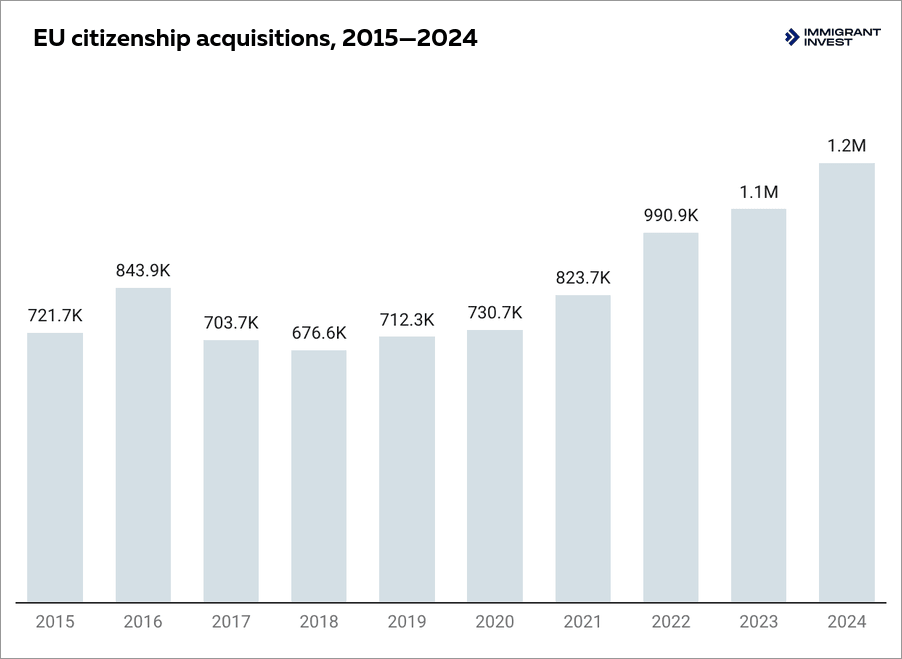
EU citizenship acquisitions increased by approximately 63% over the past decade, rising from 721,700 in 2015 to nearly 1.18 million in 2024
How to obtain a Golden Visa, establish tax residence, and acquire EU citizenship step by step
Obtaining a Golden Visa and eventually EU citizenship involves 10 key steps, from initial eligibility checks to naturalisation. Based on Immigrant Invest's experience, residence permit processing can take around 3 months in Latvia and over 12 months in Portugal. Citizenship requires several additional years, depending on the country's residence and naturalisation rules.
Applicants must also consider physical residence requirements and tax obligations, as holding a Golden Visa alone is not sufficient for naturalisation.
Pass preliminary Due Diligence
Immigrant Invest evaluates the applicant's eligibility before major expenses arise. Compliance specialists examine their background, financial history, and source of capital to identify potential risks. It helps select a suitable programme and develop a personalised application strategy.
Immigrant Invest evaluates the applicant's eligibility before major expenses arise. Compliance specialists examine their background, financial history, and source of capital to identify potential risks. It helps select a suitable programme and develop a personalised application strategy.
Choose the country and investment option
The choice depends on the applicant's budget, long-term objectives, and citizenship plans. Available options may include property purchases, investment funds, government bonds, or business contributions. Immigrant Invest compares programmes, evaluates naturalisation requirements, and helps select assets.
The choice depends on the applicant's budget, long-term objectives, and citizenship plans. Available options may include property purchases, investment funds, government bonds, or business contributions. Immigrant Invest compares programmes, evaluates naturalisation requirements, and helps select assets.
Collect documents
Lawyers prepare a tailored checklist and organise the necessary paperwork. Typical documents include a passport, criminal record certificate, proof of income and source of capital, and health insurance. Translations, notarisation, and apostilles are arranged where necessary.
Lawyers prepare a tailored checklist and organise the necessary paperwork. Typical documents include a passport, criminal record certificate, proof of income and source of capital, and health insurance. Translations, notarisation, and apostilles are arranged where necessary.
Fulfil the investment condition
The applicant completes the transaction according to the programme's payment schedule. Some countries require the full amount before submission, while others permit staged payments or investment after preliminary approval.
The applicant completes the transaction according to the programme's payment schedule. Some countries require the full amount before submission, while others permit staged payments or investment after preliminary approval.
Apply for a Golden Visa
The completed application is submitted to the relevant immigration authority. Depending on the country, lawyers may handle the process under a power of attorney. Personal attendance may still be required for identity verification or biometrics.
The completed application is submitted to the relevant immigration authority. Depending on the country, lawyers may handle the process under a power of attorney. Personal attendance may still be required for identity verification or biometrics.
Pass government Due Diligence
Authorities examine the applicant's financial background, origin of capital, and compliance with immigration rules. Checks may cover criminal records, previous visa refusals, sanctions, and other potential risks. Additional supporting documents may be requested before a decision is made.
Authorities examine the applicant's financial background, origin of capital, and compliance with immigration rules. Checks may cover criminal records, previous visa refusals, sanctions, and other potential risks. Additional supporting documents may be requested before a decision is made.
Receive a residence permit card
After approval and completion of the programme requirements, the applicant provides biometric data where necessary. The residence card is then issued, with collection procedures depending on the country.
After approval and completion of the programme requirements, the applicant provides biometric data where necessary. The residence card is then issued, with collection procedures depending on the country.
Maintain and renew residence status
Residence permits are valid for 2—5 years, while some programmes grant permanent residence immediately. Renewal requires retaining the investment and meeting ongoing programme conditions.
Applicants planning to naturalise must also satisfy the country's requirements for continuous legal residence, which involves substantial physical presence rather than occasional visits.
Residence permits are valid for 2—5 years, while some programmes grant permanent residence immediately. Renewal requires retaining the investment and meeting ongoing programme conditions.
Applicants planning to naturalise must also satisfy the country's requirements for continuous legal residence, which involves substantial physical presence rather than occasional visits.
Establish and manage tax residence
Investors pursuing citizenship through naturalisation will need to establish genuine residence in the country, often triggering tax residence. This may arise through physical presence, maintaining a permanent home, or developing substantial personal and economic ties.
Before relocating, applicants should review the rules for ending their previous tax residence, assess available tax incentives, and prepare the documentation needed to demonstrate their tax status.
Investors pursuing citizenship through naturalisation will need to establish genuine residence in the country, often triggering tax residence. This may arise through physical presence, maintaining a permanent home, or developing substantial personal and economic ties.
Before relocating, applicants should review the rules for ending their previous tax residence, assess available tax incentives, and prepare the documentation needed to demonstrate their tax status.
Apply for citizenship through naturalisation
After completing the required period of residence, investors can apply for citizenship. Once approved, the applicant completes any required oath or formalities and can obtain citizenship documents and apply for an EU passport.
After completing the required period of residence, investors can apply for citizenship. Once approved, the applicant completes any required oath or formalities and can obtain citizenship documents and apply for an EU passport.
Risks and pitfalls in EU tax and residence planning
The biggest risks in EU residence, tax, and citizenship planning often come from overlooking important legal requirements. Misunderstanding tax obligations, missing application deadlines, or failing to meet physical residence conditions can lead to unexpected costs, rejected applications, or delays in obtaining citizenship.
Confusing residence, tax residence, and citizenship
A residence permit does not automatically make its holder a tax resident or guarantee future citizenship. Each status has separate requirements.
For example, Greece Golden Visa holders can maintain their permits without living in the country, but obtaining citizenship requires genuine residence. Spending substantial time in Greece can also trigger tax residence, bringing worldwide income within the Greek tax system.
Before choosing a programme, investors should check three things: how to maintain residence, what is required for naturalisation, and when local tax obligations begin.
Failing to end previous tax residence
Establishing tax residence in a new country does not automatically end it in the previous one. An individual may continue meeting domestic residence criteria through a permanent home, family connections, or business interests.
This can result in dual tax residence, additional reporting obligations, and potential double taxation. Before moving, investors should check the exit requirements of their current country, document their relocation, and determine whether any departure or exit taxes apply.
Vladlena Baranova,
Head of Legal & AML Compliance Department, CAMS, IMCM
EU countries have double taxation treaties with other jurisdictions. These agreements help determine which country has the right to tax particular types of income and provide mechanisms to prevent the same income from being taxed twice.
Depending on the treaty, individuals may qualify for tax exemptions or credits for taxes already paid abroad. This makes reviewing the relevant treaty an essential part of planning an international relocation.
Automatic exchange of financial information
Living outside the EU or holding accounts abroad does not necessarily keep financial information beyond the reach of European tax authorities. Countries exchange tax-related information through international reporting systems, helping authorities verify cross-border income and financial assets.
Two frameworks are particularly important:
- Common Reporting Standard, CRS. Developed by the OECD, it requires participating financial institutions to identify account holders' tax residence and report information such as account balances, interest, and dividends. Tax authorities then exchange relevant information annually with participating countries[20]Source: OECD — Common Reporting Standard.
- Directive on Administrative Cooperation, DAC. This EU framework allows tax authorities in different member states to automatically share information about taxpayers' income and financial accounts. Its latest extension, DAC8, also covers cryptocurrency transactions, making it easier for authorities to track taxable crypto activity across borders[21]Source: European Commission — DAC8.
Financial reporting is based on tax residence, not citizenship. Holding an EU passport or residence permit does not determine which country receives the information. Individuals must accurately declare their tax residence to financial institutions, including multiple countries where applicable.
To avoid reporting discrepancies and potential tax penalties, individuals should keep their tax residence declarations consistent with their actual circumstances, report foreign income and assets where required, and update their bank details when their tax residence changes.
Overlooking tax risks of remote work
A Digital Nomad Visa gives permission to live and work remotely in a particular country, but it does not automatically provide tax exemptions.
Remote workers may become tax residents where they physically live, even when their salary comes from a foreign employer. Their activities could also create a permanent establishment for the employer, potentially triggering corporate tax, and reporting obligations in the host country.
Investors who own businesses or work internationally should therefore assess both personal and corporate tax exposure before relocating.
Missing deadlines for preferential tax regimes
Special tax benefits are not always granted automatically when an individual becomes a resident. Many require a separate application within a specific timeframe.
For example, Greece's non-dom regime requires an application by March 31st of the relevant tax year. In Italy, individuals who become tax residents in 2026 must elect the flat tax regime by the deadline for filing their 2026 income tax return, generally October 31st, 2027.
Missing an application deadline can mean losing preferential treatment for the intended tax year. Investors should assess eligibility and prepare the necessary paperwork before relocating rather than after establishing tax residence.
Weak documentation and compliance issues
Immigration authorities, banks, and tax administrations may request detailed evidence of an applicant's financial background, income sources, and residence history.
Incomplete source-of-capital documents can delay an investment application or lead to rejection. Similarly, missing travel records or conflicting residence declarations can complicate tax assessments. Accurate tax declarations and supporting documentation are therefore essential.
How Immigrant Invest helps you plan EU citizenship and tax residence together
Obtaining EU residence is only part of the plan. Investors also need to consider how their chosen programme affects future citizenship eligibility, physical residence requirements, and tax obligations. Immigrant Invest helps align these decisions from the outset, so clients can pursue their long-term goals without overlooking important legal or financial implications.
We have worked in investment migration since 2006, serving more than 10,000 clients worldwide through 11 offices. We combine immigration expertise, an in-house Compliance Department, and local professional networks to support clients throughout the process.
Our services include:
- Personalised programme selection. Comparing residence and citizenship routes based on the client's goals, budget, travel plans, and future naturalisation requirements.
- Preliminary Due Diligence. Reviewing the applicant's background and source of capital to identify potential risks before submitting an application.
- Investment and document support. Assisting with investments, preparing documents, coordinating translations, and filing applications with the relevant authorities.
- Tax planning coordination. Helping clients understand potential tax-residence implications and connecting them with tax professionals to assess obligations, double taxation treaties, and preferential regimes.
- Ongoing assistance. Supporting residence permit renewals, compliance requirements, and subsequent citizenship applications where eligible.
Immigrant Invest is not a tax advisory firm and does not replace independent, regulated tax advice. Our role is to coordinate immigration planning with qualified tax specialists, helping clients address tax questions before relocation and align the relevant procedures and deadlines.
Key takeaways: what actually changes when you become an EU citizen
- EU citizenship does not automatically create tax obligations. Citizenship and tax residence are determined under separate legal rules.
- Personal income tax rates vary significantly across EU countries. Some countries apply flat rates, with the lowest at 10% in Bulgaria, while others use progressive tax rates that reach around 60% in Denmark.
- Special tax regimes in Italy, Greece, Spain, Cyprus, and Malta can reduce tax liabilities through fixed annual payments, preferential rates, or exemptions.
- CRS and DAC enable automatic exchange of financial information between participating tax authorities, regardless of citizenship.
- EU citizenship can be obtained through naturalisation after residence based on employment, education, family reunification, digital nomad or financially independent visas, or investment programmes.
- EU citizens can maintain tax residence outside the EU if they meet the relevant national rules, establish genuine personal and economic ties abroad, and keep supporting documentation.
Immigrant Invest is a licensed agent for citizenship and residence by investment programs in the EU, the Caribbean, Asia, and the Middle East. Take advantage of our global 15-year expertise — schedule a meeting with our investment programs experts.