









Industry expert since 2006
With in-depth expertise, we handle every detail, from Due Diligence to investment, and resolve issues quickly
Immigrant Invest offers a range of tax consultancy services across different countries. From helping you obtain your tax ID to providing tax representation — we can handle it all
Our tax assistance is a comprehensive professional support that helps individuals and businesses understand and manage their tax obligations. It includes tax planning and optimisation, along with expert guidance across multiple jurisdictions, which is particularly relevant for international investors.
Our goal is to help you ensure compliance with local tax regulation, as well as reduce risks, avoid unnecessary costs, and provide clarity in complex tax situations.
1
Get tax advice tailored to your situation. Experts analyse your tax residency, income, and assets, explain your obligations, and suggest ways to optimise your tax position.
Get tax advice tailored to your situation. Experts analyse your tax residency, income, and assets, explain your obligations, and suggest ways to optimise your tax position.
2
With our assistance you get a tax number without dealing with tax authorities. We prepare documents and submit the application to ensure fast and correct registration.
With our assistance you get a tax number without dealing with tax authorities. We prepare documents and submit the application to ensure fast and correct registration.
3
Receive your official tax certificate quickly and without delays, with us preparing all required documents and coordinating with the authorities on your behalf.
Receive your official tax certificate quickly and without delays, with us preparing all required documents and coordinating with the authorities on your behalf.
4
You can get tax representation for 6 months or a year. We connect you with a local representative to efficiently handle your tax matters.
You can get tax representation for 6 months or a year. We connect you with a local representative to efficiently handle your tax matters.
5
We ensure a smooth process by preparing documents and handling communication with the tax authority.
We ensure a smooth process by preparing documents and handling communication with the tax authority.
6
Start your business operations legally and efficiently. We register your activity with tax authorities so you can issue invoices and comply with tax requirements.
Start your business operations legally and efficiently. We register your activity with tax authorities so you can issue invoices and comply with tax requirements.
7
Get a registered tax address for your company. We ensure proper registration, handle correspondence, and help maintain compliance with local requirements.
Get a registered tax address for your company. We ensure proper registration, handle correspondence, and help maintain compliance with local requirements.
8
If your company’s address changes, we assist with notifying tax authorities about it so all the records are accurate.
If your company’s address changes, we assist with notifying tax authorities about it so all the records are accurate.
9
Stay compliant with tax and regulatory requirements under the Malta Global Residence Programme. We help prepare and file annual forms so you maintain good standing.
Stay compliant with tax and regulatory requirements under the Malta Global Residence Programme. We help prepare and file annual forms so you maintain good standing.
After sending your request, our migration expert will contact you to confirm the details and outline the next steps.

Zlata Erlach, Head of the Austrian office
Tax obligations depend on several factors, including where you are considered a tax resident, where your income is generated, and what types of assets you own.
Your tax position is mainly shaped by three factors:
Income tax applies to salary, self-employment income, business profits, dividends, interest, pensions, and rental income. Some jurisdictions apply progressive rates, while others have flat-rate systems or special regimes for new residents and foreign income.
For internationally mobile individuals, income tax is often the first area that requires review, especially after relocation or a change in tax residency.
Capital gains tax may apply when a person sells an asset at a profit. This can include real estate, securities, or business shares. The applicable tax rate, exemptions, and holding period rules vary between countries. In some jurisdictions, gains on certain assets may be exempt. In others, they may be taxed at full rates.
Property-related taxes arise when purchasing, owning, renting out, or selling real estate. Depending on the country, this may include annual ownership tax, municipal charges, transfer tax, stamp duty, or tax on rental income.
For foreign property investors, these obligations often come with local filing and payment requirements. Proper planning helps assess the true cost of holding property abroad.
Inheritance and wealth tax. Some countries impose taxes on inherited assets, gifted wealth, or the total net value of a person’s assets. Even where no inheritance or wealth tax applies in the country of residence, tax exposure may still arise in the country where assets are located.
Cross-border tax matters can involve a number of risks if not assessed properly in advance. The most common ones include the following:

Albert Ioffe,
Legal and Compliance Officer, certified CAMS specialist
Tax rules differ significantly from one country to another. A structure that is efficient in one jurisdiction may be ineffective or non-compliant in another. This is why tax advice should always be based on the client’s specific country of residence, income sources, assets, and long-term plans.
Tax assistance is essential for individuals and businesses dealing with cross-border income, assets, or relocation. It helps ensure compliance, avoid unexpected tax liabilities, and structure finances in a more efficient way.
1. Investors applying for residence or citizenship by investment. Residency and citizenship programmes may affect tax residency status and trigger obligations in more than one country. Proper planning helps assess tax exposure before investing and optimise the structure of assets and income.
2. Individuals relocating to another country. Changing country of residence can impact how worldwide income is taxed, what needs to be reported, and whether double taxation may arise. Early tax assessment helps avoid mistakes after the move.
3. Business owners operating across multiple jurisdictions. Cross-border operations often involve complex tax rules, including corporate taxation, profit distribution, and reporting obligations. Tax assistance helps structure business activities efficiently and remain compliant in each jurisdiction.
4. Property investors abroad. Owning real estate in another country may lead to rental income tax, capital gains tax upon sale, and local property taxes. Tax planning helps manage these obligations and avoid overpayment.
5. Digital entrepreneurs and remote workers. Working from different countries or earning income internationally can create uncertainty around tax residency and reporting requirements. Professional advice helps clarify obligations and reduce compliance risks.
In all these cases, property tax assistance supports better financial decision-making across jurisdictions.
1
You receive full support from initial assessment and tax planning to implementation and ongoing compliance, which eliminates the need to engage multiple advisors.
You receive full support from initial assessment and tax planning to implementation and ongoing compliance, which eliminates the need to engage multiple advisors.
2
Each solution is tailored to your income structure, assets, and relocation plans, so you optimise your tax position efficiently and avoid unnecessary costs.
Each solution is tailored to your income structure, assets, and relocation plans, so you optimise your tax position efficiently and avoid unnecessary costs.
3
Immigrant Invest collaborates with tax advisors across multiple jurisdictions. This ensures accurate guidance and allows you to navigate local rules with confidence.
Immigrant Invest collaborates with tax advisors across multiple jurisdictions. This ensures accurate guidance and allows you to navigate local rules with confidence.
4
Professional support minimises errors in tax residency assessment, filings, and deadlines. You avoid possible penalties, disputes, and unexpected tax liabilities.
Professional support minimises errors in tax residency assessment, filings, and deadlines. You avoid possible penalties, disputes, and unexpected tax liabilities.
5
Tax matters involve complex paperwork and communication with authorities. Delegating them saves time, simplifies the process, and lets you focus on your priorities.
Tax matters involve complex paperwork and communication with authorities. Delegating them saves time, simplifies the process, and lets you focus on your priorities.
The final list of documents is determined on an individual basis and may vary depending on the jurisdiction and the specific tax services required. Immigrant Invest provides clients with a list tailored to each individual situation.
The core documents usually include the following:
One of the most requested services is obtaining a tax ID number. It consists of several standard steps and takes from several days up to 2—3 weeks. Here's how it works.
1 day
Initial consultation

Immigrant Invest’s lawyer assesses your situation, including your residency plans, source of income, and purpose of obtaining a TIN. This step helps identify requirements and the most efficient application route.
≈ 1 week
Document preparation
Lawyers provide you with the list of required documents for collection. If required, they help to translate and certify them.
1 day
Submission of the application
The application is submitted to the relevant tax authority. Depending on the country, this can be done online, in person, or through an authorised representative.
Immigrant Invest assists with submission to ensure accuracy and compliance with local requirements.
1+ days
Issuance of a tax identification number
The tax authority reviews the application, verifies the information provided, and may request additional details if needed.
Once approved, the tax ID number is issued either electronically or as an official certificate. This number is required for tax reporting, financial transactions, and compliance with local regulations.
Immigrant Invest provides expert support in international tax and compliance, backed by years of experience in investment migration.
Solutions are aligned with current regulations and tailored to each client, helping reduce risks and simplify cross-border processes. Clients benefit from a structured, discreet, and reliable approach at every stage.
The Investment Migration Council certificate confirms that Immigrant Invest is officially recognised as a qualified and ethical participant in the investment migration industry.
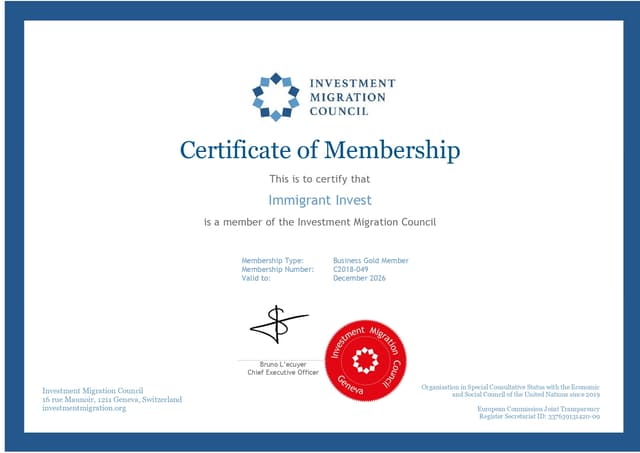
Certificate of Membership
Industry expert since 2006
With in-depth expertise, we handle every detail, from Due Diligence to investment, and resolve issues quickly
99% success rate
Our in-house compliance team conducts thorough checks upfront to ensure eligibility and protect you from rejection risks
24/7 support
You can reach a dedicated specialist online at any time. We are here to help whenever questions or urgent issues arise
Privacy guarantee
We sign an NDA that covers both personal data and the source of funds. All your information remains strictly confidential
Our team includes experienced lawyers well versed in the legislation and regulations of different countries, as well as Certified Anti-Money Laundering Specialists.
Schedule a meeting
Schedule a meeting at one of the offices or online. A lawyer will analyze the situation, calculate the cost and help you find a solution based on your goals.
Prefer messengers?