






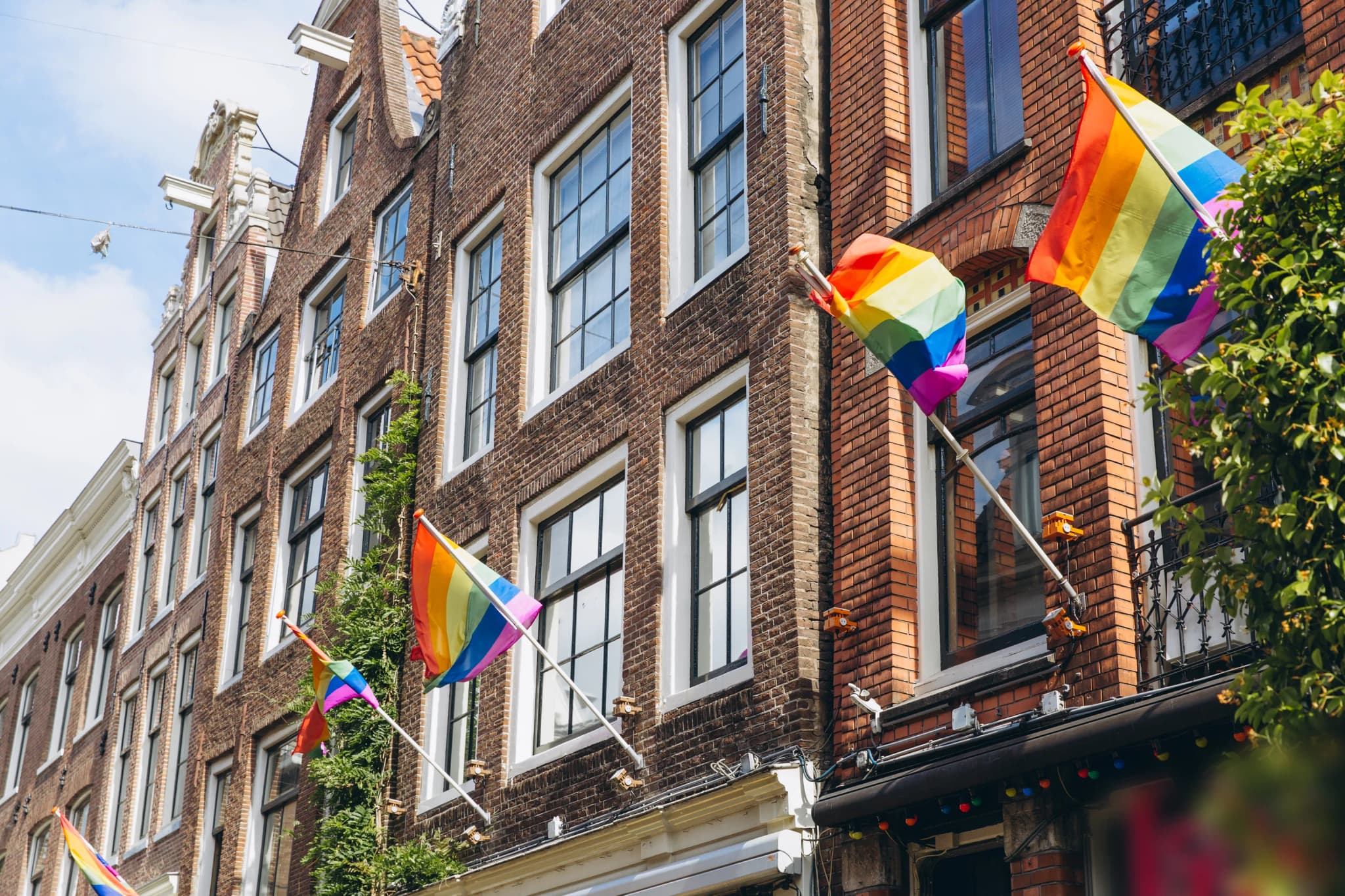

Choosing where to move as an LGBTQ+ expat is about more than visas, taxes, and the cost of living. Marriage and parental rights, social attitudes, healthcare access, and the ability to include a partner or children on a residence permit can all shape everyday life.
We compared 20 LGBTQ+-friendly countries across legal protections, family rights, social climate, healthcare, and relocation options.
LGBTQ-friendly countries for expats
For LGBT expats, choosing a country is not only about finding the most progressive laws or the most open social climate. The destination also has to be realistic for relocation. A country may offer strong legal protections but have limited visa options or no practical path for long-term residence as a foreigner.
To build the list, we combined data from the ILGA-Europe Rainbow Map[1]Source: ILGA-Europe — Rainbow Map 2026, Equaldex[2]Source: Equaldex LGBT Rights by Country & Travel Guide, and other equality indexes with Immigrant Invest’s expertise in residence and immigration routes.
The result is a practical comparison that looks not only at LGBTQ+ rights, but also at how realistic each country is for someone planning an actual move.
Top-20 countries for LGBTQ+ expats

LGBTQ-friendly countries on the world map
The map below shows where the 20 countries in this ranking are located and how widely LGBTQ+-friendly destinations are spread around the world.
Europe accounts for most of the list, but there are also strong options in the Americas, Oceania, and East Asia. For expats, that means the choice is not limited to one region or lifestyle.
1. Portugal
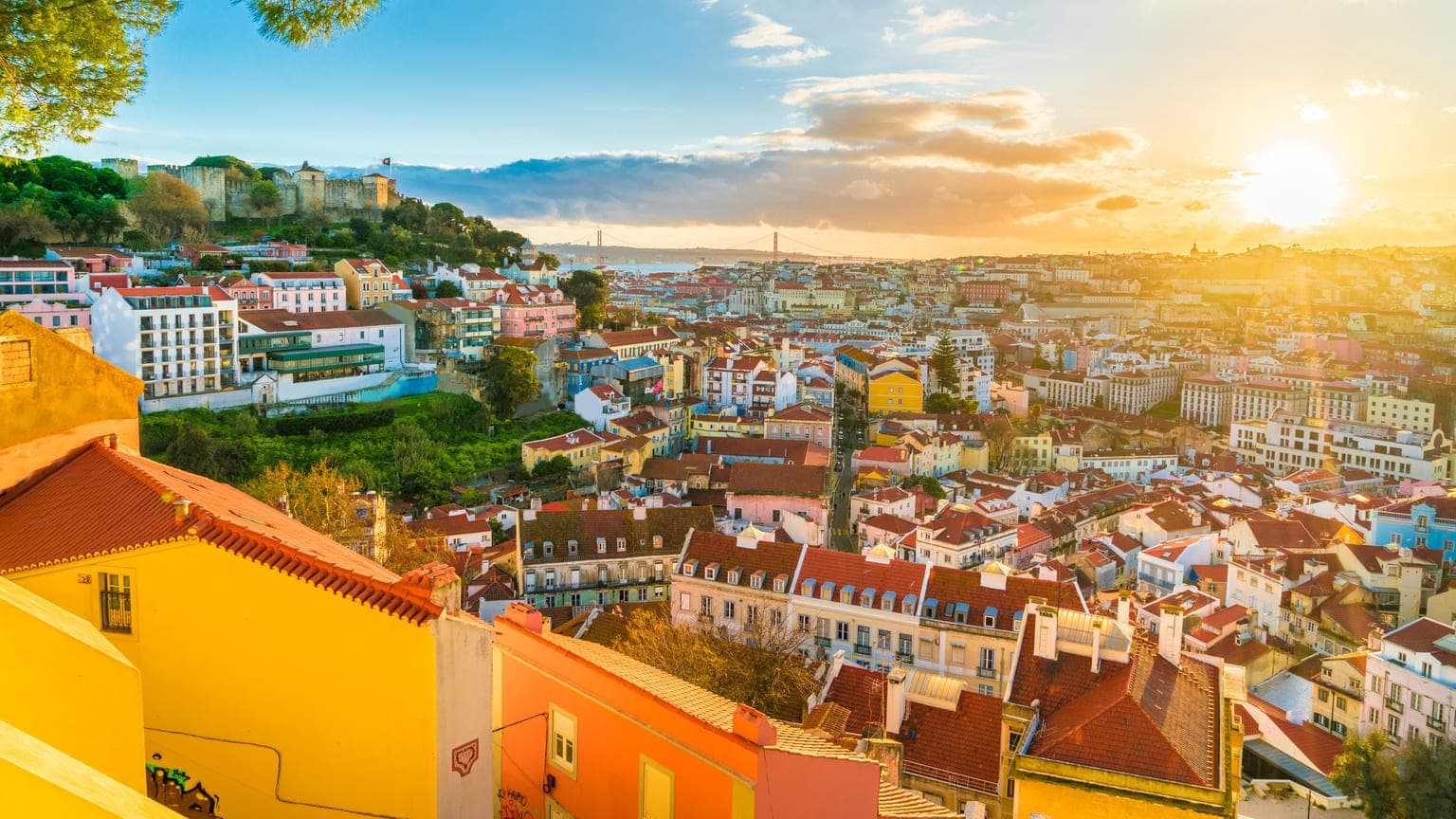
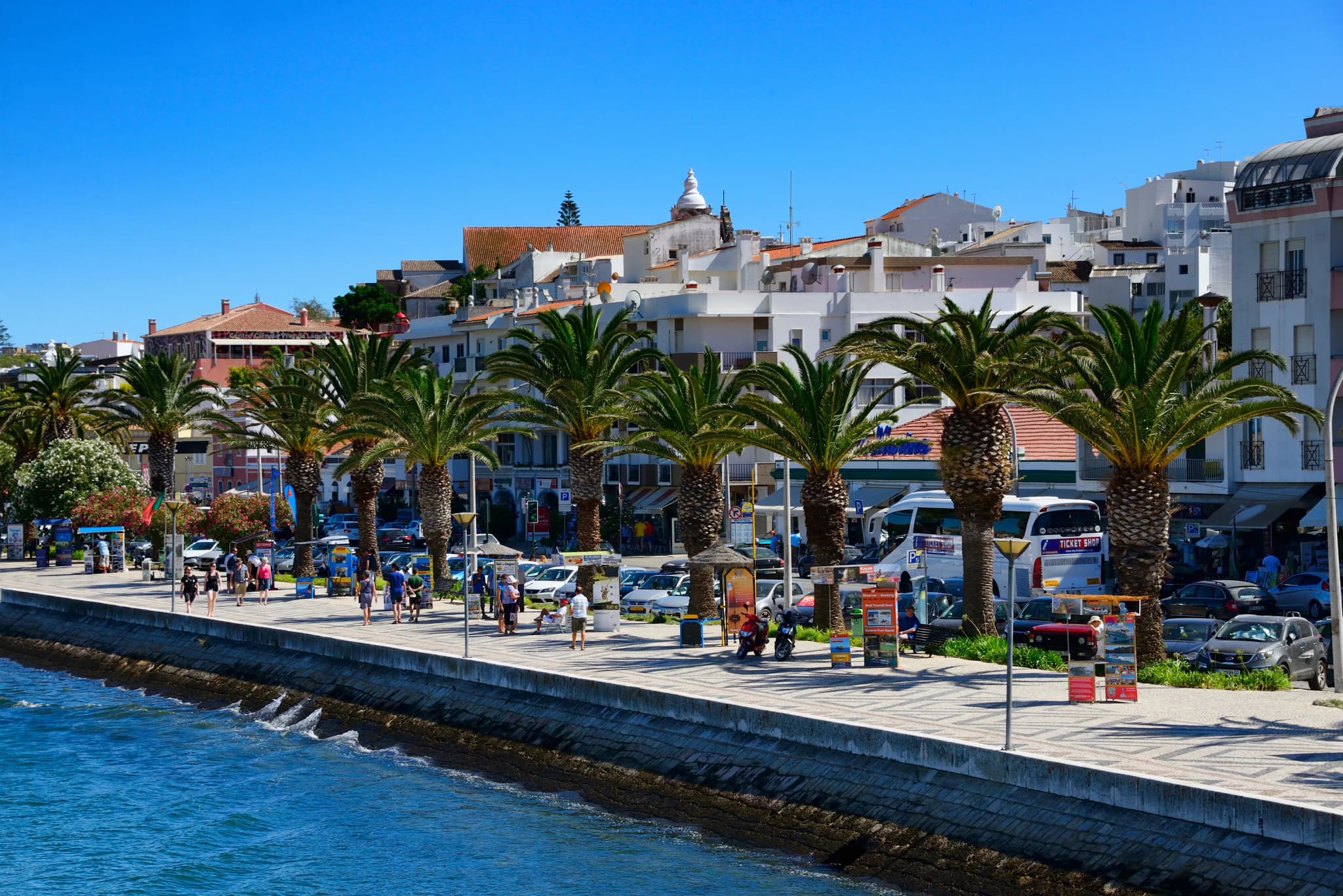
Portugal is one of the most practical choices for LGBT expats in Europe. It combines strong legal protections, a visible LGBT community, mild climate, and several residence options for investors, passive income earners, and remote workers.
LGBTQ+ rights and protections in Portugal
Portugal is one of the strongest options in Europe for LGBT expats who want both legal protection and a realistic path to residence. Same-sex marriage has been legal since 2010, and joint adoption became possible in 2016, when Portugal removed discrimination in access to adoption and other family rights[3]Source: Diário da República — Law No. 9/2010 on civil marriage].
Portugal has clear rules on gender recognition: the law establishes the right to self-determination of gender identity and gender expression[4]Source: Diário da República — Law No. 38/2018 on the right to gender identity and expression. The state also ensures that women in same-sex couples have full access to medically assisted reproduction. The law expanding these procedures to all women regardless of their marital status, sexual orientation, or infertility diagnosis, came into force in 2016[5]Source: Diário da República — Law No. 17/2016 on access to medically assisted reproduction.
In daily life, Portugal is generally open and comfortable for LGBT people, especially in Lisbon, Porto, and parts of the Algarve. Public attitudes are also positive by EU standards: in the 2023 Eurobarometer survey, 81% of respondents in Portugal agreed that same-sex marriage should be allowed throughout Europe.
At the same time, legal equality does not remove every practical issue. ILGA-Europe still recommends improvements for Portugal, including stronger protection for intersex people and further work on legal gender recognition procedures. For expats, Portugal is best understood as a highly favourable country with strong laws, visible LGBT communities, and a safe social climate.
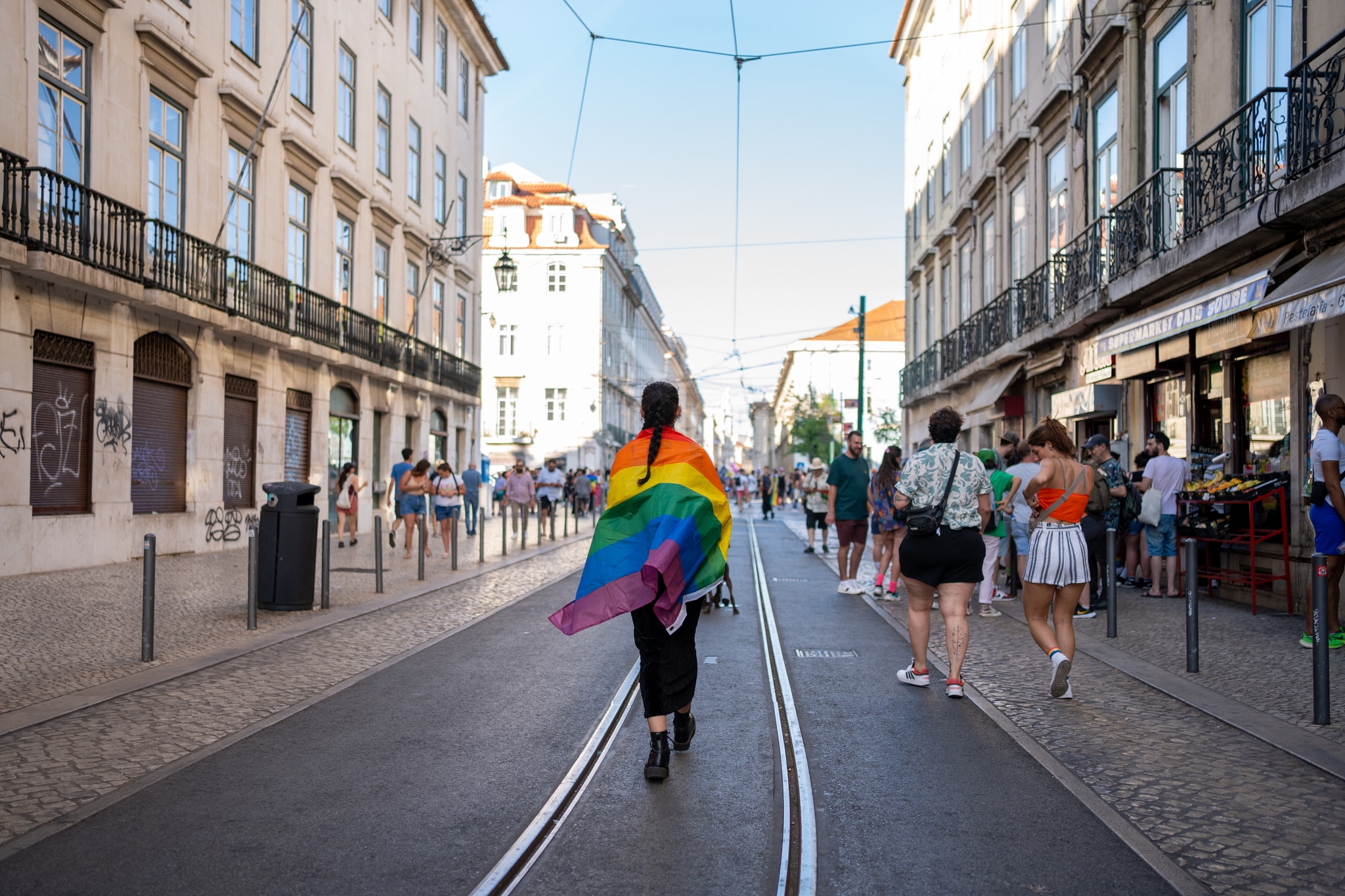
Lisbon hosted EuroPride in 2025, the first time the event took place in a Portuguese-speaking country, which reflects the visibility of the local LGBT community
Life in Portugal
Portugal is popular with expats because it offers a softer pace of life, access to the Atlantic coast, relatively mild weather, and large international communities.
Lisbon is the main business and cultural centre, Porto is slightly calmer and often more affordable, while the Algarve attracts retirees, remote workers, and families who want warmer weather and coastal living.
The climate is one of Portugal’s strongest lifestyle advantages. The Portuguese Institute for Sea and Atmosphere describes much of the country through Mediterranean climate patterns, with dry summers and mild winters, though conditions vary between the mainland, Madeira, and the Azores. In practical terms, the north is greener and wetter, Lisbon and the central coast are milder, and the Algarve is warmer and sunnier for much of the year.
The cost of living is still lower than in many Western European capitals, but Portugal is no longer a cheap destination in the most popular areas. Housing is the main pressure point, especially in Lisbon, Cascais, Porto, and the Algarve. OECD data shows that Portugal performs well in safety and environmental quality, but less strongly on income and some other well-being indicators.
For expats with foreign income, Portugal can still offer good value; for those relying on local salaries, the gap between wages and housing costs is more noticeable.
Portugal for LGBTQ+ expats at a glance
- Same-sex marriage: legal since 2010
- Joint adoption: legal since 2016
- Gender self-identification: Yes, no medical requirement for adults
- ILGA-Europe 2026 score: 67%
- Equaldex score: 77
- Residence options: Golden Visa; Passive income, Digital Nomad, and Global Talent visa
Residence options for expats
Golden Visa for investors. The Residence Permit for Investment Activity, or ARI, allows international non-EU nationals to obtain a residence permit in Portugal by making a significant contribution to the country’s economy and development.
Investment options include:
- purchase of investment fund units — €500,000+;
- a non-refundable contribution to support arts and culture — €250,000+;
- support of research activities — €500,000+;
- business investment — €500,000+;
- starting a company that creates at least 10 jobs.
Golden Visa holders can also apply for family reunification and provide close family members with residence permits as well. This applies to same-sex couples and families, too[6]Source: AIMA — Residence Permit for Investment Activity.

D7 visa for passive income earners. The D7 visa suits retirees and people living on regular income generated outside Portugal.
In 2026, the financial requirement for a single applicant is a monthly passive income of at least €920. Some types of income that qualify for this visa include pensions, rent, dividends, and royalties.
After entering Portugal on a D7 Visa, applicants can obtain a 2-year residence permit, renewable for successive 3-year periods. After five years of temporary residence, D7 visa holders may qualify for permanent residence if they meet the applicable requirements, including basic Portuguese proficiency.
D8 visa for digital nomads. Remote employees and freelancers can use the D8 visa, which requires an average monthly income of at least €3,680.
Remote workers who obtain residence through the D8 route receive a 2-year permit, which can then be renewed in 3-year periods while they continue to meet the conditions.
Global Talent visa for experienced professionals. The Portugal Global Talent Programme is designed for professionals, entrepreneurs, and specialists who can contribute to academic and innovation projects at Portuguese universities through research, mentoring, or teaching.
Applicants need a university degree, 3—5 years of professional experience, savings of at least €15,000, accommodation in Portugal, and health insurance with coverage of at least €35,000. The programme fee starts at €170,000 and covers a single applicant or a family of up to four, with additional expenses for residence permits, insurance, and documentation.
The residence permit is typically obtained within 4+ months and is initially valid for 2 years, renewable for another 3 years.
2. Malta
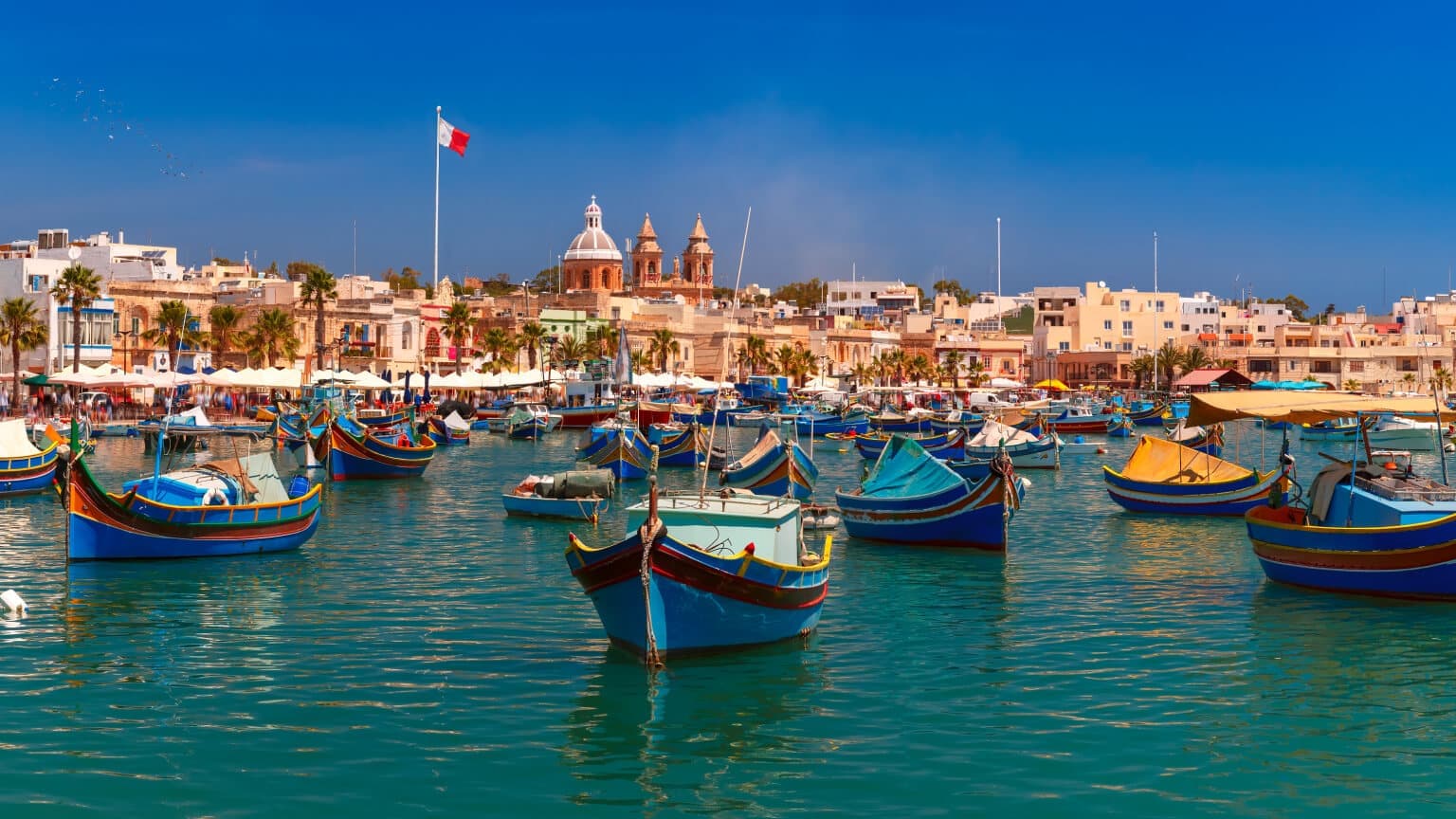
Malta combines some of Europe’s strongest LGBTQ+ protections with several residence routes for investors, remote workers, and other expats. In the 2026 ILGA-Europe Rainbow Map, Malta ranks second among 49 European countries with a score of 88%, after holding first place for the previous decade.
LGBTQ+ rights and protections in Malta
Same-sex couples have extensive family rights in Malta. Civil unions became legal in 2014, followed by marriage equality in 2017. Same-sex married couples and civil partners have the same access to adoption as different-sex couples, including joint and second-parent adoption. Maltese law also provides for automatic co-parent recognition[7]Source: Human Rights Directorate — Family Life.
Malta also has strong protections for transgender and intersex people. Adults can obtain legal recognition of their gender identity without proving that they have undergone surgery, hormone therapy, or psychiatric treatment. The law protects gender identity, gender expression, and sex characteristics, while conversion practices are prohibited[8]Source: Human Rights Directorate — Legal Gender Recognition and Bodily Integrity.
For an LGBTQ+ expat, the distinction between strong laws and everyday experience matters. Recent data suggests that Maltese residents are generally accepting of the Queer community. In a national survey conducted in 2025, 81% of residents aged 18 to 34 and 87% of those aged 35 to 64 said they were completely comfortable having an LGBTQ+ neighbour[9]Source: Malta National Statistics Office — Public perception and experiences of gender roles, tolerance, and discrimination: 2025.
LGBTQ+ people themselves also report comparatively high levels of openness. In the EU Fundamental Rights Agency survey, 62% of respondents in Malta said they were fairly or very open about being LGBTQ+, compared with 51% across the EU[10]Source: European Union Agency for Fundamental Rights — LGBTIQ Survey, Malta.
Life in Malta
Expats choose Malta for its laid-back lifestyle, easy integration and Mediterranean climate. English is widely used in everyday life, so newcomers can handle tasks such as renting a home, visiting a doctor, dealing with banks and communicating with public authorities without first learning Maltese. The compact size of the islands also makes it relatively easy to settle in and build a social circle.
Some of the popular locations for expats to settle include Valletta, Sliema and St Julians. Valletta offers historic city living, while Sliema and St Julian’s provide a denser mix of apartments, restaurants and services. The island of Gozo suits people looking for a quieter pace away from Malta’s busiest urban areas[11]Source: Government of Malta — The Maltese Islands.
Housing can be one of the largest expenses. According to Numbeo, a one-bedroom flat costs around €1,037 per month in a city centre and €859 outside the centre[12]Source: Numbeo — Cost of Living in Malta.

Alevtina Kalmuk,
Editor-in-chief and content creator for the Immigrant Invest blog
Malta ranks so highly because it is genuinely easy for foreigners to settle there. Nearly one in three residents is a foreign national, so international communities are already part of everyday life.
Malta also offers several residence routes — from permanent residence for investors to programmes for remote workers, entrepreneurs, and other expats — which makes relocation much more practical than in many other LGBTQ-friendly countries[13]Source: National Statistics Office Malta — World Population Day 2026.
Residence options for expats
Malta Permanent Residence Programme. This programme allows non-EU expats obtain permanent status in Malta by investment. Participating requires fulfilling all mandatory investment conditions:
- €60,000 administration fee;
- €37,000 government contribution;
- €2,000 charitable donation;
- real estate investment: purchase of at least €375,000 or rent for at least €14,000 a year for 5 years.
Applicants must also demonstrate assets of at least €500,000, including €150,000 in financial assets, or €650,000, including €75,000 in financial assets[14]Source: Residency Malta Agency — Malta Permanent Residence Programme.
The programme explicitly accommodates LGBTQ+ families. Its regulations define the applicant’s spouse in gender-neutral terms and recognise marriage, civil unions, and other relationships with the same or similar status as marriage. A same-sex spouse or partner can obtain permanent residence as a principally dependent person under the same rules as an opposite-sex partner[15]Source: Malta Permanent Residence Programme Regulations, S.L. 217.26.
Global Residence Programme. Malta’s Global Residence Programme is designed for non-EU, non-EEA, and non-Swiss nationals who want to establish residence and benefit from a special tax regime. Foreign-source income remitted to Malta is generally taxed at 15%, subject to a minimum annual tax of €15,000.
Applicants must also maintain residential property in Malta that meets the programme’s requirements:
- rented real estate — €8,750+ for properties in the south of Malta and the island of Gozo and €9,600 for the rest of the country;
- owned real estate — €220,000 for properties in the south of Malta and the island of Gozo and €275,000 for the rest of the country.
Participants also pay an administrative fee of €6,000. This fee is reduced to €5,500 if the applicant buys a property in the south of Malta or the island of Gozo.
Nomad Residence Permit. Remote employees, business owners, and freelancers working for foreign companies or clients can apply if they earn at least €42,000 gross per year. The permit is initially valid for one year and can be renewed three times, allowing a maximum stay of four years.
Residence permit for digital nomads does not lead to permanent residence or citizenship[16]Source: Residency Malta Agency — Nomad Residence Permit eligibility.
Malta for LGBTQ+ expats at a glance
- Same-sex marriage: legal since 2017
- Joint adoption: legal since 2014
- Gender self-identification: Yes, no medical requirement
- ILGA-Europe 2026 score: 88%
- Equaldex score: 80
- Residence options: Malta Permanent Residence Programme; Nomad Residence Permit; Global Residence Programme
3. Spain
Spain combines one of Europe’s strongest LGBTQ+ legal frameworks with widespread social acceptance and a large, visible queer community. In 2026, it moved into first place on ILGA-Europe’s Rainbow Map with a score of 89%, overtaking Malta. For expats, Spain also offers several residence routes for remote workers and financially independent people.
LGBTQ+ rights and protections in Spain
Spain legalised same-sex marriage in 2005, becoming one of the first countries in the world to do so. Marriage has the same legal effects regardless of the spouses’ sex, including equal rights in adoption and social benefits[17]Source: Boletín Oficial del Estado — Law 13/2005 on the right to marry.
The country has since expanded protections considerably. The 2022 Equal Treatment and Non-Discrimination Law prohibits discrimination on grounds including sexual orientation, gender identity, and gender expression across employment, healthcare, education, housing, access to goods and services, and other areas of public life[18]Source: Boletín Oficial del Estado — Law 15/2022 on equal treatment and non-discrimination.
Spain’s 2023 LGBTI and trans rights law strengthened these protections further. It prohibits conversion practices and allows people to change their legally registered sex without having to prove that they have undergone medical treatment. The legislation also strengthened recognition of diverse family structures[19]Source: Boletín Oficial del Estado — Law 4/2023 on trans and LGBTI rights.
Life in Spain
Spain offers considerably more choice of location than smaller LGBTQ-friendly countries. Expats who want a large-city lifestyle can consider Madrid and Barcelona, while Sitges, Gran Canaria, and Benidorm are among the destinations with established LGBTQ+ communities.
Spain’s official tourism portal describes Madrid’s Chueca neighbourhood as the city’s LGBTQ+ epicentre[20]Source: Spain.info — Chueca neighbourhood and highlights Madrid, Barcelona, Sitges, and Gran Canaria among the country’s particularly LGBTQ-friendly destinations[21]Source: Spain.info — Spain is a diverse country: keys for LGBTQI+ tourists.
This variety can make a practical difference when relocating. Someone who wants an extensive LGBTQ+ social scene, international employers and nightlife may prefer Madrid or Barcelona, while Sitges offers a smaller coastal community close to Barcelona. The Canary Islands are another option for expats prioritising year-round warm weather and a more resort-oriented lifestyle.
Living costs vary considerably by city. A one-bedroom flat in the city centre averages about €904 per month, compared with around €712 outside the centre. Barcelona and Madrid are among the country’s more expensive cities, while places such as Seville, Granada, and Alicante offer lower overall cost-of-living[22]Source: Numbeo — Cost of Living in Spain.
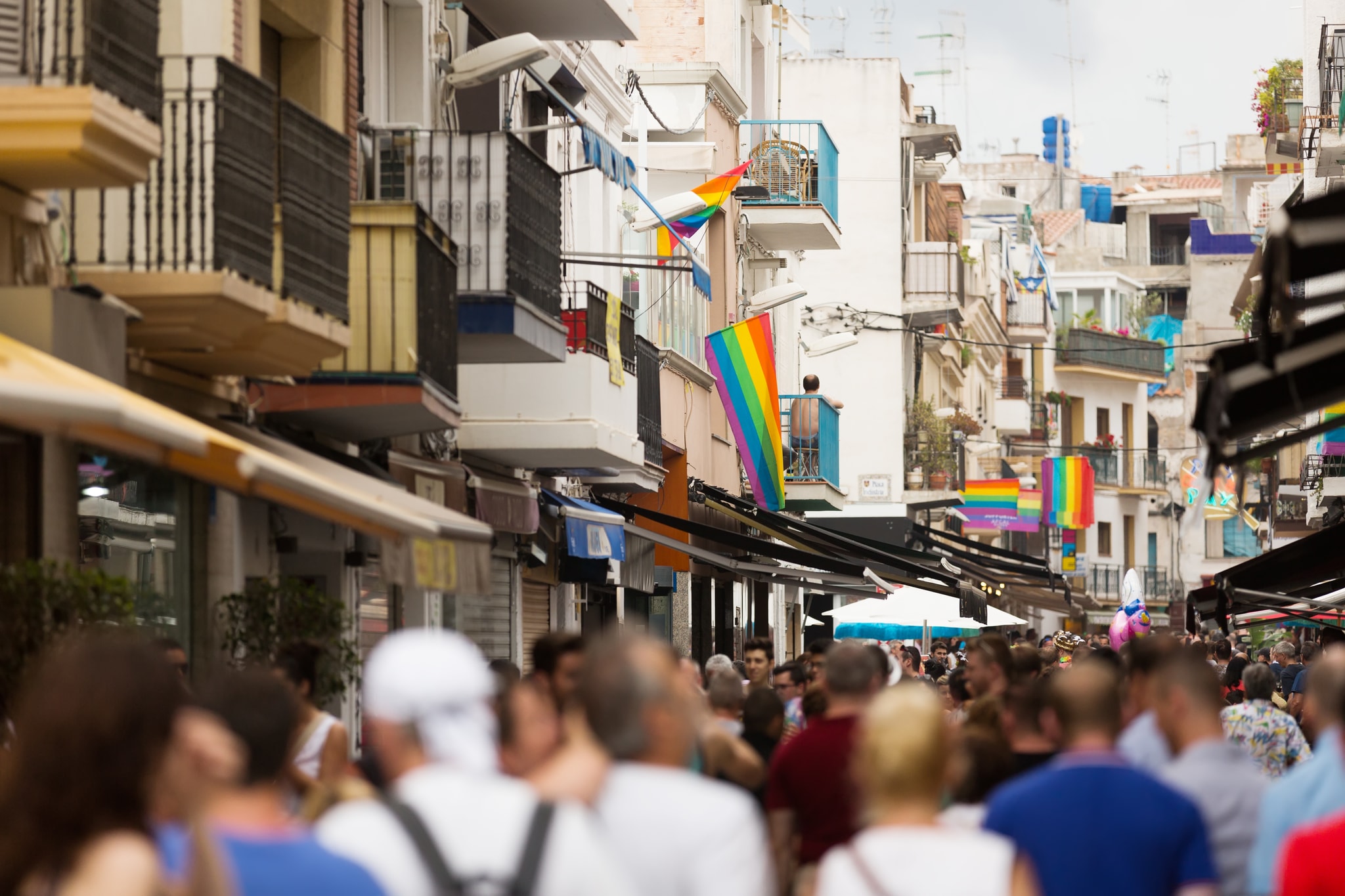
Barcelona hosted Spain’s first Pride demonstration**.** On 26 June 1977, around 4,000—5,000 people marched along La Rambla for LGBTQ+ rights. Today, Barcelona Pride draws more than 150,000 marchers and spectators
Residence options for expats
Digital Nomad Visa. Non-EU nationals who work remotely for companies or clients outside Spain can use the international teleworking route. Applicants are required to show an existing professional relationship with the foreign company or client and prove that the work can be carried out remotely.
In 2026, the minimum income requirement for a single applicant is €2,849 per month, equal to 200% of Spain’s minimum wage. A dependent spouse or partner adds €1,069 per month and each underage dependant €357 [23]Source: Ministry of Foreign Affairs — Telework (Digital Nomad) Visa.
The Digital Nomad Visa is particularly relevant to expats who want to continue working for an overseas employer or foreign clients rather than enter the Spanish labour market. Family members can accompany the main applicant, making it a practical route for same-sex couples and families as well as individual remote workers.
Non-Lucrative Visa. Financially independent non-EU nationals who do not intend to work in Spain can apply for non-lucrative residence. In 2026, the main applicant must demonstrate passive income of at least €28,800 per year. An additional €7,200 per year is required for each dependant[24]Source: Spanish Ministry of Foreign Affairs — Non-Lucrative Residence Visa.
The route can suit retirees and people living from savings, pensions, or other non-employment income. Unlike the Digital Nomad Visa, it does not authorise the applicant to use the permit as a basis for working in Spain.
Spain for LGBTQ+ expats at a glance
- Same-sex marriage: legal since 2005
- Joint adoption: legal since 2005
- Gender self-identification: Yes, no medical requirement for adults
- ILGA-Europe 2026 score: 89%
- Equaldex score: 83
- Residence options: Digital Nomad and Non-Lucrative visas
4. Netherlands
The Netherlands has played a pioneering role in LGBTQ+ rights: in 2001, it became the first country in the world to open marriage to same-sex couples. Today, it combines extensive family and anti-discrimination protections with high public acceptance, although its legal framework has some gaps compared with the countries at the top of ILGA-Europe’s ranking[25]Source: Government of the Netherlands — Equal rights for LGBTIQ+ people.
LGBTQ+ rights and protections in the Netherlands
Same-sex couples have been able to marry and adopt children since 2001[26]Source: Government of the Netherlands — Same-sex marriage. Dutch law also recognises same-sex parenthood: for example, the female partner of a birth mother can become the child’s legal parent automatically in some circumstances or acknowledge the child without going to court[27]Source: Government of the Netherlands — Legal parenthood of a co-mother.
Discrimination on the grounds of sexual orientation is prohibited under Dutch law and expressly covered by Article 1 of the Constitution[28]Source: Government of the Netherlands — Prohibition of discrimination. Since July 2025, a discriminatory motive can also increase the maximum penalty for a criminal offence by one third[29]Source: Government of the Netherlands — New Justice and Security laws as of 1 July 2025.
Legal gender recognition is available without surgery, but it is not based purely on self-identification: an applicant still needs a statement from a doctor, psychologist or psychotherapist. A proposed reform that would have removed this expert-statement requirement was withdrawn in 2025[25]Source: Government of the Netherlands — Equal rights for LGBTIQ+ people.
The Netherlands ranks 13th out of 49 European countries with a score of 64% on ILGA-Europe’s 2026 Rainbow Map. The score reflects strong protections in areas such as family rights and equality, but also remaining gaps in legal gender recognition, intersex bodily integrity, and policies addressing hate crime and hate speech.
Public attitudes are generally supportive. In the 2023 Eurobarometer, 94% of Dutch respondents supported same-sex marriage, one of the highest shares recorded in the EU[30]Source: European Commission — Special Eurobarometer 535: Discrimination in the European Union. At the same time, LGBTQ+ people still report discrimination and harassment: in the EU Fundamental Rights Agency’s latest survey, 31% of respondents in the Netherlands said they had experienced discrimination in at least one area of life during the previous year[31]Source: European Union Agency for Fundamental Rights — LGBTIQ Survey, the Netherlands.
Life in the Netherlands
The Netherlands is a highly international country: more than 3.1 million of its 18.1 million residents were born abroad[32]Source: Statistics Netherlands — Population by country of birth, 2026 .
For expats, settling in is made easier by exceptionally high English proficiency — the Netherlands ranks first out of 123 countries and regions[33]Source: EF English Proficiency Index — Netherlands. This means newcomers can usually manage everyday tasks, socialise and navigate services in English while they learn Dutch.
Amsterdam has the country’s largest and most internationally visible LGBTQ+ scene, while Rotterdam, Utrecht, and The Hague also have established queer communities and events. Amsterdam hosted WorldPride in 2026, 25 years after the Netherlands introduced marriage equality, bringing international attention back to the country’s role in LGBTQ+ rights[34]Source: Government of the Netherlands — Speech at the opening of the WorldPride Human Rights Conference.
The major drawback is cost, especially housing. A one-bedroom apartment averages around €1,460 per month in a city centre and €1,155 outside the centre[35]Source: Numbeo — Cost of Living in the Netherlands. Amsterdam is considerably more expensive: a centrally located one-bedroom apartment averages more than €2,300 per month[36]Source: Numbeo — Cost of Living in Amsterdam.
Residence options for expats
Start-up residence permit. Entrepreneurs who want to establish an innovative company can apply for a one-year start-up permit. They must work with an approved facilitator, play an active role in the business and show that the product, service or business model is innovative. After the first year, a founder can switch to a self-employed residence permit if they meet its requirements[37]Source: Immigration and Naturalisation Service — Start-up residence permit.
Self-employed residence permit. Entrepreneurs and freelancers can also apply directly under the self-employed route[38]Source: Immigration and Naturalisation Service — Residence permit self-employed person. In most cases, the authorities assess whether the proposed activity is of essential interest to the Dutch economy. Applicants need an eligible business, registration with the Chamber of Commerce and sufficient income; from July to December 2026, the required gross monthly profit is €1,766.77[39]Source: Immigration and Naturalisation Service — Required amounts income requirements.
Highly Skilled Migrant residence permit. Expats with a qualifying job offer can use the highly skilled migrant route. The employer must be recognised by the Dutch Immigration and Naturalisation Service, and the employee must meet the applicable salary threshold. In 2026, the standard monthly salary requirement is €5,942 for workers aged 30 or over and €4,357 for those under 30 [40]Source: Immigration and Naturalisation Service — Highly skilled migrant.
Netherlands for LGBTQ+ expats at a glance
- Same-sex marriage: legal since 2001
- Joint adoption: legal since 2001
- Gender self-identification: No, an expert statement is still required
- ILGA-Europe 2026 score: 64%
- Equaldex score: 77
- Residence options: Start-up, Self-employed and Highly Skilled Migrant permits; no Golden Visa
5. Belgium
Belgium combines extensive LGBTQ+ rights with a highly international population and easy access to the rest of Western Europe. It was the second country in the world to legalise same-sex marriage, after the Netherlands, and ranks 4th among 49 European countries for LGBTQ+ laws and policies in 2026.
LGBTQ+ rights and protections in Belgium
Belgium has allowed same-sex couples to marry since June 2003[41]Source: Belgium.be — Legal requirements for getting married. Same-sex couples, whether married or cohabiting, have also been able to adopt children since 2006[42]Source: Federal Public Service Justice — Adoption by same-sex couples.
Transgender adults can change their registered sex without undergoing surgery, hormone treatment, or another medical procedure. The process involves making a declaration to the civil registrar and returning to confirm it after at least three months. Foreign nationals registered in Belgium can also use the procedure[43]Source: Federal Public Service Justice — Transgender.
Belgian anti-discrimination legislation protects sexual orientation across major areas of public life, including employment, healthcare, social protection, and access to goods and services[44]Source: Unia — Which conditions must be met to constitute discrimination?.
Belgium scores 85% and ranks 4th on ILGA-Europe’s 2026 Rainbow Map, behind Spain, Malta, and Iceland. Its remaining gaps include legal recognition for non-binary people, protection of intersex children from medically unnecessary procedures, and stronger provisions addressing anti-LGBTQ+ hate crime and hate speech[45]Source: ILGA-Europe — Belgium on the Rainbow Map.
Strong legislation does not eliminate discrimination in everyday life. In the EU Fundamental Rights Agency’s latest survey, 32% of LGBTQ+ respondents in Belgium said they had experienced discrimination in at least one area of life during the previous year. At the same time, 55% believed the Belgian government effectively combats LGBTQ+ prejudice and intolerance, compared with 26% across the EU [46]Source: European Union Agency for Fundamental Rights — LGBTIQ Survey, Belgium.
Life in Belgium
Belgium is highly international: at the beginning of 2026, 13.8% of residents were non-Belgian nationals, while another 22.8% were Belgian citizens with a foreign background. This diversity can make settling in easier for expats, particularly in Brussels, where the international community is one of the biggest in the country[47]Source: Statbel — Diversity according to origin in Belgium.
Brussels has the country’s most visible international LGBTQ+ scene and hosts Brussels Pride each year[48]Source: Visit Brussels — Brussels Pride. Antwerp and Ghent provide alternatives for people who prefer smaller cities while still wanting active cultural and social life. Brussels is also home to major EU institutions, which contributes to its large international professional community[49]Source: European Commission — Buildings of the Commission in Brussels.
English also provides a useful bridge for newcomers. Belgium ranks 9th out of 123 countries and regions in the 2025 EF English Proficiency Index, in the “very high proficiency” category[50]Source: EF English Proficiency Index — Belgium. Expats can therefore often handle everyday conversations and professional life in English, especially in Brussels and major Flemish cities. For long-term integration, learning Dutch in Flanders or French in Wallonia and much of Brussels remains valuable, particularly when dealing with local administration and services.
Living costs are moderate by the standards of major Western European capitals, although Brussels is more expensive than the Belgian average. A one-bedroom flat averages about €873 per month in a city centre and €770 outside the centre[51]Source: Numbeo — Cost of Living in Belgium. In Brussels, the respective figures are around €1,170 and €987[52]Source: Numbeo — Cost of Living in Brussels.
Residence options for expats
Belgium does not offer a dedicated Golden Visa or Digital Nomad Visa comparable to those available in some other European countries. For non-EU nationals, employment and self-employment are among the main practical routes for moving to the country.
Single Permit. A non-EU national who plans to work in Belgium for more than 90 days will generally need a Single Permit, which combines permission to work and reside in the country. The future employer submits the application to the competent authority in Flanders, Wallonia, Brussels, or the German-speaking Community. Once approved, the employee can proceed with the long-stay visa formalities where required[53]Source: Federal Public Service Foreign Affairs — Employee Single Permit.
Professional Card for self-employed expats. Non-EU entrepreneurs, freelancers, and other self-employed professionals generally need a professional card to carry out an independent activity in Belgium[54]Source: Belgium.be — Self-employment. Requirements vary by region, so applicants apply under the rules of the region where their business will operate. Once the professional card has been approved, an applicant living abroad can use it to apply for a long-stay visa[55]Source: Federal Public Service Foreign Affairs — Professional Card.
Belgium for LGBTQ+ expats at a glance
- Same-sex marriage: legal since 2003
- Joint adoption: legal since 2006
- Gender self-identification: Yes, no medical requirement; three-month confirmation period
- ILGA-Europe 2026 score: 85%
- Equaldex score: 78
- Residence options: Single Permit for employees; Professional Card for self-employed applicants
6. Greece
Greece has undergone one of Europe’s most significant recent shifts in LGBTQ+ rights. It legalised same-sex marriage and joint adoption in 2024, while Athens, Thessaloniki, and Mykonos already had visible LGBTQ+ communities and events.
For expats, Greece also stands out because it combines these protections with an active Golden Visa, a Digital Nomad Visa, and a residence route for financially independent people.
LGBTQ+ rights and protections in Greece
Greece legalised civil marriage for same-sex couples in February 2024 under Law 5089/2024[56]Source: Hellenic Parliament — Law 5089/2024 on equality in civil marriage. The reform also gave married same-sex couples equal access to joint adoption and addressed legal recognition of existing same-sex families. In 2026, Greece’s Council of State upheld both same-sex marriage and the right of married same-sex couples to adopt as constitutional.
There are still limits to family equality. The 2024 reform did not extend access to medically assisted reproduction or surrogacy to male same-sex couples. This can make parenthood more legally complex for some expat families, particularly where children were born through arrangements abroad[57]Source: Greek Government — Cabinet announcement on civil marriage equality.
Anti-discrimination protections extend to sexual orientation, gender identity, gender expression, and sex characteristics in areas including employment, healthcare, social protection, education, housing and access to goods and services. Greece also prohibits conversion practices involving minors and adults under legal guardianship, although the ban does not cover consenting adults generally[58]Source: ILGA-Europe — Greece on the Rainbow Map.
Greece ranks 11th among 49 European countries with a score of 68% on ILGA-Europe’s 2026 Rainbow Map, down from seventh place in 2025. One reason for the fall was the reintroduction of restrictions on blood donation by gay men after the Council of State overturned a 2022 Health Ministry decision that had removed them.
Legal progress has also moved faster than some aspects of everyday experience. In the EU Fundamental Rights Agency’s latest survey, 45% of LGBTQ+ respondents in Greece said they had experienced discrimination in at least one area of life during the previous year, compared with 37% across the EU. Another 13% reported a physical or sexual attack during the previous five years[59]Source: European Union Agency for Fundamental Rights — LGBTIQ Survey, Greece.
Life in Greece
Athens offers the country’s largest LGBTQ+ community and the broadest range of queer nightlife, organisations and events. Athens Pride, the largest LGBTQI+ festival in Southeast Europe[60]Source: This is Athens — Athens Pride 2026, takes over central Syntagma Square each summer. Thessaloniki also has an established Pride and hosted EuroPride in 2024[61]Source: Visit Greece — Proud to Celebrate.
For people who prefer island life, Mykonos has one of Greece’s longest-established international LGBTQ+ scenes, alongside its beaches, nightlife and large seasonal international population. This gives expats a very different option from year-round city life in Athens or Thessaloniki[62]Source: Visit Greece — LGBTQ+ friendly Greece.
Greece can also be relatively affordable compared with many Western European destinations, although housing costs vary sharply by location. A one-bedroom flat averages around €492 per month in a Greek city centre and €392 outside the centre[63]Source: Numbeo — Cost of Living in Greece. In Athens, the corresponding figures are about €620 and €528[64]Source: Numbeo — Cost of Living in Athens. Popular coastal districts and islands can be substantially more expensive than these national averages.
Residence options for expats
Greece Golden Visa. The programme, which is also covered by Immigrant Invest, remains open to non-EU investors and provides a renewable five-year residence permit. For standard property purchases, the minimum investment is €800,000 in Attica, the Thessaloniki regional unit, Mykonos, Santorini, and Greek islands with more than 3,100 residents. In other areas, the threshold is €400,000[65]Source: Greek Housing Policy Portal — Golden Visa investment thresholds.
A €250,000 threshold is applied to properties converted from commercial to residential use and to certain listed buildings that undergo restoration. The standard €400,000 and €800,000 property routes require investment in a single property with at least 120 m² of main living space, while this area requirement does not apply to the conversion route.
The programme also includes investment routes involving businesses, securities and bank deposits. Same-sex spouses can qualify as family members on the same basis as other married couples following the introduction of marriage equality.
Financially Independent Person residence permit. Non-EU nationals who can support themselves without working in Greece can use the financially independent route. The current minimum stable income is €3,500 per month, with increases for accompanying family members.
The route is relevant to retirees and people living from pensions, investments, or other income generated outside Greece, but it does not provide the right to work in the country.
Greece for LGBTQ+ expats at a glance
- Same-sex marriage: legal since 2024
- Joint adoption: legal for married same-sex couples since 2024
- Gender self-identification: No full self-ID; a court procedure is required
- ILGA-Europe 2026 score: 68%
- Equaldex score: 66
- Residence options: Golden Visa, Financially Independent Person residence permit
7. Iceland
Iceland combines some of Europe’s strongest LGBTQ+ protections with exceptionally high social acceptance. It ranks 3rd among 49 European countries with a score of 86% on ILGA-Europe’s 2026 Rainbow Map.
The main limitation for prospective expats is immigration: Iceland has no Golden Visa or passive-income residence programme, so long-term relocation usually depends on employment or family ties.
LGBTQ+ rights and protections in Iceland
Same-sex marriage has been legal since 2010, when Iceland removed the remaining legal distinction between marriage and registered same-sex partnerships[66]Source: Government of Iceland — Gender Equality in Iceland. Adoption is also open to couples regardless of sexual orientation[67]Source: Ísland.is — Adopting a Child from Abroad.
Iceland’s Gender Autonomy Act allows people aged 15 and over to change their registered gender without surgery, hormone treatment, or psychiatric assessment, and permits a neutral gender marker, recorded as X in passports[68]Source: Government of Iceland — Act on Gender Autonomy. Icelandic law also prohibits discrimination based on sexual orientation, gender identity, and gender expression in employment and other areas of society[69]Source: Government of Iceland — Sixth periodic report under the International Covenant on Civil and Political Rights.
Life in Iceland
Iceland is attracting more international residents every year: immigrants made up 19.6% of the population in 2026, and first- and second-generation immigrants together accounted for 21.7%[70]Source: Statistics Iceland — Population by origin 2026.
When it comes to social acceptance of the LGBTQ+ community, it is high as well as legal protection. A 2025 poll found that 89% of Icelanders who expressed an opinion considered their community a good place for LGBTQ+ people to live[71]Source: ILGA-Europe — Iceland on the Rainbow Map. Reykjavík has the country’s main queer social scene, while Reykjavík Pride attracts more than 100,000 visitors — a striking figure in a country of under 400,000 residents[72]Source: Visit Reykjavík — Reykjavík Pride.
The main practical drawback for expats is cost of living. A one-bedroom flat averages about €2,130 per month in central Reykjavík and €1,740 outside the centre.
Another thing to consider when moving to Iceland, are the very short days and cold weather in winter[73]Source: Numbeo — Cost of Living in Reykjavík.
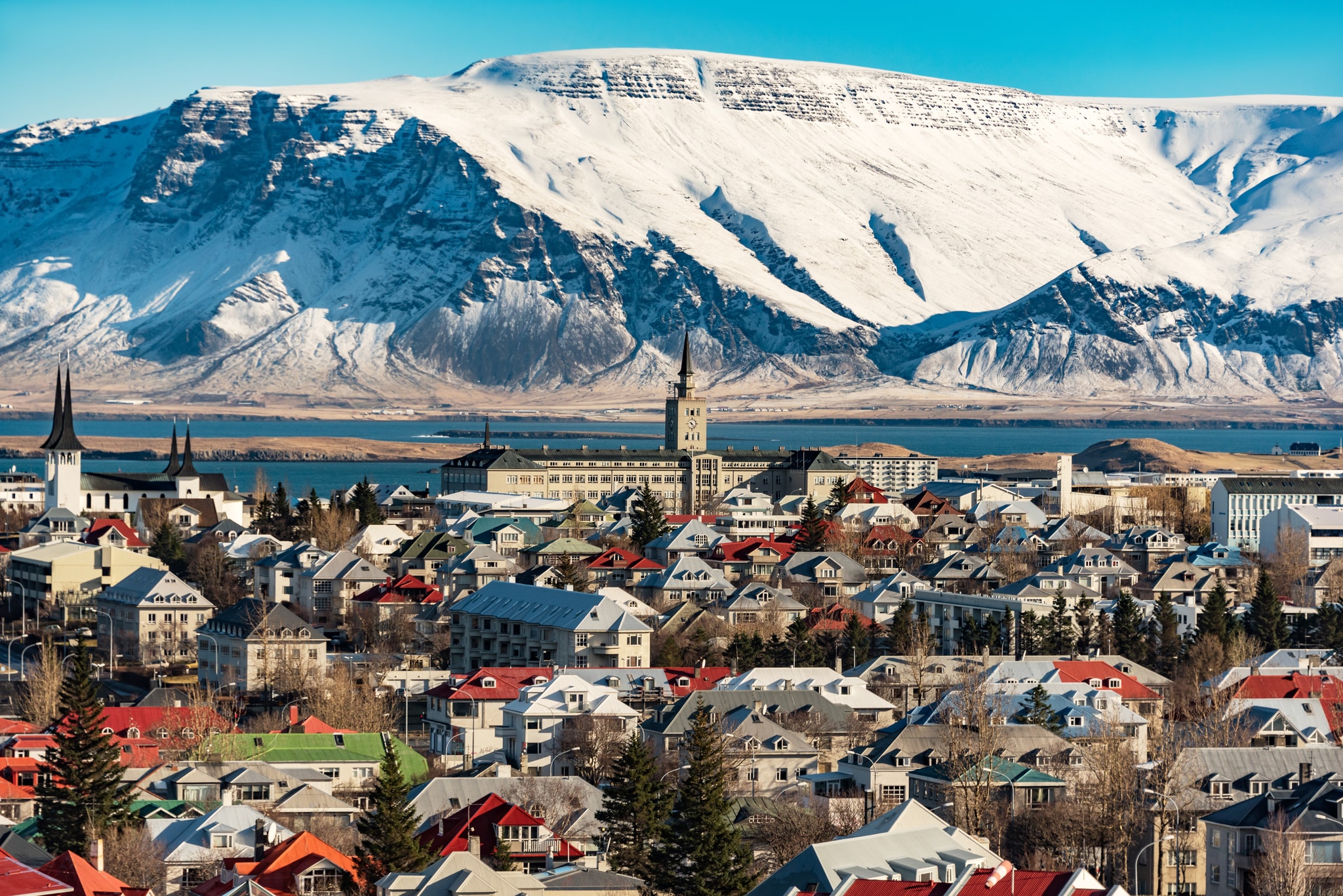
Reykjavík Pride is one of Iceland’s biggest annual events. It’s a ten-day celebration attracting more than 100,000 guests — remarkable for a country of fewer than 400,000 people
Residence options for expats
Iceland currently has no Golden Visa or dedicated passive-income residence permit. Besides, its former long-term visa framework, which had included a remote-work option, was repealed in May 2026[74]Source: Directorate of Immigration — Visa services transferred to the Ministry for Foreign Affairs. The replacement short-term residence permit is limited mainly to extended family visits and stays by artists, scientists and athletes, so it does not function as a general Digital Nomad Visa[75]Source: Ísland.is — Short-term residence permit.
For most non-EEA expats, employment is therefore the most relevant route. Iceland issues residence permits for work requiring expert knowledge, labour shortages, and several other employment categories[76]Source: Ísland.is — Residence permit based on work. A permit for work requiring expert knowledge and a job offer can be granted for up to four years. The worker cannot start employment until both residence and work permission have been granted[77]Source: Ísland.is — Work permit for expert knowledge.
Iceland for LGBTQ+ expats at a glance
- Same-sex marriage: legal since 2010
- Joint adoption: legal since 2006
- Gender self-identification: Yes, no medical requirement
- ILGA-Europe 2026 score: 86%
- Equaldex score: 93
- Residence options: Employment-based residence permits; no Golden Visa or general Digital Nomad Visa
8. Denmark
Denmark has been a pioneer in LGBTQ+ rights for decades. In 1989, it became the first country in the world to introduce registered partnerships for same-sex couples, and marriage equality followed in 2012. Today, it combines strong legal protections with high social acceptance and ranks among Europe’s leading countries for LGBTQ+ rights[78]Source: Visit Copenhagen — The ultimate LGBTQIA+ guide to Copenhagen.
LGBTQ+ rights and protections in Denmark
Same-sex marriage has been legal since June 2012, with same-sex spouses generally receiving the same legal status as different-sex married couples[79]Source: Danish Legal Information — Act on marriage between two persons of the same sex. Denmark also allows adults to change their legal gender without surgery or a medical diagnosis, although applicants must confirm their decision after a six-month reflection period[80]Source: Your Europe — Rules on legal gender recognition.
Denmark ranks 5th out of 49 European countries with a score of 85% on ILGA-Europe’s 2026 Rainbow Map. Its score rose by five points after progress including full depathologisation of trans identities in healthcare and the renewal of the country’s equality action plan.
Life in Denmark
Copenhagen has the country’s largest LGBTQ+ community, with queer bars, cultural venues, and Copenhagen Pride every August[81]Source: Visit Copenhagen — Copenhagen Pride Week.
Communication with locals is easy for expats thanks to high English proficiency in Denmark. The country ranks 7th out of 123 countries and regions in the 2025 EF English Proficiency Index[82]Source: EF English Proficiency Index — Denmark. An expat can usually manage everyday conversations and many international workplaces in English, although learning Danish remains important for deeper integration and some jobs.
The main drawback is cost, particularly in Copenhagen. A one-bedroom flat averages about €1,710 per month in Copenhagen city centre and €1,200 outside it. Expats should also factor in Denmark’s dark winters and relatively high everyday prices when comparing it with Southern European destinations. [83]Source: Numbeo — Cost of Living in Copenhagen.
Residence options for expats
Denmark has no Golden Visa, passive-income residence programme or dedicated Digital Nomad Visa, so employment is the main route for many non-EU expats.
Under the Pay Limit Scheme, an applicant with a qualifying Danish job can obtain a residence and work permit if their annual salary is at least DKK 552,000, or about €74,800, in 2026[84]Source: New to Denmark — Pay Limit Scheme.
Another option is the Positive List, which covers professions experiencing labour shortages. From July
2026, the lists contain 164 occupations requiring higher education and 63 skilled occupations. Applicants need a job offer in an eligible profession and the qualifications required for that position[85]Source: New to Denmark — Positive Lists updated from 1 July 2026.
Denmark for LGBTQ+ expats at a glance
- Same-sex marriage: legal since 2012
- Joint adoption: legal since 2010
- Gender self-identification: Yes, no medical requirement; a six-month reflection period applies
- ILGA-Europe 2026 score: 85%
- Equaldex score: 82
- Residence options: Pay Limit Scheme and Positive List work routes; no Golden Visa or Digital Nomad Visa
9. Sweden
Sweden has a long record of expanding LGBTQ+ rights and remains one of Europe’s most socially open countries. Same-sex marriage, adoption, and legal recognition of same-sex parents are established in law, while a new gender-recognition system took effect in 2025.
LGBTQ+ rights and protections in Sweden
Marriage has been gender-neutral since 2009, and married or cohabiting couples can adopt jointly regardless of sex[86]Source: Government of Sweden — Marriage. Swedish law also recognises a woman as the legal parent of a child born to her female partner under qualifying circumstances, including rules designed to recognise some families formed abroad[87]Source: Government of Sweden — About parenthood.
A new gender-recognition law took effect on 1 July 2025, making it easier to change the gender recorded in the population register from age 16[88]Source: Swedish Parliament — It will be easier to change gender. The reform helped Sweden rise to 9th place with 68% on ILGA-Europe’s 2026 Rainbow Map.
Life in Sweden
Stockholm is the centre of Sweden’s LGBTQ+ social and cultural life and hosts Stockholm Pride, described by the city’s official visitor guide as Northern Europe’s largest Pride celebration[89]Source: Visit Stockholm — Stockholm Pride 2026. Gothenburg has its own active queer community, while Malmö combines a more compact urban environment with easy access to Copenhagen across the Øresund waterway.
Newcomers can also function comfortably in English: Sweden ranks 8th globally in the 2025 EF English Proficiency Index[90]Source: EF English Proficiency Index — Sweden. Accommodation is likely to be a more significant practical concern, particularly in Stockholm, where a one-bedroom flat costs roughly €1,515 per month in the city centre and €980 outside it[91]Source: Numbeo — Cost of Living in Stockholm.
Residence options for expats
Sweden has no Golden Visa or dedicated Digital Nomad Visa, so employment is one of the main routes for non-EU nationals. Most applicants need a job offer and a work permit. Since June 2026, the salary must generally equal at least 90% of Sweden’s median salary; the current minimum is €3,060 per month, and pay must also comply with collective agreements or normal industry practice. Family members can apply together with the employee[92]Source: Swedish Migration Agency — Apply for a work permit.
Highly qualified people without a job offer from a Swedish company also have a separate option: holders of an advanced degree can obtain a residence permit for up to nine months to look for work or explore starting a business, provided they meet financial and insurance requirements[93]Source: Swedish Migration Agency — Look for work or start a business.
Sweden for LGBTQ+ expats at a glance
- Same-sex marriage: legal since 2009
- Joint adoption: legal since 2003
- Gender self-identification: No full self-ID; healthcare certification is still required
- ILGA-Europe 2026 score: 68%
- Equaldex score: 75
- Residence options: Work permits; residence permit for highly qualified jobseekers; no Golden Visa or Digital Nomad Visa
10. Norway
Norway combines extensive LGBTQ+ family and anti-discrimination rights with high living standards and a visible queer community in its major cities. It ranks among Europe’s top ten countries for LGBTQ+ laws and policies, although relocating there generally requires employment rather than investment.
LGBTQ+ rights and protections in Norway
Norway introduced gender-neutral marriage in 2009, giving same-sex couples the same access to marriage and adoption as other couples[94]Source: Government of Norway — Marriage and relationships. Lesbian couples can also use assisted reproduction under Norwegian law. Protection against discrimination extends to sexual orientation, gender identity and gender expression[95]Source: Government of Norway — More equal and inclusive society for all LGBTQ people.
The country also uses a self-declaration model for legal gender recognition: no diagnosis, surgery, or other medical treatment is required[96]Source: Helsenorge — Change of legal gender in Norway. People aged 16 and over can apply independently, while children aged 6 to 15 need parental involvement. Norway places 8th with 69% on ILGA-Europe’s 2026 Rainbow Map.
Life in Norway
Oslo is the main centre of LGBTQ+ life, with the country’s largest Pride festival and a broad range of queer organisations and venues. Bergen, Trondheim, and Stavanger have smaller communities, while still offering the infrastructure of sizable regional cities[97]Source: Visit Norway — LGBTIQ+ travel in Norway. Norway also ranks 5th globally in the 2025 EF English Proficiency Index, so many newcomers can communicate comfortably from the start without speaking Norwegian[98]Source: EF English Proficiency Index — Norway.
Daily life comes at a high price, especially in Oslo. A one-bedroom flat costs about €1,750 per month in the city centre and €1,330 outside it[99]Source: Numbeo — Cost of Living in Oslo. Climate is another factor: winter days are short across the country and become progressively darker farther north.
Residence options for expats
Norway does not run a Golden Visa, passive-income programme, or Digital Nomad Visa. For most non-EU/EEA nationals, relocation depends on qualifying for a skilled-worker residence permit. Applicants generally need relevant higher education or vocational qualifications together with a specific job offer from a Norwegian employer[100]Source: Norwegian Directorate of Immigration — Skilled workers.
Norway for LGBTQ+ expats at a glance
- Same-sex marriage: legal since 2009
- Joint adoption: legal since 2009
- Gender self-identification: Yes, no medical requirement
- ILGA-Europe 2026 score: 69%
- Equaldex score: 89
- Residence options: Skilled Worker residence permit; no Golden Visa, passive-income visa or Digital Nomad Visa
11. Finland
Finland combines strong LGBTQ+ protections with high social acceptance and a good quality of life, particularly for expats who prefer smaller, well-organised cities. It ranks 6th out of 49 European countries with a score of 70% on ILGA-Europe’s 2026 Rainbow Map.
LGBTQ+ rights and protections in Finland
Same-sex couples have been able to marry since March 2017 and receive the same rights as opposite-sex married couples, including joint adoption. Finland also replaced registered partnerships with gender-neutral marriage, although previously registered partnerships remain recognised[101]Source: Suomi.fi — Information about registered partnership.
A 2023 reform made legal gender recognition considerably simpler: adults can have their registered gender changed without undergoing medical treatment[102]Source: Finlex — Act on Gender Recognition 295/2023.
Finland still has gaps in its LGBTQ+ framework, including the absence of a nationwide conversion-practices ban and specific protection against medically unnecessary interventions on intersex minors.
Life in Finland
Everyday attitudes are broadly favourable. In Gallup’s latest global comparison, 85% of people in Finland said their local area was a good place for gay and lesbian people, putting the country among the strongest performers worldwide[103]Source: Gallup — World Split on Treatment of Gay and Lesbian People. Helsinki has the most visible LGBTQ+ community, while Tampere and Turku offer quieter alternatives with sizable student and professional populations.
Housing is less expensive than in several other Nordic capitals: a one-bedroom apartment in Helsinki averages about €1,120 per month in the centre and €780 outside it[104]Source: Numbeo — Cost of Living in Helsinki.
Dark winters are a more distinctive practical adjustment, and although many Finns speak English, learning Finnish or Swedish can widen employment and social opportunities for long-term residents.
Residence options for expats
Finland has no Golden Visa or dedicated Digital Nomad Visa, so employment is the clearest route for many non-EU nationals.
Specialists in highly skilled roles can apply for a dedicated residence permit if they have confirmed employment and earn at least €3,937 per month in 2026. A first permit can be issued for up to two years. Eligible specialists can use Finland’s fast-track service, which reduces the processing timeline from 2 months to 14 days[105]Source: Finnish Immigration Service — Residence permit for specialists.
Finland for LGBTQ+ expats at a glance
- Same-sex marriage: legal since 2017
- Joint adoption: legal since 2017
- Gender self-identification: Yes, no medical requirement for adults
- ILGA-Europe 2026 score: 70%
- Equaldex score: 76
- Residence options: Specialist and other employment-based residence permits; no Golden Visa or Digital Nomad Visa
12. Germany
Germany offers a different proposition from the Nordic countries: a much larger labour market, several major LGBTQ+ centres, and a rapidly modernised legal framework. Its 2024 Self-Determination Act was an important recent reform, while Germany moved from 8th to 7th place with 70% on ILGA-Europe’s 2026 Rainbow Map.
Its position in this ranking is lower partly because relocation options are geared mainly towards workers rather than investors or financially independent people. There is also a gap between legal equality and everyday experience: anti-LGBTQ+ hate crimes and violent attacks have increased in recent years, and discrimination remains a concern despite Germany’s comparatively strong protections[106]Source: DW — Why are LGBTQ+ hate crimes surging in Germany?.
LGBTQ+ rights and protections in Germany
Marriage has been open to same-sex couples since 2017, with marriage equality also bringing joint adoption rights[107]Source: German Bundestag — Marriage for all. The Self-Determination Act, effective since November 2024, replaced the old Transsexuals Act and allows people to change their legal gender marker and first name through a declaration at a registry office rather than a court procedure[108]Source: Federal Ministry — Self-Determination Act.
Germany’s Rainbow Map score reflects strong family and equality protections but also remaining shortcomings in areas such as intersex bodily integrity and the completeness of nationwide LGBTQ+ policies.
Life in Germany
Berlin provides one of Europe’s largest and most diverse queer scenes. But the capital is far from the only option: Cologne, Hamburg, Frankfurt, and Munich all have established LGBTQ+ communities. Berlin Pride alone brings hundreds of thousands of people onto the streets, making queer visibility a prominent part of city life[109]Source: Visit Berlin — Christopher Street Day 2026.
Berlin is no longer particularly cheap by European standards. A one-bedroom apartment is roughly €1,320 per month in the centre and €940 outside it[110]Source: Numbeo — Cost of Living in Berlin.
English is often enough to get started in Berlin and international workplaces, but German becomes much more important when dealing with bureaucracy, looking for work outside multinational companies or settling in smaller cities.
Residence options for expats
Germany does not have a conventional Golden Visa, but its Opportunity Card allows qualified non-EU nationals to enter the country to look for work without already having a German job offer. Applicants qualify through recognised professional credentials or a points system and must demonstrate resources of at least €1,091 per month in 2026[111]Source: Make it in Germany — Opportunity Card.
Professionals who already have qualifying employment may instead use the EU Blue Card. The standard 2026 salary threshold is €50,700 a year, reduced to €45,934.20 for shortage occupations and certain other applicants[112]Source: Make it in Germany — EU Blue Card.
Germany for LGBTQ+ expats at a glance
- Same-sex marriage: legal since 2017
- Joint adoption: legal since 2017
- Gender self-identification: Yes, no medical or psychiatric assessment required
- ILGA-Europe 2026 score: 70%
- Equaldex score: 80
- Residence options: Opportunity Card and EU Blue Card; no traditional Golden Visa
13. Ireland
Ireland’s transformation on LGBTQ+ rights has been particularly rapid. In 2015, it became the first country to approve marriage equality through a national referendum[113]Source: Government of Ireland — Marriage Referendum +10.
Today it combines those rights with the advantage of being an English-speaking EU country. Ireland ranks 14th with 61% on ILGA-Europe’s 2026 Rainbow Map.
The country’s Catholic heritage remains visible: 69% of residents identified as Roman Catholic in the 2022 census, despite a substantial decline in recent decades[114]Source: Central Statistics Office — Census of Population 2022. For expats, there is no longer an investment route — Ireland closed its Immigrant Investor Programme to new applications in February 2023[115]Source: Immigration Service Delivery — Closure of the Immigrant Investor Programme.
LGBTQ+ rights and protections in Ireland
The 2015 constitutional amendment established marriage without distinction as to sex[116]Source: Government of Ireland — Constitution of Ireland. In the same year, the Gender Recognition Act introduced legal gender recognition for adults, while family-law reforms expanded parenthood and guardianship rights for LGBTQ+ families[117]Source: Government of Ireland — Gender Recognition.
Ireland’s legal framework remains comparatively strong but is not comprehensive in every area. ILGA-Europe highlights continuing issues including access to gender-affirming healthcare, recognition for non-binary people, and protection of intersex minors[118]Source: ILGA-Europe — Ireland on the Rainbow Map.
Life in Ireland
An obvious advantage for many international movers to Ireland is language: expats can work, rent property, and handle everyday administration in English from the outset, without the initial language barrier common elsewhere in Europe.
Dublin has the country’s largest LGBTQ+ community and Pride programme, while Cork and Galway offer smaller-city alternatives[119]Source: Visit Dublin — Dublin Pride Festival 2026.
A one-bedroom apartment in Dublin costs approximately €2,150 per month in the centre and €1,850 outside it[120]Source: Numbeo — Cost of Living in Dublin. This makes accommodation one of the most important budget considerations before relocating.
Residence options for expats
Financially independent people who want to retire or live in Ireland without working can obtain a long-term residence permit, Stamp 0.
Applicants are required to have individual income of at least €50,000 a year, plus a lump sum sufficient for major unexpected expenses. They also need private medical insurance and cannot rely on publicly funded services[121]Source: Immigration Service Delivery — Retiring to Ireland.
For those moving for work, the Critical Skills Employment Permit covers strategically important occupations. In 2026, the main salary thresholds start at €40,904 a year for eligible occupations requiring a relevant degree, with higher thresholds for other qualifying positions [122]Source: Department of Enterprise — Critical Skills Employment Permit.
Ireland for LGBTQ+ expats at a glance
- Same-sex marriage: legal since 2015
- Joint adoption: legal since 2017
- Gender self-identification: Yes, no medical requirement for adults
- ILGA-Europe 2026 score: 61%
- Equaldex score: 70
- Residence options: Stamp 0 for qualifying financially independent people; Critical Skills Employment Permit; investor programme closed in 2023
14. Argentina
Argentina was the first country in Latin America to introduce same-sex marriage and remains an important regional centre of LGBTQ+ culture. Buenos Aires combines a highly visible queer community with comparatively accessible living costs, although expats should keep Argentina’s changing economic environment in mind when planning a long-term move.
LGBTQ+ rights and protections in Argentina
Argentina legalised same-sex marriage in 2010, extending the same marriage and adoption provisions to same-sex couples[123]Source: Government of Argentina — Law 26,618 on civil marriage. Its Gender Identity Law followed in 2012 and established a right to recognition of a person’s self-identified gender without requiring surgery or a psychiatric diagnosis[124]Source: Government of Argentina — Law 26,743 on gender identity.
There has been a recent change affecting transgender minors. Since February 2025, people under 18 cannot access the hormone treatments and surgical interventions covered by Article 11 of the Gender Identity Law[125]Source: Government of Argentina — Restrictions on hormone treatments and surgical interventions for minors.
Public support for LGBTQ+ equality nevertheless remains substantial: Ipsos reported in 2026 that 58% of Argentinians supported laws protecting LGBTQ+ people from discrimination in employment, education, housing, and social services[126]Source: Ipsos — Pride Argentina 2026.
Life in Argentina
Buenos Aires has by far the country’s largest LGBTQ+ social scene. The city’s official tourism authority describes it as the LGBT capital of Latin America, with queer nightlife, cultural centres, events, and long-established meeting areas around Palermo and Recoleta[127]Source: Buenos Aires Tourism — Diverse Buenos Aires. Mendoza and Patagonia appeal to expats looking for a smaller-scale lifestyle away from the capital.
Rent remains comparatively accessible for a major international city at about €630 per month for a one-bedroom flat in central Buenos Aires and €450 outside the centre[128]Source: Numbeo — Cost of Living in Buenos Aires.
Residence options for expats
Argentina is introducing a citizenship by investment programme that will allow foreign nationals to obtain citizenship without meeting the usual two-year residence requirement. The programme is expected to begin accepting applications by the end of 2026.
Applicants will have two options to invest:
- make a non-refundable contribution of $350,000 to the National Treasury;
- purchase a government bond worth $800,000.
Spouses and unmarried, childless children aged 18—25 can apply for an additional $100,000 each, the contribution for children under 18 is $25,000 each[129]Source: Government of Argentina — Citizenship by Investment Programme.
Argentina operates a resident option for digital nomads from selected countries. Nationals of countries that can enter Argentina visa-free as tourists may obtain transitory residence for 180 days, renewable for the same period, if they work remotely for people or companies based abroad. Applicants need evidence of their professional activity and remote income[130]Source: Government of Argentina — Digital Nomad temporary residence.
People who live from income generated by assets abroad can instead apply for one-year temporary residence, which is renewable. Monthly passive income must equal at least five Argentine minimum wages. In 2026, one minimum wage is ARS 383,800, so the applicant needs at least ARS 1,919,000 per month, or approximately $1,260. The income must come from assets such as investments, property, or business interests rather than personal employment[131]Source: Government of Argentina — Temporary residence as a rentista.
Argentina for LGBTQ+ expats at a glance
- Same-sex marriage: legal since 2010
- Joint adoption: legal since 2010
- Gender self-identification: Yes, no medical or psychological assessment required
- ILGA-Europe 2026 score: Not applicable
- Equaldex score: 75
- Residence options: Citizenship by investment, Digital Nomad residence; Rentista residence permit
15. Canada
Canada has recognised same-sex marriage nationwide for more than two decades and protects sexual orientation and gender identity at federal level. It also remains socially receptive by international standards: Ipsos’ 2026 Pride research continues to show broad Canadian support for core LGBTQ+ rights[132]Source: Ipsos — Pride Report 2026.
LGBTQ+ rights and protections in Canada
The Civil Marriage Act has defined civil marriage as the union of two persons since 2005, giving same-sex couples equal access to marriage nationwide[133]Source: Government of Canada — Civil Marriage Act. The Canadian Human Rights Act explicitly prohibits discrimination on grounds including sexual orientation and gender identity or expression within areas under federal jurisdiction[134]Source: Government of Canada — Canadian Human Rights Act.
Canada also criminalises conversion therapy: the Criminal Code prohibits providing conversion therapy, advertising it, and obtaining a material benefit from it[135]Source: Government of Canada — Criminal Code provisions on conversion therapy. Provincial law covers many other areas of everyday life, so some details of family, healthcare, and anti-discrimination rules differ by province.
Life in Canada
Toronto, Montréal, and Vancouver give expats three very different large-city options, from English-speaking Toronto and Vancouver to bilingual, predominantly French-speaking Montréal. For LGBTQ+ newcomers, this means a choice between several established urban communities rather than one dominant national hub. In Québec, learning French is especially useful for work and long-term integration.
Housing costs can be significant. A one-bedroom apartment works out at roughly €1,430 per month in the city centre and €1,265 outside it[136]Source: Numbeo — Cost of Living in Toronto.
Residence options for expats
Québec Immigrant Investor Program. Applicants need net assets of approximately €1.24 million, make a refundable five-year investment of about €622,000, and pay a contribution of around €124,000. They also need at least two years of qualifying management experience and spoken French[137]Source: Government of Québec — Conditions for immigrating as an investor .
The programme also requires a period of residence in Québec before final selection — with the minimum requirement set at 12 months within the last 2 years. Canadian immigration rules recognise spouses and common-law partners regardless of gender, so same-sex couples use the same family definitions as other applicants[138]Source: Government of Canada — Sponsoring a spouse or partner.
Canada for LGBTQ+ expats at a glance
- Same-sex marriage: legal nationwide since 2005
- Joint adoption: legal nationwide, with rules administered by provinces and territories
- Gender self-identification: Rules vary by province and territory; federal identity documents can use an X gender marker
- ILGA-Europe 2026 score: Not applicable
- Equaldex score: 78
- Residence options: Québec Immigrant Investor Program; federal skilled immigration routes
16. New Zealand
New Zealand combines established LGBTQ+ rights with high public acceptance and an active residence by investment route. Gallup’s latest global data places it among the top ten countries worldwide for the share of residents who view their area as a good place for gay and lesbian people to live.
LGBTQ+ rights and protections in New Zealand
Same-sex marriage has been legal since August 2013, with the law defining marriage regardless of sex, sexual orientation, or gender identity[139]Source: New Zealand Government — Marriage Amendment Act questions and answers. Sexual orientation is also a prohibited ground of discrimination under the Human Rights Act[140]Source: New Zealand Legislation — Human Rights Act 1993.
Since 2023, people born in New Zealand can change the sex recorded on their birth certificate through a
statutory declaration rather than a Family Court process, without proving that they have undergone medical treatment. Available markers include female, male, and non-binary[141]Source: New Zealand Government — Change the registered sex on your birth certificate.
Life in New Zealand
Auckland offers the largest urban job market and international community, while Wellington provides a smaller capital-city environment with a strong cultural and public-sector presence. The country’s main lifestyle trade-off is geography: moving to New Zealand means considerably longer journeys to Europe and North America than from any destination elsewhere in this ranking.
Auckland housing is expensive relative to local incomes. A one-bedroom apartment is about €1,060 per month in the centre and €1,050 outside it[142]Source: Numbeo — Cost of Living in Auckland.
Residence options for expats
The Active Investor Plus Visa provides residence through investment. Under the Growth category, applicants invest approximately €2.5 million for three years; the Balanced category requires about €5 million for five years. The visa allows the holder to live, work and study in New Zealand and can include a partner and dependent children aged 24 or younger[143]Source: Immigration New Zealand — Active Investor Plus Visa.
Partnership. New Zealand immigration rules define partnership as a genuine and stable relationship between two people of either the same or opposite sex, whether married, in a civil union, or in a de facto relationship. Same-sex partners therefore fall under the same partnership rules for immigration purposes[144]Source: Immigration New Zealand — Partnership visas.
New Zealand for LGBTQ+ expats at a glance
- Same-sex marriage: legal since 2013
- Joint adoption: legal for married same-sex couples since 2013
- Gender self-identification: Yes for New Zealand birth certificates, no medical requirement
- ILGA-Europe 2026 score: Not applicable
- Equaldex score: 80
- Residence options: Active Investor Plus Visa
17. Australia
Australia combines well-established LGBTQ+ rights with high social acceptance and several large, international cities. Sydney is particularly prominent in global queer culture, while Melbourne, Brisbane, and Perth also have established LGBTQ+ communities. For expats, the main constraint is immigration: Australia closed its dedicated business and investor programme to new applicants in 2024.
LGBTQ+ rights and protections in Australia
Australia introduced marriage equality in 2017 by amending the Marriage Act so that the right to marry no longer depends on sex or gender[145]Source: Australian Attorney-General’s Department — Marriage equality in Australia.
At federal level, the Sex Discrimination Act prohibits discrimination based on sexual orientation, gender identity, and intersex status in areas including employment, education, housing, and services. Some family-law and gender-recognition procedures still differ between states and territories[146]Source: Australian Human Rights Commission — LGBTIQA+ Rights.
Australia’s legal framework still has gaps. In its 2026 assessment, the Australian Human Rights Commission highlighted concerns including discrimination and the absence of federal protection against medically unnecessary interventions on intersex infants; Victoria and the Australian Capital Territory have adopted stronger safeguards in this area[147]Source: Australian Human Rights Commission — Australian Human Rights Assessment 2026: Sexual Orientation, Gender Identity and Intersex.
Life in Australia
Sydney has the country’s most internationally visible LGBTQ+ scene and hosts the Sydney Gay and Lesbian Mardi Gras, Australia’s largest LGBTQIA+ celebration[148]Source: Destination NSW — Sydney Gay and Lesbian Mardi Gras. Melbourne offers another large queer community alongside a strong arts and cultural scene. Gallup’s latest country-level comparison found that 85% of Australians considered their area a good place for gay and lesbian people to live.
Housing can make settling in Sydney expensive. A one-bedroom apartment costs approximately €2,210 per month in the city centre and €1,485 outside it. Melbourne and smaller Australian cities can offer different cost and lifestyle trade-offs, while the country’s size means expats should also consider domestic travel distances when choosing where to settle[149]Source: Numbeo — Cost of Living in Sydney.
Residence options for expats
There is no active residence or citizenship by investment programme operating in Australia.
Skilled professionals can instead consider visas such as the Skilled Independent visa, subclass 189, which grants permanent residence to invited applicants in eligible occupations[150]Source: Australian Department of Home Affairs — Skilled Independent visa. Candidates first submit an Expression of Interest through SkillSelect and compete for an invitation based on factors such as qualifications, professional experience, and English proficiency[151]Source: Australian Department of Home Affairs — SkillSelect.
Australia for LGBTQ+ expats at a glance
- Same-sex marriage: legal since 2017
- Joint adoption: legal across all states and territories since 2018
- Gender self-identification: Rules vary by state and territory
- ILGA-Europe 2026 score: Not applicable
- Equaldex score: 78
- Residence options: Skilled migration routes; direct investor programme closed in 2024
18. Uruguay
Uruguay stands out in Latin America for the breadth of its LGBTQ+ legislation and the visibility of diversity policies at both national and local level. Montevideo offers a more compact and relaxed alternative to the region’s megacities, while immigration rules make long-term settlement relatively accessible.
LGBTQ+ rights and protections in Uruguay
Uruguay legalised same-sex marriage in 2013[152]Source: IMPO — Law No. 19,075 on equal marriage. Its 2018 Comprehensive Law for Trans Persons strengthened the right to gender identity and introduced wider protections and affirmative measures for trans people[153]Source: IMPO — Law No. 19,684 on trans persons. National anti-discrimination legislation expressly includes sexual orientation and sexual identity[154]Source: IMPO — Law No. 17,817 on discrimination.
The government continues to develop LGBTQ+ policy rather than treating legal equality as complete. Uruguay’s Ministry of Social Development launched new 2026–2030 priorities for protecting LGBTIQ+ people[155]Source: Uruguay Ministry of Social Development — Department of Sexual Diversity, while Montevideo’s diversity plan explicitly acknowledges that inequalities remain in employment, healthcare, housing and access to public space[156]Source: Government of Uruguay — Montevideo Diversity Plan 2026–2030.
Life in Uruguay
Most expats considering Uruguay settle in Montevideo, where the city government runs a dedicated diversity secretariat and an LGBTIQ+ community centre[157]Source: Montevideo City Government — Secretariat of Diversity. The capital joined the Rainbow Cities Network in 2026 and has made LGBTQ+ inclusion part of its policy on housing, work, healthcare, culture and public spaces.
Montevideo is cheaper to rent in than most Western European capitals, although Uruguay is not necessarily a low-cost destination by South American standards. A one-bedroom flat averages roughly €625 per month in the centre and €485 outside it[158]Source: Numbeo — Cost of Living in Montevideo.
Residence options for expats
Remote workers and self-employed professionals working for clients or businesses abroad can initially stay under Uruguay’s digital-nomad framework. The permit starts with six months and can be renewed for another six; afterwards, those who want to remain can explore temporary or permanent residence [159]Source: Uruguay XXI — Digital nomads can live and work legally in Uruguay.
Uruguay also allows foreigners who intend to settle permanently to apply for permanent residence, with applications made after arrival in the country[160]Source: Ministry of Foreign Affairs of Uruguay — Residing in Uruguay.
Uruguay for LGBTQ+ expats at a glance
- Same-sex marriage: legal since 2013
- Joint adoption: legal since 2009
- Gender self-identification: Yes, no medical requirement
- ILGA-Europe 2026 score: Not applicable
- Equaldex score: 87
- Residence options: Digital Nomad residence; permanent residence routes
19. Taiwan
Taiwan occupies a unique position in Asia: it became the region’s first jurisdiction to legalise same-sex marriage and has continued to expand family rights since then. Taipei adds a large Pride celebration, strong public transport and a growing international professional community, making Taiwan particularly relevant to LGBTQ+ expats who want to live in East Asia.
LGBTQ+ rights and protections in Taiwan
Same-sex marriage became legal in 2019 under the Act for Implementation of Judicial Yuan Interpretation No. 748[161]Source: Taiwan Ministry of Justice — Act for Implementation of Judicial Yuan Interpretation No. 748. Amendments adopted in 2023 expanded adoption rights for married same-sex couples. Taiwan has also broadened recognition of transnational marriages: the earlier restriction affecting couples whose foreign partner came from a jurisdiction without marriage equality has largely been removed, subject to special rules for cross-strait cases[162]Source: Executive Yuan — CEDAW implementation report.
Public acceptance has continued to rise after legalisation. A 2026 survey reported 54.3% support for same-sex marriage, 63% for transnational same-sex marriage and 67.2% for joint adoption by same-sex couples[163]Source: Focus Taiwan — Support for same-sex marriage rises to 54.3%.
Life in Taiwan
Taipei is the focal point of LGBTQ+ life and hosts Taiwan LGBT+ Pride, one of Asia’s largest queer events. The 24th edition is scheduled for 31 October 2026, with community groups, universities, businesses and international organisations taking part[164]Source: Taiwan LGBT+ Pride — Official 2026 website.
Daily costs are moderate compared with many major cities covered in this ranking. A one-bedroom apartment in Taipei costs roughly €655 per month in the city centre and €450 outside it[165]Source: Numbeo — Cost of Living in Taipei. Taipei’s extensive metro system and dense urban layout can also make living without a car practical.
Residence options for expats
Taiwan’s Digital Nomad visa programme is open to nationals of visa-exempt countries. Applicants aged 30 or over must generally show annual income of at least €34,850 in one of the previous two years. For applicants aged 20—29, the threshold is about €17,425. They also need an average bank balance of roughly €8,710 over the preceding six months and international health insurance. The visa is initially issued for six months and can be extended in six-month increments for a cumulative stay of up to two years[166]Source: Taiwan Bureau of Consular Affairs — Digital Nomad Visitor Visa.
Highly qualified professionals may consider the Taiwan Employment Gold Card, which combines a resident visa, open work permit, Alien Resident Certificate and re-entry permit. It is generally valid for one to three years and does not require sponsorship from a specific employer[167]Source: Taiwan Gold Card Office — What is the Gold Card?.
Taiwan for LGBTQ+ expats at a glance
- Same-sex marriage: legal since 2019
- Joint adoption: legal since 2023
- Gender self-identification: No general statutory self-ID procedure
- ILGA-Europe 2026 score: Not applicable
- Equaldex score: 60
- Residence options: Digital Nomad Visa; Employment Gold Card
20. Thailand
Thailand became the first country in Southeast Asia to introduce marriage equality when its new law took effect in January 2025. Its legal framework is still developing in some areas, but Bangkok already has a large, visible LGBTQ+ community, while relatively low living costs and long-stay visa options make the country particularly practical for remote workers.
LGBTQ+ rights and protections in Thailand
The Marriage Equality Act took effect on 23 January 2025, giving same-sex couples equal access to civil marriage and associated rights in areas such as inheritance, property, healthcare decisions and adoption. Thailand also has protections under the Gender Equality Act, although its wider LGBTQ+ framework remains less comprehensive than those of the highest-ranking European countries[168]Source: UN Human Rights Office — Thailand’s historic marriage equality law.
Legal gender recognition remains an area of reform rather than a fully settled right. In 2026, Thailand launched its first National Health Charter on Transgender Wellbeing, which identifies legal gender recognition alongside healthcare, anti-discrimination and employment as areas requiring further action [169]Source: National Health Commission Office — National Health Charter on Transgender Wellbeing.
Life in Thailand
Bangkok has the country’s largest LGBTQ+ social scene, while Chiang Mai and Phuket combine established international communities with a slower pace of life. Pride has also expanded beyond the capital: the Thai government’s 2026 initiatives included a Pride City Network covering dozens of provinces[170]Source: Royal Thai Government — Bangkok Pride 2026. Ipsos’ 2026 survey found Thailand had the highest support among the countries surveyed for greater LGBTQ+ representation in television, films, and advertising, at 59%[171]Source: Ipsos — Pride Report 2026.
Bangkok remains substantially cheaper to rent in than most Western European capitals. A one-bedroom flat costs approximately €575 per month in the centre and €280 outside it[172]Source: Numbeo — Cost of Living in Bangkok.
Residence options for expats
The Destination Thailand Visa suits digital nomads, remote employees and freelancers working outside the Thai labour market. It is valid for five years with multiple entries and permits stays of up to 180 days per entry, with one extension of up to another 180 days. Applicants generally need financial evidence of at least €13,100. Spouses and children under 20 can obtain DTVs as dependants[173]Source: Royal Thai Embassy — Destination Thailand Visa.
Another option is the Thailand Privilege Visa. Unlike a Golden Visa, it is essentially a long-term tourist visa and does not lead to permanent residence or citizenship. Current official memberships start with the five-year Bronze package at approximately €17,000, while longer packages run for up to 20 years[174]Source: Thailand Privilege — Membership packages.
Thailand for LGBTQ+ expats at a glance
- Same-sex marriage: legal since 2025
- Joint adoption: legal for married same-sex couples since 2025
- Gender self-identification: No legal gender recognition procedure
- ILGA-Europe 2026 score: Not applicable
- Equaldex score: 65
- Residence options: Destination Thailand Visa; Thailand Privilege Visa
What to check before relocating as an LGBTQ+ expat
A country can look LGBT-friendly on paper and still feel complicated in daily life. Marriage equality, anti-discrimination laws, and gender recognition matter, but expats also need to know whether they can include a partner in a residence application, access healthcare, rent a home, work safely, and raise a family with legal certainty.
Legal protection
Same-sex marriage or civil partnerships are strong signs of recognition, but they do not cover everything. It is also worth checking whether the country bans discrimination based on sexual orientation and gender identity in employment, housing, education, healthcare, and access to services. Ratings and maps like IGLA give a realistic glance at most countries’ legal structures.
Family recognition
Some countries allow same-sex couples to marry but still restrict joint adoption, assisted reproduction, surrogacy, or automatic recognition of both parents on a birth certificate. Cross-border families should be especially careful, as parenthood recognised in one country may require extra legal steps in another. According to OECD, family rights, protection against discrimination, and access to services are all key parts of real LGBTI inclusion[175]Source: OECD.
Daily life
Social attitudes differ between countries, regions, and neighbourhoods. Large cities often have stronger LGBT communities, more inclusive employers, and better access to specialised healthcare.
In the EU, public attitudes have become more positive overall: in the 2023 Eurobarometer survey, 72% of Europeans agreed that same-sex marriage should be allowed throughout Europe, though support still varies by country[30]Source: European Commission — Special Eurobarometer 535: Discrimination in the European Union.
Healthcare deserves a separate check, especially for transgender expats and people living with HIV. Legal access does not always mean easy access in practice, so it is worth checking whether LGBT-sensitive doctors are available, whether gender-affirming care is accessible, and whether public or private insurance covers the necessary treatment.
It’s also important to look realistically at the changes in law and understand that they do not momentarily change things in a country. Greece, for example, legalised same-sex civil marriage in 2024 through Law 5089/2024[56]Source: Hellenic Parliament — Law 5089/2024 on equality in civil marriage, but administrative practice, local attitudes, and programme-specific immigration rules may take time to become clear.
Immigration status for partners and spouses
A same-sex spouse may be recognised under family law but not automatically accepted as a dependent under every visa, residence, or investor programme. Couples should check whether spouses, civil partners, unmarried partners, and children can be included in one application, and what documents prove the relationship.
For example, most European residence by investment programmes include same-sex spouses and partners in the list of family members eligible to be dependents in an investor’s application. In some regions, however, LGBTQ+ people may not have the same rights. For instance, Türkiye, Egypt, and some other countries do not recognise same-sex couples under their citizenship by investment programmes.
Risks and pitfalls of relocating abroad as an LGBTQ+ expat
Legal equality does not always mean the same experience in everyday life. A country may recognise same-sex marriage and prohibit discrimination while attitudes differ sharply between large cities and smaller or more conservative communities. Expats should look beyond national legislation and research the specific city or region where they plan to live.
Marriage and parental rights may not transfer automatically across borders. Same-sex marriages, civil partnerships, adoption orders, and birth certificates issued abroad can receive different treatment in the destination country. Families formed through assisted reproduction or surrogacy may face additional complications, so parental recognition should be checked before relocating.
Immigration rules can treat partners differently from domestic family law. A country may recognise same-sex marriage but still impose specific documentation requirements for dependent visas or family reunification. Unmarried partners and couples in civil unions should confirm whether their relationship qualifies before choosing a residence route.
Access to LGBTQ+-specific healthcare varies considerably. Availability of gender-affirming care, fertility treatment, HIV prevention, and LGBTQ-competent healthcare can differ even between countries with otherwise strong equality protections. Waiting times, insurance coverage, and access outside major cities are worth checking in advance.
Being open about your identity may feel different after relocation. Pride events and visible LGBTQ+ communities can indicate acceptance, but they do not guarantee the same level of comfort in workplaces, schools, housing or public spaces. Talking to local LGBTQ+ organisations and expat communities can give a more realistic picture than relying on legal rankings alone.
How Immigrant Invest can help obtain residence by investment
Immigrant Invest is a licensed consulting company with active coverage across Portugal, Malta, Greece, and other investor residence programmes. For LGBTQ clients, same-sex couple eligibility is assessed as a standard step — not an afterthought — at the beginning of every programme review.
Our integrated service model coordinates legal, tax, banking, and Due Diligence support within one team. This matters for LGBTQ high-net-worth clients because the risks that cause the most damage — a partner not included on the application, an unexpected tax trigger, a source-of-funds query that delays the process — typically arise from siloed advice where the immigration team and the tax team do not communicate in time.
Immigrant Invest’s process includes a dedicated compliance pre-check conducted before any contract is signed. This covers criminal records, sanctions lists, Interpol and Europol databases, politically exposed person status, and visa refusal history. The check is completed before a client commits funds, meaning applicants who would face rejection are identified and advised before they bear any material cost.
Immigrant Invest is one of the few with an in-house compliance department staffed by Certified Anti-Money Laundering Specialists and legal officers, rather than outsourcing this function to a third party.
We operate strictly under government licences in the jurisdictions where licensing is required and are explicitly accountable under the European Union’s anti-money-laundering framework. We are a member of the Investment Migration Council, the industry’s professional body, which commits members to a published code of ethics and continuous professional development.
Key takeaways: best countries for LGBTQ+ expats
- Portugal and Malta are some of the strongest options for LGBTQ+ expats looking to relocate. These countries combine strong legal frameworks with friendly community, diverse immigration options, and easy integration.
- Spain, Malta, and Iceland have some of Europe’s strongest LGBTQ+ legal frameworks. Spain ranks first on ILGA-Europe’s 2026 Rainbow Map, followed by Malta and Iceland.
- Greece combines improving LGBTQ+ rights with an active Golden Visa. Property investment starts at €250,000 for property conversions or restorations, while standard thresholds are €400,000 or €800,000 depending on location.
- The most LGBTQ-friendly countries do not always offer investor residence. Denmark, Norway, Sweden, Finland, Iceland, the Netherlands and Belgium provide strong protections and high social acceptance, but relocation usually depends on employment, entrepreneurship, or family ties rather than investment.
- Outside Europe, several countries combine LGBTQ+ rights with practical residence routes. Canada and New Zealand have investor or business-oriented options, Taiwan offers the Employment Gold Card and Digital Nomad Visa, while Thailand has long-stay routes for remote workers and lifestyle movers. Argentina recently introduced a citizenship by investment programme.
- Legal rights are only one part of choosing a destination. LGBTQ+ expats should also compare social attitudes, recognition of spouses and children, access to healthcare, immigration rules, cost of living, and the practical experience of living outside the country’s most international cities.
Immigrant Invest is a licensed agent for citizenship and residence by investment programs in the EU, the Caribbean, Asia, and the Middle East. Take advantage of our global 15-year expertise — schedule a meeting with our investment programs experts.

 Trusted by 10,000+ investors