








Portugal offers 14 legal pathways to residency — from employment, entrepreneurship, and education to family reunification, volunteering, and humanitarian grounds.
For investors, the Golden Visa remains a standout route, with options starting at €250,000. Digital nomads and financially independent individuals can also secure legal residency.
This guide breaks down all available residency options and highlights the key advantages of making Portugal home.
What is a Portugal residence permit: key things to know
The Portugal residence permit is a legal document that allows foreigners to live in the country for more than 90 days. It grants more than just the right to remain: it provides legal residency, enables visa-free travel across the 29 Schengen countries, including Portugal, and allows access to services such as healthcare, education, and in many cases, employment.
If you are a citizen of a non-EU, non-EEA country or Switzerland, and you plan to stay in Portugal for longer than 90 days, you will need a residence permit.
Pathways to residency
There are 14 recognised grounds on which third-country nationals can apply for a residence permit. Each pathway is designed for a specific purpose:
- Investment.
- Cooperation with Portuguese universities.
- Employment.
- Entrepreneurship.
- Highly qualified work.
- Remote work.
- Living in Portugal on independent means.
- Seasonal work.
- Education.
- Family reunification.
- Religious activities.
- Judicial, administrative, or cultural exchange.
- Asylum.
- Volunteering.
Most Portugal residence permits can lead to permanent residence and citizenship. The exceptions are routes designed for temporary stays, such as seasonal work, judicial, administrative or cultural exchange, volunteering, internships, and short exchange programmes.
Stay requirements
Most residents are expected to spend at least 8 months per year in Portugal to maintain their permit’s validity. This requirement ensures that the residency reflects a genuine link to the country and continued integration.
However, there is one notable exception: Golden Visa holders need only spend 7 days per year in Portugal to retain their status. This minimal requirement is a key feature of the investment route and one reason it is attractive to international applicants who prefer flexibility.

Trusted by 10,000+ investors
Check your eligibility for the Portugal Golden Visa
10 benefits of getting a Portugal residence permit
Living in Portugal means enjoying a high quality of life in a secure, modern country. It’s a destination that appeals equally to families looking for stability and to investors seeking growth and asset protection.
1. High quality of life
In Expat Insider 2025 by InterNations, Portugal ranks 10th in the Quality of Life Index. Expats value the country for its climate, natural environment, safety, and relaxed everyday lifestyle. Almost 90% are happy with the climate and weather, compared with 58% globally.
Portugal is seen as a place for a safe, peaceful life by the sea. This is reflected in why people move there: 24% of expats named better quality of life as their main reason for relocating to Portugal, compared with only 7% globally[1]Source: Internations — Expat Insider Survey 2025.
2. Unrestricted mobility and EU market access
Portuguese residents enjoy visa-free travel across all 29 Schengen countries and access to the EU single market. They can open bank accounts, invest, and conduct business across all 27 EU member states under harmonised rules.
3. Thriving business landscape
Portugal combines a competitive tax system with a dynamic startup culture. In 2026, the standard corporate income tax rate is 19% on the mainland and 13.3% in the autonomous regions of Madeira and the Azores. The mainland rate will fall further to 18% in 2027 and 17% from 2028, according to a progressive multi-year tax reduction[2]Source: Portal das Finanças — Código do IRC, Article 87: Rates.
SMEs and Small Mid-Cap companies in mainland Portugal benefit from a reduced 15% rate on the first €50,000 of taxable income, or 10.5% in Madeira and the Azores[3]Source: PwC — Portugal corporate taxation.
Portugal’s startup ecosystem is gaining recognition: in the Financial Times’ Europe’s Leading Start-Up Hubs 2025 ranking, seven Portuguese incubators and accelerators were listed among Europe’s top 150, led by Unicorn Factory Lisboa in 17th place[4]Source: Financial Times — Europe’s Leading Start-Up Hubs 2025. Lisbon and Porto have become key tech hubs in Portugal, supported by competitive operating costs and a highly educated, multilingual workforce.
Economic indicators are also strong: Portugal’s real GDP grew by 1.9% in 2025, outperforming the EU average of 1.6%[5]Source: Eurostat — GDP up by 0.3% in both the euro area and the EU.
4. Investor-friendly regulations
Portugal attracts foreign investors, supported by a steady rise in investment projects and pro-business reforms. Between 2019 and 2024, the number of foreign direct investment projects increased by 40%[6]Source: AICEP — Portugal is the 7th destination in Europe for foreign investment. In 2025, this trend continued, with new FDI projects rising by 21%. As a result, Portugal remains among the top 10 European countries most attractive for foreign direct investment, with 196 FDI projects recorded[7]Source: EY Portugal — Portugal remains in Europe’s top 10 for foreign direct investment.
The IFICI+ tax regime further boosts Portugal’s appeal. It offers a 20% flat income tax on eligible employment and self-employment income from Portuguese sources, and generally exempts foreign-source income from IRS — incentives that can last up to 10 years.
5. Mild climate and stunning natural beauty
Portugal enjoys a warm, Mediterranean climate with over 300 days of sunshine annually. The Atlantic coastline offers scenic beaches, with swimming possible from May to September — or nearly year-round in Madeira. Winters are mild, and most homes don’t require central heating.
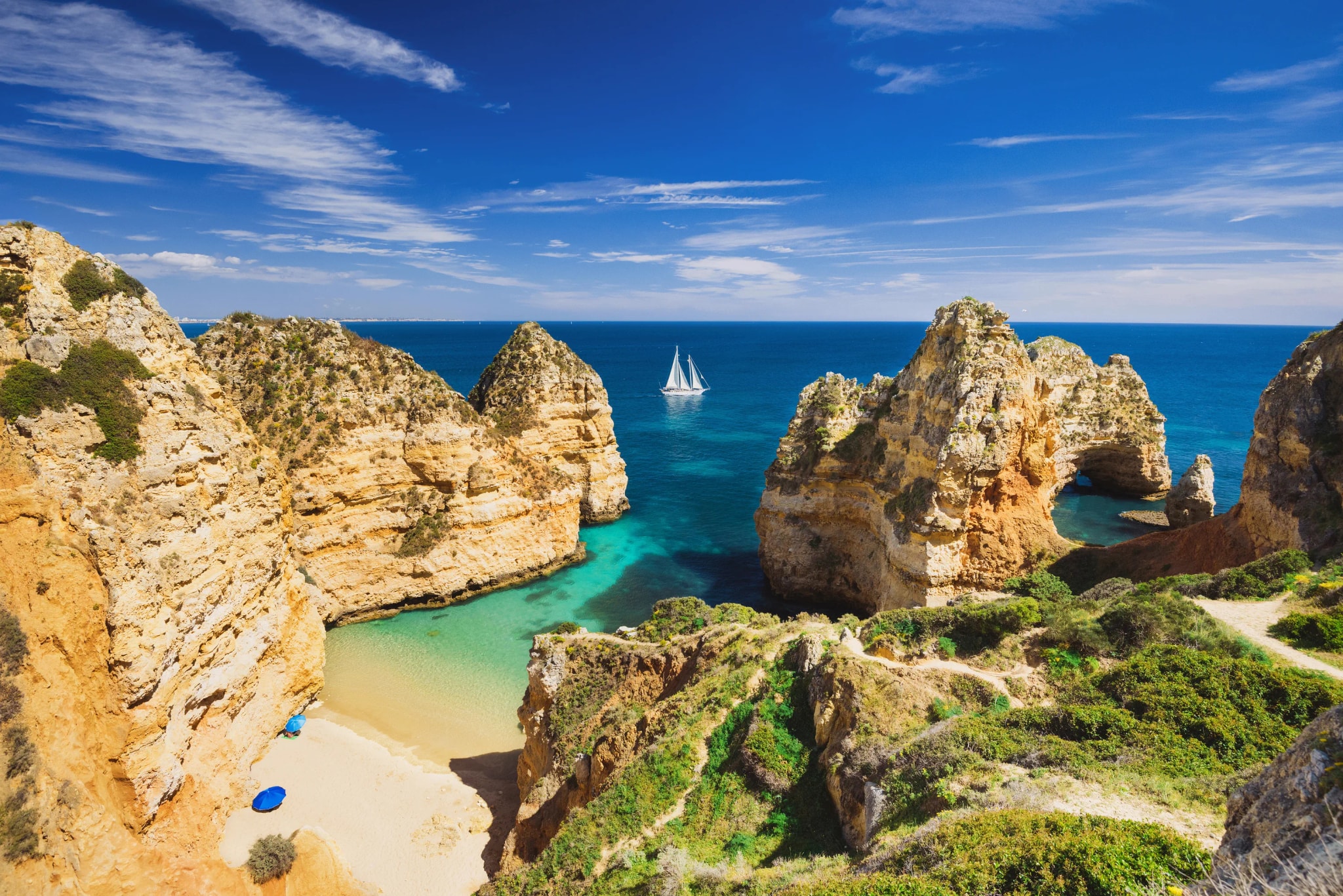
Many of the country’s beaches are internationally recognised for their cleanliness and safety, with 404 of them awarded the prestigious Blue Flag status[8]Source: ABAAE — Blue Flag 2025 results in Portugal
6. High levels of safety and security
Portugal consistently ranks among the safest countries in Europe. It placed 9th for safety and security in the Expat Insider 2025 survey, with most respondents saying they feel safe walking or cycling in daily life. They also highlight low crime rates, effective policing, a politically stable environment, and freedom of expression.
7. Modern, high-quality healthcare system
Foreign residents with a permit can access the national healthcare system, which provides free or low-cost treatment at public hospitals and clinics. The country is known for its strong preventative care, modern facilities, and high vaccination coverage.
Life expectancy remains among the highest in Europe — 82.9 years.
8. Strong and accessible education system
Children with residence permits can attend public kindergartens and schools. Portugal is also home to top international institutions like St Julian’s British School and Carlucci American International School. Education outcomes are high: 100% of children complete primary school.
As for higher education, 5 Portuguese universities rank among the world’s top 500[9]Source: QS World University Rankings 2026 — Portugal.
9. Welcoming, multicultural society
Portugal is known for its warmth and hospitality: 74% of expats describe locals as friendly, compared with the global average of 62%. Newcomers often find it easier to settle in thanks to open social interactions and a relaxed pace of life.
Language also helps make daily life smoother. While Portuguese is relatively accessible to learn, English is widely spoken in major cities and tourist areas. Portugal ranks 6th in the English Proficiency Index, reflecting a very high level of English among non-native speakers[10]Source: English Proficiency Index — Portugal.
10. Family-friendly lifestyle
Portugal’s mild climate and relaxed pace encourage families to spend more time outdoors — hiking forested hills, sailing along the Atlantic coast, or enjoying slow weekends in historic town squares.
The country also offers access to world-class entertainment. Families can enjoy concerts by international performers, top-division football matches, and major events like the NOS Alive music festival or the Lisbon & Sintra Film Festival.
Many high-net-worth individuals choose to live in premium coastal resorts designed with families in mind. These developments often include “soft programming” tailored for teenagers, such as professional surf coaching, archaeology workshops, and language or tech camps.

Portugal is renowned for its cultural treasures. Among them is the Regaleira Palace, where children can descend into the 27 m Initiation Well and discover hidden waterfalls and grottoes
14 ways to get a Portugal residence permit
Portugal offers a flexible and inclusive approach to residency, with 14 distinct pathways tailored to various personal, professional, and financial circumstances. Whether through investment, employment, education, or family ties, non-EU nationals can find a route that fits their goals.
1. Investment
The Portugal Golden Visa programme grants residency in exchange for investment. Almost 40,000 people have already used this route, which starts from €250,000 depending on the option selected. Family members, including spouse or partner, children under 26, and parents can also qualify.
2. Passive income
The Portugal D7 Visa is designed for financially independent individuals with regular foreign income such as pensions, dividends, or rent.
In 2026, applicants need a monthly income of at least €920, plus 50% for a spouse or dependent parent and 30% for each child. They also need savings equal to 12 months of living costs — €11,040 for one person, increased by the same percentages for dependants.

3. Employment
The Portugal D1 Visa allows non-EU nationals to live and work in Portugal if they have a job offer or work contract with a Portuguese employer. It applies to salaried employment and requires the applicant to submit a work contract or a promise of a work contract when applying for the visa[11]Source: AIMA — Residence permit for subordinate professional activity.
4. Remote work
Digital nomads — freelancers, employees of foreign companies, self-employed professionals, and individual entrepreneurs — can apply for a dedicated visa if they earn at least €3,680 per month.
Applicants must also hold savings equivalent to 12 months of living expenses — €11,040 for a single applicant, increasing by 50% for a spouse or parent and 30% per child.
5. Entrepreneurship
The Portugal D2 Visa offers three routes to residency for businessmen. The first is the Startup Visa, which involves creating a business with a certified incubator in Portugal. There’s no set investment threshold.
The other two options are for self-employed professionals and entrepreneurial immigrants. Self-employed applicants must present a service contract or a proposal. Entrepreneurs must submit a business plan and a statement confirming they have established or plan to establish a business in Portugal.
Applicants are expected to fund their own project, either by launching a new venture or relocating an existing business, and prove they have at least €11,040 to cover 1 year of living expenses.
6. Portugal Global Talent Programme
The Portugal Global Talent Programme offers a residence permit for highly qualified professionals, entrepreneurs, researchers, and industry experts who can contribute to Portugal’s academic and innovation ecosystem. To qualify, applicants must establish a formal collaboration with a recognised Portuguese university or research institution.
Eligibility requirements include:
- bachelor’s degree or higher;
- 3 to 5 years of relevant professional experience;
- participation fee of €170,000, covering the main applicant and up to three dependants;
- savings of at least €15,000.
Family members can be included in the application: a spouse and children under 26. Children over 18 must be full-time students.

Trusted by 10,000+ investors
Check your eligibility for the Portugal Global Talent Programme
7. Highly qualified work
The Portugal D3 Visa is for professionals with higher education and job offers in roles requiring advanced scientific or technical skills, such as senior management, intellectual fields, or academic professions[12]Source: AIMA — Residence permit for highly qualified activity.
Contracts must last at least one year and meet minimum salary thresholds:
- €2,403, which is 1.5 × the national average gross salary — standard threshold;
- €1,922, which is 1.2 × national average gross salary — reduced threshold for ISCO Groups 1 and 2;
- €1,074.26, which is 2 × IAS — alternative threshold for ISCO Groups 1 and 2.
ISCO Groups 1 and 2 refer to top-tier occupational categories under the International Standard Classification of Occupations. Group 1 includes legislators, senior officials, and managers. Group 2 covers professionals such as scientists, engineers, university lecturers, healthcare specialists, and IT experts.
8. Seasonal work
The Portugal D9 Visa suits non-EU nationals who plan to take seasonal jobs in Portugal, especially in sectors such as agriculture, tourism, hospitality, and other industries with temporary labour needs. It requires a valid work contract or job offer for seasonal employment with an employer established in Portugal.
The visa may cover work for up to 90 days or a longer temporary stay, depending on the duration of the seasonal contract. Seasonal workers receive the same core labour rights as Portuguese workers, including pay, working conditions, and access to vocational training. If the employer charges for accommodation, the fee must be reasonable and cannot exceed 20% of the worker’s salary[13]Source: European Commission — Seasonal worker in Portugal.
9. Education
The Portugal D4 Visa is for non-EU students admitted to Portuguese universities or other recognised higher education institutions. Applicants must present proof of admission or enrolment and show that they have enough funds to support themselves during their stay.
In 2026, the minimum reference amount is €537.13 per month. For a 12-month stay, this means at least €6,445.56. The amount may be reduced if the student can prove that accommodation or both accommodation and meals are already secured[14]Source: Diário da República — Law No. 23/2007 of July 4th, Article 61.
10. Family reunification
Legal residents in Portugal can bring eligible family members through the D6 Family Reunification Visa. Eligible relatives include:
- spouse or partner;
- children under 18 or incapacitated children;
- adopted minors;
- dependent adult children who are single and enrolled in education in Portugal;
- dependent parents of the resident or their spouse.
Applicants must earn at least €920 per month in 2026, plus 50% for a spouse or parent, and 30% per child.
The resident must have held a valid residence permit for at least 2 years before applying for family reunification. For a spouse or partner who lived with the resident before their move to Portugal, this may be reduced to 15 months. Some family members are exempt, including dependent minors, incapacitated relatives, and relatives of certain permit holders[15]Source: AIMA — Family Reunification with a Family Member Outside Portugal.
11. Religious activities
Clergy, missionaries, and other religious workers may apply for a visa or residence route if they are coming to Portugal for religious training or religious activity with a recognised congregation or religious organisation.
The application should be supported by documents from the host organisation, such as a formal invitation, appointment letter, or confirmation of participation in a religious programme[16]Source: VFS Global — Residence visa for retirement purposes, religious purposes or for living from individual revenues.
12. Cultural, training or international exchange
This route is for people who come to Portugal for cultural work, student exchange, professional training, unpaid internships, volunteering, or programmes under international agreements.
Applicants need an invitation or acceptance letter from a recognised organisation, company, institution, or programme in Portugal[17]Source: gov.pt — Request a residency visa for study, student exchange, professional internship or volunteering.
13. Asylum
Asylum and international protection are for people who need protection in Portugal, including refugees and people eligible for subsidiary protection. Depending on the case, Portugal may provide support such as accommodation, food, clothing, transport assistance, or daily allowances[18]Source: Diário da República — Law No. 23/2007 of July 4th.
Victims of human trafficking or assistance to irregular migration can apply for a separate residence permit. This permit may be granted even if the person entered Portugal irregularly or does not meet the usual residence requirements. It is usually valid for 1 year[19]Source: AIMA — Residence permit for victims of human trafficking or assistance to illegal immigration.
14. Volunteering and internships
People accepted into approved volunteer programmes or professional internships can apply for a temporary-stay visa if the programme lasts more than 3 months. They need proof of acceptance from a recognised organisation, company, or training provider in Portugal. Interns may also need a training agreement and programme schedule[20]Source: Diário da República — Law No. 23/2007 of July 4th, Article 54.
Who can obtain a Portugal residence permit: eligibility criteria
All applicants for the Portugal residence permit must first meet basic legal, financial, and documentation requirements. The exact conditions then depend on the chosen route, with the Golden Visa following a separate investment-based framework.
General Portugal residency requirements
To qualify for any Portuguese residence permit, applicants must meet several standard criteria:
- have a clean criminal record;
- provide proof of legal accommodation in Portugal;
- obtain a D-type visa;
- demonstrate sufficient means of subsistence — typically equal to the national minimum wage, €920 per month, or the IAS benchmark, €537.13 per month, depending on the visa type.
Golden Visa requirements
Golden Visa applicants must be at least 18 years old and use funds originating from outside Portugal. There is no minimum income requirement, but the investment capital must come from a legal source and be clearly documented. Applicants for a Golden Visa are not required to have accommodation in Portugal.
Immediate family members may be included in a Golden Visa application:
- spouse or partner, including same-sex partners;
- children under 18;
- children aged 18 to 25, if they are unmarried, financially dependent on the investor, and enrolled in university;
- parents of the investor or spouse.
A partner must prove that the relationship has lasted for at least 2 years.
Parents aged 65 or over can be included without proof of financial dependence. Parents under 65 must prove that they are financially dependent on the investor.

Discover the benefits of the Portugal Golden Visa and a unique way to EU citizenship
Portugal residence permit validity and renewal periods
The validity of a residence permit in Portugal depends on the grounds on which it is granted. While most permits are issued for 2 years initially, the renewal periods vary significantly — from annual extensions for students to multi-year terms for passive income holders or remote workers.
Understanding these differences is essential for long-term planning, especially if you intend to maintain legal residence, apply for permanent residency, or eventually pursue Portuguese citizenship.
Portuguese residence permit validity by type

Portuguese residence permit renewal
To renew a Portuguese residence permit, applicants must continue meeting the same requirements as for their initial application. This includes maintaining valid accommodation, proving sufficient financial means, holding health insurance, and presenting a clean criminal record. They must also continue to meet the core eligibility conditions — such as ongoing employment, active studies, or maintaining their investment.
In addition, the minimum stay requirement applies: Golden Visa holders must spend at least 7 days per year in Portugal. For other residents holding a standard 2-year temporary residence permit, absences from Portugal must not exceed 6 consecutive months or a total of 8 months within the 24-month period, whether in a row or separately.
How to get a Golden Visa in Portugal: investment pathways
The Portugal Golden Visa programme offers 5 core investment pathways for residence:
- €500,000 — purchase of investment fund units.
- €250,000 — support for cultural projects.
- €500,000 — investment in scientific research activities.
- €500,000 — capital injection into a new or existing business, with the creation of at least 5 jobs.
- Starting a company in Portugal that creates at least 10 jobs, or 8 jobs if the business is based in a low-density area.
The purchase of investment fund units is the most popular Golden Visa option. It allows investors to diversify assets, earn potential annual returns of 2 to 20%, and receive dividends quarterly or annually, depending on the fund.
Investment funds are managed by professional fund managers and regulated by Portugal’s financial authorities, which adds structure and transparency to the process. Their built-in diversification across sectors, asset classes, and markets helps reduce risk and provides more stability during periods of volatility.

Pedro Barata,
Head of Portuguese office
Portugal Golden Visa investment funds differ in asset composition, return potential, and dividend schedules. Options span various sectors — infrastructure, hospitality, AI technologies. renewable energy, agriculture, data centres, and even football management.
Most funds have a lifespan of 6 to 12 years, aligning well with the Golden Visa’s 5-year minimum holding period.
After the mandatory 5-year holding period, investors may choose between several exit strategies. Depending on the fund, they can resell units to incoming investors, redeem shares through the fund, or hold the investment until maturity and receive capital repayment.
Portugal’s fund-based Golden Visa pathway is flexible and transparent, supported by a broad selection of qualified funds. By comparison, Hungary currently offers only two eligible funds, while Greece does not disclose fund options publicly until an investor submits a formal request.
Trusted by 10,000+ investors
Quick guide to Portugal Golden Visa investment funds
Portugal Golden Visa benefits over other residence permits
The Portugal Golden Visa stands apart from standard residence permits because it offers more flexibility, fewer relocation requirements, and broader rights for the whole family.
1. Plan B
The Portugal Golden Visa gives investors the freedom to live in the country or stay abroad for most of the year. With just 7 days of annual presence required, it suits those with global commitments.
At the same time, it offers a reliable safety net: in times of uncertainty, holders retain the guaranteed right to enter, live, work, and study in Portugal, even when borders are closed to tourists.
2. Work and business rights for the whole family
A Portugal Golden Visa gives the investor and their family the right to live, work, study, and do business in Portugal. With most other permits, these rights depend on the visa type and purpose of stay; with the Golden Visa, they apply to the whole family included in the application.
3. No need for a D visa
Most Portugal residence permits require applicants to first secure a national long-stay visa D before entering the country — a process involving extensive paperwork, long wait times, and consulate appointments.
The Golden Visa bypasses this entirely. Eligible applicants can enter Portugal on a Schengen short-stay visa or visa-free, depending on nationality.
4. Ease of family inclusion
The Golden Visa allows for the inclusion of close family members — spouses, dependent children, and parents — under a single application. This simplifies administration and ensures the entire family enjoys the same residency rights. Golden Visa applicants along with their family members are not required to pass any integration exams.
For those applying under other residency categories, family reunification follows stricter rules. If relatives are already in Portugal, their legal residence must be verified. If they are abroad, the resident may apply for reunification only after 2 years of living in the country. Once reunited, family members are required to take part in an integration program, including Portuguese language and civic studies.
5. Investment returns
Unlike most residency routes, the Golden Visa allows capital to work while securing legal status. Investment funds under the programme yield 2—20% annually. Dividends are paid quarterly or annually, and fund terms — usually 5 to 12 years — align well with Golden Visa requirements.
Investors can exit through fund redemption, resale, or maturity payouts.
Portugal Golden Visa statistics
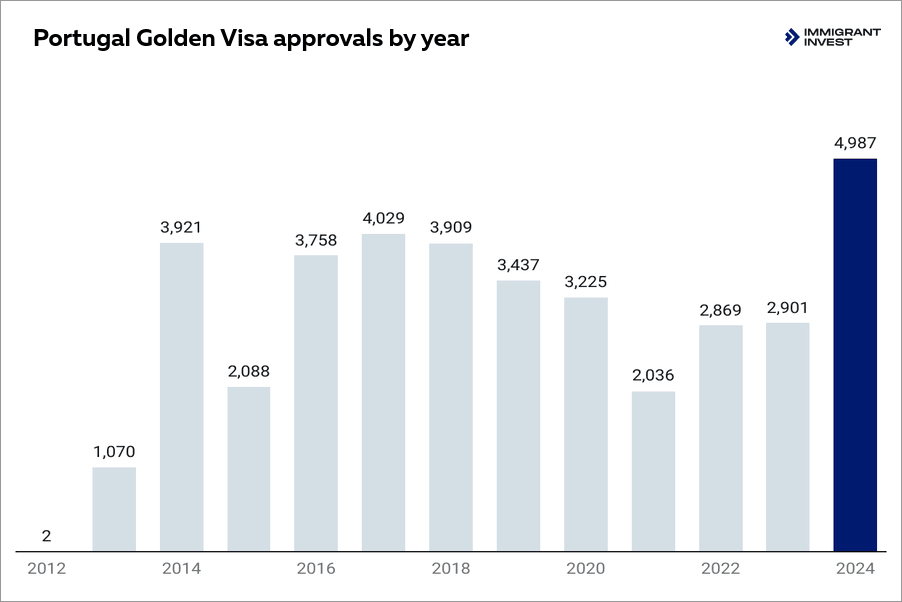
Since its launch and through 2024, the Portugal Golden Visa programme has resulted in 38,132 residence permits: 14,799 for main applicants and 23,333 for their family members.
The programme reached a new peak in 2024, with 4,987 Golden Visas granted — a 72% increase on the previous year and above the former record of 4,029 permits set in 2017, according to Agency for Integration, Migration and Asylum, AIMA[21]Source: Portugal Golden Visa statistics — 2012—2023 by SEF and 2024 by AIMA.
Chinese investors remain the largest group of applicants, followed by nationals of Brazil, Türkiye, and South Africa. Interest is also rising among North American and British investors, many of whom increasingly favour the investment-fund route.
Documents required for a Portugal residence permit
The exact document list depends on the Portugal residence route, but most applicants must prove their identity, legal basis for stay, accommodation, financial stability, and medical coverage. Additional documents are required for work, study, family reunification, investment, or talent-based routes.
Core document requirements
All applicants must submit:
- passport — at least 6 months’ validity beyond the intended stay;
- 2 recent colour passport-size photos;
- health insurance;
- proof of accommodation in Portugal, such as rental contract, property deed, or hotel reservation;
- evidence of means of subsistence, such as bank statements, payslips, pension statements, scholarship award, or proof of investment;
- criminal record certificate.
Route-specific additions
Depending on the chosen pathway, you may also need to provide the following:
- D7 Visa — proof of regular income from foreign sources;
- Digital Nomad Visa — evidence of remote that originates outside Portugal;
- Global Talent Visa — proof of formal collaboration with a recognised Portuguese university, research institution, or innovation organisation;
- D3 Highly Qualified Work Visa — employment contract or job offer for highly qualified work, plus proof of higher education or specialised professional qualifications;
- family reunification — marriage or birth certificates, translated and apostilled;
- D2 Startup Visa — business plan and incubator partnership confirmation;
- D4 Student Visa — official acceptance or enrolment letter.
Golden Visa supplements
Golden Visa applicants must provide additional documents related to the investment. These include proof of the investment transfer, a declaration from a Portuguese bank, and documents confirming the legal origin of the invested money. For investment fund units, applicants must also submit a certificate from the fund manager confirming the purchase of units and the investment amount.
Other supporting documents may include the applicant’s tax identification number from their country of residence, Portuguese tax number, and proof of no debts to the Portuguese tax and social security authorities.
Step-by-step procedure for obtaining a Portugal residence permit by investment
Obtaining a Portugal Golden Visa takes at least 12 months, according to Immigrant Invest’s experience. The process involves several stages, including document preparation, investment completion, application submission, biometrics, and receiving residence cards.
The timeline depends on the workload of the Agency for Integration, Migration and Asylum, AIMA, appointment availability, the chosen investment option, and how quickly the applicant prepares the required documents.
1 day
Preliminary Due Diligence
Immigrant Invest conducts a background check using international databases to assess the risk of application refusal. This step is mandatory before signing a service contract and helps reduce the rejection risk to 1%.
Immigrant Invest conducts a background check using international databases to assess the risk of application refusal. This step is mandatory before signing a service contract and helps reduce the rejection risk to 1%.
Preparation of documents
Up to 2 weeks
Lawyers prepare a personalised list of documents and assist in filling out government forms. They also help translate and notarise all required documents.
Lawyers prepare a personalised list of documents and assist in filling out government forms. They also help translate and notarise all required documents.
1—2 weeks
Obtainment of a tax number
Applicants receive a Número de Identificação Fiscal, NIF, which is necessary for all financial transactions in Portugal, including opening a bank account and making investments.
Applicants receive a Número de Identificação Fiscal, NIF, which is necessary for all financial transactions in Portugal, including opening a bank account and making investments.
1—1.5 months
Opening of an account in a Portuguese bank
A local bank account is opened to facilitate the investment. Lawyers assist in the process, and funds are transferred once the account is ready.
A local bank account is opened to facilitate the investment. Lawyers assist in the process, and funds are transferred once the account is ready.
1 week to 1.5 months
Investment
Depending on the selected route, the applicant purchases investment fund units, starts a business, or supports arts or science. Lawyers gather documents to confirm the investment has been made.
Depending on the selected route, the applicant purchases investment fund units, starts a business, or supports arts or science. Lawyers gather documents to confirm the investment has been made.
5—6 months
Application
The application and scanned documents are submitted to AIMA for review and processing.
The application and scanned documents are submitted to AIMA for review and processing.
1—2 weeks
Submission of biometrics
The investor and family members visit Portugal to provide original documents and fingerprint scans. Biometrics appointments must be scheduled in advance.
The investor and family members visit Portugal to provide original documents and fingerprint scans. Biometrics appointments must be scheduled in advance.
Within 6 months after biometrics
Approval and acquisition of residence permit cards
Within 6 months after biometrics, AIMA reviews the application. Once approved, the applicant pays the government fees, and the residence cards are issued and collected in person or via a lawyer.
Within 6 months after biometrics, AIMA reviews the application. Once approved, the applicant pays the government fees, and the residence cards are issued and collected in person or via a lawyer.
Recent updates to the Portugal Golden Visa programme
The Portugal Golden Visa programme has undergone several important changes in recent years. The updates point to new investor preferences, wider use of digital processing, stricter citizenship rules, and a new tax framework for those who decide to relocate.
Rising fund and cultural investment
Investment funds have become the main Portugal Golden Visa route since real estate and direct capital-transfer options were removed in 2023. Interest has grown sharply: fund approvals increased from 7 in 2019 to 352 in 2023, while total investment through funds reached about €125 million in 2023.
Cultural investment is also gaining traction. In 2025, this option attracted €46.8 million, up 298% from €11.7 million in 2024. It was the strongest result since the cultural route was launched in 2020[22]Source: Dinheiro Vivo — Cultural donations to obtain Golden Visas soared almost 300% in 2025.
Shift to digital processing
AIMA has moved more Golden Visa procedures online to reduce delays and simplify renewals. From February 16th, 2026, Golden Visa renewals became available through AIMA’s Renewal Portal, with online submission and payment of fees[23]Source: AIMA — Online ARI renewal portal announcement.
AIMA’s portal also allows investors and family members to upload documents, pay fees, and schedule appointments online, with only one in-person visit required.
New tax regime
Portugal has replaced the old Non-Habitual Resident regime with the IFICI tax incentive, aimed at attracting talent in scientific research, innovation, and other qualifying high-value activities.
Eligible residents can benefit from a 20% special tax rate on qualifying employment or self-employment income for 10 consecutive years. This regime is separate from the Golden Visa itself, but may be relevant for investors who decide to relocate and become Portuguese tax residents[24]Source: Portal das Finanças — IFICI regime.
Changes to citizenship eligibility
Portugal has changed the citizenship timeline for Golden Visa holders and other residents. Previously, investors could apply for Portuguese citizenship after 5 years of legal residence. Starting May 19th, 2026, the required residence period increased to 7 years for nationals of Portuguese-speaking countries and EU member states, and 10 years for nationals of other countries[25]Source: Portugal Government — Parliament approves new Law on Nationality.
The new Nationality Law does not include grandfathering, so applications submitted before the law entered into force are still assessed under the old rules. The longer citizenship timelines apply only to applications filed after the new law took effect.
How to obtain Portuguese citizenship after a residence permit
A Portugal residence permit can lead to citizenship, but the required period now depends on the applicant’s nationality. Most residents become eligible after 10 years of legal residence. Citizens of Portuguese-speaking countries can apply earlier, after 7 years.
There is also a separate rule for children born in Portugal. They may qualify for citizenship if, at the time of birth, one of the parents has been living legally in Portugal for at least 5 years.
Applicants must prove that they are integrated into Portuguese society. This includes:
- passing a Portuguese language test;
- showing knowledge of the country’s culture, history, and political system;
- signing a written declaration of commitment to democratic principles.
After obtaining Portuguese citizenship, foreigners receive an EU passport with wide travel freedom. It allows visa-free access to the Schengen Area and more than 170 countries and territories, including the UK, Japan, Canada, Singapore, the UAE, and Brazil.
Portugal recognises dual citizenship. Residents can usually keep their first passport after naturalisation, unless their home country does not permit dual nationality.
Pedro Barata,
Head of Portuguese office
After 5 years of legal residence in Portugal, Golden Visa holders can apply for permanent residence instead of citizenship. This option suits investors who want long-term security in Portugal but do not want to wait for a passport, apply for naturalisation, or risk losing their first citizenship if their home country does not allow dual nationality.
Permanent residence also changes the investor’s obligations. Once it is granted, the applicant no longer needs to maintain the Golden Visa residence permit or keep the qualifying investment for Golden Visa purposes. The status itself has no expiry limit, although the residence card is issued for 5 years and must be renewed.
To qualify, applicants must show basic knowledge of Portuguese, prove they have accommodation in Portugal, and demonstrate sufficient means of subsistence.
Risks and pitfalls of obtaining the Portugal Golden Visa
The Portugal Golden Visa is a structured route, but mistakes in documents, funds, timing, or tax planning can still delay the process or lead to refusal. To avoid refusal and protect your investment, it is strongly recommended to work with a qualified lawyer who will ensure compliance and handle the application correctly.
Application delays
Golden Visa delays remain a key risk. In early 2025, AIMA was reported to have more than 55,000 Golden Visa-related applications pending, including main applicants, family members, and renewals[26]Source: The Portugal News — “Good news” for golden visa applicants in Portugal. However, digital processing will gradually ease the pressure.
Still, families should not plan relocation, school enrolment, tax residency, or major travel around the shortest possible timeline.
Source of funds and document validity issues
Golden Visa applicants must prove that their investment funds come from legal sources. This may require bank statements, income records, tax returns, sale agreements, inheritance documents, business ownership records, or dividend statements to show the full money trail.
Timing also matters. Criminal record certificates are usually accepted only if issued within the last 3 months, while bank statements should be recent and commonly cover the previous 6 months. Health insurance must remain valid for the residence period, and the passport must have enough validity for the residence card to be issued. Preparing documents too early can lead to extra updates later.
Biometrics travel requirement
Even with digital processing, applicants still need to attend a biometrics appointment in Portugal. This applies to the main investor and family members included in the application.
Travel planning matters, especially for families living outside Europe. Missing the appointment or arriving with incomplete documents can push the case back and extend the overall timeline.
Changing programme rules
Portugal has changed the Golden Visa programme several times, including the removal of real estate and direct capital-transfer options. Citizenship rules have also changed, with longer residence periods now applying to most applicants. A route, timeline, or benefit in force when the programme was first considered may no longer apply by the time the application is filed.
Tax residency mistakes
A Golden Visa does not automatically make the investor a Portuguese tax resident. A person becomes tax resident if they:
- spend more than 183 days in Portugal in any 12-month period;
- or have a home in Portugal that suggests an intention to keep and use it as a habitual residence, even with fewer than 183 days of stay[27]Source: PwC — Portugal tax residence.
Tax residency can affect how income is taxed. Portuguese tax residents are taxed on worldwide income, while non-residents are usually taxed only on Portugal-source income. It may also affect reporting duties, access to special tax regimes, and possible conflicts with tax residency in another country.
Pedro Barata,
Head of Portuguese office
Portugal’s Golden Visa rules continue to evolve, so investors need more than document support — they need ongoing monitoring. At Immigrant Invest, we track legal updates, AIMA procedures, renewal rules, and citizenship requirements, then inform clients about changes that may affect their application, timeline, or long-term plans.
How Immigrant Invest can help with the Portugal Golden Visa
Immigrant Invest supports investors who want to obtain Portugal residence by investment with a clear, legally compliant process. The company is a licensed consultancy firm with 20 years of experience, 11 offices worldwide, and more than 10,000 clients assisted with residence, citizenship, relocation, and long-term planning.
For the Portugal Golden Visa, our services include:
- preliminary Due Diligence to assess the applicant’s profile and reduce the risk of refusal;
- source-of-funds review before contracts are signed or capital is transferred;
- NIF registration and Portuguese bank account opening by power of attorney;
- preparation of the Golden Visa application, including family members;
- translation, notarisation, and legalisation of documents where required;
- tracking document validity to prevent expiry during the process;
- submission of the application through the official portal;
- coordination of biometrics appointments in Portugal;
- support with purchasing or renting housing for a registered address in Portugal;
- coordination with independent specialists where tax or investment advice is required.
After approval, we continue to support clients with residence permit renewals and keep them informed about changes that may affect their status or long-term plans.
To sum up: what you need to know about Portugal residency
- There are 14 pathways to Portuguese residency, including investment, employment, entrepreneurship, passive income, remote work, collaboration with the Portuguese university, seasonal work, education, highly qualified work, family reunification, asylum, religious service, and volunteering.
- Among these, the Portugal Golden Visa is the most popular route for wealthy foreigners. The minimum investment starts at €250,000, while the most sought-after option — Portuguese fund units — requires €500,000.
- Portugal Golden Visa holders enjoy one of the most flexible residence requirements: only 7 days in Portugal per year. Most other Portuguese residence permits require at least 8 months of annual stay to keep the status.
- Portugal residents enjoy visa-free travel across all 29 Schengen countries, along with access to public healthcare, free education, employment opportunities, and the ability to start or run a business.
- Portuguese citizenship becomes available after 10 years of legal residence, unlocking the rights of an EU passport.
Immigrant Invest is a licensed agent for citizenship and residence by investment programs in the EU, the Caribbean, Asia, and the Middle East. Take advantage of our global 15-year expertise — schedule a meeting with our investment programs experts.

 Trusted by 10,000+ investors