










The President of Portugal promulgated the new citizenship law and signed the decree on May 3rd, 2026[1]Source: The news on signing the law was published on the official website for information of the presidency of the Portuguese Republic.. Lei Orgânica n.º 1/2026, the new Portuguese Nationality Law, was published in Diário da República n.º 95/2026, Série I on May 18th, 2026, and entered into force on May 19th, 2026[2]Source: The full text of the published law can be found in the Official Journal of the Portuguese Republic..
Pedro Barata, Senior Investment Migration Advisor at Immigrant Invest, explains the changes confirmed in the statute, the statutory transitional rule under Artigo 7.º.2, and what they mean for investors at the residency stage.
Changes to the waiting period for naturalisation
One of the key changes concerns the naturalisation procedure for foreigners. Under the old rules, Portuguese citizenship could be obtained after 5 years of permanent residence in the country. Lei Orgânica n.º 1/2026 replaces that universal 5-year baseline.
For adult foreigners
The new law establishes the following rules:
- The naturalisation period has been increased to 10 years. To apply for a passport, third-country nationals now need to live in Portugal for 10 years instead of the previous 5. For citizens of the EU and the Community of Portuguese Language Countries, the naturalisation period will be 7 years. This supersedes the prior universal 5-year regime for any nationality application filed from May 19th, 2026, onwards.
- The 10-year period will be counted from the date the first residence permit is issued, rather than from the moment the documents are submitted to the AIMA agency, as was the case before.
For children of foreigners
Previously, a child could obtain citizenship if, at the time of their birth, one of their parents had legally lived in Portugal for at least 1 year. Under the new law, the required period of the parent’s residence increases to 5 years.
Statutory transitional rule
Under Artigo 7.º.2, citizenship applications already submitted will be considered under the old law. What this means in practice: for nationality applications filed on or before May 18th, 2026 — the prior Lei 37/81 regime of 5 years before citizenship continues to apply by force of statute. These applications are not affected by the new 7/10-year requirement.

Pedro Barata,
Head of Portuguese office
The law is not retroactive: citizenship applications submitted before May 19th, 2026, will be reviewed under the previous rules. Applying the new naturalisation waiting period in such cases would be regarded as undermining trust in the state.
For investors at the residence stage who have not yet filed a nationality application, Lei Orgânica n.º 1/2026 contains no transitional provision. Any citizenship application filed from May 19th, 2026, onwards is subject to the new 7-year or 10-year requirement.
Whether prior residency time accrued under a Golden Visa or other residence permit counts toward the new clock is currently silent in the statute, disputed, and the subject of a collective legal action by 500+ Golden Visa holders[3]Source: Information about the lawsuit was published by the Portugal News..
Pedro Barata,
Head of Portuguese office
We are monitoring AIMA guidance and the forthcoming Regulamento da Nacionalidade Portuguesa, which the Government has 90 days from May 18th, 2026, to update.
Stricter integration requirements
To obtain Portuguese citizenship, applicants need to meet several requirements.
Prove sufficient knowledge of:
- the Portuguese language;
- culture;
- history;
- national symbols;
- fundamental rights and duties of nationality;
- and the political organisation of the Portuguese State.
As evidence, an approved test or certificate is accepted. CIPLE / CAPLE at A2 level remains the standard for the language requirement for non-Lusophone applicants.
A solemn declaration of adherence to the fundamental principles of the democratic rule-of-law State is required for citizenship applicants.
The criminal-record threshold was also revised in Artigo 6.º(1)(f). The denial of naturalisation for a final imprisonment sentence of 3 years or more now applies only to specific crime categories: terrorism, violent and especially-violent crime, highly organised crime, crimes against State security, and crimes of aid to illegal immigration. For ordinary crimes outside these categories, the 3-year threshold no longer applies as an automatic ground.
The expanded loss-of-nationality grounds discussed in the press during 2025 came from a separate decree, Decreto AR n.º 49/XVII[4]Source: The full text of the Decree is published and available for reading., which was sent for preventive constitutional review. The Tribunal Constitucional issued an unconstitutionality finding on May 12th, 2026, and these expanded grounds are not part of Lei Orgânica n.º 1/2026.
The statute retains only voluntary renunciation by dual-nationals as a ground for loss of nationality, as per Artigo 8.º.
For descendants of Sephardic Jews, the simplified naturalisation procedure is no longer in force. Previously, they did not need to take exams or meet the minimum residence period in the country. To obtain citizenship, it was enough to confirm descent from Sephardic Jews.
When will the new law come into force?
The new citizenship law, Lei Orgânica n.º 1/2026, was published in Diário da República n.º 95/2026, Série I, on May 18th, 2026, and entered into force on May 19th, 2026[2]Source: The full text of the published law can be found in the Official Journal of the Portuguese Republic..
The Portuguese Government has 90 days from May 18th to update the implementing regulation, the Regulamento da Nacionalidade Portuguesa. Detailed AIMA and IRN procedural guidance is expected through approximately mid-August 2026.
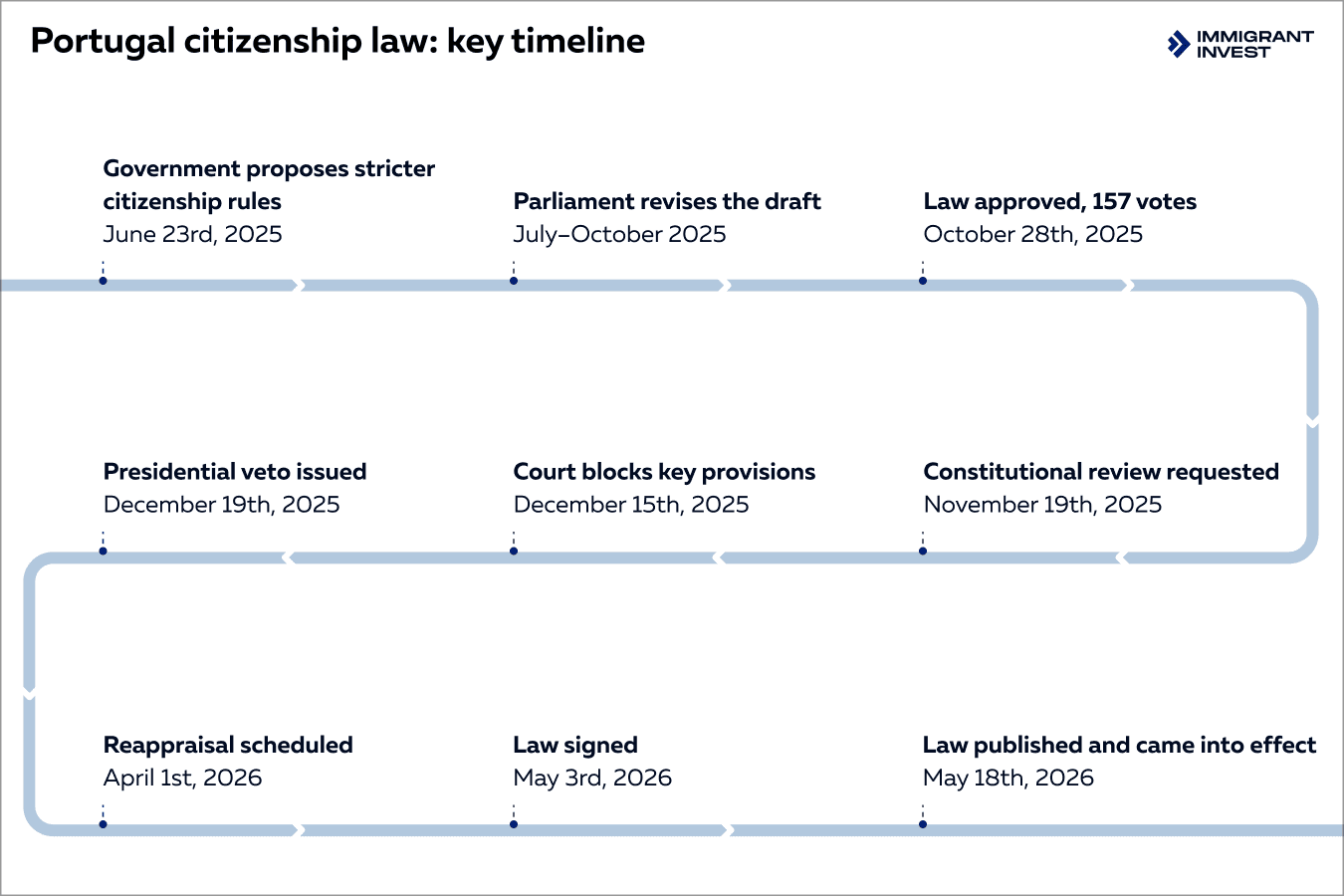
The Portuguese government proposed changes to the citizenship law in June 2025. Since then, the new law has gone through a long process, including a presidential veto and constitutional review.
What should investors do?
Portugal remains a strong option for those who plan to live, invest, or build long-term ties with the EU. However, it may no longer serve as a route to fast citizenship.
Investors obtaining a Portuguese residence permit in 2026 will only become eligible for citizenship between 2036 and 2038. In that case, Portugal would still suit some families, but primarily as a long-term residence and naturalisation strategy.
Portuguese permanent residence is still available after 5 years. Spouses of Portuguese citizens can qualify for nationality after 3 years, this timeframe remains unchanged.
Therefore, the right decision depends on each investor’s goals, family plans, timeline, and priorities. Immigrant Invest lawyers can assess the situation and help choose the most suitable route.