










The Portugal healthcare system consists of 242 hospitals, 135 of which are private[1]Source: PORDATA for 2024 and Statistics Portugal data for 2023. Most hospitals provide services to patients in Portuguese and English.
Free treatment in Portugal is available to all residents who contribute to the Social Security Fund and pregnant women, children and pensioners.
Learn more about the features of Portuguese medicine and how to get quality treatment in the country.
Portugal healthcare system overview
50 years ago, Portuguese medicine was available only to wealthy people and employees of enterprises who had an analogue of modern medical insurance. Peasants and the poor received medical care only from volunteer doctors.
In 1979, the Portuguese Government began to carry out medical reforms and founded the National Health Service, SNS. Today, Portugal performs above the OECD average on seven of ten selected health-status indicators and five of ten access-and-quality indicators[2]Source: OECD Health Statistics 2025. Life expectancy in Portugal is 82.5 years, which is 1.4 years above the OECD average[2]Source: OECD Health Statistics 2025.
Available healthcare options
Public healthcare for Portuguese residents is administered through local and regional health centres and hospitals.
The SNS is a tax-funded public health service. Registered users generally receive SNS consultations, hospital care and prescribed examinations without a user fee. Charges may still apply to medicines, dental care, private treatment and hospital emergency care used without prior SNS referral when the patient is not admitted.
Private healthcare options are also developed in Portugal. Often the same doctors consult both in a private clinic and in a public one. Many patients choose a paid consultation to get an appointment faster. Almost every specialist in the private system speaks English.
Portugal’s healthcare for expats is available if they have medical insurance coverage for their stay in the country.
Foreigners with Portugal residence permits — Golden Visas, D7 Visas, Digital Nomad Visas — can get an SNS number and use public medical services for free.

Trusted by 10,000+ investors
Check your eligibility for the Portugal Golden Visa
Doctors and hospitals
63, 965 doctors work in Portugal, 9,297 of whom are general practitioners and family doctors[3]Source: INE/ALEA — Health-professional statistics for 2024. They are engaged in diagnosing, preventing and treating the most common diseases.
Family doctors are in demand in Portugal. The difference from general practitioners is that they undergo an additional four-year specialist residency and training programme under the guidance of an experienced specialist.
The competence of family doctors includes accompanying patients from birth to death, including pregnancy management and carrying out preventive gynaecological examinations.
All hospitals in Portugal can be divided into two types:
- clinics — outpatient medical institutions where you can get advice from doctors of various specialities and take tests;
- hospitals — medical institutions with a hospital, operating rooms, and research laboratories.
Depending on the Portuguese region and the severity of the disease, the queue for a consultation with specialists in public clinics can be from several days to a year.
Portugal is actively promoting digital services on the SNS website[4]Source: SNS 24 website. Patients can get a video consultation or a prescription for medicine, make an appointment or request a health certificate.
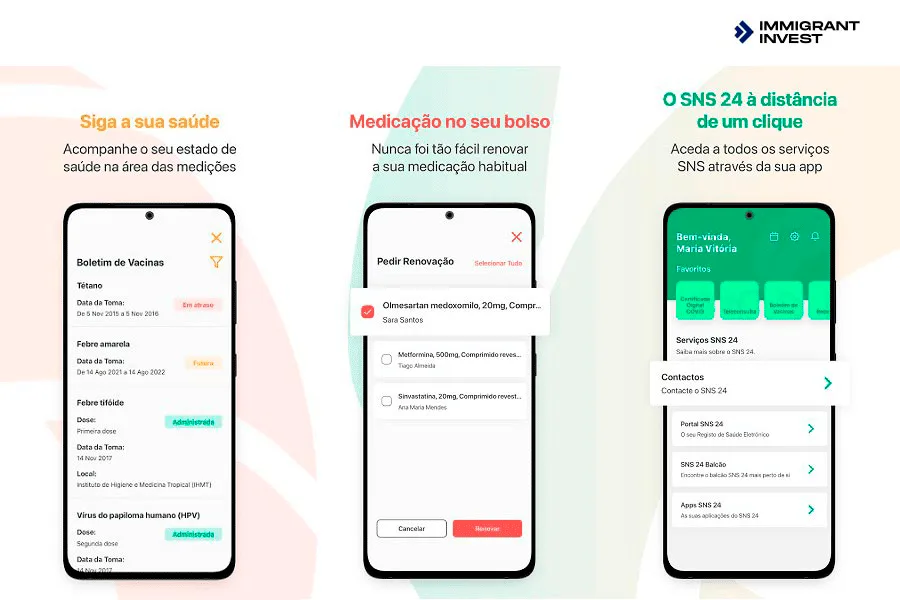
Here is the SNS mobile application, which is available for download in Google Play and App Store
How much does Portugal medical care cost?
Medical care from the list of mandatory services is free for Portuguese residents who contribute to the Social Security Fund, as well as pregnant women, children and pensioners. Everyone pays for additional diagnostics.
Cost of treatment in public hospitals
The SNS mainly covers the cost of treatment in public hospitals. User fees ended in almost all SNS services on June 1st, 2022[5]Source: Gov.pt — End of user fees in almost all SNS services. A fee remains for hospital emergency attendance when the patient has no prior SNS referral and is not admitted.
Exempted from fees in any situation are the following groups of patients[5]Source: Gov.pt — End of user fees in almost all SNS services:
- pregnant women and women in labour;
- children under 12;
- people with a disability of 60% or more;
- blood, cell, tissue and organ donors;
- patients after transplantation;
- firefighters and military;
- veterans with disabilities received during their service;
- dependents, the unemployed and people in difficult economic situations[6]Source: List of people and circumstances to qualify for fee exemptions.
Cost of private services
The cost of private medical care depends on the region. Usually, the larger the city, the more expensive consultations and treatment.
The average prices for treatment in private hospitals in Portugal are:
- €80 — a doctor's consultation;
- €102 — emergency care;
- €60 — an X-ray;
- €130 — an ultrasound diagnostics;
- €38 — ECG;
- €250 — a CT scan.
How to register in SNS
Portuguese citizens and legal residents can register with Portugal’s National Health Service, or SNS, and obtain a healthcare user number known as a Número de Utente[7]Source: Procedure of obtaining an SNS registration number.
The procedure takes approximately 1—2 days, excluding any delays in obtaining the required documents or processing the application.
Check whether you already have a Número de Utente
Portuguese citizens usually have their Número de Utente linked to their Citizen Card. They can present this card when visiting a public health centre or hospital.
Residents may receive a Número de Utente through their employer. Before applying, check whether a number has already been assigned to you.
Portuguese citizens usually have their Número de Utente linked to their Citizen Card. They can present this card when visiting a public health centre or hospital.
Residents may receive a Número de Utente through their employer. Before applying, check whether a number has already been assigned to you.
Prepare the required documents
Prepare the following documents:
- valid residence permit or permanent residence card;
- your Portuguese tax identification number, or NIF.
Prepare the following documents:
- valid residence permit or permanent residence card;
- your Portuguese tax identification number, or NIF.
Choose a health centre
Select a convenient public health centre, known as a Centro de Saúde. You can search for health centres through the official ePortugal portal.
You may need to register at the centre responsible for your residential address.
Select a convenient public health centre, known as a Centro de Saúde. You can search for health centres through the official ePortugal portal.
You may need to register at the centre responsible for your residential address.
Apply in person
Visit the selected Centro de Saúde and ask to register with the SNS. Present the required documents to the registration staff.
Opening hours, appointment requirements and waiting times may vary between health centres.
Visit the selected Centro de Saúde and ask to register with the SNS. Present the required documents to the registration staff.
Opening hours, appointment requirements and waiting times may vary between health centres.
Receive your Número de Utente
Registration is free of charge. In many cases, the Número de Utente is issued during the visit. However, processing may take longer if the centre needs to verify your documents or request additional information.
Once issued, the Número de Utente can be used when accessing SNS healthcare services and arranging medical consultations.
Registration is free of charge. In many cases, the Número de Utente is issued during the visit. However, processing may take longer if the centre needs to verify your documents or request additional information.
Once issued, the Número de Utente can be used when accessing SNS healthcare services and arranging medical consultations.
Medical insurance in Portugal
Healthcare coverage in Portugal combines the tax-funded National Health Service with supplementary private insurance and special arrangements for certain visitors.
State coverage system
Portugal’s National Health Service, or SNS, is a tax-funded public healthcare service available to citizens and eligible residents. It is not a health insurance policy and cannot be replaced by private insurance[8]Source: OECD — Portuguese health-system structure.
Patients can use the SNS to access care at public health centres and hospitals, subject to the applicable eligibility rules, referral procedures and charges.
Private health insurance
Private health insurance and occupational health subsystems provide supplementary coverage. They may offer faster access to appointments, treatment in private facilities or services that are not fully covered by the SNS.
In 2024, the Portuguese Insurance and Pension Funds Supervisory Authority, or ASF, recorded approximately 4 million people with private health insurance, representing an annual increase of 3.6%[9]Source: ASF — Health-insurance market indicators for 2024.
Gross written health-insurance premiums reached €1.7 billion in 2024. The average premium was approximately €418 per insured person[9]Source: ASF — Health-insurance market indicators for 2024.
The cost and scope of private insurance vary considerably. Policies may include coverage limits, exclusions, waiting periods, excesses and co-payments. When the cost of treatment exceeds the policy limit or falls outside the policy’s coverage, the patient is responsible for the remaining amount.
Insurance for tourists and non-residents in Portugal
Applicants for a Schengen short-stay visa must normally present travel insurance valid throughout the Schengen Area, with minimum cover of €30,000[10]Source: Regulation (EC) No 810/2009, Article 15. Requirements differ for visa-exempt visitors and residence-visa applicants.
Citizens insured in an EU state, Iceland, Liechtenstein, Norway, Switzerland or the UK can use a valid European Health Insurance Card, EHIC, to access medically necessary state healthcare during a temporary stay in Portugal.
Treatment is provided under the same conditions and at the same cost as for people insured in Portugal, so it may not be free. However, the EHIC is not a substitute for travel insurance[11]Source: European Commission on the European Health Insurance Card.
Citizens of Andorra, Brazil, Cape Verde, and Morocco can also receive public medical assistance. The governments of these countries have entered into mutual agreements on health care with Portugal.

Medical emergency in Portugal
In Portugal, there are Medical Emergency Centers — Centros de Orientação de Doentes Urgentes, CODU. You can seek help by calling 112; SNS 24 can be reached on 808-24-24-24 for triage and referral in non-life-threatening situations. Ambulances, fire trucks, and paramedic teams respond to calls[12]Source: Official website of the National Institute of Medical Emergency.
When a patient is taken to the admissions department of the hospital, the staff determines the severity and assigns him a bracelet of a particular colour:
- red — urgent resuscitation or surgery is required;
- orange — help is needed as soon as possible;
- yellow — the patient can wait one hour for the doctor;
- green — the disease is not severe, and the patient can be referred to a day hospital or a family doctor;
- blue — does not need urgent help.
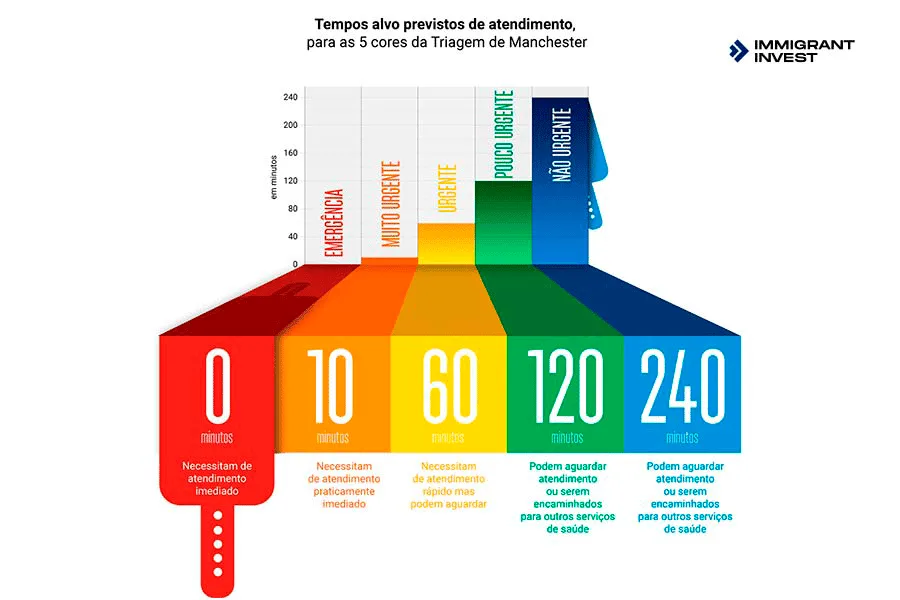
The picture shows the Portuguese system for assessing the condition of patients who are taken to hospitals by ambulance
Pregnancy and childbirth in Portugal
Gynaecology and obstetric services are available at public hospitals and health centres across Portugal. Routine maternity care provided through the National Health Service, or SNS, generally does not attract a user fee.
Pregnancy care is usually coordinated through the woman’s local primary-care team and the maternity pathway assigned to her area. Depending on her medical needs, she may be referred to hospital obstetric services, including specialist care for a high-risk pregnancy.
Women may also choose to receive some or all of their pregnancy care at a private clinic, subject to the clinic’s fees and any private insurance coverage.
During the first visit, the gynaecologist gives the patient a pregnancy book — Boletim de Saúde da Grávida, which records examinations, test results, and relevant medical information.
Expectant mothers may also attend antenatal preparation classes, including exercise, breathing and childbirth education sessions. Some SNS facilities offer these classes, while private courses such as prenatal yoga or gymnastics may involve an additional charge.
Most births take place in hospitals. Women may also use the services of a doula for practical and emotional support during pregnancy, childbirth and the postnatal period. A doula does not replace the medical professionals responsible for clinical care.
Medical care for children in Portugal
Children's health is one of the priorities in the Portuguese healthcare system, so treatment for children is free. The current National Child and Youth Health Programme entered into force on June 1st, 2013[13]Source: National Child and Youth Health Programme. Paediatricians, family doctors and general practitioners provide medical care for children[14]Source: Paediatricians society in Portugal.
Children undergo medical examinations from birth, and all information about the child's health is kept in the medical record.
Portugal has a National Vaccination Programme under which vaccinations are generally free and strongly recommended, but not generally compulsory. Specific diphtheria and tetanus vaccination requirements may apply in certain education-related circumstances[15]Source: Gov.pt — Preventive healthcare and vaccination.
Portugal also has a system to support children aged 0—6 and their families when the child has an impairment affecting development or faces a serious risk of developmental delay — the Sistema Nacional de Intervenção Precoce na Infância, or SNIPI.
SNIPI units are open in all areas of Portugal and include the following specialists:
- nurses;
- social workers;
- educators;
- speech therapists;
- physiotherapists.
If necessary, other specialists are also involved, such as specialist doctors and nutritionists. Support is provided in the settings where the child usually spends time, including at home, in residential care or at kindergarten.
Children with physical or psychological impairments affecting their development, as well as children who meet the criteria for a serious risk of developmental delay, may be eligible for SNIPI support[16]Source: The list of diseases is published on the SNIPI's website.

Most private and public hospitals in Portugal have an emergency department for children under 17
Dentistry in Portugal
The services of Portuguese dentists are most often paid for. Free or subsidised dental care is available to certain eligible patients through public programmes.
You can receive subsidised care from participating dental providers. Appointments in private clinics are otherwise paid for by the patient or covered by private insurance, depending on the policy. Some participating private clinics accept the Cheque-Dentista, an electronic dental voucher issued through the SNS[17]Source: SNS Transparency/DGS — National Oral Health Promotion Programme.
The Cheque-Dentista programme is available through relevant pathways to:
- children and young people up to the age of 18;
- pregnant women receiving pregnancy care through the SNS;
- older people receiving the solidarity supplement, Complemento Solidário para Idosos;
- people living with HIV;
- patients referred for early oral-cancer diagnosis and treatment;
- other SNS users referred through primary-care oral-health services.
Mental healthcare in Portugal
The National Mental Health Program aims to promote the integration of mental healthcare into the SNS, both in primary and long-term care. It focuses on mental health promotion, mental illness prevention, treatment, and rehabilitation.
Pediatric hospitals in Lisbon, Porto, and Coimbra have mental health centres for children and adolescents. Portugal created Children and Adolescents Community Mental Health Teams. Children’s mental health care is provided by nursing, psychological, social, and rehabilitation support.
Primary care is a common entry point for non-emergency mental-health needs. SNS 24 can provide triage, while urgent or life-threatening situations require emergency services.
Depending on your situation, your doctor can:
- prescribe medication;
- refer you to counselling or a specialist;
- for more severe conditions, refer you to an emergency or psychiatric unit;
- refer you to a community-based programme.
Psychiatrists in Portugal make medical diagnoses and treatment plans. They must be registered as members of the Ordem dos Médicos.

Psychologists in Portugal can perform in the context of mental and psychological health issues. Unlike psychiatrists, they can’t prescribe medication. Under the law, they must be registered in the Ordem dos Psicólogos Portugueses
Best hospitals in Portugal
Public hospitals in Portugal provide patients with emergency care, outpatient care, aftercare, care for pregnant women and children, psychiatric consultations and palliative care.
There are also specialised clinics in the country, such as dentistry, orthopaedics, and plastic surgery[18]Source: Association of private clinics in Portugal.
The best Portuguese hospitals are located in the capital and major regions of Porto and the Algarve.
Hospital de Santa Maria, Lisbon
Hospital de Santa Maria is one of Portugal’s principal university and tertiary-referral hospitals. Its scale and extensive specialist departments make it particularly suitable when a case requires several disciplines, advanced intensive care or access to clinicians who regularly manage uncommon conditions.
The hospital ranks 3rd among Portuguese health institutions in SCImago’s 2026 assessment, behind two oncology-focused organisations[19]Source: SCImago Institutions Rankings 2026.
Best for: Highly complex and rare conditions, multidisciplinary public care, major emergencies.
Main drawback: As a major public hospital, elective pathways may involve referrals and longer waits.
ULS São José, Lisbon
ULS São José, formerly Centro Hospitalar Universitário de Lisboa Central, is one of Portugal’s largest and most specialised public healthcare organisations.
Its seven hospitals provide complementary expertise in areas including trauma and emergency medicine, neurosurgery, cardiovascular care, transplantation, infectious diseases, paediatrics, maternity care and mental health. This makes it particularly valuable for complex cases requiring coordination between several specialist centres.
The institution ranks 7th among Portuguese health institutions in SCImago’s 2026 assessment[19]Source: SCImago Institutions Rankings 2026. All seven of its hospitals also hold ACSA international quality certification at ‘good’ level.
Best for: Complex multidisciplinary care, trauma and neurosurgery, cardiovascular medicine, transplantation, specialist paediatrics.
Main drawback: Services are distributed across several hospital sites, and public-system referrals and elective waiting times can make access less straightforward.
Unidade Local de Saúde São João, Porto
The hospital is northern Portugal’s leading tertiary university institution, with emergency medicine, high-complexity surgery, transplant services, clinical education and research. It ranks 4th in Portugal in SCImago’s 2026 health-sector ranking[19]Source: SCImago Institutions Rankings 2026.
Best for: Complex care, transplantation, major surgery, critical care, university medicine.
Main drawback: Public-system access and waiting times can be less predictable for non-urgent treatment.
ULS Santo António, Porto
ULS Santo António is a major university and tertiary-referral healthcare organisation serving Porto and northern Portugal. It treats patients referred through national networks for rare and complex diseases and combines advanced clinical care with medical education, research and innovation.
The hospital’s broad capabilities make it a strong option for complicated adult medical and surgical cases, neurosciences, ophthalmology, maternal care and mental health.
The institution ranks 16th among Portuguese health institutions in SCImago’s 2026 overall assessment and 9th when the ranking is restricted to medicine[19]Source: SCImago Institutions Rankings 2026. It has also received international recognition for its connected-health and hospital-technology initiatives.
Best for: Rare and complex diseases, tertiary adult care, neurosciences, advanced surgery, university medicine.
Main drawback: ULS São João generally has greater overall scale and referral depth in northern Portugal, while elective treatment at Santo António may involve public-system waiting times.
Hospitais da Universidade de Coimbra, Coimbra
The Coimbra university-hospital system covers adult university medicine, a dedicated paediatric hospital, maternity services and numerous specialist departments. Its documented areas include heart and vascular medicine, oncology, renal transplantation, neurology, neurosurgery and paediatrics.
The hospital serves as a final-referral institution for several complex services in central Portugal and ranks 6th nationally in SCImago’s 2026 ranking[19]Source: SCImago Institutions Rankings 2026.
Best for: Transplantation, paediatrics, burns, cardiac surgery, highly specialised regional referrals.
Main drawback: Care may be distributed across different hospital campuses, making coordination less straightforward.
Hospital da Luz Lisboa, Lisbon
Hospital da Luz is one of Portugal’s most prominent private hospitals. It combines a broad specialist portfolio with modern diagnostics, coordinated appointments and a more streamlined patient experience than most public institutions.
The Hospital da Luz organisation ranks 9th among Portuguese health institutions in SCImago’s 2026 assessment[19]Source: SCImago Institutions Rankings 2026.
Best for: Premium private multidisciplinary care, planned surgery, international patients.
Main drawback: Costs can be substantial without suitable insurance, and the most unusual or nationally centralised cases may still be referred into the public university system.
Hospital CUF Tejo, Lisbon
CUF is one of Portugal’s largest and most established private healthcare groups. CUF Tejo is its major modern Lisbon hospital and is designed for high-complexity multidisciplinary treatment.
CUF’s parent organisation, José de Mello Saúde, places 5th in SCImago’s 2026 Portugal health-sector ranking, indicating strong research and institutional activity[19]Source: SCImago Institutions Rankings 2026.
Best for: Complex private surgery, cardiology, oncology, neurosciences, coordinated elective treatment.
Main drawback: The quality of an individual pathway still depends heavily on the specific consultant and clinical team selected.
Hospital Lusíadas Lisboa, Lisbon
Lusíadas Lisboa provides more than 40 clinical specialties and has particular strengths in oncology, cardiology, orthopaedic surgery, neurology and reproductive medicine.
The hospital’s Joint Commission International accreditation was revalidated in 2024; the assessment covers more than 1,200 clinical, safety and organisational requirements.
Best for: Internationally accredited private care, orthopaedics, cardiology, oncology, neurology, reproductive medicine.
Main drawback: For ultra-complex academic cases, Santa Maria, São João or Coimbra may offer a deeper subspecialist referral ecosystem.
Instituto Português de Oncologia de Lisboa Francisco Gentil, Lisbon
IPO Lisboa is a specialist cancer institution rather than a general hospital. It ranks 2nd among Portuguese health-sector institutions in SCImago’s 2026 assessment, reflecting its substantial oncology research and institutional impact[19]Source: SCImago Institutions Rankings 2026.
Best for: Cancer diagnosis, surgery, radiotherapy, multidisciplinary oncology.
Main drawback: It is not the correct destination for unrelated general medical or surgical problems.
Hospital de Braga, Braga
Hospital de Braga is the principal specialist and acute-care hospital for a large part of the Minho region, with a referral area extending across the districts of Braga and Viana do Castelo. It provides broad medical, surgical and emergency services and benefits from links with the University of Minho. Its specialist capabilities continue to expand, including the introduction of cardiothoracic surgery in 2025.
The hospital ranks 18th among Portuguese health institutions in SCImago’s 2026 assessment[19]Source: SCImago Institutions Rankings 2026. This relatively low research-weighted position does not fully reflect its importance as a major regional clinical provider.
Best for: Regional tertiary care, emergencies, general and specialist surgery, cardiology, patients in the Minho region.
Main drawback: Patients with exceptionally rare conditions or requiring highly specialised national referral services may need to be transferred to larger university centres in Porto, Coimbra or Lisbon.
Top 10 hospitals and private clinics in Portugal

Pharmacies in Portugal
Portuguese pharmacies — Farmacia — operate throughout the country. The opening hours vary depending on the locality. Pharmacies are usually open from Monday to Friday, 9:00 to 13:00, and 15:00 to 19:00. On Saturdays they are open from 9:00 to 13:00[20]Source: European Commission — Portugal: prescriptions and pharmacies. Emergency pharmacies are open 24/7[21]Source: Lists of pharmacies providing 24-hour service.
Pharmacies dispense medicines both by prescription and without them. The list of drugs sold without a prescription is prescribed in the legislation. For example, it includes antihistamines and antivirals. Antibiotics can only be bought with a doctor’s prescription.
Some medicines, dietary supplements and medical supplies, such as bandages, hydrogen peroxide, and diapers, can be bought in pharmacies, para pharmacies such as Wells, and designated departments of supermarkets. Non-prescription and cosmetic products can be ordered online.
Portugal’s residence permits to access healthcare
A Portuguese residence permit can make it easier for eligible residents to register with the National Health Service, or SNS, and obtain a healthcare user number, Número de Utente. Registration is not always automatic: applicants may need to provide identification, proof of legal residence, a Portuguese address and other supporting documents.
A residence permit does not necessarily make all healthcare free. Access, referral requirements and possible charges depend on the service and the patient’s circumstances. Residents may also take out supplementary private health insurance, whose premiums and conditions vary by provider.
Non-EU nationals can obtain residence in Portugal through employment, self-employment, study, family reunification and several dedicated residence routes.
Golden Visa
The Portugal Golden Visa is available to qualifying non-EU investors. Current qualifying options include:
- investing at least €500,000 in qualifying investment or venture-capital funds that are not directly or indirectly intended for property investment;
- contributing at least €250,000 to arts or the preservation of national cultural heritage;
- investing at least €500,000 in scientific research;
- creating at least 10 jobs;
- investing at least €500,000 in a Portuguese company while creating five permanent jobs or maintaining at least 5 jobs.
Golden Visa applicants are subject to lower minimum physical-presence requirements than holders of standard residence permits: to maintain residence, investors are required to spend only 7 days a year in the county.
D7 Visa
The D7 Visa is intended primarily for non-EU nationals who plan to live in Portugal and have regular, stable passive income from outside the country. This may include pensions, rental income, dividends, royalties or other recurring passive income.
Applicants must normally demonstrate sufficient financial means, suitable accommodation and the intention to reside in Portugal. A residence visa is valid for 4 months and allows its holder to enter Portugal and apply for a residence permit.
The D7 is not an investment programme. Its holders are expected to make Portugal their principal place of residence and comply with the applicable residence requirements.

Digital Nomad Visa
Portugal’s Digital Nomad Visa is intended for non-EU nationals who work remotely for employers or clients based outside Portugal. It is available as either a temporary-stay visa or a residence visa, depending on the intended length of stay.
Applicants must provide evidence of remote employment or independent professional activity and demonstrate income meeting the applicable threshold of €3,680 per month.
Global Talent Visa
The Portugal Global Talent Programme is a residence pathway for experienced professionals, entrepreneurs and innovators who collaborate with an accredited Portuguese university. Participants contribute to academic or innovation projects through activities such as mentoring, research, guest lectures or support for start-ups.
The initial residence permit is valid for 2 years and may be renewed for a further 3 years, provided that the applicant continues their cooperation with the university and meets the applicable residence requirements.
A spouse or partner and dependent children may obtain residence through family reunification. The programme fee starts at €170,000 and covers the main applicant and up to three family members, although government charges, accommodation, insurance and document-related expenses may be payable separately.
Key conclusions on healthcare in Portugal
- Public and private care serve different needs. The SNS provides broad tax-funded access for eligible residents, while private care generally offers faster appointments and more English-speaking specialists.
- SNS access requires registration. Citizens and legal residents can obtain a free Número de Utente through a Centro de Saúde, usually using proof of residence and a NIF.
- Public care is not entirely free. Charges may apply to medicines, dental treatment, private services and some emergency visits without an SNS referral.
- Public specialist appointments can take from several days to a year, whereas paid consultations often provide quicker access.
- Hospital choice should reflect clinical complexity. Major public university hospitals are strongest for rare, complex and multidisciplinary cases, while leading private hospitals focus on coordinated elective treatment and patient convenience.
- Residence permits facilitate healthcare access. Eligible residents can use a Portuguese residence permit to register with the SNS, although the permit does not make every service free and supporting documents may still be required.
Immigrant Invest is a licensed agent for citizenship and residence by investment programs in the EU, the Caribbean, Asia, and the Middle East. Take advantage of our global 15-year expertise — schedule a meeting with our investment programs experts.

 Trusted by 10,000+ investors