









Cultural donations under the Portugal Golden Visa surged in 2025, reaching €46.8 million, nearly four times the €11.7 million recorded a year earlier[1]Source: According to the Dinheiro Vivo, Portuguese business and financial media outlet. These figures show growing interest in the cultural donation route, which allows investors to qualify for Portugal residence by supporting artistic production or the recovery and maintenance of national cultural heritage.
With a standard threshold of €250,000, reduced to €200,000 for eligible low-density projects, cultural donation is the lowest-cost Portugal Golden Visa option.
This guide covers the legal framework, GEPAC's certification role, the application process, and a full cost breakdown.
What is the cultural donation route under the Portugal Golden Visa?
The cultural investment route allows third-country nationals to access the Portugal Golden Visa by making a contribution to an eligible cultural project, rather than investing through a financial instrument or commercial venture. Applicants contribute at least €200,000, depending on the project’s location, and obtain a residence permit valid for 2 years, renewable for further 2-year periods.
The Portugal Golden Visa, officially the Autorização de Residência para Investimento, ARI[2]Source: AIMA: Residence by investment regulations, is regulated by Article 90.º-A of Law No. 23/2007, Portugal’s Aliens Act, in its current consolidated version[3]Source: Diário da República: Legal framework for the entry, stay, exit, and removal of foreigners. The 2023 reform removed real estate and simple capital transfer routes while preserving qualifying cultural support[4]Source: Diário da República: Law No. 56/2023 of October 6th, 2023.
Alongside the cultural donation, the Portugal Golden Visa offers the following options:
- investment in non-real-estate funds — €500,000+;
- transfer of capital for research or scientific activity — €500,000+;
- business investment with creation of 5 jobs — €500,000+;
- creation of at least 10 jobs with no investment threshold.
Investors who participate in the Portugal Golden Visa programme benefit from the right to live in Portugal and to travel visa-free in the Schengen Area. They also gain access to permanent residence after 5 years and are eligible to apply for Portuguese citizenship after 10 years[5]Source: Diário da República: Portuguese Nationality Law of legal residence. For nationals of Portuguese-speaking countries, the citizenship timeline is reduced to 7 years of legal residence.
Cultural donation projects approval
Investors cannot donate to any cultural project and use it for the Portugal Golden Visa. The project must first be approved by GEPAC, the Ministry of Culture body responsible for assessing cultural investment activities under the ARI framework.
This approval starts with the project promoter, not the investor. Under the official procedure, a cultural organisation, foundation, municipal body, or another eligible promoter submits the project to GEPAC for prior assessment.
GEPAC checks whether the receiving entity is eligible, whether the activity fits the legal scope of artistic production or cultural heritage preservation, whether the amount matches the project and territory, and whether the project has clear cultural objectives. Only after this assessment can the project be treated as suitable for the cultural donation route.
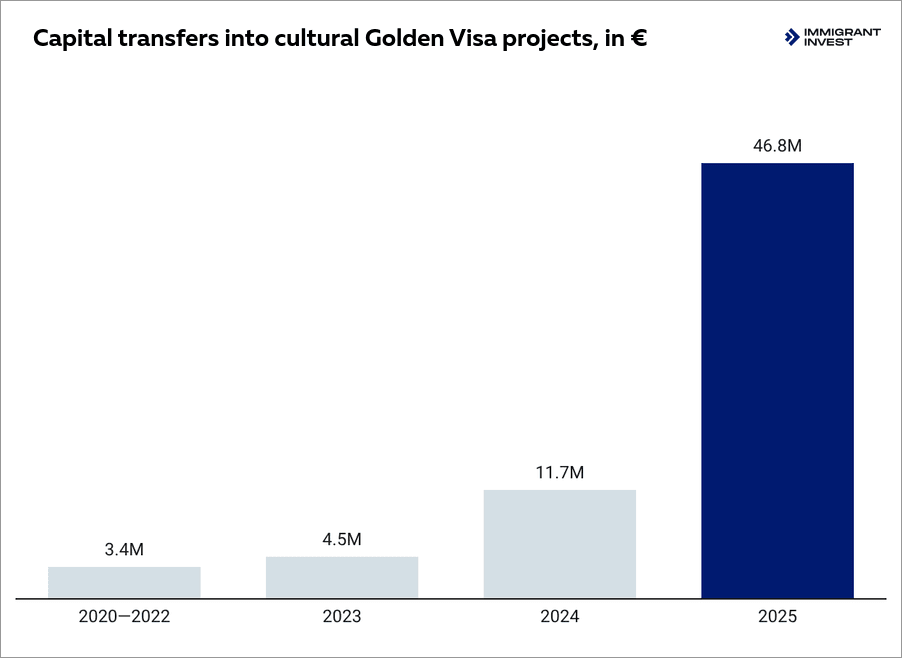
In recent years, the popularity of the cultural donation option has increased significantly, especially following the abolition of the real estate route[6]Source: Jornal de Negócios: 2024, 2025, and total data[7]Source: Diário de Notícias: 2023 figure
Eligibility criteria for the cultural donation option
The cultural donation route is available to third-country nationals — citizens of countries outside the European Union, European Economic Area, and Switzerland. To be eligible for the cultural donation option under the Portugal Golden Visa, the investor must also:
- have no criminal convictions punishable by more than one year of imprisonment in Portugal;
- earn investment money outside Portugal;
- have no debts in Portugal;
- confirm the legality of their income.
The following family members can be added to the application:
- spouse or registered partner, same-sex couple included;
- children under 18;
- children under 25, provided they remain financially dependent and are full-time students and/or live with the investor;
- parents of the investor or the investor's spouse — if under 65, they must be financially dependent.

Trusted by 10,000+ investors
Check your eligibility for the Portugal Golden Visa
5 benefits of the cultural donation option under the Portugal Golden Visa
The Portugal Golden Visa cultural donation option is designed for investors who want residence in Portugal without managing a fund investment or taking part in the daily running of a project. The route combines a comparatively low entry threshold with a clear donation process and a visible cultural impact.
Lowest investment threshold
The cultural donation has the lowest investment threshold among the Portugal Golden Visa options. The standard amount is €250,000, while some approved cultural projects in low-density areas qualify for a reduced threshold of €200,000.
By comparison, other routes require more capital. For example, investment fund units and business investment options start from €500,000. This makes the cultural donation route attractive for investors whose main goal is Portuguese residence rather than financial return.
Zero ongoing risk or management burden
Unlike fund investments, the donation does not expose the investor to market fluctuations, fund performance, liquidity risk, or exit uncertainty. There are also no subscription fees, annual management fees, performance fees, or capital lock-up periods. The amount is fixed from the start, so investors know the cost of this part of the process in advance.
The donor is also not responsible for managing or delivering the cultural project. After the donation is made, the beneficiary entity and the project team handle implementation, reporting, and execution.
Transparent, government-approved projects
Cultural donation projects are assessed by GEPAC, the Ministry of Culture body responsible for validating cultural investments under the Portugal Golden Visa. Approved projects receive official recognition that they qualify as cultural activities for Golden Visa purposes.
Donations are made through dedicated project bank accounts and supported by formal agreements, confirmations, audit trails, and reporting. This adds transparency to the process and helps investors understand where the contribution goes and which entity is responsible for the project.
Creating cultural and regional impact
The cultural donation option allows investors to support real projects with long-term cultural value. These are not paper-only initiatives created only for immigration purposes. The available projects include documentary films, television series, heritage initiatives, and projects connected with regional development, Portuguese history, folklore, architecture, and environmental awareness.
Through such projects, donors can help preserve local memory, promote Portuguese cultural identity, support jobs in the creative economy, and bring attention to regions that are less visible internationally.
Non-financial acknowledgment
Some projects also offer non-financial recognition for donors. Depending on the project, this may include the donor’s name in the credits of a film or television series, invitations to premieres, set visits, meetings with the director or cast members, signed posters, crew gifts, or private project-related experiences.

Castelo Branco is one of the regions represented in the cultural Golden Visa projects. This municipality is treated as a low-density territory, with its parishes forming the basis of a documentary series
How does the Portugal Golden Visa cultural donation route work?
Under the cultural donation route, the investor does not purchase an asset, subscribe to a fund, or provide a loan. The investment takes the form of a non-refundable donation — a transfer of capital — to a qualifying cultural project. There is no expectation of financial return, no right of redemption, and no equity interest in the receiving entity.
Qualifying projects
Qualifying projects under the Portugal Golden Visa cultural donation route generally fall into two broad groups: artistic production and cultural heritage preservation.
Category 1: artistic production. This may include original creative works such as feature films, television series, documentaries, theatre, music, performing arts, literary projects, and other cultural initiatives.
To qualify, the project must have a genuine cultural or artistic purpose and be carried out through an eligible receiving entity, such as a public cultural body, public or private foundation with public utility status, intermunicipal entity, municipal organisation, or other recognised cultural organisation.
Current examples include an Emmy-winner-led television series rooted in Portuguese history and mythology, and a documentary project about the creation of an elephant sanctuary in Alentejo. Such projects may have active production plans, recognised creative teams, and non-financial donor acknowledgement frameworks, such as credits, premiere invitations, or project-related experiences.
Category 2: cultural heritage preservation. This covers projects aimed at the recovery, maintenance, restoration, or conservation of Portuguese cultural heritage. Eligible projects may involve historic buildings, cultural sites, museum assets, archives, collections, or other heritage initiatives.
Before capital is transferred, the project or activity should have the relevant GEPAC assessment or eligibility confirmation for ARI purposes. A project that appears culturally credible but has not been assessed or confirmed under the GEPAC process should not be treated as a safe basis for a Golden Visa application.
Investment thresholds
The threshold is determined by project location.
The baseline cultural donation is €250,000, applicable to projects located anywhere in Portugal.
A reduced threshold of €200,000 applies to projects carried out in qualifying low-density territories — areas defined under Portuguese regional classification criteria as having fewer than 100 inhabitants per km² or a GDP per capita below 75% of the national average[8]Source: Diário da República: Regulatory Decree No. 15-A/2015, of September 2nd, 2015.
The cultural donation at €200,000 depends not only on regulatory criteria but on live project availability, as capacity at this threshold is inherently limited.

How eligible cultural projects are selected and documented
Cultural projects are reviewed and approved by the Gabinete de Estratégia, Planeamento e Avaliação Culturais, GEPAC, the Ministry of Culture’s strategic planning and evaluation office.
GEPAC is the competent body for cultural investment procedures and issues the investor-specific declaration confirming that capital has been transferred to an eligible project. This declaration is one of the required documents for a Golden Visa application under the cultural donation route[9]Source: Diário da República: Order No. 2360/2017, of March 20th, 2017.
How the GEPAC process work: project review, reservation, and investor declaration
There are 4 key stages in the GEPAC documentation process:
- The project promoter initiates the approval process by submitting the project to GEPAC for review.
- The cultural project or activity is assessed and recognised as eligible by GEPAC.
- Once the project has GEPAC approval, the investor can reserve a donation slot and receive the project eligibility declaration.
- After the donation is transferred, the investor or their lawyer requests the investor-specific cultural declaration.
Project selection normally takes place before the donation is made. Investors and their lawyers review the available projects, including their cultural scope, institutional sponsor, producer or creative team, location, GEPAC status, donation amount, budget, timeline, and donor acknowledgement terms.
If the project is already approved, the investor may proceed to reservation. If it is still pending approval, the investor may enter pre-reservation, which converts into a reservation once GEPAC approval is issued.
Due Diligence on the receiving entity
Before committing to a project, the investor must verify the following points:
- foundation or organisation holds a current, valid GEPAC certificate — not an expired or pending one;
- project has a dedicated bank account specifically for donor funds, separate from any general operating account of the entity;
- entity can produce a signed Investment Agreement specifying the project, donation amount, donor acknowledgement terms, and dedicated account details;
- entity has a documented process for issuing the formal Confirmation of Donation.

Pedro Barata,
Head of Portuguese office
Through our partnership with a specialised cultural project operator in Portugal, we can give investors access to a vetted pipeline of GEPAC-approved projects. After the investor selects a suitable option, we help reserve a donation slot and confirm the key terms before the main contribution is made.
How much does it cost to obtain the Portugal Golden Visa through cultural donation?
A cultural donation is only one part of the total cost of the Portugal Golden Visa. Investors should also budget for government fees, document preparation, and other application-related expenses.
AIMA government fees are charged per applicant. For example, a family application that includes the main investor, a spouse, and 2 children will incur fees for all family members at the applicable rates. The required donation amount, however, does not increase with family size: it remains the same whether the investor applies alone or with eligible dependants.
Cost breakdown of the cultural donation option

How to obtain the Portugal Golden Visa through cultural donation: step-by-step process
The cultural donation application follows a structured workflow, moving from preliminary Due Diligence through to biometrics and permit issuance.
Based on Immigrant Invest’s experience, the minimum processing timeframe is 12 months. However, due to backlogs at the Agency for Integration, Migration, and Asylum, the authority responsible for processing applications, the procedure may take 18—36 months.
1 day
Preliminary Due Diligence
Immigrant Invest conducts a preliminary Due Diligence check to identify any circumstances preventing the applicant from participation in the Portugal Golden Visa programme.
Upon successful completion of the check, Immigrant Invest prepares a service agreement to provide further support.
Immigrant Invest conducts a preliminary Due Diligence check to identify any circumstances preventing the applicant from participation in the Portugal Golden Visa programme.
Upon successful completion of the check, Immigrant Invest prepares a service agreement to provide further support.
2+ weeks
Document collection
An assigned Immigrant Invest lawyer provides the investor with a list of required documents and then helps certify them and arrange translations.
An assigned Immigrant Invest lawyer provides the investor with a list of required documents and then helps certify them and arrange translations.
1+ weeks
Obtaining a tax number and opening a bank account in Portugal
Before capital can be transferred, the investor must hold a Portuguese tax identification number, NIF, and a Portuguese bank account. NIF can be obtained remotely through a fiscal representative without travelling to Portugal.
The Portuguese bank account is opened after NIF issuance, and KYC and source-of-funds verification happen at this stage.
Before capital can be transferred, the investor must hold a Portuguese tax identification number, NIF, and a Portuguese bank account. NIF can be obtained remotely through a fiscal representative without travelling to Portugal.
The Portuguese bank account is opened after NIF issuance, and KYC and source-of-funds verification happen at this stage.
2+ weeks
Project selection and reservation of a slot
Immigrant Invest helps the investor choose a project suitable for obtaining a Golden Visa to Portugal. Experts provide official information about eligible culture projects and arrange a consultation with organisation managers for the final selection.
Once a project is selected, Immigrant Invest submits the investor's passport to the project to formally reserve a slot.
Immigrant Invest helps the investor choose a project suitable for obtaining a Golden Visa to Portugal. Experts provide official information about eligible culture projects and arrange a consultation with organisation managers for the final selection.
Once a project is selected, Immigrant Invest submits the investor's passport to the project to formally reserve a slot.
1+ weeks
Investment
A formal donation agreement is executed between the investor as donor and the beneficiary cultural foundation or organisation as donee. The agreement specifies the project, the donation amount, the dedicated account details, the acknowledgment benefits, and the obligation of the foundation to issue the formal Confirmation of Donation.
The investor transfers €200,000 or €250,000 by bank wire directly to the project's dedicated bank account. After verifying receipt of the transfer, the cultural foundation issues the formal Confirmation of Donation.
A formal donation agreement is executed between the investor as donor and the beneficiary cultural foundation or organisation as donee. The agreement specifies the project, the donation amount, the dedicated account details, the acknowledgment benefits, and the obligation of the foundation to issue the formal Confirmation of Donation.
The investor transfers €200,000 or €250,000 by bank wire directly to the project's dedicated bank account. After verifying receipt of the transfer, the cultural foundation issues the formal Confirmation of Donation.
≈ 6 months
Residence application and biometrics submission
After the contribution is transferred, the investor adds the supporting documents to the application package, including:
- GEPAC investor declaration;
- signed Investment Agreement;
- certified bank transfer evidence;
- formal Confirmation of Donation.
The electronic application is submitted to AIMA, Agency for Integration, Migration, and Asylum.
At the same time, the lawyer schedules an appointment for the investor and their family members to submit biometrics and personal documents for residence permits at AIMA. All applicants then travel to Portugal.
After the contribution is transferred, the investor adds the supporting documents to the application package, including:
- GEPAC investor declaration;
- signed Investment Agreement;
- certified bank transfer evidence;
- formal Confirmation of Donation.
The electronic application is submitted to AIMA, Agency for Integration, Migration, and Asylum.
At the same time, the lawyer schedules an appointment for the investor and their family members to submit biometrics and personal documents for residence permits at AIMA. All applicants then travel to Portugal.
Within 6 months after biometrics
Obtaining residence cards
AIMA reviews the documents of the investor and their family within 6 months of the biometric submission date.
Once the application is approved, the investor pays the required fee for the residence permit cards.
Cards are issued within 6 months after biometrics and are collected in person by the investor or by a lawyer under power of attorney.
AIMA reviews the documents of the investor and their family within 6 months of the biometric submission date.
Once the application is approved, the investor pays the required fee for the residence permit cards.
Cards are issued within 6 months after biometrics and are collected in person by the investor or by a lawyer under power of attorney.
Every 2 years
Residence permit renewal
Residence permit cards are valid for 2 years and can be renewed subsequently, provided that all holders spend at least 7 days per year in Portugal.
To renew the documents, investors are not required to make a new contribution.
Residence permit cards are valid for 2 years and can be renewed subsequently, provided that all holders spend at least 7 days per year in Portugal.
To renew the documents, investors are not required to make a new contribution.
Cultural donation vs. investment fund route: which fits your profile?
Both the cultural donation and investment fund routes lead to the same minimum stay requirements, family inclusion rules, and eligibility route towards permanent residence and, separately, citizenship by naturalisation. The main differences lie in capital commitment, recoverability, fees, and risk exposure.
The cultural donation route is usually better suited to investors whose primary objective is EU residence rather than capital return. It offers the lowest capital commitment compatible with Portuguese residence and a path to citizenship: €200,000 for eligible projects in low-density territories, or €250,000 for other qualifying cultural projects.
The donation is irrevocable and does not generate financial return, but its cost is known from day one, with no ongoing management fees, fund selection, portfolio monitoring, market exposure, or exit uncertainty.
The fund route may be more appropriate for investors who want to keep their capital in an investment structure and are willing to accept financial risk in exchange for potential return. It requires at least €500,000 and may offer capital recovery or profit, but neither is guaranteed.
Investors should also account for subscription fees, annual management fees, fund strategy, liquidity terms, and the possibility that the exit value may be lower than expected.
Cultural donation vs. fund investment: comparison
Risks and pitfalls of obtaining the Portugal Golden Visa through cultural donation
The cultural donation route carries specific risks that investors should assess before committing funds. The donation is irrevocable, the processing timeline is subject to administrative variables outside any party's control, and regulatory changes can affect long-term planning.
1. Donation is permanently irrecoverable
The cultural contribution is a non-refundable donation. Unlike a qualifying fund subscription, there is no lock-up period to wait out and no buyback mechanism to activate. If the application is refused, the donated capital is not returned.
Eligibility screening, criminal record review, and source-of-funds verification are most protective when completed before any donation transfer is initiated, not after.
2. Slot scarcity at the €200,000 threshold operates without public notice
Projects qualifying at the lower €200,000 threshold must be located in officially designated low-density territory, and the number of such projects with current GEPAC certification and available donor capacity is limited. The GEPAC directory does not display real-time capacity, so a project that appears open may already be fully allocated.
Investors who complete NIF registration and bank account opening, which can take several weeks, sometimes find their preferred project unavailable by the time they are ready to transfer funds. Slot availability is best confirmed and reserved concurrently with document preparation, not after it.
3. Project-level execution risk varies by project type
Heritage-preservation projects, where restoration needs exist regardless of market conditions, carry different operational risk profiles to artistic or performance-production projects, where outcomes can depend on audience reception, distribution agreements, or production schedules.
A project that is delayed, restructured, or cancelled after donation does not restore the investor's capital and may also affect the documentary completeness required for the AIMA proof pack. GEPAC certification confirms legal eligibility, not operational maturity or timeline credibility.
Practical Due Diligence on the beneficiary organisation, including its track record, legal structure, dedicated donation account, and current certification status, goes beyond confirming GEPAC listing.
4. AIMA processing backlogs create extended periods of legal uncertainty
Portugal Golden Visa applications may face delays at several stages of AIMA processing, especially when scheduling biometrics appointments and issuing physical residence cards. Even after the donation has been completed and the proof pack has been submitted, applicants may wait months before biometrics are scheduled or the next procedural step is confirmed.
This can create a difficult planning period: the application is pending, but the applicant may not yet have a biometrics slot, approval, or a residence card. The uncertainty can affect decisions about travel, relocation, tax planning, schooling, and employment.
For this reason, investors should base their plans on realistic timeline ranges rather than best-case projections, and should allow for delays between submission, biometrics, approval, and card issuance.
5. Political and regulatory changes can affect long-term planning
The Portugal Golden Visa was substantially restructured in October 2023, showing that investment migration rules are not fixed. Further administrative or legislative changes may affect qualifying territories, GEPAC eligibility criteria, renewal practice, or other parts of the process before an investor reaches later milestones.
Citizenship is often part of an applicant’s long-term plan. The recent extension of the naturalisation period to 7 years for citizens of the EU and Portuguese-speaking countries and to 10 years for all other nationals shows that the rules in force at the time of investment may differ from the rules at the moment when the investor becomes eligible to apply.
For this reason, planning based on a single regulatory scenario is fragile. Investors should allow for possible changes between the application, renewal, permanent residence, and any future citizenship application.
6. Source-of-funds documentation failures block the donation before it can be made
Before the donation transfer can occur, the investor must open a Portuguese bank account.
Portuguese banks apply their own KYC requirements independently of AIMA and GEPAC. Clients who cannot quickly produce acceptable source-of-funds evidence — bank statements, asset declarations, corporate ownership chains, or tax returns in a recognised format — face delays that can push them past a slot reservation window or a project's certification renewal date.
Source-of-funds documentation is most usefully assembled before project selection begins, not after slot reservation.
7. Inclusion of family members is more restricted than families typically expect
Adult children qualify only if they are unmarried, enrolled in full-time education, and financially supported by the main applicant. Children over 25 are generally not eligible. Parents may also qualify, but the requirements depend on their age: those under 65 must prove financial reliance on the investor.
Family eligibility, including the age and dependency status of each potential secondary applicant, should be confirmed before the investment threshold or programme route is selected.
How Immigrant Invest can help you obtain the Portugal Golden Visa
Immigrant Invest provides end-to-end support for the cultural donation application, from preliminary Due Diligence check through to AIMA filing and beyond.
We have an office in Portugal, which gives clients local support throughout the Golden Visa process. Our team can coordinate directly with Portuguese lawyers, tax advisers, banks, cultural project operators, and other local counterparties, helping to reduce communication gaps and keep each stage properly documented.
We handle NIF registration, Portuguese bank account opening, document preparation, donation transfer coordination, and biometrics support through a single team with a single point of accountability. For investors who cannot travel to Portugal multiple times during the process, this consolidated service model reduces delays at each handoff point.
Our support continues after the residence permit is issued. We assist clients with matters that may arise while they hold Portuguese residence, including document renewals and replacements, tax consultations, company registration, and relocation support.
Key takeaways on the cultural donation route under the Portugal Golden Visa
- The Portugal Golden Visa allows third-country nationals to obtain a residence permit in Portugal in exchange for investment. One of the routes is a donation to cultural projects, which offers the lowest threshold under the programme.
- The cultural donation amount is €200,000 for qualifying low-density territory projects or €250,000 for projects located anywhere in Portugal, the lowest entry point across all current investment routes.
- The donation is non-refundable and produces no financial return: there is no capital return, no management fee, no lock-up, and no financial upside.
- All cultural projects are approved by GEPAC, or the Ministry of Culture's strategic planning and evaluation office, in Portugal.
- Portugal Golden Visa investors can live and work in Portugal, travel visa-free in the Schengen Area, apply for permanent residence after 5 years, and seek citizenship after 7 or 10 years of legal residence, depending on their nationality.
Immigrant Invest is a licensed agent for citizenship and residence by investment programs in the EU, the Caribbean, Asia, and the Middle East. Take advantage of our global 15-year expertise — schedule a meeting with our investment programs experts.

 Trusted by 10,000+ investors