










Portugal Golden Visa is often viewed as a residence route, but for wealthy families it can also work as an asset diversification tool.
Through a qualifying investment fund, investors can place capital into a regulated Portuguese investment structure while securing residence rights in an EU country.
This guide explains how the fund route works, which costs and risks to model, why fund selection matters before committing €500,000, and what benefits the Portugal Golden Visa can offer beyond asset diversification.
What is the Portugal Golden Visa?
The Portugal Golden Visa is a residence by investment programme officially called Autorização de Residência para Investimento, ARI, and introduced under Article 90-A of Law No. 23/2007[1]Source: AIMA — Portugal Golden Visa. The programme allows non-EU investors to obtain residence in Portugal by making an investment, including a €500,000 subscription in eligible investment funds.
For investors focused on asset diversification, the Portugal Golden Visa fund route combines two goals: access to a regulated investment and legal residence in the EU. It allows investors to diversify part of their wealth through a Portuguese fund structure while securing mobility, Schengen access, and a long-term residence option for themselves and eligible family members.
After 10 years of legal residence, Golden Visa holders may apply for Portuguese citizenship, provided they meet requirements such as basic knowledge of the Portuguese language, history, culture, and political system.

Trusted by 10,000+ investors
Check your eligibility for the Portugal Golden Visa
How the Portugal Golden Visa supports diversification for investors
For high-net-worth families, the Portugal Golden Visa for asset diversification delivers two separate outcomes: capital deployment and EU residence optionality.
Through eligible fund investment
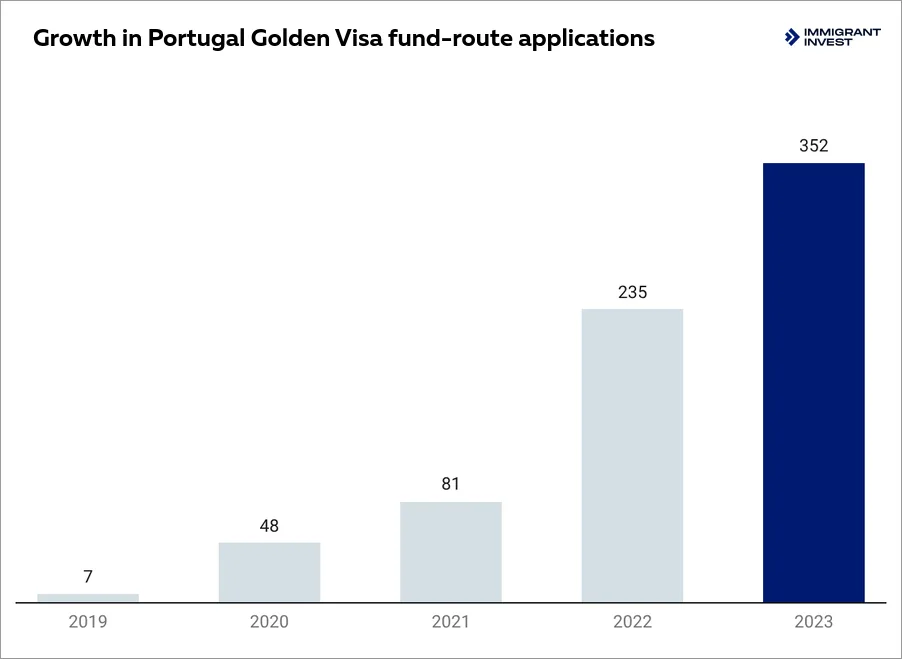
Portugal’s Golden Visa has supported asset diversification since its launch, when real estate was its most popular route. Investors bought property in Portugal not only to qualify for residence, but also to add a tangible European asset with potential capital appreciation and rental income.
In 2023, Portugal changed the Golden Visa rules and removed the real estate route[2]Source: Diário da República — Lei n.º 56/2023, de 6 de outubro. Demand then shifted to the remaining options: investment funds, business, scientific research contributions, and cultural donations.
The minimum €500,000 fund subscription is an illiquid alternative investment with its own risk and return profile: it may generate gains, stay flat, or lose value, regardless of the immigration benefit. Among the remaining options, funds stand out because they help investors:
- spread capital across several companies, sectors, or assets;
- gain exposure to Portuguese and European markets without direct asset management;
- access sectors such as private equity, venture capital, hospitality, renewable energy, healthcare, technology, or infrastructure;
- rely on professional managers who select assets, monitor performance, handle reporting, and make investment decisions;
- choose a strategy that matches their risk profile, as some funds focus on lower- or medium-risk assets while others target higher returns.
The shift towards the fund route under the Portugal Golden Visa reflects a broader wealth-management trend. According to Capgemini’s World Wealth Report 2025, high-net-worth individuals allocate 15% of portfolios to alternative investments, while two-thirds plan to increase private equity exposure[3]Source: Capgemini’s World Wealth Report 2025. Funds can fit this allocation.
Through EU residence optionality
For investors concentrated in one political, regulatory, or currency environment, the Portugal Golden Visa can create a second legal base without full relocation: investors need to spend only 7 days in Portugal per year to keep the status valid. Families who manage most of their wealth and daily life in the US, UK, or Australia gain more flexibility for travel, education, lifestyle, and long-term planning.
Wider wealth trends support growing North American interest in European residence options. North America’s high-net-worth individual population grew by 7.3% in 2024, while Europe’s fell by 2.1%[4]Source: Capgemini — North America high-net-worth individual population surges, while Europe and Middle East shrink. As wealth grows in North America, more US and Canadian families are considering the Portugal Golden Visa to diversify assets and jurisdictional exposure.
7 Portugal Golden Visa benefits besides asset diversification
Beyond asset diversification, the Portugal Golden Visa works as a wider planning tool for wealthy families, combining mobility, business access, tax flexibility, work rights, education, healthcare, citizenship prospects, and year-round lifestyle advantages.
1. Freedom of movement
Portugal residence permit holders can travel visa-free across the 29 Schengen Area countries. This makes short trips across the EU simple: Spain is reachable by car or train, while France, Italy, Germany, the Netherlands, and other countries are only a few hours away by plane.
Portugal also has regular international flights from Lisbon, Porto, and Faro, which makes travelling for business, holidays, or family visits convenient.
2. Business opportunities
Portugal Golden Visa investors and their family members can freely conduct business in Portugal. The country is attractive for technology, renewable energy, tourism, healthcare, life sciences, and export-oriented services. In 2024, Portugal’s economy grew by 1.9%, more than double the EU average, driven by tourism, construction, pharmaceuticals, and energy[5]Source: U.S. Department of State — 2025 Portugal Investment Climate Statement.
Portugal is also recognised as a strong environment for startups and innovation. In the World Bank’s Business Ready assessment, the country ranks in the top 20% of economies, with strong scores for its regulatory framework and digital infrastructure[6]Source: The World Bank — Business Ready: Portugal. Lisbon remains the main startup hub, while Porto, Braga, and other cities are building their own technology and innovation ecosystems.
3. No automatic tax residence
A Portugal Golden Visa does not make the investor a tax resident automatically. Tax residence usually applies if a person spends at least 183 days a year in Portugal or has their centre of vital interests there. The Golden Visa has a low stay requirement of just 7 days per year, so investors can keep Portuguese residence without necessarily becoming tax residents.
If investors become Portuguese tax residents, they may apply for the IFICI regime. Applicants must carry out eligible high-value activities, such as research, innovation, technology, or other qualified professional work. The regime offers a 20% flat tax rate on Portuguese income for 10 years, compared with standard progressive rates that can reach 48%[7]Source: Portal das Finanças — IFICI regime.
4. Work rights
Golden Visa investors and their family members can work in Portugal, where the labour market remains active but not overheated. Employment reached 5.45 million people in December 2025, the highest figure recorded by Eurostat[8]Source: Eurostat — Portugal employment. At the same time, the job vacancy rate stood at 1.4% in Q4 2025, below the EU average of 2%[9]Source: Eurostat — Job vacancy rate.
5. Access to healthcare and education
Portugal Golden Visa applicants must have private health insurance, but residence also gives access to the public healthcare system. Families can combine it with private care for faster appointments, wider specialist choice, and English-speaking doctors in major cities.
Children of Golden Visa investors can attend public schools in Portugal free of charge. Families who prefer English-language education can choose international schools, mainly in Lisbon, Porto, Cascais, and the Algarve. Tuition ranges from around €6,000 to over 25,000 per year, depending on the school, grade, curriculum, and location.
6. Pathway to citizenship
A Portugal Golden Visa can become a route to citizenship over time. Investors usually qualify after 10 years of legal residence in Portugal. Citizens of Portuguese-speaking countries may apply sooner — after 7 years. There is also a faster route for children born in Portugal: they receive Portuguese citizenship at birth if at least one parent has legally lived in Portugal for 5 years.
Portuguese citizenship gives families an EU passport. With it, they can live, work, study, and do business in any EU country. Portuguese citizens also get visa-free or visa-on-arrival access to over 170 countries and territories.
7. Mild climate for business and lifestyle planning
Portugal’s mild climate makes business travel and networking easier throughout the year. Investors can visit Portugal outside the peak holiday season to meet advisers, fund managers, lawyers, business partners, or developers without major weather disruptions. Average temperatures are around +15°C in winter and +25…30°C in summer on the mainland.
For families, the climate supports a comfortable long-term base. Mild winters and warm summers make it easier to plan extended stays, gradual relocation, or school holidays in Portugal. Families can enjoy golf, sailing, surfing, hiking, cycling, wine tourism, wellness retreats, and outdoor dining across much of the year.


Investors in Madeira may enjoy the island’s natural beauty alongside lower corporate tax rates: 13% generally, and 8.75% for small and medium-sized enterprises[10]Source: PwC — Taxes on corporate income in Portugal
What are the investment routes under the Portugal Golden Visa?
Portugal Golden Visa applicants can qualify through several investment routes, but they serve different goals. Some are non-refundable contributions, others require active business involvement, while the fund route combines residence eligibility with a regulated investment asset. For asset diversification, this difference is key.
Portugal Golden Visa fund option for asset diversification
A subscription of at least €500,000 in eligible investment funds can give non-EU investors the right to apply for a Portuguese residence permit. These funds work like regular investment funds, but must also meet Golden Visa criteria and be regulated by Comissão do Mercado de Valores Mobiliários, CMVM, Portugal’s securities market regulator.
A fund pools investors’ capital and invests it in assets such as Portuguese companies, commercial property, industrial sites, or European stocks. The minimum holding period is 5 years, although investors usually redeem their units after 6—12 years and receive any returns net of fees.
Among all Portugal Golden Visa routes, CMVM-regulated funds are the only option that combines immigration eligibility with a professionally managed, audited, and regulated investment asset.
Other investment options
Besides the fund option, Portugal Golden Visa investors can choose four other routes:
- Supporting arts and culture — €250,000+.
- Investment in research activities — €500,000+.
- Business investment — €500,000+, with the creation of at least 5 jobs.
- Opening a company — no fixed minimum investment threshold, but at least 10 jobs must be created. In low-density areas, the requirement may be reduced to 8 jobs.
The cultural route shows how demand changed after Portugal removed the real estate option. In 2024, cultural-route investments grew by 165%, reaching €12 million for the year and €22.15 million in total since the programme began[11]Source: Schengenvisainfo — Portugal Sees Increased Interest in Cultural Heritage Golden Visa. However, this route does not work as an asset-diversification strategy: once the contribution is made, the capital is not returned.
Business and job-creation routes suit investors who want to run or expand a company in Portugal. For those focused on capital preservation and portfolio diversification, the fund route is more suitable because it offers exposure to a regulated investment asset rather than a donation or an active business commitment.
Portugal Golden Visa investment routes comparison

Portugal Golden Visa funds for asset diversification: key things to know
CMVM-regulated funds are the main Portugal Golden Visa routes for investors who want both capital deployment and immigration eligibility. They can support asset diversification, but legal, liquidity, and risk constraints should be checked before committing €500,000.
CMVM oversight and Golden Visa eligibility
Regulation. Qualifying funds must be authorised by CMVM, Portugal’s securities market regulator[12]Source: Portugal’s securities market regulator — Comissão do Mercado de Valores Mobiliários. CMVM-regulated funds follow reporting, custody, valuation, and audit rules. This distinguishes them from unregulated offshore products or informal investment mandates.
Eligibility. CMVM authorisation alone does not automatically make a fund eligible for the Portugal Golden Visa. The fund must also meet the programme rules. CMVM does not keep a separate public list of Golden Visa-eligible funds, and Immigrant Invest works only with verified funds and checks their eligibility before subscription.
Risk spread. Programme rules allow investors to split the required €500,000 between several qualifying funds. This approach helps reduce concentration risk by avoiding full exposure to one manager, one strategy, and one portfolio, while preserving Golden Visa eligibility.
Allocation. Golden Visa-eligible funds must invest at least 60% of the subscription value in companies based in Portugal[13]Source: Portugal Aliens Act — Law No. 23/2007. This gives investors access to the Portuguese market, but it also means the investment is not fully global. The remaining 40% may be invested in other markets, depending on the fund’s strategy. Some managers use this flexibility to add sector or geographic diversification.
Trusted by 10,000+ investors
Quick guide to Portugal Golden Visa investment funds
Open vs. closed funds
A fund may be open-ended or closed-ended, which affects how and when the invested capital can be returned.
Open-ended funds usually allow investors to subscribe and redeem units during defined periods, although redemptions can still be limited by notice periods, gates, or liquidity rules. They may offer more flexibility, but early redemption can affect Golden Visa eligibility.
Closed-ended funds are more common for private equity, venture capital, and long-term investment strategies. Investors commit capital for a fixed term and usually exit only when the fund sells its assets, reaches maturity, or offers a formal redemption window. This structure can match long-term Golden Visa planning, but it also means capital is locked for longer.
Types of qualifying funds
Qualifying funds can follow different investment strategies. Each type has its own risk, return, and liquidity profile.
Venture capital funds invest in early-stage companies. They may offer higher growth potential, but the risk and volatility are also higher.
Private equity funds invest in established companies at growth or mature stages. They are usually less volatile than early-stage venture funds, but their target returns may also be lower.
Mixed or balanced funds combine different asset classes, such as equity and fixed-income positions. They may offer a more moderate risk profile.
Sector-specific funds focus on areas such as technology, healthcare, infrastructure, energy, or real estate development. These funds can be useful for targeted exposure, but they also increase dependence on one sector.
Holding period and redemption risks
Golden Visa-eligible funds must have a minimum maturity of 5 years at the time of investment. In practice, many investors redeem their units after 6—12 years, depending on the fund’s rules and exit strategy.
The key risk is timing. The fund’s redemption schedule and the investor’s immigration timeline are not automatically aligned. If the fund redeems before the investor has secured the required residence period or citizenship outcome, the investor may need to reinvest in another option to avoid an eligibility gap.
The opposite can also happen. If the fund extends beyond its expected term, capital may remain locked for longer than planned.

Pedro Barata,
Head of Portuguese office
To maintain the Portugal Golden Visa, the investor must keep an investment in place. A fund’s poor performance, lower return, or fall in net asset value does not usually affect the residence permit as long as the investor still holds the fund units and the fund continues to operate.
The problem arises if the fund is liquidated or redeemed before the investor no longer needs the Golden Visa. Once the capital is returned, the original investment no longer supports the residence permit. In this case, the investor may need to reinvest in another option to keep the Golden Visa valid.
Target returns
Fund returns depend on what the fund invests in, how risky the strategy is, how well the manager selects assets, market conditions, fees, and the exit price. A higher target return usually means higher risk or less predictable results. A lower target return may mean a more conservative strategy, but it does not automatically make the fund safer.
For example, a fund targeting 8% per year may invest in more stable assets and aim for moderate growth. A fund targeting 15% per year usually needs faster growth, higher-risk assets, or more successful exits to reach that result. The second fund may bring higher profit, but it can also deliver a lower return or even a loss if the strategy underperforms.
Profit distribution
Besides the target return, the profit distribution model also matters. Some funds reinvest income until exit, while others make periodic distributions. Expected profit sharing shows when and how the fund plans to pay income before final redemption. For example, funds may offer:
- 5.5% annual income distribution;
- 2% annual dividend distribution starting after the first year;
- 8% annual dividend distribution from year two plus 80% of profit.
Some funds do not offer profit sharing at all and reinvest income until exit. Periodic payments are not the same as the total fund return: the final result also depends on capital repayment, exit value, fees, and taxes.
Portugal Golden Visa eligible funds 2026
Who can apply for the Portugal Golden Visa: eligibility criteria
Eligibility for the Portugal Golden Visa is assessed for both the main applicant and the family members included in the application. These criteria define the document package and affect how the fund investment route is structured.
Main investor eligibility
To qualify for the Portugal Golden Visa through investment funds, the main applicant must:
- be at least 18 years old;
- not hold citizenship of Switzerland, the EU, or the EEA;
- have no criminal record;
- hold comprehensive health insurance;
- have legal income sources outside Portugal.
A clean criminal record means the applicant must not have a conviction that would carry a prison sentence of more than 1 year under Portuguese law or in their country of origin.
Documents proving the legal source of the invested money should trace the money clearly: where it originated, how it was accumulated, and how it reached the Portuguese bank account.
Family eligibility
The Portugal Golden Visa also allows the investor to include eligible family members in the same application:
- spouse or legal partner — with clean criminal record;
- children under 18;
- financially dependent children up to 26, if they live with the investor or study at university;
- parents of the main applicant or their spouse.
Parents aged 65 or older can be included without proof of financial dependence. Parents under 65 must provide documents confirming they are financially dependent on the investor.

Portugal Golden Visa costs: fund fees and other expenses
The total cost of obtaining the Portugal Golden Visa through fund investment goes beyond the €500,000 subscription. Fund fees, government charges, renewal costs, and health insurance affect the overall budget and final net return.
Fund fees
Portugal Golden Visa funds usually charge several types of fees which can reduce the final return and differ significantly between funds.
Subscription fee: 0—2%. A one-time fee charged on the amount invested when fund units are purchased.
Performance fee: 0—30%. A fee charged only if the fund generates profit or exceeds a defined return threshold. For example, if the performance fee is 30%, the manager may take 30% of the profit, while 70% remains with the investor. The exact calculation depends on the fund terms, including hurdle rates and other conditions.
Pedro Barata,
Head of Portuguese office
Choosing the right fund depends on the investor’s priorities: target return, fee tolerance, risk profile, preferred sector, liquidity needs, and expected exit timeline.
For example, some funds may suit investors who accept higher fees in exchange for a more liquid and diversified strategy, a 6-year term, and a higher target return of 15—20%. Others may suit more conservative investors who prioritise lower fund costs, such as a 0.25% annual management fee, annual dividend distribution after the first year, and clearer exit mechanics.
In simple terms, the choice usually comes down to a trade-off between higher-return, higher-fee strategies and lower-fee, lower-return options with a more straightforward income and exit structure.
Government fees and health insurance
Portugal Golden Visa government fees are paid for each applicant, including family members. The cost includes two main payments:
- application fee of €632.10;
- residence card issuance fee of €6,314.20.
The residence permit must be renewed every 2 years. The government renewal fee is €3,157.80 per person.
Portugal Golden Visa investors must also buy health insurance for each family member for the whole residence period. Coverage must be at least €30,000, and policies usually start at around €400 per person per year, or €800 per person for the first 2-year residence period.
The table below shows the estimated costs of the Portugal Golden Visa through a fund with no fees. The fund has a 12-year maturity term, while investment returns may be available after 6 years.
First Portugal residence permit costs through the purchase of fund units
How to get a Portugal Golden Visa for asset diversification through fund investment: step-by-step process
Based on Immigrant Invest experts’ experience, obtaining a Portugal Golden Visa through fund investment takes at least 12 months. The process is straightforward in structure, but document-heavy in practice, so preparation before submission is critical.
Processing times can still vary: AIMA reportedly had 45,000—50,000 pending Golden Visa cases in February 2025, and biometrics appointments may create delays[14]Source: Bloomberg — Portugal speeds up Golden Visa processing. A positive change came in February 2026, when AIMA launched an online renewal portal to streamline renewal submissions and make the renewal process more convenient for investors[15]Source: AIMA — Online ARI renewal portal announcement.
Immigrant Invest lawyers in Portugal support investors at every stage, from choosing a suitable fund and preparing documents to completing the investment and applying for a residence permit.
1 day
Preliminary Due Diligence
Immigrant Invest carries out a preliminary Due Diligence check to detect any issues that could prevent the applicant from qualifying for the selected programme. The procedure is fully confidential.
If the check is successful, Immigrant Invest prepares a service agreement for further legal support.
Immigrant Invest carries out a preliminary Due Diligence check to detect any issues that could prevent the applicant from qualifying for the selected programme. The procedure is fully confidential.
If the check is successful, Immigrant Invest prepares a service agreement for further legal support.
2 weeks
Collecting documents
A dedicated Immigrant Invest lawyer helps the applicant prepare the required documents, including certification and translation where needed.
Typical documents required for the Portugal Golden Visa include:
- passport;
- birth certificate, if applicable;
- marriage certificate, if applicable;
- tax identification number in the country of residence;
- bank statement for the previous 6 months;
- health insurance;
- police clearance certificate;
- authorisation for AIMA to check Portuguese criminal records;
- proof of tax compliance;
- proof of residential address in Portugal;
- documents confirming the legal source of investment funds;
- completed and signed forms, including investment subscription forms, anti-money laundering declarations, and investor profile questionnaires.
Documents issued in languages other than English or Portuguese must be translated into Portuguese, with the translation certified by a Portuguese lawyer.
A dedicated Immigrant Invest lawyer helps the applicant prepare the required documents, including certification and translation where needed.
Typical documents required for the Portugal Golden Visa include:
- passport;
- birth certificate, if applicable;
- marriage certificate, if applicable;
- tax identification number in the country of residence;
- bank statement for the previous 6 months;
- health insurance;
- police clearance certificate;
- authorisation for AIMA to check Portuguese criminal records;
- proof of tax compliance;
- proof of residential address in Portugal;
- documents confirming the legal source of investment funds;
- completed and signed forms, including investment subscription forms, anti-money laundering declarations, and investor profile questionnaires.
Documents issued in languages other than English or Portuguese must be translated into Portuguese, with the translation certified by a Portuguese lawyer.
1—2 weeks
Registering a taxpayer number in Portugal
A Portuguese taxpayer number, Número de Identificação Fiscal, NIF, is required to open a bank account, subscribe to investment fund units, and apply for a residence permit.
Foreign investors can obtain a NIF remotely through a Portuguese tax representative. They may also apply in person at an office in Portugal.
A Portuguese taxpayer number, Número de Identificação Fiscal, NIF, is required to open a bank account, subscribe to investment fund units, and apply for a residence permit.
Foreign investors can obtain a NIF remotely through a Portuguese tax representative. They may also apply in person at an office in Portugal.
1—1.5 months
Opening an account in a Portuguese bank
The Portugal Golden Visa investment must be made from the applicant’s Portuguese bank account.
We help open and activate it. Once it is ready, the applicant transfers the required investment amount.
The Portugal Golden Visa investment must be made from the applicant’s Portuguese bank account.
We help open and activate it. Once it is ready, the applicant transfers the required investment amount.
1 week to 1.5 months
Making the investment
Immigrant Invest helps choose a reliable investment fund that qualifies for the Portugal Golden Visa and matches the investor’s goals. Lawyers provide official fund information and arrange consultations with fund managers so the investor can make the final decision.
The lawyers collect the supporting documents that confirm the investment has been made.
Immigrant Invest helps choose a reliable investment fund that qualifies for the Portugal Golden Visa and matches the investor’s goals. Lawyers provide official fund information and arrange consultations with fund managers so the investor can make the final decision.
The lawyers collect the supporting documents that confirm the investment has been made.
5—6 months
Applying for the Portugal Golden Visa
Once the documents are ready, the lawyers submit the application and electronic copies of the supporting documents to AIMA, the Portuguese Agency for Integration, Migration, and Asylum.
Once the documents are ready, the lawyers submit the application and electronic copies of the supporting documents to AIMA, the Portuguese Agency for Integration, Migration, and Asylum.
1—2 weeks
Submitting biometrics in Portugal
The investor and their family travel to Portugal for a biometrics appointment, where they submit fingerprints and present the original documents. The AIMA appointment is booked in advance for a convenient date and time.
The investor and their family travel to Portugal for a biometrics appointment, where they submit fingerprints and present the original documents. The AIMA appointment is booked in advance for a convenient date and time.
Within 6 months after biometrics
Receiving the residence permit card
AIMA reviews the investor’s original documents and makes a final decisio on the residence application. After approval, the investor pays the residence card issuance fee and receives the card in person or through a lawyer acting by proxy.
AIMA reviews the investor’s original documents and makes a final decisio on the residence application. After approval, the investor pays the residence card issuance fee and receives the card in person or through a lawyer acting by proxy.
Every 2 years
Renewing the residence permit card
The Portugal Golden Visa residence permit must be renewed every 2 years. For each renewal, the investor must confirm that the qualifying investment is still maintained, prove compliance with the minimum stay requirement, provide updated criminal record certificates, and pay government renewal fees for each family member.
Immigrant Invest lawyers help prepare the renewal documents, check deadlines, and submit the application so the investor can keep residence status without interruptions.
The Portugal Golden Visa residence permit must be renewed every 2 years. For each renewal, the investor must confirm that the qualifying investment is still maintained, prove compliance with the minimum stay requirement, provide updated criminal record certificates, and pay government renewal fees for each family member.
Immigrant Invest lawyers help prepare the renewal documents, check deadlines, and submit the application so the investor can keep residence status without interruptions.
What American investors need to know before applying for the Portugal Golden Visa
American investors can apply for the Portugal Golden Visa on the same basis as other non-EU nationals. The main difference is not immigration-related, but tax-related. US citizens and tax residents remain subject to US tax rules even when they invest abroad, so fund selection should be checked with a US tax adviser before subscription.
US tax risks come first
Many Portugal Golden Visa funds may be treated as Passive Foreign Investment Companies, PFICs, under US tax law. A foreign fund may fall into this category if most of its income is passive or if most of its assets produce passive income[16]Source: IRS — Instructions for Form 8621.
PFIC status can create unfavourable tax treatment for US investors. If no election is made, PFIC gains and certain distributions may be taxed at the highest applicable US federal income tax rate, currently 37% for individuals, plus an interest charge over the holding period. For a fund held for several years, this can significantly reduce the final return.
Fund tax treatment needs planning
One common way to reduce PFIC tax risk is a Qualified Electing Fund, QEF, election. With this election, the US investor reports their share of the fund’s ordinary earnings and capital gains each year, instead of waiting until the fund pays out or is sold[16]Source: IRS — Instructions for Form 8621.
A QEF election is only possible if the fund manager provides an annual PFIC information statement with the data required by the IRS. The investor cannot create this information independently. For this reason, annual PFIC reporting availability is an important point to confirm with the fund manager before subscription.
Annual revaluation may not be available
Another possible PFIC option is the mark-to-market election, where the investor reports annual changes in the value of the investment. However, this usually applies only to marketable shares that are regularly traded on a qualified exchange.
Most private Golden Visa funds are not traded on an exchange, so this option is usually unavailable. For a specific fund, the use of this option depends on confirmation from a US tax adviser.
Foreign reporting is mandatory
American investors with a Portuguese bank account or a Portugal Golden Visa fund investment need to file annual US reports. The main forms are:
- FinCEN Form 114, or FBAR. Applies if the total value of foreign financial accounts exceeds $10,000 at any point during the year. The form is due on April 15th of the following year, with an automatic extension to October 15th[17]Source: IRS — Report of Foreign Bank and Financial Accounts.
- Form 8938 under FATCA. Applies if specified foreign financial assets exceed the relevant threshold. The threshold starts at $50,000 for single taxpayers living in the US and can reach $600,000 for married couples living abroad. Form 8938 is usually due on April 15th for calendar-year taxpayers[18]Source: IRS — Instructions for Form 8938.
Penalties for missing these forms can be severe. US tax review is therefore important before fund subscription, especially with a CPA experienced in international tax reporting.
Golden Visa residence is not tax residence
Holding a Portugal Golden Visa residence card does not automatically make an American investor a Portuguese tax resident. Tax residence usually applies if a person spends more than 183 days in Portugal in a 12-month period or has a home in Portugal that suggests habitual residence.
Investors who meet only the Golden Visa minimum stay requirement usually do not become Portuguese tax residents.
Pedro Barata,
Head of Portuguese office
If an American investor later becomes a Portuguese tax resident, they may face obligations in both countries. Portugal may tax them as a resident, while the US continues to tax US citizens on worldwide income.
This does not automatically mean double taxation, but it does require planning. A US Certified Public Accountant and a Portuguese tax adviser should review the tax treaty, foreign tax credits, reporting duties, and expected income before the investor relocates or spends significant time in Portugal.
Risks and pitfalls of using Portugal Golden Visa funds for asset diversification
The Portugal Golden Visa fund route can support asset diversification, but it is not risk-free. The final decision depends on the fund structure, immigration timeline, tax position, and other risks linked to the €500,000 investment.
Fund exit may not match the citizenship timeline
A qualifying fund must usually have a minimum maturity of 5 years, but Portuguese citizenship is now usually available after 10 years of legal residence, or 7 years for citizens of Portuguese-speaking countries. This means the fund’s exit date and the investor’s citizenship timeline may not align.
If the fund redeems capital before the investor secures the required residence period or citizenship outcome, the investor may need to reinvest in another qualifying option to keep the Golden Visa valid. The opposite is also possible: the fund may extend its term by 1 or 2 years, keeping the capital locked for longer than expected.
The fund’s maturity date, extension clauses, redemption windows, and the immigration timeline all affect how suitable the fund structure is for the Portugal Golden Visa.
Regulation does not mean capital protection
CMVM regulation means the fund must follow reporting, custody, audit, and compliance rules. It does not mean the investor’s capital is insured, protected from losses, or guaranteed to generate returns.
A Golden Visa fund can lose value while the investor’s residence status remains valid. For capital preservation, the regulated fund label is not enough: the fund’s strategy, risk level, assets, fees, manager track record, and downside scenarios also matter.
Investors do not control fund decisions
Fund investors do not own or manage the underlying assets directly. The fund manager decides what to buy, when to sell, how to allocate capital, and when investors can exit. This differs from direct property ownership or running a business.
This risk is usually managed through due diligence before subscription: reviewing audited accounts, custodian arrangements, valuation methods, governance rules, advisory board structure, fee terms, and the manager’s experience through market cycles.
Currency risk can reduce real returns
The €500,000 investment is made in euros. Investors whose wealth is held in US dollars, British pounds, UAE dirhams, or other currencies face exchange-rate risk.
Currency movements can affect the result at several stages: when funds are converted into euros, when distributions are paid, and when capital is redeemed and converted back. Even if the fund performs well, an unfavourable exchange rate can reduce the investor’s real return.
Source-of-funds checks can delay or block the application
Funds, banks, custodians, and AIMA require clear proof of the investment money’s origin. Weak documentation can delay the process or create rejection risk.
Common issues include money held in joint accounts, undocumented family transfers, unclear inheritance records, unsupported intercompany transfers, or cash savings without a banking trail. Source-of-funds review takes place before fund documents are signed or capital is transferred.
Tax status can create unexpected obligations
Holding a Golden Visa does not automatically make the investor tax resident in Portugal. Tax residence usually depends on actual presence, such as spending 183 or more days a year in Portugal, or having a home there that indicates an intention to live in the country habitually.
US investors face an additional issue. Many qualifying funds may be treated as Passive Foreign Investment Companies under US tax rules, which can trigger annual reporting and potentially unfavourable taxation without proper planning. For US investors, cross-border tax review with a CPA is important before fund subscription.
Programme rules can change
Portugal’s Golden Visa programme has changed several times since launch, including the removal of real estate routes. Future changes may affect timelines, procedures, or eligibility rules. Grandfathering is not always automatic and may depend on when the application was submitted and whether it was complete.
Pedro Barata,
Head of Portuguese office
The fund route is not suitable for every investor. Before committing €500,000, applicants need to consider their liquidity needs, risk tolerance, tax position, and ability to prepare the required documentation.
The fund route may not suit investors who:
- need access to the €500,000 within the next 5 years;
- expect guaranteed returns;
- do not want to accept market, currency, or liquidity risk;
- are US persons unwilling to manage fund-related tax reporting;
- want a simpler non-refundable contribution route instead of an investment product.
For investors who do not want fund-related risks, other Portugal Golden Visa options may be more suitable, such as cultural support, research investment, or business and job-creation routes.
How Immigrant Invest helps with a Portugal Golden Visa for asset diversification
Immigrant Invest is a consulting company specialising in residence and citizenship by investment since 2006. More than 10,000 investors have trusted us with their investment migration cases, including Portugal Golden Visa applications.
For investors using the Portugal Golden Visa as an asset diversification tool, we support the process at each key stage:
- preliminary compliance check before any engagement fee is collected;
- source-of-funds review before contracts are signed or capital is transferred;
- assessment of fund eligibility under Portugal Golden Visa rules;
- coordination with independent specialists where tax or investment advice is required;
- NIF registration and Portuguese bank account opening by power of attorney;
- preparation of the Golden Visa application, including family members;
- submission of the application through the official portal;
- coordination of biometrics appointments in Portugal;
- renewal support every 2 years;
- monitoring of legal and regulatory changes that may affect the investor’s timeline.
Immigrant Invest’s role is to coordinate the immigration process and prepare the application file for AIMA. We do not replace licensed financial advisers, US CPAs, or Portuguese tax advisers, but can help coordinate communication with qualified tax and financial specialists when needed.
We also have an office and lawyers in Portugal, which allows us to monitor programme updates locally and respond quickly to any changes.
Key takeaways on the Portugal Golden Visa for asset diversification
- Portugal Golden Visa funds can support asset diversification because they combine residence eligibility with a regulated investment asset.
- The minimum fund investment is €500,000. Funds may invest in sectors such as hospitality, renewable energy, technology, agriculture, credit, infrastructure, and fixed income.
- Fund capital is usually locked until redemption. Depending on the fund terms, investors may receive their capital and returns after 6—12 years.
- Other options include cultural donation, scientific research, and business investment, but they work as non-refundable contributions or business injections rather than portfolio assets.
- Obtaining a Portugal Golden Visa usually takes at least 12 months. The first residence permit is valid for 2 years and must be renewed to keep residence status.
- Investors can include family members in their Portugal Golden Visa applications, such as a spouse or partner, children under 26, and parents.
- Portuguese tax residence does not start automatically with the Golden Visa. It usually begins if the investor spends at least 183 days a year in Portugal or moves their centre of vital interests there.
- Beyond asset diversification, the Portugal Golden Visa gives access to Schengen visa-free travel, business and work opportunities, tax optimisation options, healthcare and education, and a mild climate for long-term living.
- Portuguese citizenship may become available after 10 years of legal residence, or 7 years for citizens of Portuguese-speaking countries.
Immigrant Invest is a licensed agent for citizenship and residence by investment programs in the EU, the Caribbean, Asia, and the Middle East. Take advantage of our global 15-year expertise — schedule a meeting with our investment programs experts.

 Trusted by 10,000+ investors