









European countries offer residence permits by investment that do not require relocation. Investors can maintain their existing lifestyle while securing plan B and access to the Schengen Area.
This article explains how zero-days and low-stay Golden Visa options work, and what benefits and risks US applicants should consider before applying.
Why US citizens seek European residence without relocation
For many US citizens, European residence is not about immediate relocation. It is a tool that provides an additional place of residence, and a long-term backup plan for the family.
This type of status is usually relevant to investors who want to keep their life and business in the United States while gaining the right to live in Europe if circumstances change. In practice, the main interest often comes from family security, education planning, and the possibility of applying for citizenship in the future.
Several European countries offer residence by investment routes that do not require full relocation. Among the best-known options are Greece, Malta, Hungary, Latvia, and Italy.
Portugal, and Cyprus require limited physical presence under Golden Visa programme rules.
7 key benefits of a zero-days European residence for US citizens
A zero-days or minimal-days European residence permit gives US citizens legal residence rights in Europe without requiring full relocation. For most applicants, this is not a lifestyle move at the start. It is a practical way to build optionality, protect family interests, and create a legal base in Europe while keeping life, business, and tax ties in the United States.
Some advantages of European residence usually become meaningful only after a person actually moves, or at least spends substantial time in the host country.
1. Plan B in case of emergency relocation
For many US applicants, the main value of European residence lies in optionality. A valid residence permit gives the investor and their family the legal right to move to the host country. This is useful when living conditions drastically change, including political instability, personal security concerns, family emergencies, or broader economic uncertainty.
2. Family inclusion and long-term security for relatives
All of the EU residence by investment programmes allow the main applicant to include close relatives in one application: spouse, dependent children, and sometimes parents or grandparents.
For families, this creates more than mobility. It helps secure a long-term safety net for children and older relatives, especially where future residence rights, access to services, and a stable living environment matter as much as the investor’s own status.
3. Potential passive income from the investment
Greece, Portugal, and other countries allow applicants to place capital in assets that may generate income. Depending on the programme, this may come from rental property, fund distributions, bond income, or business returns.
Portugal Golden Visa fund route may target an annual return of around 4%, depending on the fund’s strategy and market conditions. This should not be treated as a guaranteed outcome, because returns depend on the fund structure, risk profile, and overall market performance.
In late 2025, the average gross yield for residential property in Athens reached 5.43%. In some central Athens districts, gross yields were higher. For example, one-bedroom apartments in Patision and Kipseli were close to 8%[1]Source: Greek property prices, Bank of Greece.
Greek real estate investment property


Greece, Athens
€720,000+
Cosy and stylish apartments in modern style, Glyfada, Athens
 98 m²
98 m² 2
2  2
2 
Greece, Athens
€1,185,000+
Luxury apartments, Varkiza, Athens
207 m²4 4 
Greece, Kassandra
€505,000+
Modern villa, Sani, Kassandra
170 m²4 3 4. Business opportunities and easier work with European clients
European residence may help investors diversify part of their assets geographically. It can support opening bank accounts, acquiring property, and holding investments outside the United States[2]Source: US tax abroad, IRS, which reduces concentration risk and creates a broader international financial footprint.
For business owners targeting Europe, a residence permit may also make it easier to build a local presence and work with European clients and partners.
For US citizens, holding a European residence permit and moving part of their assets to Europe does not cancel reporting obligations such as FBAR and FATCAs[3]Source: US tax obligations, IRS. However, it may still be valuable for investors who want part of their wealth, banking relationships, or property exposure outside a single jurisdiction.
5. Freedom from stay-limit calculations and a stable European base
A residence permit from a Schengen country removes the usual tourist constraint of 90 days in any 180-day period in the host country[4]Source: Schengen visa rules, European Commission. This gives the holder the right to stay there without counting tourist days and creates a practical European base that can be used when needed.
For investors who spend time in Europe throughout the year, that predictability can be as valuable as the residence status itself.
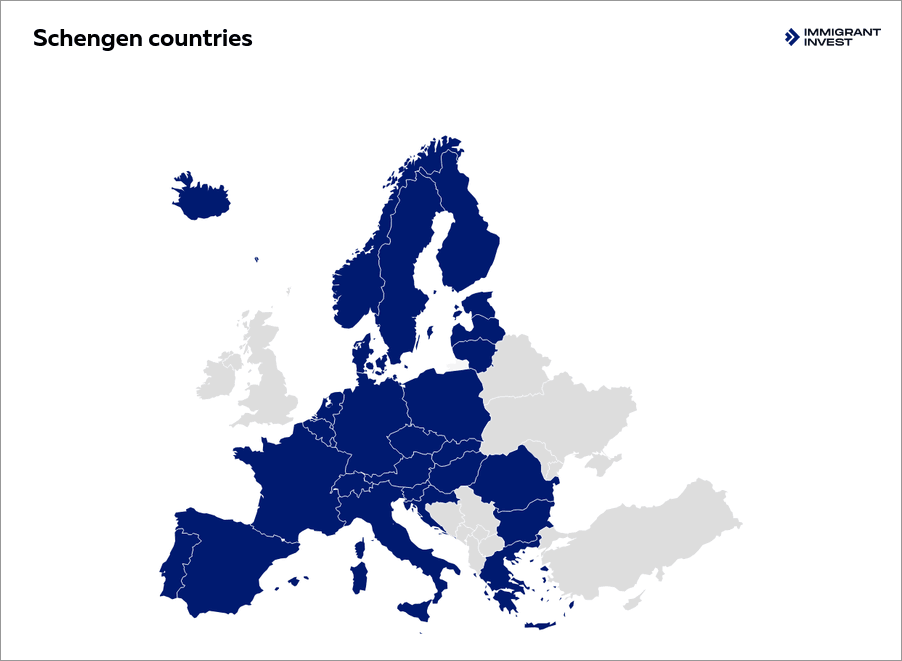
A residence permit from a Schengen country means the 90/180-day tourist rule no longer limits stays in the host country
6. Access to education and healthcare
A European residence permit makes it easier to send children to study in Europe. Europe is home to highly ranked universities, including the University of Bologna and Politecnico di Milano, which appear in the QS Europe 2026 ranking.
European residence permit holders may also arrange treatment in established European clinics if healthcare needs become more urgent later. This matters especially to families planning for older relatives or for future relocation in retirement.
Europe includes internationally recognised hospitals such as:
- Charité in Berlin;
- Karolinska University Hospital in Stockholm;
- Hôpital Universitaire Pitié-Salpêtrière in Paris.
7. Inclusivity and expat-friendly environment
European countries already have infrastructure designed for foreigners. This includes international schools, private healthcare, English-speaking service providers, and professional support in banking, legal matters, and real estate.
Malta is seen as the easiest to navigate for international families because English is an official language.
In Portugal, areas such as Lisbon, Porto, and the Algarve have well-established expat communities and services tailored to foreign residents.
In Cyprus, cities such as Limassol and Paphos are popular among international investors and retirees, which makes relocation more predictable for families who may later decide to move.

Italy Golden Visa turned out to be a good fit for a retirement Plan B
A 58-year-old retiree from the United States invested in a government-approved startup focused on hotel renovation and advanced technologies, with an expected annual return of 3 to 5%. She now lives near Lake Garda, and receives about €10,000 in annual income from the investment
European residence by investment with zero-stay and minimum stay requirement: an overview
Several European countries offer residence permits by investment that do not require investors to live in the country to maintain their status. This format is often referred to as “zero-days” or “minimum stay” residence, as no or minimum physical presence is required for renewal.
Such options are available in Portugal, Greece, Italy, Latvia, Hungary, Malta, and Cyprus. These programmes allow investors to maintain residence and tax ties in their home country while holding legal residence rights in Europe, provided the investment is maintained and renewal conditions are met.
Comparison of European residence by investment options with zero or minimal stay requirements

Greece Golden Visa — the option to invest in real estate
Greece's Golden Visa, governed by L. 5038/2023 and administered by the Ministry of Migration and Asylum, requires zero mandatory physical presence to maintain residence[5]Source: Greece Golden Visa requirements, Ministry of Migration and Asylum. Investors must travel to Greece only for the initial biometric appointment and residence card collection.
Investment threshold. Real estate investments require €400,000 or €800,000 depending on the region. A €250,000 threshold applies to specific categories such as:
- full restoration of listed buildings;
- or conversion of commercial properties into residential use.
Alternative routes include investments in funds, government bonds, or fixed-term deposits starting at €350,000 to 500,000 depending on the category.

Residence permit validity. The Greek residence permit is valid for five years. Investors may renew it indefinitely as long as they keep the investment.
Family inclusion. The programme allows the main applicant to include:
- spouse or unmarried partner,
- unmarried children under 21,
- parents or grandparents of both the applicant and the spouse.
Children under 24 may also qualify if they are enrolled in full-time education.
Family members keep their status for as long as the main applicant’s permit remains valid. When the main applicant’s permit expires, the family members’ permits expire as well.
Processing time. Greek authorities usually issue the residence card within up to 2 months after the applicant submits a complete set of documents, with the total process from the document preparation to getting residence taking at least 4 months.
Key benefits. Greece remains one of the few European Golden Visa programmes that still offers a real estate investment route. The property may be leased on a long-term basis, which gives the investor an opportunity to receive passive rental income.
The investor may also sell it later at a profit. Greek residential property prices have continued to rise in recent years. For example, apartment prices in Greece rose by 7.7% year-on-year in the third quarter of 2025, after increasing by 9.1% on average in 2024[6]Source: residential price indices, Bank of Greece.

Mohamed Zakaria,
Senior Investment Migration Expert
A real estate investment route does not mean that the investor has to manage the property personally. In practice, many tasks may be outsourced to a management company, which can pay the bills, arrange insurance, find tenants, and oversee the property on an ongoing basis.
Investors can keep the residence status and the asset without being physically present in the country, while rental income may be received remotely if the property is suitable for that purpose.
Italy Golden Visa — options for different investor profiles
Italy’s Investor Visa allows applicants to maintain their residence permit without a mandatory stay requirement[7]Source: Italy Investor Visa rules, Italy Government.
Investment options. Applicants may choose one of several investment routes:
- €250,000 in an innovative startup registered in the special section of the Italian Companies Register under Decree-Law 179/2012;
- €500,000 in the share capital of an Italian limited company with an active operational status.
Alternative routes include investments in funds, government bonds, or fixed-term deposits starting from €350,000 to €500,000 depending on the category.
Applicants must complete the investment within 3 months of entry to Italy and maintain it for the whole validity period of the residence permit.
Residence permit validity. Italy issues the initial residence permit for 2 years. The authorities may renew it for 3-year periods if the investment remains in place and continues to meet programme requirements.
Family inclusion. The programme allows the main applicant to include a spouse and minor children. Children over 18 may also qualify if they are disabled or financially dependent. In some cases, dependent parents may be included as well, but the conditions are stricter.
Parents usually qualify only if they are dependent on the applicant and either have no other children in their country of origin, or are over 65 and their other children cannot support them for serious health reasons.
Family members join the main applicant through standard family reunification procedures after the main applicant receives the residence permit.
Processing time. The overall time usually takes at least 4 months. The Nulla Osta decision takes about 1 month, the visa application at the consulate usually takes 1 to 2 months, and the residence permit stage usually takes another 1 to 2 months.
Key benefits. Italy offers investment routes that suit both active business owners and innovation tech enthusiasts. Business-related options can also bring stronger income potential than more conservative investments, where returns often stay around 3—4%, making them a more realistic choice for investors who want both residence and the prospect of higher gains.

A residence permit in Italy makes it easier to enjoy long holidays or seasonal living by the sea without worrying about stay limits
Hungary Golden Visa
Hungary’s Guest Investor Programme allows applicants to obtain a residence permit without a minimum stay requirement for permit maintenance[8]Source: Guest Investor Visa, National Directorate-General for Aliens Policing. The route starts with a Guest Investor Visa, which is valid for up to 6 months and allows the applicant to enter Hungary and then apply for a residence permit.
Investment options. Hungary currently offers two investment routes:
- Acquisition of investment fund units worth at least €250,000 in a real estate fund registered by the Hungarian National Bank.
- Financial donation of at least €1 million to a higher education institution maintained by a public trust with a public-service mission.
The fund route comes with additional technical requirements. The applicant must hold the fund units for at least 5 years, and the fund must meet the statutory conditions, including a portfolio structure linked to Hungarian residential real estate.
Fund investments are recoverable after the holding period. Educational donations are non-refundable.
Residence permit validity. Hungary grants the initial residence permit for up to 10 years. The permit may then be extended once for up to another 10 years for the same purpose.
Family inclusion. The programme allows the main applicant to include a spouse or registered partner and children under 18. Financially dependent parents may be included.
Under the official rules, family members apply through the family reunification route linked to the main applicant’s guest investor status.
Processing time. The process takes 5 months or more, including the official administrative period for the residence permit issue of 21 days.
Key benefits. Hungary offers one of the longest-validity residence permits among European residence by investment programmes. While other countries offer 2—-5 year permits, Hungary grants residence for 10 years, extendable once for the same period, making 20 years of residence in total. For applicants using a zero-days strategy, this means less administrative pressure.
Another practical advantage is that the investment is made after the applicant is approved for the Golden Visa, so there’s no risk to invest and then get rejected.
Malta Permanent Residence Programme — the path to lifelong status
The Malta Permanent Residence Programme grants permanent resident status without requiring continuous relocation[9]Source: permanent residence programme, Residency Malta Agency. Unlike temporary residence permits, this status is permanent from the outset.
Applicants do not need to live in Malta on an ongoing basis to keep their status. The programme is therefore suitable for US investors who want a long-term residence option without moving to the country full time.
Investment requirements. The total required investment starts at €169,000. An applicant must fulfil several mandatory investment conditions:
- Rent real estate for at least €14,000 per annum or buy a property for at least €375,000.
- Pay €60,000 as an administration fee, regardless of whether they choose to buy or rent property.
- Make a one-time, non-refundable contribution of €37,000.
- Donate €2,000 to a local NGO, contributing to social projects in Malta.
- Demonstrate assets worth at least €500,000 with €150,000 in liquid financial assets, or show a portfolio of €650,000 with at least €75,000 in financial assets.
Refundability of investments. The recoverability of capital depends on the structure of the investment. If the applicant purchases property, they must retain it for at least 5 years and may rent it out for a short term, while they are absent from Malta.
After the five-year holding period ends, the investor may sell the property and recover the capital, subject to market conditions. The government contribution, the administrative fee, and the donation are non-refundable.
If the investor chooses to rent real estate instead of buying it, they will not be able to refund the costs.
Family inclusion. The programme allows the main applicant to include several family members in the same application. These include a spouse, children under 29 who remain financially dependent, and dependent parents and grandparents.
Status validity. The Malta Permanent Residence Programme grants permanent residence for life, provided the applicant continues to comply with the programme rules. Applicants do not need to maintain continuous physical presence in Malta to keep the status.
While the status does not expire, residence permit cards are subject to renewal every 5 years. Residence cards for minors follow a different renewal schedule: minors must renew their cards shortly after reaching the ages of 14 and 18.
Key benefits. Malta offers permanent residence from the outset rather than a temporary permit that later becomes permanent. This gives applicants a stable long-term status without requiring full relocation.

Gozo is Malta’s second-largest island known for its historic fortifications, and archaeological sites older than the pyramids of Egypt. The island offers a quiet lifestyle and a slower pace of life compared to Malta’s main island
Latvia Golden Visa — the lowest investment threshold
Latvia grants a temporary residence permit to non-EU investors under the investment provisions of its Immigration Law[10]Source: Migration procedures in Latvia, Office of Citizenship and Migration Affairs.
Investment options. Latvia currently offers one active investment route under the Golden Visa programme: business investment. Applicants invest at least €50,000 or €100,000 in the share capital of a Latvian company, plus a €10,000 payment to the state budget.
From September 15th, 2026, the former real estate and bank deposit routes were removed for new applicants.
A new investment option has also been introduced under the new Immigration Law. It requires at least €150,000 to be invested for 5 years through a state-established alternative investment fund manager, plus a €10,000 state payment. This route is not yet available to applicants, as the fund and application procedure are still being developed.
Residence permit validity. The residence permit and physical residence card are issued for 2 years under the business route and 5 years under the fund option. There is no minimum stay requirement, and the permit can be renewed as long as the investment is maintained.
Family inclusion. The programme allows the main applicant to include a spouse and minor children in one application.
Processing time. The process usually takes 3 months or more. Applicants may submit the application through a Latvian embassy or directly to the Office of Citizenship and Migration Affairs in Latvia. After approval, they need to travel to Latvia to provide biometrics and collect the residence permit card.
Key benefits. Latvia has one of the lowest starting points in Europe at €50,000 through the business option. Another advantage is the preferential taxation for companies: Latvia does not levy corporate income tax on profits that a company reinvests into its business. The standard 20% rate applies only when the company distributes profits as dividends.
Portugal Golden Visa — 7 days a year of residence requirement
Portugal remains one of the best-known low-stay residence by investment programmes in Europe. The holder must stay in Portugal for at least 7 days in the first year and at least 14 days in each subsequent two-year period[11]Source: Portugal Golden Visa residence permit, AIMA.
Investment options. Eligible investment options include:
- cultural support projects — €250,000+;
- investment in regulated funds — €500,000+;
- research contributions — €500,000+;
- business investment that creates or sustains jobs in Portugal.
Residence permit validity. Portugal issues the initial residence permit for 2 years. After that, the permit is renewable, and citizenship may become available after 10 years if the applicant meets the standard naturalisation requirements.
Family inclusion. The main applicant may include a spouse or partner, children under 18, children aged 18 to 25 if they are financially dependent, unmarried, and either live with the investor or study at a university, as well as financially dependent parents.
Processing time. Obtaining a residence permit by investment in Portugal takes at least 12 months. The timeline mainly depends on the applications backlog at AIMA.
Key benefits. Portugal’s main advantage is that it combines a relatively light stay requirement with a broad set of non-real-estate investment options, and a structure that can work for investors who want a European base without relocating immediately.
Cyprus permanent residence — one visit every 2 years
Cyprus offers permanent residence rather than a temporary Golden Visa-style permit. The status is granted indefinitely once the conditions are satisfied. To maintain the permit, the investor must visit Cyprus at least once every two years[12]Source: Cyprus visas information, Cyprus government.
Under the current investor policy, the applicant must make an investment that starts at €300,000 and shows a secure annual income of at least €50,000, with additional income amounts required for a spouse and dependent children.
Investment options. The minimum investment starts at €300,000. Applicants may invest in new residential or commercial real estate, shares in Cypriot companies, or units in local investment funds.
If the investor chooses non-residential property, they must also own or rent housing in Cyprus.
Residence permit validity. Cyprus grants permanent residence from the outset. The status itself is indefinite, although the residence card is renewed every 10 years.
Family inclusion. The main applicant may include a spouse or partner, children under 18, children under 25 if they are students, unmarried, and financially dependent, as well as children of any age if they have physical or mental disabilities.
Processing time. The application review itself takes about 4 months, while the full process usually takes 9 months or more.
Key benefits. Cyprus appeals to investors who want permanent residence from the outset rather than a permit that needs to be converted later. The programme also combines a low ongoing presence requirement with several investment routes, family inclusion, and the possibility of using Cyprus as a long-term Plan B in Europe.
For applicants interested in business structuring, the route may also be attractive because Cyprus positions itself as a business-friendly jurisdiction with access to the European market.
Is a zero-days European residence right for you?
A zero-days or low-stay European residence permit works best as a long-term strategic tool. It suits US citizens who want a legal base in Europe, a family backup plan, and the option to relocate later without moving immediately.
At the same time, this strategy has clear limits:
- A zero-days residence permit is not a tax haven. It does not by itself change US tax residence, remove US filing obligations, or exempt the holder from FBAR and FATCA reporting.
- Residence permit does not give the right to live anywhere in the European Union. The permit gives residence rights in the host country and may allow Schengen travel, but it does not create automatic settlement rights across the EU.
- A zero-stay route does not provide immediate work rights across Europe. In most cases, any work rights are limited to the host country and depend on national rules.
A consultation with Immigrant Invest lawyers can help assess whether this strategy matches your goals, budget, family structure, and long-term plans.
How to obtain a Golden Visa in the EU as an American?
The process of obtaining a Golden Visa takes 3 months to a year and beyond, depending on the country and the type of investment. Investors may be required to visit the country. Obtaining a residence permit in Portugal, Hungary, Latvia, Italy, and Greece involves traveling to the country to submit biometrics.
1 day
Preliminary Due Diligence
Immigrant Invest certified Compliance Anti Money Laundering Officer checks the information on the investor against international databases. It helps to decrease the refusal risk to 1%.
Immigrant Invest certified Compliance Anti Money Laundering Officer checks the information on the investor against international databases. It helps to decrease the refusal risk to 1%.
1+ weeks
Selecting a programme
Immigrant Invest helps to choose an appropriate country that aligns with the applicant's investment goals and lifestyle aspirations.
Immigrant Invest helps to choose an appropriate country that aligns with the applicant's investment goals and lifestyle aspirations.
2—3 weeks
Gathering documents and submitting an application
To apply successfully, applicants must provide the necessary documentation, including:
- proof of income;
- police clearance certificate;
- evidence showing that all legal obligations regarding residence rights within the chosen jurisdiction have been met.
To apply successfully, applicants must provide the necessary documentation, including:
- proof of income;
- police clearance certificate;
- evidence showing that all legal obligations regarding residence rights within the chosen jurisdiction have been met.
1+ months
Due Diligence
Applicants must undergo Due Diligence, a comprehensive background check conducted by the government or a designated third-party agency of the chosen country.
This process is crucial for verifying the applicant’s financial standing, criminal history, and overall eligibility for the Golden Visa. It ensures that the individual meets the required standards and helps protect the integrity of the programme by preventing fraud or illegal activities.
Applicants must undergo Due Diligence, a comprehensive background check conducted by the government or a designated third-party agency of the chosen country.
This process is crucial for verifying the applicant’s financial standing, criminal history, and overall eligibility for the Golden Visa. It ensures that the individual meets the required standards and helps protect the integrity of the programme by preventing fraud or illegal activities.
Up to 2 months
Making the required investment
Depending on the country, this step may take place either before or after Due Diligence. In some programmes, the investor is expected to complete the investment in advance, while in others the investment is made only after the applicant has passed the initial checks or received preliminary approval.
Depending on the country, this step may take place either before or after Due Diligence. In some programmes, the investor is expected to complete the investment in advance, while in others the investment is made only after the applicant has passed the initial checks or received preliminary approval.
2 to 8 months
Approval and receiving a residence permit
Upon approval, the applicant will receive a residence permit. Afterward, it is essential to fulfil the ongoing obligations required to maintain and renew the status.
Upon approval, the applicant will receive a residence permit. Afterward, it is essential to fulfil the ongoing obligations required to maintain and renew the status.
Tax implications for US citizens with EU residence
US citizens pay federal income tax on worldwide income regardless of where they live or which residence permits they hold. A European Golden Visa does not remove US tax filing obligations and does not change a person’s status as a US taxpayer.
Residence permit is not tax residence
Holding a residence permit in Greece, Portugal, Italy, or any other European country does not automatically make a person a tax resident there. In most cases, tax residence arises under one of two tests:
- Physical presence test. A person usually becomes a tax resident if they spend 183 days or more in the country during a calendar year.
- Centre of vital interests test. A person may become a tax resident earlier if they move their primary home, family, or main economic interests to that country.
In both cases, US citizens still remain subject to US worldwide taxation.
Risk of dual tax residence
A person may become a tax resident both in the United States and in a European country if they spend 183 days or more in that European country or create substantial ties there. This may happen, for example, when a family enrols children in local schools, registers a business, or buys and occupies a primary home.
Many countries have tax treaties with the United States that include tie-breaker rules to resolve cases of dual tax residence. These rules usually look at factors such as permanent home, centre of vital interests, habitual abode, and nationality. Even so, dual tax residence still creates major compliance complexity and may lead to double taxation issues.
To reduce this risk, applicants need to track their travel days carefully, consult both US and local tax advisers before making long stays or stronger ties in the host country, and avoid triggering tax residence by accident.
FBAR reporting requirements
US persons who have a financial interest in foreign financial accounts, or signature authority over them, must file FinCEN Form 114, also known as the Report of Foreign Bank and Financial Accounts, if the combined value of all foreign accounts exceeds $10,000 at any point during the calendar year[13]Source: Foreign account reporting, FinCEN.
Foreign financial accounts include bank accounts, brokerage accounts, mutual funds, and any other financial account held outside the United States.
The FBAR is filed electronically through the BSA E-Filing System and separately from the tax return. The deadline is April 15th, with an automatic extension to October 15th. Willful failure to file may lead to criminal penalties and civil penalties of up to 50% of the account balance for each violation.
FATCA reporting requirements
The Foreign Account Tax Compliance Act requires certain US taxpayers to report specified foreign financial assets on Form 8938, which is filed together with the annual Form 1040.
The reporting thresholds depend on filing status and tax residence:
- Unmarried US residents: more than $50,000 at year end or more than $75,000 at any time during the year.
- Married taxpayers filing jointly in the United States: more than $100,000 at year end or more than $150,000 at any time during the year.
- Unmarried US taxpayers residing abroad: more than $200,000 at year end or more than $300,000 at any time during the year.
- Married taxpayers filing jointly while residing abroad: more than $400,000 at year end or more than $600,000 at any time during the year.
A Golden Visa holder may be treated as residing abroad for Form 8938 purposes if they meet the physical presence test of 330 days outside the United States during a 12-month period or the bona fide residence test. However, investors who spend zero or only a small number of days in Europe and keep their US domicile normally remain US residents for reporting purposes and therefore stay subject to the lower thresholds.
If a Golden Visa holder is treated as residing abroad for Form 8938 purposes, they may benefit from higher reporting thresholds when disclosing foreign financial assets, although US reporting obligations still remain in place.
Risks & pitfalls when applying for zero-days EU Golden Visa as a US citizen
A zero-days or low-stay residence permit may look simple on paper, but in practice it is still a legal, financial, and administrative process with real constraints. For US citizens, the main risk is not only choosing the wrong country, but also misunderstanding what the permit does and does not provide.
Before investing, applicants usually need to assess more than the headline threshold. The key questions are whether the chosen route matches the family structure, liquidity needs, source-of-funds profile, and long-term plans for residence, taxation, and possible citizenship.
Choosing the wrong investment route
Not every asset works equally well for every investor. Some programmes rely on real estate, others on funds, business investment, bank deposits, or donations, and each option comes with different rules on holding periods, income potential, and exit flexibility.
Problems usually begin when applicants focus only on price. A lower threshold may still come with restrictions on property eligibility, higher ongoing costs, weaker liquidity, or a structure that does not fit the investor’s real goal.
Family eligibility and timing risks
Family inclusion rules vary significantly from one country to another. Age limits for children, dependency requirements, and the treatment of parents or grandparents are not the same across Greece, Italy, Malta, Portugal, Latvia, or Hungary.
This becomes especially important when a child is close to the maximum eligible age. If the application is delayed, the family member may no longer qualify and may need a separate route, which changes both cost and strategy.
Liquidity and exit constraints
A Golden Visa investment is usually not short-term capital. Real estate often needs to be held for at least 5 years, fund routes may have lock-up periods, and some government contributions or donations are fully non-refundable from the start.
This means applicants need to think beyond approval. If access to capital may be needed in the near future, a rigid investment structure can become a burden rather than a benefit, especially if market conditions worsen.
Source-of-funds and banking scrutiny
For US applicants, one of the most important parts of the process is proving the lawful origin of funds. Authorities and financial institutions may request tax returns, bank statements, sale agreements, inheritance documents, and a clear explanation of how the capital was accumulated.
Banking also creates friction. Cross-border transfers may be delayed, some structures are not accepted, and funds usually need to come from the applicant’s personal account. If the paper trail is weak or overly complex, the case may slow down or fail.
Process delays and administrative complexity
A zero-days route does not mean a fully passive process. Depending on the country, the applicant may still need to deal with document legalisation, translations, biometrics, annual formalities, renewals, or extra checks before and after approval.
Timelines also vary widely. Greece may move relatively quickly, while Portugal, Italy, or Latvia may take much longer depending on the stage, backlog, or structure of the investment. For this reason, investors should plan for a range rather than a fixed deadline.
Mistaking residence for broader rights
A residence permit does not automatically give full European mobility, immediate work rights across the EU, tax advantages, or a guaranteed path to citizenship. In most cases, the permit gives residence rights in one country and only limited visitor access elsewhere in the Schengen Area.
This misunderstanding creates unrealistic expectations. A zero-days residence permit works best as a legal base, a family backup plan, and a long-term strategic tool, not as a shortcut to tax-free status, free movement across the EU, or an instant second passport.
Why trust Immigrant Invest in obtaining EU plan B as an American
Immigrant Invest is a government-licensed consulting company that specialises in citizenship and residence by investment. The company follows a compliance-first approach and focuses on legal safety, transparent process management, and long-term permit security.
With a team of more than 70 lawyers, compliance officers, and investment migration specialists, including members of the Investment Migration Council, we are a compliance-focused partner whose role is to reduce delays, avoid technical errors, and support the long-term validity of the residence permit.
Before any investment or application begins, each client goes through a detailed eligibility and compliance review that covers source of funds, previous visa refusals, security concerns, including politically exposed person status, and compliance with legal and financial requirements. This review is conducted by in-house CAMS-certified Anti-Money Laundering specialists and helps reduce the risk of refusal to around 1%.
We work only with verified and government-approved investment options. We also provide structured legal and administrative support throughout the entire process, from preliminary due diligence and document preparation to biometrics and residence card issuance.
Final thoughts on obtaining zero-days EU residence permit as a US citizen
- For US citizens, residence by investment in the EU can work as a long-term Plan B. It provides broader mobility, family inclusion, and future relocation options while allowing investors to keep their life, business, and tax base in the United States.
- Greece, Italy, Hungary, Malta, and Latvia offer zero-stay or no ongoing residence requirement, while Portugal and Cyprus require limited physical presence to maintain the status.
- Entry thresholds and investment structures vary significantly by country and start at $50,000 in Latvia.
- A European residence permit does not automatically change US tax residence. US citizens remain subject to US taxation on worldwide income and may also face FBAR and FATCA reporting obligations if they hold foreign accounts or assets.
- A residence permit in an EU country may create a future path to citizenship there, but only if the applicant meets the country’s residence and integration rules.
Immigrant Invest is a licensed agent for citizenship and residence by investment programs in the EU, the Caribbean, Asia, and the Middle East. Take advantage of our global 15-year expertise — schedule a meeting with our investment programs experts.

 Trusted by 10,000+ investors