










Pessoas de alta renda podem obter o Golden Visa de Portugal se adquirirem cotas de fundos de investimento no valor mínimo de € 500.000. O período de manutenção dos ativos é de pelo menos 5 anos.
O Golden Visa de Portugal é uma autorização de residência concedida em troca da contribuição para a economia do país. Ele permite que toda a família do solicitante viva e trabalhe na UE e, após 5 anos, solicite a residência permanente.
Mas como funciona na prática o investimento em fundos pelo programa Golden Visa? Quais são os principais benefícios e como escolher o fundo certo? Vamos detalhar tudo o que você precisa saber para tomar uma decisão informada.
O que é um fundo de investimento em Portugal?
Um fundo de investimento em Portugal é um veículo financeiro regulado que reúne capital de múltiplos investidores e o aloca em uma carteira diversificada de ativos[1]Fonte: CMVM — Fundos de investimento: o que os investidores precisam saber. Estes podem incluir ações portuguesas ou europeias, títulos, imóveis comerciais ou residenciais, projetos de infraestrutura ou investimentos em private equity em empresas locais.
Esses fundos não são empresas em si, mas são normalmente estruturados como organismos de investimento coletivo e geridos por sociedades gestoras licenciadas.
Quando você investe em um fundo português, seu dinheiro é combinado ao de outros investidores. A sociedade gestora do fundo toma as decisões de investimento com base em uma estratégia predefinida descrita nos documentos constitutivos do fundo.
Após gerar retornos, o fundo deduz as taxas de gestão e de desempenho aplicáveis e distribui os lucros remanescentes proporcionalmente entre os investidores.
A maioria dos fundos de investimento possui dois componentes principais, a saber:
- gestor do fundo, que cuida da gestão diária da carteira, toma decisões de compra e venda, monitora o desempenho e garante a conformidade com os objetivos de investimento do fundo;
- comitê de investimento, que fornece supervisão e aprova decisões estratégicas, especialmente alocações de grande porte ou de alto risco.
Esta estrutura garante tanto agilidade operacional quanto uma gestão de risco sólida.
Cada fundo opera sob uma estratégia de investimento específica, claramente definida em seus registros regulatórios e contratos com investidores. Essas estratégias podem variar amplamente — desde investir exclusivamente em imóveis residenciais até apoiar startups de tecnologia ou infraestrutura de energia renovável.
Um fundo só pode investir dentro do escopo de sua estratégia declarada. Alterações nessa estratégia normalmente exigem aprovação do órgão regulador e, em muitos casos, dos próprios investidores[2]Fonte: Diário da República — Regime de Gestão de Ativos português consolidado.
Acrônimos úteis para investidores em fundos do Golden Visa de Portugal. Alguns dos acrônimos específicos de Portugal usados na indústria de fundos de investimento que podem ser úteis para solicitantes do Golden Visa são os seguintes:
- QIF — Qualified Investment Fund (Fundo de Investimento Qualificado);
- FCR — Fundo de Capital de Risco, ou fundo de private equity;
- UP, ou PU em inglês — Unidade de Participação, ou cota de participação, que equivale a uma cota em um fundo;
- PU — Participation Unit em inglês (Unidade de Participação);
- SCR — Sociedade de Capital de Risco, ou empresa de capital de risco;
- RG — Regulamento de Gestão, ou seja, o documento que define os princípios operacionais do fundo;
- CMVM — Comissão do Mercado de Valores Mobiliários, a autoridade do mercado de valores mobiliários de Portugal;
- SGOIC — Sociedade Gestora de Organismos de Investimento Coletivo, empresas licenciadas de gestão de fundos.
Elegibilidade para residência. Os investidores que adquirem cotas de fundos de investimento em Portugal podem se qualificar para o Golden Visa[3]Fonte: AIMA — Requisitos de solicitação do Golden Visa para cotas de fundos de investimento.

Com a confiança de 10.000+ investidores
Verifique sua elegibilidade para o Golden Visa de Portugal
Quem pode se beneficiar ao investir em fundos portugueses?
O investimento em fundos qualificados é uma das rotas mais acessíveis e populares para obter o Golden Visa de Portugal, oficialmente chamado de Autorização de Residência para Investimento (ARI). Esta rota pode ser particularmente adequada para solicitantes que já estão familiarizados com instrumentos financeiros, desejam uma opção de investimento com gestão autônoma ou preferem não gerir um negócio em Portugal.
O Golden Visa de Portugal atrai solicitantes de um perfil e nacionalidades diversificados. Resumos de mercado recentes baseados na AIMA identificam cidadãos norte-americanos, chineses, brasileiros e nacionais turcos entre os grupos de solicitantes representados no programa.
Aqueles que já investem em instrumentos financeiros. Os fundos são frequentemente escolhidos por investidores que compreendem o funcionamento dos mercados financeiros e desejam preservar o capital: investir em fundos ajuda a diversificar rendimentos e riscos.
Aqueles que desejam obter uma autorização de residência em Portugal. Até 2023, os imóveis eram a rota mais popular para garantir uma autorização de residência portuguesa. Após reformas legislativas, esta opção deixou de estar disponível, tornando os fundos de investimento a escolha preferida de muitos solicitantes.
Outras opções disponíveis incluem contribuições para pesquisa científica ou projetos culturais e a criação de empresas — mas, para muitos, os fundos continuam sendo a escolha mais simplificada e de baixa manutenção.
Aqueles que não querem investir em uma empresa portuguesa. Um investidor estrangeiro possui duas opções empresariais no âmbito do programa Golden Visa:
- Investir pelo menos € 500.000 em uma empresa portuguesa existente e criar no mínimo 5 empregos.
- Abrir uma empresa em Portugal e criar no mínimo 10 empregos.
Manter um negócio no exterior pode ser um desafio e não se adapta aos objetivos de todos. Além disso, o retorno do dinheiro investido não é garantido, pois depende fortemente do sucesso e dos lucros do projeto.
Portanto, se um investidor não estiver pronto para exercer uma atividade empresarial, desejar receber uma renda passiva e reaver o dinheiro investido em alguns anos, ele prefere cotas de fundos a opções de negócios.

Farid e Sabina,
Proprietário de uma empresa de fintech e dona de casa
Do estresse com vistos à estabilidade por meio do investimento em fundos
Farid e Sabina moravam nos EUA com vistos de turista, enfrentando uma longa espera de 10 anos pela residência e o risco iminente de deportação para o Azerbaijão. Eles precisavam de um Plano B seguro — e rápido.
Em vez de abrir uma empresa ou assumir opções arriscadas, eles escolheram um investimento de € 500.000 em um fundo português focado no setor imobiliário. A opção oferecia um caminho de baixo risco e sem necessidade de gestão direta para o Golden Visa de Portugal.
No início, Portugal era o Plano B do casal. Porém, como o filho deles já morava no Porto, eles se apaixonaram pelo estilo de vida e fizeram do país sua residência permanente.
Com o nosso suporte, os cônjuges receberam o Golden Visa em apenas 14 meses, obtendo residência na UE e tranquilidade a longo prazo — mantendo abertos os seus objetivos nos EUA.
Como os fundos de investimento se diferenciam entre si
Os fundos de investimento do Golden Visa de Portugal diferem pelo tipo de ativos na carteira, pelo valor das comissões e taxas, pela frequência de pagamento de dividendos — anualmente ou ao final do prazo —, pela rentabilidade e pelo modelo de investimento.
Tipo de ativos
Abaixo estão as categorias de fundos de investimento mais comuns:
- fundos que investem em valores mobiliários, como ações de empresas e títulos;
- fundos que investem em empresas comerciais, como fábricas, startups de TI e vinícolas;
- fundos mistos que combinam vários tipos de ativos.
Os fundos mistos são raros: representam cerca de 10% do mercado. O restante distribui-se de forma aproximadamente equivalente.
Para os investidores interessados em ativos alternativos, alguns fundos também podem oferecer exposição a ativos digitais.
Grau de diversificação
Os fundos diferem quanto ao grau de diversificação de suas carteiras. Alguns se concentram em um único setor, empresa ou imóvel, enquanto outros distribuem os investimentos por vários negócios, setores ou classes de ativos.
A diversificação geográfica também pode variar. Um fundo pode investir exclusivamente em ativos portugueses ou combinar investimentos em Portugal com exposição a outros mercados europeus ou internacionais.
Para se qualificar para o Golden Visa, o fundo deve investir pelo menos 60% do valor do seu investimento em empresas comerciais com sede em Portugal[4]Fonte: AIMA — Autorização de Residência para Atividade de Investimento, Artigo 90.º-A. A parcela restante pode proporcionar exposição a empresas ou ativos de outros mercados, dependendo da estratégia de investimento do fundo. Uma carteira mais diversificada pode reduzir a dependência do desempenho de uma única empresa ou setor, embora não elimine o risco de investimento.
Risco e retorno
Todos os fundos oferecem uma combinação diferente de risco e retorno. Fundos de menor risco geralmente se concentram em ativos mais consolidados e priorizam a preservação do capital, enquanto fundos de risco moderado podem combinar investimentos estáveis com ativos que possuem maior potencial de crescimento. Fundos de maior risco normalmente buscam um crescimento de capital mais elevado, mas também estão mais expostos à volatilidade do mercado e à possibilidade de perdas.
Por exemplo, os fundos de capital de risco do Golden Visa de Portugal que investem em empresas em estágio inicial podem oferecer potenciais retornos mais altos, mas também envolvem maior risco, pois o desempenho de empresas jovens é menos previsível. Esses fundos muitas vezes não pagam dividendos regulares e o prazo do investimento pode se estender por cerca de 10 anos.
Quais fundos são adequados para o investimento do Golden Visa de Portugal?
O investimento em fundos do Golden Visa de Portugal pode ser uma opção adequada para solicitantes que não pretendem residir permanentemente em Portugal ou não desejam investir em um negócio para obter uma autorização de residência.
Principais critérios para fundos do Golden Visa de Portugal
O investimento mínimo em fundos é de € 500.000. É necessário manter os ativos por pelo menos cinco anos, mas o dinheiro é normalmente devolvido após 6 a 10 anos.
Existem aproximadamente 200 fundos de investimento em Portugal, mas apenas cerca de 50 registrados na Comissão do Mercado de Valores Mobiliários (CMVM) se qualificam para residência por investimento e estão incluídos na lista de fundos de investimento do Golden Visa de Portugal. Isso se deve a requisitos específicos que um fundo deve cumprir em relação à distribuição de capital e ao vencimento das cotas.
Para se qualificar para o Golden Visa de Portugal, o fundo deve:
- estar registrado na Comissão do Mercado de Valores Mobiliários (CMVM) de Portugal;
- ter pelo menos 60% do capital investido em empresas ou ativos portugueses;
- emitir cotas com vencimento mínimo de 5 anos.
Aspectos a considerar ao escolher um fundo
Ao selecionar um fundo para investir com foco no Golden Visa, é necessário considerar um conjunto de critérios, incluindo:
- estratégia de investimento e carteira;
- experiência da sociedade gestora;
- equipe do fundo;
- comissões para gestão de ativos, subscrição e transferência de recursos;
- estratégia de saída.
Fundos de investimento do Golden Visa de Portugal

As taxas de estruturação e de gestão já estão incluídas no investimento
Como os fundos do Golden Visa são regulamentados
Os fundos de investimento elegíveis para o Golden Visa de Portugal operam dentro de um quadro regulatório rigoroso, projetado para proteger os investidores e garantir a integridade do mercado. Aqui estão os principais aspectos da regulamentação.
Órgãos de supervisão
Os fundos de private equity e de capital de risco elegíveis para o Golden Visa são regulamentados pela Comissão do Mercado de Valores Mobiliários de Portugal (CMVM) — a autoridade nacional do mercado de valores mobiliários. Os gestores dos fundos são obrigados a reportar periodicamente à CMVM e a cumprir uma supervisão contínua.
Esses fundos também devem cumprir as regulamentações da União Europeia, incluindo os procedimentos de Prevenção à Lavagem de Dinheiro (AML) e Conheça seu Cliente (KYC), que ajudam a prevenir irregularidades financeiras e garantem transparência, proteção aos investidores e gestão adequada de riscos.
Cada fundo deve ser gerido por uma sociedade gestora licenciada, conhecida como Sociedade Gestora de Organismos de Investimento Coletivo (SGOIC). A CMVM supervisa todas as entidades licenciadas dessa categoria que operam em Portugal.
Envolvimento do investidor
Ao contribuir para um fundo, o investidor geralmente celebra um contrato como sócio comanditário (Limited Partner - LP). Essa estrutura limita a responsabilidade do investidor ao valor investido e não exige seu envolvimento nas operações do fundo.
Os solicitantes do Golden Visa podem diversificar seu capital entre vários fundos elegíveis, desde que o investimento total seja de pelo menos € 500.000 e seja mantido por um período mínimo de cinco anos, conforme exigido pela legislação de imigração portuguesa[5][AIMA — Requisitos para a opção de fundos de investimento do Golden Visa].
Estratégia de investimento
Os fundos elegíveis para o Golden Visa podem investir em empresas portuguesas que atuam em setores como tecnologia, saúde, indústria, energia renovável e hotelaria. Pelo menos 60% dos investimentos do fundo devem ser realizados em empresas comerciais com sede em Portugal.
Os fundos elegíveis não podem investir direta ou indiretamente no setor imobiliário, independentemente de sua localização ou finalidade pretendida. O fundo também deve ter uma maturidade mínima de cinco anos no momento do investimento.
Os retornos são normalmente distribuídos quando as empresas da carteira são vendidas ou quando o fundo atinge o final de seu prazo. No entanto, nem o rendimento nem o retorno do capital são garantidos. Os investidores devem avaliar a estratégia, as taxas, os riscos, o prazo esperado e as disposições de saída do fundo antes da subscrição.
Rendimento de investimento e perfil dos fundos portugueses
O potencial de retorno e a preservação do capital estão intimamente ligados na escolha de um fundo de investimento português. Avaliar ambos ajuda os investidores a determinar se um fundo é compatível com seus objetivos financeiros e com sua tolerância à incerteza.
Rendimentos de investimento
Os rendimentos de anos anteriores não garantem a mesma renda no futuro, pelo que é impossível prever os números exatos com precisão. Os rendimentos-alvo variam de 3 a 10%, dependendo do modelo de investimento do fundo.
Fundos com rentabilidades esperadas elevadas costumam investir em ativos de maior risco, por exemplo startups e, portanto, apresentam um perfil de risco mais elevado. A compra de cotas em fundos de baixo risco proporciona aos investidores rendimentos menores.
Riscos
O perfil de risco dos fundos de investimento portugueses, que define o potencial de perda financeira para os investidores, depende de vários fatores, incluindo, entre outros:
- ativos adquiridos pelo fundo;
- setor da economia;
- experiência do gestor do fundo;
- liquidez dos ativos;
- o ciclo econômico atual.
A escala de risco geralmente inclui 5 níveis de risco: muito baixo, baixo, médio, alto e muito alto.
Rendimento e risco de investimento nos fundos portugueses
Etapas de investimento em um fundo português
Com mais frequência, os fundos de investimento são organizados juridicamente sob a forma de sociedade de responsabilidade limitada (LLC). Isso significa que se pode investir no fundo apenas durante sua constituição e retirar o dinheiro sem perda de juros somente após seu encerramento.
Os investidores que adquirem cotas de fundos para obter o Golden Visa de Portugal devem manter seus investimentos por pelo menos 5 anos para conservar o status. Caso o titular do Golden Visa retire seus investimentos antes do prazo, sua autorização de residência será renunciada.
1. Subscrição
Durante os primeiros dois anos, os fundos captam recursos com os investidores. Havendo capital suficiente, o fundo pode iniciar imediatamente a seleção de ativos e propriedades adequados. Esse período é denominado Período de Subscrição.
Durante o Período de Subscrição, os investidores devem firmar um contrato e depositar os valores. Depois disso, o fundo encerra a subscrição e não aceita mais novos investidores.
O investimento mínimo depende do fundo e pode começar em valores a partir de € 1.000, mas o solicitante de autorização de residência em Portugal deve investir pelo menos € 500.000.
A subscrição pode ser isenta ou exigir comissão, a qual é deduzida do valor do investimento e pode chegar a até 3,5% do montante investido.
2. Investimentos e gestão de ativos
Nos quatro anos seguintes, os fundos investem os recursos, montando uma carteira de ativos conforme seu modelo de investimento definido em contrato. Alguns fundos pagam dividendos anualmente, enquanto em outros os investidores recebem os rendimentos apenas no encerramento.
Os fundos cobram uma taxa anual de gestão de ativos, que varia de 0,5 a 3% do valor investido. No entanto, isso não acarreta custos adicionais: a taxa é deduzida dos próprios investimentos ou lucros.
Os investidores do Golden Visa geralmente não podem simplesmente resgatar seu investimento qualificado durante esta etapa. A possibilidade de resgate ou transferência das cotas do fundo depende da estrutura jurídica do fundo e de seus documentos constitutivos.
Mais importante ainda, os investidores que continuam dependendo do investimento para renovar o Golden Visa devem manter o investimento qualificado. Reduzi-lo para um valor inferior aos € 500.000 exigidos pode comprometer a renovação subsequente[6]Fonte: AIMA — Autorização de Residência para Atividade de Investimento, Artigo 90.º-A.
3. Desinvestimento
Próximo ao final do prazo do fundo, o gestor inicia a venda dos ativos da carteira e a distribuição dos resultados aos investidores. O período de desinvestimento pode levar vários anos, particularmente quando os gestores aguardam condições de mercado adequadas em vez de vender ativos a preços desfavoráveis.
Os investidores normalmente recebem seu capital e quaisquer retornos de acordo com as regras de distribuição e liquidação do fundo, em vez de resgatar todo o investimento mediante solicitação imediata. O momento exato depende, portanto, do vencimento do fundo, de sua carteira e de seus documentos constitutivos.
Para os investidores do Golden Visa, o status migratório também deve ser considerado antes que o capital seja devolvido ou as cotas do fundo sejam vendidas. Mesmo após o período mínimo legal de investimento de cinco anos, o investidor que ainda estiver renovando o Golden Visa com base nesse investimento pode precisar mantê-lo ativo. Assim que o investidor obtiver um status de residência independente, como a residência permanente, a exigência de investimento do Golden Visa pode não se aplicar mais da mesma forma[7]Fonte: AIMA — Perguntas Frequentes sobre o Golden Visa.
Etapas operacionais dos fundos de investimento portugueses
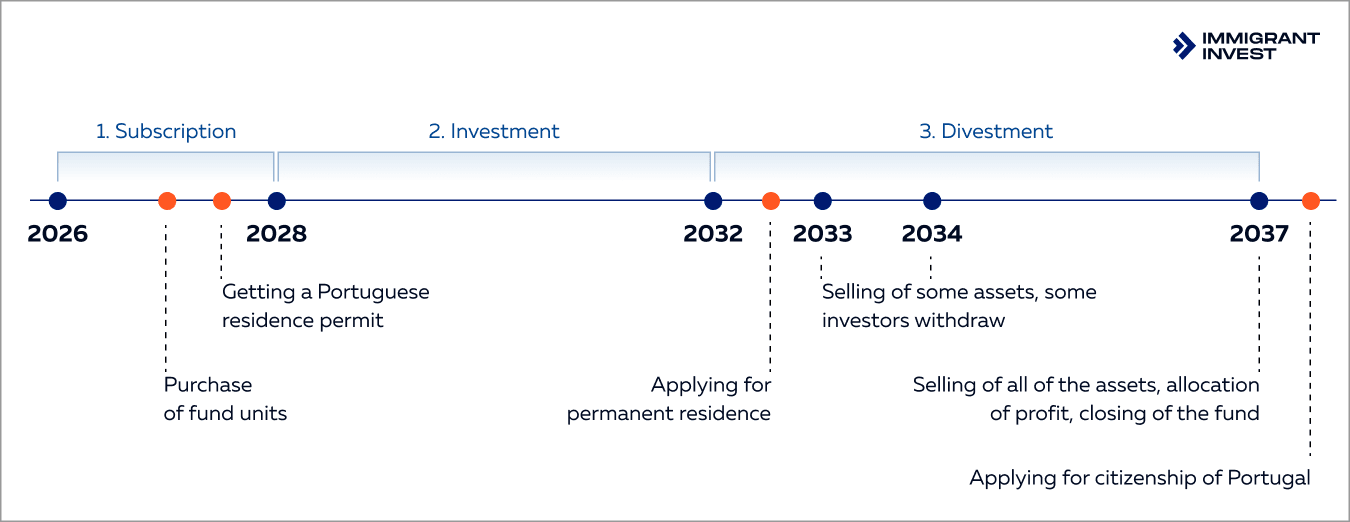
O ciclo de vida dos fundos de investimento é dividido em três etapas: subscrição, investimento e desinvestimento
Como sair do fundo de investimento
A saída de um fundo de investimento português depende dos termos do fundo, da disponibilidade de compradores e do cronograma migratório do investidor. Compreender as rotas de saída disponíveis ajuda os investidores a planejar quando e como seu capital poderá ser retornado.
Para manter a residência legal em Portugal, o investidor não pode resgatar os investimentos antes de 5 anos contados a partir da obtenção de sua autorização. Em regra, os fundos de investimento elegíveis para o Golden Visa de Portugal não permitem saídas antecipadas para garantir que o investimento permaneça válido durante o período exigido pelas condições do programa.
Resgate de valores antes do prazo
Uma saída antecipada do fundo é muitas vezes possível se o investidor revender sua cota a outro investidor. Contudo, as cotas de fundos de investimento, especialmente aqueles projetados para solicitantes do Golden Visa, possuem baixa liquidez e pode levar algum tempo para encontrar um comprador.
Alguns fundos oferecem a oportunidade de recomprar cotas de investidores com desconto. Isso geralmente é possível após o titular cumprir o período mínimo de investimento exigido pelo programa Golden Visa.
Saída do fundo no vencimento
Na data estabelecida, o gestor do fundo vende os ativos e divide os recursos e lucros conforme a participação de cada investidor. O gestor deduz suas comissões e transfere o montante aos investidores de acordo com os procedimentos internos do fundo.
Requisitos e custos do Golden Visa de Portugal
Para obter o Golden Visa de Portugal por meio de cotas de fundos de investimento, os solicitantes devem cumprir os requisitos de elegibilidade do programa e investir pelo menos € 500.000 em um fundo elegível. Eles também devem prever no orçamento as taxas governamentais, os encargos do fundo, o seguro-saúde e os custos de preparação de documentos.
Condições para os solicitantes
Os investidores devem cumprir requisitos específicos para obter uma autorização de residência em Portugal. Esses requisitos dizem respeito a renda, saúde, idade e histórico pessoal. O cumprimento dos requisitos do programa Golden Visa é comprovado por meio de certidões e documentos pessoais e financeiros correspondentes.
Um investidor pode participar do programa de autorização de residência em Portugal se:
- for maior de 18 anos;
- não for cidadão da Suíça, de um dos países da UE ou do EEE;
- não tiver antecedentes criminais;
- não tiver doenças transmissíveis graves, como tuberculose;
- possuir seguro-saúde com cobertura total;
- tiver uma renda lícita fora de Portugal.
Ao solicitar o Golden Visa, o investidor deve apresentar a comprovação da transferência de € 500.000 para uma conta bancária em Portugal. Deve também apresentar um contrato celebrado com o fundo especificando o valor do investimento e o modelo de investimento do fundo.
O Golden Visa de Portugal pode ser estendido à família do investidor, incluindo o cônjuge, filhos dependentes com menos de 26 anos e pais dependentes.
Despesas para obtenção de residência via compra de cotas de fundos
Juntamente com a compra de cotas de fundos de investimento, os solicitantes arcam com despesas adicionais. Abaixo está a lista de custos adicionais pagos pelos investidores que obtêm o Golden Visa de Portugal por meio da aquisição de cotas de fundos de investimento:
- taxa de subscrição — até 3,5%;
- comissão anual do fundo sobre os lucros — 0,5 a 3%;
- imposto sobre o rendimento de investimentos — 14% para residentes fiscais portugueses, 0% para não residentes;
- taxa de solicitação — € 632,10 por membro familiar;
- taxa do cartão de autorização de residência — € 6.314,20 por membro familiar;
- taxa de processamento de documentos — € 2.000;
- seguro-saúde — € 400+ por membro familiar.

Obtenha sua estimativa de custos personalizada para o Golden Visa de Portugal
Quais documentos reunir para o investimento em fundos
Antes de prosseguir com a aquisição de cotas de fundos de investimento para o seu Golden Visa de Portugal, você deve providenciar uma documentação completa. Essa documentação serve para verificar sua identidade, comprovar sua capacidade financeira e garantir a conformidade tanto com as exigências do fundo quanto com a regulamentação portuguesa.
Os documentos necessários são:
-
Passaporte. Passaporte válido e cópias de todas as páginas, incluindo as em branco.
-
Comprovante de endereço. Contas de consumo, extratos bancários ou correspondência oficial com o seu endereço atual, emitidos nos últimos três meses.
-
NIF, ou Número de Identificação Fiscal de Portugal. Este número único de contribuinte é obrigatório para transações financeiras em Portugal, incluindo investimentos em fundos.
-
Conta bancária em Portugal. Documentação comprobatória da abertura de conta bancária em Portugal, a qual será utilizada para a transferência do investimento.
-
Comprovante de recursos. Extratos bancários, relatórios de carteira de investimentos, documentos de propriedade de empresas, certificados de herança ou outros documentos que comprovem a origem lícita dos recursos de investimento.
-
Formulários preenchidos e assinados. Formulários de subscrição de investimento fornecidos pela sociedade gestora do fundo, acompanhados de declarações de prevenção à lavagem de dinheiro e questionários de perfil do investidor.
Documentos adicionais podem ser exigidos dependendo do fundo de investimento específico e das suas circunstâncias pessoais. Os especialistas da Immigrant Invest são especializados em solicitações de Golden Visa de Portugal e garantirão que toda a documentação seja devidamente preparada e enviada.

Com a confiança de 10.000+ investidores
Abra uma conta bancária em Portugal com suporte completo de compliance
Golden Visa de Portugal por investimento: procedimento passo a passo
De acordo com a experiência dos especialistas da Immigrant Invest, a obtenção do Golden Visa de Portugal por meio do investimento em cotas de fundos leva pelo menos 12 meses.
Os investidores podem solicitar o Golden Visa de Portugal diretamente junto à AIMA, mas erros na legalização de documentos, na conformidade do investimento ou nos procedimentos em português podem levar ao indeferimento. Trabalhar com um advogado qualificado ajuda a garantir a conformidade e a conduzir a solicitação corretamente.
Os advogados da Immigrant Invest em Portugal acompanham o investidor durante todo o processo de obtenção do Golden Visa de Portugal: desde a escolha do fundo e preparação dos documentos até a conclusão do negócio e a solicitação da autorização de residência.
1 dia
Due Diligence preliminar
A Immigrant Invest realiza uma verificação de Due Diligence preliminar para identificar qualquer circunstância que possa impedir o solicitante de participar do programa selecionado.
Após a conclusão bem-sucedida da verificação, a Immigrant Invest elabora o contrato de prestação de serviços para oferecer suporte adicional.
O processo é totalmente confidencial.
A Immigrant Invest realiza uma verificação de Due Diligence preliminar para identificar qualquer circunstância que possa impedir o solicitante de participar do programa selecionado.
Após a conclusão bem-sucedida da verificação, a Immigrant Invest elabora o contrato de prestação de serviços para oferecer suporte adicional.
O processo é totalmente confidencial.
2 semanas
Coleta de documentos
Um advogado designado da Immigrant Invest orienta o solicitante ao longo do processo de coleta de documentos, incluindo autenticação e tradução.
Um advogado designado da Immigrant Invest orienta o solicitante ao longo do processo de coleta de documentos, incluindo autenticação e tradução.
1—2 semanas
Registro do Número de Identificação Fiscal em Portugal
O número de identificação fiscal em Portugal (NIF) é necessário para abrir conta bancária, comprar cotas de fundos de investimento e solicitar autorização de residência.
Os investidores estrangeiros podem fazer isso remotamente, por meio de um representante fiscal em Portugal. Também é possível comparecer pessoalmente a um posto de atendimento em Portugal.
O número de identificação fiscal em Portugal (NIF) é necessário para abrir conta bancária, comprar cotas de fundos de investimento e solicitar autorização de residência.
Os investidores estrangeiros podem fazer isso remotamente, por meio de um representante fiscal em Portugal. Também é possível comparecer pessoalmente a um posto de atendimento em Portugal.
1—2 meses
Abertura de conta em um banco português
Os advogados da Immigrant Invest ajudam a preparar os documentos necessários e acompanham o investidor até a agência do banco desejado ou realizam a abertura de conta remotamente.
Os advogados da Immigrant Invest ajudam a preparar os documentos necessários e acompanham o investidor até a agência do banco desejado ou realizam a abertura de conta remotamente.
2—3 semanas
Seleção de um fundo de investimento
A Immigrant Invest auxilia na seleção de um fundo de investimento confiável e qualificado para o Golden Visa de Portugal, levando em consideração os objetivos do investidor. Os advogados fornecem todas as informações oficiais sobre os fundos e organizam uma consulta com os gestores dos fundos para a escolha final.
A Immigrant Invest auxilia na seleção de um fundo de investimento confiável e qualificado para o Golden Visa de Portugal, levando em consideração os objetivos do investidor. Os advogados fornecem todas as informações oficiais sobre os fundos e organizam uma consulta com os gestores dos fundos para a escolha final.
5—6 meses
Solicitação do Golden Visa de Portugal
Os advogados da Immigrant Invest fornecem ao investidor a lista de documentos a serem reunidos, providenciam sua tradução para o português e autenticam as cópias. Os documentos são preparados no prazo de 2 a 3 semanas.
Quando a documentação estiver pronta, os advogados a submetem à AIMA (Agência para a Integração, Migrações e Asilo de Portugal). A Agência leva até 6 meses para analisar a solicitação.
Os advogados da Immigrant Invest fornecem ao investidor a lista de documentos a serem reunidos, providenciam sua tradução para o português e autenticam as cópias. Os documentos são preparados no prazo de 2 a 3 semanas.
Quando a documentação estiver pronta, os advogados a submetem à AIMA (Agência para a Integração, Migrações e Asilo de Portugal). A Agência leva até 6 meses para analisar a solicitação.
1—2 semanas
Envio de dados biométricos em Portugal
O investidor deve comparecer a Portugal após a aprovação da solicitação para realizar a coleta de impressões digitais e apresentar os documentos originais. O agendamento junto à AIMA é realizado previamente para data e horário convenientes.
O investidor deve comparecer a Portugal após a aprovação da solicitação para realizar a coleta de impressões digitais e apresentar os documentos originais. O agendamento junto à AIMA é realizado previamente para data e horário convenientes.
Até 6 meses
Obtenção do cartão de autorização de residência
A AIMA analisa os documentos originais do investidor e decide sobre a solicitação de residência. Em seguida, o investidor paga a taxa de emissão do cartão de autorização de residência e o retira pessoalmente ou por meio de advogado munido de procuração.
A AIMA analisa os documentos originais do investidor e decide sobre a solicitação de residência. Em seguida, o investidor paga a taxa de emissão do cartão de autorização de residência e o retira pessoalmente ou por meio de advogado munido de procuração.
Considerações para cidadãos dos EUA que solicitam o Golden Visa de Portugal por investimento em fundos
O investimento em cotas de fundos é uma opção viável para cidadãos dos EUA que buscam o Golden Visa de Portugal. No entanto, os investidores devem cumprir não apenas as regras de imigração e investimento de Portugal, mas também as obrigações fiscais e de prestação de declarações dos EUA. Essas obrigações permanecem vigentes mesmo após o investidor se tornar residente em Portugal.
Impostos sobre o rendimento para cidadãos dos EUA
A legislação norte-americana tributa todos os cidadãos dos EUA sobre sua renda global, independentemente de sua residência fiscal. Os EUA e Portugal possuem um acordo para evitar a dupla tributação, estabelecendo que os americanos devem pagar impostos sobre sua renda em todos os casos.
Em Portugal, o imposto é devido somente quando a alíquota de imposto dos EUA for inferior à de Portugal. Nesse caso, o investidor recolhe a diferença às autoridades portuguesas.
Obrigações de declaração do FATCA
Nos termos da Lei de Conformidade Fiscal de Contas Estrangeiras (FATCA), os contribuintes dos EUA devem declarar determinados ativos financeiros estrangeiros ao IRS quando seu valor ultrapassar o limite aplicável. Para contribuintes residentes nos EUA, o limite inicia em $ 50.000 no último dia do ano fiscal ou $ 75.000 em qualquer momento durante o ano. Para contribuintes residentes no exterior, inicia em $ 200.000 no final do ano ou $ 300.000 em qualquer momento durante o ano.
Como a rota de fundos do Golden Visa de Portugal exige um investimento mínimo de € 500.000, os investidores norte-americanos geralmente ultrapassarão esses limites e poderão precisar declarar o investimento no Formulário 8938 juntamente com sua declaração de imposto de renda anual nos EUA.
A declaração do FATCA é independente de outras exigências de declaração de ativos no exterior dos EUA, como o FBAR, portanto o investidor pode precisar preencher mais de um formulário.
Escolha de um banco português para abertura de conta
O IRS, a receita federal do governo dos EUA, exige que entidades financeiras estrangeiras, como bancos e fundos, informem aos EUA sobre ativos mantidos por seus clientes americanos.
Assim, para cumprir a lei norte-americana ao solicitar o Golden Visa de Portugal, o solicitante dos EUA deve abrir conta em um banco que envie relatórios ao IRS.
Regras para Sociedades de Investimento Estrangeiro Passivo (PFIC)
Cidadãos dos EUA que investem em sociedades estrangeiras classificadas como PFIC devem seguir regras e procedimentos de declaração rigorosos.
Uma empresa estrangeira é classificada como PFIC se preencher um dos seguintes critérios:
- teste de renda — pelo menos 75% de sua renda bruta é passiva, como dividendos, juros, royalties ou ganhos de capital; ou
- teste de ativos — pelo menos 50% dos seus ativos são mantidos para a produção de renda passiva.
A maioria dos fundos de investimento em Portugal para o Golden Visa é considerada PFIC, de modo que os solicitantes que adquirem a residência portuguesa devem entregar o Formulário 8621. O formulário é apresentado anualmente, declara a renda do investidor e calcula eventuais impostos aplicáveis sob as regras da PFIC. O formulário é enviado mesmo que nenhum rendimento tenha sido recebido.

Com a confiança de 10.000+ investidores
Pensando em sair dos EUA? Descubra suas opções
Riscos do investimento em fundos portugueses
Assim como qualquer outro investimento, a aquisição de cotas em fundos de private equity portugueses envolve certos riscos. Eles podem afetar o valor, a liquidez ou o retorno esperado do investimento, e alguns também podem influenciar a estratégia do Golden Visa do investidor.
A Immigrant Invest ajuda os clientes a avaliar esses riscos antecipadamente e a selecionar fundos alinhados aos seus objetivos de investimento e à sua tolerância ao risco.
Risco de mercado
Este risco inclui desacelerações econômicas, mudanças nas políticas governamentais ou retração geral do mercado. Reduzimos esse risco selecionando fundos com carteiras de investimento diversificadas e monitorando as tendências econômicas para recomendar fundos com potencial estável e de longo prazo.
Risco de liquidez
As cotas do fundo podem ser difíceis de vender antes do término do prazo de investimento, principalmente se não houver um mercado secundário ativo. O resgate antecipado também pode ser restrito pelas regras do fundo, e o investidor pode precisar aceitar um preço menor para sair antes do prazo.
A Immigrant Invest ajuda a reduzir o risco de liquidez priorizando fundos com mecanismos de saída claramente definidos, como vendas no mercado secundário, acordos de recompra ou assistência do gestor do fundo para revenda. A equipe também analisa a maturidade do fundo, as condições de resgate e a experiência anterior com a saída de investidores antes de recomendar uma opção.
Risco regulatório e legal
Alterações nas leis do Golden Visa, impostos ou regulamentos de fundos podem impactar os investimentos. Para mitigar esse risco, monitoramos de perto as regulamentações da CMVM e as políticas governamentais, mantendo nossos clientes informados sobre qualquer atualização. Também colaboramos com especialistas jurídicos de alto nível para garantir a total conformidade com os requisitos fiscais e de visto.
Risco de gestão do fundo
O sucesso de um fundo depende fortemente da experiência e competência do seu gestor. Decisões inadequadas podem resultar em perdas. Mitigamos esse risco fazendo parceria apenas com gestores de fundos renomados e regulados pela CMVM, com histórico comprovado de entrega de fortes retornos. Também avaliamos minuciosamente a governança do fundo, as estratégias de investimento e a saúde financeira antes de recomendar qualquer opção.
Risco de desempenho e retorno
O desempenho abaixo do esperado é sempre uma possibilidade, podendo levar a retornos inferiores aos previstos. Gerenciamos esse risco selecionando fundos com histórico sólido de desempenho e relatórios transparentes. Nosso objetivo é garantir que os investimentos estejam alinhados a perfis de risco-retorno realistas, adaptados às preferências de cada investidor.
Risco cambial
Como os investimentos são feitos em euros, as oscilações nas taxas de câmbio podem impactar os retornos finais caso a moeda de origem do investidor se desvalorize. Para minimizar esse impacto, orientamos os clientes sobre estratégias de proteção cambial (hedging) e abordagens de investimento multimoedas, ajudando-os a avaliar sua exposição aos riscos cambiais antes de assumirem um compromisso.
5 vantagens de obter o Golden Visa de Portugal por meio de fundos
1. Maior diversificação de ativos. O dinheiro do solicitante é investido em vários ativos simultaneamente. Isso reduz os riscos de perdas e ajuda a maximizar os lucros.
2. Gestão profissional dos investimentos. O solicitante não precisa procurar projetos de investimento, lidar com empreiteiros ou se envolver nas operações do fundo. O investidor pode, de modo geral, não se preocupar com os investimentos até o momento do encerramento do fundo.
3. Retorno do investimento. Os investidores podem reaver seu dinheiro em 6 a 10 anos. Em comparação, o retorno de investimentos empresariais não pode ser garantido, pois depende dos lucros e do sucesso da empresa.
4. Otimização tributária. Dividendos e ganhos de capital não são tributados em Portugal se o investidor tiver o Golden Visa e não for residente fiscal em Portugal.
5. Segurança. Os fundos são registrados na Comissão do Mercado de Valores Mobiliários (CMVM). Suas atividades também são reguladas pelo Banco Central do país e pela sociedade gestora do fundo. As autoridades fiscais também realizam auditorias regulares. Isso permite que os investidores tenham total confiança no cumprimento de todas as normas legais e no cumprimento da estratégia de investimento escolhida.

Banele, 34 anos
Proprietário de fábrica de móveis
Golden Visa de Portugal por aquisição de cotas de fundos de investimento
Banele, proprietário de uma bem-sucedida fábrica de móveis, buscava mais do que apenas viagens sem visto. Ele queria um futuro onde seus filhos pudessem crescer em um ambiente globalmente conectado, com acesso à educação e a oportunidades em toda a Europa.
Ajudamos Banele e sua família a obter a residência por investimento por meio do programa Golden Visa de Portugal. Ele optou por investir no fundo Blue Crow, conhecido por seu perfil de baixo risco e foco em projetos de imóveis comerciais em Portugal.
O fundo oferecia um rendimento anual de 5%, a opção de saída antecipada e uma participação estimada nos lucros de 10% por ocasião do seu encerramento em 2028, tornando-se uma escolha prática e estratégica para o planejamento financeiro e de estilo de vida de longo prazo.
Como a Immigrant Invest ajuda os solicitantes a escolher um fundo para o Golden Visa de Portugal
A Immigrant Invest oferece suporte completo aos solicitantes durante todo o processo do Golden Visa de Portugal, com foco especial na seleção e na realização de um investimento qualificado em fundos. Nossos especialistas avaliam os objetivos do investidor, o nível de risco preferido, o período de retenção esperado, as circunstâncias familiares e os planos de longo prazo antes de recomendar as opções adequadas.
A equipe trabalha em colaboração com advogados licenciados, bancos, gestores de fundos e outros profissionais em Portugal. Isso nos permite analisar a documentação dos fundos, esclarecer termos de investimento e taxas, coordenar a due diligence e ajudar os investidores a compreender como cada fundo se ajusta aos requisitos do Golden Visa.
Nossa presença local em Portugal também nos ajuda a gerir as etapas práticas do processo, desde a obtenção do Número de Identificação Fiscal e abertura de conta bancária até a transferência do investimento e a preparação da solicitação de residência. Assim, eventuais entraves podem ser identificados antecipadamente, antes que causem atrasos ou afetem a elegibilidade do investimento.

Pedro Barata,
Diretor do escritório em Portugal
Nosso suporte continua após a subscrição do fundo e a aprovação da autorização de residência. A Immigrant Invest auxilia nas renovações da autorização notificando os investidores sobre os prazos futuros, ajudando a preparar os documentos necessários e coordenando a solicitação de renovação.
Principais pontos sobre os fundos de investimento portugueses
- Os fundos de investimento portugueses reúnem capital para investir em ativos como imóveis, empresas ou ações. Esses fundos são regulados pela Comissão do Mercado de Valores Mobiliários (CMVM), garantindo a conformidade com as estratégias de investimento e as normas legais.
- O investimento em fundos portugueses oferece diversificação, gestão profissional e potencial para otimização tributária, uma vez que não residentes não são tributados sobre dividendos ou ganhos de capital.
- Investidores estrangeiros que adquirem cotas de fundos de investimento portugueses podem se qualificar para o Golden Visa de Portugal. Para obter o status, eles devem investir pelo menos € 500.000 e manter os ativos por 5 anos ou mais. Cerca de 50 de um total de 200 fundos portugueses cumprem os requisitos do Golden Visa.
- Os investidores e seus familiares garantem o direito de morar, trabalhar e estudar em Portugal, podendo solicitar a cidadania após 10 anos de residência (7 anos para cidadãos da UE e nacionais de países de língua portuguesa).
- Investidores norte-americanos devem cumprir os requisitos de declaração do IRS para Sociedades de Investimento Estrangeiro Passivo (PFIC) e enviar anualmente o Formulário 8621 informando os rendimentos gerados pelo fundo. Eles também estão sujeitos aos requisitos de declaração de ativos no exterior do FATCA, geralmente por meio do Formulário 8938, caso atinjam os limites aplicáveis.
A Immigrant Invest é um agente autorizado para programas de cidadania e residência por investimento na UE, no Caribe, na Ásia e no Oriente Médio. Aproveite nossos 15 anos de experiência global — agende uma reunião com nossos especialistas em programas de investimento.

 Com a confiança de 10.000+ investidores