









Les personnes fortunées peuvent obtenir un Visa Doré du Portugal en faisant l’acquisition de parts de fonds d’investissement pour un montant d’au moins 500 000 €. Le délai de détention est d’au moins 5 ans.
Le Visa Doré du Portugal est un permis de séjour accordé en contrepartie d’une contribution à l’économie du pays. Il permet à l’ensemble de la famille du demandeur de vivre et de travailler dans l’UE et, après 5 ans, de demander la résidence permanente.
Mais comment fonctionne réellement l’investissement dans des fonds dans le cadre du programme de Visa Doré ? Quels en sont les principaux avantages et comment choisir le bon fonds ? Découvrez tout ce qu’il faut savoir pour prendre une décision éclairée.
Qu’est-ce qu’un fonds d’investissement au Portugal ?
Un fonds d’investissement au Portugal est un véhicule financier réglementé qui regroupe le capital de plusieurs investisseurs et l’alloue à un portefeuille d’actifs diversifié[1]Source : CMVM — Investment funds: what investors need to know. Il peut s’agir d’actions portugaises ou européennes, d’obligations, de biens immobiliers commerciaux ou résidentiels, de projets d’infrastructures ou d’investissements en capital-risque dans des entreprises locales.
Ces fonds ne sont pas des sociétés en soi, mais sont généralement structurés sous forme d’organismes de placement collectif et gérés par des sociétés de gestion de fonds agréées.
Lorsque vous investissez dans un fonds portugais, votre argent est combiné avec celui d’autres investisseurs. La société de gestion du fonds prend des décisions d’investissement basées sur une stratégie prédéfinie et détaillée dans les documents constitutifs du fonds.
Après avoir généré des rendements, le fonds déduit les frais de gestion et de performance applicables et distribue les bénéfices restants proportionnellement entre les investisseurs.
La plupart des fonds d’investissement comportent deux éléments clés, à savoir :
- le gestionnaire de fonds, qui gère au quotidien le portefeuille, prend les décisions d’achat et de vente, suit les performances et veille au respect des objectifs d’investissement du fonds ;
- le comité d’investissement, qui assure la surveillance et approuve les décisions stratégiques, en particulier les allocations importantes ou à haut risque.
Cette structure garantit à la fois une agilité opérationnelle et une gestion rigoureuse des risques.
Chaque fonds fonctionne selon une stratégie d’investissement spécifique, clairement définie dans ses déclarations réglementaires et ses contrats d’investissement. Ces stratégies peuvent varier considérablement — de l’investissement exclusif dans l’immobilier résidentiel au soutien de startups technologiques ou d’infrastructures d’énergie renouvelable.
Un fonds ne peut investir que dans le cadre de sa stratégie déclarée. Toute modification de cette stratégie nécessite généralement l’approbation de l’organisme de réglementation et, dans de nombreux cas, des investisseurs eux-mêmes[2]Source : Diário da República — Régime consolidé de gestion d’actifs au Portugal.
Sigles utiles pour les investisseurs dans des fonds pour le Visa Doré du Portugal. Voici quelques sigles spécifiques au Portugal utilisés dans le secteur des fonds d’investissement qui peuvent être utiles aux demandeurs de Visa Doré :
- QIF — Qualified Investment Fund (fonds d’investissement qualifié) ;
- FCR — Fundo de Capital de Risco, ou fonds de capital-risque ;
- UP (ou PU en anglais) — Unidade de Participação, ou unité de participation, l’équivalent d’une part de fonds ;
- PU — Participation Unit en anglais ;
- SCR — Sociedade de Capital de Risco, ou société de capital-risque ;
- RG — Regulamento de Gestão, ou règlement de gestion, document définissant les principes opérationnels du fonds ;
- CMVM — Comissão do Mercado de Valores Mobiliários, ou Commission du marché des valeurs mobilières du Portugal ;
- SGOIC — Sociedade Gestora de Organismos de Investimento Coletivo, sociétés de gestion de fonds d’investissement collectif agréées.
Éligibilité à la résidence. Les investisseurs faisant l’acquisition de parts de fonds d’investissement au Portugal peuvent prétendre au Visa Doré[3]Source : AIMA — Exigences de demande de Visa Doré pour l’achat de parts de fonds d’investissement.

Plus de 10 000 investisseurs nous font confiance
Vérifiez votre éligibilité au Visa Doré du Portugal
Qui peut bénéficier d’un investissement dans des fonds portugais ?
L’investissement dans des fonds éligibles est l’une des voies les plus accessibles et les plus populaires pour obtenir le Visa Doré du Portugal. Cette option convient particulièrement aux demandeurs déjà familiarisés avec les instruments financiers, qui souhaitent une option d’investissement relativement passive ou préfèrent ne pas gérer d’entreprise au Portugal.
Le Visa Doré du Portugal attire des demandeurs aux profils et nationalités variés. Des synthèses récentes du marché basées sur les données de l’AIMA indiquent que les ressortissants américains, chinois, brésiliens et turcs figurent parmi les groupes représentés dans le programme.
Ceux qui investissent déjà dans des instruments financiers. Les fonds sont souvent choisis par des investisseurs qui comprennent le fonctionnement des marchés financiers et souhaitent préserver leur capital : investir dans des fonds aide à diversifier les revenus et les risques.
Ceux qui souhaitent obtenir un permis de séjour du Portugal. Jusqu’en 2023, l’immobilier était la voie la plus prisée pour obtenir un permis de résidence du Portugal. À la suite de réformes législatives, cette option n’est plus disponible, faisant des fonds d’investissement le choix privilégié de nombreux demandeurs.
D’autres options restent disponibles, comme les contributions à la recherche scientifique ou à des projets culturels, ainsi que la création d’entreprise — mais pour beaucoup, les fonds demeurent le choix le plus simple et nécessitant le moins de gestion.
Ceux qui ne souhaitent pas investir dans une entreprise portugaise. Un investisseur étranger dispose de deux options entrepreneuriales dans le cadre du programme de Visa Doré :
- Investir au moins 500 000 € dans une entreprise portugaise existante et créer au moins 5 emplois.
- Créer une entreprise au Portugal et créer au moins 10 emplois.
Gérer une entreprise à l’étranger peut s’avérer complexe et ne correspond pas aux objectifs de chacun. De plus, le retour sur investissement n’est pas garanti, car il dépend fortement du succès et des bénéfices du projet.
Par conséquent, si un investisseur n’est pas prêt à exercer une activité entrepreneuriale, souhaite percevoir un revenu passif et récupérer son capital au bout de quelques années, il préfèrera l’achat de parts de fonds d’investissement aux options d’entreprise.

Farid et Sabina,
Propriétaire d’une entreprise de fintech et mère au foyer
Du stress lié au visa à la stabilité grâce à l’investissement dans un fonds
Farid et Sabina vivaient aux États-Unis avec des visas touristiques, confrontés à une attente de 10 ans pour obtenir la résidence et au risque d’expulsion vers l’Azerbaïdjan. Ils avaient besoin rapidement d’une solution de sécurité pour la famille.
Plutôt que de créer une entreprise ou de choisir des options risquées, ils ont opté pour un investissement de 500 000 € dans un fonds portugais axé sur l’immobilier. Cela leur offrait une voie à faible risque et sans gestion directe vers le Visa Doré du Portugal.
Au départ, le Portugal était un plan B pour le couple. Mais leur fils vivant déjà à Porto, ils sont tombés sous le charme du cadre de vie et en ont fait leur résidence permanente.
Grâce à notre accompagnement, les époux ont obtenu leur Visa Doré en seulement 14 mois, bénéficiant d’une résidence dans l’UE et d’une tranquillité d’esprit à long terme — tout en préservant leurs projets aux États-Unis.
Comment les fonds d’investissement se différencient les uns des autres
Les fonds d’investissement éligibles au Visa Doré du Portugal diffèrent selon le type d’actifs en portefeuille, le montant des commissions et frais, la fréquence de versement des dividendes (annuelle ou au terme du fonds), la rentabilité et le modèle d’investissement.
Type d’actifs
Voici les catégories de fonds d’investissement les plus courantes :
- fonds investissant en actions, telles que des actions de sociétés et des obligations ;
- fonds investissant dans des entreprises commerciales telles que des usines, des startups IT et des domaines viticoles ;
- fonds mixtes combinant plusieurs types d’actifs.
Les fonds mixtes sont rares : ils représentent environ 10 % du marché. Le reste est réparti de manière approximativement égale.
Pour les investisseurs intéressés par les actifs alternatifs, certains fonds peuvent également offrir une exposition aux actifs numériques.
Degré de diversification
Les fonds diffèrent par le niveau de diversification de leur portefeuille. Certains se concentrent sur un seul secteur, une seule entreprise ou un seul bien immobilier, tandis que d’autres répartissent leurs investissements sur plusieurs entreprises, secteurs d’activité ou classes d’actifs.
La diversification géographique peut également varier. Un fonds peut investir exclusivement dans des actifs portugais ou combiner des investissements au Portugal avec une exposition à d’autres marchés européens ou internationaux.
Pour être éligible au Visa Doré, un fonds doit investir au moins 60 % de sa valeur d’investissement dans des sociétés commerciales ayant leur siège social au Portugal[4]Source : AIMA — Permis de séjour pour activité d’investissement, article 90-A. La part restante peut offrir une exposition à des sociétés ou actifs sur d’autres marchés, selon la stratégie du fonds. Un portefeuille plus diversifié peut réduire la dépendance à la performance d’une seule entreprise ou d’un seul secteur, bien qu’il n’élimine pas le risque d’investissement.
Risque et rendement
Tous les fonds proposent une combinaison différente de risque et de rendement. Les fonds à faible risque se concentrent généralement sur des actifs plus établis et privilégient la préservation du capital, tandis que les fonds à risque modéré peuvent associer des investissements stables à des actifs présentant un plus fort potentiel de croissance. Les fonds à risque plus élevé visent habituellement une croissance du capital plus soutenue, mais sont davantage exposés à la volatilité des marchés et au risque de perte.
Par exemple, les fonds de capital-risque du Visa Doré du Portugal investissant dans des entreprises en phase de démarrage peuvent offrir des rendements potentiels plus élevés, mais comportent aussi un risque accru car la performance des jeunes entreprises est moins prévisible. Ces fonds ne versent souvent pas de dividendes réguliers et leur durée de détention peut s’étendre sur environ 10 ans.
Quels fonds sont éligibles à l’investissement pour le Visa Doré du Portugal ?
L’investissement dans des fonds dans le cadre du Visa Doré du Portugal est une option adaptée aux demandeurs qui ne prévoient pas de vivre en permanence au Portugal ou qui ne souhaitent pas investir dans une entreprise pour obtenir un permis de séjour.
Principaux critères applicables aux fonds du Visa Doré du Portugal
L’investissement minimum dans les fonds est de 500 000 €. Il convient de conserver les actifs pendant au moins cinq ans, mais les fonds sont généralement restitués au bout de 6 à 10 ans.
Il existe environ 200 fonds d’investissement au Portugal, mais seuls 50 inscrits auprès de la Commission du marché des valeurs mobilières sont éligibles à la résidence par investissement et figurent sur la liste des fonds d’investissement éligibles au Visa Doré du Portugal. Cela est dû aux exigences spécifiques qu’un fonds doit remplir en matière de répartition du capital et d’échéance des parts.
Pour être éligible au Visa Doré du Portugal, un fonds doit :
- être enregistré auprès de la Commission du marché des valeurs mobilières du Portugal (CMVM) ;
- investir au moins 60 % de son capital dans des entreprises ou actifs portugais ;
- émettre des parts ayant une échéance d’au moins 5 ans.
Aspects à prendre en compte lors du choix d’un fonds
Lors de la sélection d’un fonds pour investir dans le cadre du Visa Doré, il convient d’analyser un ensemble de critères, notamment :
- la stratégie d’investissement et le portefeuille ;
- l’expérience de la société de gestion ;
- l’équipe du fonds ;
- les commissions de gestion d’actifs, de souscription et de transfert de fonds ;
- la stratégie de sortie.
Fonds d’investissement pour le Visa Doré du Portugal

Les frais de constitution et de gestion sont déjà inclus dans l’investissement
Comment les fonds du Visa Doré sont réglementés
Les fonds d’investissement éligibles au Visa Doré du Portugal fonctionnent dans un cadre réglementaire strict conçu pour protéger les investisseurs et garantir l’intégrité du marché. Voici les principaux aspects de cette réglementation.
Organismes de surveillance
Les fonds de capital-investissement et de capital-risque éligibles au Visa Doré sont réglementés par la Comissão do Mercado de Valores Mobiliários (CMVM), l’autorité nationale des marchés financiers du Portugal. Les gestionnaires de fonds sont tenus d’adresser des rapports réguliers à la CMVM et de se soumettre à une surveillance continue.
Ces fonds doivent également respecter les réglementations de l’Union européenne, notamment en matière de lutte contre le blanchiment d’argent (AML) et d’obligations de connaissance du client (KYC), ce qui permet de prévenir les manquements financiers et de garantir la transparence, la protection des investisseurs et une gestion appropriée des risques.
Chaque fonds doit être géré par une société de gestion de fonds agréée, appelée Sociedade Gestora de Organismos de Investimento Coletivo (SGOIC). La CMVM supervise l’ensemble de ces entités agréées opérant au Portugal.
Implication de l’investisseur
Lorsqu’un investisseur apporte des capitaux à un fonds, il conclut généralement un contrat en qualité d’associé commanditaire (Limited Partner, LP). Cette structure limite la responsabilité de l’investisseur au montant investi et ne nécessite pas sa participation aux opérations du fonds.
Les demandeurs du Visa Doré peuvent répartir leur capital entre plusieurs fonds éligibles, à condition que l’investissement total s’élève à au moins 500 000 € et soit conservé pendant au moins cinq ans, conformément aux exigences de la législation portugaise sur l’immigration[5][AIMA — exigences pour la voie du Visa Doré par fonds d’investissement].
Stratégie d’investissement
Les fonds éligibles au Visa Doré peuvent investir dans des entreprises portugaises opérant dans des secteurs tels que la technologie, la santé, l’industrie, les énergies renouvelables et l’hôtellerie. Au moins 60 % des investissements du fonds doivent être réalisés dans des sociétés commerciales ayant leur siège social au Portugal.
Les fonds éligibles ne peuvent pas investir directement ou indirectement dans des biens immobiliers, indépendamment de leur localisation ou de leur usage prévu. Le fonds doit également présenter une échéance minimale de cinq ans au moment de l’investissement.
Les rendements sont généralement distribués lors de la revente des entreprises du portefeuille ou lorsque le fonds arrive à son terme. Toutefois, ni les revenus ni la restitution du capital ne sont garantis. Les investisseurs doivent analyser la stratégie, les frais, les risques, la durée prévue et les modalités de sortie du fonds avant toute souscription.
Rendement de l’investissement et profil des fonds portugais
Le potentiel de rendement et la préservation du capital sont étroitement liés lors du choix d’un fonds d’investissement portugais. L’évaluation de ces deux aspects aide les investisseurs à déterminer si un fonds est compatible avec leurs objectifs financiers et leur tolérance à l’incertitude.
Rendements des investissements
Les rendements des années précédentes ne garantissent pas les revenus futurs, il est donc impossible d’établir des chiffres exacts. Les rendements cibles s’échelonnent de 3 à 10 %, selon le modèle d’investissement du fonds.
Les fonds présentant des rendements attendus élevés investissent généralement dans des actifs plus risqués, comme les startups, et affichent par conséquent un profil de risque plus élevé. L’achat de parts dans des fonds à faible risque génère un revenu plus modeste pour les investisseurs.
Risques
Le profil de risque des fonds d’investissement portugais, qui définit la possibilité pour les investisseurs de subir une perte en capital, dépend de plusieurs facteurs, notamment :
- les actifs acquis par le fonds ;
- le secteur économique ;
- l’expérience du gestionnaire de fonds ;
- la liquidité des actifs ;
- le cycle économique actuel.
L’échelle de risque comprend généralement 5 niveaux : très faible, faible, moyen, élevé et très élevé.
Rendement d’investissement et risque dans les fonds portugais
Étapes de l’investissement dans un fonds portugais
Le plus souvent, les fonds d’investissement sont organisés juridiquement sous forme de société à responsabilité limitée (LLC). Cela signifie qu’il n’est possible d’investir dans le fonds que lors de sa constitution et que le capital ne peut être retiré sans perte d’intérêts qu’après sa clôture.
Les investisseurs qui font l’acquisition de parts de fonds pour obtenir le Visa Doré du Portugal doivent conserver leurs investissements pendant au moins 5 ans pour maintenir leur statut. Si le titulaire du Visa Doré retire ses investissements avant cette échéance, son permis de séjour sera révoqué.
1. Souscription
Au cours des deux premières années, les fonds collectent les capitaux auprès des investisseurs. Si le capital est suffisant, le fonds peut immédiatement commencer la sélection des actifs et biens appropriés. Cette période est appelée la Période de Souscription.
Pendant la Période de Souscription, les investisseurs doivent conclure un contrat et déposer l’argent. Ensuite, le fonds clôture la souscription et n’accepte plus de nouveaux investisseurs.
L’investissement minimum dépend du fonds et peut débuter à partir de 1 000 € seulement, mais un demandeur de permis de séjour au Portugal doit investir au moins 500 000 €.
La souscription peut être gratuite ou nécessiter une commission, prélevée sur le montant de l’investissement et pouvant atteindre jusqu’à 3,5 % des sommes investies.
2. Investissements et gestion d’actifs
Pendant les quatre années suivantes, les fonds investissent l’argent en se constituant un portefeuille d’actifs conformément au modèle d’investissement stipulé dans le contrat. Certains fonds versent des dividendes chaque année, tandis que dans d’autres, les investisseurs ne perçoivent leurs revenus qu’après la clôture.
Les fonds prélèvent des frais annuels de gestion d’actifs, allant de 0,5 à 3 % du montant investi. Cependant, cela n’entraîne pas de coûts supplémentaires : les frais sont directement prélevés sur les investissements ou sur les bénéfices.
Les investisseurs du Visa Doré ne peuvent généralement pas retirer leur investissement éligible pendant cette phase. La possibilité de racheter ou de transférer des parts dépend de la structure juridique et des documents constitutifs du fonds.
Plus important encore, les investisseurs qui continuent de s’appuyer sur cet investissement pour renouveler leur Visa Doré doivent maintenir l’investissement éligible. Réduire le montant sous le seuil requis de 500 000 € peut compromettre le renouvellement ultérieur[6]Source : AIMA — Permis de séjour pour activité d’investissement, article 90-A.
3. Désinvestissement
Vers la fin du terme du fonds, le gestionnaire commence à vendre les actifs du portefeuille et à distribuer le produit des ventes aux investisseurs. La période de désinvestissement peut s’étendre sur plusieurs années, notamment lorsque les gestionnaires attendent des conditions de marché favorables plutôt que de céder les actifs à un prix désavantageux.
En règle générale, les investisseurs récupèrent leur capital et les rendements éventuels selon les règles de distribution et de liquidation du fonds, plutôt qu’en effectuant un retrait sur demande. Le calendrier dépend donc de l’échéance du fonds, de son portefeuille et de ses documents constitutifs.
Pour les investisseurs du Visa Doré, le statut d’immigration doit également être pris en compte avant la restitution du capital ou la vente des parts. Même après la période minimale d’investissement obligatoire de cinq ans, un investisseur qui renouvelle encore son Visa Doré sur la base de cet investissement peut devoir maintenir l’investissement éligible en place. Une fois que l’investisseur a obtenu un statut de résidence indépendant, tel que la résidence permanente, l’exigence d’investissement liée au Visa Doré peut ne plus s’appliquer de la même manière[7]Source : AIMA — FAQ Visa Doré.
Étapes opérationnelles des fonds d’investissement portugais
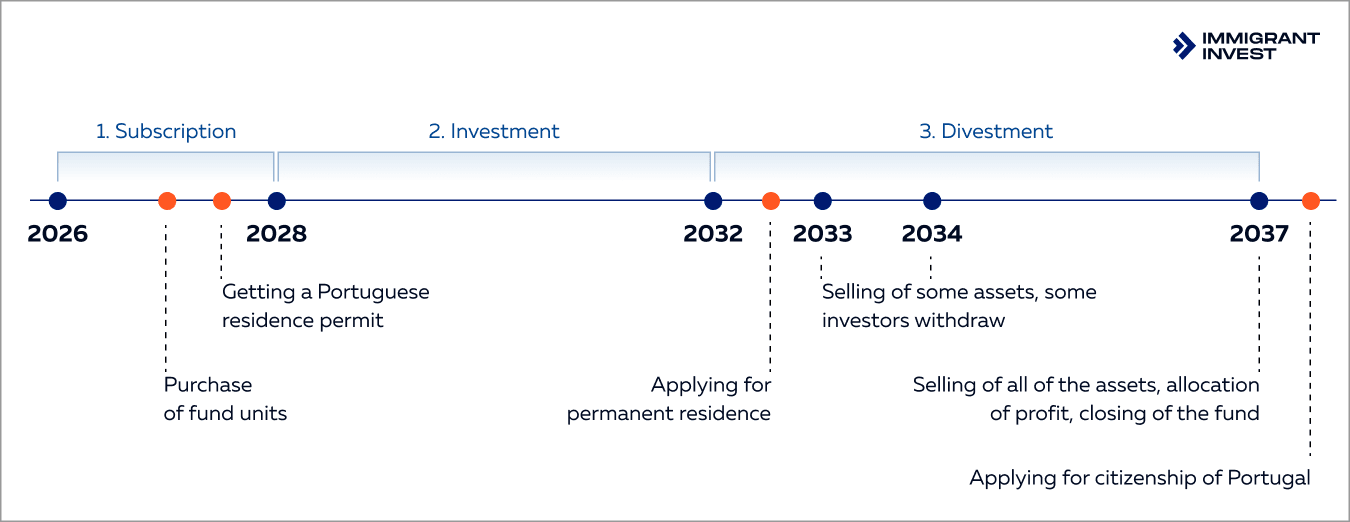
La durée de vie des fonds d’investissement comprend trois étapes : la souscription, l’investissement et le désinvestissement
Comment sortir d’un fonds d’investissement
Le retrait d’un fonds d’investissement portugais dépend des conditions du fonds, de la disponibilité d’acheteurs et du calendrier d’immigration de l’investisseur. Comprendre les options de sortie disponibles permet aux investisseurs de planifier quand et comment leur capital pourra leur être restitué.
Pour maintenir sa résidence légale au Portugal, un investisseur ne peut pas retirer ses investissements avant l’expiration d’un délai de 5 ans suivant l’obtention de son permis. En règle générale, les fonds d’investissement éligibles au Visa Doré du Portugal ne permettent pas de sortie anticipée afin de garantir que l’investissement reste valide pendant la période requise par le programme.
Retirer des fonds avant l’échéance
Une sortie anticipée du fonds est souvent possible si l’investisseur revend sa part à un autre investisseur. Cependant, les parts de fonds d’investissement, en particulier celles conçues pour les demandeurs du Visa Doré, sont peu liquides et la recherche d’un acheteur peut prendre du temps.
Certains fonds offrent la possibilité de racheter les parts des investisseurs à des prix minorés. Cela est généralement possible dès lors que le titulaire a accompli la durée minimale d’investissement requise par le programme du Visa Doré.
Sortir du fonds à l’échéance
À la date fixée, le gestionnaire de fonds vend les actifs du fonds et répartit les capitaux et les bénéfices en fonction des parts des investisseurs. Le gestionnaire prépare ses commissions et transfère les fonds aux investisseurs conformément aux procédures internes du fonds.
Conditions et coûts du Visa Doré du Portugal
Pour obtenir un Visa Doré du Portugal par l’achat de parts de fonds d’investissement, les demandeurs doivent satisfaire aux critères d’éligibilité du programme et investir au moins 500 000 € dans un fonds éligible. Ils doivent également prévoir un budget pour les frais gouvernementaux, les charges liées au fonds, l’assurance et la préparation des documents.
Conditions applicables aux demandeurs
Les investisseurs doivent remplir des conditions spécifiques pour obtenir un permis de séjour au Portugal. Elles concernent les revenus, la santé, l’âge et les antécédents. Le respect des exigences du programme de Visa Doré est attesté par des certificats correspondants ainsi que par des documents personnels et financiers.
Un investisseur peut participer au programme de permis de séjour au Portugal si :
- il est âgé de plus de 18 ans ;
- il n’est pas citoyen de la Suisse, ni d’un pays membre de l’UE ou de l’EEE ;
- il a un casier judiciaire vierge ;
- il n’est atteint d’aucune maladie socialement dangereuse comme la tuberculose ;
- il dispose d’une assurance médicale avec une couverture complète ;
- il bénéficie de revenus légaux en dehors du Portugal.
Lors de sa demande de Visa Doré, l’investisseur doit fournir la justification d’un virement de 500 000 € vers un compte bancaire au Portugal. Il doit également présenter la convention conclue avec le fonds précisant le montant de l’investissement et le modèle d’investissement du fonds.
Le Visa Doré du Portugal peut être étendu à la famille de l’investisseur, notamment au conjoint, aux enfants à charge de moins de 26 ans et aux parents à charge.
Dépenses liées à l’obtention de la résidence via l’achat de parts de fonds
En plus de l’achat de parts de fonds d’investissement, les demandeurs supportent des frais complémentaires. Voici la liste des coûts additionnels pris en charge par les investisseurs obtenant un Visa Doré du Portugal par l’acquisition de parts de fonds d’investissement :
- frais de souscription — jusqu’à 3,5 % ;
- commission annuelle du fonds sur les bénéfices — 0,5 à 3 % ;
- impôt sur les revenus d’investissement — 14 % pour les résidents fiscaux portugais, 0 % pour les non-résidents ;
- frais de dossier — 632,10 € par membre de la famille ;
- frais de carte de séjour — 6 314,20 € par membre de la famille ;
- frais de traitement des documents — 2 000 € ;
- assurance maladie — à partir de 400 € par membre de la famille.

Quels documents rassembler pour un investissement dans un fonds
Avant de procéder à l’acquisition de parts d’un fonds d’investissement pour votre Visa Doré du Portugal, vous devez constituer un dossier complet. Ces pièces servent à vérifier votre identité, à établir votre capacité financière et à garantir la conformité tant aux exigences du fonds qu’à la réglementation portugaise.
Les documents requis sont :
-
Passeport. Un passeport valide et des copies de toutes ses pages, y compris les pages vierges.
-
Justificatif de domicile. Factures de services publics, relevés bancaires ou correspondances officielles mentionnant votre adresse actuelle, datant de moins de trois mois.
-
NIF, ou numéro d’identification fiscale portugais. Ce numéro d’identifiant fiscal unique est obligatoire pour réaliser des transactions financières au Portugal, y compris des investissements dans des fonds.
-
Compte bancaire portugais. Documents attestant de l’ouverture d’un compte bancaire au Portugal, qui servira au transfert de l’investissement.
-
Preuve de l’origine des fonds. Relevés bancaires, rapports de portefeuille d’investissement, titres de propriété d’entreprise, certificats de succession ou autres documents établissant l’origine licite de votre capital d’investissement.
-
Formulaires complétés et signés. Formulaires de souscription d’investissement fournis par la société de gestion du fonds, accompagnés des déclarations relatives à la lutte contre le blanchiment d’argent et des questionnaires de profil investisseur.
Des documents supplémentaires peuvent être exigés selon le fonds d’investissement choisi et votre situation personnelle. Les experts d’Immigrant Invest spécialisés dans les demandes de Visa Doré du Portugal veilleront à ce que l’ensemble de votre dossier soit préparé et soumis conformément aux exigences.

Plus de 10 000 investisseurs nous font confiance
Ouvrir un compte bancaire au Portugal avec un accompagnement complet en matière de conformité
Visa Doré du Portugal par investissement : procédure étape par étape
Selon l’expérience des experts d’Immigrant Invest, l’obtention du Visa Doré du Portugal par investissement dans des parts de fonds prend au moins 12 mois.
Les investisseurs peuvent déposer leur demande de Visa Doré du Portugal directement auprès de l’AIMA, mais des erreurs dans la légalisation des documents, la conformité de l’investissement ou le suivi des démarches en langue portugaise peuvent entraîner un refus. Faire appel à un juriste qualifié permet d’assurer la conformité du dossier et de mener la procédure de façon rigoureuse.
Les juristes d’Immigrant Invest au Portugal accompagnent l’investisseur tout au long de la procédure d’obtention du Visa Doré du Portugal : du choix du fonds et de la constitution du dossier jusqu’à la finalisation de l’opération et la demande du permis de séjour.
1 jour
Vérification diligente préliminaire
Immigrant Invest réalise une vérification diligente préliminaire afin d’identifier toute circonstance susceptible d’empêcher le demandeur de participer au programme sélectionné.
Lorsque la vérification est concluante, Immigrant Invest établit un contrat de prestation de services pour assurer la suite de l’accompagnement.
La procédure est strictement confidentielle.
Immigrant Invest réalise une vérification diligente préliminaire afin d’identifier toute circonstance susceptible d’empêcher le demandeur de participer au programme sélectionné.
Lorsque la vérification est concluante, Immigrant Invest établit un contrat de prestation de services pour assurer la suite de l’accompagnement.
La procédure est strictement confidentielle.
2 semaines
Rassemblement des documents
Un juriste dédié d’Immigrant Invest guide le demandeur dans la collecte des pièces justificatives, y compris les démarches de certification et de traduction.
Un juriste dédié d’Immigrant Invest guide le demandeur dans la collecte des pièces justificatives, y compris les démarches de certification et de traduction.
1 à 2 semaines
Obtention d’un numéro d’identification fiscale au Portugal
Le numéro d’identification fiscale portugais (NIF) est obligatoire pour ouvrir un compte bancaire, acheter des parts de fonds d’investissement et solliciter un permis de séjour.
Les investisseurs étrangers peuvent réaliser cette démarche à distance, par l’intermédiaire d’un représentant fiscal au Portugal. Il est également possible de se rendre dans un bureau au Portugal.
Le numéro d’identification fiscale portugais (NIF) est obligatoire pour ouvrir un compte bancaire, acheter des parts de fonds d’investissement et solliciter un permis de séjour.
Les investisseurs étrangers peuvent réaliser cette démarche à distance, par l’intermédiaire d’un représentant fiscal au Portugal. Il est également possible de se rendre dans un bureau au Portugal.
1 à 2 mois
Ouverture d’un compte dans une banque portugaise
Les juristes d’Immigrant Invest vous aident à préparer les documents nécessaires et vous accompagnent dans l’établissement bancaire de votre choix ou réalisent l’ouverture de compte à distance.
Les juristes d’Immigrant Invest vous aident à préparer les documents nécessaires et vous accompagnent dans l’établissement bancaire de votre choix ou réalisent l’ouverture de compte à distance.
2 à 3 semaines
Sélection d’un fonds d’investissement
Immigrant Invest vous conseille dans le choix d’un fonds d’investissement fiable et qualifié pour le Visa Doré du Portugal, en tenant compte des objectifs de l’investisseur. Les juristes fournissent l’ensemble des informations officielles sur les fonds et organisent un entretien avec les gestionnaires de fonds pour la sélection finale.
Immigrant Invest vous conseille dans le choix d’un fonds d’investissement fiable et qualifié pour le Visa Doré du Portugal, en tenant compte des objectifs de l’investisseur. Les juristes fournissent l’ensemble des informations officielles sur les fonds et organisent un entretien avec les gestionnaires de fonds pour la sélection finale.
5 à 6 mois
Demande de Visa Doré du Portugal
Les juristes d’Immigrant Invest fournissent à l’investisseur la liste des pièces à rassembler, organisent leur traduction en portugais et font certifier les copies. La préparation des documents prend de 2 à 3 semaines.
Lorsque les pièces sont prêtes, les juristes les soumettent à l’AIMA (l’Agence portugaise pour l’intégration, les migrations et l’asile). L’Agence dispose d’un délai allant jusqu’à 6 mois pour analyser la demande.
Les juristes d’Immigrant Invest fournissent à l’investisseur la liste des pièces à rassembler, organisent leur traduction en portugais et font certifier les copies. La préparation des documents prend de 2 à 3 semaines.
Lorsque les pièces sont prêtes, les juristes les soumettent à l’AIMA (l’Agence portugaise pour l’intégration, les migrations et l’asile). L’Agence dispose d’un délai allant jusqu’à 6 mois pour analyser la demande.
1 à 2 semaines
Enregistrement des données biométriques au Portugal
L’investisseur doit se rendre au Portugal dès l’acceptation de la demande pour la prise de ses empreintes digitales et la présentation des documents originaux. Le rendez-vous auprès de l’AIMA est réservé à l’avance à la date et à l’heure souhaitées.
L’investisseur doit se rendre au Portugal dès l’acceptation de la demande pour la prise de ses empreintes digitales et la présentation des documents originaux. Le rendez-vous auprès de l’AIMA est réservé à l’avance à la date et à l’heure souhaitées.
Jusqu’à 6 mois
Obtention de la carte de séjour
L’AIMA contrôle les documents originaux de l’investisseur et statue sur la demande de résidence. Ensuite, l’investisseur s’acquitte des frais d’émission de sa carte de séjour et la retire en personne ou par l’intermédiaire d’un juriste mandaté.
L’AIMA contrôle les documents originaux de l’investisseur et statue sur la demande de résidence. Ensuite, l’investisseur s’acquitte des frais d’émission de sa carte de séjour et la retire en personne ou par l’intermédiaire d’un juriste mandaté.
Considérations pour les citoyens américains sollicitant le Visa Doré du Portugal par investissement dans un fonds
L’investissement dans des parts de fonds constitue une option accessible aux citoyens américains recherchant le Visa Doré du Portugal. Cependant, les investisseurs doivent se conformer non seulement aux règles portugaises d’immigration et d’investissement, mais également aux obligations fiscales et déclaratives des États-Unis. Ces obligations s’appliquent même après que l’investisseur est devenu résident portugais.
Impôts sur le revenu pour les citoyens américains
La législation américaine impose l’ensemble des citoyens américains sur leur revenu mondial, indépendamment de leur résidence fiscale. Les États-Unis et le Portugal ont conclu une convention de double imposition stipulant que les Américains doivent déclarer leurs revenus dans tous les cas.
Au Portugal, l’impôt n’est dû que lorsque le taux d’imposition américain est inférieur à celui du Portugal. Dans ce cas, l’investisseur s’acquitte de la différence auprès des autorités portugaises.
Obligations déclaratives FATCA
Dans le cadre de la loi FATCA (Foreign Account Tax Compliance Act), les contribuables américains doivent déclarer certains actifs financiers étrangers à l’IRS dès lors que leur valeur dépasse le seuil applicable. Pour les contribuables résidant aux États-Unis, le seuil débute à 50 000 $ au dernier jour de l’année fiscale ou à 75 000 $ à tout moment de l’année. Pour les contribuables résidant à l’étranger, il commence à 200 000 $ en fin d’année ou à 300 000 $ à tout moment de l’année.
Comme la voie d’investissement en fonds pour le Visa Doré du Portugal exige un investissement d’au moins 500 000 €, les investisseurs américains dépassent généralement ces seuils et peuvent être tenus de déclarer cet investissement via le formulaire 8938 joint à leur déclaration de revenus annuelle aux États-Unis.
La déclaration FATCA est distincte des autres obligations de déclaration d’actifs étrangers aux États-Unis, comme le FBAR, de sorte qu’un investisseur peut avoir à remplir plusieurs formulaires.
Choisir une banque portugaise pour ouvrir un compte
L’IRS, l’administration fiscale du gouvernement fédéral américain, exige des entités financières étrangères, telles que les banques et les fonds, qu’elles lui communiquent les informations relatives aux actifs détenus par leurs clients américains.
Ainsi, pour se conformer au droit américain lors d’une demande de Visa Doré du Portugal, un demandeur issu des États-Unis doit ouvrir un compte dans une banque qui transmet des déclarations à l’IRS.
Règles relatives aux sociétés d’investissement étrangères passives
Les citoyens américains qui investissent dans des sociétés étrangères classées comme PFIC doivent respecter des règles et des procédures de déclaration strictes.
Une société étrangère est classée comme PFIC si elle répond à l’un des critères suivants :
- critère de revenu — au moins 75 % de son revenu brut est passif, notamment sous forme de dividendes, d’intérêts, de redevances ou de gains en capital ; ou
- critère d’actif — au moins 50 % de ses actifs sont détenus pour générer des revenus passifs.
La plupart des fonds d’investissement portugais éligibles au Visa Doré étant considérés comme des PFIC, les demandeurs obtenant la résidence portugaise doivent souscrire un formulaire 8621. Ce formulaire est soumis annuellement, déclare les revenus de l’investisseur et calcule les impôts applicables selon les règles PFIC. Le formulaire doit être déposé même si aucun revenu n’a été perçu.
Plus de 10 000 investisseurs nous font confiance
Vous envisagez de quitter les États-Unis ? Découvrez vos options
Risques liés à l’investissement dans des fonds portugais
Comme pour tout autre investissement, l’acquisition de parts de fonds de capital-investissement portugais comporte certains risques. Ceux-ci peuvent influer sur la valeur, la liquidité ou le rendement escompté de l’investissement, et certains peuvent également avoir une incidence sur la stratégie d’obtention du Visa Doré de l’investisseur.
Immigrant Invest aide les clients à évaluer ces risques au préalable et à sélectionner des fonds qui correspondent à leurs objectifs d’investissement et à leur tolérance au risque.
Risque de marché
Ce risque inclut les ralentissements économiques, les changements de politiques gouvernementales ou une détérioration globale du marché. Nous le réduisons en sélectionnant des fonds aux portefeuilles d’investissement diversifiés et en suivant les tendances économiques pour recommander des fonds au potentiel stable et à long terme.
Risque de liquidité
Les parts de fonds peuvent être difficiles à vendre avant la fin de la durée d’investissement, en particulier s’il n’existe pas de marché secondaire actif. Le rachat anticipé peut également être restreint par le règlement du fonds, et un investisseur peut devoir accepter un prix inférieur pour sortir plus tôt.
Immigrant Invest aide à réduire le risque de liquidité en accordant la priorité aux fonds disposant de mécanismes de sortie clairement définis, tels que des ventes sur le marché secondaire, des accords de rachat ou l’aide du gestionnaire de fonds pour la revente. L’équipe examine également la maturité du fonds, les conditions de rachat et l’expérience passée des sorties d’investisseurs avant de recommander une option.
Risque réglementaire et juridique
Les modifications des lois relatives au Visa Doré, de la fiscalité ou de la réglementation des fonds peuvent influer sur les investissements. Pour réduire ce risque, nous suivons de près la réglementation de la CMVM et les politiques gouvernementales, en tenant nos clients informés de toute mise à jour. Nous collaborons également avec des experts juridiques de premier plan pour garantir le strict respect des exigences fiscales et de visa.
Risque de gestion du fonds
Le succès d’un fonds repose largement sur l’expérience et les compétences de son gestionnaire. De mauvaises décisions pourraient entraîner des pertes. Nous atténuons ce risque en collaborant uniquement avec des gestionnaires de fonds renommés, régulés par la CMVM et ayant fait leurs preuves en matière de rendements solides. Nous évaluons également de manière approfondie la gouvernance du fonds, ses stratégies d’investissement et sa santé financière avant de recommander des options.
Risque de performance et de rendement
Une sous-performance est toujours possible, ce qui peut conduire à des rendements inférieurs aux prévisions. Nous gérons ce risque en sélectionnant des fonds affichant des performances historiques solides et un suivi transparent. Notre objectif est de veiller à ce que les investissements correspondent à des profils de risque-rendement réalistes et adaptés aux préférences de chaque investisseur.
Risque de change
Les investissements étant réalisés en euros, les fluctuations des taux de change peuvent influer sur les rendements finaux si la monnaie nationale de l’investisseur se déprécie. Pour minimiser ce risque, nous conseillons nos clients sur des stratégies de couverture et des approches d’investissement multi-devises, en les aidant à évaluer leur exposition aux risques de change avant de s’engager.
5 avantages de l’obtention d’un Visa Doré du Portugal par les fonds
1. Diversification accrue des actifs. Le capital du demandeur est investi simultanément dans plusieurs actifs. Cela permet de réduire les risques de perte et de contribuer à maximiser les rendements.
2. Gestion professionnelle des investissements. Le demandeur n’a pas besoin de rechercher des projets d’investissement, de traiter avec des prestataires ni de s’impliquer dans la gestion opérationnelle du fonds. L’investisseur n’a généralement pas à se préoccuper de ses investissements jusqu’à la liquidation du fonds.
3. Récupération de l’investissement. Les investisseurs peuvent récupérer leur capital en 6 à 10 ans. En comparaison, la récupération des investissements commerciaux ne peut être garantie, car elle dépend des bénéfices et du succès de l’entreprise.
4. Optimisation fiscale. Les dividendes et les gains en capital ne sont pas imposés au Portugal si l’investisseur détient un Visa Doré et n’est pas résident fiscal portugais.
5. Sécurité. Les fonds sont enregistrés auprès de la Commission du marché des valeurs mobilières (CMVM). Leurs activités sont également réglementées par la Banque centrale du pays et par la société de gestion du fonds. Les services fiscaux effectuent également des contrôles réguliers. Cela permet aux investisseurs de s’assurer de la conformité avec l’ensemble des normes légales et du respect de la stratégie d’investissement choisie.

Banele, 34 ans
Propriétaire d’une usine de meubles
Visa Doré du Portugal par l’acquisition de parts de fonds d’investissement
Banele, propriétaire d’une fabrique de meubles florissante, cherchait bien plus qu’un simple accès aux voyages sans visa. Il souhaitait offrir à ses enfants un avenir au sein d’un environnement ouvert sur le monde, avec un accès à l’éducation et aux opportunités offertes dans toute l’Europe.
Nous avons accompagné Banele et sa famille dans l’obtention d’une résidence par investissement dans le cadre du programme de Visa Doré du Portugal. Il a choisi d’investir dans le fonds Blue Crow, reconnu pour son profil à faible risque et son orientation vers des projets immobiliers commerciaux à travers le Portugal.
Le fonds proposait un rendement annuel de 5 %, la possibilité d’une sortie anticipée ainsi qu’une part de bénéfice projetée de 10 % lors de sa clôture en 2028, constituant ainsi un choix à la fois pratique et stratégique pour sa planification financière et de mode de vie à long terme.
Comment Immigrant Invest aide les demandeurs à choisir un fonds pour le Visa Doré du Portugal
Immigrant Invest accompagne les demandeurs tout au long de la procédure du Visa Doré du Portugal, en se concentrant en particulier sur la sélection et la réalisation d’un investissement éligible dans un fonds. Nos experts évaluent les objectifs de l’investisseur, son niveau de risque privilégié, le délai de détention prévu, sa situation familiale et ses projets à long terme avant de recommander les options les plus adaptées.
L’équipe collabore avec des juristes agréés, des banques, des gestionnaires de fonds et d’autres professionnels au Portugal. Cela nous permet d’examiner la documentation du fonds, d’expliquer les conditions d’investissement et les frais, de coordonner la vérification diligente et d’aider les investisseurs à comprendre comment chaque fonds répond aux conditions du Visa Doré.
Notre présence locale au Portugal nous permet également de gérer les étapes pratiques du processus, de l’obtention d’un numéro d’identification fiscale et de l’ouverture d’un compte bancaire au transfert de l’investissement et à la préparation de la demande de résidence. Les problèmes potentiels peuvent ainsi être identifiés à un stade précoce, avant qu’ils ne provoquent des retards ou n’affectent l’éligibilité de l’investissement.

Pedro Barata,
Responsable du bureau portugais
Notre accompagnement se poursuit après la souscription des parts et l’approbation du permis de séjour. Immigrant Invest vous assiste lors des renouvellements de permis en vous notifiant les échéances à venir, en vous aidant à préparer les documents requis et en coordonnant le dépôt de la demande de renouvellement.
Points clés concernant les fonds d’investissement portugais
- Les fonds d’investissement portugais regroupent des capitaux pour investir dans des actifs tels que l’immobilier, les entreprises ou les actions. Ces fonds sont réglementés par la Commission du marché des valeurs mobilières du Portugal (CMVM), ce qui garantit le respect des stratégies d’investissement et des normes légales.
- L’investissement dans des fonds portugais offre une diversification, une gestion professionnelle et la possibilité d’une optimisation fiscale, car les non-résidents ne sont pas imposés sur les dividendes ni sur les gains en capital.
- Les investisseurs étrangers faisant l’acquisition de parts de fonds d’investissement portugais peuvent être éligibles au Visa Doré du Portugal. Pour obtenir ce statut, ils doivent investir au moins 500 000 € et conserver leurs actifs pendant au moins 5 ans. Environ 50 fonds portugais sur 200 répondent aux conditions du Visa Doré.
- Les investisseurs et leurs familles obtiennent le droit de vivre, de travailler et d’étudier au Portugal et peuvent demander la citoyenneté après 10 ans de résidence (7 ans pour les citoyens de l’UE et les ressortissants des pays lusophones).
- Les investisseurs américains doivent se conformer aux obligations de déclaration de l’IRS pour les sociétés d’investissement étrangères passives (PFIC) et soumettre chaque année un formulaire 8621 indiquant leurs revenus générés par le fonds. Ils sont également soumis aux exigences de déclaration des actifs étrangers au titre du FATCA, généralement par le biais du formulaire 8938, si les seuils applicables sont atteints.
Immigrant Invest est un agent agréé pour les programmes de citoyenneté et de résidence par investissement dans l’UE, les Caraïbes, l’Asie et le Moyen-Orient. Profitez de nos 15 ans d’expertise internationale — prenez rendez-vous avec nos experts en programmes d’investissement.

 Plus de 10 000 investisseurs nous font confiance