










In 2024 alone, Portugal issued 2,081 residence permits by investment activity, along with 2,909 permits for accompanying family members[1]Source: According to the latest official AIMA data available.
Within the Portugal Golden Visa, purchasing units of qualifying funds has become the preferred route for many high-net-worth applicants. An increasingly popular segment within this category is crypto-exposed funds — Portuguese collective investment vehicles that allocate part of their portfolios to digital assets.
A contribution of at least €500,000 in a cryptocurrency fund qualifies applicants for a residence permit valid for 2 years, with the option of indefinite renewals thereafter.
Portugal Golden Visa: overview
The Portugal Golden Visa is a residence permit granted to foreigners in exchange for investment[2]Source: AIMA: Golden Visa rules. It is officially known as the Autorização de Residência para Atividade de Investimento, ARI, and is governed by Law no. 23/2007 of July 4th[3]Source: Diário da República: ARI law and its subsequent amendments.
Qualifying routes
Applicants for the Portugal Golden Visa can choose from 5 options:
- fund subscription — €500,000+ into a non-real-estate collective investment vehicle, with a minimum 5-year maturity;
- support of scientific research — €500,000+ into recognised public or private research institutions;
- donation to arts and culture — €250,000+ into artistic production or heritage preservation;
- business investment with the creation of at least 5 jobs — €500,000+;
- job creation — incorporation or reinforcement of a Portuguese company with the creation of at least 10 permanent jobs.
Eligibility criteria
Core eligibility criteria for the main applicant include the following:
- being a non-EU, non-EEA, and non-Swiss citizen;
- having no criminal record;
- having no outstanding tax or social security liabilities in Portugal;
- confirming the legality of income;
- maintaining a qualifying investment for a minimum of 5 years.
Investors can add their family members to the application, including spouses or partners, children under 25, and parents. Proving financial dependency for adult children and parents under 65 is required.
Benefits
The Portugal Golden Visa offers a wide range of benefits, including:
- right to live, work, and study in Portugal during the entire validity of a residence permit;
- low physical-presence requirement — a minimum of 7 days per year;
- potential return on investment — around 10% for the fund units option;
- visa-free travel across the Schengen Area, which includes 29 countries[4]Source: European Commission: Schengen Area;
- eligibility for permanent residence after 5 years and for citizenship after 10 years in total.

Trusted by 10,000+ investors
Check your eligibility for the Portugal Golden Visa
Can cryptocurrency qualify for the Portugal Golden Visa?
Direct Bitcoin or other crypto purchases do not qualify under any investment route of the Portugal Golden Visa. However, applicants can purchase units of funds that invest in digital assets.
Not every crypto-exposed fund qualifies. To be eligible for the Portugal Golden Visa, an investment vehicle must meet several mandatory criteria simultaneously:
- Be regulated by the CMVM, the Portuguese Securities Market Commission.
- Invest at least 60% of its net assets in Portuguese-domiciled companies or assets.
- Issue fund units with a maturity of at least 5 years.
- Have no residential real estate exposure[5]Source: Diário da República: Amendments to the Golden Visa Law.

Pedro Barata,
Head of Portuguese office
The 60% Portugal rule means the qualifying part of a crypto-exposed fund must be invested in commercial companies headquartered in Portugal. Exposure through offshore accounts, foreign crypto platforms, or non-Portuguese entities does not by itself meet this requirement.
The real-estate restriction also applies broadly. The fund strategy should avoid property-backed tokens, real-estate vehicles, or other structures that could create direct or indirect real-estate exposure.
Portugal and EU cryptocurrency legislations
Portugal regulates crypto-assets under national law and the EU Markets in Crypto-Assets Regulation, MiCA. The framework applies to individuals, companies, crypto-asset issuers, and crypto-asset service providers operating in Portugal.
MiCA — the EU baseline
MiCA was adopted on May 31st, 2023[6]Source: EUR-Lex: MiCA regulation, and became fully applicable across all member states, including Portugal, on December 30th, 2024. It creates a single framework for crypto-assets that are not already regulated as financial instruments under existing EU securities law.
The regulation applies to issuers, offerors, persons seeking admission of crypto-assets to trading, and crypto-asset service providers, or CASPs. CASPs provide services such as custody, exchange, transfer or trading of crypto-assets across the EU if authorised in one member state.
A fund with direct crypto-asset exposure may need to use a MiCA-authorised CASP for regulated services, depending on its structure, the type of assets it holds, and its service providers.
MiCA does not create a separate regime for private ownership of cryptocurrency. However, it requires issuers and CASPs to disclose key risks, safeguard client assets, handle complaints, and, for certain token types, provide holder rights such as redemption rights.
Portuguese national crypto legislation
Portugal has not introduced a separate national crypto regime independent of MiCA. Instead, it regulates crypto-assets mainly through the EU MiCA framework, supported by national implementing legislation, including Law No. 69/2025[7]Source: Diário da República: MiCA implementation in Portugal. The law mainly applies to market participants, not ordinary crypto holders.
Law appoints the Bank of Portugal and CMVM as Portugal’s crypto-asset supervisors. They oversee crypto-asset service providers, certain token issuers, public offers, admission to trading, and market abuse. Portugal publishes a list of authorised crypto-asset service providers and the services they may offer.
Providers that advise clients on crypto-assets must ensure their staff have adequate knowledge, qualifications and experience, assessed at least annually. Clients and consumer associations may submit complaints to regulators, while crypto-asset service providers and certain token issuers must provide access to alternative dispute resolution.
Breaches of MiCA and related crypto rules are treated as administrative offences. These include unauthorised crypto services, misleading claims of authorisation, breaches of custody, complaints, conflicts of interest, outsourcing and advisory rules, as well as insider dealing and market manipulation.
Fines are set for both companies and individuals. For very serious offences, they range from €25,000 to 5 million for companies and from €4,000 to 5 million for individuals. For serious offences, fines range from €12,500 to 2.5 million for companies and from €1,000 to 1.5 million for individuals. For companies, the maximum fine may also be tied to economic benefit or annual turnover, with caps of up to 15%[7]Source: Diário da República: MiCA implementation in Portugal.
There are no special rules on personal ownership of cryptocurrency. Individuals are not prohibited from holding, buying or selling crypto-assets, or using them in private transactions where accepted by the parties. Crypto payments are not legal tender, and cryptocurrency is not an official means of payment in Portugal.

Types of crypto-related funds eligible for the Portugal Golden Visa
Crypto-related funds can be grouped into three broad categories, depending on how they provide exposure to the crypto market: through a limited crypto allocation, through direct or listed crypto exposure, or through investments in blockchain-related companies.
Hybrid funds with limited crypto exposure
Hybrid funds combine traditional assets with a smaller allocation to crypto-assets or crypto-linked instruments. The main part of the portfolio may include fixed-income instruments, equities, private credit, commodities, real-economy assets, or alternative investments, while the crypto part may include Bitcoin, Ethereum, crypto ETFs, tokenised assets, or listed blockchain companies.
This category includes two main approaches.
Fixed-income plus crypto hybrid funds use debt and income-generating instruments as the portfolio base, with crypto added as a secondary growth component.
Diversified multi-asset funds with a crypto sleeve are broader than fixed-income plus crypto hybrid funds. The non-crypto part may include several asset classes, not mainly fixed-income instruments.
The risk profile is moderate compared with pure crypto funds, but still higher than traditional diversified or fixed-income funds. This type may suit investors who want some crypto exposure without making it the main investment strategy.
Direct or listed crypto exposure funds
These funds give investors direct or indirect exposure to crypto-market performance. Exposure may be obtained through direct holdings of crypto-assets or through listed products such as Bitcoin or Ethereum ETFs.
Within this category:
- Bitcoin-heavy funds focus mainly on Bitcoin and are therefore highly concentrated.
- Digital-assets index funds spread exposure across a basket of crypto-assets, reducing reliance on a single token but remaining exposed to the wider crypto market.
- ETF-linked funds are defined by structure rather than asset choice: they access crypto through listed products instead of holding tokens directly.
The risk profile is high because fund performance is closely linked to crypto-market movements. Bitcoin-heavy funds carry the highest concentration risk, while index-style funds provide broader exposure but can still fall sharply during market-wide declines. ETF-linked funds may reduce operational and custody risks, but they do not remove price volatility.
Blockchain and Web3 venture funds
Blockchain and Web3 venture funds usually invest in companies rather than holding cryptocurrencies directly. Their portfolio may include businesses developing blockchain infrastructure, digital-asset platforms, tokenisation tools, compliance technology or decentralised finance products.
The category provides indirect crypto exposure. Returns depend less on the daily price of Bitcoin or Ethereum and more on the success of portfolio companies, funding rounds, acquisitions, or exits.
The risk profile is venture-style: illiquid, long-term and high-risk, with higher return potential. This type may suit investors who are comfortable with early-stage company risk and want exposure to the growth of the blockchain economy rather than direct ownership of crypto-assets.
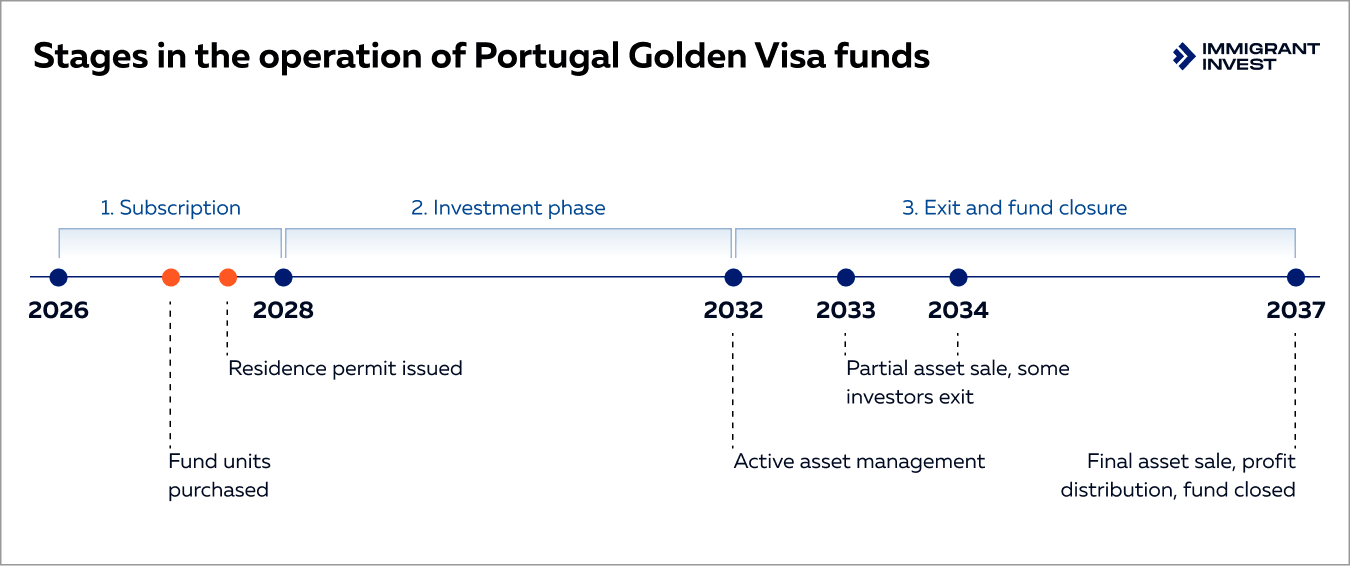
Operational stages of Portugal Golden Visa investment funds
How to evaluate a crypto-exposed Golden Visa fund: Due Diligence checklist
Selecting the wrong fund is the primary operational risk in the Portugal Golden Visa fund route. The checklist below provides a screening framework for investors considering a cryptocurrency fund structure.
1. Check Golden Visa eligibility. The fund must be suitable for the Portugal Golden Visa investment route. This includes the required investment amount, the required holding period, and compliance with the programme’s rules for qualifying investment funds.
A fund may have an attractive crypto strategy, but it is only relevant for Golden Visa investors if it can be used for the residence application.
2. Verify regulatory status. The fund and its management company should be checked from a regulatory perspective. In Portugal, this usually means reviewing the fund’s status with the CMVM, the Portuguese Securities Market Commission, and confirming that the fund is managed by an authorised entity.
3. Review custody and service providers. This may include custodians, brokers, administrators, auditors and, where relevant, crypto-asset service providers.
Investors should focus on how their assets are protected, whether custody arrangements are clear, and whether the structure complies with applicable Portuguese and EU rules, including MiCA, where relevant.
4. Assess risk, liquidity, and fees. Investors should understand the fund’s risk profile before subscribing. Relevant factors include the size of the crypto allocation, volatility, diversification, use of leverage or derivatives, lock-up period, redemption terms, and possible restrictions on exit.
Fees also affect the final result. These may include management fees, performance fees, subscription or redemption fees, custody costs and administrative expenses.
5. Understand the exit strategy. The exit terms are especially important for Golden Visa investors because the investment must be maintained for at least 5 years. It is recommended to review when and how the investor can exit the fund, whether redemptions are available, whether there are lock-up periods, and whether the fund has the right to suspend withdrawals during market stress.
Investors should understand whether the exit will be based on fund redemptions, sale of units to another investor, liquidation of the fund, or another mechanism.
6. Confirm Golden Visa documentation. The fund must be able to support the residence application with the necessary documents. These may include subscription documents, proof of investment, bank transfer records, fund statements and confirmation that the investment can be maintained for the required period.
Immigrant Invest works with a crypto-exposed fund eligible for the Portugal Golden Visa and makes the investment process easier by pre-screening the fund, explaining its structure, and supporting the client through the application.
Step-by-step application process of obtaining the Portugal Golden Visa through the fund route
The entire process takes at least 12 months and may take longer due to backlogs within the Portuguese authorities.
Immigrant Invest supports investors at every stage of the procedure, from the initial preliminary Due Diligence check to the issuance of residence permit cards.
1 day
Preliminary Due Diligence
Immigrant Invest first carries out a preliminary Due Diligence review to check whether there are any issues that could prevent the investor from applying under the Portugal Golden Visa.
If the review is successful, Immigrant Invest prepares a service agreement for further support.
Immigrant Invest first carries out a preliminary Due Diligence review to check whether there are any issues that could prevent the investor from applying under the Portugal Golden Visa.
If the review is successful, Immigrant Invest prepares a service agreement for further support.
Up to 2 weeks
Document preparation
An Immigrant Invest lawyer assists the applicant with collecting the required documents, as well as arranging certification and translation where necessary.
An Immigrant Invest lawyer assists the applicant with collecting the required documents, as well as arranging certification and translation where necessary.
1 to 2 weeks
Obtaining a tax number
Applicants, with the help of Immigrant Invest, receive a unique nine-digit Portuguese tax number, the Número de Identificação Fiscal, or NIF. It is required for opening a bank account in Portugal, buying or renting property, registering a company, and completing many other official procedures.
Immigrant Invest helps applicants obtain NIF without travelling to Portugal.
Applicants, with the help of Immigrant Invest, receive a unique nine-digit Portuguese tax number, the Número de Identificação Fiscal, or NIF. It is required for opening a bank account in Portugal, buying or renting property, registering a company, and completing many other official procedures.
Immigrant Invest helps applicants obtain NIF without travelling to Portugal.
Up to 1.5 months
Bank account opening
The Portugal Golden Visa investment must be made from the applicant’s account with a Portuguese bank.
Immigrant Invest assists with opening and activating the account. Once the account is ready, the applicant transfers the funds required for the investment.
The Portugal Golden Visa investment must be made from the applicant’s account with a Portuguese bank.
Immigrant Invest assists with opening and activating the account. Once the account is ready, the applicant transfers the funds required for the investment.
≈ 2 weeks
Fund selection
Immigrant Invest assists the investor in selecting a fund that may qualify for the Portugal Golden Visa.
We provide official information on eligible funds from public sources and organise a consultation with fund managers before the investor makes the final decision.
Immigrant Invest assists the investor in selecting a fund that may qualify for the Portugal Golden Visa.
We provide official information on eligible funds from public sources and organise a consultation with fund managers before the investor makes the final decision.
Up to 1.5 months
Investment
After the fund is chosen, the investor starts the approval process and signs an agreement with the fund management company.
Once the agreement is signed, the investor transfers the required amount to an account in Portugal and purchases fund units.
After the fund is chosen, the investor starts the approval process and signs an agreement with the fund management company.
Once the agreement is signed, the investor transfers the required amount to an account in Portugal and purchases fund units.
5 to 6 months
Application for residence
Lawyers submit the electronic application to AIMA, the Agency for Integration, Migration and Asylum.
Lawyers submit the electronic application to AIMA, the Agency for Integration, Migration and Asylum.
1 to 2 weeks
Biometrics submission
The lawyers book a biometrics appointment at AIMA. The investor and their family members travel to Portugal to submit biometrics and original documents for residence permits.
The lawyers book a biometrics appointment at AIMA. The investor and their family members travel to Portugal to submit biometrics and original documents for residence permits.
Within 6 months after biometrics
Residence permit cards issuance
AIMA reviews the investor’s and family members’ documents within 6 months after biometrics are submitted.
The residence permit cards can be collected personally by the investor or by a lawyer acting under a power of attorney.
After the residence permit is issued, we continue to support clients with any post-approval matters.
AIMA reviews the investor’s and family members’ documents within 6 months after biometrics are submitted.
The residence permit cards can be collected personally by the investor or by a lawyer acting under a power of attorney.
After the residence permit is issued, we continue to support clients with any post-approval matters.
Overview of taxes on crypto assets in Portugal
Portugal taxes crypto assets based on the type of income they generate[8]Source: Portal das Finanças: Crypto taxation. For individuals, crypto income falls under the Portuguese personal income tax system, known as IRS, mainly as capital gains, investment income, or business and professional income.
For companies, crypto-related income is generally taxed under the corporate income tax system, known as IRC. The tax treatment depends on the transaction type, the taxpayer’s activity, holding period, and whether the asset is treated as a regular crypto asset, a security, or another regulated financial instrument.
Taxes on income from crypto fund units
The tax treatment depends primarily on the fund’s legal structure and the investor’s tax residence.
For Portuguese tax resident individuals, income from fund units is generally taxed under IRS rules. Income from securities investment fund units is commonly taxed at 28%[9]Source: Portal das Finanças: Withholding tax, unless aggregation under progressive IRS rates applies. Progressive IRS rates range from 12.5 to 48%, with an additional solidarity tax for higher incomes[10]Source: Portal das Finanças: IRS tax brackets.
For Portuguese tax resident companies, income from fund units is generally included in taxable corporate profit and taxed under corporate income tax rules. In mainland Portugal, the standard corporate income tax rate is 19%, with municipal and state surtaxes potentially applying in some cases.
For non-resident investors, income from Portuguese securities investment fund units is generally exempt from Portuguese tax. If the exemption does not apply, the rate is generally 28% for individuals[11]Source: Portal das Finanças: Article 72 of the IRS Code and 25% for corporate investors[12]Source: Portal das Finanças: Article 87 of the IRC Code. For non-resident investors in venture capital, private equity, or credit alternative fund structures, income is usually equally exempt. If the exemption does not apply, the rate is 10%[13]Source: Portal das Finanças: Fund tax regime.
365-day rule for private investors
The 365-day rule is a Portuguese tax exemption for private investors who sell crypto assets after holding them for at least one year.
If an individual sells crypto assets held for 365 days or more, the capital gain may be exempt from tax, provided the activity is not treated as a business or professional activity. If the crypto assets are sold before the 365-day period is reached, the gain is generally taxed at 28%[8]Source: Portal das Finanças: Crypto taxation.
The holding period also includes crypto assets acquired before January 1st, 2023. However, the exemption generally applies only to crypto assets that are not treated as securities or other regulated financial instruments. If a crypto asset qualifies as a security, different tax rules may apply[8]Source: Portal das Finanças: Crypto taxation.
Tax rates on crypto income
Crypto taxation in Portugal depends on the source of income. Capital gains from short-term disposals are generally taxed at 28%, while business or professional crypto income may be taxed under the general progressive IRS rules. Investment income from crypto-related operations may also be taxed at 28%, unless it falls under another income category[8]Source: Portal das Finanças: Crypto taxation.
Crypto-to-crypto swaps and conversion into fiat
Crypto-to-crypto swaps are generally not taxed at the moment of exchange if the taxpayer receives another crypto asset in return. Instead, the crypto asset received takes the acquisition value of the asset given up. Taxation is usually deferred until there is an effective disposal for money or for another non-crypto asset.
Conversion into fiat, such as selling Bitcoin for euros, is treated differently. If the crypto asset was held for less than 365 days, any gain may be taxed at 28%. If the asset was held for at least 365 days, the gain may be excluded from taxation.
Special considerations for US and UK applicants
For US taxpayers, Portuguese funds may be treated as Passive Foreign Investment Companies, or PFICs, depending on the fund’s structure, income, and assets. US investors may need to file Form 8621[14]Source: Internal Revenue Service: Instructions for Form 8621 for each PFIC interest held. Under the default PFIC regime, excess distributions and gains on disposal are subject to special tax rules, including deferred tax and interest charges.
A Qualified Electing Fund or mark-to-market election may reduce the tax impact, but only if the fund and investor meet the relevant conditions.
For UK taxpayers, the key issue is whether the fund has UK Reporting Fund status[15]Source: HMRC: Approved offshore reporting funds. If a non-UK fund is not on the approved offshore reporting funds list, gains on exit may normally be treated as offshore income gains and taxed as income rather than capital gains.
US and UK applicants should obtain personal tax advice before investing, especially on PFIC classification, Reporting Fund status, annual filings, distributions, and exit taxation.
Tax treatment of different types of crypto income in Portugal

Risks and pitfalls of obtaining the Portugal Golden Visa through a cryptocurrency fund
The fund route carries a distinct set of risks that investors should evaluate before committing capital. The following risks are specific to the Portugal Golden Visa crypto investment structure and to the ARI process more broadly.
Investment threshold and programme condition changes
The Portugal Golden Visa conditions have changed before and may change again. The October 2023 reform removed real-estate and capital-transfer routes entirely.
The Spain Golden Visa closure in 2024 demonstrates that EU investor residence programmes can be suspended or restructured with limited notice.
Checking investment terms before committing to a fund selection meaningfully reduces this exposure.
Processing and biometrics delays
End-to-end timelines of more than 12 months are common due to the large number of applications and backlog at the Portuguese authorities.
Investors planning business restructuring or school placements around a specific completion date face material disruption risk if they treat indicative timelines as fixed. Building contingency into relocation and planning reduces downstream disruption when administrative queues extend.
Costs beyond the headline investment
The €500,000 fund subscription is the minimum qualifying investment, not the total outlay. Government fees amount to €6,314.1 per person for residence card issuance, plus a €632.2 application fee per person. Additional costs include a subscription fee of up to 7.5%, performance fees, health insurance, legal fees, and translation costs.
For families of three or four, the cumulative cost above the investment minimum is substantial. Investors who budget to the minimum investment figure are typically underestimating total outlay.
Source-of-funds documentation delays
Source-of-funds documentation is the stage where applications most frequently stall. Investors with capital from business sales, cryptocurrency proceeds, inherited assets, or overseas property disposals face a detailed compliance review at the banking stage. Demonstrating a clean, traceable chain from crypto to fiat is a distinct evidential task that differs from standard income documentation.
Delays at this stage can set back the entire process by 6—8 weeks. Assembling documentation early and verifying it against the specific requirements of the receiving bank reduces the risk of last-minute complications.
Limited access to capital before fund maturity
Golden Visa holders must keep their fund investment for at least 5 years. However, fund contractual terms commonly extend to 7 or 10 years, so investors may be unable to withdraw capital when personal, business, or relocation plans change.
Reviewing lock-up terms, redemption conditions, and exit mechanisms before subscription provides a realistic picture of when capital can be recovered.
False assumptions about IFICI eligibility
The IFICI tax regime, which replaced NHR from January 1st, 2024, is not automatic with the Portugal Golden Visa. An investor who does not establish tax residency will not qualify for IFICI[16]Source: Portal das Finanças: IFICI tax regime. IFICI requires a separate application, full Portuguese tax residency, and professional eligibility criteria.
How Immigrant Invest can help obtain the Portugal Golden Visa
Immigrant Invest is a consulting company specialising in investment migration. We help clients worldwide obtain residence and citizenship in Europe, the Caribbean, and other regions, providing professional support throughout the fund application process.
Our compliance process includes a preliminary Due Diligence check carried out by our in-house Legal and AML Compliance Department. This review is especially thorough for clients whose capital comes from cryptocurrency transactions, as they must provide a clear and traceable chain from crypto to fiat.
For Portugal Golden Visa applicants, we work with eligible fund options and help investors choose a suitable route based on their goals, risk profile, family situation, and source of funds. Our specialists explain how each fund is structured, coordinate communication with fund managers, and support clients through the subscription process.
Our support continues after the first residence permit is issued. We assist with permit renewals, citizenship applications, and further steps in the investor’s migration journey.
Key takeaways on obtaining the Portugal Golden Visa through a cryptocurrency fund
- Non-EU and non-EEA nationals can obtain the Portugal Golden Visa by investing €500,000+ in fund units.
- Direct use of crypto assets for investment is not allowed; however, a subscription to fund units with crypto exposure qualifies.
- To be eligible for the Portugal Golden Visa, a fund must be regulated by the CMVM, invest at least 60% of its net assets in Portuguese-domiciled companies or assets, and have no residential real estate exposure.
- End-to-end processing for the Portugal Golden Visa takes at least 12 months.
- Portugal taxes crypto assets depending on the type of income: capital gains, investment income, or business and professional income.
- The tax treatment of income from crypto fund units depends primarily on the fund’s legal structure and the investor’s tax residence. Non-residents are usually exempt.
Immigrant Invest is a licensed agent for citizenship and residence by investment programs in the EU, the Caribbean, Asia, and the Middle East. Take advantage of our global 15-year expertise — schedule a meeting with our investment programs experts.

 Trusted by 10,000+ investors