










After Brexit, UK citizens lost unrestricted access to the EU and became subject to the 90-day Schengen limit. Many high-net-worth Britons therefore began looking for ways to regain greater flexibility within the EU, with the Portugal Golden Visa becoming one of the most popular solutions.
By investing at least €250,000, British applicants can obtain a 2-year residence permit for themselves and eligible family members.
This guide explains how the Portugal Golden Visa works for British citizens, including the investment routes, application process, costs, tax considerations, and practical benefits.
What is the Portugal Golden Visa?
The Portugal Golden Visa, or formally Autorização de Residência para Investimento, ARI[1]Source: AIMA — Autorização de Residência para Investimento – Art. 90.º-A, is a pathway to Portuguese residence in exchange for an investment of €250,000+. Holders receive a temporary residence permit renewed every 2 years, with a long-term route to permanent residence and citizenship.
The programme offers the following investment options:
- €500,000 in units of investment funds;
- €500,000 in scientific research;
- €250,000 in for artistic production or conservation of cultural heritage;
- €500,000 in a business with creation of at least 5 jobs;
- creation of at least 10 permanent jobs with no minimum investment requirements.
The cultural contribution and support of scientific research are non-refundable. The fund and business routes require maintaining the investment for at least 5 years; early exit triggers permit revocation.
Obtaining residence permit through property purchase is not available after the 2023 reform.
The Portugal’s Golden Visa legal basis is Article 90-A of Law 23/2007 of July 4th[2]Source: Diário da República — Lei n.º 23/2007, de 4 de julho, the country’s principal statute on the entry, stay, exit, and removal of foreign nationals. The administering authority is AIMA, the Agency for Integration, Migration and Asylum.

Trusted by 10,000+ investors
Check your eligibility for the Portugal Golden Visa
What does a Portugal Golden Visa give a British citizen after Brexit?
After Brexit, British nationals lost the automatic right to live and work in Portugal as EU citizens. A Portugal Golden Visa restores many of the practical advantages of Portuguese residence without requiring the investor to move to Portugal full-time.
Right to live in Portugal
The Golden Visa holder has the legal right to make Portugal a second home rather than use it only as a holiday destination. For a British family, this means the possibility to spend an entire winter in the Algarve, stay for several months in Lisbon, or gradually move more of their life to Portugal without counting days against the 90 days in 180-day periods limit applicable to ordinary UK visitors.
Portugal can be a good place for living due to its high level of safety, affordable costs, pleasant climate, and welcoming locals.
The permit does not, however, turn its holder into an EU resident with an unrestricted right to settle anywhere in Europe. Residence rights attach primarily to Portugal, while travel elsewhere in the Schengen Area remains subject to the applicable short-stay rules.
Route to EU citizenship
The Golden Visa can ultimately lead to Portuguese citizenship, but the rules changed substantially in 2026. For applications filed from May 19th, 2026[3]Source: Diário da República — Amendment to Law No. 37/81, of October 3rd, Portugal increased the general naturalisation period to 10 years. However, if a UK citizen also holds the nationality of a Portuguese-speaking country the required period is reduced to 7 years.
If naturalisation is approved, the distinction is significant for a British citizen: Portuguese nationality is also EU citizenship. The person can then exercise EU free-movement rights as an EU citizen.
Both Portugal and the UK recognise dual citizenship, which means Brits do not need to renounce their British nationality upon obtaining a Portuguese one.
Freedom to maintain status with minimum stay requirements
One of the main differences between the Golden Visa and conventional residence routes is the amount of physical presence required in Portugal.
Investors must spend only 7 days in Portugal during the first year and 14 days during subsequent periods. This means the investor does not have to relocate to Portugal simply to preserve the permit. A British investor can continue living and working primarily in the UK while maintaining Portuguese residence, provided the investment and the other renewal requirements remain satisfied.
The same minimum-stay rules are relevant to the investor’s family members holding residence permits.
Residence status for the entire family
The Portugal Golden Visa allows investors to include family members, and the family application can be submitted together with the investor's application, although approval of the family's residence depends on approval of the principal investor.
Eligible relatives include the following:
- spouse or partner;
- children under 25;
- parents of the investor and spouse.
Each qualifying family member receives their own residence status rather than merely being listed as a visitor under the investor's permit.
Right to work and run a business in Portugal
The Portugal Golden Visa is not limited to passive residence. It also gives a British holder the right to work in Portugal, whether as an employee, a self-employed professional, or a business owner without a separate work permit.
This gives investors flexibility. Someone may initially obtain the Golden Visa purely as a residence and investment option while continuing to work in the UK, then later accept a position in Lisbon, open a consultancy, launch a Portuguese subsidiary of an existing UK company or become actively involved in a local business.

Portugal is one of the safest countries in the world, ranking 7th in the Global Peace Index 2026. In the same rating, the UK ranks 39th[4]Source: Vision of Humanity — 2026 Global Peace Index
Requirements for UK citizens applying for the Portugal Golden Visa
A Golden Visa applicant must meet baseline eligibility rules, and eligible family members can join the same application. UK applicants also face a specific document checklist tied to British civil and criminal-record procedures.
Baseline eligibility criteria for investors
An applicant must meet the following requirements:
- be at least 18 years old;
- have a clean criminal record with no registration in the Schengen Information System;
- demonstrate the legal source of funds and overseas origin of the investment capital;
- have no debts in Portugal;
- make the investment from a non-Portuguese bank account through a documented transfer.
Requirements for family members
The investor may include their spouse or civil partner, children under 25, and parents in one application. Age, dependency, and other requirements apply.
Spouse or partner. The investor may include a spouse in a registered marriage or a partner in an unregistered relationship, provided they have a clean criminal record. Unregistered partners must be in relationship with the investor for at least 2 years. Both same-sex and different-sex couples are eligible.
Children. No specific requirements apply to minor children. Adult children under age of 25 must:
- financially depend on the investor;
- be unmarried;
- live with the investor or study at a university.
Children over 25 do not qualify as dependants.
Parents. To be eligible, parents under 65 must be financially dependent on the investor. Parents over 65 do not need proof of financial dependency.
Required documents
British nationals typically need to provide the following:
- valid UK passport;
- NIF, the Portuguese tax identification number;
- ACRO Police Certificate or another acceptable criminal record certificate from the UK and, where applicable, from any country where the applicant has lived for more than 1 year;
- private health insurance valid in Portugal;
- proof of investment;
- source-of-funds evidence, such as bank statements, asset-sale records, or business income documentation;
- proof of dependency for family members included in the application, such as birth certificates for children or a marriage certificate for a spouse.
UK public documents that require authentication for use in Portugal are generally legalised with an apostille issued by the UK Legalisation Office. This can apply, for example, to ACRO Police Certificates, birth certificates, and marriage certificates. Where a document is not in Portuguese, a certified translation is also required.

Pedro Barata,
Head of Portuguese office
In practice, the main challenge is not collecting the documents themselves, but coordinating their timing, legalisation, and translation so that everything is valid when the application is submitted.
British applicants most often face delays with ACRO Police Certificates, apostilles, and certified translations. Timing matters because some documents have limited validity, and delays in the process can mean that documents need to be renewed. Obtaining a Portuguese NIF and arranging the required banking and investment documentation from the UK also takes advance planning.
Immigrant Invest coordinates these steps with the overall application timeline, helping clients prepare documents in the correct order and reduce the risk of avoidable delays.
Investment options under the Portugal Golden Visa
Portugal no longer offers a Golden Visa through the purchase of residential or commercial property. Law 56/2023 removed both real estate and general capital-transfer routes for new applicants. British investors now have 5 investment options, ranging from regulated investment funds to job creation.
Purchase of investment funds — €500,000+
An applicant can place €500,000+ in units of Portuguese investment funds, which must meet the following criteria:
- be established under Portuguese law;
- have a maturity of at least 5 years at the time of investment;
- place at least 60% of its investment value in companies headquartered in Portugal;
- not be structured, directly or indirectly, around real estate[5]Source: AIMA — Investment fund route.
The investor can choose among funds with different sector focuses and investment strategies. Available options may target renewable energy and infrastructure, technology and innovation, AI, agriculture, hospitality, equities, digital assets, and other sectors. This allows applicants to select a fund that better matches their preferred risk profile, investment horizon, and expected return.
Qualifying funds are subject to oversight by CMVM, the Portuguese Securities Market Commission, which supervises investment funds, fund managers, and securities markets in Portugal. This adds a regulatory layer around fund operations, reporting and investor protection, although CMVM supervision does not guarantee investment performance or protect against losses.
For many British applicants, fund investment is the most convenient route because it does not require active participation, and the capital is professionally managed according to the fund's strategy.
Contribution to arts and cultural heritage — €250,000+
The lowest threshold is €250,000 for investment in artistic production or the preservation, restoration, or maintenance of Portugal's national cultural heritage. The amount may be reduced by 20% for investments in designated low-density areas, down to €200,000. Low-density territories are defined as areas with fewer than 100 inhabitants per square kilometre or GDP per capita below 75% of the national average[6]Source: AIMA — Cultural donation route.
The money must be channelled through an eligible public or qualifying cultural body, such as public institutions, certain foundations, municipal entities or cultural associations recognised under Portuguese law. It is therefore not enough simply to buy art or make a private donation to an organisation of the investor's choice.
This route is primarily philanthropic rather than return-driven. In exchange for the lower entry threshold, investors should not expect recovering or earning a return on their capital as they might through an investment fund.
Support of scientific research — €500,000+
A minimum investment of €500,000 can be directed towards research activities carried out by public or private scientific institutions that form part of Portugal's national scientific and technological system. The threshold can fall to €400,000 when the qualifying activity takes place in a designated low-density area[7]Source: AIMA — Scientific support route.
The applicant must provide evidence that the funds were transferred and applied to an eligible research institution. This route may suit investors who want their capital to support areas such as science, technology, or academic research rather than a conventional investment portfolio.
Investment in a Portuguese company — €500,000+
An investor can transfer at least €500,000 into a Portuguese company and combine that investment with employment creation.
For a newly incorporated company, the investment must be accompanied by the creation of at least 5 permanent jobs. Alternatively, the investor can inject capital into an existing Portuguese company and create at least 5 permanent jobs or maintain at least 10 jobs, of which at least 5 must be permanent. The employment conditions must be maintained for at least 3 years[8]Source: AIMA — Business investment route.
This route gives the investor direct involvement and may suit entrepreneurs who want to expand into Portugal or acquire an interest in a local company. It also carries greater operational responsibility, as the company must meet Portuguese corporate, employment, tax, and social-security rules while maintaining both the required capital investment and jobs throughout the relevant period.
Creation of 10 jobs
Under the route, no fixed minimum capital amount is established. Instead, the applicant must create at least 10 jobs in Portugal. In a designated low-density area, the employment requirement is reduced by 20%, from 10 to 8 jobs[9]Source: AIMA — Creation of at least 10 jobs.
In practice, the investor needs a business capable of supporting the required employees and must maintain evidence that the jobs genuinely exist. The real financial commitment can therefore be considerably higher than the absence of a statutory minimum might initially suggest, once salaries, employer social-security contributions, and operating costs are included.

Full cost breakdown under the Portugal Golden Visa
The minimum cost of the Portugal Golden Visa starts at €250,000, but the qualifying investment is only part of the budget. Applicants also pay AIMA fees for each family member, as well as document, insurance, and investment-related expenses.
Government fees
Application fee. AIMA charges a fee to receive and analyse an application. The amount applicable through the discounted electronic procedure is €632.10 per applicant.
Residence permit fee. Once the application is approved, there is a separate fee for granting the Golden Visa residence permit. The current electronic-procedure amount is €6,314.20 per person.
Both fees are paid not only for the main investor but also for each family member applying for residence through family reunification.
Document preparation
The document-processing expenses start at around €2,000, although the actual amount depends on the number of applicants and documents involved. Family applications are generally more expensive because additional birth, marriage, and dependency documents may need to be obtained, legalised, and translated.
Health insurance costs approximately €400+ per applicant. However, the total depends on the applicant's age, insurer, and level of cover.
Business option expenses
Applicants choosing the company route should budget for business setup and employment costs in addition to the Golden Visa fees. Typical setup expenses include:
- €2,800 for company registration;
- €220 in government registration fees;
- €500 to open a corporate bank account.
The larger cost is ongoing employment. Based on Portugal’s 2026 minimum wage of €920 and the standard 23.75% employer Social Security contribution, employing 5 people costs at least around €80,000 per year, while 10 employees cost at least €160,000 per year in salaries and employer contributions alone. Accounting, insurance, premises, and other operating expenses are additional.
Cost breakdown for the Portugal Golden Visa under fund investment

How should British investors evaluate Portuguese investment funds?
Investment in fund units is one of the most popular Portugal Golden Visa options because it requires no active business management or job creation, benefits from CMVM regulatory oversight, and offers the potential for capital growth and investment returns.
Immigrant Invest offers a selection of funds already reviewed for Golden Visa eligibility. When comparing them, investors should focus on the factors that affect risk, returns, liquidity, and overall investment fit:
- Investment strategy. Funds may focus on technology, renewable energy, infrastructure, agriculture, hospitality, corporate credit, and other sectors. The investor should choose a strategy that matches their expectations and tolerance for sector-specific risk.
- Risk and expected return. The funds show a wide range of estimated returns, from around 2 to 15—20% a year, with higher projected returns coming with greater uncertainty. Investors should therefore consider downside scenarios, such as falling asset values, weaker company performance, delayed exits, or losses in a concentrated sector, rather than choosing solely by the headline return.
- Fund term and exit. Golden Visa funds are long-term investments and may operate for 6 to 12 years. Investors should consider when they are likely to recover their capital and whether the fund term fits their residence and financial plans.
- Income distribution. Some funds distribute income during the investment period, while others reinvest profits and return most of the capital and gains at exit. This matters for investors who prefer regular cash flow.
- Diversification. The €500,000 investment can be divided among several eligible funds, allowing investors to spread exposure across different sectors and strategies.
Immigrant Invest helps applicants compare pre-selected funds and choose an option based on their preferred level of risk, expected return and investment horizon.

Trusted by 10,000+ investors
Quick guide to Portugal Golden Visa investment funds
Portugal Golden Visa through investment funds: step-by-step process
The application follows 8 main stages, from preliminary Due Diligence to card issuance, with Immigrant Invest accompanying the investor throughout them all. Most steps can be completed remotely from the UK, as only the biometrics appointment requires travel to Portugal.
In Immigrant Invest experience, obtaining the Portugal Golden Visa takes at least 12 months.
1 day
Preliminary Due Diligence
Immigrant Invest first conducts a Due Diligence check to identify any circumstances that could affect the applicant’s eligibility for the programme. If the applicant passes the review, we sign a service agreement, and the preparation process begins.
Immigrant Invest first conducts a Due Diligence check to identify any circumstances that could affect the applicant’s eligibility for the programme. If the applicant passes the review, we sign a service agreement, and the preparation process begins.
2+ weeks
Document preparation
A dedicated lawyer provides the investor with a list of required documents, and then helps arrange certification and translation.
A dedicated lawyer provides the investor with a list of required documents, and then helps arrange certification and translation.
1+ weeks
Obtaining a Portuguese tax number
Immigrant Invest assists the applicant with obtaining a nine-digit Número de Identificação Fiscal, or NIF. It is required to open a Portuguese bank account and is also used for activities such as registering a business, buying or renting property, and dealing with the Portuguese tax system.
Immigrant Invest assists the applicant with obtaining a nine-digit Número de Identificação Fiscal, or NIF. It is required to open a Portuguese bank account and is also used for activities such as registering a business, buying or renting property, and dealing with the Portuguese tax system.
1+ months
Opening a Portuguese bank account
Golden Visa investments must generally be transferred from an account held in the investor’s own name at a Portuguese bank, and the bank provides confirmation of the capital transfer for the application. Immigrant Invest coordinates the account-opening process and activation.
Golden Visa investments must generally be transferred from an account held in the investor’s own name at a Portuguese bank, and the bank provides confirmation of the capital transfer for the application. Immigrant Invest coordinates the account-opening process and activation.
Up to 2 months
Fund selection and investment
Immigrant Invest helps the applicant compare funds that qualify for the Golden Visa. The investor receives information on suitable options and can consult fund managers before making the final choice.
Once the investor selects the fund they complete the fund’s approval and onboarding procedures. The required capital is then transferred to a Portuguese account and used to purchase fund units.
Immigrant Invest helps the applicant compare funds that qualify for the Golden Visa. The investor receives information on suitable options and can consult fund managers before making the final choice.
Once the investor selects the fund they complete the fund’s approval and onboarding procedures. The required capital is then transferred to a Portuguese account and used to purchase fund units.
5—6 months
Application processing
Immigrant Invest submits residence application electronically to AIMA. Processing typically takes several months.
Immigrant Invest submits residence application electronically to AIMA. Processing typically takes several months.
1+ days
Biometrics
All applicants travel to Portugal to provide biometrics and submit original documents. The appointment must be scheduled in advance.
All applicants travel to Portugal to provide biometrics and submit original documents. The appointment must be scheduled in advance.
Within about 6 months after biometrics
Residence cards issuance
AIMA reviews the documents submitted by the investor and family members. Once the application is approved and the relevant government fee is paid, residence cards are issued. They can be collected personally by the investor or by an authorised lawyer.
AIMA reviews the documents submitted by the investor and family members. Once the application is approved and the relevant government fee is paid, residence cards are issued. They can be collected personally by the investor or by an authorised lawyer.
Every 2 years
Residence permit renewal
Residence permits are valid for 2 years and can be renewed for further 2-year periods.
Before each renewal, the investor needs to confirm that they maintain the investment and have spent 7+ days per year in Portugal. Updated supporting documents and AIMA renewal fees may also be required. Immigrant Invest assists with preparing the renewal file and coordinating the procedure.
Residence permits are valid for 2 years and can be renewed for further 2-year periods.
Before each renewal, the investor needs to confirm that they maintain the investment and have spent 7+ days per year in Portugal. Updated supporting documents and AIMA renewal fees may also be required. Immigrant Invest assists with preparing the renewal file and coordinating the procedure.
Permanent residence and citizenship after the Portugal Golden Visa for UK citizens
For UK citizens, the Portugal Golden Visa can provide a route to permanent residence and, eventually, Portuguese citizenship[10]Source: Regional Attorney General's Office of Lisbon website — Nationality Law No. 37/81, of October 3rd. However, neither status is granted automatically. Investors must maintain legal residence and meet the requirements that apply at the time of application.
Permanent residence: legal eligibility at 5 years
Golden Visa holders may apply for permanent residence after 5 years of legal residence in Portugal, provided they continue to meet the conditions of their residence status.
To qualify, applicants generally need to:
- maintain legal residence in Portugal for the required 5-year period;
- comply with the Golden Visa minimum-stay requirements during the temporary residence period;
- maintain the qualifying investment;
- have sufficient means of subsistence;
- have suitable accommodation in Portugal;
- have no disqualifying criminal convictions.
Permanent residence removes the need to continue relying on temporary Golden Visa renewals. It does not, however, make the holder an EU citizen or give an unrestricted right to settle in other EU countries.
Citizenship: 10 years for UK nationals
Under the rules introduced in 2026[3]Source: Diário da República — Amendment to Law No. 37/81, of October 3rd, most British nationals need 10 years of legal residence before they can apply for Portuguese citizenship by naturalisation.
In addition to the residence period, applicants must meet the naturalisation requirements, including:
- Portuguese language proficiency at A2 level or higher;
- sufficient knowledge of Portuguese culture, history, national symbols, and the political system;
- understanding of fundamental rights and duties;
- adherence to the principles of Portugal's democratic rule of law;
- no disqualifying serious criminal convictions;
- no threat to national security;
- sufficient financial means.
If citizenship is granted, the investor becomes both a Portuguese and an EU citizen, gaining the right to live, work, and study across EU member states.
Tax considerations in Portugal for British applicants
Obtaining a Portugal Golden Visa does not automatically make a British investor tax resident in Portugal. Many applicants continue living and working primarily in the UK and remain UK tax residents, but residence for tax purposes must be assessed separately under the rules of each country.
Tax residency in the UK and Portugal
A Portugal Golden Visa does not automatically make its holder a Portuguese tax resident. The residence permit has a low physical-presence requirement, while tax residency is determined under separate rules in Portugal and the UK.
In Portugal, an individual is generally considered a tax resident if they spend more than 183 days in the country during any 12-month period. A person can also become a tax resident with fewer days if they maintain a home in Portugal that is intended to be used as their habitual residence[11]Source: Portuguese Tax and Customs Authority — Tax residency rules.
Portuguese tax residents are generally taxed on worldwide income, while non-residents are taxed only on Portuguese-source income.
In the UK, tax residency is determined under the Statutory Residence Test[12]Source: HM Revenue & Customs — Statutory Residence Test guidance. A person is automatically a tax resident if they spend 183 days or more in the UK. They may also qualify as resident with fewer days if the UK is their main home or they work full-time there. If none of these automatic tests applies, HMRC considers the number of days spent in the UK together with ties such as family, accommodation, and work.
British Golden Visa holders usually face one of the common scenarios:
- The investor continues living mainly in the UK. Spending only the minimum time required for the Golden Visa will not usually trigger Portuguese tax residency. If the investor also continues to meet the UK Statutory Residence Test, they will generally remain UK tax resident and continue to be taxed there under the usual UK rules.
- The investor relocates to Portugal. Spending more than 183 days there will normally make the investor a Portuguese tax resident. They may then need to declare worldwide income in Portugal, including UK pensions, employment income, dividends, interest, and investment gains.
Becoming a Portuguese tax resident does not mean that all UK-source income is taxed only in Portugal. Some earnings, such as rent from property, may still be taxable in the UK. The Double Taxation Convention sets out which country can tax different types of income, how the two countries prevent double taxation, and which country is regarded as the person’s treaty residence.
For example, under the current treaty, most private and occupational pensions paid to a Portuguese tax resident are taxable only in Portugal. UK government-service pensions are generally taxable in the UK.
Main taxes in Portugal
Personal income tax, or IRS. Portuguese tax residents are generally taxed on worldwide income at progressive rates from 12.5 to 48% in 2026. The top 48% rate applies to taxable income above €86,634. Non-residents are normally taxed only on Portuguese-source income, often under separate flat-rate rules depending on the type of income[13]Source: Portuguese Tax and Customs Authority — IRS rates.
Property taxes. Annual IMI is a municipal property tax generally charged at 0.3—0.45% of the property's taxable value[14]Source: Portuguese Tax and Customs Authority — IMI rates, with the exact rate set by the municipality. For example, in 2026, Lisbon applies a rate of 0.3%[15]Source: Lisbon City Council — Municipal Budget for 2026, while Porto applies 0.324% to urban property[16]Source: Porto City Council — Municipal Budget for 2026.
Higher-value residential property and building land may also be subject to AIMI, an additional property tax. For individuals, the standard rate is 0.7%, rising to a marginal rate of 1% on the portion of taxable value above €1 million and up to €2 million, and 1.5% on the portion above €2 million[17]Portuguese Tax and Customs Authority — AIMI tax rates.
The calculation is subject to statutory deductions and other rules, so AIMI does not simply apply to the property's full market price.
Business taxes. Investors using the company or job-creation routes should also budget for corporate tax and employment costs. The standard Portuguese corporate income tax, or IRC, rate is being reduced gradually: 19% for tax periods beginning in 2026, 18% in 2027, and 17% from 2028 onwards[18]Source: Portuguese Tax and Customs Authority — Corporate income tax rates.
Qualifying SMEs and Small Mid Caps benefit from a 15% rate on the first €50,000 of taxable profit, with the standard rate for the relevant year applying above that amount. Qualifying startups may benefit from a 12.5% rate on the first €50,000, subject to the statutory conditions[18]Source: Portuguese Tax and Customs Authority — Corporate income tax rates.
For ordinary employees, employers generally contribute 23.75% of gross salary to Portuguese Social Security, while the employee contribution is normally 11%[19]Source: Portuguese Social Security — Contribution rates. These payroll costs can therefore be significant for investors using a Golden Visa route that requires job creation.
Tax treatment of Golden Visa fund investments
The Portuguese tax treatment depends on the investor’s tax residence and the legal structure of the fund.
For Portuguese tax residents, income and gains from ordinary Portuguese investment funds are generally taxed at 28%[20]Source: PwC Worldwide Tax Summaries — Portugal: Individual income determination. Venture capital and credit alternative investment funds that are legally established and operate under Portuguese law benefit from a special 10% regime[21]Source: Portuguese Tax and Customs Authority — Article 23 of the Tax Benefits Code, which applies to distributions, redemptions, and gains on the sale of fund units.
For non-residents, income from Portuguese venture capital and credit alternative investment funds can be exempt from Portuguese tax if the investor has no permanent establishment in Portugal, is not resident in a blacklisted low-tax jurisdiction, and provides proof of non-resident status[21]Source: Portuguese Tax and Customs Authority — Article 23 of the Tax Benefits Code.
The British tax treatment for investors who remain UK tax residents depends on the fund’s HMRC reporting status.
A fund that qualifies for the Portugal Golden Visa does not automatically have HMRC reporting fund status. Golden Visa eligibility concerns Portuguese immigration rules, while HMRC status determines how gains are taxed in the UK.
If a fund has reporting status, gains on disposal are generally treated as capital gains and taxed at 18% or 24%, depending on the income[22]Source: HM Revenue & Customs — Capital gains tax rates and allowances. Investors may also need to report their share of the fund's reportable income.
If a fund is non-reporting, gains are generally treated as offshore income gains and taxed as income rather than capital gains[23]Source: HM Revenue & Customs — HS265 Offshore funds. The UK income tax rates range from 20 to 45%, depending on the investor’s income.
The UK—Portugal Double Taxation Convention may also apply. If Portuguese tax is paid on income or gains that are also taxable in the UK, the treaty sets out which country can tax the amount and may allow Portuguese tax to be credited against UK tax on the same income or gain.
Double taxation between the UK and Portugal
The UK and Portugal have a double taxation convention designed to prevent the same income or gain from being taxed twice without relief. A new convention signed in 2025 was ratified and is now in force[24]Source: HM Revenue & Customs — 2025 UK—Portugal Double Taxation Convention.
The treaty determines which country has primary taxing rights over different categories of income and provides mechanisms such as foreign tax credits when both countries are entitled to tax the same amount. For example, where a Portuguese tax resident receives income that may also be taxed in the UK, Portuguese rules can allow credit for qualifying UK tax paid, subject to treaty limits.
The treaty does not mean an investor can simply choose where to pay tax. The result depends on tax residence, the type and source of income, and the relevant treaty article.
IFICI tax regime
Portugal's Non-habitual tax regime, NHR, was repealed from January 1st, 2024. It was replaced by the Incentivo Fiscal à Investigação Científica e Inovação, or IFICI[25]Source: Portuguese Tax and Customs Authority — Tax Incentive for Scientific Research and Innovation, which is much narrower.
IFICI applies a 20% flat IRS rate to eligible income from qualifying activities, such as:
- scientific research and higher education;
- highly qualified roles in innovation and technology;
- work for certified startups;
- R&D activities;
- qualified positions in companies with significant investment projects;
- certain export-oriented or strategically important business activities;
- certain jobs and professional activities in Madeira or the Azores that are specifically approved under regional IFICI rules.
The regime is vaid for 10 years, provided the person becomes a Portuguese tax resident.
Tax planning before relocating
Before moving to Portugal, British Golden Visa holders should review their tax position in both countries rather than waiting until after they become Portuguese tax residents.
In practice, this means checking the timing of the move, how many days will be spent in each country, and whether the UK Statutory Residence Test will still be met. Investors should also review UK pensions, dividends, investment funds, company interests, and rental income, since these may be taxed differently once Portuguese tax residency begins.
Before relocating, it is also worth checking whether the investor may qualify for IFICI, as eligibility depends on becoming a Portuguese tax resident and carrying out a qualifying activity. The structure and timing of income can matter as well: receiving a large dividend, selling investments or realising capital gains shortly before or after the move can produce very different tax results.
For this reason, tax planning is best done before changing residence, ideally with both UK and Portuguese tax advisers reviewing the same move.
Moving to Portugal from the UK: what to know beyond the Golden Visa
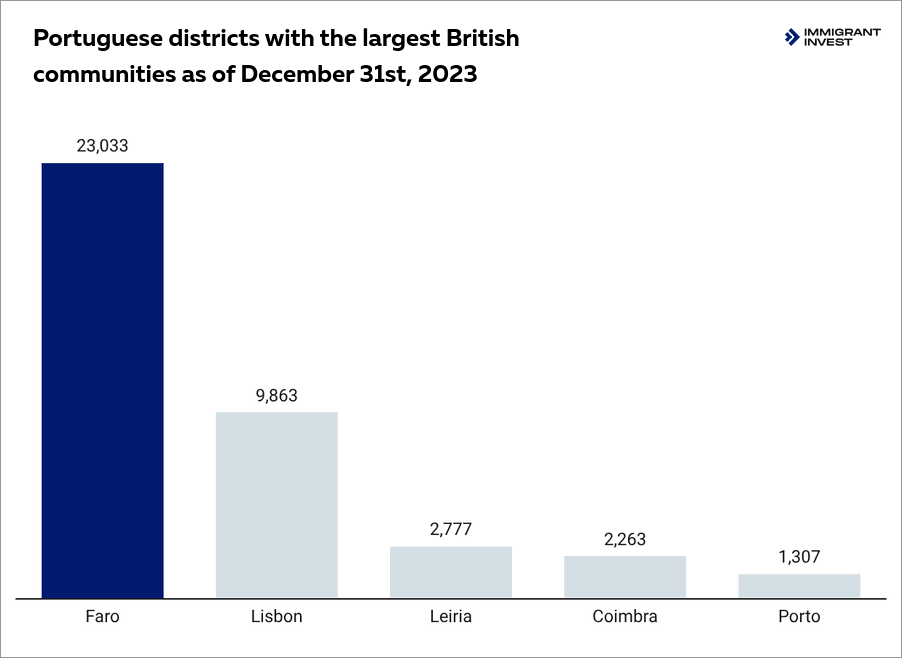
Portugal has a sizeable British community. Around 48,200 UK citizens held Portuguese residence status at the end of 2024, almost 3 times as many as a decade earlier[26]Source: The Portugal Brief — British Residents in Portugal Nearly Triple in a Decade as Post-Brexit Migration Accelerates. British residents are particularly established in the Algarve, as well as in the Lisbon area and parts of Portugal’s central coast.
Best places to live in Portugal
The best place to live in Portugal depends mainly on whether the priority is city life, access to the coast, international services, climate, or a quieter pace.
Lisbon is Portugal’s capital and main business centre, located on the Atlantic coast at the mouth of the Tagus River. It offers the country’s widest choice of international schools, private healthcare, professional services, restaurants, and cultural venues. It suits people who want a large-city environment and regular international travel without giving up access to beaches and coastal towns nearby.
Cascais lies west of Lisbon on the Atlantic coast and is connected to the capital by suburban rail. It is especially popular with families and international residents who prefer a more residential setting, access to beaches, and a smaller-town feel while remaining within easy reach of Lisbon. The wider Cascais and Estoril area also has a strong concentration of international schools and private services.
Porto is Portugal’s second-largest city and the main urban centre in the north. It sits on the Douro River close to the Atlantic and combines a compact historic centre with a large business and university community. Porto suits people who want city infrastructure and direct international connections but prefer a smaller scale than Lisbon.
The Algarve covers Portugal’s southern coast and includes places such as Faro, Lagos, Albufeira, Tavira, and Loulé. The region is known for mild winters, long dry summers, beaches, and a large international community. It is particularly suitable for retirees, remote workers, and people who prioritise outdoor living, although the experience can differ significantly between busy resort areas and quieter inland or eastern Algarve towns.
Braga is in northern Portugal, around 55 kilometres from Porto. It is one of the country’s main university and technology centres and has a younger population than many smaller Portuguese cities. Braga can suit families and professionals who prefer a more compact city, shorter daily journeys and easy access to northern Portugal, while still being close enough to Porto.
Cost of living
Portugal is generally cheaper than the UK, but the difference depends heavily on where a family settles. On average, the cost of living in the UK is about 41% higher than in Portugal before rent, while rents are around 29% higher on average. The gap is especially noticeable in restaurants and groceries, which are around 60% and 38% more expensive in the UK, respectively.
For a family of four, monthly living costs in Portugal are around €2,446 excluding rent. Housing then becomes the main variable, and this is where the differences between Portuguese cities are substantial.
Lisbon remains the most expensive major market. In June 2026, asking rents averaged around €20 per m² in the Lisbon district, compared with €14.9 in Porto, €15.5 in Faro, and €10.2 in Braga. For a 100 m² family home, that is roughly equivalent to €2,000 per month in Lisbon, €1,490 in Porto, €1,550 in Faro, and €1,020 in Braga.
Porto offers a noticeable saving on housing while still providing the services of a large city. The Algarve is not necessarily a low-cost alternative, particularly in popular coastal areas, where demand from expats and holidaymakers keeps rents high. Braga and other smaller northern cities offer much lower housing costs, although families have fewer international schools and English-language services nearby.
In practice, Portugal offers the greatest cost advantage to families who are flexible about location. Moving from London to central Lisbon can reduce everyday expenses, but choosing Porto, Braga, or another smaller city can make the difference considerably larger.
Language and everyday life
English is widely spoken in Portugal, especially in Lisbon, Porto, the Algarve, Cascais, and other areas popular with international residents. In the EF English Proficiency Index 2025, Portugal ranked 6th out of 123 countries and regions, with a Very High level of English proficiency[27]Source: Education First, EF — English Proficiency Index 2025.
For British residents, this means many everyday situations can be handled in English, particularly in private healthcare, international schools, banks, restaurants, hotels, and businesses serving foreign clients. Portuguese becomes more important for dealing with public authorities, local services, smaller businesses, and life outside the main international areas.
Families with children can get language support through Português Língua Não Materna, or PLNM, in public schools. Children whose first language is not Portuguese are assessed and placed at an appropriate level, from A1/A2 to B2/C1, with additional Portuguese instruction provided free of charge.
Learning Portuguese also matters in the longer term, as applicants pursuing permanent residence or citizenship must demonstrate Portuguese-language ability.
Buying and renting property
Property purchase. For buyers, a Portuguese NIF is essential before signing the purchase. It is used for property contracts, taxes and other financial transactions. The purchase itself is normally completed through a deed and registration, and Portugal’s Casa Pronta service allows the transfer of ownership, tax payments, and property registration to be handled in one procedure.
The purchase price is not the final cost. Buyers pay IMT property transfer tax, which ranges from 0 to 8% for residential property, with 6% or 7.5% flat rates applying to high-value residential purchases above the statutory threshold. Since 2026, a 7.5% rate also generally applies to residential purchases by non-residents unless an exception is available[28]Source: Portuguese Tax and Customs Authority — IMT rates. Stamp duty of 0.8% is also generally payable[29]Source: Portuguese Tax and Customs Authority — General stamp duty table.
Before buying, it is sensible to verify the property registration, ownership, licences, energy certificate, and any mortgages, or other charges attached to the property. Casa Pronta requires documents including the use licence where applicable and the energy certificate for the transaction.
Property rent. Renting first can be the more practical option for families moving from the UK. It gives them time to test a neighbourhood, school commute, and daily routine before committing to a purchase.
Upon renting a property, landlords may ask for up to 2 months of rent in advance and a security deposit equivalent to up to 2 months of rent. The lease should be formally registered with the Portuguese Tax Authority, and tenants should receive official electronic rent receipts.
In popular markets such as Lisbon, Cascais, Porto, and parts of the Algarve, tenants should be prepared to provide identification, a NIF, and evidence of income, or financial means. Newcomers should also confirm that the contract can be used as proof of their Portuguese address, since a rental agreement and rent receipts may be needed when dealing with public authorities.
Before signing the contract, tenants should check the contract length, renewal rules, notice period, deposit conditions, and whether utilities are included.
Working and doing business
A Golden Visa gives its holder the right to work in Portugal, so a British citizen does not need a separate Portuguese work visa before taking local employment.
Those planning to operate a business should first obtain the identifiers needed for Portuguese administration, particularly a tax identification number, NIF and, where relevant, a Social Security number, NISS. Foreign residents can request a NIF and NISS at designated Citizen Shops if they meet the eligibility conditions.
Starting a company is relatively procedural. Portugal's Empresa Online service can establish common structures such as a private limited company. The incorporation fee is €220 with a pre-approved articles-of-association template or €360 with customised articles. Where there are no issues with the application, registration is normally completed within 5 days for a pre-approved template or 10 days for customised articles.
Healthcare
Portugal combines a public healthcare system, the Serviço Nacional de Saúde, or SNS, with a broad private healthcare sector.
Public healthcare. British citizens who become legal residents in Portugal can register with the SNS and use public healthcare on the same basis as Portuguese residents. To access the system, they need an SNS user number, or Número Nacional de Utente. Once this number is issued, they can register with the health centre serving their area of residence and use it for appointments, referrals, prescriptions, and hospital care.
SNS healthcare is state-funded, but not every service is completely free. Patients may have to contribute towards prescription medicines, while dental care is generally outside the standard SNS coverage and is often paid for privately.
Private healthcare. Many international residents use private healthcare alongside the SNS to get faster access to specialists and a wider choice of doctors and hospitals.
Private care involves additional costs. At CUF, one of Portugal’s largest private healthcare networks, a general and family medicine consultation costs around €104. A first dental consultation with diagnostic exams and a treatment plan costs around €58. Private insurance can reduce these out-of-pocket costs, although coverage depends on the policy, provider network, excess, and co-payment rules.
English-speaking doctors are particularly easy to find in areas with large international communities, including Lisbon, Cascais, Porto, and the Algarve. GOV.UK maintains a list of medical facilities in Portugal where English-speaking staff are available[30]Source: GOV.UK website — Portugal: medical facilities.
UK-funded healthcare in Portugal. Some British residents can have their healthcare in Portugal funded by the UK through an S1 form[31]Source: GOV.UK website — Healthcare for UK nationals living in Portugal. This can include UK State Pension recipients, people receiving exportable benefits such as Maternity Allowance or qualifying bereavement benefits, and frontier workers.
The S1 form is issued by the UK authorities, usually through NHS Overseas Healthcare Services. An eligible resident would generally need to do the following:
- Request an S1 from the UK.
- Register the S1 with Portuguese Social Security.
- Take the registered S1 to the local health centre.
- Obtain an SNS user number and register for routine healthcare.
Applicants may need to provide documents such as their passport, Portuguese residence documentation, NIF, and the S1 itself.
Once registered, an S1 holder can use the Portuguese public healthcare system under the applicable resident rules. Eligible dependants may also be covered.
Registered S1 holders can also qualify for a UK-issued GHIC for healthcare during temporary travel in other European countries. However, GHIC is not a substitute for registering with the Portuguese healthcare system after moving permanently. It is mainly intended to cover medically necessary state healthcare during temporary stays abroad.
Schools and education
Schools. Portugal has public, private, and international schools. Public basic and secondary education is compulsory from ages 6 to 18 and free of tuition fees, while pre-school is available from age 3. Newly arrived pupils may need their previous studies recognised before placement.
Private Portuguese schools usually follow the national curriculum and often charge at least €5,000 per year. International schools allow children to continue in English and follow British or international curricula such as GCSEs, A Levels, and the International Baccalaureate. Fees commonly start at around €10,000 per year and can exceed €20,000.
Universities. Portugal has several internationally recognised institutions, including the University of Lisbon, University of Porto, NOVA University Lisbon, and University of Coimbra[32]Source: QS TopUniversities — QS World University Rankings 2026.
English-taught degrees are available, particularly at master's level. Tuition varies by institution: at ISEG, University of Lisbon, international master's fees for 2026—2027 range from about €4,100 to €8,000 for the first year.
Golden Visa families may eventually fall outside the international-student category. Non-EU nationals who have been legally resident in Portugal for more than 2 uninterrupted years by the relevant admission date, as well as qualifying children living with them, may be exempt from international-student status.
The exemption can reduce tuition fees substantially: at NOVA School of Business & Economics, for example, the annual fee for a Bachelor's in Management is €7,500 for international students versus €697 for Portuguese and EU students[33]Source: NOVA School of Business & Economics — Bachelor's in Management fees, a difference of about 11 times.
Overview of best places to live in Portugal
Portugal residence options for Brits: Golden Visa vs. D7 Visa vs. Digital Nomad Visa
The Golden Visa suits applicants ready to make a big investment who want EU residence optionality with minimal physical presence, not those relocating to Portugal full-time. Those who are ready to move to the country may also consider the D7 Visa and the D8 Visa, also known as the Digital Nomad Visa.
The D7 Visa is suitable for UK citizens who have passive income such as a pension, dividends, or rental income of at least €920 per month.
The D8 Visa is suitable for UK remote workers or digital nomads whose income derives from foreign employment or service contracts. They must earn at least €3,680 per month.
Golden Visa vs. D7 Visa vs. D8 Visa: comparison
What are the main risks and common mistakes for UK applicants acquiring the Portugal Golden Visa?
The Portugal Golden Visa involves more than meeting the immigration requirements. UK applicants also need to think about tax residence, HMRC treatment, document timing, source of funds and changes in family circumstances. Understanding these before committing capital reduces the chance of costly surprises later in the process.
Becoming tax resident in Portugal unexpectedly
The Golden Visa has a low stay requirement, but Portuguese tax residence follows separate rules. Spending more than 183 days in Portugal will generally make an investor tax resident, although residence can also arise with fewer days if Portugal is their habitual home.
A British investor may therefore be considered resident in both the UK and Portugal. In that case, the UK—Portugal double taxation treaty may determine treaty residence and how income is taxed. Anyone planning to spend significantly more time in Portugal should review their tax position before relocating.
Using outdated Golden Visa rules
Outdated information about the programme is still common online, particularly claims that property remains a qualifying investment. This is no longer the case for new applicants.
Applicants should check the current rules before committing funds, as relying on outdated information may result in an investment that does not qualify for the ARI.
Being unable to exit a fund when planned
The fund route is a long-term investment, and the minimum holding period may be shorter than the fund’s actual term. Some funds run for well over 5 years, restrict early redemption, or have limited secondary-market liquidity. Investors may therefore reach a residence milestone before they can recover their capital.
Before subscribing, investors should check the fund's maturity, redemption rules, possible extensions, exit strategy and any restrictions on transferring units.
Paying more tax on fund returns than expected
A Golden Visa fund can create an unexpected tax bill if investors focus only on immigration eligibility. For instance, for UK tax residents, gains from a non-reporting fund are usually taxed as income rather than capital gains. Tax may also apply in Portugal if the investor has no exemptions. Depending on the fund’s legal structure, income and gains may be taxed at 28% or 10%.
Investors should therefore check the fund’s Portuguese tax classification, HMRC reporting status, and the relevant provisions of the UK—Portugal Double Taxation Convention before investing.
Documents expiring during AIMA delays
Application timelines can be unpredictable, and delays may cause time-sensitive documents to expire. Criminal record certificates, apostilles and other supporting documents must be recent when submitted. If they are obtained too early and the application process takes longer than expected, the applicant may have to request, legalise, and translate them again.
The safest approach is to prepare time-sensitive documents in line with the expected filing date rather than collecting everything at the beginning of the process.
Failing source-of-funds checks
The investment must be backed by a clear, documented source of funds. Applicants need to evidence capital from savings, business income, inheritance, or asset sales using bank statements, tax records, sale agreements, or corporate documents. Issues often arise when funds pass through multiple accounts or records are incomplete.
Preparing the source-of-funds file before transferring capital can help avoid delays during bank compliance checks and the Golden Visa application.
Family members becoming ineligible during processing
Family circumstances can change while an application or renewal is pending. This is particularly relevant for dependent adult children, as their eligibility depends on factors such as age, financial dependency, student status, and whether they remain unmarried. A child who stops studying, becomes financially independent, or marries may no longer meet the family-reunification conditions.
Because Golden Visa processing can take longer than expected, applicants should assess family eligibility against a realistic timeline rather than only the family's circumstances on the day the application is prepared.
How can Immigrant Invest help UK applicants obtain the Portugal Golden Visa?
Immigrant Invest supports British applicants throughout the Portugal Golden Visa process, from the first eligibility check to residence permit renewals. Our work starts with a preliminary review of the applicant’s profile, source of funds, and documents, so potential compliance issues can be identified before money is committed. This check helps us keep the rejection rate at 1%.
After that, our team coordinates the practical steps of the application: obtaining a NIF, opening a Portuguese bank account, selecting and completing the investment, preparing apostilled and translated documents, filing the application, and arranging biometrics.
We have an office in Portugal, which allows us to coordinate local procedures directly with Portuguese lawyers, banks, and other institutions. This is particularly useful for steps that are difficult to manage entirely from the UK.
Our support continues after approval. The same team can assist with residence permit renewals, replacement documents, and other practical matters needed to maintain Portuguese residence.
Key takeaways on the Portugal Golden Visa for British citizens
- As third-country nationals after Brexit, UK citizens are eligible for the Portugal Golden Visa.
- The investment threshold is €250,000 for a cultural contribution, but the €500,000 fund route is the main option for most applicants. Property purchase does not qualify since 2023.
- Golden Visa holders must meet the minimum stay requirement in Portugal and maintain their qualifying investment to keep their residence permits valid.
- Most UK investors remain UK tax residents, as Portuguese tax residency is generally triggered after spending more than 183 days in Portugal in a 12-month period.
- Since May 2026, obtaining Portuguese citizenship requires at least 10 years of legal residence for nationals of non-EU and non-Portuguese-speaking countries. Applicants must also demonstrate Portuguese language proficiency at A2 level and meet the integration requirements.
Immigrant Invest is a licensed agent for citizenship and residence by investment programs in the EU, the Caribbean, Asia, and the Middle East. Take advantage of our global 15-year expertise — schedule a meeting with our investment programs experts.

 Trusted by 10,000+ investors