








A residence permit by investment in Europe opens up opportunities for visa-free travel, a comfortable life, and business development.
Many investors seeking residence abroad choose real estate as their investment option. Property can serve a dual purpose: it helps qualify for residence status while providing a home for personal use or an asset that can generate rental income.
Although several EU states have restricted or closed real estate options in their residence by investment programmes in recent years, this route still remains available in some countries, such as Malta, Greece, and Cyprus. These countries offer residence opportunities linked to property purchase, with investment thresholds starting at €250,000 depending on the country.
Let’s compare the current conditions for obtaining a residence permit in Europe by real estate investment.
6 reasons to invest in real estate in Europe
The EU property market attracts investors with its scale, legal safeguards, and long-term housing demand. It is not a single real estate market: prices, rents, and conditions differ widely between member states, which gives investors a broad choice of locations and strategies.
At the same time, investment takes place within an EU framework that protects property rights, supports legal certainty, and allows the free movement of capital[1]Source: European Justice, Land Registers.
1. Sustained property price growth
Residential property has remained an important asset class in the EU, although performance differs by country and by period. According to Eurostat, house prices in the EU were 5.5% higher in the third quarter of 2025 than a year earlier. Over the longer term, the upward trend is even clearer: between 2015 and the third quarter of 2025, house prices in the EU rose by 63.6% [2]Source: Eurostat, House prices and rents went up in Q3 2025.
This does not mean every market grows at the same pace. Eurostat data shows wide differences between member states. In the third quarter of 2025, Slovakia recorded one of the strongest quarter-on-quarter increases at 4.9%, while Hungary led annual growth, with house prices rising 21.1% year on year.
2. Stable rental demand and income potential
Returns do not depend only on resale value. In markets with persistent demand for long-term rentals, real estate can also generate regular income, especially in cities and coastal areas where supply is constrained, and demand remains resilient.
Rental demand remains strong in many parts of Europe, which supports the income side of a real estate investment. Eurostat reported that rents in the EU were 3.1% higher in the third quarter of 2025 than a year earlier, and 21.1% higher than in 2015. While rental growth is more moderate than house price growth at the EU level, it has been steadier over time.
3. Transparent and protected ownership
Another reason investors consider European property is the legal infrastructure behind ownership. According to the European e-Justice Portal, land registries in EU countries are designed to register, examine, and store information about property, including location and ownership, and to make it available to the public and professional users.
Access to these records allows buyers to verify ownership, confirm that rights are properly recorded, and ensure that transactions follow recognised legal procedures. Transparency at this level strengthens legal protection by reducing the risk of disputes, undisclosed claims, or uncertainty over title. For foreign buyers in particular, this makes the market easier to navigate and adds predictability to the purchase process.
4. Growing focus on energy efficiency and asset quality
The EU market is becoming more focused on building quality and energy performance. The European Commission states that 85% of EU buildings were built before 2000, and 75% have poor energy performance.
As renovation rules tighten under the Energy Performance of Buildings Directive, energy-efficient and upgraded properties are likely to become more competitive. Right now, the EU is on track to achieve a fully decarbonised building stock by 2050[3]Source: European Commission, Energy Performance of Buildings Directive.
5. Long-term wealth transfer
For some investors, European property is not only about returns but also about preserving and passing on capital. Real estate can form part of long-term family wealth planning, especially where the investor wants to hold a tangible asset that can later be transferred to children or other heirs.
This benefit can be especially relevant in countries such as Cyprus, where inheritance tax is not levied. In Malta, there is no conventional inheritance tax either, although inherited immovable property may still trigger other charges and registration-related duties.
6. Opportunity to become an EU resident
In some EU countries, foreigners can obtain a residence permit by purchasing real estate that meets specific requirements and applying for a residence by investment programme. This option is available in Greece, Malta, and Cyprus.
How the EU real estate market compares with other popular investment destinations
The EU is not the only destination for property investors. The US attracts buyers with its scale and liquidity, while markets in the Middle East, especially Dubai, appeal through tax advantages and strong international demand. Yet the EU stands out for a different reason: it offers a broader mix of countries, more varied entry points, and a more structured legal environment.
Broader geographic choice compared with the US
The US is often seen as a large and liquid property market. However, it remains one national market with broadly connected pricing dynamics, interest-rate exposure, and financing conditions. Foreign-buyer activity is also concentrated in a limited part of the overall market.
The American market sets a high entry point for international buyers. According to the National Association of Realtors, foreign buyers purchased 78,100 existing homes in the US in the 12 months to March 2025, worth $56 billion in total. This represented 1.9% of existing-home sales. The median purchase price for foreign buyers was $494,400, which shows that international buyers often enter the market at a relatively high price point[4]Source: National Association of Realtors, 2025 International Transactions in US Residential Real Estate.
The EU offers a different type of scale and more options. Instead of one national market, investors can compare several countries with different entry levels and growth cycles. Eurostat data for the fourth quarter of 2025 shows how wide the spread can be: EU house prices rose by 5.5% year-on-year overall, while annual country-level performance varied between -3.1% in Finland and +21.2% in Hungary[5]Source: Eurostat, House prices up by 5.5% in the euro area and by 5.7% in the EU.
This variation allows investors to compare lower-, mid-, and higher-growth markets country by country instead of entering one high-cost national market with a single pricing cycle. It also makes the EU more flexible for investors who want to combine property ownership with rental income, capital preservation, or residence planning.
More diversified market than in the Middle East
In the Middle East, investor attention is concentrated in a small number of headline markets, above all Dubai. Dubai Land Department data shows how dominant the emirate has become: in the first quarter of 2026, real estate investments reached AED173 billion, while foreign investment totalled AED148.35 billion across 48,445 investments[6]Source: Dubai Land Department, Dubai’s real estate transactions surge 31% to reach AED 252 billion in Q1 2026.
Dubai’s appeal is clear. The UAE does not levy income tax on individuals, which strengthens the country’s appeal for internationally mobile investors.
Real estate investment income earned by natural persons may also fall outside UAE corporate tax under specific conditions, according to guidance issued by the Federal Tax Authority. At the same time, property buyers still face transaction charges, service costs, maintenance fees, and other property-related expenses, so the overall cost structure is not simply ‘tax-free’ [7]Source: PwC, United Arab Emirates: Taxes on personal income.
Political shocks affect sentiment quickly. In March 2026, the Dubai Financial Market General Index fell by 4.71% in one session after UAE markets reopened following a two-day halt during regional tensions. This did not mean that Dubai property prices immediately fell, but it showed how quickly investor confidence can react to regional security events[8]Source: Dubai Financial Market, DFM General Index .
The EU offers a more diversified structure. Rather than relying on one standout city, investors can compare established property markets such as Greece, Cyprus, Portugal, Spain, and Malta. If the goal is also to obtain residence through property investment, the shortlist becomes narrower, as not every popular EU property market still links real estate purchase to residence status.
For many investors, the EU’s advantage is not speed or tax lightness. It is the combination of country choice, legal structure, market transparency, and long-term predictability.
Stronger regional mobility compared to Latin America
Latin America can be attractive for real estate investors who want a second base, lower entry costs in many markets, and exposure to fast-growing urban centres.
The region has strong housing demand: the Inter-American Development Bank notes that around 80% of people in Latin America and the Caribbean live in cities, while 55 million households face some form of housing deficit. This creates demand for residential property, but it also shows uneven infrastructure, planning, and housing quality across the region.
Panama is one example of how property investment can be linked to residence. Under the Qualified Investor Programme, a foreign investor can obtain permanent residence by investing at least $300,000 in real estate in Panama.
The regional picture is more mixed than the EU’s. Latin America offers growth potential, but the World Bank’s April 2026 outlook describes the region’s growth as constrained by structural challenges and projects regional GDP growth of 2.1% in 2026, below the 2.4% recorded in 2025[9]Source: World Bank, Latin America and the Caribbean Economic Review. For property investors, this means that market selection is especially important: returns may depend heavily on one city, district, currency, or local political cycle.
The EU is usually more regulated and often more expensive, but it offers advantages that Latin America generally cannot match. A residence permit in a Schengen country can support short-term travel across the Schengen Area, while EU rules on the free movement of capital support cross-border investment within the Single Market.
The European Commission monitors capital flows and acts against barriers incompatible with Treaty rules, although property law, taxation, and residence requirements still remain national matters[10]Source: European Commission, Monitoring the free movement of capital.
For investors focused on long-term residence planning, family relocation, asset preservation, and legal predictability, the EU is usually the stronger option. Latin America, on the other hand, is suitable for those who prioritise affordability, flexibility, and easier entry.
Where in Europe an investor can get a residence permit for the purchase of real estate
Buying property in a EU state does not automatically make one eligible for a residence permit. Only a few European countries allow investors to obtain residence by purchasing real estate:
- Greece. The Greece Golden Visa offers one of the most extensive lists of options for real estate investment in the EU with the investment threshold of €250,000.
- Cyprus. The Cyprus permanent residence programme offers a straightforward path to lifelong permanent residence for purchase of residential or commercial property worth at least €300,000.
- Malta. The country offers two residence by investment programmes, different from the traditional Golden Visa framework: the Global Residence Programme and the Permanent Residence Programme.
The above-mentioned countries impose no or minimal residence conditions to maintain the permit. In other words, investors are not obliged to live in the country.
Latvia was previously also among the European countries offering residence through real estate, with a minimum property investment of €250,000. From September 15th, 2026, however, Latvia reshaped its Golden Visa rules and removed both the real estate and bank deposit routes for new applicants.
The rules of selling the investment property vary by country. In most states, the required ownership period to maintain residence is usually 5 years. After this period, investors may sell the property only if they have obtained permanent residence or another status that no longer depends on the original investment. If they continue to renew their investor residence permit, they need to keep the investment.
European countries that grant a residence permit for real estate purchase

Country
 Greece
Minimum investment
€250,000
Mandatory ownership
5 years
Processing time
4+ months
Eligible dependants
Spouse, children under 21, parents
Country
 Malta — Global Residence Programme
Minimum investment
€270,200
Mandatory ownership
For the entire permit validity
Processing time
3+ months
Eligible dependants
Spouse, children under 25, siblings, parents, grandparents
Country
Malta —
Permanent Residence Programme
Minimum investment
€474,000
Mandatory ownership
5 years
Processing time
6+ months
Eligible dependants
Spouse, children under 29, parents, grandparents
Country
 Cyprus
Minimum investment
€300,000
Mandatory ownership
5 years
Processing time
9+ months
Eligible dependants
Spouse, children
Country | Minimum investment | Mandatory ownership | Processing time | Eligible dependants |
|---|---|---|---|---|
| €250,000 | 5 years | 4+ months | Spouse, children under 21, parents |
| €270,200 | For the entire permit validity | 3+ months | Spouse, children under 25, siblings, parents, grandparents |
| €474,000 | 5 years | 6+ months | Spouse, children under 29, parents, grandparents |
| €300,000 | 5 years | 9+ months | Spouse, children |
Residence permit in Greece — €250,000+
The Greece Golden Visa offers the widest selection of options when it comes to real estate purchase. Investors can choose to buy residential or commercial property or invest in a hotel or a timeshare agreement.
Real estate investment requirements
The Greece Golden Visa programme offers several pathways, primarily focused on real estate.
The minimum investment amount for real estate depends on the property location and type:
- €800,000 — in Attica, Thessaloniki, Mykonos, Santorini, and islands with over 3,100 residents;
- €400,000 — in all other regions of the country;
- €250,000 — for properties converted into residential or restoration projects.
Also, by investment of €400,000 or more, the Greece Golden Visa programme offers several flexible options:
- Lease of a hotel unit or tourist residence. Investors may lease a fully furnished unit within a resort under a minimum 10-year agreement, meeting the investment requirement without acquiring full ownership.
- Timeshare agreement. Investors can obtain the right to use a property for specific periods each year. Contracts may range from 1 to 60 years, provided the property is licensed by the Greek National Tourism Organisation.
Investors who purchase property under the programme may also rent it out on a long-term basis, with potential annual yields of around 5%, generating income while maintaining residence status.

Total cost of obtaining residence by real estate investment in Greece
In addition to the minimum investment amount, applicants should account for government fees, taxes, and transaction costs associated with purchasing property and obtaining residence in Greece.
The government fees include the following:
- €2,000 — application processing fee;
- €180 — consular fee for obtaining a National Entry Visa;
- €16 — issuance fee for a residence permit card.
The property transfer tax is 3.09% of the property value.
The notary costs are usually between 1—2% of the real estate purchase price.
In total, a single investor obtaining a Greek Golden Visa by investing €250,000 in a property should expect to spend at least €262,400.
Examples of Golden Visa properties in Greece


Greece, Athens
€720,000+
Cosy and stylish apartments in modern style, Glyfada, Athens
 98 m²
98 m² 2
2  2
2 
Greece, Athens
€1,185,000+
Luxury apartments, Varkiza, Athens
207 m²4 4 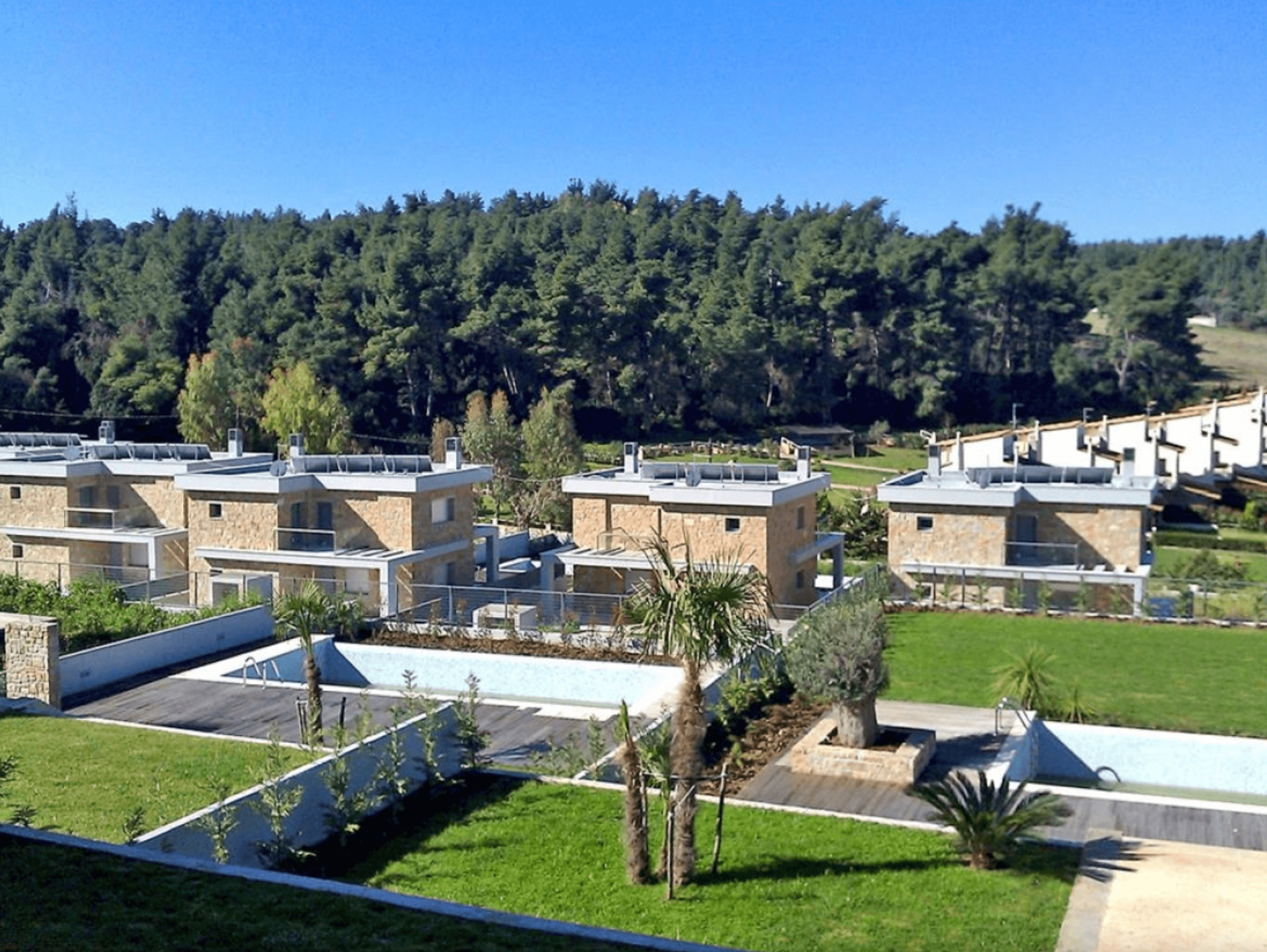
Greece, Kassandra
€505,000+
Modern villa, Sani, Kassandra
170 m²4 3 Property taxes in Greece
Purchase. In Greece, the main tax on purchase is the real estate transfer tax, charged at 3% of the taxable value of the property. In addition, a municipal levy equal to 3% of the transfer tax is charged. As a result, the total effective tax burden comes to 3.09% of the property’s taxable value [11]Source: Ministry of National Economy and Finance of Greece, Capital taxation.
Ownership. Once the property has been acquired, owners are also subject to ENFIA, Greece’s annual unified property tax. ENFIA is not charged at a single flat rate. It is calculated each year based on the type of property, its size, location, zone value, age, floor, use, and other characteristics. For residential property, base rates range between €2 and €16 per square metre.
Sale. For private individuals, Greece’s capital gains tax on the sale of immovable property is set at 15%, but its application is currently suspended until December 31st, 2026. As a result, private sellers generally do not pay capital gains tax on property sales during this period.
Rental income. Rental income is taxed separately as income from immovable property. The applicable rates are:
- 15% on annual income up to €12,000;
- 35% on the portion between €12,001 and €35,000;
- 45% on the portion above €35,000.
Malta Permanent Residence Programme — €474,000+
To obtain permanent residence in Malta through investment in real estate, applicants fulfil several mandatory requirements: buy or rent real estate, pay a state fee, and donate to a charitable organisation.
Besides the contributions, investors must prove assets of at least €500,000, with at least €150,000 of them liquid, or €600,000 with €75,000 liquid.
Real estate investment requirements
The financial thresholds for real estate start at €375,000 in the case of purchase and €14,000 a year in the case of rent.
Investors are required to hold the investment for at least 5 years. After that mark, they can sell the purchased property or switch to a more affordable rent with no minimum threshold.
Total cost of obtaining Malta permanent residence by investment
Fees and the charitable donation are mandatory conditions of the programme along with the property investment.
State fees include a contribution fee of €37,000 and an administrative fee of €60,000. The latter increases depending on a family composition: for each family member over 18, except for the spouse, the investor adds €7,500.
A donation of €2,000 must be made to a locally registered charitable, cultural, sports, scientific, or artistic non-governmental organisation or society registered with the Commissioner for Voluntary Organisations.
Additional expenses. In case of a real estate purchase, investors pay about 7% of the property value in fees.
The Malta permanent residence by investment programme includes most of the administrative costs in the total investment requirement. Above that, applicants pay:
- €500 — residence card fee;
- around €400 for medical insurance;
- costs for translation and notarisation of documents.
Malta Global Residence Programme — €270,200+
The Malta Global Residence Programme combines real estate investment with preferential tax treatment, offering applicants a route to residence alongside access to a favourable fiscal regime.
To maintain the residence status, participants must not spend more than 183 days per year in any other single country, ensuring they do not become tax residents elsewhere.
Real estate investment requirements
Buying a home in Malta is an important condition for obtaining a residence permit. The minimum amount of investment starts at €275,000 for properties in the central or northern part of Malta, or at €220,000 for properties on the island of Gozo or in the south of the country.
Alternatively, applicants may rent a property for a minimum period of five years. The annual rent must be at least €9,600 in the north or central areas, or €8,750 in the south and Gozo.
Total cost of obtaining Malta Global Residence
The programme requires applicants to obtain a special tax resident status in Malta. Residents are subject to a 15% tax on foreign income remitted to Malta, with a minimum annual tax of €15,000. This is less than in many European countries.
In Malta Global Residence Programme, the key fixed government charge for a single investor is the €6,000 administrative fee. This fee can be reduced to €5,500 if an applicant buys real estate in the south of Malta or the island of Gozo.
On top of the contribution fee, the applicant also pays for:
- medical insurance — around €400;
- document preparation and notary fees — €4,000+.
Examples of Malta properties to qualify for a residence permit

Malta, St Julian's
€950,000 — €2,290,000
Elegant apartments, St. Julians, Malta
98 m² — 193 m²1—3 1—3 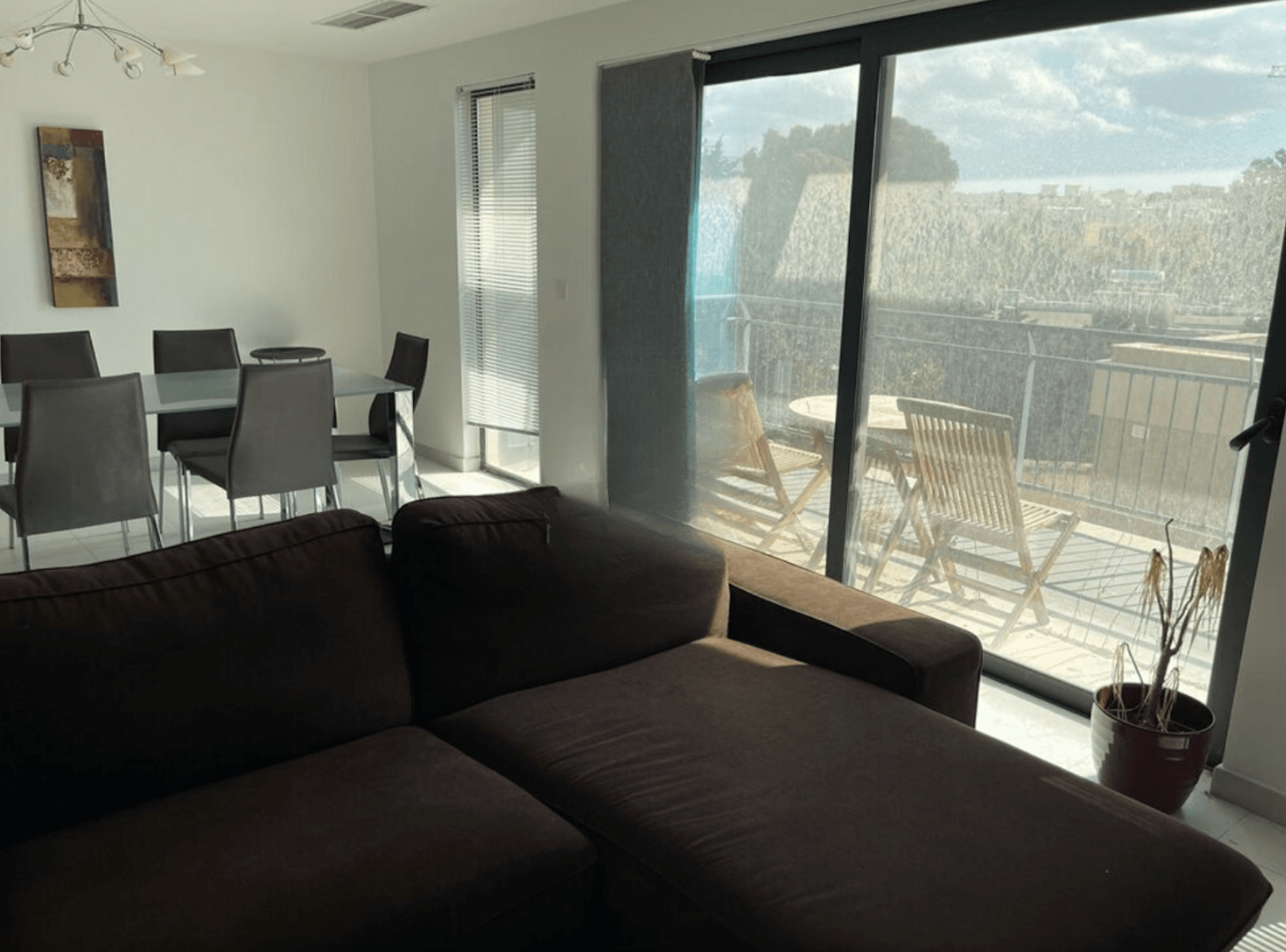
Malta, St Julian's
€750,000+
Apartments in modern style, St. Julians
172 m²3 2 
Malta, Sliema
€1,170,000+
Apartments in modern style, Sliema
116 m²1 1 Property taxes in Malta
Purchase. In Malta, the buyer pays stamp duty of 5% of the higher of the contract value and the market value. When a promise of sale is signed, a provisional duty of 1% is usually paid first, with the balance settled on the final deed[12]Source: Malta Tax and Customs Administration, Manual on taxation of rental income.
Ownership. Malta does not operate a standard annual nationwide recurrent property tax.
Sale. Transfers are subject to a withholding tax of 8% on the value of the property transferred.
Rental income. Malta allows an optional 15% final tax on gross rental income. Instead, property owners can choose to declare net rental income and be taxed at the normal rates of up to 35%.
Permanent residence in Cyprus — €300,000+
Investment in real estate allows applicants to obtain permanent residence in Cyprus, a country known for its favourable tax system and mild climate.
Real estate investment requirements
To obtain permanent residence in Cyprus, applicants must invest a minimum of €300,000 in one of the following:
- New residential property, up to two properties allowed.
- Commercial real estate, such as offices or hotels.
Properties may be rented out, with typical annual yields of up to 4%.
Applicants must also demonstrate a stable annual income of at least €50,000 from sources outside Cyprus. This requirement increases by €15,000 for each additional adult dependant and by €10,000 for each child, starting from the second child in families of three or more.
Total cost of obtaining residence by real estate investment in Cyprus
In addition to the required investment, applicants pay government fees, taxes, and transaction-related expenses associated with acquiring property and obtaining residence in Cyprus.
The main government and transaction costs include:
- €500 — application fee;
- €70 — residence card issuance fee;
- €500 — medical insurance for a single applicant;
- €70 — registration fees.
Stamp duty is not charged in Cyprus since January 1st, 2026.
VAT is normally charged at 19%. A reduced rate of 5% applies if the real estate is the only residential property of the owner.
Property transfer fees depend on whether the transaction is subject to VAT. If VAT applies, there is a full exemption from transfer fees. If VAT does not apply, the law provides a 50% reduction on the standard transfer fees.
Legal support is usually estimated at 1% of the property value, which adds €3,000 for a €300,000 purchase.
In total, a single investor purchasing property for €300,000 to obtain permanent residence in Cyprus should expect overall costs of approximately €322,140 if eligible for the reduced 5% VAT rate, or around €364,140 if the standard 19% VAT rate applies.
Examples of Cyprus properties to qualify for a residence permit

Cyprus, Paphos
€1,607,000 — €2,239,000
Comfortable and stylish villas, Konia, Paphos
452 m² — 630 m²4 4 
Cyprus, Limassol
€1,300,000 — €2,200,000
Modern apartments with bright elements, Agios Athanasios, Limassol
96 m² — 585 m²1—6 1—6 
Cyprus, Paphos
€425,000 — €575,000
Stylish villas with traditional elements, Pegeia, Paphos
118 m² — 155 m²3 3 Property taxes in Cyprus
Purchase. For a purchase, the main rates are:
- standard VAT rate is 19%;
- reduced 5% VAT applies for the purchase or construction of a new dwelling, or in cases when the real estate is the only residential property of the owner.
If the VAT is not paid, the transfer tax applies:
- 3% on the first €85,000;
- 5% on the next €85,000;
- 8% on the amount above €170,000.
If the transaction is not subject to VAT, the transfer fee is reduced by 50% [13]Source: Tax Department of Cyprus, Immovable property tax .
Ownership. Cyprus does not currently present a standard annual state immovable property tax. Property owners may still have to pay local authority charges, such as municipal, community or sewerage-related charges, which vary by locality.
Sale. For private individuals, Cyprus generally charges capital gains tax at 20% on the taxable gain from the sale of immovable property situated in Cyprus. The tax is charged on the profit made, rather than on the full selling price.
Rental income in Cyprus is taxed under the normal income-tax system with the following bands:
- 0% up to €22,000;
- 20% on €22,001 to 32,000;
- 25% on €32,001 to 42,000;
- 30% on €42,001 to 72,000;
- 35% above €72,000.
How to buy property in Europe and get residence: a step-by-step process
Each country has its own peculiarities, but in general, the procedure consists of predictable stages: Due Diligence, selection of the property, collecting documents, buying real estate, and applying for a residence permit. In total, the process can take around 4 months or more.
Immigrant Invest assists clients on each step of the process, including property selection and purchase. The support does not end once the investor gets their residence permit: our experts stay in touch to assist with further renewals.
1 day
Preliminary Due Diligence
Immigrant Invest experts conduct an internal check on compliance with the requirements of different countries. They help to choose the right programme to minimise the risk of rejection.
Immigrant Invest experts conduct an internal check on compliance with the requirements of different countries. They help to choose the right programme to minimise the risk of rejection.
7+ days
Real estate selection
The real estate specialists offer different options depending on the client’s goals. Immigrant Invest works directly with developers in Malta, Greece, and Cyprus.
After preliminary approval of real estate options, the lawyers organise a trip to the country so the client can see the house or apartment by themselves.
Completing the purchase remotely is also possible. In this case, an Immigrant Invest specialist acts on the investor’s behalf in the chosen country.
Lawyers also assist in opening a bank account for the transfer of investments and payment of administrative fees.
The real estate specialists offer different options depending on the client’s goals. Immigrant Invest works directly with developers in Malta, Greece, and Cyprus.
After preliminary approval of real estate options, the lawyers organise a trip to the country so the client can see the house or apartment by themselves.
Completing the purchase remotely is also possible. In this case, an Immigrant Invest specialist acts on the investor’s behalf in the chosen country.
Lawyers also assist in opening a bank account for the transfer of investments and payment of administrative fees.
10+ days
Property purchase
In most cases, applicants are required to fulfil the investment condition before applying for the residence permit. The exception is Malta’s Permanent Residence Programme, where investors can make the real estate investment after approval.
Immigrant Invest experts accompany the transaction from start to finish: check all the documents of the object and certify the necessary forms.
In most cases, applicants are required to fulfil the investment condition before applying for the residence permit. The exception is Malta’s Permanent Residence Programme, where investors can make the real estate investment after approval.
Immigrant Invest experts accompany the transaction from start to finish: check all the documents of the object and certify the necessary forms.
7+ days
Preparation of documents for the Golden Visa application
The lawyers help investors collect, translate, notarise, and apostille the necessary documents.
The lawyers help investors collect, translate, notarise, and apostille the necessary documents.
1+ days
Application submission
Accompanied by a lawyer, the client takes documents to public services and submits biometric data.
Accompanied by a lawyer, the client takes documents to public services and submits biometric data.
1—3 months
Residence permit cards issuance
The processing times highly depend on the country and chosen programme. According to Immigrant Invest experience, the application processing can take 1 to 6 months. If there are a lot of applications, the period can stretch up.
Investors travel to the country to submit biometrics and receive the residence cards once they are ready. If by the time of the card issuance the investor is no longer in the country, the Immigrant Invest lawyer will act by power of attorney — they will receive the permit card and arrange for a convenient way to hand them over to the client.
The processing times highly depend on the country and chosen programme. According to Immigrant Invest experience, the application processing can take 1 to 6 months. If there are a lot of applications, the period can stretch up.
Investors travel to the country to submit biometrics and receive the residence cards once they are ready. If by the time of the card issuance the investor is no longer in the country, the Immigrant Invest lawyer will act by power of attorney — they will receive the permit card and arrange for a convenient way to hand them over to the client.
Benefits of obtaining a residence permit in Europe
Buying a house in Europe and obtaining residence provides multiple strategic advantages for international investors and their families beyond simple property ownership.
Visa-free travel within the Schengen Area
Residents of most EU countries enjoy visa-free travel across 29 Schengen Area countries for short stays of up to 90 days within any 180-day period[14]Source: European Commission, Schengen Area .
Of the countries mentioned above, Cyprus is the only one not yet part of the Schengen Area. The country’s residence permit does not grant visa-free travel within the region. However, Cyprus participates in Schengen cooperation and is working towards full membership, which would involve removing border controls with other Schengen countries[15]Source: European Commission, Migration and Home Affairs.
Tax optimisation
Some EU countries offer favourable tax regimes to new residents or Golden Visa investors.
Greece offers a special tax regime for high-net-worth individuals with a flat annual tax of €100,000 on foreign income, instead of rates of up to 45%. Besides, taxpayers under this regime are exempt from inheritance and gift tax on their foreign assets.
The flat tax regime is available only to new tax residents of Greece. To qualify, an applicant must not have been a Greek tax resident for 7 of the 8 years before transferring tax residence to Greece. They must also invest at least €500,000 in Greece, for example in real estate, businesses, securities, or shares in Greek companies. The regime can be used for up to 15 tax years.
Cyprus offers an attractive regime through its non-domicile status to investors who are not planning to permanently move to the country. Non-domiciled tax residents of Cyprus are exempt from the Special Defence Contribution on dividends, interest, and rental income. Cyprus also does not levy wealth or inheritance tax.
To benefit from the non-dom regime, an investor first needs to become a tax resident of Cyprus. The standard way is to spend more than 183 days a year in the country. There is also a lighter option: the 60-day rule.
Under the 60-day rule, an investor must spend at least 60 days a year in Cyprus and must not spend more than 183 days in any other country during the same year. They also need to have a connection to Cyprus through business, employment, or a director’s role in a Cyprus-based company, and have a permanent home in the country, either owned or rented.
The status is usually available for up to 17 years, as a person is generally treated as domiciled in Cyprus after being a Cyprus tax resident for 17 out of the previous 20 years.
Residence for the whole family
European residence-by-investment programmes allow including close relatives in the application. The list of eligible family members depends on the country and the specific programme.
All programmes allow spouses and minor children to be included. Adult children can also participate — under certain conditions and with age limits.
Access to high-quality healthcare and education
Holding a residence permit allows families to access the European healthcare system, which is consistently ranked among the best globally.
EU countries provide a mix of public and private healthcare, with strong outcomes in life expectancy and medical standards.
Children of residents can attend public schools, often free or at low cost, and have access to internationally recognised universities across Europe. Many EU universities are ranked among the world’s top institutions.
Business and investment opportunities
Most EU residence permits by investment also open access to one of the world’s largest economic areas.
Residents benefit from access to the EU single market, which includes over 450 million consumers, the ability to establish and operate businesses locally, and a stable legal and regulatory environment.
The EU single market supports the free movement of goods, services, capital, and, to a large extent, labour, making it attractive for entrepreneurs and investors.
Prospect of citizenship in Europe
Making a property investment in Europe in exchange for residence can become the first stage on the way to citizenship in the EU country for the whole family. However, the pathway varies depending on the country.
Investors aiming at citizenship follow the general naturalisation path in the country of their residence. To progress towards citizenship, one must relocate to the chosen country and establish genuine residence there for the minimum required number of years. Naturalisation takes at least:
- 7 years in Greece;
- 8 years in Cyprus.
Applicants must also meet integration requirements, such as knowledge of the local national language and the basics of history and culture.
Risks to consider when choosing a real estate investment programme in Europe
Choosing a residence by investment programme is not just about meeting the minimum investment requirement. Each country has its own rules on property eligibility, taxation, residence rights, and long-term prospects. A careful review at the start helps avoid delays, extra costs, and false expectations later.
Underestimating the investment amount and property eligibility rules
The minimum investment threshold is often the first thing investors look at, but it should not be viewed in isolation. The real investment can increase by several thousands of euros after fees, property taxes, and additional expenses.
What matters just as much is what kind of property actually qualifies under the programme rules. Greece is a good example: it is often presented as one of the most affordable options, with entry points starting at €250,000, but this lower threshold mainly applies to properties for renovation or conversion. In many locations, standard residential properties fall under the higher €400,000 or €800,000 thresholds.
Tax risks
Tax benefits can be attractive, but they should be approached carefully. In most cases, a residence permit by itself does not create tax advantages. Those depend on becoming a tax resident and meeting the separate tax-law requirements of the country. For instance, Cyprus and Greece offer special tax regimes for new residents, but they do require investors to spend some time in the country.
Overestimating potential returns
The quality of the investment itself matters just as much as the immigration result. If an investor is looking to use the investment real estate for passive income, some programmes’ rules might be too restrictive.
In Greece, for example, rental yields in Athens often range between 4% and 6%, which looks quite profitable. However, Golden Visa investors are not allowed to rent out their properties short-term, which means no Airbnb-style rents.
Restrictions on work rights and business activity
Residence rights do not always include the right to work. This is an important point that applicants often overlook.
In Greece, the Golden Visa gives the right to reside, but not automatic access to employment as an employee or active business owner. Investors are allowed only to hold shares in local companies and sit on board as non-executive members.
If the plan includes working locally or operating a business, that should be checked at the start of the process. It may require a different permit, a separate registration, or a different legal structure.
Holding period and exit strategy risks
Real estate residence programmes are not designed for quick resale. In most cases, the investor must keep the property for a certain period in order to preserve the residence permit. Most often, investors are expected to hold their investments until they obtain permanent residence, which is at least 5 years.
Selling too early can lead to the loss of status. This point matters for investors who want flexibility or may need to rebalance their portfolio sooner than planned. The holding period should be treated as part of the investment timeline, not as a minor technical detail.
How Immigrant Invest can help obtain EU residence by real estate investment
Immigrant Invest is a consulting company specialising in residence and citizenship by investment. We work with programmes in Europe, the Caribbean, the Middle East, and other destinations. Over 10,000 people have obtained second residence or citizenship with our assistance.
Our clients receive support not only with the residence application, but also with the choice of investment property. We operate a dedicated real estate team whose experts select properties that match both the investor’s goals and the requirements of the chosen programme.
We have our own real estate database and offer properties that match both the investor’s goals and the requirements of the programme. This helps avoid unsuitable listings that may look attractive but do not qualify for residence.
Our team also supports the practical side of the purchase. Lawyers help check whether the property meets the programme criteria, review the legal and transaction aspects, and guide the client through the investment process. As a result, investors receive support with both the property selection and the residence application in one place.
Main points on getting a residence permit in Europe by investing in property
- Some countries in the European Union allow non-EU nationals to obtain residence permits if they purchase real estate.
- Greece offers the lowest investment threshold starting at just €250,000, being a top choice for those seeking EU residence at a lower cost.
- Cyprus offers a luxury property market with a minimum real estate investment of €300,000. The country’s location, favourable tax regime, and Mediterranean lifestyle make it ideal for high-net-worth individuals.
- Malta is known for its stability and strong rental market. The Malta Permanent Residence Program, MPRP, allows investors to gain permanent residence by investment. Renting or buying real estate is one of the investment conditions under this programme. The financial threshold for participation is €474,000 in case of purchasing property.
- Owning real estate in the EU offers several advantages, including access to a stable market, potential capital appreciation, strong legal protection of ownership, and the opportunity to generate rental income.
Immigrant Invest is a licensed agent for citizenship and residence by investment programs in the EU, the Caribbean, Asia, and the Middle East. Take advantage of our global 15-year expertise — schedule a meeting with our investment programs experts.

 Trusted by 10,000+ investors