








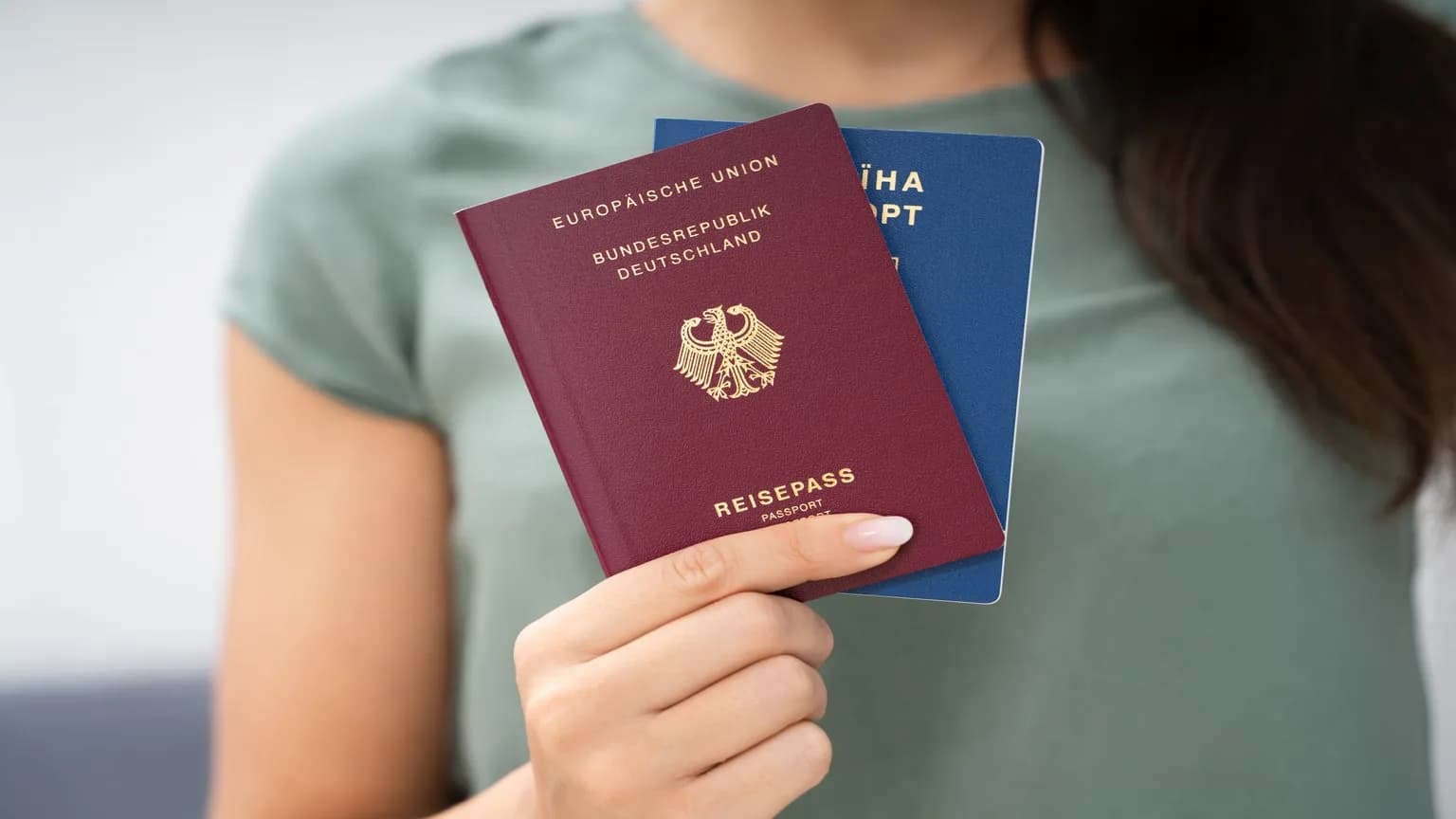

49% of all countries allow dual citizenship: the US, Caribbean states, Türkiye, and many others. With dual citizenship, one can choose better living conditions, receive social benefits, and have more opportunities to travel.
Careful planning is essential when obtaining dual citizenship; it's important to verify whether the home country permits it to avoid losing the original citizenship.
Continue reading to learn which countries offer dual citizenship and what is the easiest way to obtain one more nationality.
What is dual and second citizenship?
People with dual citizenship are nationals of two countries at the same time. They have equal rights with other citizens of these states: pay taxes, get social benefits, and receive a pension. People with dual citizenship are called dual citizens or dual nationals.
People with dual citizenship can choose in which country to serve in the military, and they pay taxes and receive social benefits in the state in which they permanently reside.
Dual citizenship is possible only if both countries have an agreement and recognise the rights and obligations of a citizen in another state. For example, such agreements exist between Spain and its former colonies: Peru, Chile, Paraguay, Nicaragua, Guatemala, Bolivia, Ecuador, Costa Rica, Honduras, the Dominican Republic, Argentina, and Colombia.
Some countries, like Italy and Portugal, allow dual citizenship, while others, such as Austria, prohibit it.
Dual citizenship is different from second citizenship. Holding a second passport does not grant equal rights in both countries. In this case, each state considers a person with two nationalities only as its own citizen.

Vladlena Baranova,
Head of Legal & AML Compliance Department, CAMS, IMCM
Second citizenship offers both advantages and responsibilities. Dual nationals can access social benefits and pensions in both countries. However, they may also be required to pay taxes and fulfill military service obligations in each.
Many countries have tax treaties to prevent double taxation. These agreements determine which country has the primary right to tax specific types of income.
Public authorities may not be aware of a person’s second citizenship if the law does not require notification of its existence. If there is such a legal requirement, a fine or criminal liability could be imposed for failing to notify the government about a second citizenship.
In most cases, citizenship of any other country will be considered the second.
A passport can be obtained in different ways: for example, by participating in investment programs, naturalisation, or marriage.

11 main advantages of dual citizenship
Holders of several passports can get the benefits offered by each state where they are citizens. Depending on the state, these benefits may include the right to vote, access to social support, public healthcare, education, employment, and business opportunities.
Dual citizenship also gives more flexibility in personal, family, and financial planning. A second passport can make travel easier, help secure a safer place to live, open new markets for business, and give children more options for education and future careers.
1. Visa-free travel
Holding two passports can make international travel easier and less dependent on visa rules. A person may choose the passport that gives simpler entry to a particular country, reduces the number of documents required, or allows them to stay abroad for longer without applying for a visa in advance.
For example, a European passport grants visa-free entry into the Schengen Area and most of the world’s countries. Caribbean citizenship, such as that of Dominica, provides visa-free access to over 145 countries. This can be useful for frequent travellers, business owners, investors, and families who often visit different regions.
2. High-quality healthcare system
Dual nationality can give access to the healthcare systems of both countries of citizenship. This allows a person to choose where to receive medical care, depending on the quality of services, availability of specialists, treatment costs, and waiting times.
Citizenship of an EU country may allow a person to apply to public medical institutions in the union and use medical services free of charge or at reduced rates.
3. Access to the best education
Second citizenship can give children more opportunities to study in countries with strong school and university systems. Many of the world’s leading educational institutions are located in the US, the UK, and the EU, and citizenship may simplify access to schools, colleges, and universities in these regions.
A second passport can also make it easier for parents to support their children during their studies. They may visit them without visa obstacles, help them settle in another country, and stay involved in important decisions about education, accommodation, and future career plans.
4. Moving to another country
Dual citizens have more freedom to choose where to live. They can relocate to one of their countries of citizenship without applying for a residence permit, which makes the moving process simpler and more predictable.
A second country may offer a warmer climate, cleaner environment, stronger infrastructure, or a more attractive tax system.
5. Business development
Entrepreneurs with dual citizenship can use the advantages of both countries for business growth. A second passport may help them enter new markets, open a company abroad, work with international partners, and build a more stable business structure.
Dual citizenship can also make business travel more convenient. Entrepreneurs can attend meetings, visit partners, negotiate contracts, and manage operations abroad with fewer visa-related delays. This is especially useful for companies that depend on cross-border trade, investment, consulting, or international clients.
6. Employment opportunities
Dual citizens have the right to work in their countries of citizenship without applying for a work permit. This broadens access to the labour market and gives more freedom to choose between employers, industries, and locations.
A second passport can also improve long-term career planning. A person may move to another country for a better salary, stronger professional network, or a more promising sector.
7. Better future for the family
Children born in families with multiple nationalities can automatically obtain citizenship of the country in which they were born. Dual nationals can also sponsor family members for citizenship or residence permits. For example, in the USA, citizens can sponsor relatives for Green Cards.
Citizenship by investment programs also allow to include family members in the application: a spouse, children, parents, grandparents, and siblings. Relatives will become dual citizens at the same time as the investor.
8. Personal safety
Holding citizenship in more than one country offers flexibility to relocate or find refuge during political or economic instability. Dual citizens have a backup plan, allowing them to move freely and settle in another country where they hold citizenship if necessary. This provides peace of mind and a sense of stability, knowing multiple safe havens are available.
9. Tax optimisation
Second citizenship may provide opportunities for more favourable tax regimes, depending on the country. For instance, Caribbean nations like Antigua and Barbuda or St Kitts and Nevis do not tax personal income, capital gains, or inheritances, which can be highly beneficial for wealth management and estate planning.
10. Expanded property ownership rights
In many countries, property ownership is restricted to citizens. Holding a second citizenship allows individuals to purchase property in locations otherwise restricted to foreigners, offering investment opportunities and personal residence options unavailable otherwise.
11. Cultural heritage and identity
For many, holding citizenship in a country connected to their ancestry can be deeply fulfilling. It allows them to strengthen ties with their cultural heritage, participate in traditions, and maintain linguistic and historical connections.

Uncover the advantages of European citizenship and the fastest way to obtain an EU passport
Disadvantages of dual citizenship
Despite the many advantages, there are also some drawbacks to obtaining dual citizenship. A second passport can give more freedom, but it may also create extra legal, tax, and administrative obligations.
Before applying, it is important to check the rules of both countries. Some states allow dual citizenship without restrictions, while others limit it or require a person to renounce their previous nationality.
Complicated process of obtaining citizenship
Obtaining second citizenship can be expensive and time-consuming. Applicants usually need to collect many documents, such as birth certificates, police clearance certificates, proof of income, medical records, and documents confirming the legal source of funds.
The process may also involve translations, notarisation, apostilles, government fees, due diligence checks, and professional assistance. In some cases, applicants need to wait several months or even years before receiving approval, especially if citizenship is obtained through naturalisation.
Double taxation
Dual citizens may face tax obligations in both countries of citizenship. This does not always mean that a person pays the same tax twice, but they may still need to file tax returns, report foreign income, or prove their tax residence.
The United States is one of the most well-known examples. US citizens must usually report their worldwide income to the US tax authorities, even if they live abroad and hold another passport.
Dual obligations
As a dual national, one must comply with the laws of both countries — for example, to serve in the military. If there is a conflict between two countries, the choice of one side may lead to the loss of citizenship in the second country or even a tribunal.
Some countries, such as Israel, require all citizens to serve in the military, including those naturalised. Caribbean states offering citizenship by investment, such as St Kitts and Nevis and Dominica, do not impose military service obligations.
No career in politics
A person with dual or second citizenship is not entitled to work in government bodies or have access to state secrets. The ban on work in state bodies is imposed due to a threat to the state’s internal security. This applies to both the country of origin and the country of second and subsequent citizenship.
Who stateless persons are
Stateless persons are individuals who do not hold any citizenship. They can be born into a stateless family or lose their citizenship during their lifetime.
One can become a stateless person if:
- They are born into a family where both parents are stateless. However, if they are born in a country where the principle of “jus soli” is applied, they acquire citizenship.
- They renounce their citizenship. For example, this may occur when a person seeks citizenship in another country. Until they obtain proof of identity in the new country, they are considered stateless.
- They are sentenced to lose citizenship for committing crimes that the state believes pose a threat to its citizens.
- Their passport is annulled because it was obtained illegally.
- The country of their citizenship de jure and de facto ceases to exist.
- There is a conflict of nationality laws. For example, a woman may lose her citizenship in some countries if she marries a foreigner. If her husband’s country does not grant her citizenship immediately, she becomes stateless.
Statelessness can create significant challenges for individuals, including the inability to travel, work, or access basic services.
What duties and rights arise when obtaining a second citizenship
Duties of dual citizens
Countries that grant citizenship usually do not report this to the authorities of other countries. If a person decides to hide the fact of having a second passport, the executive bodies may not find out about it. However, if they do, the citizen may face criminal liability if prescribed by the law of the country.
If a citizen acquires a second citizenship, they are obliged to maintain the status of a citizen of both countries and comply with their laws, e.g. pay taxes.
A second citizenship does not, by itself, create an obligation to pay taxes in both countries. Taxation depends on the country of tax residence and source of income. For example, if a French citizen moves to the country of their second citizenship and becomes a tax resident there, but continues to receive income from sources in France, they may have an obligation to pay taxes in both countries.
Rights of dual citizens
Dual nationals have nearly all the rights and obligations of citizens of both countries. They can live, work, receive medical treatment, and educate children in both countries. A second passport may also expand travel opportunities; for example, citizens with Caribbean citizenship can visit Schengen Area countries without a visa.
Which countries allow dual citizenship
49% of all countries allow dual citizenship, but some of them permit their citizens to hold dual nationality only under certain conditions.
For example, the Netherlands generally requires naturalised citizens to renounce their previous nationality. However, exceptions apply for spouses of Dutch citizens and individuals from countries that do not allow renunciation of citizenship.
Full list of countries that allow dual citizenship
Countries where you cannot have dual citizenship
Some countries require their subjects to have only one citizenship.
For example, Austria has strict rules and a complex process of obtaining citizenship. Permanent residents must live in the country continuously for 10 years before applying for citizenship. Applicants then must renounce any other citizenship.
List of countries that do not allow dual citizenship
Countries that allow dual citizenship only by descent
Some countries grant citizenship by descent based on proof that your ancestors were citizens of that country.
List of countries where dual citizenship by descent is allowed:
- Bulgaria,
- Croatia,
- Cambodia,
- Liechtenstein,
- South Korea.
Bulgaria allows ethnic Bulgarians to obtain multiple nationalities without renouncing their Bulgarian passport. Those who renounced citizenship in the past may get it back. However, naturalised foreigners must renounce their other nationalities by becoming only Bulgarian citizens.
Croatia has similar requirements to Bulgaria, while ethnic Croatians who have acquired citizenship by descent from at least one parent may have dual nationalities. However, naturalised Croatians have to renounce all other citizenships when obtaining a Croatian passport.
Cambodia grants citizenship by descent to those born to at least one Khmer parent, regardless of the place of birth.
Some countries also permit dual citizenship in exceptional cases, such as birth abroad, marriage to a foreign national, or economic migration.
List of countries that allow dual citizenship in exceptional cases
Dual citizenship with the US
The United States allows dual citizenship and does not require naturalised individuals to renounce their home country. Despite the Oath of Allegiance to the United States, which refers to the rejection of "allegiance and fidelity" to other nations, the US law does not require a person to choose one nationality or another.
The US Department of State states that dual citizenship means allegiance to both the United States and a foreign state. People who have dual citizenship with the US are required to comply with the laws of both countries, and any country has the right to enforce its laws.
List of countries that allow dual citizenship with the US
Although the US allows dual nationality, not all countries also support it. For example, China can automatically revoke a person’s citizenship if they become an American citizen.
India also does not allow dual citizenship with the United States. When one becomes an American citizen, they will automatically lose their Indian passport. However, a person can register as an "Overseas Citizen of India", or OCI, to get a multi-entry permanent visa and have all citizen rights except some political ones.
Benefits of US dual citizenship
Having dual citizenship with the US opens up broad opportunities:
- right to work anywhere in the country without a work visa;
- ability for family members to apply for a Green Card;
- access to universities without a student visa;
- freedom to travel abroad without restrictions;
- eligibility for social benefits and the right to vote.
However, when applying for US citizenship, it is important to consider the possible pitfalls.
Trusted by 10,000+ investors
Thinking of leaving the USA? Discover your options
Drawbacks of US dual citizenship
People who hold any political posts may encounter challenges in employment. Having dual citizenship may be prohibited for military officers, judges, ministers, or deputies.
One may face double taxation if their country does not have a tax agreement with the United States. US citizens pay tax in the US regardless of where they live. For example, even after living in the Cayman Islands for 10 years, a US citizen must still pay US taxes.
Process of obtaining dual citizenship
Obtaining multiple citizenships can be either easy or arduous, depending on the country and the way of getting another nationality.
Citizenship by birth
Some countries grant citizenship automatically to individuals born within their territory, regardless of their parents’ nationality. This principle is known as jus soli, meaning right of the soil.
Countries like the United States and Canada follow this rule. Other countries, such as Germany and Japan, do not grant automatic citizenship by birth unless at least one parent is a citizen or meets specific residency requirements.
Citizenship by naturalisation
This way is relatively simple if a foreigner has grounds to stay in the country for a long time. Investing, studying, or working in the country allows them to obtain citizenship in the future.
Conditions of obtaining citizenship by naturalisation may differ depending on the country. But, as a rule, foreigners must reside in the country for a long time.
For example, to apply for citizenship in Portugal, one has to reside in the country for 10 years, have no criminal record, and demonstrate knowledge of the state language, culture, and history.
Many countries offer residence by investment programs, also known as Golden Visas. These allow investors to obtain a residence permit in exchange for an investment, such as purchasing real estate or creating jobs.
Golden Visa holders can often apply for citizenship by naturalisation after fulfilling residency and other legal requirements. Countries like Portugal, Hungary, and Greece offer this path to citizenship.
Citizenship by marriage
Many countries offer a simplified naturalisation process for spouses of their citizens. The requirements vary: some countries grant citizenship immediately upon marriage, while others require the couple to be married for a certain period and prove genuine cohabitation.
For example, Spain allows spouses to apply for citizenship after just one year of marriage and residence, while the United States offers a three-year path to naturalisation for spouses of US citizens.
Citizenship by descent
Some countries like Spain or Ireland have a “right of blood,” meaning if one’s parents or grandparents come from a country, they may be eligible to obtain that country’s citizenship.
Citizenship by origin is available only to those who can prove their family ties. A more straightforward and relatively simple way is to obtain citizenship by investment.
Citizenship by investment
Citizenship by investment is available in the Caribbean and some countries in Oceania and Africa. Investors can contribute to a state fund, invest in local businesses, or purchase real estate to obtain citizenship. It is possible to apply alone or include family members in the application.
Which countries grant citizenship to investors



Country | Investment | Period of citizenship obtaining |
|---|---|---|
$90,000+ | 2+ months | |
$90,000+ | 3+ months | |
$130,000+ | 2+ months | |
$200,000+ | 6+ months | |
$230,000+ | 6+ months | |
$235,000+ | 8+ months | |
$240,000+ | 6+ months | |
$250,000+ | 4+ months | |
$250,000+ | 10+ months | |
$400,000+ | 8+ months |
Some other countries also have investment programs. They allow foreigners to obtain a residence permit or permanent residence by making an investment — and then apply for citizenship.
Portugal is on the list of countries where dual citizenship is allowed. This country also has flexible conditions for obtaining a residence permit by investment. The minimum investment amount is €250,000. Fund shares or business investments can be purchased for this amount to obtain residency. After 10 years of receiving a residence permit, citizenship becomes an option.
Which countries grant residency by investment


Country | Type of residence | Investment | Period of obtaining |
|---|---|---|---|
Residence permit | €250,000+ | 12+ months | |
Permanent residence | €169,000+ | 6+ months | |
Permanent residence | €300,000+ | 9+ months | |
Residence permit | €250,000+ | 4+ months | |
Residence permit | €250,000+ | 5+ months | |
Residence permit | €250,000+ | 4+ months | |
Residence permit | AED 750,000+ | 2+ months | |
Residence permit | €600,000+ | 2+ months |
Key takeaways about countries that allow dual citizenship
- Dual citizenship means holding nationality in two countries simultaneously, with equal rights in both. However, this is distinct from second citizenship, where rights in the second country may not be equal to those of its native citizens.
- 49% of countries, including the US, Caribbean states, and Türkiye, allow dual citizenship, offering benefits such as improved living conditions, social services, and travel opportunities.
- It is essential to verify whether one’s home country permits dual citizenship to prevent the loss of original nationality. For example, dual citizenship is prohibited in China, India, Austria, and Japan.
- Dual citizenship can be obtained on various grounds, such as naturalisation, descent, and investment.
- Citizenship by investment is granted to foreigners who make investments in a local business, a state fund, or real estate. Some countries also allow the opening of a bank deposit or the purchase of government bonds.
Immigrant Invest is a licensed agent for citizenship and residence by investment programs in the EU, the Caribbean, Asia, and the Middle East. Take advantage of our global 15-year expertise — schedule a meeting with our investment programs experts.

 Trusted by 10,000+ investors