Summary
In 2025, the Malta Permanent Residence Programme underwent several changes — some favourable to investors, others more restrictive.
For instance, the minimum participation cost was initially raised from €150,000 to €182,000, before being reduced to €169,000. Another amendment permitted investors to rent out their property, though only under specific conditions.
This guide explores the current requirements, recent changes, benefits, and important considerations.
What is a Malta Permanent Residence Programme?
The Malta Permanent Residence Programme, or MPRP, is a residency-by-investment route that grants non-EU nationals and their families the right to settle permanently in Malta[1]. Recognised as one of the most attractive residence programmes in the EU, it provides lifelong residency without the need for continuous physical presence in the country.
Key requirements under the MPRP
To qualify for the Malta residency programme, applicants must meet specific financial and administrative criteria, including:
- Renting or purchasing residential property in Malta.
- Paying a government contribution.
- Paying an administrative fee.
- Donating to a registered Maltese non-profit organisation.
All of these requirements are mandatory, with the only flexibility being the choice between renting or buying property.
Economic impact of the MPRP
The Malta Permanent Residence Programme plays an important role in the national economy. In 2024 alone, Identity Malta — the government agency managing residence and citizenship — generated more than €132 million.
According to Home Affairs Minister Byron Camilleri, the programme received 1,500 applications, bringing:
- €46 million to the Consolidated Fund, the state’s main budget;
- €50 million in lease contracts;
- €36 million in property purchases[2].
Recent changes to the programme
In 2025, several reforms were introduced, reshaping both the financial and family-related conditions.
Investment threshold adjustments. The minimum cost was first raised from €150,000 to €182,000, then reduced to €169,000, restoring accessibility for investors.
Unified property values. Previously, prime locations required higher minimums. Now the same thresholds apply across all regions, simplifying choices.
Stricter rules for dependent children. Previously, there was no age limit for including dependent children in the application. From 2025, eligibility is capped at 29 years, provided they are unmarried and financially dependent.
Flexible asset requirements. Investors can now choose between €500,000 in total assets with €150,000 financial, or €650,000 with at least €75,000 financial.
Permission to lease real estate. Property acquired under the programme may now be rented out short-term when the investor is absent from Malta.
Opportunity to obtain a 1-year residence permit. Under the new rules, an investor can first obtain a temporary residence permit and then collect the necessary documents to apply for a permanent one. This step is not mandatory, but it is advantageous for those who want faster visa-free access to the Schengen Area.
11 benefits of obtaining Malta permanent residency
Benefits of Malta permanent residence include a combination of lifestyle, financial, and mobility advantages. The programme appeals to a broad mix of investors, entrepreneurs, retirees, and families who value stability in Europe.
1. Whole-family coverage
The MPRP allows applicants to include close relatives under a single application:
- spouses or partners;
- dependent children under 29;
- parents;
- grandparents.
2. No minimum stay requirement and Schengen mobility
Investors under the MPRP enjoy complete flexibility — there is no requirement to live in Malta full-time. They may relocate, use the island as a Plan B and visit whenever needed, or even retain residency without ever moving, since the status does not impose stay obligations.
This freedom goes hand in hand with Schengen mobility: Maltese permanent residents can travel visa-free across the Schengen Area for up to 90 days within any 180-day period. The absence of stay requirements in Malta makes the programme especially convenient for globally mobile families and investors who frequently move around Europe.
3. Running business in the EU
Permanent residents can set up and manage companies across the EU, with Malta serving as a strategic base thanks to its stable regulations and favourable tax system. The country operates a full imputation system, taxing company profits at 35% but granting shareholders significant refunds.
In most cases, a 6/7ths rebate reduces the effective tax rate to about 5%, making Malta one of Europe’s most efficient jurisdictions. More than 8,000 companies already benefit from this structure, saving a combined €13 billion in corporate taxes between 2008 and 2022[3].
Malta also attracts entrepreneurs with its strategic time zone, leading GDP growth in the EU, low employer costs, and business funding programmes.
4. Opening bank accounts in the EU
Malta’s banking sector is well-developed, with more than 20 local and international banks operating on the islands. MPRP holders are eligible to open accounts in any of these institutions. The following documents are usually required:
- valid passport or national identity card;
- residence permit;
- proof of residential address;
- proof of income or employment.
5. English-speaking environment
Settling in Malta can be far easier than in many other European countries: with English as an official language, Malta removes one of the biggest barriers to moving abroad.
Schools, healthcare, business and everyday services all operate comfortably in English, while most locals are bilingual, switching seamlessly between English and Maltese. This creates a welcoming environment where newcomers can study, work, or retire without language-related obstacles.
6. Wide expat community
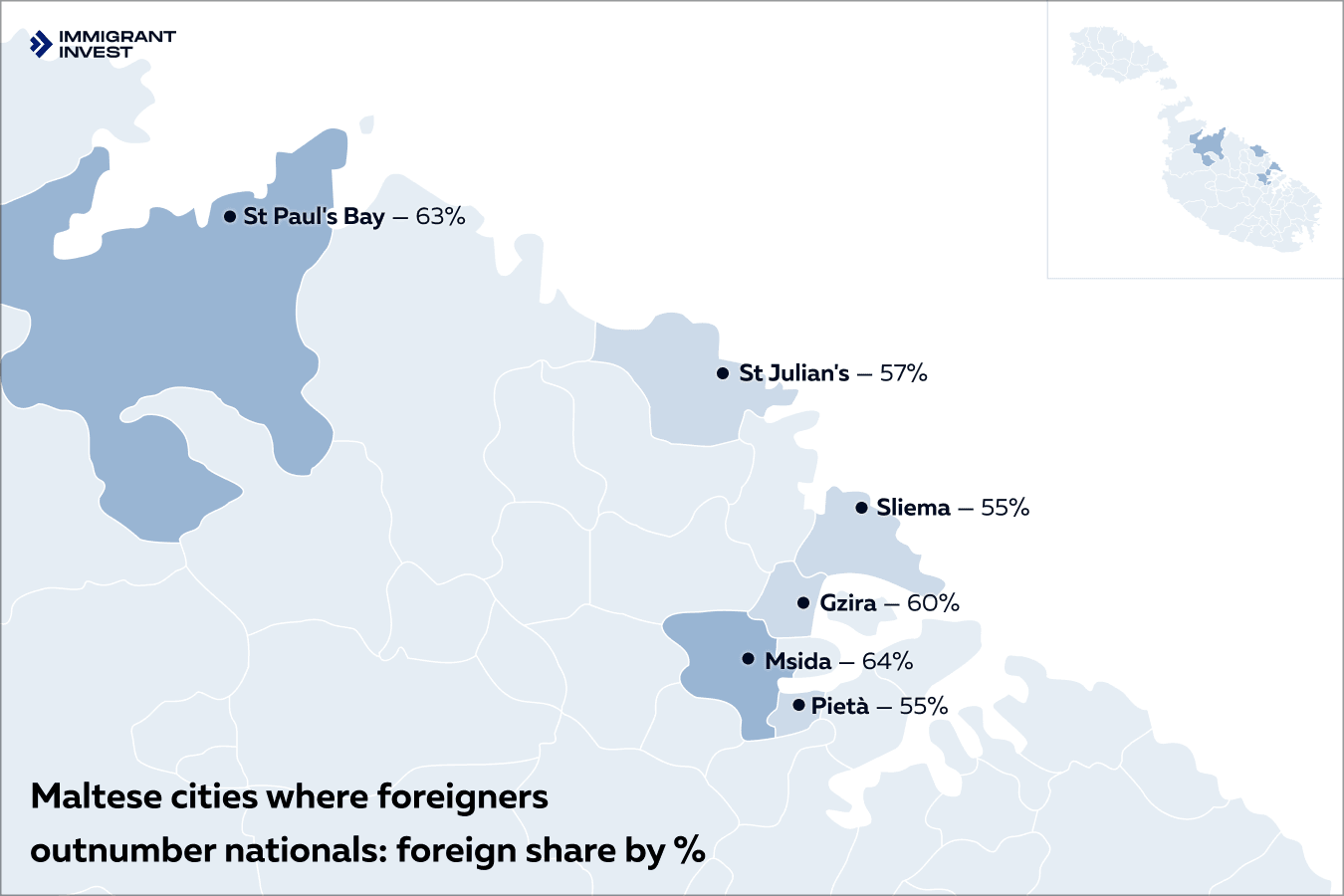
By the end of 2024, Malta was home to around 168,938 foreign residents, making up nearly 30% of the country’s total population[4]. This steady growth highlights Malta’s position as one of the most internationally diverse countries in Europe.
The sizeable expat community has become an integral part of Maltese society, drawn by the island’s work opportunities, lifestyle, and residence programmes.
7. Attractive tax system
The Malta Permanent Residence Programme itself does not include special tax benefits. Simply holding residency does not make an applicant a Maltese tax resident — this status is acquired only by spending at least 183 days a year in the country.
However, those who do become tax residents enjoy clear advantages: no tax on foreign income kept abroad, no inheritance or wealth tax, and double-tax treaties with more than 70 countries, including the US[5]. These features make Malta’s tax system especially appealing to international investors, particularly Americans.
8. Access to healthcare
Public healthcare in Malta is of a high standard and is accessible to citizens and EU residents free of charge. The system, modelled on the British NHS, is consistently ranked among the best in Europe. According to the Healthcare Index 2024 by CEOWORLD, Malta ranked 18th out of 196 countries, outperforming nations such as Portugal, Finland, and the UAE[6].
Private insurance is mandatory for MPRP holders, so they mainly rely on private healthcare providers, with costs covered by their policy. Annual premiums for a family of four average around €2,000. Each beneficiary must be insured for at least €100,000 per year, ensuring full coverage of medical expenses in Malta and across other European countries.
9. Access to education
State schools in Malta provide free education, including textbooks and school transport, with lessons delivered in English and Maltese. Malta also has a variety of private and international schools, many following British or international curricula, such as QSI International School of Malta and Chiswick House School & St Martin’s College. Annual fees range between €3,000 and 8,000.
Higher education is also accessible. The University of Malta offers programmes at relatively low tuition costs for residents compared with other EU universities. Fees generally range from €7,500 to 16,000 per year, depending on the faculty and degree.
10. Low cost of living
Living costs in Malta are around 35—40% lower than in the UK and the US. The country strikes a balance between affordability and European quality of life.
Monthly expenses for a single person average about €770 without rent, while a family of four needs around €2,800[7]. Rent is a major factor: a one-bedroom apartment in central areas such as Sliema or St Julian’s costs €700—1,200 per month, while the same property in smaller towns can be €500—800.
11. Mediterranean climate and beautiful nature
With more than 300 sunny days a year, hot summers of around +30°C and mild winters near +10°C, Malta’s climate encourages outdoor living. The long swimming season makes beaches and water sports a year-round attraction, while the mild winters are ideal for hiking and exploring the islands.
Fresh produce, seafood, and seasonal fruits shape a wholesome Mediterranean diet that is both healthy and affordable. Local markets brim with sun-ripened vegetables, citrus, and olives, while freshly caught fish is a staple on Maltese tables.
Beyond food, natural highlights such as the Blue Lagoon’s turquoise waters, the dramatic Dingli Cliffs, and the historic charm of the Three Cities create a setting where everyday life blends relaxation, culture, and outdoor beauty.
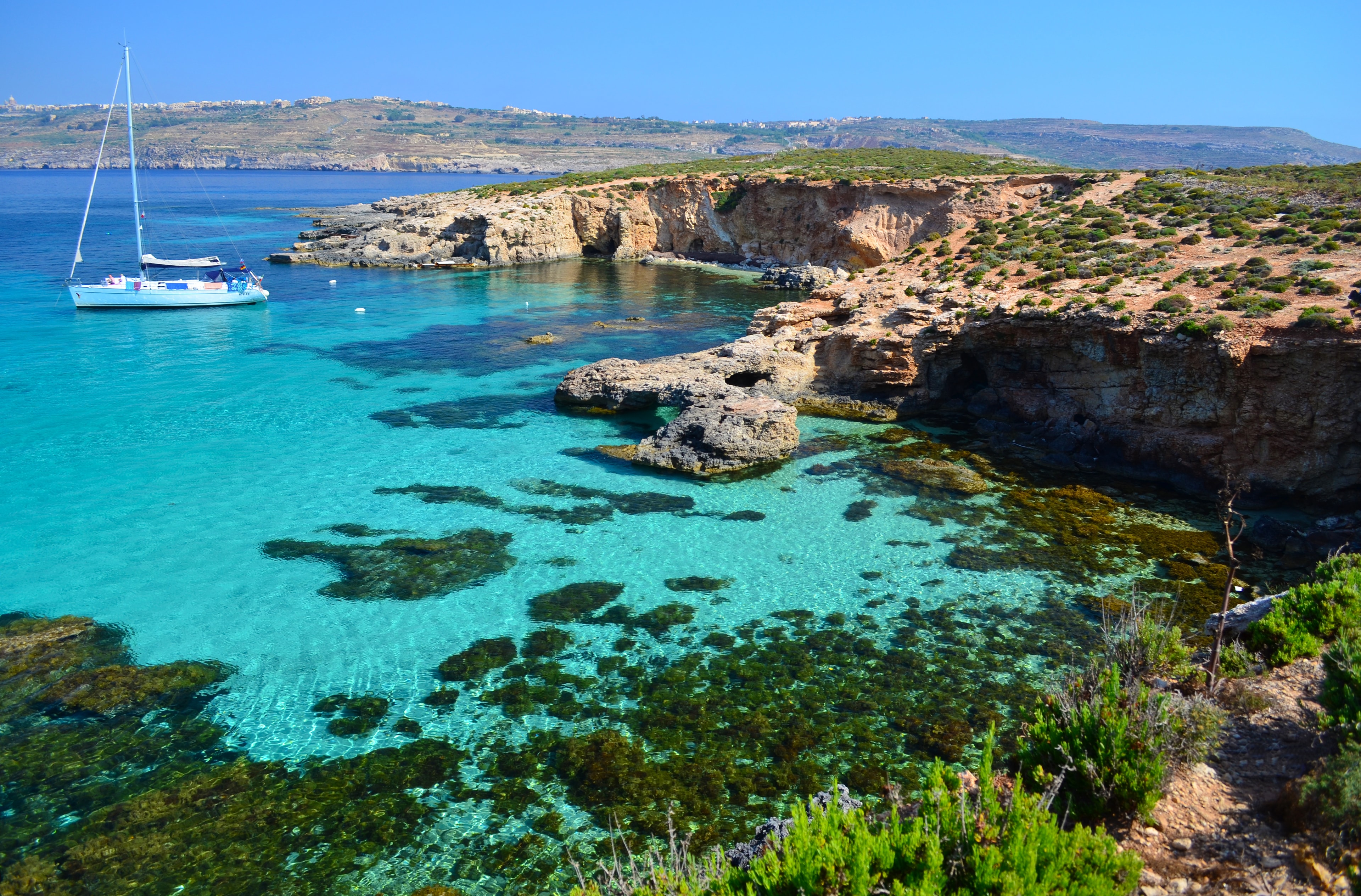
Renting a boat or yacht near Comino ranges from €195 to over €2,200, depending on the type of vessel, its age and included amenities
Who is eligible for the Malta Permanent Residence Programme?
Eligibility for the MPRP is based on a set of clear criteria. Both the main applicant and their family members must meet specific requirements to be included in the application.
Requirements for the investor
To qualify for Malta PR, the investor must:
- Be a citizen of a country outside the EU, EEA and Switzerland.
- Be at least 18 years old.
- Hold a clean criminal record, confirmed by a police certificate.
- Not be subject to international sanctions.
- Be able to prove the lawful origin of funds.
- Have no visa refusals from countries that have a visa-free agreement with Malta.
- Maintain comprehensive health insurance coverage.
- Possess total assets of at least €500,000, including a minimum of €150,000 in liquid financial assets, or alternatively €650,000 in total assets with at least €75,000 in liquid financial assets.
Rules for family inclusion
The following family members may be included in the application:
- Spouse or long-term partner, whether legally married, in a registered partnership, or in a documented relationship. Same-sex couples are also eligible.
- Children under 18, including biological, adopted or stepchildren, with the other parent’s consent if applicable.
- Children aged 18 to 29, provided they are unmarried and financially dependent on the applicant or spouse.
- Parents and grandparents of any age, provided they are financially dependent on the applicant or spouse.

Anna Semenyuk,
Citizenship by Investment Programs Advisor
If an applicant lacks sufficient funds, a relative may act as a sponsor under the MPRP. Sponsorship is only permitted from family members, and the relationship with the main applicant must be clearly documented.
In practice, this often applies when, for example, a parent sponsors a child who does not yet have the required financial resources. The sponsor must undergo the same Due Diligence checks as the main applicant to ensure full compliance with Maltese regulations.
Investment routes to Malta PR: rent or buy real estate
Investors can either buy or rent property. In both cases, they must also pay the required fees and make a donation to a registered Maltese non-governmental organisation.
Renting property — €169,000+
The minimum rental price is €14,000 per year. Investors must rent a property for at least 5 years to maintain their residential address.
After 5 years, they must continue renting, but the price thresholds no longer apply. Subletting is also possible after 5 years, provided the property owner grants permission.
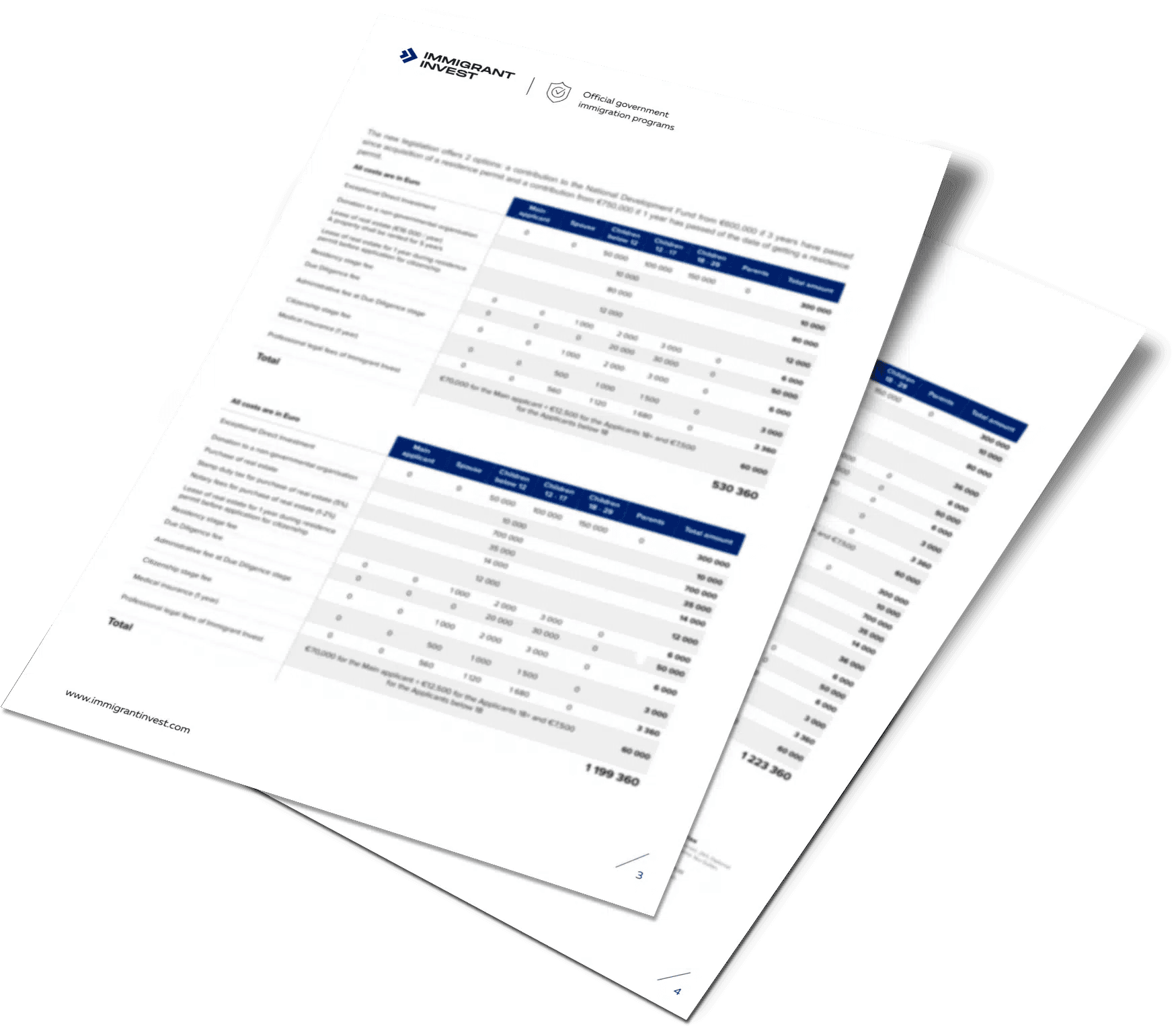
Breakdown of costs is the following:
- Rental costs for 5 years — €70,000+.
- Contribution fee — €37,000.
- Administration fee — €60,000 for the investor and €7,500 for each family member over 18, except for the spouse.
- Charitable donation — €2,000.
Cost breakdown of Malta PR: rental route
Purchasing property — €474,000+
The minimum purchase price is €375,000. The property must be held for at least 5 years. During this time, it may be rented out short-term while the investor is absent from Malta.
After the 5-year period, the property can be sold. However, to maintain the registered residential address in Malta, the investor must immediately rent or purchase another property. In this case, there are no minimum value requirements.
Breakdown of costs includes:
- Property purchase — €375,000+.
- Contribution fee — €37,000.
- Administration fee — €60,000 for the investor and €7,500 for each family member over 18, except for the spouse.
- Charitable donation — €2,000.
Upon buying real estate, additional government and legal fees amount to about 7% of the property value, or roughly €26,250+.
Cost breakdown of Malta PR: purchase route
Documents required for Malta PR application
To apply for the Malta Permanent Residence Programme, applicants must prepare and submit the following documents:
- Passports.
- Identity cards.
- Residence permits from other countries.
- Evidence of dependence, including marriage and birth certificates, as well as documents confirming civil union or cohabitation.
- Parental consent form, if applicable.
- Marriage or divorce certificates, if applicable.
- Education certificates.
- Proof of residential address.
- Police conduct certificates for applicants over 14.
- Bank statements.
- Health insurance policy.
- Evidence of corporate affiliation, employment, source of funds and wealth, and a list of assets.
Copies must be notarised and either apostilled or legalised. This is not necessary if they are certified by a Maltese notary. Originals must be sent to Malta for authentication and will be returned afterwards.
Translations must be provided by a licensed translator in Malta. Immigrant Invest can arrange this service upon receipt of scanned copies.
Step-by-step procedure of obtaining Malta permanent residency
The Malta Permanent Residence Programme can only be applied for through licensed agents.
Immigrant Invest is authorised by the Maltese government to represent investors. We guide you through the process, making it smooth and predictable. From the first consultation to receiving your residence cards, it usually takes around 6 months.
1 day
Preliminary Due Diligence
We start with a quick internal check using the same databases as Residency Malta, the government agency responsible for administering the programme. This helps us confirm your eligibility and reduce the risk of refusal to just 1%.
Once you’re cleared, we sign a service agreement and move forward.
We start with a quick internal check using the same databases as Residency Malta, the government agency responsible for administering the programme. This helps us confirm your eligibility and reduce the risk of refusal to just 1%.
Once you’re cleared, we sign a service agreement and move forward.
1+ months
Temporary residence permit (optional)
If you’d like, we can arrange a 1-year temporary residence card while your main application is being prepared. You’ll only need to visit Malta once to give biometrics, and the card will be ready within a few weeks.
A fee of €100 per temporary residence card and the first part of the administrative fee of €15,000 are paid at this step.
If you’d like, we can arrange a 1-year temporary residence card while your main application is being prepared. You’ll only need to visit Malta once to give biometrics, and the card will be ready within a few weeks.
A fee of €100 per temporary residence card and the first part of the administrative fee of €15,000 are paid at this step.
1—2 weeks
Choosing property
Based on your preferences, we shortlist suitable rental or purchase options with trusted local agents.
Our lawyers carefully review contracts, negotiate terms if needed, and make sure everything is in order before you commit.
Based on your preferences, we shortlist suitable rental or purchase options with trusted local agents.
Our lawyers carefully review contracts, negotiate terms if needed, and make sure everything is in order before you commit.
1+ months
Collecting documents and filing the application
Our lawyers prepare an individual checklist of documents tailored to your family’s situation. Most documents must be collected by the investor — such as passports, certificates, and bank statements. We handle the rest: filling in all forms and applications on your behalf, assisting with proper formatting, and arranging certified translations.
Once everything is ready, we submit the full application package to Residency Malta. If the investor did not opt to get a temporary residence permit, they pay the first part of the administrative fee of €15,000 at this step.
Our lawyers prepare an individual checklist of documents tailored to your family’s situation. Most documents must be collected by the investor — such as passports, certificates, and bank statements. We handle the rest: filling in all forms and applications on your behalf, assisting with proper formatting, and arranging certified translations.
Once everything is ready, we submit the full application package to Residency Malta. If the investor did not opt to get a temporary residence permit, they pay the first part of the administrative fee of €15,000 at this step.
3—6 months
Due Diligence by Residency Malta
The Residency Malta Agency conducts detailed checks and may ask for clarifications. We handle all communication and prepare responses, so you don’t have to worry about paperwork.
After completion of the checks by the Agency, a Letter of approval in Principle or rejection is issued.
The Residency Malta Agency conducts detailed checks and may ask for clarifications. We handle all communication and prepare responses, so you don’t have to worry about paperwork.
After completion of the checks by the Agency, a Letter of approval in Principle or rejection is issued.
Within 8 months of approval
Fulfilling investment conditions
Once your application is approved, we help you complete the remaining steps: paying the balance of the administrative fee — €45,000, making the charitable donation, settling the contribution fee, arranging health insurance, and finalising your property lease or purchase.
When the investment requirements are fulfilled, the Residency Malta Agency issues a certificate of permanent residence.
Once your application is approved, we help you complete the remaining steps: paying the balance of the administrative fee — €45,000, making the charitable donation, settling the contribution fee, arranging health insurance, and finalising your property lease or purchase.
When the investment requirements are fulfilled, the Residency Malta Agency issues a certificate of permanent residence.
4+ weeks
Permanent residence cards
You and your family provide biometrics in Malta. Residence cards are then produced and either couriered to you or collected in Malta.
You and your family provide biometrics in Malta. Residence cards are then produced and either couriered to you or collected in Malta.
For the first 5 years
Annual compliance checks
For the first 5 years, Residency Malta checks once a year that all conditions are still met: you maintain a property in Malta and keep the required level of assets. We remind you in advance and help prepare any documents needed.
For the first 5 years, Residency Malta checks once a year that all conditions are still met: you maintain a property in Malta and keep the required level of assets. We remind you in advance and help prepare any documents needed.
Real estate in Malta for MPRP applicants
Malta’s property market reached a record €5.1 billion in sale agreements in 2024, underscoring its role as one of the country’s key economic drivers[8]. Around 15% of these transactions involved international buyers, highlighting sustained foreign demand and keeping Malta’s real estate sector highly competitive within the EU.
Where foreigners live in Malta
Foreign residents in Malta tend to cluster in central and coastal hubs that offer good transport links and modern amenities. Popular choices include Sliema, St Julian’s, Gżira, Msida, Pietà, and St Paul’s Bay — all localities where foreigners now even outnumber Maltese residents:
- Prime coastal living: Sliema, St Julian’s, and Valletta stand out with their vibrant lifestyle, seafront properties, and proximity to business centres.
- North coast: St Paul’s Bay, Qawra, and Mellieħa offer a more affordable cost of living while still providing a seaside atmosphere.
- Gozo: Towns such as Victoria, Xlendi, and Marsalforn are particularly attractive for their lower entry prices and relaxed pace of life.
Special Designated Areas: premium property for foreigners
A Special Designated Area, or SDA, is a status granted by the Maltese government to selected residential and business developments in prime locations. These projects offer high-end facilities such as landscaped gardens, pools, gyms, and underground parking.
Anna Semenyuk,
Citizenship by Investment Programs Advisor
The key advantage of SDAs is that foreigners can buy property just like Maltese citizens. Normally, non-EU buyers must obtain an Acquisition of Immovable Property, or AIP, permit, which limits them to one home that cannot be rented out. In SDAs, no permit is needed — buyers can purchase multiple properties and rent them out without restrictions.
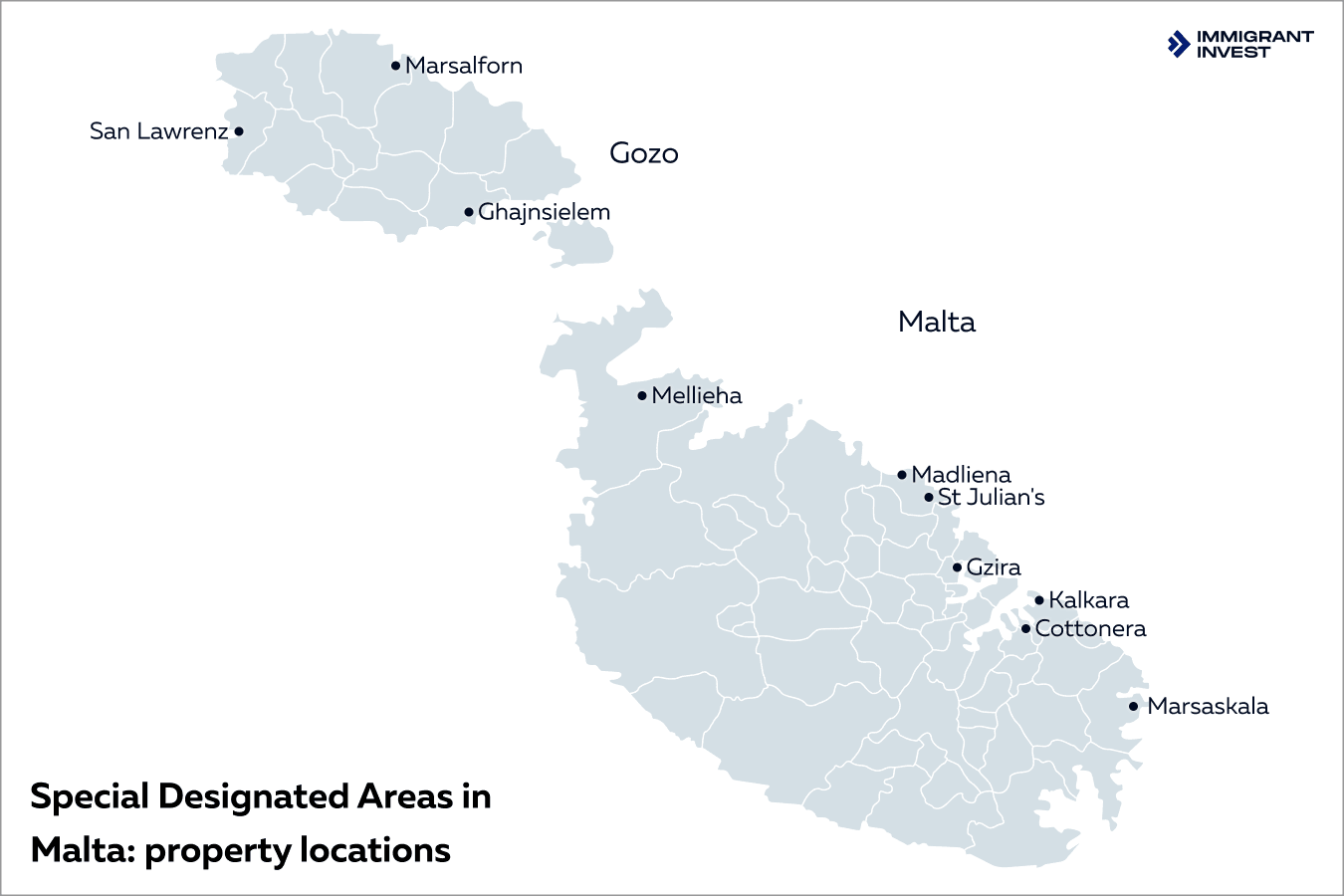
SDA complexes are spread across Malta and Gozo, often in highly desirable areas:
- St Julian’s — Portomaso Development, Pender Place, Mercury House Site.
- Cottonera — Cottonera Development.
- Gozo, Ghajnsielem — Fort Chambray.
- Gozo, Marsalforn — Vista Point.
- Mellieha — Tas-Sellum Residence, Southridge, Mistra Heights.
- Gozo, San Lawrenz — Kempinski Residences.
- Gzira — Manoel Island, Metropolis Plaza.
- Madliena — Madliena Village Complex.
- Marsaskala — Ta’ Monita Residence.
- Mriehel — Quad Business Towers.
- Kalkara — Smart City.
Yields and resale potential
Yields. SDA properties generate annual rental yields of 5—7%, thanks to their prime locations and high demand. By contrast, properties outside SDA areas yield significantly less: national average gross rental yields range from 3.6% to 4.1%[9].
In general, Malta’s rental market is on a strong upward trajectory. Rental prices grew by 17.5% in 2023, placing the country 10th in the EU for year-on-year increases[10].
Resale. After 5 years, investors may resell their property acquired under the Malta Permanent Residence Programme. To maintain residency, they must simply rent or purchase another property in Malta, with no minimum value required.
SDA real estate has appreciated by 8—10% annually, well above the general market. Overall property prices in Malta have risen by 65% since 2015, outpacing the EU average[11].
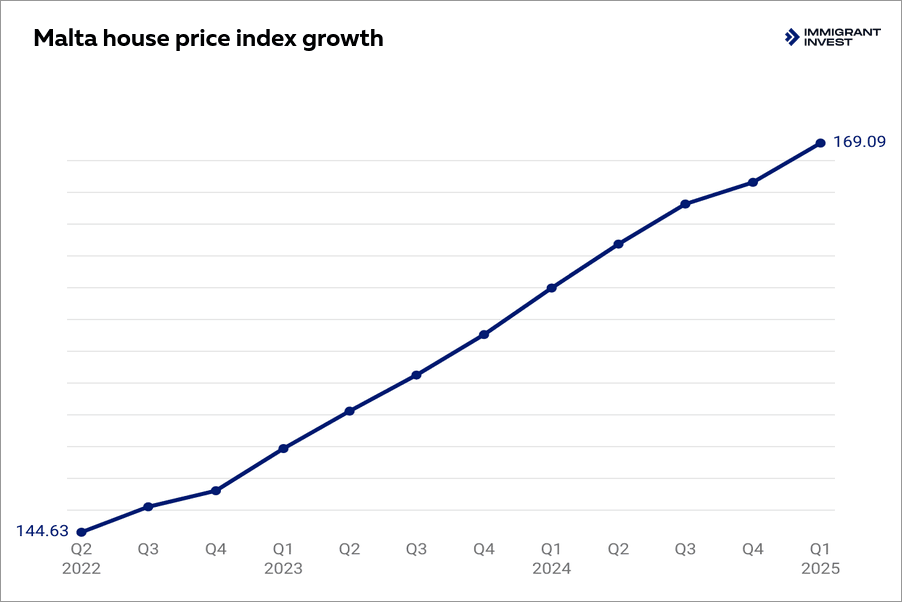
Based on house prices, using 2015 as the reference point of 100
Taxes and transaction costs
Buying real estate in Malta involves several one-off expenses at the time of purchase, as well as limited ongoing obligations for owners:
- Stamp duty — 5% of the property value. For first and sole residences, buyers are exempt from stamp duty on the first €200,000 and pay 5% on the balance.
- Notary fee — 1 to 2% of the property value.
- Agent’s fee — 1 to 2% of the property value plus 18% VAT, payable only if a licensed estate agent is used.
- AIP permit — €350, required only for non-SDA properties.
- Architect’s inspection — around €300.
Maintenance of property in Malta is relatively straightforward, as there are no recurring ownership levies. The country does not impose an annual property tax, and rental income is taxed at a flat rate of 15%.

Risks when choosing property in Malta — and how to avoid them
Renting or buying property in Malta may seem straightforward, but for MPRP applicants even a small error can cost time, money or — worst of all — permanent residence status. At Immigrant Invest, we have helped dozens of clients avoid these pitfalls.
Risk 1. Hidden contract clauses
Some lease agreements contain clauses that allow landlords to terminate early. One of our clients signed such a contract without noticing the small print. When the landlord decided to sell the flat, the tenant was forced to move out within weeks. This left them without a valid registered address — a direct threat to their MPRP status.
How we help: our lawyers review every contract before signing, making sure that landlords cannot evict clients prematurely. If a problem does arise, we quickly arrange alternative housing and re-register the address so that residency remains secure.
Risk 2. Rental scams and fraudulent payments
Fraudulent agents sometimes ask for rent to be transferred into their personal bank accounts, without disclosing the landlord’s details. Another client faced this: after several months of paying rent, they discovered that the property owner had never received the money and was about to cancel the lease. This was a clear case of fraud — and could have cost the client both money and residency.
How we helped: we intervened, contacted the landlord directly, and arranged a proper rental contract for a property that met all MPRP requirements. Within days, the client was registered at the new address, and their residency status was not affected.
Risk 3. Taking on a bank loan
Some investors consider financing their Maltese property through a local bank loan. However, loans can complicate the application, as the MPRP requires proof of sufficient personal assets. One of our clients initially wanted to take out a mortgage but quickly realised that this could cast doubt on their financial independence and slow down the approval process.
How we helped: we advised the client not to rely on a loan for the property purchase and ensured all asset requirements were met with personal funds. By restructuring the investment plan, the client’s eligibility was safeguarded and the application proceeded smoothly.
How to minimize risks with Immigrant Invest
At Immigrant Invest, we protect investors from costly mistakes when renting or buying property in Malta:
- Work only with trusted partners.
- Provide full legal Due Diligence on every contract.
- Conduct personal property inspections with clients.
- Ensure compliance with the Malta Permanent Residence Programme.
- Offer a portfolio of pre-vetted properties in prime locations, including SDAs.
Taxes in Malta for PR holders
No automatic tax residency. Holding permanent residence in Malta does not automatically make an individual a tax resident. To acquire tax residency, MPRP holders must spend at least 183 days per year in the country.
Personal income tax. Income is taxed on a progressive scale of up to 35%. Taxpayers are divided into three categories — single, married, and parent — each with its own progressive tax bands.
Personal income tax rates in Malta
Foreign-source income not remitted to Malta is not subject to taxation.
Rental income is taxed at a flat rate of 15%.
Capital gains in Malta are taxed at 8—12%. Foreign-source capital gains are not taxed, even if remitted.
Malta does not impose wealth tax, inheritance or estate tax, or municipal property tax.
Stamp duty of 5% applies on property transfers.
Double taxation treaties. Malta has signed more than 70 double taxation treaties, including with the US, UK, Canada, and most EU countries.
These agreements ensure that income is not taxed twice — once in the country of origin and again in Malta. For example, if a permanent resident receives dividends from abroad, the treaty may reduce withholding tax in the source country and allow Malta to credit any tax already paid.
How to obtain Malta citizenship after permanent residence
Malta citizenship is offered through six recognised routes:
- naturalisation,
- marriage,
- descent,
- family reunification,
- distinguished services,
- refugee status.
Permanent residency can still be the first step toward naturalisation. To become eligible for citizenship after holding MPRP status, applicants must follow the standard naturalisation process.
Permanent residency can still be the first step toward naturalisation. To become eligible for citizenship after holding MPRP status, applicants must follow the standard naturalisation process.
Key requirements include:
- at least 5 years of permanent residence in Malta;
- living in Malta for most of the year;
- integration into society, including knowledge of Maltese or English, civic knowledge, and cultural familiarity;
- clean criminal record and good moral character.
Applicants must also secure endorsements from at least two Maltese citizens who are not family members. One guarantor must hold a recognised professional or official position, such as a lawyer, doctor, civil servant, judge, priest, police officer, prosecutor, captain, magistrate, or notary. The second guarantor must simply be a Maltese citizen aged 18 or older who did not acquire citizenship through naturalisation.
Malta allows dual citizenship, so applicants can obtain Maltese nationality without giving up their original passport.
To sum up: main aspects of the MPRP
- The Malta Permanent Residence Programme offers the right to live indefinitely in Malta and travel across the Schengen Area.
- Minimum investment starts at €169,000 for the rental route and €474,000 for property purchase.
- SDA properties are especially attractive for purchase, as they can be bought without a special permit, rented out and resold, with yields of up to 5—7%.
- Eligible family members include the spouse or partner, children under 29, as well as parents and grandparents.
- Key benefits of obtaining MPRP include the ability to operate a business, no minimum stay requirement, access to Malta’s healthcare and education, English as an official language, a large expat community, relatively low cost of living, and a Mediterranean lifestyle.
- Tax residency in Malta is optional. MPRP holders become tax residents only if they spend 183 days per year in the country.
Immigrant Invest is a licensed agent for citizenship and residence by investment programs in the EU, the Caribbean, Asia, and the Middle East. Take advantage of our global 15-year expertise — schedule a meeting with our investment programs experts.
 Trusted by 10,000+ investors