








Dominica grants citizenship for a contribution to the Economic Diversification Fund or for buying a unit in a government-approved real estate project. Both options start at $200,000 and lead to the same passport.
However, the options differ in their final costs, refundability, and ongoing profits. In this article, we break down all comparison points for you to make an informed decision.
Dominica CBI programme overview: what the options have in common
Dominica offers a citizenship by investment programme where the fund and real estate options lead to the same passport. The options share the eligibility rules, the procedure, and most of the fees.
Eligibility requirements
Before granting approval, the CBI Unit runs Due Diligence checks on the whole family and interviews every member aged 16 or over.
The main applicant must be at least 18, have no criminal record, and meet the health requirements. They also have to prove that their funds come from a legal source.
The following family members can be included:
- legally married spouse;
- children under 18;
- children aged 18—30 in full-time higher education who are financially supported by the main applicant or their spouse;
- unmarried daughters under 25 who are substantially supported by the main applicant or their spouse;
- children over 18 with a physical or mental disability who are supported by the family;
- parents and grandparents of the main applicant or their spouse, aged 65 or over.
Minimum investment
Both options start at $200,000 for a single applicant.
Under the fund option, the contribution rises with family size. Under the real estate option, the property price stays at $200,000 whatever the number of family members in the application. Instead, the government charges a separate fee that rises with the number of people in the application.
Fees applicable to both options
Irrespectful of the chosen investment path, each Dominica citizenship applicant pays the following fees:
- Due Diligence fee — $7,500 for the main applicant and $4,000 per dependant aged 16+;
- interview fee — $1,000 per applicant aged 16+;
- processing fee — $1,000 per application;
- fee for processing of forms — $250 per applicant;
- passport fee — $300 per applicant;
- certificate of naturalisation fee — $500 per applicant.
Additionally, applicants pay for translation and notarisation of documents, plus courier fees where applicable. These expenses are about $4,000 per application but depend on the number of documents and the investor’s location.
5 main benefits of Dominica citizenship
1. Travel freedom. The Dominica passport gives visa-free, visa-on-arrival or eTA access to 159 destinations. These include:
- Schengen Area states for 90 days in any 180-day period;
- China for up to 30 days;
- Singapore for up to 30 days;
- Hong Kong for up to 90 days.
2. Dual citizenship. Dominica doesn't require new citizens to give up their current passport, unless the country of the first citizenship requires renunciation.
3. Tax optimisation. People who don't live in Dominica pay taxes only on income earned there. The country has no capital gains, inheritance or wealth tax.
4. Business development. Dominica citizens can register companies in the country. Dominica has no significant currency controls: companies can generally move capital, dividends, and profits abroad without restriction.
5. Plan B. Citizens can live, work, and study in Dominica without limits. They can also settle and work in other member states of the Organisation of Eastern Caribbean States.

What unique opportunity can the Dominica investment program offer
How much each route costs
Both options start at $200,000, but they add up differently. On the fund route, the contribution grows with family size. On the real estate route, the property price stays fixed and the government charges a separate fee on top.
Fund contribution add-ons
A family of up to four contributes $250,000. Starting from the 5th applicant, each additional dependant adds:
- $25,000 if aged under 18;
- $40,000 if aged 18+[1]Source: Dominica CBIU — Economic Diversification Fund.
Extra expenses on buying property
The government fee applies to real estate applicants:
- $75,000 for a single investor;
- $100,000 for a family of 2—4 people;
- $25,000 per additional dependant aged under 18, starting from the 5th applicant;
- $40,000 per additional dependant age 18+, starting from the 5th applicant[2]Source: Dominica CBIU — Dominica Real Estate Investment.
Foreign buyers generally face an Alien Landholding Licence fee of 10% of the property value, but CBI programme participants are exempt from it.
Cost breakdown example: single applicant and family of four
In the table below, you can compare the total estimated costs per option, with expenses breakdown per item.
The family of four here is two spouses and two children under 16.

Agent's fees, bank and courier charges aren't included as they arise depending on the applicant’s situation.
A single applicant pays about $75,000 more for property, and a family about $100,000 more. That money is spent up front but can come back if the owner sells the property after the 3-year holding period or earns rental income from it.

What happens to the money after you’ve obtained Dominica citizenship
On both routes, the applicant pays everything before citizenship is granted. The difference is what's left afterwards.
Fund contribution: cost that doesn't come back
The contribution to the Economic Diversification Fund is officially non-refundable. It's paid only after approval in principle, so if the CBI Unit rejects the application earlier, the family doesn't pay it at all. In that case, they lose only the Due Diligence and processing fees.
Once citizenship is granted, the money is gone. The upside is predictability: the total is known from day one and doesn't depend on any market.
Property: selling after the holding period and rental income
Holding period and re-selling. Property bought under the CBI programme can be sold 3 years after citizenship is granted. If the new owner is also using it to apply for citizenship, the holding period is 5 years.
The main demand for CBI units comes from other applicants, who need a qualifying property worth at least $200,000. Between the 3rd and 5th year, the owner can sell only to people who aren't applying for citizenship, and there are far fewer of them. So for many owners, the real exit is after 5 years.
Rental yields. Most approved projects are resorts or hotels. The operator manages the units through a rental pool, and owners receive a share of the income after the operator's costs.
The yield is 2—10% a year, depending on the project.
Rental income earned in Dominica is taxed there. Non-resident owners may be subject to a 15% withholding tax.
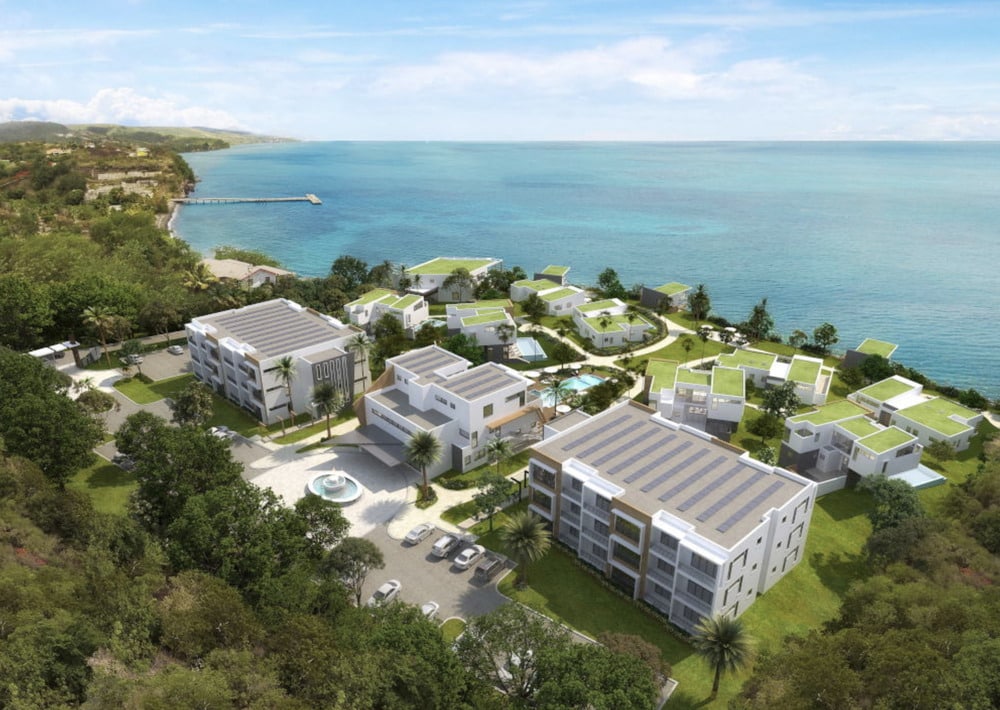
Examples of investment real estate in Dominica

Dominica, Roseau
$220,000+
Share in a resort on the coast of Dominica managed by Hilton
 1—3
1—3 
Dominica, Portsmouth
$220,000+
Share in a five-star hotel managed by Intercontinental

Dominica, Roseau
$216,000 — $3,800,000
Share and villas in a six-star resort
1—2  1
1 Risks of each route to Dominica citizenship by investment
On the fund route, the cost is fixed from the start: the contribution is spent, and nothing can make it bigger or smaller. On the real estate route, the final cost depends on the project, the market, and the weather. Some risks apply to both routes.
Risks for both investment options
Refusal. If the CBI Unit rejects the application, the applicant loses the Due Diligence and processing fees[3]Source: Commonwealth of Dominica Citizenship by Investment Regulations 2024, S.R.O. 8 of 2024, regulation 7(7), gazetted June 28th, 2024. The main payment isn't at risk, because it's made only after approval. In Immigrant Invest's experience, the preliminary check reduces the risk of refusal to about 1%.
Changes to the rules. Dominica revises the programme regularly. In 2024, it raised the minimum contribution from $100,000 to $200,000[4]Source: Commonwealth of Dominica Citizenship by Investment Regulations 2024, S.R.O. 8 of 2024, gazetted June 28th, 2024. In June 2026, it announced a mandatory visit to the country, but the change isn't in force yet[5]Source: Government of Dominica — Budget Address dated August 4th, 2026.
Risks associated with the real estate route
Construction delays. Some approved projects are sold before completion, and their opening dates can move by years. For example, Tranquility Beach, a resort in the Curio Collection by Hilton, was announced in 2015 with an opening planned for 2018[6]Source: Hospitality Net — Hilton Worldwide Debuts in Dominica with Addition of Tranquility Beach Resort to Curio. In 2020, the date moved to late 2021 or early 2022[7]Source: PR Newswire — Dominica Hilton Resort Approved for Citizenship by Investment Will Open in 2021—2022, July 7th, 2020, and in late 2022 to early 2024[8]Source: Dominica Update — Tranquility Beach Resort, a "true labor of love," plans to open by early 2024, December 28th, 2022. A delay doesn't affect citizenship, but rental income starts later and the unit is harder to sell.
Hurricanes. Dominica lies in the Atlantic hurricane belt. In 2017, Hurricane Maria caused damage estimated at 226% of the country's GDP, and the rebuilding held up projects across the island[9]Source: Climate Investment Funds — Dominica case study: Climate Resilience, Disaster Recovery, May 2023. Insurance reduces the loss but adds a yearly cost. A damaged resort earns nothing until it's repaired.
Developer. The unit is only worth as much as the project is well run. Poor management means low occupancy, which in turn means low rental income and a weaker resale price. A hotel share owner has almost no influence over how the property is run.
Resale and income. The resale market is rather small and mostly consists of other applicants, and they can buy only after 5 years[10]Source: Dominica Citizenship by Investment Unit — Real Estate Investment.
How Immigrant Invest reduces the risks and helps with obtaining Dominica citizenship
Immigrant Invest is a licensed agent of the Dominica citizenship by investment programme and has helped families obtain second citizenship since 2006. We help investors at every stage: before, during, and after applying.
Choosing a route. A lawyer compares the fund and real estate routes for the applicant's family, taking into account all fees and property expenses.
Preliminary Due Diligence. Before the application is submitted, the in-house compliance team checks the applicant's background in one day. It identifies anything that could lead to a refusal and reduces the risk of rejection to about 1%.
Documents and application. Experienced lawyers prepare the document list, help fill in the forms, and obtain certificates. They then submit the application to the CBI Unit and represent the family until the passports are issued.
Buying property. On the real estate route, Immigrant Invest selects units in approved projects to match the budget and the owner's plans, whether that's rental income, personal stays or resale after the holding period.
The team manages the purchase and works through the risks described above before the you sign anything:
- Immigrant Invest confirms that the project is on the government's approved list, and reviews the developer's track record and the title to the land;
- we review the reservation contract, the contract of sale, and the escrow agreement. Lawyers check when the developer receives the money and what happens to the deposit and escrow funds if the application is refused;
- we check whether the project's insurance covers hurricane damage and who pays the premiums;
- real estate team analyses the rental pool terms and any guaranteed return, including how long the guarantee lasts and whether its cost is built into the price.
After citizenship. Immigrant Invest helps renew passports, add family members, obtain a social security number in Dominica, and other tasks by demand.
How to get Dominican citizenship through fund and real estate routes
The whole process is currently remote, and the family doesn't need to visit Dominica before or after receiving their passports. In June 2026, Dominica announced that a mandatory visit to the country will be introduced for citizenship by investment but the changes are not yet in force yet[5]Source: Government of Dominica — Budget Address dated August 4th, 2026.
In Immigrant Invest's experience, getting citizenship takes at least 6 months. The procedure is the same for both routes. The only difference is that on the real estate route, the applicant also chooses a property before submitting the application, and completes the purchase after approval.
1 day
Preliminary Due Diligence
Immigrant Invest runs a confidential background check, which needs only the applicant's passport. The check identifies anything that could lead to a refusal and reduces the risk of rejection to about 1%.
If the check reveals concerns, the team suggests a solution, such as submitting additional documents or choosing a different programme.
Immigrant Invest runs a confidential background check, which needs only the applicant's passport. The check identifies anything that could lead to a refusal and reduces the risk of rejection to about 1%.
If the check reveals concerns, the team suggests a solution, such as submitting additional documents or choosing a different programme.
2+ weeks
Preparing documents
Immigrant Invest lawyers give the applicant a list of personal documents and financial records, help fill in the forms and obtain the certificates.
On the real estate route, the applicant chooses a unit in a government-approved project at this stage. The package then also includes a reservation contract, a contract of sale, an escrow agreement, and proof of the deposit.
Immigrant Invest submits the documents to the Citizenship by Investment Unit.
Immigrant Invest lawyers give the applicant a list of personal documents and financial records, help fill in the forms and obtain the certificates.
On the real estate route, the applicant chooses a unit in a government-approved project at this stage. The package then also includes a reservation contract, a contract of sale, an escrow agreement, and proof of the deposit.
Immigrant Invest submits the documents to the Citizenship by Investment Unit.
3—6 months
Due Diligence and interview
The CBI Unit checks the information against the programme requirements.
Every family member aged 16 or over takes an interview on a secure online platform, in their chosen language, with their ID documents to hand. The family is usually interviewed together. If someone can't attend, a separate interview is scheduled for an additional fee.
When Due Diligence and the interview are complete, the CBI Unit notifies Immigrant Invest of the approval.
The CBI Unit checks the information against the programme requirements.
Every family member aged 16 or over takes an interview on a secure online platform, in their chosen language, with their ID documents to hand. The family is usually interviewed together. If someone can't attend, a separate interview is scheduled for an additional fee.
When Due Diligence and the interview are complete, the CBI Unit notifies Immigrant Invest of the approval.
Up to 1 month
Making the investment
After approval, the applicant pays on the chosen route — a fund contribution or real estate.
After approval, the applicant pays on the chosen route — a fund contribution or real estate.
Up to 1 month
Receiving passports
Once the payment is confirmed, the CBI Unit prepares the documents. The passport and certificate of naturalisation are usually issued within 4 weeks. A courier delivers them to the family's chosen address.
Once the payment is confirmed, the CBI Unit prepares the documents. The passport and certificate of naturalisation are usually issued within 4 weeks. A courier delivers them to the family's chosen address.
Which investment route to Dominica citizenship suits whom
Both investment options lead to Dominica citizenship. The choice depends on how much money the family can pay upfront, and whether they want to get some of it back later.
The fund route suits families who want to pay as little as possible from the start: about $215,000 for a single applicant or $223,000 for a family of four. The procedure is also simpler, because there's no project to choose and no contract to sign with a developer.
However, the contribution is non-refundable.
The real estate route suits for recovering the investment several years later. The option requires about $75,000—100,000 more than the fund upfront, but real estate can be sold and the money returned in 3—5 years. So, it works best for families who plan to stay in the property or earn rental income from it, and who are prepared to vet the project and wait for a buyer if the market is slow.

Lyle Julien,
Investment programmes expert
Clients often choose the fund because it looks cheaper. But once we calculate the full picture for their family, some see that property can cost less in the end, if they're ready to wait 5 years and choose the right project. So we start by asking what the family wants from the property. If the answer is 'nothing,’ the fund is the better choice.
Comparison of Dominica citizenship with other Caribbean passports
If you consider obtaining a Dominica passport, these materials will help you understand how it compares to other Caribbean passports, highlighting the unique benefits and requirements of each:
Immigrant Invest is a licensed agent for citizenship and residence by investment programs in the EU, the Caribbean, Asia, and the Middle East. Take advantage of our global 15-year expertise — schedule a meeting with our investment programs experts.

 Trusted by 10,000+ investors