![How to get St Kitts and Nevis citizenship by investment in [!year]](/_next/image/?url=https%3A%2F%2Fa.storyblok.com%2Ff%2F176292%2F1536x864%2F61e03a3b4e%2Fhow-to-citizenship-st-kitts-and-nevis-by-investment237690379.jpeg&w=3840&q=75)

Summary
The St Kitts and Nevis CBI Program is a government initiative that allows individuals to obtain citizenship by investment. It was established to attract foreigners to the country and promote economic development.
The program offers several investment options with a minimum financial requirement of $250,000. The investor and their family members obtain citizenship in 6+ months from the application date. However, under the Public Benefit Option, the expected processing time is around 4 months, provided all documents are submitted correctly and Due Diligence is completed without delays.
Find out more about how to participate in a CBI Program and become a St Kitts and Nevis citizen.
What are the requirements for St Kitts and Nevis citizenship by investment?
The St Kitts and Nevis citizenship by investment program is among the oldest and most respected. Established in 1984, it is the longest-running CBI program globally[1].
Under the CBI Index Report 2024, the St Kitts and Nevis program ranks the best across different areas, including Due Diligence, ease of processing, the simplified rules of mandatory residence and visiting the country, and the program’s stability and reputation[2].
Meet basic eligibility criteria
Requirements for participants are the following:
- investor must be over 18 with legal income, without a criminal record and serious illnesses;
- spouse of the opposite sex without a criminal record;
- children under 25, financially dependent on the investor or spouse;
- parents over 55, financially dependent on the investor.
Family members of the investor must be included in the investor’s citizenship application. After the application has been submitted, the investor may add a spouse or minor child to the application, provided it is done before the citizenship approval date, evidenced by the issue of Certificates of Registration.
The St Kitts and Nevis CBI Unit verifies the authenticity of the documents, the absence of a criminal record and sanctions, as well as rejections of applications for other citizenship programs or residence permits.
Pass Due Diligence successfully
Applicants and their dependents aged 16 and above must undergo a thorough background check conducted by the government of St Kitts and Nevis.
This Due Diligence process ensures that applicants meet the character requirements for citizenship. It also allows applicants to prepare all necessary documents properly before their case is assessed.
Select an investment option
The St Kitts and Nevis citizenship by investment programe provides three options[3]:
- Sustainable Island State Contribution — $250,000 for a single applicant.
- Approved real estate — $325,000 invested in government-approved property.
- Public Benefit Option — $250,000 invested in an approved public benefit project.
Each route has its own minimum investment threshold, eligibility rules, and Due Diligence requirements, allowing investors to select the option that best aligns with their objectives.
Submit application documentation
Applicants are required to submit various documents as part of their application, including:
- Passport and identification documents.
- Birth certificates.
- Marriage certificates.
- Police clearance certificates.
- Health certificates.
- Proof of the source of funds for the investment.
Once the application is submitted, it will be reviewed by the government of St Kitts and Nevis. If the application meets all requirements and is approved, applicants and their eligible family members will be granted citizenship of St Kitts and Nevis.
What are the latest changes to the St Kitts and Nevis program?
The St Kitts and Nevis program has introduced enhanced Due Diligence, mandatory interviews for all main applicants, updated dependent rules, and a limited-time reduction in the SISC contribution.
The latest changes include:
- Enhanced Due Diligence. More comprehensive background checks are now mandatory for all applicants to maintain a high level of programe integrity.
- Mandatory interviews. Applicants over 16 must complete an interview as part of the assessment procedure.
- Lower age threshold for parents. Parents of the main applicant may now be included as dependents from the age of 55. Previously, eligibility applied only from 65.
- New government fee for newborn dependents. A fee of $7,500 applies to newborn children under 3 years old who are added to the citizenship after the main applicant has already obtained their passport. The fee for children aged 4 to 18 remains $10,000.
- Updated bankruptcy requirement. Applicants are not eligible for citizenship if they have been declared bankrupt within 10 years before submitting their application.
Until December 31st, 2025, families of up to 4 applicants using the Public Benefit Option are exempt from government fees. Citizenship can be obtained in 4 months instead of 6 under other options.
Non-refundable contribution
To obtain St Kitts and Nevis citizenship, investors contribute $250,000 to the Federal Consolidated Fund under the Sustainable Island State Contribution Option. The contribution is non-refundable, made once, and doesn’t imply income.
The main advantage is that it requires fewer investments. If the investor participates in the CBI program alone, the total investment sum will amount to $270,000, including additional expenses.
The expenses increase when the investor adds family members to the application for citizenship. Family participation might be more beneficial under a real estate purchase option.
Contributions go to the Federal Consolidated Fund. It distributes investments between St Kitts and Nevis social programs to fight poverty and climate change. For example, the fund’s money went to help those affected by hurricanes.
Expenses on obtaining St Kitts and Nevis citizenship through a fund contribution
Real estate purchase
Investors buy shares or condominium units in projects approved by the country's government. Applicants usually invest $325,000, but $600,000 is the minimum investment in a single-family private dwelling designated as an Approved Private Home.
The main advantage is that the investments are refundable. The property can be sold in 7 years. The investor can earn an income of 2 to 5% per annum from leasing the property.
St Kitts and Nevis offers about a hundred real estate projects for purchase under the CBI program. Investors can also buy unapproved projects.
Immigrant Invest real estate experts analysed the developers’ offers and selected the best properties for investors.
Real estate investment costs in St Kitts and Nevis
Public Benefit Option: Prime Creative Arts Centre
Applicants invest $250,000 in Approved Public Benefit Projects.
Investors who would like to develop a project that brings substantial benefits to St Kitts and Nevis can apply to be designated as an Approved Public Benefactor. Once recognised, they can propose their projects for designation as Approved Public Benefit Projects, making them eligible for sale through this option.
Projects approved as Public Benefit Projects by the citizenship by investment unit boost local employment and facilitate technology transfer and capacity building in St Kitts and Nevis.
Investment costs under the Prime Creative Arts Centre Option
Public Benefit Option: National Housing Corporation
Another approved project under the Public Benefit Option is the National Housing Corporation.
Contributions under this option support the construction of new housing in St Kitts and Nevis, so the impact is clear and immediate. The project is run by a statutory body established by Parliament and overseen by the Citizenship by Investment Unit.
The funds are paid directly into government accounts, which makes the process transparent and secure.
Investment costs under the National Housing Corporation Option
What are the fees for obtaining St Kitts and Nevis citizenship?
When obtaining citizenship of St Kitts and Nevis through the CBI Program, applicants are required to pay various fees. These fees cover different aspects of the application process and the investment in the country’s economy.
State fees
These fees are payable to the government of St Kitts and Nevis and cover the cost of processing the citizenship application. Government processing fees vary depending on the number of dependents and the chosen investment option:
- processing fee for a single applicant: $250;
- Naturalisation Certificate fee: $50;
- passport fee: $361.
The National Housing Corporation option and real estate purchase option also include a processing fee of $2,500 for a family of up to 4 and $3,500 for a family of more than 4 members.
Under the Real Estate and the National Housing Corporation Options, an additional government fee of $25,000 applies to the main applicant. For dependants, the fees are $15,000 for a spouse, $10,000 for each dependent under 18, and $15,000 for each dependent aged 18 or over.
Under the Prime Creative Arts Centre Option, the investor is excluded from the government fee, but they need to pay $15,000 for a spouse, $10,000 for each dependent under 18, and $15,000 for each dependent aged 18 or over.
Due Diligence fees
Due Diligence fees cover the cost of background checks conducted by the government. These fees apply across all investment options and must be included when budgeting for the application:
- $10,000 for the main applicant;
- $7,500 for each dependent over 16.
Additional fees
Additional fees may arise during the application process. These may include courier charges for document delivery, translation of non-English documents, administrative costs related to mandatory interviews, and other expenses associated with preparing and submitting the required documentation.
Which investment option is more profitable?
The minimum contribution to the SCIC and Public Benefit Option is $250,000. However, this does not necessarily make these options more profitable in comparison to purchasing real estate, for contribution to the SCIC is non-refundable.
Real estate investment starts at $325,000 and the minimum cost of a share does not depend on the number of participants. Moreover, the property can be rented and then sold at a profit a few years later.
Comparison of expenses for a family of four with two children aged 9 and 17
How to apply for St Kitts and Nevis passport by real estate investment
Obtaining St Kitts and Nevis citizenship by investment takes place in several stages. Investors don’t pass exams or visit the country to do so.
The procedure is entirely remote, confidential, and lasts 6+ months.
1 day
Preliminary Due Diligence
Immigrant Invest conducts a preliminary check. With the expertise of Immigrant Invest lawyers, the preliminary check minimizes the risk of rejection by the citizenship program department. It takes 1 day. The investor provides only a copy of the passport and address of residence.
Our certified AML Compliance specialists check the applicant in international databases, which investment program departments use in their work. Based on the verification results, our lawyers recommend a package of documents covering all possible questions for the applicant during Due Diligence.
Immigrant Invest conducts a preliminary check. With the expertise of Immigrant Invest lawyers, the preliminary check minimizes the risk of rejection by the citizenship program department. It takes 1 day. The investor provides only a copy of the passport and address of residence.
Our certified AML Compliance specialists check the applicant in international databases, which investment program departments use in their work. Based on the verification results, our lawyers recommend a package of documents covering all possible questions for the applicant during Due Diligence.
2—4 weeks
Choosing an investment real estate
The investor selects a suitable property from the verified Immigrant Invest database and enters into a preliminary purchase and sale agreement. According to the terms of the agreement, the investor makes an advance payment of 10% of the value of the property.
The investor selects a suitable property from the verified Immigrant Invest database and enters into a preliminary purchase and sale agreement. According to the terms of the agreement, the investor makes an advance payment of 10% of the value of the property.
2—4 weeks
Preparation of documents for citizenship
Our lawyers help the investor collect the documents required to obtain St Kitts and Nevis citizenship. They analyse a specific situation, based on which they form a list of documents. Further, legal explanations are prepared, state forms are filled out, apostilles are affixed, and documents are checked for correctness.
When the package of documents is collected, it is transferred to the department of the St Kitts and Nevis citizenship program for Due Diligence. The investor pays government fees and verification immediately.
Our lawyers help the investor collect the documents required to obtain St Kitts and Nevis citizenship. They analyse a specific situation, based on which they form a list of documents. Further, legal explanations are prepared, state forms are filled out, apostilles are affixed, and documents are checked for correctness.
When the package of documents is collected, it is transferred to the department of the St Kitts and Nevis citizenship program for Due Diligence. The investor pays government fees and verification immediately.
3—6 months
Due Diligence by the St Kitts and Nevis government
When the program department receives a package of documents, it proceeds to Due Diligence. Its purpose is to find out if the investor and his family members meet the conditions of the St Kitts and Nevis program.
If additional requests are received from the citizenship program department, our lawyers respond to them. If necessary, collect more documents or prepare explanations.
All applicants over 16 must participate in an online or in-person interview. In some cases, Interviews may also be requested for dependents.
When the program department receives a package of documents, it proceeds to Due Diligence. Its purpose is to find out if the investor and his family members meet the conditions of the St Kitts and Nevis program.
If additional requests are received from the citizenship program department, our lawyers respond to them. If necessary, collect more documents or prepare explanations.
All applicants over 16 must participate in an online or in-person interview. In some cases, Interviews may also be requested for dependents.
Up to 3 months
Approval and completing the investment
When the application is approved, an official notification comes. It is the basis for investing. The applicant pays the remaining 90% of the property value.
When the application is approved, an official notification comes. It is the basis for investing. The applicant pays the remaining 90% of the property value.
Up to 1 month
Getting citizenship
The investor receives a Certificate of Registration after the investment is made. The Certificate of Registration must be collected in person in St Kitts and Nevis or at an approved Embassy or Consulate.
The investor receives a Certificate of Registration after the investment is made. The Certificate of Registration must be collected in person in St Kitts and Nevis or at an approved Embassy or Consulate.
10 benefits of St Kitts and Nevis citizenship
Obtaining citizenship in St Kitts and Nevis, a passport from the country offers several benefits, which may appeal to individuals seeking greater mobility, financial opportunities, and security.
1. Fast and remote process
St Kitts and Nevis's citizenship by investment program is designed for efficiency, typically concluding within 6 months. The application and all related processes can be done remotely.
2. No residency requirement
The investment program comes with the added advantage of no mandatory residence requirement. It means applicants don’t need to live in St Kitts and Nevis before, during, or after the application process.
3. Global mobility
Increased global mobility is an important benefit under the citizenship by investment program. St Kitts and Nevis citizens do not need visas or obtain visas upon arrival in most countries.

St Kitts and Nevis citizenship for travelling
Arsen and Lusine began thinking about obtaining second citizenship when they started to experience problems with getting visas to Europe.
It was easier for Arsen because he travelled often, and the countries like France and Italy issued him a visa for 5 years. However, his family usually got short-term visas.
Arsen made up his mind to solve this problem. More and more friends and acquaintances shared with him the benefits of second citizenship by investment.
4. Possibility to obtain a US visa
St Kitts and Nevis passport holders can get a B‑1/B‑2 Visitor Visa for the US, valid for 10 years and allowing multiple entries. Those visas can be extended online without an interview if they are valid or expired during the past 24 months.
St Kitts and Nevis citizens can also get a 10-year tourist visa to Canada that grants multiple 180-day entries[4].
5. Investment opportunities
The St Kitts and Nevis Citizenship by Investment provides an opportunity to invest in government-approved real estate. Eligible properties include resort residences, villas, and apartments within established developments.
Such assets may generate rental income, with average returns in the range of 2—5% per year, depending on the property type, location, and occupancy levels.
6. Tax benefits
St Kitts and Nevis is known for its favourable tax environment, with no personal income tax, capital gains tax, or inheritance tax. The country also offers attractive conditions for business ownership and asset protection, making it appealing for investors seeking tax efficiency and long-term financial planning.
7. Dual citizenship
St Kitts and Nevis allows for dual citizenship. Investors can retain original citizenship while holding a St Kitts and Nevis passport. It provides added flexibility and benefits.
Citizens are expected to comply with the laws of St Kitts and Nevis, respect national regulations, and fulfil any legal obligations associated with owning property or conducting business in the country.
8. Transfer of St Kitts and Nevis citizenship by inheritance
St Kitts and Nevis is one of the few countries that allows citizenship by investment to be transferred by inheritance. Thus, the investor’s children under the age of 18 can become citizens by submitting an appropriate registration application.
9. Benefits for Commonwealth Citizens
St Kitts and Nevis is a member of the Commonwealth of Nations[5]. Citizens of Commonwealth countries may benefit from several privileges, including:
- facilitated entry procedures and smoother border formalities when travelling to other Commonwealth states;
- access to support, guidance, and consular protection from the embassies and high commissions of fellow member countries;
- eligibility for certain educational scholarships and academic programs offered by institutions in Commonwealth states, including the United Kingdom.
Major members of the Commonwealth include the United Kingdom, Canada, Australia, New Zealand, Singapore, India, South Africa, and more than 40 other countries across Asia, Africa, the Caribbean, and the Pacific.
10. Second home in a peaceful country
Citizens can visit St Kitts and Nevis anytime and stay there as long as they want. It may become useful to change scenery or in an emergency in the country of permanent residence.

Let’s explore why the St Kitts and Nevis citizenship program and the country's tax system are attractive for investors
Non-investment ways to get a St Kitts and Nevis passport
Non-investment routes to St Kitts and Nevis citizenship are limited and apply only in specific circumstances defined by law. These pathways are generally available to individuals with strong family ties or exceptional connections to the country, rather than to foreign investors seeking citizenship through financial contributions.
Residency and naturalisation
To qualify, applicants must demonstrate that they have resided in St Kitts and Nevis for a minimum of 14 consecutive years, including continuous residence throughout the 12 months immediately prior to their application.
Descent or birth
Individuals born in the country to at least one citizen parent are eligible for citizenship by birth. Additionally, individuals born outside of St Kitts and Nevis may be eligible for citizenship if at least one parent is a citizen of the country.
Marriage to a citizen
A spouse of a St Kitts or Nevis national can apply for citizenship following three years of lawful marriage. However, it is prohibited to marry a citizen of the country primarily to acquire citizenship.
The government may deny applications from spouses undergoing a divorce or no longer residing together as a married couple.

Visa-free countries for St Kitts and Nevis passport holders
The list of countries and territories with which Saint Kitts and Nevis have a visa-free regime is flexible and changes constantly depending on the situation in the world.
St Kitts and Nevis citizens do not need visas for 97 countries. When crossing the border, it is enough to provide a national passport. In most cases, the maximum stay is 90 days.
Visa on arrival is issued in 24 countries. Thе visualisation takes place at the airport or a security checkpoint.
Electronic Travel Authorization, eTA, is issued in 32 countries. The estimated time of arrival can be obtained online through the request form on the special website of the country's migration service. The process usually takes 1—2 days.
Citizens must renew their passports to ensure the document remains valid for international travel and to maintain uninterrupted access to the mobility benefits available to St Kitts and Nevis nationals.
St Kitts and Nevis passport visa-free travel list
Taxes and doing business in St Kitts and Nevis
St Kitts and Nevis exchanges information with other states according to the international system of common reporting standards, CRS. Investors with a St Kitts and Nevis second citizenship do not need to pay taxes in both their countries of citizenship.
Taxes
An investor becomes a tax resident by living in St Kitts and Nevis for at least six months of the year. Tax residents do not pay taxes on income, capital gains, inheritance, gifts, or dividends.
Tax rates for individuals include:
- 0% on income earned outside St Kitts and Nevis;
- up to 0.3% on real estate;
- 6 to 10% on the sale of real estate.
Corporate tax rates are also quite low for St Kitts and Nevis tax-resident organisations[6]:
- up to 0.3% on real estate;
- 6 to 10% on the sale of real estate;
- 6% social contributions;
- 33% on global income.
St Kitts and Nevis does not disclose financial information about the beneficial owners of the business. The personal data of the owners is not disclosed when registering companies. The government will provide another state with such data only in urgent cases: for example, if a company is found to be involved in fraud or terrorism.
Registering a company
Most business in St Kitts and Nevis is conducted through companies registered in the form of an international business company, IBC. It is recognised by the jurisdictions of different countries and allows working with foreign partners.
Registering an IBC costs about $2,300 and takes less than two weeks. The total minimum annual cost of maintaining the company is $1,600.
Documents required for registering a company in St Kitts and Nevis:
- Memorandum of Association.
- Director’s appointment letter.
- Certificate of registration of the St. Kitts and Nevis office.
- Declaration that the owner of the company has reached the age of majority.
The credibility of the company is influenced by the political relations between states and the country’s reputation. Sometimes foreign partners prefer to work with a business registered in St Kitts and Nevis rather than in a politically or economically less stable country.

How a UK citizen acquired St Kitts and Nevis citizenship and cut taxes
Gareth got tired of living in a big city, the unstable political situation worldwide, and of the rapidly rising prices. The businessman wanted his second home to be remote and secluded. Gareth had been on Caribbean cruises and was familiar with the region, so he created a Plan B.
Five Caribbean countries offer citizenship by investment under similar terms. Looking closer at the countries, Gareth discovered he could find a second home and cut taxes.
Banking in St Kitts and Nevis
St Kitts and Nevis has a well-regulated banking sector that supports both personal and corporate financial needs. Local banks provide services for residents, businesses, and international clients, including current accounts, savings accounts, and corporate banking solutions for IBCs.
Investors open accounts to manage assets, receive payments, or facilitate international transactions.
Interesting facts about St Kitts and Nevis
Fewer than 50,000 inhabitants reside on the two islands of St Kitts and Nevis. The state is situated to the east of Cuba and the Dominican Republic.
The two small islands of St Kitts and Nevis are located in the Caribbean, covering an area of 261 km² with a population of less than 50,000.
A visa for St Kitts and Nevis allows foreign nationals to enter the country for tourism, business, or short-term visits. Citizens of more than 100 countries may enter St Kitts and Nevis without a visa for short stays, depending on their nationality and the purpose of travel.
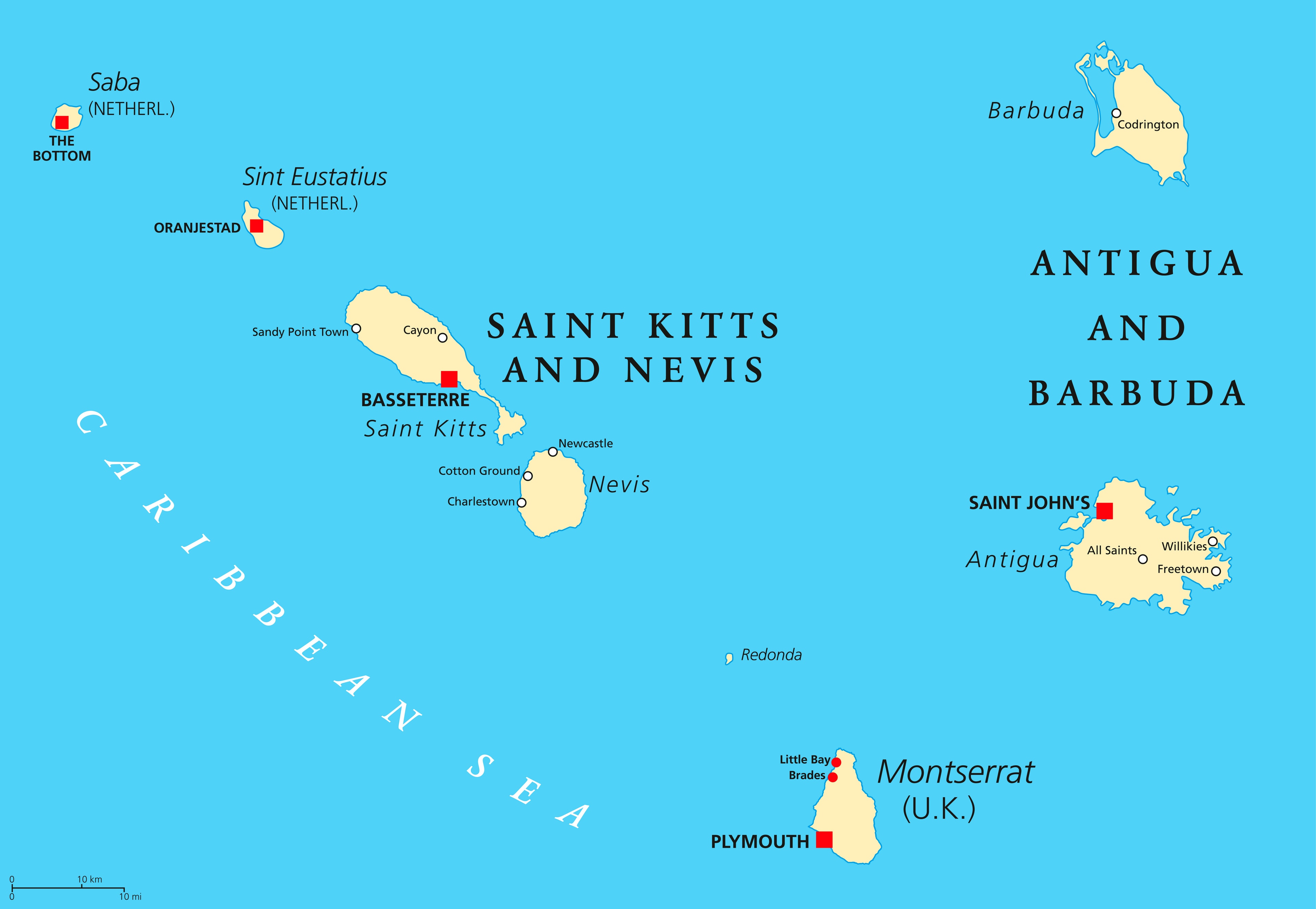
Map of St Kitts and Nevis
Climate
Humid and hot, with winds constantly blowing from the southeast. It is sunny all year round and the average temperature remains +25…32°C. The period of intermittent rains lasts from May to November, and hurricanes occur from August to October.
Saint Kitts and Nevis combines tropical nature, beautiful beaches, and respectability. The capital, Basseterre, is the centre of business, culture, and fashion. Many Hollywood stars visit to relax and shop.
Jagged mountains overgrown with tropical forests, coconut groves, sandy beaches with coral reefs, pink salt lakes and blooming orchids along the river banks abound in St Kitts and Nevis. There are several extinct volcanoes in the country. A lake has formed in the crater of the highest volcano, Llamiuga.
Sightseeing
Equestrian tournaments and a salsa and jazz music carnival are held annually in June in St Kitts. At the end of December, tourists arrive to take part in the most spectacular show, a carnival with colorful costumes and dances.
In the village of Challengers, an ancient rock painting of the Caribbean Indians has been preserved. The country has monuments of architecture from the Victorian era. Brimstone Hill Fortress National Park is a UNESCO World Heritage Site.
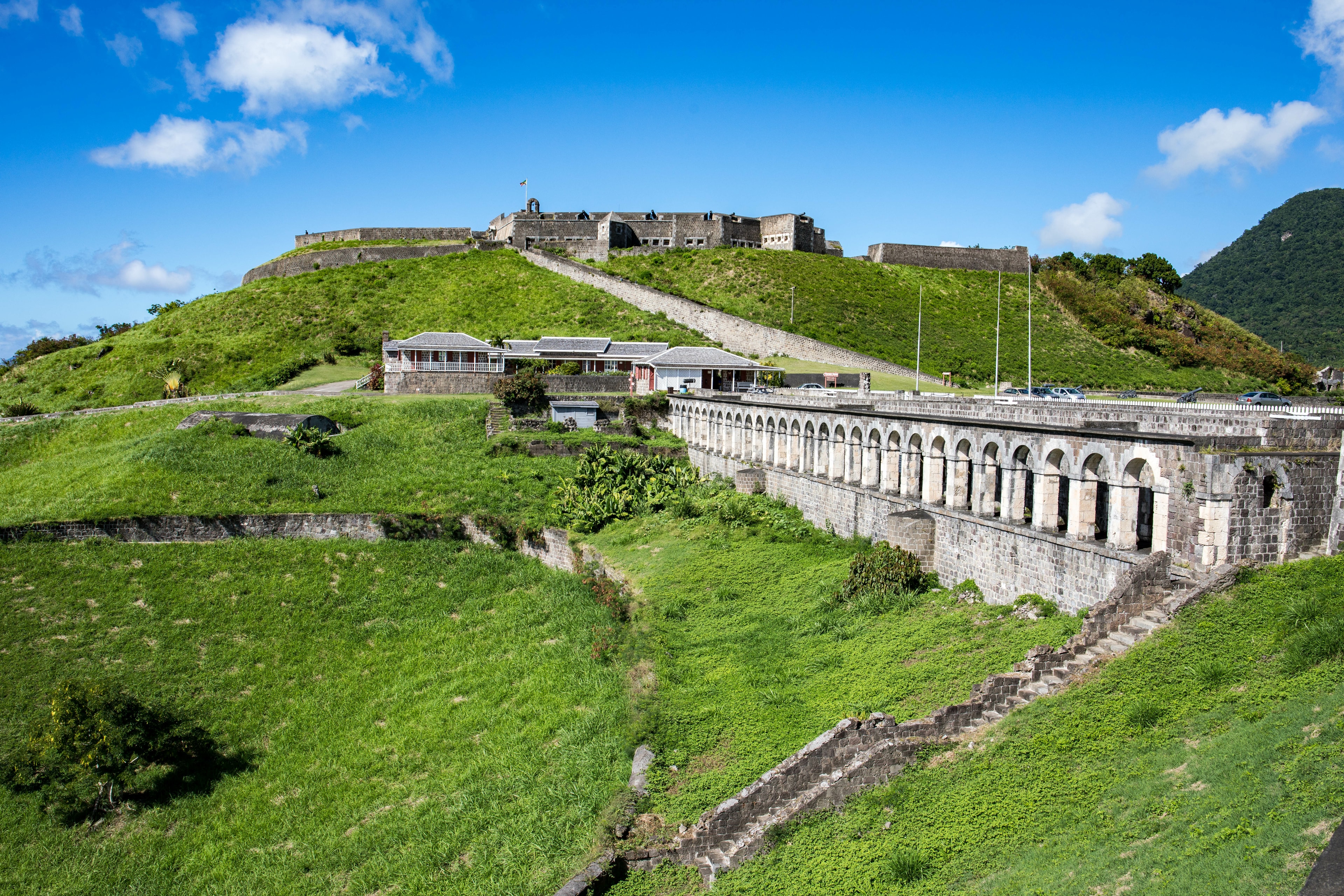
Brimstone Hill Fortress National Park, located on the St Kitts built in the 17th and 18th centuries under British colonial rule
Saint Kitts and Nevis was a British colony until 1983. The country’s legal system is based on English law. The country is part of the British Commonwealth, and its formal ruler is the British Queen.
English is the language of communication in the country. The locals speak English making it easy for foreigners to communicate and resolve issues that arise in everyday life.
Economy
The main currency is the East Caribbean dollar. 1 US dollar is equivalent to 2.7 East Caribbean dollars. The country’s economy is based on tourism and agriculture. There are many luxurious hotels and a developed tourist infrastructure. On the islands, sugar cane, coffee, and cotton are primarily grown.
Transport
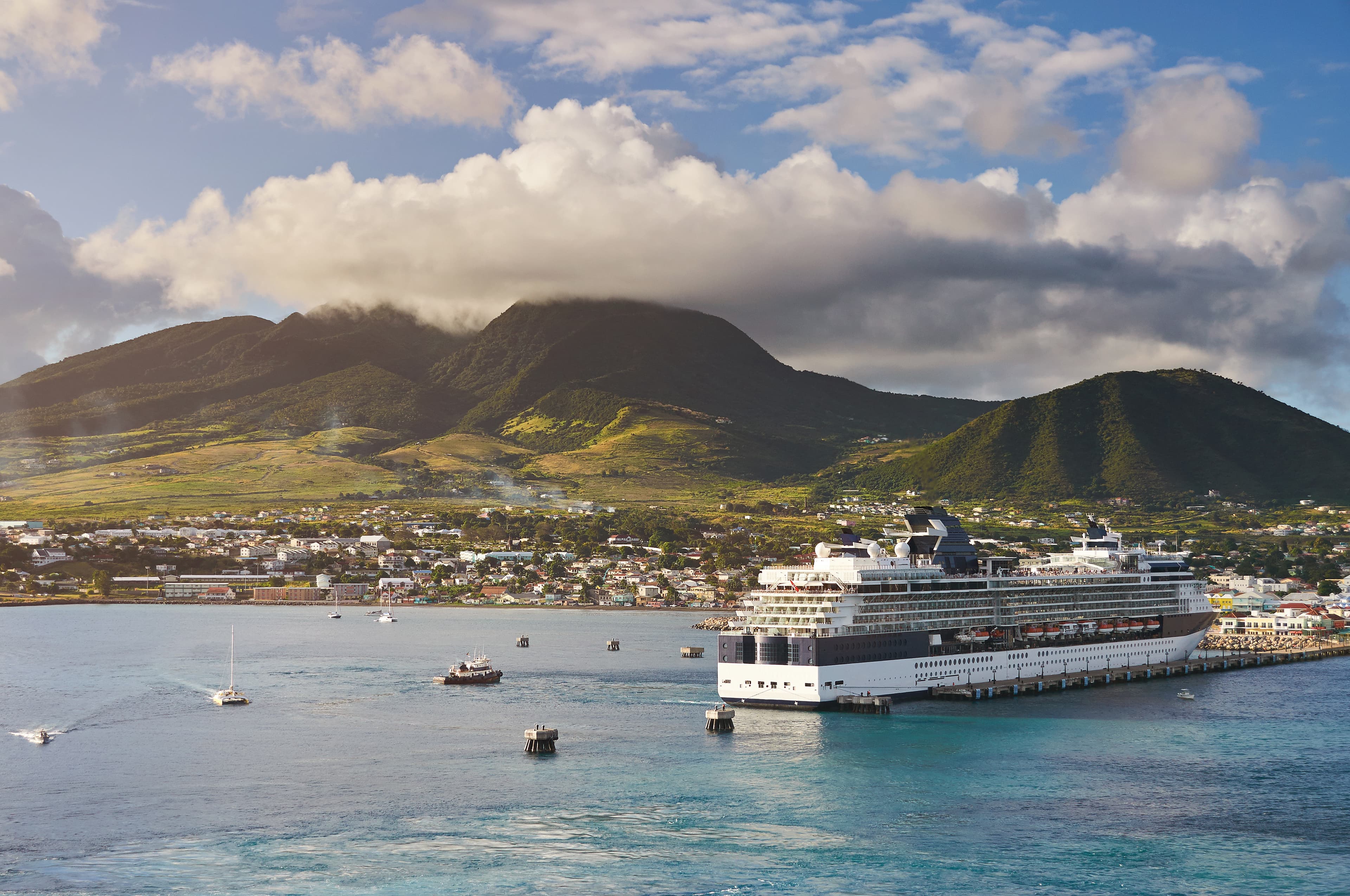
The country has two international airports: Robert Bradshaw is located in St Kitts and Vance Amory, on the island of Nevis. Each island has modern ports that accept the largest cruise ships.
Public transport: minibuses, taxis and ferries. Travelling in a minibus costs $3 per 10 miles and in a taxi, $1 per mile. Ferries transport people and cars between the islands in 45 minutes. The fare is $25.
A narrow-gauge railway runs along the perimeter of the island of St Kitts, along which excursions are carried out in double-decker carriages. They last for four hours. The well-informed guides point out the sights of interest on the island and answer any questions that are raised.
Yachting
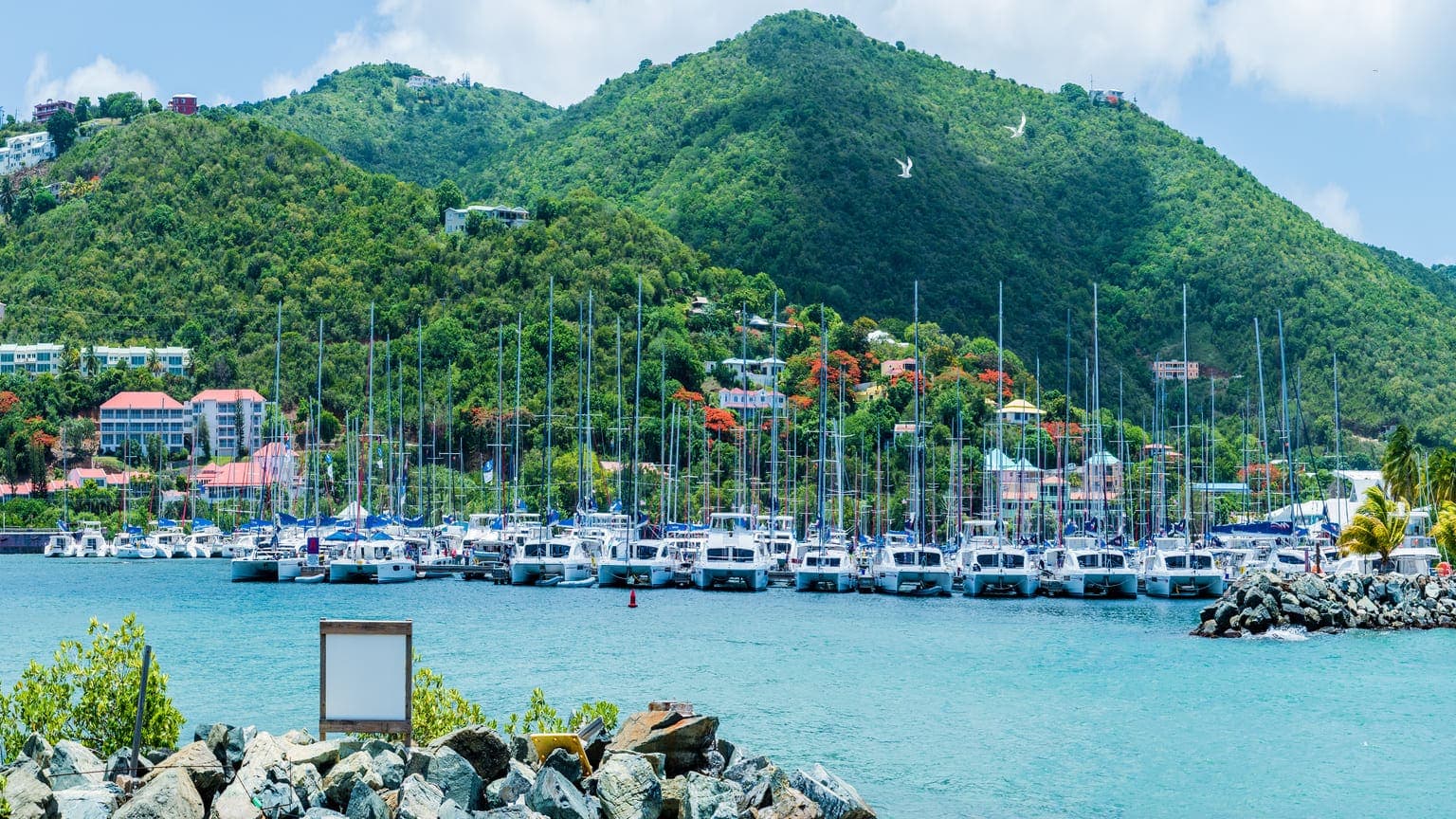
Christophe Harbor is home to the largest and most modern port in the Caribbean. There are berths for 300 ships and 60 berths for large yachts.
There is a customs office in Christophe Harbor. All amenities are equipped for yachtsmen: showers, cafes, shops, and beaches. The prices for goods do not include duties. Spare parts and fuel for yachts are cheaper here than in European ports.
Only St Kitts and Nevis citizens can register a yacht under the country’s flag. The yacht is registered in one day, while the owners remain anonymous.
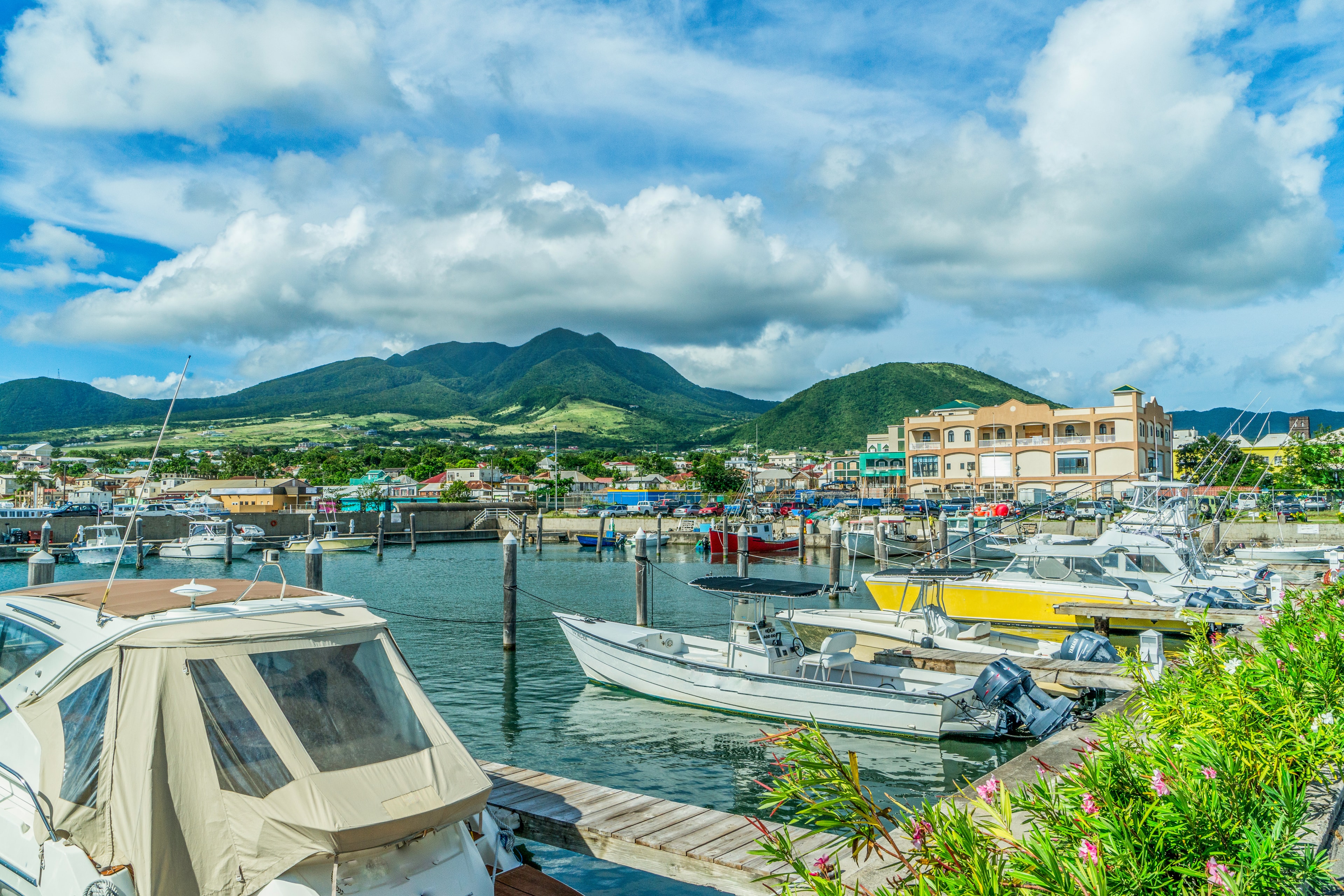
Marina at Basseterre, capital of Saint Kitts and Nevis
Dual citizenship benefits
St Kitts and Nevis allows for dual citizenship. It means that individuals who obtain St Kitts and Nevis passport through the Citizenship by Investment program or any other means can retain their original citizenship while holding citizenship of St Kitts and Nevis simultaneously.
Dual citizenship offers several advantages, including:
- Increased travel opportunities. With dual citizenship, individuals can benefit from visa-free or visa-on-arrival access to a broader range of countries, as they can choose to travel on either passport, depending on their destination.
- Access to services. Dual citizens have access to the rights and privileges afforded to citizens of both countries, including healthcare, education, and social welfare services.
- Business and investment opportunities. Holding citizenship of St Kitts and Nevis and another country can give individuals access to diverse business and investment opportunities in both jurisdictions.
- Cultural and personal connections. Dual citizenship allows individuals to maintain strong ties to their country of origin while forging connections and contributing to the community in St Kitts and Nevis.

Freedom of movement for a blogger
An investor from South Africa, together with his wife, teenage daughter and elderly father, turned to Immigrant Invest seeking a second citizenship to overcome visa restrictions and travel delays impacting his global media work.
The family chose the St Kitts and Nevis Citizenship. The investor proceeded via the non-refundable contribution route plus Due Diligence fees. From initial contact to obtaining passports took about 4.5 months.
Following approval, the main applicant achieved visa-free travel to over 150 countries, his spouse expanded business operations globally, and his daughter accessed European universities with flexibility.
How does St Kitts and Nevis citizenship compare with other Caribbean programs?
Several Caribbean countries offer citizenship by investment programs, and St Kitts and Nevis is one of five such jurisdictions in the region. The others are Antigua and Barbuda, Dominica, Grenada, and St Lucia.
Caribbean citizenship programs share common features, yet each of them offers different advantages depending on an investor’s goals, family profile, and preferred investment route.
St Kitts and Nevis stands out as the longest-running programe in the region, known for its strong Due Diligence standards and clearly structured application process. Investors often choose it for predictable timelines and a well-established regulatory framework.
Other Caribbean countries provide competitive alternatives. Antigua and Barbuda offers a lower contribution threshold for families, while Grenada is the only Caribbean country with access to the US E‑2 treaty visa through separate procedures.
Dominica and St Lucia remain attractive due to their accessible investment levels and straightforward application requirements. Comparing these programs helps applicants determine which route aligns best with their long-term plans, family needs, and investment strategy.
Comparison of Caribbean citizenship programs
Key takeaways about SKN citizenship by investment
- St Kitts and Nevis’ citizenship by investment program offers individuals and families an efficient and flexible pathway to citizenship.
- The program, designed to attract foreign investment and promote economic development, provides three options with varying minimum investment requirements — $250,000 to 600,000.
- The process typically concludes within 6+ months, and applicants can benefit from remote application procedures without residency requirements.
- To navigate the application process successfully, applicants must meet Due Diligence requirements, submit required documentation, and cover associated government and Due Diligence fees. Applications are accepted from licensed agents only.
- St Kitts and Nevis citizenship provides visa-free or visa-on-arrival access to 150+ countries tax advantages, dual citizenship, and transferable citizenship to dependents.
Immigrant Invest is a licensed agent for citizenship and residence by investment programs in the EU, the Caribbean, Asia, and the Middle East. Take advantage of our global 15-year expertise — schedule a meeting with our investment programs experts.
 Trusted by 10,000+ investors