










Personal income tax in Türkiye is progressive, with rates from 15% to 40%. Individuals can claim deductions if they meet the conditions set by law.
Türkiye has 19 free zones in operation. Registering a company in a free zone does not by itself exempt it from corporate income tax, but the relief can cover certain activities, such as some types of manufacturing and services provided entirely abroad.
The standard VAT rate in Türkiye is 20%. Reduced rates of 10% and 1% apply to specific goods and services.
Who pays Turkish taxes?
Tax residence is a key factor in determining tax liability in Türkiye. Tax-resident individuals are generally taxed on their worldwide income, while non-residents are generally taxed only on income derived from sources in Türkiye.
Individuals
An individual is a tax resident of Türkiye if their domicile is in the country or if they stay there continuously for more than 6 months in a calendar year. Such individuals pay income tax on their worldwide income. Everyone else pays it only on income from Turkish sources.
Staying in Türkiye for more than 6 months is possible with a residence permit or citizenship, for example, obtained by investment.
Some foreigners keep non-resident status even after more than 6 months in Türkiye. This applies to people who come for a specific temporary assignment or job. It also covers those who stay to study, receive medical treatment, rest or travel[1]Source: GIB — Individual tax residence rules and exceptions.
Companies
A company has full corporate tax liability in Türkiye if its legal centre or its business centre is in the country[2]Source: GIB — Corporate tax residency definitions:
- legal centre is the address stated in the company's articles of association;
- business centre is the place where the company actually concentrates and manages its business.
If both centres are outside Türkiye, the company has limited tax liability and pays corporate tax only on income earned in Türkiye[3]Source: GIB — Limited corporate tax liability.
Trusted by 10,000+ investors
Sort out your tax obligations before it becomes a problem
Taxes for individuals
Türkiye has no annual tax on an individual's total net wealth. Individuals pay personal income tax, including tax on dividends and interest, as well as inheritance and gift tax. Employees also pay social-security and unemployment-insurance contributions.
Personal income tax
Personal income tax, PIT, is regulated by Income Tax Law No. 193[4]Source: LEXPERA — Income Tax Law No. 193 — consolidated text.
The law divides taxable income into seven categories:
- Wages and salaries — cash, benefits in kind and other benefits with a monetary value that an employee receives for work done for an employer. This includes salary, bonuses, allowances, premiums and compensation. Some retirement, disability, widow's and orphan's pensions also count as wages, though exemptions may apply[5]Source: GIB — 2026 Wage Income Tax Guide.
- Self-employment earnings — income from professional services performed independently, where personal expertise matters more than capital. Examples are freelance writers, lawyers, accountants, doctors, architects, and consultants.
- Income from immovable property and rights — rent from buildings, land, permanent rights over real estate, mines and quarries. The category also covers income from leasing certain movable assets and rights: ships, boats and aircraft; machinery and equipment; intellectual property such as patents, copyrights, trade marks, trade names, designs, models, plans, films and recordings; know-how, secret formulas, and production methods.
- Income from movable capital — dividends, interest and similar income from cash capital and other money-based assets, provided it does not come from the taxpayer's commercial, agricultural or professional activity. Examples are share dividends, certain profit shares, bank deposit interest, and bond interest[6]Source: GIB — 2026 Movable Capital Income Tax Guide.
- Commercial earnings — income from any commercial or industrial activity, such as trade in goods and services, manufacturing, transport, running shops, restaurants, private schools or hospitals, mining and quarrying, and regularly buying, selling or building real estate. A non-resident pays Turkish tax on this income only if it is earned through a permanent establishment or permanent representative in Türkiye[7]Source: GIB — 2026 Commercial Earnings Tax Guide.
- Agricultural earnings — income from farming on land, at sea or in lakes and rivers: growing crops, planting, livestock breeding, fishing and similar work.
- Other earnings and revenues — mainly capital gains and incidental earnings. Examples: gains from selling certain assets and rights; one-off commercial deals, intermediary services or professional services; payments for ending a commercial, agricultural or professional activity; payments for not bidding in tenders; payments for transferring a lease or vacating rented property; certain income received after a business closes[8]Source: GIB — Other earnings and revenues FAQ.
PIT rates are progressive. The brackets are as follows:
- 15% on the annual income of up to TRY 190,000;
- 20% — on TRY 190,000—400,000;
- 27% — on TRY 400,000—1,000,000;
- 35% — on TRY 1,000,000—5,300,000;
- 40% — on an income over TRY 5,300,000.
For wages, the 27% bracket extends to TRY 1,500,000, and the 35% rate applies only above that amount[9]Source: GIB — 2026 income tax rates for employment income.
Social-security contributions
Social-security contributions are calculated on an employee's earnings, but only within a minimum and maximum base. In 2026, the base for standard private-sector employees is TRY 33,030—297,270 per month, or TRY 1,101—9,909 per day[10]Source: SGK — 2026 contribution bases.
Contribution rates for standard employees are the following:
- 14% — social security;
- 1% — unemployment insurance.
The state adds another 1% to unemployment insurance. In qualifying cases, employer incentives reduce the employer's share[11]Source: SGK — Employer and employee contribution rates.
A foreign employee sent to Türkiye temporarily by an overseas employer can stay outside the Turkish social-security system for up to 3 months. To qualify, the employee must meet the statutory conditions and document foreign insurance coverage[12]Source: SGK — Social security rules for foreign employees. If Türkiye has a bilateral social-security agreement with the employee's country, the agreement sets the exemption period and conditions[13]Source: SGK — Türkiye’s bilateral social security agreements.
Tax on dividends
Dividend income distributed by a Turkish resident company is generally subject to 15% withholding. For qualifying dividends received by individuals, 50% of the gross dividend is exempt from personal income tax.
For income earned in 2026, the remaining taxable amount generally becomes subject to annual declaration when the applicable TRY 400,000 declaration threshold is exceeded. Tax withheld when the dividend is distributed may generally be credited against the income tax calculated in the annual return[14]Source: GIB — Dividend taxation and declaration thresholds.
Capital gains tax
Interest and capital gains on securities in Türkiye are taxed under one of two regimes. The first is the special withholding regime of Temporary Article 67 of Income Tax Law No. 193[4]Source: LEXPERA — Income Tax Law No. 193 — consolidated text. The second is the general rules of the same law.
Temporary Article 67 covers income from securities and other capital-market instruments received through banks and brokerage houses in Türkiye. The bank or broker withholds the tax. For individuals, this is the final tax, and they do not declare this income in a tax return.
The rate depends on the instrument, and sometimes on the date it was bought or issued:
- shares — gains on shares listed on Borsa Istanbul and acquired on or after January 1st, 2006 are taxed at 0% for resident and non-resident individuals;
- government bonds and Treasury bills — the standard rate is 10% for bonds and bills issued on or after January 1st, 2006. A temporary 0% rate applied to bonds and bills acquired between December 22nd, 2021 and June 30th, 2026;
- equity derivatives and warrants — futures and options on shares or share indices, as well as certain share warrants, are taxed at 0%;
- investment funds — the rate depends on the type of fund and the date the units were bought. Funds that invest mainly in shares can qualify for 0%, and other funds are taxed at higher rates.
Income outside Temporary Article 67 is taxed under the general rules and declared in the annual tax return. This includes, for example, interest and gains on government bonds and Treasury bills issued before January 1st, 2006.
Inheritance and gift taxes
Inheritance and gift tax is progressive. Inheritance is taxed at 1 to 10%, while gifts and other gratuitous transfers are taxed at 10 to 30%.
Exemptions and special rules may reduce the amount due. Prizes from competitions, lotteries and games of chance are taxed through withholding under separate rules.
The tax is paid in six equal instalments over 3 years, each May and November[15]Source: GIB — 2026 inheritance and gift tax.

Tax deductions for individuals
Individuals in Türkiye can reduce their taxable income through deductions, each with its own conditions and limits.
Employees deduct certain items from their wages before tax is calculated, such as their social-security contributions. Taxpayers who file an annual return can also deduct insurance premiums, education and healthcare expenses, sponsorship spending, and donations:
- up to 15% of declared income, but no more than the annual gross minimum wage of TRY 396,360 — total insurance deduction[16]Source: GIB — Wage income and deductions;
- up to 10% of declared income — education and healthcare expenses;
- up to 5% of declared income, or 10% in priority development regions — donations and charitable contributions;
- 100% — donations and spending on culture and tourism;
- 100% — donations for schools, healthcare facilities, student dormitories, childcare centres, and some other public facilities;
- 100% — donations to Presidential aid campaigns;
- 100% — cash donations to the Turkish Red Crescent and Turkish Green Crescent;
- 50% — professional sports sponsorship;
- 100% — amateur sports sponsorship[17]Source: GIB — 2026 guidance on deductible donations, insurance and education/health expenses;
- 50% deduction — life insurance premiums[18]Source: GIB — 2026 guide to life and personal insurance premium deductions;
- 100% — death, accident, sickness, health, disability, maternity, birth, and education insurance premiums.
20-year tax holiday for new residents
Türkiye gives tax benefits to three groups: foreigners who move to Türkiye, companies, and owners of assets held abroad[19]Source: Law on tax benefits, Resmî Gazete.
A foreign national can use the tax holiday if they:
- were not a Turkish tax resident in the previous 3 years;
- have moved to Türkiye and become a tax resident.
Income received in Türkiye before the move does not affect eligibility.
What is exempt for individuals
For 20 years, a new resident pays no Turkish income tax on foreign-source income: dividends, business profits, investment returns, and earnings from assets abroad. None of it has to be included in the annual return.
Turkish-source income is still taxed at progressive rates from 15 to 40%. Two restrictions apply: expenses related to foreign income cannot be deducted from it, and tax paid abroad cannot be credited against Turkish tax.
During the holiday, inheritance and gift tax is charged at a flat 1% instead of the standard rates of 1 to 30%.
Foreign asset amnesty
Until July 31st, 2027, taxpayers can declare money, gold, foreign currency, and securities held outside Türkiye through Turkish banks and brokerage firms. The assets must then be transferred to Türkiye within 2 months.
The longer the assets stay in Turkish financial instruments, the lower the tax:
- less than a year — 5%;
- 1 year — 4%;
- 2 years — 3%;
- 3 years — 2%;
- 4 years — 1%;
- 5 years — 0%.

Business tax rates in Türkiye
The main taxes for companies in Türkiye are corporate income tax and value-added tax, VAT. Depending on the business, a company may also pay banking and insurance transactions tax, digital services tax, special consumption tax, and employer social-security and unemployment-insurance contributions.
Corporate tax
The corporate income tax applies to:
- capital companies, such as joint-stock and limited liability companies, and their foreign equivalents;
- cooperatives;
- public economic enterprises;
- businesses owned by associations or foundations;
- business partnerships.
The standard rate is 25%. Banks and other financial institutions, as well as some companies in public-private partnership projects, pay 30%[20]Source: GIB — Corporate tax rate under Article 32.
Value-added tax
Value-added tax, VAT, applies to goods and services supplied in Türkiye and to imports. Exports of goods and some export-related services are exempt.
The standard rate is 20%. Reduced rates apply to the following goods and services:
- 10% — clothing and textiles, pharmaceuticals and medical products, healthcare, education and accommodation services, restaurants and catering, some cultural and entertainment services;
- 1% — basic foods, agricultural products and certified seeds, some sales of residential property, financial leasing of machinery and equipment under investment incentive certificates.
The exact rate depends on how the goods or services are classified in the VAT lists and whether the conditions of these lists are met[21]Source: GIB — Current VAT rates: 20%, 10% and 1%.
Other taxes for companies
Banking and insurance transactions tax applies to transactions of banks and insurance companies that fall outside VAT. The general rate is 5%, with special rates and exemptions for some transactions. The tax is charged on the amount a bank or insurer earns from the transaction[22]Source: GIB — Banking and Insurance Transactions Tax.
Digital services tax applies at 5% to digital content, digital advertising, and some intermediary platform services[23]Source: GIB — 2026 Digital Services Tax rate reduction to 5%.
Special consumption tax is charged only once in the supply chain, on goods from four lists in the law:
- petroleum products, natural gas, lubricating oil, solvents, and derivatives of solvent;
- land, air and sea vehicles;
- alcoholic beverages and cola soda pops, cigarettes and other tobacco products;
- luxury products, such as caviar, furs, mobile phones, etc.
The tax amount is defined by the kilogram, litre, cubic metre, or other goods’ units.
Social-security and unemployment-insurance contributions for standard employees that the employer pays:
- 21.75% — social security;
- 2% — unemployment insurance.
Tax benefits for businesses in Türkiye
Turkish companies may benefit from reduced corporate tax rates for manufacturers and exporters and special regimes applicable to free zones.
Corporate tax benefits
Türkiye cuts the corporate tax rate from 25% to:
- 12.5% for manufacturers;
- 9% for manufacturing exporters;
- 11% for other exporters.
Companies in the Istanbul Finance Centre pay no corporate tax on transit trade income and, until 2047, on income from exporting financial services[24]Source: Resmî Gazete — Law on the special Istanbul financial centre.
Free zones
Türkiye has 19 free zones in operation[25]Source: Ministry of Trade — 19 operating free zones in Türkiye. They offer customs, tax, and administrative benefits designed mainly to attract export-oriented production, trade and investment.
Registering in a free zone does not by itself exempt a company from income or corporate tax. The benefits a company receives depend on its activity, its licence, and the conditions set by law.
The main benefits in free zones:
- income and corporate tax — exemptions cover specific activities. For example, a manufacturer with a production licence pays no tax on income from selling goods made in the free zone, whether the goods are sold abroad, within the same zone or to other Turkish free zones;
- stamp duty and fees — transactions and documents related to free-zone activity are exempt from stamp duty and some fees;
- real estate tax — free-zone rules provide an exemption from real estate tax;
- VAT — services performed in free zones are exempt, as are some export-related supplies and freight services[26]Source: GIB — VAT treatment of services and freight involving free zones;
- customs duties — goods entering, stored in or leaving a free zone may benefit from customs advantages[27]Source: Ministry of Trade — Tax and other advantages of free zones.
To work in a Turkish free zone, an individual or a company needs an Activity Licence (Faaliyet Ruhsatı) from the General Directorate of Free Zones at the Ministry of Trade[28]Source: Ministry of Trade — Activity Licence application procedure. Depending on the zone, the licence can cover manufacturing, trade, storage, logistics, assembly and packaging, software development, and other services.
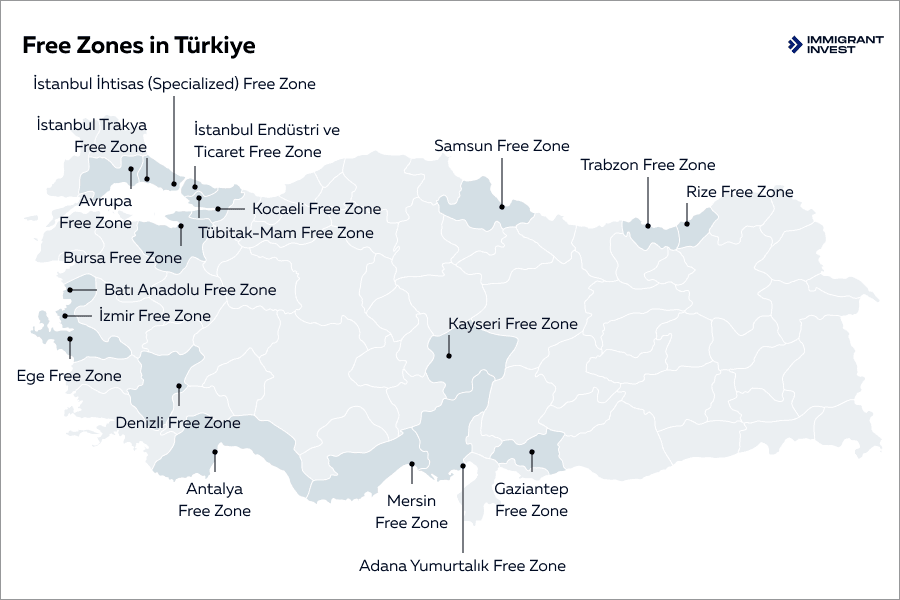
The free zones are located near major Turkish ports along the Black, Aegean and Mediterranean Seas. This location provides quick access to major international trade[25]Source: Ministry of Trade — 19 operating free zones in Türkiye
Property taxes in Türkiye
Buyers, owners, landlords, and sellers of real estate in Türkiye pay different taxes and fees. Each has its own tax base: for some it is the sale price, for others the property's tax value.
Buying real estate
A buyer pays the title deed transfer charge and the Land Registry service fee. Depending on the transaction, VAT and stamp duty may also apply.
Title deed transfer charge is 4% of the sale price, split equally: 2% paid by the buyer and 2% by the seller. The sale price declared for the charge cannot be lower than the property's tax value.
VAT applies mainly to purchases from developers. The rate depends on the type of property, the date of the building permit and the project.
For housing with a building permit issued after April 1st, 2022:
- 10% applies to the part of the home up to 150 m² net;
- 20% applies to the part above 150 m²;
- 1% applies in some cases, such as urban transformation projects and some transactions under transitional rules.
For older building permits, transitional rules apply, and the rate may depend on the municipality, the construction class, and the land value.
Commercial property is taxed at the standard rate of 20%[29]Source: GIB — Current VAT rates and transitional residential-property rules.
VAT exemption for foreign buyers. Foreigners and Turkish citizens living abroad do not pay VAT on the first sale of a home or workplace if they pay in foreign currency brought into Türkiye. At least 50% of the price must be transferred before the invoice is issued, and the rest within the period set by law.
The buyer must keep the property for at least 3 years. If it is sold earlier, the buyer pays the VAT with interest[30]Source: GIB — 2026 VAT General Application Communiqué — residential VAT and foreign-buyer exemption.
Stamp duty. Transferring ownership at the Land Registry is not subject to stamp duty, but separate written agreements may be.
The general rate for contracts with a stated amount is 0.948%. Notarised promises to sell real estate and some prepaid housing sale agreements are taxed at 0%[31]Source: GIB — Stamp duty rates.
Döner Sermaye fee. The Land Registry and Cadastre Directorate charges this service fee under its annual tariff.
Owning real estate
The annual property tax rate depends on the type of property and whether it is within the boundaries of a metropolitan municipality[32]Source: GIB — Property tax rates.
Türkiye has 30 metropolitan municipalities, including Istanbul, Ankara, Izmir, Antalya, and Muğla. Each one covers the whole province, so resort towns such as Alanya and Bodrum are also taxed at the higher rates[33]Source: Mevzuat — Metropolitan municipality law No. 5216.
Annual property tax rates in Türkiye

Tax on rental income. Individuals pay no tax on residential rental income up to TRY 58,000 a year.
For commercial rental income, the declaration threshold depends on whether tax was withheld:
- TRY 400,000 of gross rent if tax was withheld at source;
- TRY 22,000 if tax was not withheld and the income is not exempt.
Income above the exemption and deductions is taxed at progressive rates of 15 to 40%. A company includes rental income in its taxable income and pays corporate tax at 25%[34]Source: GIB — 2026 rental-income thresholds.
Valuable residence tax. Owners of housing with a tax value above TRY 17,711,000 pay an annual tax at progressive rates:
- 0.3% on the part of the value between TRY 17,711,000 and TRY 26,567,000;
- 0.6% on TRY 26,567,000—35,425,000;
- 1% on the part above TRY 35,425,000.
Each rate applies only to the part of the value within its band, not to the whole value[35]Source: GIB — 2026 valuable residence tax thresholds and rates.
Selling real estate
An individual who sells a property within 5 years of buying it pays income tax on the gain. The gain is calculated as follows: sale price − indexed purchase price − sale expenses and taxes.
The purchase price is indexed using the domestic producer price index (Yİ-ÜFE) if the index has risen by at least 10% over the ownership period.
The first TRY 150,000 of the gain is tax-free. The rest is taxed at progressive rates of 15 to 40%. A company includes the gain in its taxable income and pays corporate tax at 25%.
Examples of properties in Türkiye


Turkey, Istanbul
$420,000+
Elegant apartments, Beylikduzu, Istanbul
 177 m²
 3
3  1
1 
Turkey, Istanbul
$475,000+
Elegant and stylish apartments, Istanbul
149 m²3 2 
Turkey, Istanbul
$455,000+
Cosy apartments, Zeytinburnu, Istanbul
53 m²2 3 How to file taxes in Türkiye
Most steps can be completed online through the Digital Tax Office (Dijital Vergi Dairesi) of the Turkish Revenue Administration.
The tax year is the calendar year, from January 1st to December 31st. With approval, a company can use a special accounting period.
Register with the Turkish tax authorities
A foreigner applies for a potential tax number through the Digital Tax Office. The application requires a passport, contact details and an address.
Individuals running a business or practising a profession, as well as companies, also register for the taxes that apply to their activity. This includes non-resident companies operating through a permanent establishment or permanent representative in Türkiye[36]Source: GIB — Digital Tax Office — potential tax identification number for foreigners.
A foreigner applies for a potential tax number through the Digital Tax Office. The application requires a passport, contact details and an address.
Individuals running a business or practising a profession, as well as companies, also register for the taxes that apply to their activity. This includes non-resident companies operating through a permanent establishment or permanent representative in Türkiye[36]Source: GIB — Digital Tax Office — potential tax identification number for foreigners.
Pay provisional tax during the year
Individuals with commercial or self-employment income pay provisional income tax at 15% of their provisional taxable income. Companies pay provisional corporate tax, usually at the standard 25%[37]Source: GIB — 2026 provisional tax rates.
Provisional tax is an advance payment on the annual tax. It is declared and paid three times a year, and each time the calculation starts from January 1st:
- by 17 May, the taxpayer declares income for January to March and pays tax on it;
- by 17 August, the taxpayer declares income for January to June. The tax is calculated on the full 6 months, and the amount paid in May is deducted, so only the difference is due;
- by 17 November, the taxpayer declares income for January to September. The tax is calculated on the full 9 months, and the amounts paid in May and August are deducted.
Income for October to December is not covered by provisional tax. It is included in the annual return, where all provisional tax paid during the year is credited against the final tax.
Employees skip this step: their employer withholds income tax from their salary through the payroll system.
Individuals with commercial or self-employment income pay provisional income tax at 15% of their provisional taxable income. Companies pay provisional corporate tax, usually at the standard 25%[37]Source: GIB — 2026 provisional tax rates.
Provisional tax is an advance payment on the annual tax. It is declared and paid three times a year, and each time the calculation starts from January 1st:
- by 17 May, the taxpayer declares income for January to March and pays tax on it;
- by 17 August, the taxpayer declares income for January to June. The tax is calculated on the full 6 months, and the amount paid in May is deducted, so only the difference is due;
- by 17 November, the taxpayer declares income for January to September. The tax is calculated on the full 9 months, and the amounts paid in May and August are deducted.
Income for October to December is not covered by provisional tax. It is included in the annual return, where all provisional tax paid during the year is credited against the final tax.
Employees skip this step: their employer withholds income tax from their salary through the payroll system.
File the annual return
Provisional tax paid during the year is credited against the tax due in the return.
Individuals file between March 1st and 31st of the following year. Whether an employee must file depends on the amount and sources of their income[38]Source: GIB — Annual personal income-tax filing and payment dates.
Companies using the calendar year file between April 1st and 30th of the following year. Companies with a special accounting period file by the last day of the 4th month after the period ends.
Provisional tax paid during the year is credited against the tax due in the return.
Individuals file between March 1st and 31st of the following year. Whether an employee must file depends on the amount and sources of their income[38]Source: GIB — Annual personal income-tax filing and payment dates.
Companies using the calendar year file between April 1st and 30th of the following year. Companies with a special accounting period file by the last day of the 4th month after the period ends.
Pay the tax
Individuals pay in two equal instalments: by March 31st and by July 31st. An individual who must file a return because they are leaving Türkiye files it and pays the tax within the 15 days before departure.
Companies pay by the filing deadline for the annual return.
Individuals pay in two equal instalments: by March 31st and by July 31st. An individual who must file a return because they are leaving Türkiye files it and pays the tax within the 15 days before departure.
Companies pay by the filing deadline for the annual return.
How to avoid double taxation and not pay taxes in two countries
Türkiye has 93 double taxation agreements in force[39]Source: GIB — DTTs in force. These agreements prevent the same income from being taxed twice in different countries.
A treaty may still allow both Türkiye and the other country to tax certain types of income. In that case, double taxation is relieved in one of the following ways:
- country of residence credits tax paid in the other country, including tax withheld at source;
- one of the countries exempts the income from tax;
- another method set out in the treaty applies.
Treaties also cap the withholding tax that the country where the income arises can charge on dividends, interest, and royalties.
Which relief applies depends on the specific treaty, the taxpayer's residence status and the type of income.
Countries with double tax treaties with Türkiye
- Albania
- Algeria
- Argentina
- Australia
- Austria
- Azerbaijan
- Bahrain
- Bangladesh
- Belarus
- Belgium
- Bosnia and Herzegovina
- Brazil
- Bulgaria
- Cambodia
- Canada
- Chad
- China
- Croatia
- Czech Republic
- Denmark
- Egypt
- Estonia
- Ethiopia
- Finland
- France
- Gambia
- Georgia
- Germany
- Greece
- Hungary
- India
- Indonesia
- Iran
- Ireland
- Israel
- Italy
- Japan
- Jordan
- Kazakhstan
- Kosovo
- Kuwait
- Kyrgyzstan
- Latvia
- Lebanon
- Lithuania
- Luxembourg
- Malaysia
- Malta
- Mexico
- Moldova
- Mongolia
- Montenegro
- Morocco
- Netherlands
- New Zealand
- North Macedonia
- Norway
- Oman
- Pakistan
- Philippines
- Poland
- Portugal
- Qatar
- Romania
- Russia
- Rwanda
- Saudi Arabia
- Serbia
- Sierra Leone
- Singapore
- Slovakia
- Slovenia
- South Africa
- South Korea
- Spain
- Sri Lanka
- Sudan
- Sweden
- Switzerland
- Syria
- Tajikistan
- Thailand
- Tunisia
- Turkish Republic of Northern Cyprus
- Turkmenistan
- Ukraine
- United Arab Emirates
- United Kingdom
- United States
- Uzbekistan
- Venezuela
- Vietnam
- Yemen
How to live in Türkiye legally to become a country’s taxpayer
A foreigner can usually stay in Türkiye on a visa or visa exemption for up to 90 days within any 180-day period. The exact rules depend on nationality and the type of visa.
To stay longer, a foreigner needs a residence permit or another legal basis, such as a work permit, long-term residence status or Turkish citizenship. However, none of these makes a person a Turkish tax resident automatically. Tax residence depends on domicile or on staying in Türkiye continuously for more than 6 months in a calendar year.
A foreign national can apply for Turkish citizenship by investment in:
- real estate — property worth at least $400,000 that can be sold after 3 years;
- fixed company capital investment — at least $500,000;
- bank deposit — at least $500,000, kept in a bank in Türkiye for 3 years;
- government bonds — at least $500,000, held for 3 years;
- funds — at least $500,000 in units of real estate or venture capital funds, held for 3 years.
The applicant's spouse and children under 18 can obtain citizenship in the same procedure.
The process of obtaining citizenship by investment takes 8+ months and does not require relocation either before or after becoming a citizen.
Key takeaways on taxes in Türkiye
- Tax residents pay tax on worldwide income, and non-residents pay only on Turkish-source income. A person becomes a tax resident by having a domicile in Türkiye or by staying more than 6 months in a calendar year.
- Personal income tax is progressive, 15 to 40%.
- Foreigners who become tax residents after 3 years of non-residence pay no Turkish tax on foreign-source income for 20 years. During that period, inheritance and gift tax is 1%.
- The standard corporate tax rate is 25%. Manufacturers and exporters pay 9 to 12.5%. A company in a free zone gets tax benefits only for certain activities.
- The standard VAT rate is 20%, with reduced rates of 10% and 1%.
- When buying property, the buyer and seller each pay a 2% title deed charge. Owners pay annual property tax of 0.1 to 0.6%. A foreign buyer can avoid VAT on a new property by paying in foreign currency and keeping the property for 3 years.
- Türkiye has double tax treaties with 93 countries.
- Turkish citizenship by investment starts from $400,000 in real estate or $500,000 in other options. The process takes 8+ months and does not require relocation.
Immigrant Invest is a licensed agent for citizenship and residence by investment programs in the EU, the Caribbean, Asia, and the Middle East. Take advantage of our global 15-year expertise — schedule a meeting with our investment programs experts.

 Trusted by 10,000+ investors