








The Eastern Caribbean Central Bank has described the current stage of the Caribbean citizenship by investment industry as a ‘make-or-break era.’
Avril Blanchett, Investment Migration Advisor at Immigrant Invest, commented on this assessment.
Growing economic dependence on CBI programmes
According to the Eastern Caribbean Central Bank, or ECCB, citizenship by investment funds have helped pay for major projects across the Caribbean. These include Dominica’s international airport, as well as tourism and hospitality projects in St Kitts and Nevis[1]Source: ECCU CBI make-or-break era, Eastern Caribbean Central Bank..
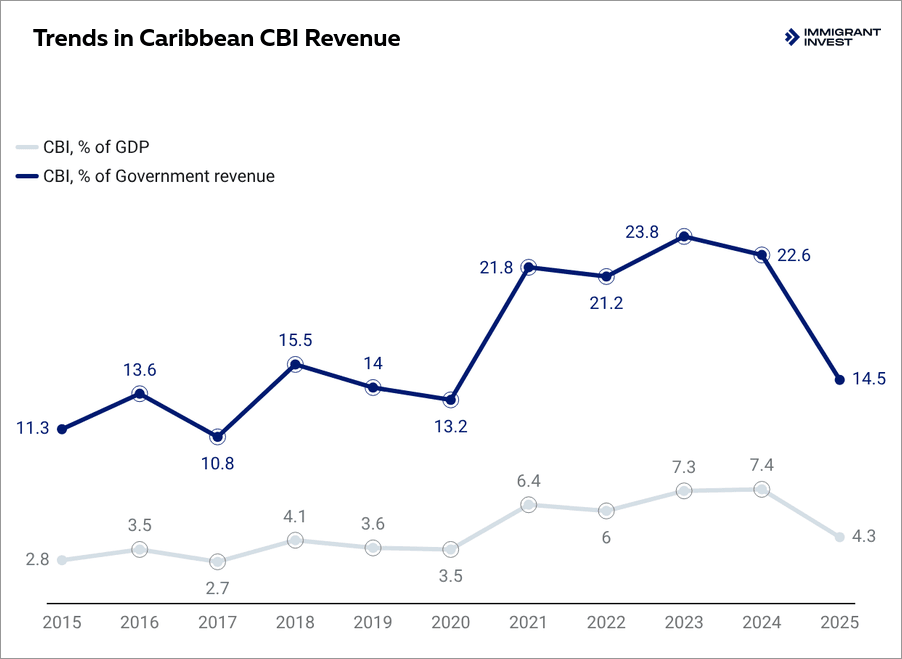
The ECCB estimates that in 2025:
- CBI receipts made up 4.3% of the ECCU’s GDP;
- revenues from citizenship by investment provided 14.5% of all government income;
- investment-funded projects helped create jobs in construction, tourism, hospitality and real estate.
These revenues became especially important during the COVID-19 pandemic, when tourism income fell sharply. For several governments, CBI money helped keep public services running.
Caribbean citizenship by investment remains one of the world’s largest investment migration markets. For Antigua and Barbuda, Dominica, Grenada, St Kitts and Nevis, and St Lucia, these programmes are not only a way to attract foreign investors. They are also an important source of money for development, especially when the economy is under pressure.
Regional regulator moves closer to launch
A central theme of the ECCB publication is the creation of a regional supervisory framework for Caribbean citizenship by investment programmes[1]Source: ECCU CBI make-or-break era, Eastern Caribbean Central Bank..
Antigua and Barbuda, Dominica, Grenada, St Kitts and Nevis, and St Lucia are currently working on establishing the Eastern Caribbean Citizenship by Investment Regulatory Authority, or ECCIRA. The future regulator is expected to:
- introduce common Due Diligence standards;
- supervise licensed agents and developers;
- reduce regulatory arbitrage between programmes;
- strengthen transparency and compliance requirements;
- improve cooperation with international partners.
The ECCB has previously stated that harmonised rules would help minimise unfair competition among Caribbean programmes while improving credibility with foreign governments.
ECCB calls for a broader vision of investment migration
Beyond regulation, the ECCB argues that citizenship by investment programmes should evolve beyond their traditional role as a source of government revenue[1]Source: ECCU CBI make-or-break era, Eastern Caribbean Central Bank..
Future programmes should place greater emphasis on attracting entrepreneurs, business owners, highly skilled professionals and members of the Caribbean diaspora who can contribute to long-term economic growth.

Avril Blanchette,
Investment Migration Advisor
The International Monetary Fund, or IMF, said in its 2025 report that CBI programmes remain economically important for the Eastern Caribbean. However, it warned that investor demand may change quickly, especially as foreign governments pay closer attention to these programmes.
The IMF recommended stronger transparency rules, clearer procedures for how CBI revenues are used, and better risk management[2]Source: ECCU CBI risks report, International Monetary Fund..
How to obtain Caribbean citizenship by investment
Caribbean citizenship by investment programmes remain available in five Caribbean countries with the following minimum investment threshold:
- Antigua and Barbuda — $230,000.
- Dominica — $200,000.
- Grenada — $235,000.
- St Kitts and Nevis — $250,000.
- St Lucia — $240,000.
Despite the challenges, investors can still reduce risks with the right support. Immigrant Invest conducts its own Due Diligence before submitting an application to check the investor’s profile and protect both the applicant and the host country.
Our experts know the requirements of each programme and help clients obtain second citizenship without unnecessary delays.