









In Vanuatu, individuals pay no personal income, inheritance, capital gains, or capital export tax, while companies pay no corporate income tax. Instead, the tax system relies mainly on VAT, duties, and business fees.
This guide explains which taxes still apply to residents, investors, and companies in Vanuatu.
Who pays taxes in Vanuatu?
Vanuatu is an island country in Oceania with an unusual tax system: it does not levy personal income tax. This means becoming a Vanuatu tax resident does not trigger the same income-tax obligations that residence can create in many other countries.
Tax residents. An individual may be treated as a Vanuatu tax resident if they have a home in the country or spend at least 183 days there within a relevant 12-month period[1]Source: Vanuatu Value Added Tax Act — Definition of resident.
Non-residents. Vanuatu does not operate a separate personal income-tax regime for non-residents. In practice, both residents and non-residents do not pay Vanuatu tax on salaries, investment income, or capital gains. Other taxes and charges may still apply depending on their activities or assets in the country.
Citizenship by investment holders. Obtaining Vanuatu citizenship through the country’s investment programme does not automatically make an investor a tax resident. Citizenship and tax residence are separate statuses, so a new citizen who continues to live abroad may remain non-resident unless they meet the relevant residence criteria.
What taxes apply in Vanuatu?
Vanuatu income tax is effectively 0% for both individuals and companies, as the country does not levy personal or corporate income tax[2]Source: OECD — Revenue Statistics in Asia and the Pacific 2026. Other taxes and charges still apply, including VAT, pension contributions, business licence fees, and certain property-related taxes.
Taxes for individuals
Personal income tax — 0%. Individuals do not pay Vanuatu tax on salaries, wages, investment income, or capital gains.
Pension contributions. Employers and employees are each required to contribute 6% of the employee's gross monthly remuneration to the Vanuatu National Provident Fund.
The contribution base includes regular salary and wages but excludes allowances, expense reimbursements, severance pay, and contractual gratuity payments[3]Source: Vanuatu National Provident Fund — Contribution rate increase.
Taxes and charges for businesses
Corporate income tax — 0%. Companies registered or operating in Vanuatu do not pay corporate income tax on their profits. Businesses may still face other obligations, including business licence fees, VAT, and sector-specific charges.
VAT — 15%. VAT applies to most goods and services supplied in Vanuatu and to most imported goods. Businesses must register for VAT if their taxable supplies exceed VT 4 million, or around $33,900, in a 12-month period. The tax is ultimately borne by the final consumer[4]Source: Vanuatu Customs & Inland Revenue — VAT.
Business licence fees. Businesses operating for profit need a business licence. Fees depend on the activity and, for many categories, on annual turnover.
For example, the minimum annual licence fee for a retail shop is VT 10,000, around $85. Licence fees increase with turnover and can reach VT 1 million, around $8,470, for some business categories[5]Source: Vanuatu Customs & Inland Revenue — Information for New and Existing Business Licence Holders.
International company fees. International Companies registered in Vanuatu must pay an annual fee of $300 to the Vanuatu Financial Services Commission. There is also a one-off incorporation fee of $150[6]Source: Vanuatu Financial Services Commission — Companies Fees and Penalties.
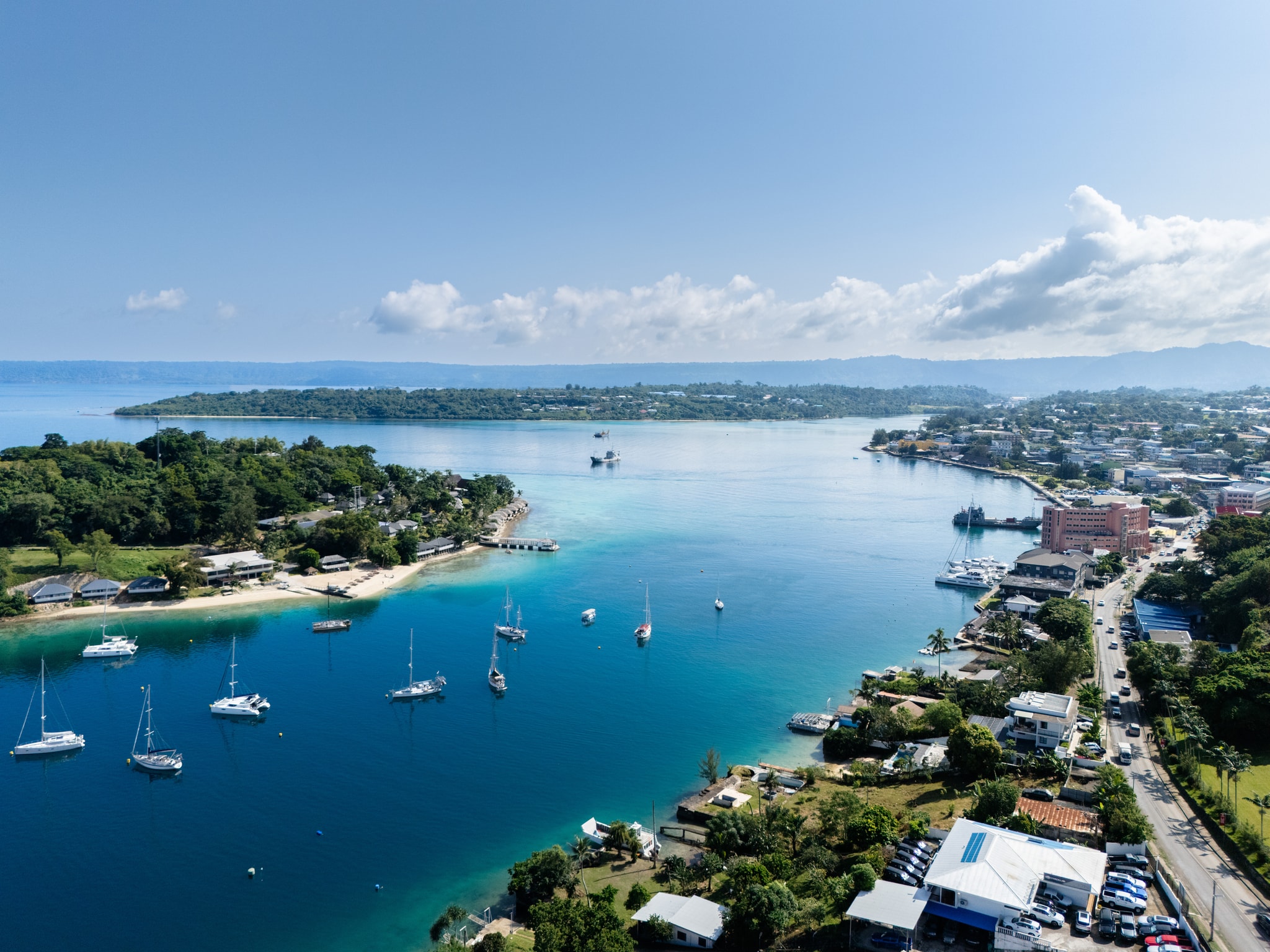
Port Vila is the centre of business activity in Vanuatu, where VAT is a major source of government tax revenue
Property taxes in Vanuatu
Vanuatu does not impose a general annual tax simply for holding a property interest, but taxes and government fees can arise when property rights are acquired, transferred, or the property is rented out.
Land in Vanuatu is held under long-term leases, often lasting up to 75 years, rather than owned outright.
Taxes and fees when acquiring property
Vanuatu tax rates on property transactions vary by the type of charge and transaction:
- Stamp duty — 2%. When a lease or lease transfer is stamped, the fee is calculated at 2% of the relevant consideration or value.
- Registration fee — 5%. Registration of a lease or transfer with the Land Registry attracts a 5% fee based on the relevant consideration or value[7]Source: Vanuatu Ministry of Lands — Lease transfer and registration fees.
- VAT — 15% where applicable. VAT can apply to commercial property transactions and certain residential property sales. Long-term residential rentals and sales of properties used exclusively for residential rental for at least 5 years are exempt[8]Source: Vanuatu Customs & Inland Revenue — VAT exemptions.
The exact amount depends on whether the transaction involves a new lease, transfer of an existing lease, or another type of land dealing.
Tax on rental income
Rental income can be subject to either rent tax or VAT, depending on the type of property and the landlord’s VAT status.
Long-term residential rent is subject to rent tax. Commercial and short-term residential rent is subject to VAT where the landlord is VAT-registered. If the landlord is below the VAT threshold and not voluntarily registered, rent tax may apply instead.
For individuals, rent tax is charged at 12.5% on gross rental income above VT 200,000, or around $1,700, per 6-month period. The first VT 200,000 is exempt[9]Source: Vanuatu Customs & Inland Revenue — Rent Tax.
For example, if an individual receives VT 300,000, or around $2,540, in rent during 6 months, only VT 100,000, or about $850, is subject to rent tax. The tax due is therefore VT 12,500, or around $105.
For companies and other non-natural persons, the 12.5% rent tax applies to the full amount of rental income, without the VT 200,000 allowance.
Rent tax returns are filed twice a year: on June 29th and December 28th[10]Source: Vanuatu Customs & Inland Revenue — Important Dates.
Tax reporting in Vanuatu
Vanuatu does not have a general personal or corporate income-tax return because it does not levy personal or corporate income tax. Reporting obligations instead arise when a person or business is subject to specific taxes or licensing requirements.
Tax identification number. Individuals and entities need a Taxpayer Identification Number if they are registered for VAT, required to file rent-tax returns, hold a business licence, or meet certain other tax and licensing obligations[11]Source: Vanuatu Customs & Inland Revenue — Tax Identification Numbers.
VAT reporting. VAT-registered businesses must submit VAT returns monthly, although those with annual taxable supplies below VT 8 million, or around $67,300, may apply for quarterly filing. Returns are due by the 27th of the following month[4]Source: Vanuatu Customs & Inland Revenue — VAT.
Businesses must also keep records supporting their taxable supplies, purchases, and VAT calculations.
Rent-tax reporting. Landlords whose rental income is subject to rent tax must file returns twice a year. They are also required to keep records that explain their rental transactions. Tax records need to be retained for at least 5 years.
Company records. Companies must keep accounting records that accurately explain their transactions and allow their financial position to be determined. They must also maintain corporate records such as a share register, while annual returns contain basic information about shareholders, directors, and the company itself[12]Source: Vanuatu Financial Services Commission — Learn about companies and other business types.
Trusted by 10,000+ investors
Sort out your tax obligations before it becomes a problem
Tax information exchange and double taxation in Vanuatu
Vanuatu protects private financial information, but it also participates in international tax-transparency frameworks and may exchange information with foreign tax authorities where required.
Automatic exchange of information
Vanuatu participates in the Common Reporting Standard[13]Source: Vanuatu Customs & Inland Revenue — Exchange of Information. Banks and other financial institutions may report details such as an account holder’s identity, tax residence, account balance, and certain income, which can then be exchanged with participating foreign tax authorities.
As a result, opening a bank account in Vanuatu does not make financial information invisible to the account holder’s home tax authority.
Tax information exchange agreements
Vanuatu has Tax Information Exchange Agreements, TIEAs, with 14 jurisdictions, including:
- Australia;
- Denmark;
- Faroe Islands;
- Finland;
- France;
- Greenland;
- Grenada;
- Iceland;
- Ireland;
- New Zealand;
- Norway;
- Republic of Korea;
- San Marino;
- Sweden.
The TIEAs allow foreign tax authorities to request information that is relevant to the administration or enforcement of tax laws. Requests may concern both civil tax matters and tax investigations.
Vanuatu also participates in broader international cooperation on tax transparency, including through the OECD framework for exchange of information.
Double taxation
Vanuatu has no double taxation agreements in force. As the country does not impose general personal or corporate income tax, double taxation is less likely to arise within Vanuatu itself.
Still, individuals and companies may owe tax in another country depending on their tax residence and that country’s rules on foreign income. For example, a person who earns rental income from a property in Vanuatu but is a tax resident of another country may have to pay tax on that income in both countries. Holding Vanuatu citizenship, a company, or a bank account does not by itself remove tax obligations elsewhere.
How to become a tax resident of Vanuatu through citizenship by investment: key rules
To become a Vanuatu tax resident, one needs to establish sufficient presence or a home in the country. A residence permit can provide the legal basis for living there, while citizenship offers a more permanent option.
Citizenship by investment can be a convenient route for foreigners planning a long-term connection with the country. Vanuatu recognises dual citizenship, so investors can obtain Vanuatu nationality without being required to renounce their existing citizenship.
Requirements for investors
To qualify for Vanuatu citizenship by investment, applicants must:
- Be at least 18 years old.
- Have no criminal record and meet the programme’s health requirements.
- Be capable of confirming the legality of the income.
- Make a contribution of at least $130,000.
- Demonstrate available assets of at least $250,000.

Vladlena Baranova,
Head of Legal & AML Compliance Department, CAMS, IMCM
Vanuatu citizenship and tax residence are separate. Receiving a passport does not automatically make an investor a Vanuatu tax resident.
To establish tax residence, an individual needs to have a home in Vanuatu or spend at least 183 days there. They should also ensure they no longer remain tax resident in their previous country under its domestic rules, as dual tax residence can otherwise arise.
Investment options
Vanuatu citizenship by investment is available through two contribution routes[14]Source: Vanuatu Citizenship Office & Commission — Citizenship by Investment.
1. Government fund contribution — $130,000+. The investor makes a non-refundable contribution to a government fund used to support Vanuatu’s economic development and recovery from natural disasters.
2. Cocoa Sustainable Development Fund contribution — $165,000+. The investor contributes to a fund established to support the development of Vanuatu’s cocoa industry.
After citizenship is granted, the applicant also receives a $50,000 unit in the fund. After 5 years, the unit may be redeemed, allowing the investor to recover part of the original contribution.
Family eligibility
Close family members can be included in the same Vanuatu citizenship application:
- spouse of the opposite sex, with no criminal records;
- children under 18;
- children aged 18 to 25 who are studying at university and are financially dependent on the main applicant;
- parents aged 50 or over who are financially dependent on the main applicant.
Additional fees apply when family members are included. Under the fund route, for example, the fee is $20,000 for a spouse and $15,000 for each additional family member.

Step-by-step procedure for obtaining Vanuatu citizenship by investment
Based on Immigrant Invest’s experience, obtaining Vanuatu citizenship by investment takes at least 2 months. This makes it one of the fastest citizenship by investment routes available internationally.
Most steps can be completed remotely. The investor and family members only need to appear in person to submit biometric data, either in Vanuatu or at an approved overseas location.
1 day
Preliminary Due Diligence
An Anti-Money Laundering Compliance Officer reviews the applicant’s passport details and checks international databases for potential risks that could affect the citizenship application. If issues are identified, Immigrant Invest’s lawyers assess them before the investor proceeds.
The check is confidential and usually requires only a passport.
2+ weeks
Preparation of documents
The applicant and Immigrant Invest’s lawyers prepare the documents required for Due Diligence and the citizenship application. These usually include a passport, police clearance certificate, CV, and personal and financial records. The lawyers also complete the required application forms.
The applicant and Immigrant Invest’s lawyers prepare the documents required for Due Diligence and the citizenship application. These usually include a passport, police clearance certificate, CV, and personal and financial records. The lawyers also complete the required application forms.
Up to 1 week
Due Diligence at the FIU
The documents are submitted through an authorised Vanuatu agent to the Financial Intelligence Unit. The FIU conducts Due Diligence on the investor and included family members.
The documents are submitted through an authorised Vanuatu agent to the Financial Intelligence Unit. The FIU conducts Due Diligence on the investor and included family members.
2—4 weeks
Citizenship application
After FIU approval, the citizenship application is submitted for review. Before filing, the investor pays 25% of the required contribution, and proof of payment is included in the application. The Screening Committee and Citizenship Commission then review the case.
After FIU approval, the citizenship application is submitted for review. Before filing, the investor pays 25% of the required contribution, and proof of payment is included in the application. The Screening Committee and Citizenship Commission then review the case.
Up to 90 days; on average, 3—6 weeks
Approval and investment completion
Once the Citizenship Commission approves the application, the investor pays the remaining 75% of the required contribution. The payment must be completed within 90 days of approval.
Once the Citizenship Commission approves the application, the investor pays the remaining 75% of the required contribution. The payment must be completed within 90 days of approval.
1 day
Biometric submission
The investor and included family members submit biometric data in person. This can be done in Vanuatu or at an approved overseas location, including the UAE, New Caledonia, or Hong Kong. In some cases, arrangements can be made for a consul to collect biometrics elsewhere.
The investor and included family members submit biometric data in person. This can be done in Vanuatu or at an approved overseas location, including the UAE, New Caledonia, or Hong Kong. In some cases, arrangements can be made for a consul to collect biometrics elsewhere.
2—4 weeks
Passport issuance
After the full investment amount is received, the Citizenship Commission issues the naturalisation certificate and the passport application is processed. The completed documents are then sent to the investor’s chosen address.
After the full investment amount is received, the Citizenship Commission issues the naturalisation certificate and the passport application is processed. The completed documents are then sent to the investor’s chosen address.
Risks and pitfalls of Vanuatu citizenship by investment
Vanuatu citizenship by investment process is relatively straightforward, but applicants should still account for several risks before applying.
Citizenship does not automatically create tax residence
A Vanuatu passport alone does not make an investor a Vanuatu tax resident. To benefit from the country’s tax system as a resident, the investor must separately meet Vanuatu’s tax-residence criteria and check whether they remain tax resident in another country.
Tax obligations may continue abroad
Investors who remain resident in another jurisdiction may still have to declare and pay tax there on worldwide income, assets, or investments. Obtaining Vanuatu citizenship does not by itself end those obligations.
Processing may take longer than expected
Although Vanuatu is known for fast processing, the timeline can extend if documents are incomplete, additional checks are required, family members are included, or programme requirements take longer to complete. Under the Citizenship Act, the Commission has up to 3 months from receipt of an application to make a decision.
Due Diligence may uncover issues that delay the case
Applicants and included family members undergo background checks. Missing information, inconsistencies in documents, or additional compliance questions can lead to requests for further evidence or deferment of the application. The Citizenship Commission may defer a case if required information or documents are missing.
Post-approval deadlines must be observed
After the Citizenship Commission approves an application, the applicant has 3 months to complete the required oath and pay the citizenship fee. A further 2-month extension may be requested in writing before the original deadline expires if there is a reasonable excuse[15]Source: Vanuatu Citizenship Office — Application Process.
If the requirements are not completed within the permitted period, the approval expires and the applicant must submit a new citizenship application.
How Immigrant Invest can help with Vanuatu citizenship by investment and tax residence
Immigrant Invest has worked with citizenship and residence by investment programmes since 2006. For Vanuatu, we hold a valid Letter of Representation and are authorised to promote the programme and submit citizenship applications.
We focus on investment migration rather than personal tax advice. Where tax residence or tax planning is involved, our team can coordinate with qualified tax professionals and assist with related administrative steps.
We assist our clients with:
- preliminary Due Diligence before the investor commits to the programme;
- checking eligibility and selecting the appropriate Vanuatu citizenship route;
- calculating programme costs for the investor and included family members;
- preparing and checking the citizenship application documents;
- coordinating official Due Diligence and communication with the authorised Vanuatu representatives and authorities;
- arranging the investment payment and monitoring the application process;
- coordinating biometric submission and passport issuance.
Our support does not end once citizenship is approved. We can assist with passport-related matters, banking, company incorporation, relocation logistics, and coordination with qualified tax professionals if the investor later plans to establish tax residence in Vanuatu.
Key takeaways about the Vanuatu tax system
- Vanuatu does not levy personal income tax, corporate income tax, capital gains tax, or inheritance tax.
- Tax residents and non-residents are treated similarly for personal income tax.
- VAT is charged at 15% on most goods and services.
- Property transactions and rental income can still trigger taxes and fees, including stamp duty, registration fees, rent tax, and VAT in certain cases.
- Vanuatu citizenship does not automatically create a Vanuatu tax residence. Investors must separately meet the applicable residence criteria.
Immigrant Invest is a licensed agent for citizenship and residence by investment programs in the EU, the Caribbean, Asia, and the Middle East. Take advantage of our global 15-year expertise — schedule a meeting with our investment programs experts.

 Trusted by 10,000+ investors