





Around 90,000 people currently hold temporary residence in Latvia, most of whom have obtained their permits by employment, study, or family reunification. Wealthy individuals often choose the Golden Visa, which requires a minimum investment of €50,000.
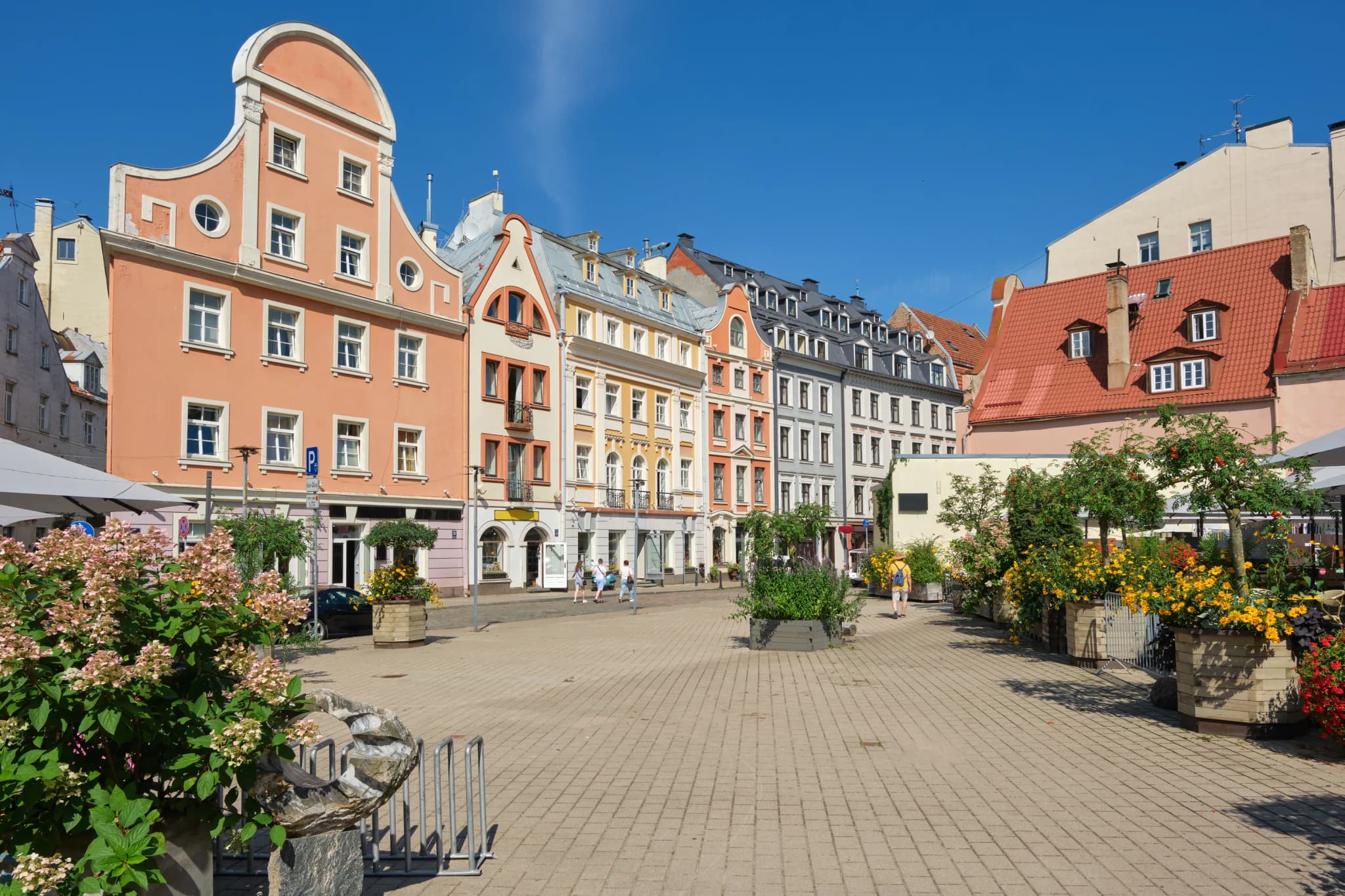
Latvia appeals to foreigners with its lower cost of living compared to much of Western and Northern Europe, high quality of life, modern healthcare system, and one of the EU’s most business-friendly tax regimes.
What types of residence permits does Latvia offer?
Latvia offers more than ten types of residence permits designed for different purposes. The most common categories are employment, study, family reunification, and investment, and in each case, applicants must prove their eligibility with specific supporting documents[1]Source: Documents required for each type of residence permit.
For investors. The most advantageous path to a Latvian residence permit for investors is the Golden Visa. It is granted in exchange for contributing to a business, with the investment threshold starting at €50,000.
Golden Visa holders are not required to live in Latvia to maintain their residence status.
Trusted by 10,000+ investors
Check your eligibility for the Latvia Golden Visa
For employees. A residence permit can be issued to foreign nationals employed by Latvian companies. There are two types of work permits under this category:
- Standard work permit for general employment, issued on the basis of a valid job offer and employment contract with a Latvian employer.
- EU Blue Card for highly qualified specialists with higher education or extensive experience and a salary at least 1.5 times higher than the national average.
To be eligible, applicants must have a registered job offer, provide a valid work contract, prove a sufficient income level, and buy health insurance.
For students. Foreign nationals admitted to accredited Latvian educational institutions can receive a residence permit for the duration of their studies.
To be eligible, applicants must provide confirmation of enrolment, proof of sufficient financial means, and health insurance.
For relatives of Latvian residents and citizens. Family members, including spouses, minor children, and in some cases parents, of Latvian residents or citizens can apply under the family reunification category.
To be eligible, applicants must provide proof of family relationships and buy health insurance. The Latvian resident or citizen must also confirm sufficient means to support their relatives.
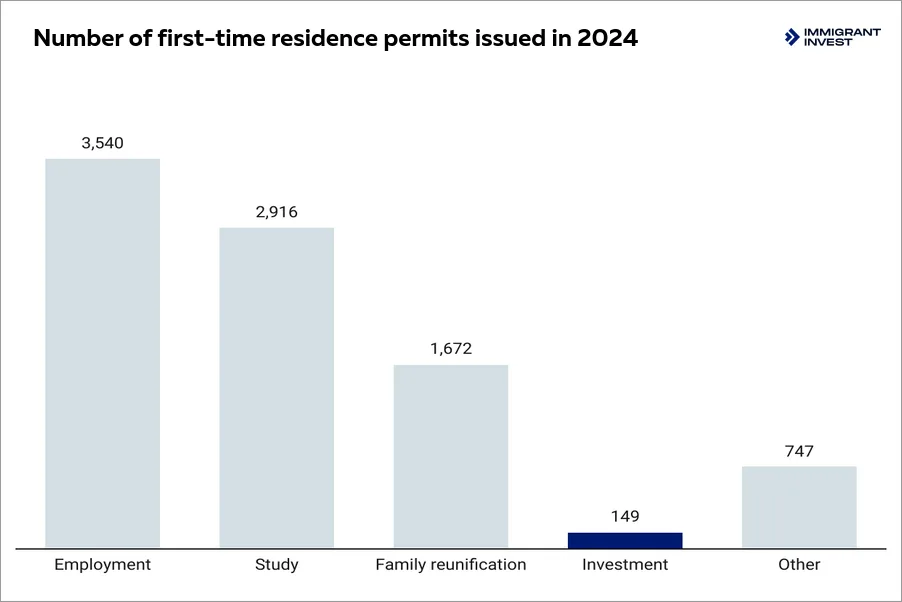
Latvian Golden Visa figures for 2024 come from Investment Migration Insider AS; other residence permit data is confirmed by the Latvian Asylum and Migration Report
Why choose Latvia for residence?
Latvia offers a unique combination of lifestyle, business, and mobility advantages within the European Union. With affordable living costs, a safe environment, and a clear path to EU citizenship, it has become one of the most practical residence destinations in Northern Europe.
29 European countries for visa-free travel
Holding Latvian residence gives you the right to travel visa-free within the Schengen Area, which includes 29 European countries.
Residents can spend up to 90 days within any 180-day period in other Schengen states for tourism or business without additional visas. This rule applies to the entire region, not to each country individually.
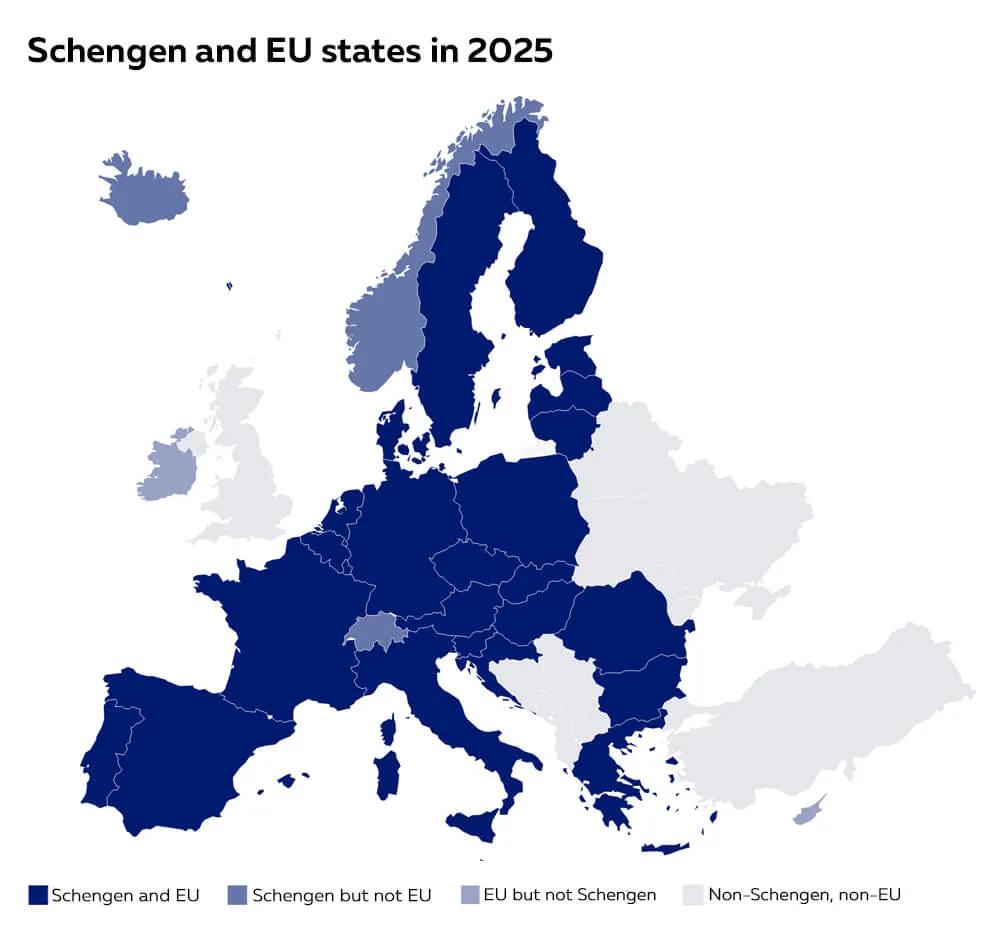
Latvian residents can travel freely throughout the Schengen Area and do not need separate visas for Ireland and Cyprus
Lower cost of living compared to Western Europe
Latvia offers a cost of living up to 30—50% lower than in countries such as Germany, France, or the Netherlands. A single person can live in Riga for around €1,200 per month, including rent, utilities, and food. Renting a one-bedroom apartment in the city centre costs roughly €300—400, while dining out and transport remain highly affordable[2]Source: According to the Numbeo database.
This makes Latvia an attractive choice for families, students, and remote professionals seeking a high standard of living at a reasonable cost.
Political and economic stability
Latvia is recognised for its strong democratic institutions, transparent governance, and consistent economic growth within the European Union. As a full member of the EU, Schengen Area, Eurozone, and NATO, the country benefits from political security, stable regulations, and close integration with European markets.
The economy has shown steady performance, with GDP per capita of around $26,312 as of 2025[3]Source: Overview of economic, social, environment, and institutional indicators in Latvia. Inflation has stabilised, and public debt remains well below the EU average, standing at 46.6% of GDP[4]Source: According to Trading Economics.
The Latvian government supports foreign investment through clear legislation, low bureaucracy, and an internationally competitive tax system, including 0% corporate tax on reinvested profits.
22nd safest country in the world
Latvia ranks 19th out of 163 countries worldwide in terms of safety[5]Source: Global Peace Index 2025 produced by the Institute of Economics and Peace. The country records low rates of violent crime and maintains strong public order.
The security threats index for Latvia in 2024 was around 1.70[6]Source: Latvia Security threats index, which is well below the global average of approximately 4.87.
In recent years, Latvia’s safety indicators have gradually improved: levels of internal conflict and crime have decreased, while its peace score has remained stable or improved compared with neighbouring countries.
Medical treatment in Latvia and across the EU
Latvia offers residents access to high-quality, affordable healthcare that meets European Union standards. The system combines state-funded medical care with an extensive network of private clinics. Public healthcare is managed by the National Health Service and is available to all legally resident individuals who contribute to Latvia’s social security system or hold valid health insurance.
Private healthcare is widely used by expatriates and investors, offering short waiting times, English-speaking doctors, and modern facilities at reasonable prices.
Residents in Latvia also benefit from the European Health Insurance Card, which provides access to emergency and medically necessary care while travelling within the EU and EEA countries under the same conditions as local citizens.
Easy access to 100+ destinations
Latvia’s location makes it a strategic gateway between the EU, Scandinavia, and Eastern markets. Its strong transport infrastructure connects the country efficiently to the rest of Europe and beyond. Riga International Airport offers direct flights to over 100 destinations, including major hubs such as London, Frankfurt, Paris, and Dubai, making both business trips and leisure travel convenient.
In addition, Latvia’s ports on the Baltic Sea and modern road and rail networks ensure smooth transit for goods and travellers alike, linking the country seamlessly with neighbouring regions and popular tourist destinations across Europe.
EU citizenship in 10 years
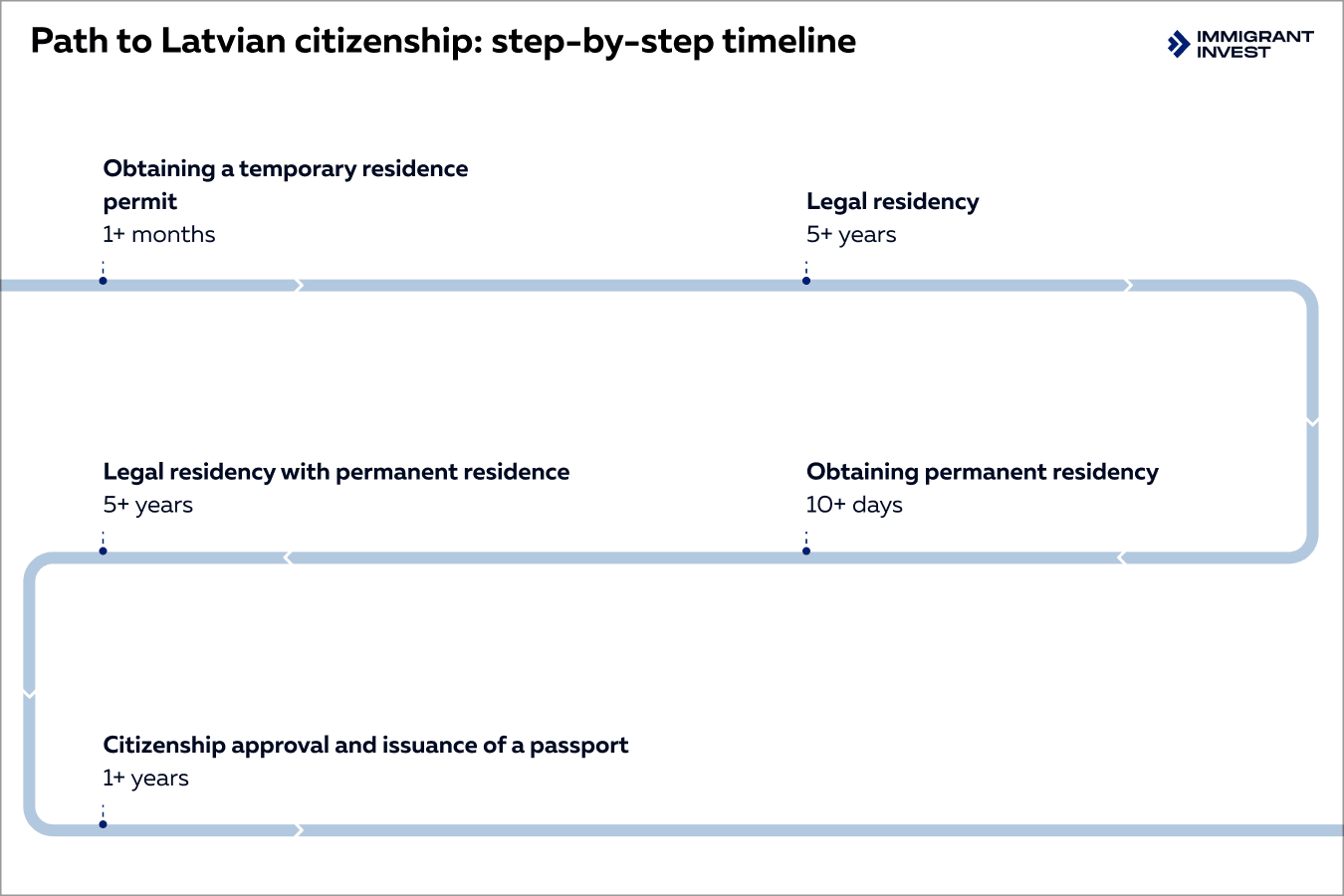
Temporary residents can obtain permanent residence in Latvia after 5 years. After an additional 5 years, they may qualify for Latvian citizenship, subject to language and integration requirements[7]Source: Latvian Citizenship Law with Amendments to 2022.
The Latvian passport grants full EU rights, including the freedom to live, work, and study in any EU member state, as well as visa-free access to over 170 countries worldwide.
What are the investment options for the Latvia Golden Visa?
Since September 15th, 2026, Latvia has reshaped its Golden Visa programme. The real estate and bank deposit routes have been removed for new applicants.
The main active option is now investment in a Latvian business. A new fund investment route has also been introduced under the updated Immigration Law, but it is not yet available to applicants.
The changes mark a clear shift from passive investment towards options that channel capital more directly into Latvia’s economy.
Business investment — €50,000+
Applicants may contribute €50,000 or more to the share capital of a Latvian company that employs fewer than 50 people and has an annual turnover below €10 million. Alternatively, they may contribute €100,000 or more to a larger company with over 50 employees and an annual turnover exceeding €10 million.
In addition to making a €50,000+ investment, the applicant pays €10,000 as a state fee, and additional fees totaling €1,645+.
The qualifying company must also pay at least €40,000 in taxes per year to the Latvian government.
The money must be transferred from the investor’s personal account directly to the company’s account, and the investment must be held for 6 or 8 years.
Under the business route, the residence permit is issued for 2 years and can be renewed for successive 2-year periods as long as the investment is maintained.

Anna Semenyuk,
Acting Client Manager Director
Investors cannot choose a company for the equity investment option on their own. These companies are pre-approved by Latvian authorities and have passed Due Diligence and financial monitoring. Information about them is publicly available on government websites.
We also conduct all compliance and financial monitoring ourselves and provide investors with valuation reports and financial statements.
Investment in funds — €150,000+
The new Immigration Law introduces a fund investment route requiring at least €150,000 to be invested for a minimum of 5 years, plus a €10,000 payment to the state budget.
The route has been added to the legal framework but is not yet available to applicants. The fund and application procedure still need to be established through implementing regulations.
The residence permit under this option is valid for 5 years and may be renewed.
Who qualifies for the Latvia Golden Visa?
Investors qualify for the Latvia investment residence if they meet the following criteria:
- are over 18;
- are not EU, EEA, or Swiss citizens;
- have no criminal record;
- can prove the legality of their income;
- are in good health and can provide a medical certificate.
The main applicant for a Latvia residence permit must also have at least €8,880 in their bank account. Additional funds are required for family members: €8,880 for a spouse and €2,664 per child.
Family members. Eligible relatives include spouses in a legal marriage and children under 18 who are unmarried and financially dependent on the investor. Other family members may only qualify if they are under the applicant’s legal custody.

How to obtain the Latvia Golden Visa: step-by-step process
In Immigrant Invest’s experience, obtaining a Latvian Golden Visa takes at least 3 months. The timeline depends on how quickly the applicant prepares the required documents and completes the investment.
Lawyers support applicants throughout the process, from document collection and Due Diligence to filing the application and receiving residence cards for the investor and eligible family members.
1 day
Preliminary Due Diligence
Immigrant Invest conducts preliminary Due Diligence to identify any circumstances preventing the applicant from obtaining the Latvia Golden Visa. This check allows us to reduce refusal risk down to 1%.
Upon successful completion of the check, Immigrant Invest prepares a service agreement to provide further support.
The process is fully confidential.
Immigrant Invest conducts preliminary Due Diligence to identify any circumstances preventing the applicant from obtaining the Latvia Golden Visa. This check allows us to reduce refusal risk down to 1%.
Upon successful completion of the check, Immigrant Invest prepares a service agreement to provide further support.
The process is fully confidential.
2—3 weeks
Preparation of documents
Immigrant Invest compiles a list of documents required for the application, and the investor provides the originals.
The lawyer guides the applicant through the process of document collection, certification, and translation, if needed.
Immigrant Invest compiles a list of documents required for the application, and the investor provides the originals.
The lawyer guides the applicant through the process of document collection, certification, and translation, if needed.
≈ 2 months
Investment fulfilment
The applicant completes the investment in a Latvian business and pays the required €10,000 contribution to the state budget.
The investment must be documented before the residence permit application is submitted, as confirmation of the transaction forms part of the application package.
The applicant completes the investment in a Latvian business and pays the required €10,000 contribution to the state budget.
The investment must be documented before the residence permit application is submitted, as confirmation of the transaction forms part of the application package.
Up to 1 month
Application submission
Once the investment is completed, the investor can submit the application in either of the following ways:
- through a Latvian embassy in the applicant’s country of residence;
- directly at the Office of Citizenship and Migration Affairs, OCMA, in Latvia.
Applicants may be required to attend an interview.
If the applicant holds a passport allowing visa-free entry to the EU or has a valid Schengen visa, it is recommended to submit the application from Latvia.
Once the investment is completed, the investor can submit the application in either of the following ways:
- through a Latvian embassy in the applicant’s country of residence;
- directly at the Office of Citizenship and Migration Affairs, OCMA, in Latvia.
Applicants may be required to attend an interview.
If the applicant holds a passport allowing visa-free entry to the EU or has a valid Schengen visa, it is recommended to submit the application from Latvia.
Up to 1 month
Obtaining a D visa, if applicable
Once the application is approved, the investor applies for a D visa to enter Latvia, if they need one.
Once the application is approved, the investor applies for a D visa to enter Latvia, if they need one.
Within 3 months of obtaining the D visa
Biometric submission and receiving residence cards
The investor and their family members included in the application travel to Latvia to submit biometrics, undergo medical examination, and pay the remaining government fees.
Investors have 3 months to complete this step. Afterwards, residence cards are printed within 5 to 30 days. Applicants must collect them in person.
The investor and their family members included in the application travel to Latvia to submit biometrics, undergo medical examination, and pay the remaining government fees.
Investors have 3 months to complete this step. Afterwards, residence cards are printed within 5 to 30 days. Applicants must collect them in person.
How does the Latvia Golden Visa compare with other EU Golden Visas?
Alongside Latvia, several other EU countries offer Golden Visa, including Portugal, Greece, Hungary, and Italy. They differ in investment amounts, available options, processing times, validity periods, and the inclusion of family members.
Latvia stands out for offering the most affordable Golden Visa in the European Union. It is also typically granted faster than in most other countries.
Latvia vs. Portugal vs. Greece vs. Hungary vs. Italy Golden Visas: comparison

Criteria
Investment threshold
 Latvia
€50,000
 Portugal
€250,000
 Greece
€250,000
 Hungary
€250,000
 Italy
Italy
€250,000
Criteria
Obtaining period
Latvia
3+ months
Portugal
12+ months
Greece
4+ months
Hungary
5+ months
Italy
4+ months
Criteria
Family inclusion
Latvia
Spouse, children under 18
Portugal
Spouse, children under 25, parents
Greece
Spouse, children under 21, parents
Hungary
Spouse, children under 18, parents
Italy
Spouse, children under 18, children of any age with disabilities, parents
Criteria
Validity
Latvia
2 or 5 years, renewable indefinitely
Portugal
2 years, renewable indefinitely
Greece
5 years, renewable indefinitely
Hungary
10 years, renewable once
Italy
2 years, renewable for 3-year periods indefinitely
Criteria
Time to citizenship
Latvia
10 years
Portugal
10 years
Greece
7 years
Hungary
11 years
Italy
10 years
Criteria |
|
|
|
|
|
|---|---|---|---|---|---|
Investment threshold | €50,000 | €250,000 | €250,000 | €250,000 | €250,000 |
Obtaining period | 3+ months | 12+ months | 4+ months | 5+ months | 4+ months |
Family inclusion | Spouse, children under 18 | Spouse, children under 25, parents | Spouse, children under 21, parents | Spouse, children under 18, parents | Spouse, children under 18, children of any age with disabilities, parents |
Validity | 2 or 5 years, renewable indefinitely | 2 years, renewable indefinitely | 5 years, renewable indefinitely | 10 years, renewable once | 2 years, renewable for 3-year periods indefinitely |
Time to citizenship | 10 years | 10 years | 7 years | 11 years | 10 years |
How can employees obtain Latvia residence?
Employees can obtain Latvian residence by securing a job with a Latvian-registered company and applying for a standard work permit or an EU Blue Card.
Standard work permit
The standard work permit is the most common form of employment-based residence in Latvia. It is intended for foreigners who have received a job offer from a Latvian-registered employer.
The permit is usually issued for up to 1 year, corresponding to the term of the employment contract, and can be renewed as long as the employment continues.
The employer must first register the vacancy with the State Employment Agency and obtain permission to hire a non-EU worker. The position must generally be one that cannot be filled by a local or EU candidate.
The employee must earn at least the national average salary, which is €1,815 as of 2025[8]Source: Official data from the Latvian Central Statistical Bureau, and provide proof of health insurance and accommodation in Latvia.
EU Blue Card
The EU Blue Card is designed for highly qualified professionals from outside the European Union.
To qualify, the applicant must meet the following requirements:
- hold a higher education degree or have at least 5 years of professional experience in the relevant field;
- have a job offer or employment contract valid for at least 1 year;
- earn a salary that is 1.5 times higher than the national average gross wage — as of 2025, the minimum required salary is €2,528;
- buy health insurance;
- provide proof of accommodation.
The EU Blue Card is issued for up to 5 years or for the duration of the work contract plus 3 months. Holders can also move to another EU country after 18 months to continue working there under the same Blue Card.
Required documents
When applying for a residence permit based on employment, the applicant must submit the following documents to the Office of Citizenship and Migration Affairs, PMLP, or to a Latvian embassy:
- completed application form for a residence permit;
- valid passport;
- recent passport photo;
- signed employment contract with a Latvian company;
- employer’s invitation or approval issued by the State Employment Agency;
- proof of qualifications or professional experience;
- proof of sufficient income showing compliance with salary requirements;
- health insurance valid in Latvia with coverage of at least €42,600;
- proof of accommodation, such as a rental contract or ownership certificate;
- criminal record certificate from the applicant’s country of residence;
- payment receipt for the state processing fee.
All foreign documents must be legalised or apostilled and accompanied by an official Latvian translation.
Application process
On average, the process takes 30 to 60 days and includes the following steps:
- Registration by an employer. The employer registers the vacancy and obtains authorisation to employ a non-EU citizen.
- **Document preparation and application submission.**The applicant submits all required documents at the nearest Latvian embassy or directly to the PMLP in Latvia.
- Waiting for the decision. Applications are usually processed within 30 to 60 days. Expedited processing is available for an additional fee, reducing the time to 10—20 working days.
- Arrival in Latvia and registration. After approval, the applicant receives a visa to enter Latvia, registers biometric data, and collects the residence card in the country.
How to obtain Latvia residence by family reunification?
Latvia residence by family reunification can be obtained by close relatives of Latvian citizens or residents, such as spouses, minor children, or dependent parents. This pathway is designed to preserve family unity and provides the right to reside, work, and access social services during the permit’s validity.
Who can apply
A residence permit for family reunification can be granted to:
- spouse of a Latvian citizen or foreign resident holding a valid residence permit;
- children of a Latvian citizen or resident, including adopted children;
- parents or legal guardians of a Latvian minor or a dependent foreign resident.
The applicant must prove genuine family ties and the intention to live together in Latvia. Marriages of convenience or relationships created solely for immigration purposes are strictly prohibited and carefully checked by authorities.
Required documents
To apply for a residence permit under family reunification, the applicant must provide:
- valid passport;
- recent photographs;
- proof of family relationship, such as a marriage certificate, birth certificate, or adoption documents;
- health insurance valid in Latvia.
The person being joined must hold a valid Latvian residence permit or passport and demonstrate stable income and adequate living space for dependents. The required financial means are €740 per month for an adult and €222 per month for a minor child.
Application process
On average, the process takes 30 to 90 days. Applicants undergo the following steps:
- Document preparation. The documents must be legalised or apostilled and translated into Latvian.
- Application. The application is submitted to a Latvian embassy abroad or directly to the Office of Citizenship and Migration Affairs in Latvia.
- Waiting for the decision. The standard processing time is 30 to 90 days, depending on the case. Expedited processing is available for an additional fee, reducing the time to 10—20 working days.
- Obtaining a residence permit. Once approved, the applicant receives a visa for entry and later collects the residence card in Latvia.
The first family reunification permit is usually issued for 1 year, with the possibility of renewal. Subsequent extensions are typically granted for up to 4 years.
How can students obtain Latvia residence?
Foreign nationals admitted to Latvian educational institutions can apply for a temporary residence permit for the purpose of study. This permit allows students to live in Latvia for the duration of their studies and attend classes full-time.
Students may also work part-time, up to 20 hours per week during the academic year, and full-time during holidays.
Who can apply
To qualify, applicants must be accepted into a full-time accredited study programme in Latvia. Eligible options include bachelor’s, master’s, or doctoral degrees, as well as vocational education or recognised exchange programs such as Erasmus+. Distance-learning students are generally not eligible unless their studies require physical presence in Latvia.
Applicants must also prove that they can support themselves financially, usually at least €740 per month, and have health insurance covering at least €42,600. Proof of accommodation in Latvia is required. In most cases, students must also present confirmation of tuition payment for the first semester.
Required documents
To apply for a residence permit for studies, applicants must submit the following:
- valid passport;
- recent passport photo
- official letter of admission or confirmation from the Latvian educational institution
- proof of sufficient financial means to cover living expenses and tuition;
- health insurance;
- proof of accommodation, such as a dormitory confirmation or rental agreement;
- criminal record certificate from the home country;
- receipt of payment for the state application fee.
All foreign documents must be legalised or apostilled and translated into Latvian by a certified translator.
Application process
On average, the process takes 30 to 60 days. Applicants undergo the following steps:
- University acceptance. The student first receives an offer or acceptance letter from an accredited Latvian educational institution.
- Document preparation and submission. The residence permit application and supporting documents are submitted to a Latvian embassy abroad or directly to the Office of Citizenship and Migration Affairs, PMLP, in Latvia.
- Waiting for the decision. The decision is usually made within 30—60 days, depending on the case. Expedited processing is available for an additional fee, reducing the time to 10—20 working days.
- Arrival in Latvia and registration. Once the application is approved, the student receives a visa to enter Latvia, provides biometric data, and collects the residence card from the PMLP.
The residence permit for studies is issued for the duration of the academic year or study programme, typically up to 1 year, and must be renewed annually until the completion of studies.
After completion, graduates may apply for a 1-year post-graduation residence permit to seek employment in Latvia or transition to another type of residence permit.
Other types of Latvia residence permits
In addition to the main categories of residence permits, Latvia offers several other options designed for specific professional, humanitarian, or personal circumstances.
Scientific or research collaboration
Researchers, scientists, and lecturers can apply for a residence permit if they are invited by a Latvian research institution or university to participate in an approved research project or academic exchange.
The permit is usually issued for the duration of the project and can be renewed if cooperation continues.
Religious or church activities
Clergy members, missionaries, and other individuals engaged in religious or spiritual work may obtain a residence permit through recognised religious organisations registered in Latvia.
The applicant must provide confirmation of their role and the organisation’s legal status in the country.
Health treatment or medical reasons
A temporary residence permit may be issued to foreigners who require long-term medical treatment in Latvia.
Applicants must submit documentation from a Latvian healthcare institution confirming the need and duration of the treatment, as well as proof of financial means to cover medical and living expenses.
Participation in international projects or treaties
Foreigners can receive a residence permit if they are involved in an international project or programme in which Latvia participates, based on international agreements or intergovernmental cooperation.
The permit remains valid for the duration of the project or mission.
Remote work
Remote workers from non-EU countries employed or self-employed by companies in OECD member states[9]Source: List of the OECD member states can obtain Digital Nomad Visas in Latvia.
Applicants must prove at least 6 months of work history and earn a monthly income above 2.5 times the national average, which is around €4,200 as of 2025[10]Source: Requirements for the Digital Nomad Visa in Latvia. The residence permit is granted for up to 1 year and can be renewed for 1 additional year.

How to obtain permanent residence and citizenship after temporary residence?
Foreigners usually obtain permanent residence and citizenship by naturalisation after living in the country for a specific number of years.
Permanent residence
Latvian permanent residence is granted after 5 years of holding a temporary residence permit. During this period, the applicant must have lived in Latvia for at least 4 years.
In addition, applicants are required to pass the Latvian language test at level A2 and demonstrate knowledge of the country’s general history and national anthem.
Citizenship
Latvian citizenship is generally available after an additional 5 years, totaling 10 years of legal residence.
To be eligible for a Latvian passport, applicants must pass an exam covering the country’s culture, history, Constitution, and national anthem. They must also demonstrate Latvian language skills sufficient for integration into society and communication in everyday life.
As a rule, Latvia does not recognise dual citizenship; therefore, applicants are required to renounce other nationalities upon obtaining a Latvian one. Exceptions are made for citizens of EU and EFTA member states, NATO countries, Australia, Brazil, and New Zealand[11]Source: All cases when dual citizenship is allowed in Latvia.
Living in Latvia: what to expect as a resident
Living in Latvia offers a balance between an affordable European lifestyle, access to nature, and the benefits of residing within the European Union.
However, residents should be ready for a slower pace of life, a relatively small economy, and a climate that demands some adaptation.
Cost of living
Latvia is significantly more affordable than Western Europe. A one-bedroom apartment in central Riga costs €300—500, while utilities average €270 per month.
Public transport passes are around €30—35, and eating out costs €12—30 per meal.
Monthly expenses for one person are around €1,200, and about €3,500 for a family of four, including rent and utilities[2]Source: According to the Numbeo database.
Average monthly net income is about €1,305, though higher in ITC, finance, and engineering[8]Source: Official data from the Latvian Central Statistical Bureau.
Healthcare and insurance
Latvia has a universal healthcare system managed by the National Health Service, NVD, which provides access to public doctors, hospitals, and emergency care. Residents registered in the system receive subsidised treatment, though waiting times can be long. Many foreigners therefore choose private clinics, especially in Riga, where English-speaking doctors are available and appointments are quicker.
Health insurance is mandatory for residence permits and visas, with minimum coverage of €42,600.
Private consultations cost about €30—40 for a GP and €50—80 for a specialist, which is affordable by EU standards. Pharmacies are widespread, and prescription medicines are partly reimbursed for insured residents.
Education
Education in Latvia is free and compulsory for children aged 5 to 16. Public schools teach primarily in Latvian. For expatriate families, private and international schools provide instruction in English and offer recognised diplomas such as the International Baccalaureate, IB, with tuition fees between €6,000 and 12,000 per year.
Latvia’s universities, including the University of Latvia, Riga Technical University, and Riga Stradiņš University, attract international students with English-taught programs, especially in medicine, engineering, and business. Tuition fees range from €2,000 to 8,000 per year, depending on the field and nationality.
Language and community
The official language is Latvian, but Russian remains widely spoken, and English is common in business, higher education, and major cities. Learning basic Latvian is strongly recommended for smoother integration and is a requirement for permanent residence and citizenship applications.
Latvia has a growing international community, especially in Riga, which hosts digital nomads, investors, and students. There are active expat groups, language exchange meet-ups, and community organisations that help newcomers settle. Latvians are generally polite and reserved, but social connections deepen with time and sincerity.
Climate
Latvia has a temperate climate shaped by the Baltic Sea. Winters are cold and snowy, averaging -2°C on the coast and -7°C inland, while summers are mild at around +20…25 °C. The sea moderates temperatures, making coastal areas warmer in winter and cooler in summer.
Rainfall is steady year-round, with slightly wetter months in late summer and autumn. Days are long and bright in summer but short in winter. Residents enjoy all four seasons, from snowy winters to green, sunlit summers.
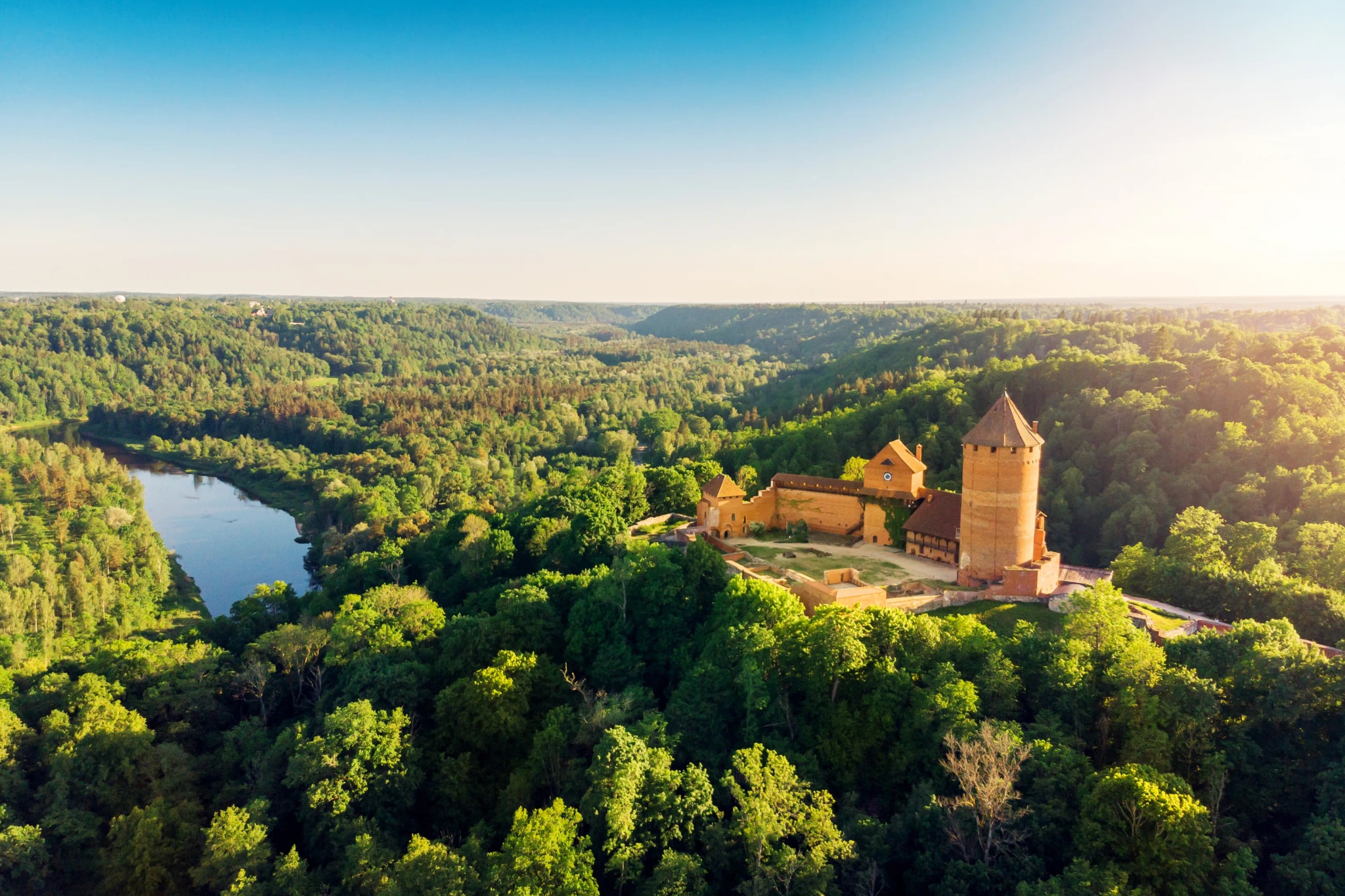
Latvia is one of the best countries for nature-lovers. It is among the most forested countries in the EU and also features a large number of lakes, rivers, and sandy Baltic beaches
What are the tax implications for Latvian residents?
In Latvia, tax residents pay personal income tax on their global income, while non-residents pay only on Latvian-source income.
A person is considered a tax resident in any of the following cases:
- they have declared Latvia as their place of residence;
- they stay in Latvia for 183 days or more within any 12-month period;
- they have a permanent place of residence in Latvia, even if they also reside in another country.
Tax residence is typically determined by the State Revenue Service based on official registration and physical presence. A person is considered to have a permanent place of residence in Latvia if they have housing available for year-round use, whether owned, rented, or shared with family, which indicates stable personal or economic ties to the country.
Dual residents are assessed under the double taxation treaties Latvia has signed with over 60 countries[12]Source: Tax treaties on the website of the Ministry of Finance of the Republic of Latvia, which determine where taxes should be paid.
Taxes for individuals
Personal income. Latvia applies a progressive tax rate, depending on annual earnings:
- 25.5% on income up to €105,300 per year;
- 33% on income above €105,300 per year.
An additional 3% surcharge applies to income exceeding €200,000[13]Source: Official data from the Latvian State Revenue Service.
Dividends and capital gains are generally taxed at 25.5%[13]Source: Official data from the Latvian State Revenue Service, though dividends distributed by Latvian companies that have already paid corporate income tax are usually exempt[14]Source: Official data from the Ministry of Finance of the Republic of Latvia.
Social security contributions total around 34.09% of gross salary, usually shared between employer and employee: 23.59% is paid by the employer and 10.5% is paid by the employee[15]Source: Official data from the Latvian State Revenue Service. These contributions fund pensions, healthcare, unemployment, and other benefits.
Real estate. Property owners also pay real estate tax, typically between 0.2% and 1.5% of the cadastral value, depending on the municipality[16]Source: Real estate taxation rules according to the Ministry of Finance of the Republic of Latvia.
Taxes for legal entities
Corporate income. Latvia’s corporate income tax system is based on a deferred taxation model, meaning that profits are only taxed when distributed. The standard rate is 20%, applied to the grossed-up distributed profit. Reinvested or retained profits are not taxed.
Small businesses that meet specific size and turnover limits can opt for the microenterprise tax regime, which simplifies administration by applying a single 25% tax on turnover instead of corporate and payroll taxes. This regime suits small-scale businesses and freelancers with limited staff[17]Source: According to the Worldwide Tax Summaries.
Capital gains from share sales can be exempt if the shares have been held for at least 36 months[18]Source: According to the Worldwide Tax Summaries.
How Immigrant Invest can help with obtaining residence in Latvia
Immigrant Invest is an international consulting company specialising in residence and citizenship by investment. We have worked in the industry since 2006 and have assisted more than 10,000 clients worldwide.
We hold licenses authorising us to accompany investors seeking citizenship and residence in other countries and are also a member of the Investment Migration Council. Our in-house Compliance Department follows AML/KYC standards and conducts preliminary Due Diligence before clients proceed with an investment programme.
For Latvia Golden Visa applicants, Immigrant Invest supports investors throughout the entire process, from the initial eligibility check to receiving residence cards:
- preliminary Due Diligence to identify possible refusal risks;
- preparation and review of documents;
- assistance with completing and documenting the qualifying investment;
- preparation and submission of the residence permit application;
- support with a D visa, biometrics, and residence card issuance.
Key takeaways: all Latvian residence permit types
- Latvia has over 10 types of residence permits. Among them, work, student, family reunification, and investment permits are the most common.
- The investment permit, or Latvia Golden Visa, is granted to foreigners contributing €50,000+ to the country’s economy.
- Temporary residence holders can become eligible for permanent residence after 5 years and for citizenship after an additional 5 years.
- Some of the benefits of Latvian residence include visa-free travel within the Schengen Area, access to high-quality healthcare, a safe and economically stable environment, and an affordable cost of living.
- Foreigners pay taxes on global income in Latvia if they become tax residents. Non-residents pay taxes only on Latvian-source income.
Immigrant Invest is a licensed agent for citizenship and residence by investment programs in the EU, the Caribbean, Asia, and the Middle East. Take advantage of our global 15-year expertise — schedule a meeting with our investment programs experts.

 Trusted by 10,000+ investors