









St Lucia has published an annual report on the performance of its citizenship by investment programme in 2023—2024[1]Annual report 2023—2024, St Lucia CIP department..
Lyle Julien, investment programmes expert, compared the key indicators for the number of applications, programme revenue, and applicant geography.
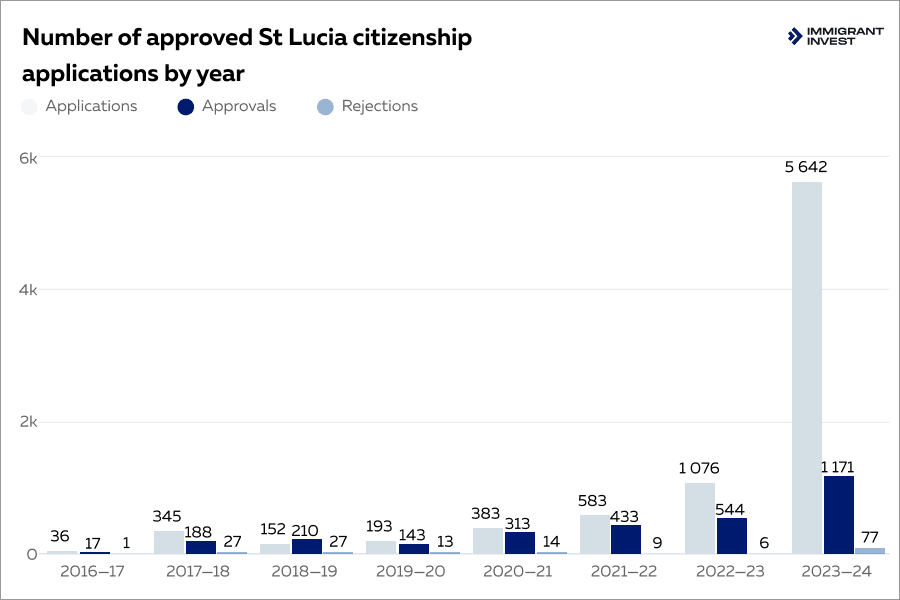
Citizenship applications grew by 424%
A total of 5,642 applications were submitted to the St Lucia Citizenship by Investment Unit in the financial year ending March 31st, 2024, representing a 424% increase compared to the previous period. 1,171 applications were approved, while 77 were rejected.
A total of 2,768 applications were submitted over the entire period of the programme from 2016 to 2023.
Programme revenue increased by 296%
Total revenue for the 2023—2024 financial year reached $89 million. This represents a 296% increase compared to the previous fiscal year. The main sources of revenue were Due Diligence fees and administrative fees under the real estate investment option.

Lyle Julien,
Investment programmes expert
Contributions to the National Economic Fund decreased by 60%. At the same time, demand for the real estate option increased. Administrative fees alone generated $33 million for the state budget, four times more than in the previous period.
Chinese citizens submitted most applications
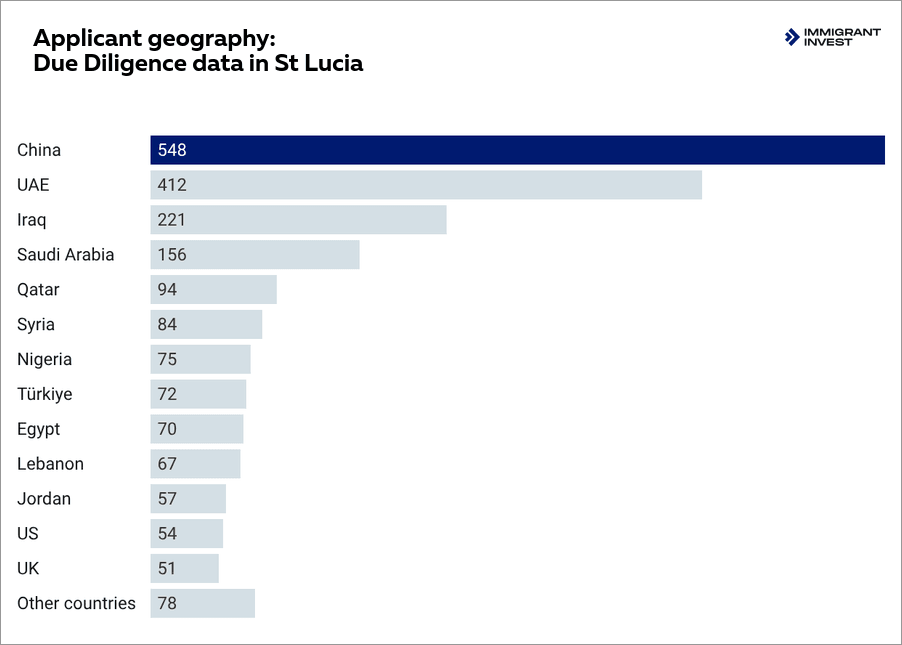
In the annual report, data on the applicants’ countries are based on information from providers that conduct Due Diligence checks and organise interviews.
The most detailed report is provided by Exiger. The programme department sent the provider 1,164 Due Diligence orders, including checks on 1,995 main applicants and their family members. The largest share of applicants came from China, followed by the UAE and Iraq.
According to Exiger, 70% of the screened subjects were classified as low risk, 26% as medium risk, and 4% as high risk.
How to obtain St Lucia citizenship by investment
St Lucia citizenship by investment is granted in as little as 6 months, without travelling to the country. The application may include a spouse, children, and parents.
Minimum investment options:
- non-refundable contribution to the National Economic Fund — $240,000;
- purchase of government bonds — $300,000;
- purchase of approved real estate — $300,000;
- investment in infrastructure projects — $250,000;
- investment in business — $1,000,000.
Investments in bonds or real estate can be returned after 5 years.



 Trusted by 10,000+ investors