
Summary
Higher education and years of experience can open the door to a new professional setting and even long-term settlement in Portugal. The Global Talent Programme offers both career mobility and long-term residence in the EU.
Learn all the nuances and benefits of residency for highly-qualified workers.
What is the Portugal Global Talent Programme?
The Portugal Global Talent Programme is a national residence visa for non-EU, non-EEA, and Swiss nationals engaged in teaching, research, cultural, or other highly qualified professional activities[1].
The legal framework is set by Law No. 23/2007 and Decree-Law 41/2023[2], which created the Agency for Integration, Migration and Asylum, AIMA — the agency responsible for processing residence permits.
Residency through the Portugal Global Talent Programme is granted directly by AIMA without requiring an initial D-visa in the home country[3], followed by biometrics and issuance of residence cards. The whole process takes around 4 months.

Who qualifies as a highly-qualified professional under the Portugal Global Talent Programme
The Portugal Global Talent Programme is designed for professionals with advanced qualifications or exceptional experience who come to Portugal for skilled employment, research, or cultural work.
Eligibility criteria
A candidate is generally considered highly qualified if the following applies:
- holds a higher education degree at ISCED level 6 or above — bachelor’s, master’s, or PhD;
- has at least 3—5 years of specialised professional experience that demonstrates equivalent expertise, as recognised in AIMA’s standards[4].
To qualify, the applicant must also have a valid agreement or a Letter of Commitment with a Portuguese university or R&D institution.
Eligible professional categories
Typical Global Talent Programme applicants include:
- entrepreneurs and business owners;
- executives or senior professionals — directors, consultants;
- academics and researchers;
- technology and engineering specialists;
- finance, investment, and legal professionals;
- creative professionals — design, gaming, media, architecture;
- retired professionals with a record of expertise or mentorship capacity.
Example profiles
For instance, the following individuals qualify for the Portugal Global Talent Programme:
- US-based software engineer with 5 years of experience seeking EU relocation;
- retired executive mentoring startup founders through the university mentorship track;
- entrepreneur from Singapore establishing links with Portuguese R&D projects;
- crypto investor collaborating with fintech research centers under the mentorship framework.
How to get Portugal residency via university route
The Global Talent Programme was designed to attract highly skilled individuals who can contribute knowledge, mentorship, and innovation to Portuguese academic institutions, while also supporting regional development by integrating foreign professionals into university-led research and development ecosystems across the country. Therefore, the application must include a Letter of Commitment from the university.
The university route is based on formal cooperation agreements with institutions such as Coimbra, Évora, Algarve, Beira Interior, ISTEC, and NOVA Medical School. It is most suitable when the applicant’s stay in Portugal is linked to a specific academic or research project.
Each participant becomes affiliated with a Portuguese university or research institution, receiving recognised academic status within the EU. Through teaching, mentoring, or advisory roles, they contribute international expertise to support innovation and talent growth in Portugal.
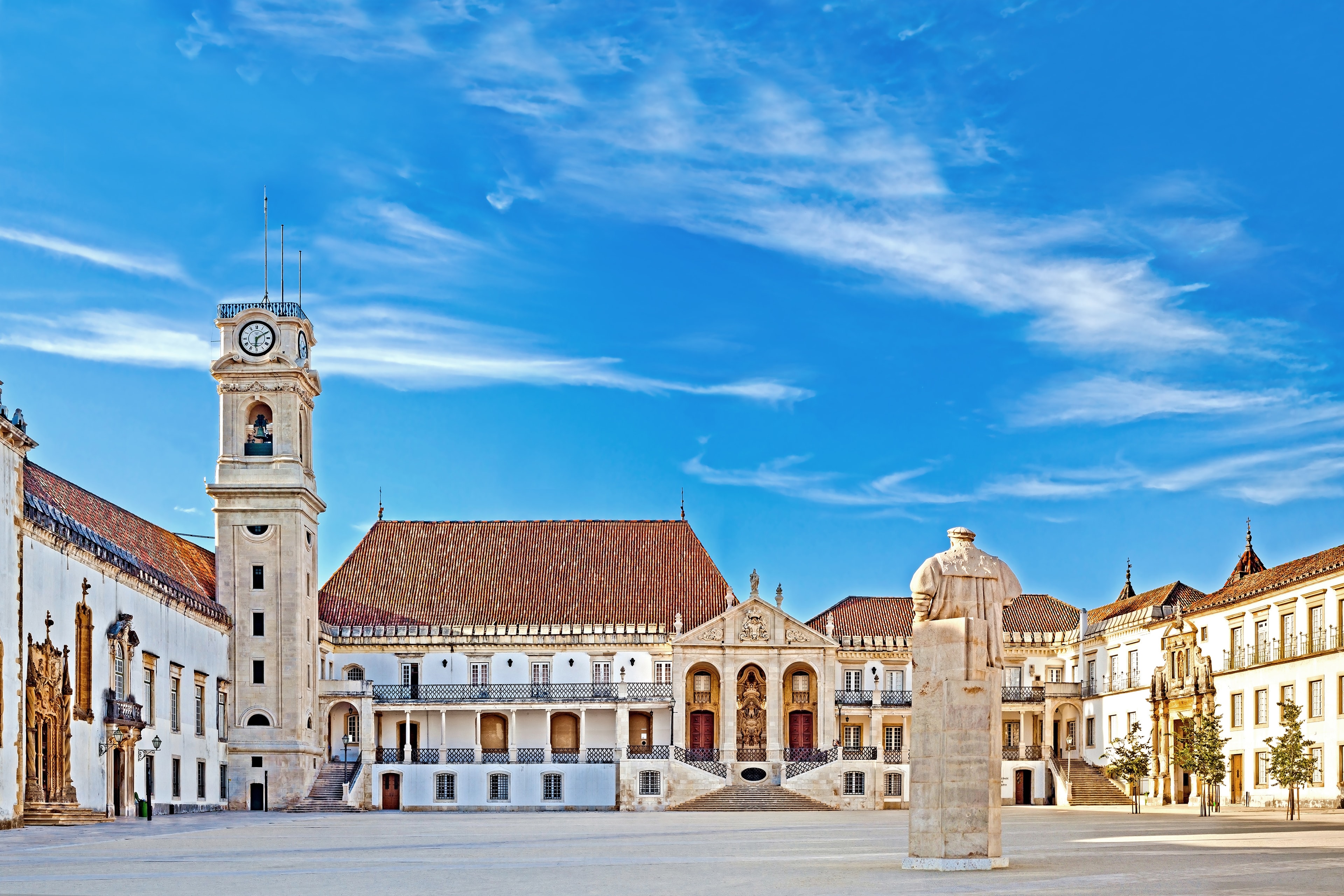
Five Portuguese universities, including the featured University of Coimbra, rank among the top 500 globally[5]
Can family members join under the Portugal Global Talent Programme?
The Portugal GTP allows family reunification. Applications for dependents are submitted immediately after the principal applicant receives a residence card.
Family members eligible under the Portugal Global Talent Programme include:
- spouse or registered partner;
- children under 18;
- dependent full-time students under 26.
Parents or adult children over 26 are not included in the main family unit, but they may apply separately.
Each dependent must provide:
- Passport copy.
- Birth or marriage certificate.
- Health insurance.
- Proof of family relationship.
Appointments scheduled by AIMA are issued within 2—3 months after the main applicant’s approval.
Fee structure for the Portugal Global Talent Programme
The applicant pays participation and government fees and rents or buys a residential property to have a registered address in Portugal.
Total cost is €170,000+
The participation fee covers all legal and residence services for 5 years for the main applicant and up to three dependents. An extra €5,000 is added for each additional dependent, starting with the 5th.
Payment is made in three steps:
- The process begins with a €20,000 non-refundable payment upon signing the contract and onboarding.
- When the AIMA appointment is scheduled, the next €75,000 is paid — refundable if the application is rejected.
- The final €75,000 is paid at residence card issuance and is refunded if the renewal at year 2 is denied.
Government fees amount to €1,000+
In addition to the programme fee, applicants must pay AIMA fees for residence permits and biometrics. These vary based on the number of family members.
Biometric fee is €406.90 for adults and €58.10 for minors. The residence permit appointment fee is €397 per person, irrespective of age.
Accommodation and insurance are €8,000 per year
Housing is another major cost. It must be rented for at least 12 months, with cost depending on location and property type. Health insurance is mandatory for residency applicants, too.
The table below shows the total cost for a single applicant and for a couple with two minor children and one adult child.
Expenses for Portugal Global Talent Programme
Documents required for Portugal residency application
Document checklist for the Portugal Global Talent Programme includes:
- Passport.
- Non-criminal record.
- University degree or diploma.
- Proof of address, such as utility bill, rental agreement, or bank statement — not older than 3 months.
- CV in English.
- Bank statement showing regular income or at least €15,000 balance.
- Health insurance valid for 12 months, with a minimum €35,000 coverage.
- Proof of accommodation — lease or technical address agreement.
- NIF — Portuguese tax number, secured by Power of Attorney.
- Proof of tax and social security registration, handled by World Talents.
- University cooperation letter, issued later during the matching process.
All foreign documents must be apostilled or legalised and translated into English. The legal team must review each document for expiry and validity before uploading to the shared folder. If any document is pending, AIMA submission cannot proceed.
How to apply for the Portugal Global Talent Programme: step by step
Among Portugal residence options, the GTP route is the fastest. Based on Immigrant Invest’s legal practice, the process usually takes a little over 4 months. It includes 6 key stages, beginning with an initial Due Diligence check and ending with residence cards issued to all family members.
The Global Talent Programme maintains a 100% approval rate through coordination with AIMA and accredited universities. Each application is verified for eligibility and compliance before submission. The sequence below outlines the typical procedure.
1 day
Preliminary Due Diligence
Immigrant Invest performs an initial Due Diligence screening to detect any factors that might prevent participation in the selected program.
Once the verification is successfully completed, a service agreement is drafted to formalise continued legal support. The review remains strictly confidential.
Immigrant Invest performs an initial Due Diligence screening to detect any factors that might prevent participation in the selected program.
Once the verification is successfully completed, a service agreement is drafted to formalise continued legal support. The review remains strictly confidential.
≈ 1 month
Document preparation
All required papers are gathered, legalised, and checked before being submitted to AIMA. The legal department examines every document for validity and expiry before uploading it to the shared system. If any item is incomplete or missing, submission to AIMA is postponed.
All required papers are gathered, legalised, and checked before being submitted to AIMA. The legal department examines every document for validity and expiry before uploading it to the shared system. If any item is incomplete or missing, submission to AIMA is postponed.
2—3 weeks
University matching and Letter of Commitment
After all papers are received, the legal team circulates the client’s CV and professional summary among more than ten partner universities. Institutions assess the profile and propose possible collaborations in fields such as research, mentoring, or executive education.
The client reviews available options. Once a match is confirmed, the chosen university issues a Letter of Commitment confirming participation and project details.
After all papers are received, the legal team circulates the client’s CV and professional summary among more than ten partner universities. Institutions assess the profile and propose possible collaborations in fields such as research, mentoring, or executive education.
The client reviews available options. Once a match is confirmed, the chosen university issues a Letter of Commitment confirming participation and project details.
≈ 3 months
Submission to AIMA
Lawyers file the full case with AIMA under a power of attorney. The agency then sets a date for biometrics and issues a written appointment confirmation.
Visit #1 — bank and university procedures. During the first trip to Portugal, applicants present original documents, meet university representatives to sign the hosting agreement, and open a bank account with in‑person KYC.
Lawyers file the full case with AIMA under a power of attorney. The agency then sets a date for biometrics and issues a written appointment confirmation.
Visit #1 — bank and university procedures. During the first trip to Portugal, applicants present original documents, meet university representatives to sign the hosting agreement, and open a bank account with in‑person KYC.
1—1.5 months from appointment to card delivery
Biometrics and residency approval
Applicants travel to Portugal for the scheduled AIMA appointment, accompanied by legal counsel and an interpreter, to provide biometrics.
Following submission, AIMA finalises the review and issues the residence card within 4—6 weeks.
Visit #2 — final approval and card issuance. During the second visit, applicants provide originals and complete biometrics. As residence is usually pre‑approved, cards are produced within roughly 45—90 days. The card is sent to the Lisbon office for collection or courier delivery.
Applicants travel to Portugal for the scheduled AIMA appointment, accompanied by legal counsel and an interpreter, to provide biometrics.
Following submission, AIMA finalises the review and issues the residence card within 4—6 weeks.
Visit #2 — final approval and card issuance. During the second visit, applicants provide originals and complete biometrics. As residence is usually pre‑approved, cards are produced within roughly 45—90 days. The card is sent to the Lisbon office for collection or courier delivery.
2—3 months after the main applicant’s approval
Family reunification
Relatives may apply for residence through the family reunification procedure once the principal applicant’s card has been issued.
Additional costs apply for health insurance, biometrics, card production, and translation or notarisation of supporting documents.
Relatives may apply for residence through the family reunification procedure once the principal applicant’s card has been issued.
Additional costs apply for health insurance, biometrics, card production, and translation or notarisation of supporting documents.
Rights and duties that come with Portugal residency
With a Portugal residence permit, foreigners gain access to:
- public healthcare,
- free kindergartens for their children,
- schooling for minors,
- work rights in a qualified role,
- visa-free travel within the Schengen Area.
Below is a more detailed overview of these rights, along with the related stay requirements.
Travel
A valid Portuguese residence card unlocks visa-free access to the entire Schengen Area, allowing short stays of up to 90 days in any 180-day period — ideal for those balancing work in Portugal with travel across Europe.
Residence presence
Portugal’s Global Talent Programme offers a legal exemption from the usual physical stay requirement. Programme participants involved in recognised academic, professional, or cultural activities outside Portugal are not required to live in Portugal for 6 months per year.
Participation must be formally documented by the host institution. Records such as virtual lectures, mentorship sessions, or advisory meetings are maintained by the university and used to support residency renewal. This allows applicants to keep their Portuguese residence status while remaining internationally mobile.

Pedro Barata,
Senior Investment Migration Advisor
When spending time abroad, it is important to keep clear proof of activity. Common documents include assignment letters, project contracts, research invitations, conference schedules, and boarding passes. Before any extended stay outside Portugal, it is advisable to confirm that all records align with the legal exemption and your renewal plan.
How to renew a Portugal residence permit and get permanent residency or citizenship
To renew the Portugal residence permit, foreigners must continue to meet the Global Talent Programme requirements. Permanent residence and citizenship each have separate sets of conditions that must be fulfilled.
Renewal of the Portugal residence permit
The first Portugal residence permit is valid for 2 years. It is then renewed for 3 years, completing a total of 5 years of legal residence.
For renewal, applicants must provide:
- Updated proof of cooperation with the university or institution.
- Valid health insurance.
- Evidence of accommodation in Portugal.
The university issues an updated participation report confirming continued engagement.
Portuguese permanent residence and citizenship
After 5 years of legal residence, programme participants may apply for permanent residence or citizenship[6]. Both applications require the following:
- Clean criminal record.
- Proof of stable financial means.
- Rental or ownership of housing in Portugal.
- Portuguese language proficiency at A2 level[7].
Portugal recognises dual citizenship, allowing individuals to retain their original nationality. With a Portuguese passport, foreigners can travel visa-free to 174 countries.
Newborn children whose parents have held residence permits in Portugal for 5 years receive Portuguese citizenship by birth.
Pedro Barata,
Senior Investment Migration Advisor
The Immigrant Invest team monitors each client’s timeline, reminds them when renewal is due, and assists with the full process. Support includes gathering updated documentation, coordinating with AIMA, and helping prepare for permanent residence or citizenship when eligible.
How are taxes handled under the Portugal Global Talent Programme
Programme participants are not automatically considered tax residents. Due to the flexible stay requirement, they may spend limited time in Portugal and are free to choose their tax residency based on where they live and work most of the year.
Taxes for Portuguese residents
If a foreigner becomes a Portuguese tax resident — by spending more than 183 days per year in the country — they are subject to Portugal’s standard tax rules.
The main taxes include:
- Personal income tax: progressive rates from 12.5 to 48%[8].
- Social security contributions: 11% for employees, 23.75% for employers, 21.4% for self-employed[9].
- Capital gains tax: 28% on most investment income[10].
- Property tax: 0.3 to 0.8% annually, depending on the property value and location[11].
- Wealth tax: 0.7% on residential property worth over €600,000[12].
- Inheritance and gift tax: 10% for non-direct relatives and unrelated individuals[13].
Special tax regime for highly qualified professionals
The IFICI+ regime, introduced on December 23rd, 2024, is a tax programme designed to attract professionals in science, technology, and innovation[14].
Qualified individuals benefit from a 20% flat income tax rate and a 0% rate on capital gains and dividends. These advantages apply for up to 10 consecutive years.
Eligible professions include:
- executive and managing directors;
- specialists in physical sciences, mathematics, engineering and technology;
- industrial product and equipment designers;
- medical doctors;
- higher education lecturers;
- ICT professionals.
Eligibility requires the applicant not to have been a tax resident in Portugal in the 5 years prior to applying.
How does the Portugal GTP compare to other residency routes?
Among Portugal’s popular residency options — such as the Golden Visa, D7, D2, and D8 — the Global Talent Programme stands out for its structure and efficiency. For example, it is granted for 5 years upfront, for renewal is already covered at the start.
Unlike most other routes, the GTP allows flexible physical presence, making it suitable for professionals with international commitments.
Direct coordination with AIMA and partner universities ensures fast processing and a 100% approval rate in compliant cases, setting the GTP apart as the most streamlined legal route for highly qualified applicants.
Distinction from other Portugal residency options
Сommon pitfalls and how we can help avoid them
Several recurring issues can delay or block a Global Talent Programme application:
- incorrect criminal record certificates: expired documents, missing apostille, or apostille placed on the wrong page;
- offer and Letter of Commitment gaps: unclear job role, weak project details, or missing supervision and timeline;
- timeline errors: late AIMA booking or consular steps not matching project start or travel plans;
- document inconsistency: mismatched names or dates, poor translations, or missing notarisation and legalisation.
Immigrant Invest helps prevent these issues with a detailed readiness check, full document review, and a final audit of the consular pack to ensure compliance and smooth processing with AIMA.
Summary: key aspects highly-qualified workers need to know
- The Portugal Global Talent Programme offers residence to non-EU professionals in highly qualified roles.
- Applicants must hold at least a bachelor’s degree and 3—5 years of experience.
- The programme implies university or R&D collaboration.
- The €170,000 fee is not a donation or investment but a full-service package covering all residence-related costs for 5 years.
- Residents are not required to live full-time in Portugal to maintain status.
- The program maintains a 100% success rate through direct coordination with AIMA.
- Eligible professionals may benefit from the IFICI+ tax regime with a 20% flat income tax and 0% on dividends and capital gains.
Immigrant Invest is a licensed agent for citizenship and residence by investment programs in the EU, the Caribbean, Asia, and the Middle East. Take advantage of our global 15-year expertise — schedule a meeting with our investment programs experts.
 Trusted by 10,000+ investors