










Italy has published official statistics on the number of new residence permits issued to citizens of countries outside the European Union.
Robert Outerbridge, Investment Migration Expert at Immigrant Invest, examined the most common grounds for obtaining residence permits in Italy.
Latest statistics
In 2025, Italy issued 426,956 new residence permits to foreigners from countries outside the EU. This is 47.2% more than in 2024, when 290,119 residence permits were issued. The data was published by the Italian National Institute of Statistics, ISTAT[1]Source: ISTAT report “Non-EU Citizens in Italy — 2025”.
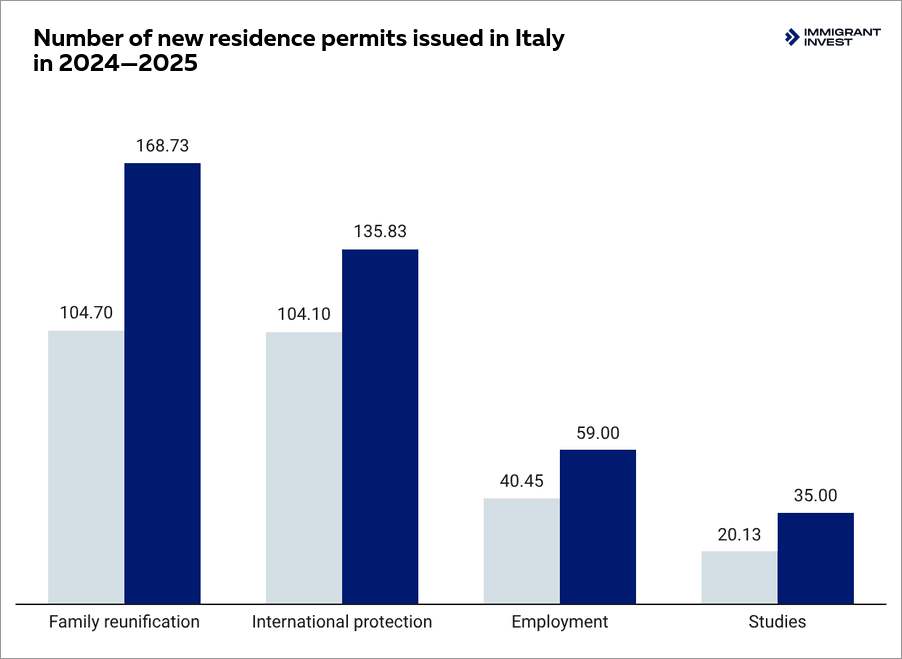
The largest increases in residence permit issuance were recorded in 4 categories:
- Study — 76%.
- Family reunification — 61%.
- International protection — 30%.
- Employment — 46%.
The issuance of residence permits for families increased by 61.2% compared with the previous year. At the same time, family reunification requirements in Italy became stricter. Law No. 187/2024 introduced a requirement for 2 years of continuous legal residence in the country for certain categories of applicants[2]Source: Law No. 187 of December 9th, 2024, “Amendments to Immigration Legislation” in the Official Gazette of Italy. ISTAT experts suggest that the increase in the number of permits issued may be related to the processing of applications submitted before the new restrictions came into force.
Italy issued a record number of entry permits. More new residence permits were issued only in 2022, when many refugees arrived from Ukraine.
Which nationalities received the most residence permits — and in which Italian regions
Citizens of 5 countries accounted for around 42% of all new residence permits issued by Italy to third-country nationals in 2025.
India recorded the most significant increase: the number of new residence permits issued to its citizens rose by 79%. For citizens of Morocco, the figure increased by 73%, and for citizens of Egypt, by 59%.
In 2025, citizens of the following countries received the most new Italian residence permits:
- Morocco — 44,549.
- Bangladesh — 39,807.
- Egypt — 32,235.
- Albania — 31,777.
- India — 30,227.
The largest number of new residence permits was issued in Lombardy: 98,128 permits, or 23% of the total. Emilia-Romagna ranked second with 38,789 residence permits.
The largest increases compared with 2024 were recorded in Lombardy, at 61.6%, Veneto, at 57.4%, and Campania, at 55.8%.

Robert Outerbridge,
Investment Migration Expert
As of December 31st, 2025, more than 4 million third-country nationals held valid residence permits in Italy. During the same year, more than 178,000 people obtained Italian citizenship.
Why residence permit issuance increased by category
The issuance of student residence permits increased by 76%. This is the highest figure since 2010. The growth is linked to initiatives by Italian universities to attract international students.
The main initiatives include scholarships, tuition fee waivers, and the launch of new programs taught in English. China, Turkey, and Iran led in the number of student residence permits issued.
Italy issued 45.9% more residence permits to foreign workers than in 2024. These included:
- 32,826 residence permits for employment;
- 20,526 residence permits for seasonal work;
- 707 residence permits for self-employment.
Citizens of India, Morocco, Tunisia, Egypt, and Bangladesh received work residence permits most often.
How to obtain an Italian residence permit by investment
Foreigners from countries outside the European Union can obtain a residence permit in Italy under the Investor Visa for Italy programme.
Four investment options are available:
- Investment in an innovative startup — €250,000.
- Investment in an Italian company — €500,000.
- Charitable donation to projects of public interest — €1,000,000.
- Purchase of Italian government bonds — €2,000,000.
The residence permit is valid for 2 years and can be renewed for another 3 years if the investment is maintained.
Immigrant Invest lawyers will help choose a suitable option and prepare documents based on the investor’s family composition and goals.


 Trusted by 10,000+ investors