










Eurostat has published data on the number of residence permits issued in 2025.
Vladlena Baranova, head of Legal & AML Compliance Department, CAMS, IMCM, explains which countries issued the most residence permits and the main reasons why foreigners moved there.
Overall statistics on residence permits issued
EU countries issued 3.9 million first residence permits in 2025[1]Source: Eurostat — Statistics on first permits issued during the year. This was 10.1%, or 355,350 permits, more than a year earlier. The figure was the highest since records began in 2008.
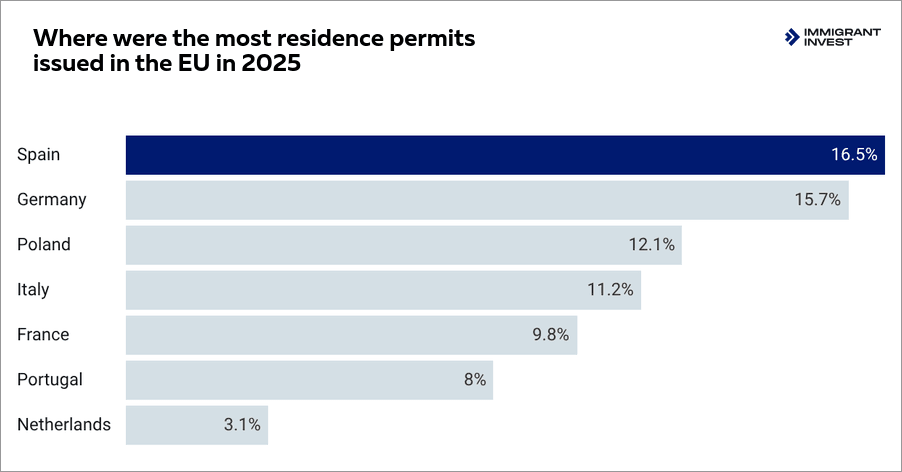
The largest numbers of first residence permits in 2025 were issued by:
- Spain.
- Germany.
- Poland.
- Italy.
- France.
- Portugal.
- The Netherlands.
These 7 countries accounted for 76.4% of all first residence permits issued to non-EU citizens in 2025.
Portugal recorded the strongest year-on-year growth: the number of first residence permits increased by 154.9%, from 121,872 in 2024 to 310,639 in 2025. Romania, Italy and Slovakia also recorded notable increases.
The number of first residence permits declined in Croatia, Greece and Austria. The figure fell by 43.3% in Croatia, 20.6% in Greece and 15.5% in Austria.
Employment is the most common reason for obtaining a residence permit
In 2025, residence permits for employment accounted for 33.6% of all first permits issued in the EU, or about 1.3 million.
Other reasons were distributed as follows:
- family reunification — 28.1%;
- study — 15.5%;
- other reasons, including international protection programmes — 22.8%.
Compared with 2024, EU countries issued 179,701 more first residence permits for employment, 133,941 more for family reasons and 49,623 more for study.
Where residence permits were most often issued for work, family reunification, and study
Employment was the main reason for issuing first residence permits in 13 EU countries. The highest shares of employment-related permits were recorded in:
- Croatia — 93%;
- Romania — 81.5%;
- Lithuania — 78.5%;
- Portugal — 77.4%.
Poland, Portugal, Spain and Germany issued the largest numbers of first residence permits for employment. Together, these countries accounted for 60.3% of all first employment-related residence permits in the EU.
Spain, Germany, Italy and France issued the largest numbers of first residence permits for family reunification, while France, Germany and Spain led in permits for study.
Which nationalities received residence permits most often
Ukrainian citizens received the largest number of first residence permits in the EU in 2025 — 335,096, or 8.7% of the total. Indian citizens ranked second with 227,577 permits, or 5.9%, followed by Moroccan citizens with 202,054, or 5.2%.
Brazil and Pakistan entered the top 10 countries whose citizens most often received first residence permits in the EU. They replaced Bangladesh and Afghanistan.

Vladlena Baranova,
Head of Legal & AML Compliance Department, CAMS, IMCM
The choice of country for residence is often influenced by geographical proximity, language, historical ties and established expat communities. For example, many Ukrainians and Belarusians obtained residence permits in Poland, Moroccans in Spain and France, Brazilians in Portugal, and Turkish citizens in Germany.
Across the EU, an average of 9 first residence permits per 1,000 residents were issued in 2025. The highest rates relative to population were recorded in Malta, with 57 permits per 1,000 residents, Cyprus with 47 and Portugal with 27.
The lowest rates were recorded in Slovakia, Czechia, Romania, Estonia and Bulgaria, with 4 first residence permits per 1,000 residents.
Can you obtain residence in Europe by investment?
Yes. Applicants need to prove their financial solvency, pass Due Diligence and meet an investment requirement.
Close family members may obtain residence together with the main investor, including a spouse, children and parents.
Greece and Cyprus offer residence through property investment, while Portugal offers investment options involving funds and culture. In Cyprus, applicants receive permanent residence for life immediately. Latvia offers 2 investment options: investment in a business or a new state fund.
Countries where foreigners can obtain residence by investment



The Immigrant Invest team will help applicants choose a suitable country, prepare the documents and obtain residence abroad based on their family and business goals.
The company’s in-house Compliance Department conducts checks that reduce the probability of residence permit refusal to 1%.

 Trusted by 10,000+ investors