Summary
Foreign nationals can obtain two main types of visas for Malta. Those staying for fewer than 90 days apply for a Schengen C visa, while stays exceeding 90 days require a National D visa. The D visa usually allows the holder to apply for a residence permit and is often issued for purposes such as employment, study, or family reunification.
Wealthy individuals may obtain residency directly, without a D visa, by investing at least €30,000 for a temporary residence permit or €169,000 for permanent residency.
What types of visas exist in Malta?
Malta issues two main types of visas for foreign nationals: the Schengen short-stay C visa and the National long-stay D visa. These visas differ in the length and purpose of stay, as well as the legal framework governing them.
Schengen short-stay C visas
The C visa is typically issued for short-term purposes such as tourism, business trips, visiting family or friends, attending cultural or sporting events, short training courses, or receiving medical treatment.
Depending on travel needs, the visa may be single-entry, double-entry, or multiple-entry.
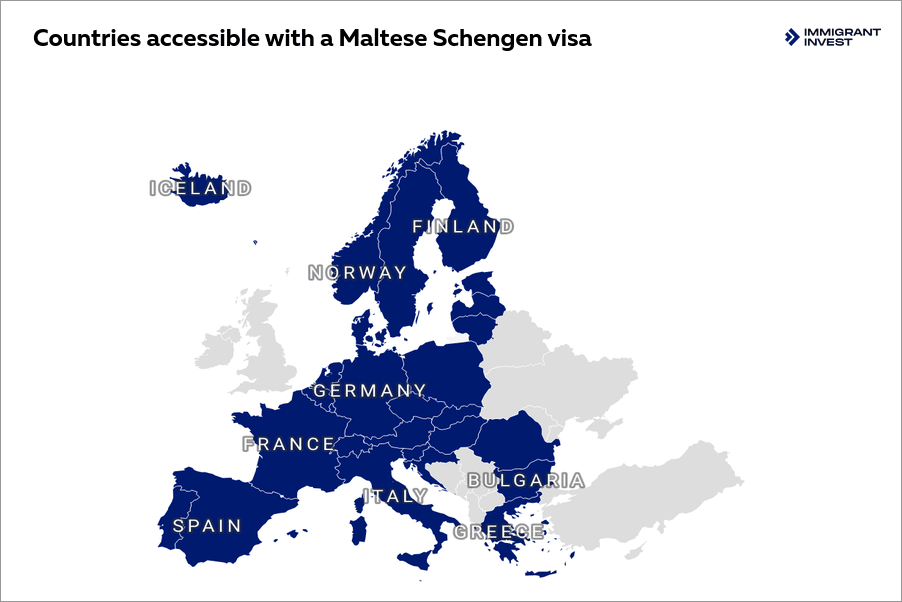
C visa holders may travel freely within the Schengen Area[1] during the period of validity, but not for longer than 90 days within any 180-day period.
National long-stay D visas
The D visa is intended for individuals who plan to stay in Malta for more than 90 days and is most often required by those moving to Malta for work, study, or family reunification.
This visa is usually granted for up to one year and is governed by Malta’s national immigration regulations rather than the Schengen framework.
Upon arrival, D visa holders must apply for a residence permit to remain in Malta legally beyond the visa’s validity. However, neither the visa nor the residence permit issued under it automatically grants unrestricted travel within the Schengen Area beyond the short-stay limit.
Non-D visa residency
Besides D visas, there are other paths to Maltese residency available to foreigners investing in the country’s economy. The temporary residence permit is offered under the Malta Global Residence Programme, MGRP, while permanent residence is available under the Permanent Residence Programme, MPRP.
The MGRP and MPRP are distinct from D visas in that they are based on investment and financial capacity, offering greater stability and benefits, whereas D visas are usually granted on the basis of specific activities.
How to obtain a short-stay visa to Malta?
To obtain a short-stay Schengen visa for Malta, applicants must follow a structured process to ensure they meet both Schengen and Maltese entry requirements.
1. Determine if you need a visa
Citizens of EU and Schengen countries do not need a visa to enter Malta. Nationals of countries with visa-free agreements with Malta, such as the US, UK, or Canada, also do not need a visa and can enter with their passports.
Nationals of countries without visa-free agreements with Malta, such as India, China, or South Africa, must apply for a Schengen short-stay visa before travelling.
A full list of countries subject to visa requirements is available on Malta’s Central Visa Unit website[2].
2. Choose the purpose of your visit
The C visa can be issued for several purposes, including:
- tourism;
- business or professional meetings;
- visiting family or friends;
- attending cultural, sports, or academic events;
- short-term study or training under 90 days;
- medical treatment.
The purpose of the visit must be supported by specific documents.
3. Prepare the required documents
Applicants must submit a complete set of supporting documents with their application. These typically include:
- completed visa application form;
- valid passport — issued within the past 10 years and valid for at least 3 months beyond the intended departure date;
- recent passport-sized photos meeting Schengen standards;
- proof of travel purpose, such as hotel bookings, invitation letters, or event confirmations;
- proof of financial means, showing you can cover accommodation, transport, and living expenses during your stay;
- travel medical insurance with coverage of at least €30,000 for medical emergencies and repatriation;
- proof of return travel, such as a booked round-trip ticket.
Additional documents may be required depending on your reason for travel — for example, an employment letter for business travel or an invitation from family members in Malta.
4. Book an appointment and submit the application
Applications are usually submitted in person at the nearest Maltese embassy, consulate, or visa application centre.
Some applicants may be required to provide fingerprints if they have not done so in the past 5 years.
5. Pay the visa fee
The standard Schengen visa fee is €90 for adults and €45 for children aged 6—12. Certain applicants, such as students or children under 6, may be exempt from the fee.
6. Wait for processing
Visa processing usually takes 15 calendar days, though it can take longer during busy periods or if additional checks are required. Applicants are advised to apply at least 3 weeks before their intended trip.
7. Receive the decision
If approved, the visa sticker will be placed in your passport, indicating the number of entries, validity period, and length of authorised stay.
If refused, the applicant will receive a written explanation and may have the right to appeal the decision.
What are the main types of long-stay visas?
Malta offers several types of long-stay visas for individuals intending to live, work, or study in the country for more than 90 days. These visas allow holders to remain in Malta legally for the purpose specified in their application and are often the first step towards obtaining a residence permit.
Digital Nomad Visa
Malta’s Digital Nomad Visa, also known as the Nomad Residence Permit, is designed for remote workers who earn their income from sources outside Malta. It allows digital professionals to live in Malta while working for a foreign employer or running a remote business[6].
To qualify, applicants must have a minimum monthly income of €3,500 and provide proof of employment or self-employment.
The visa is initially valid for 1 year and can be renewed up to 3 times.

Employment visa
Malta has two types of employment visas: the standard work permit, also known as the Single Permit, and the EU Blue Card for highly qualified professionals — both issued under the supervision of Identità Malta’s Expatriates Unit.
The Single Permit allows a foreign national to live and work in Malta for a specific employer and role. Applicants must first secure a job offer from a Maltese employer, who then submits the application jointly with the employee.
Under the Single Permit, two special schemes are offered:
- Key Employee Initiative, KEI[3] — designed for highly skilled professionals in senior or technical roles.
- Specialist Employee Initiative, SEI[4] — intended for mid-level skilled workers with technical expertise in sectors facing labour shortages, such as IT, finance, and engineering.
The minimum salary under the KEI is €45,000 per year, and under the SEI it is €30,000 per year. For employees not eligible for these schemes, no minimum salary is officially established.
The Single Permit is usually valid for one year and can be renewed as long as employment is maintained.
The EU Blue Card[5] is a unified EU initiative for highly qualified professionals from non-EU countries. It grants the holder the right to work in Malta and, under certain conditions, in other EU Member States. After 12 months of legal employment in Malta, Blue Card holders may move to another Member State to work under simplified procedures.
To qualify for the EU Blue Card, applicants must hold a university degree or equivalent qualification and have a binding job offer for at least 6 months in a highly skilled role. The offered salary must be at least 1.5 times the national average gross salary — roughly €3,125 in 2025.
The residence permit under the Blue Card scheme is issued for up to 2 years, or for the duration of the employment contract plus 3 months, and is renewable.
Student visa
The student visa is granted to non-EU citizens enrolled in educational institutions in Malta for courses lasting longer than 90 days.
Applicants must provide proof of enrollment, sufficient financial resources to cover tuition and living costs, valid health insurance, and accommodation arrangements.
The visa duration corresponds to the length of the academic programme.
Family reunification visa
The family reunification visa enables family members of Maltese citizens or legal residents to join their relatives in Malta. Eligible family members usually include spouses, children, and dependent parents.
Applicants must provide proof of the family relationship, evidence of adequate accommodation, health insurance, and sufficient financial means to support themselves in Malta.
Other long-stay visas
Besides the main categories, Malta also offers several other long-stay visas for specific purposes:
- business or self-employment visa — for entrepreneurs who intend to establish or manage a business in Malta;
- research or training visa — for researchers, interns, or professionals attending long-term training programmes;
- religious or missionary visa — for members of recognised religious organisations residing in Malta for religious or charitable work;
- medical treatment visa — for individuals undergoing long-term medical care in Malta;
- voluntary or cultural visa — for participants in volunteer, cultural, or youth exchange projects lasting over 90 days.
Each visa type has specific requirements but allows legal residence in Malta for more than 3 months.

What are the financial requirements for D visas?
Applicants for a long-stay D visa must demonstrate sufficient financial means to support themselves in Malta without relying on public assistance. The required amount varies by visa category and must cover accommodation, living expenses, insurance, and transport for the entire stay.
Applicants can usually prove their financial capacity through several types of documentation, such as:
- recent bank statements — usually covering the past 3 to 6 months, showing regular income or sufficient savings;
- payslips or employment contracts — confirming salary and job stability;
- scholarship or sponsorship letters — for students;
- tax declarations or audited financial accounts — for self-employed applicants;
- evidence of prepaid accommodation or a rental contract — to demonstrate living arrangements.
All documents must be official, verifiable, and in English or accompanied by a certified translation.
Financial requirements for D visas: comparison
What is an e-residence permit card and how to obtain it after a D visa?
A e-residence permit is a Maltese residence card for foreign nationals legally residing in the country. To obtain it, they enter Malta on a D visa and file an application for the card to the migration authorities.
How Malta’s e-residence permit works
The “e” in “e-residence permit” stands for “electronic”: the card is a smart, chip-based document that stores the holder’s personal and biometric data. This includes fingerprints, photo, and signature, along with electronic certificates for digital identification and signatures.
The card serves as official proof of residence and indicates the legal basis of stay, such as employment, study, investment, or family reunification. Holders use it to access government online services through an e-ID account, enabling secure digital authentication for administrative procedures without visiting offices in person.
The e-residence permit replaced paper-based residence stickers in 2013, modernising Malta’s identity management system in line with EU standards. It now functions similarly to Maltese citizens’ e-ID cards and is required for all non-EU nationals entering Malta on a long-stay visa or residence programme.
Obtaining process
To obtain an e-residence card in Malta, residents go through the following steps:
- Enter Malta using the D visa. The D visa grants legal entry and a limited stay, typically up to 180 days. During this period, the applicant must begin the residence registration process. The visa cannot be extended.
- File a residence permit application with Identità. The applicant applies through Identità’s Expatriates or Residence services by completing the official application form and submitting all required supporting documents. The application is usually made in person or via the online portal[7].
- Submit biometrics. The applicant provides biometric data at an Identità office in Malta.
- Obtain the e-residence card. After verifying all documentation and biometric data, Identità issues the e-residence permit card, which serves as the official residence document.
Cardholders must report any changes in address, marital status, or employment to the national authority, Identità. When the residence status or purpose changes, a new application must be submitted to update the permit.
If the card is lost, stolen, or damaged, the holder must report it immediately and apply for a replacement.
Government bodies responsible
Identità verifies the authenticity and adequacy of financial documents during both the visa and e-residence card stages.
Jobsplus checks employment contracts, income levels, and sectoral wage compliance for work-related applications.
Educational and research institutions confirm the value of scholarships or stipends for student and research visas.
What are the requirements for obtaining a Malta investment residence permit?
There are two government-approved investment paths to residency in Malta: for temporary permit and special tax status through the Global Residence Programme and for life-long status through the Permanent Residence Programme. Below, we’ll take a closer look at the tax residence permit and what it means in practice.
Under Malta’s Global Residence Programme, MGRP, foreigners must make qualifying investments: either rent or purchase real estate and pay an administration fee. They must also pay an annual tax of €15,000.
Eligibility requirements for investors and family members
The investor must meet the following requirements:
- be at least 18 years old;
- have a clean criminal record;
- possess legal and stable income;
- have health insurance;
- demonstrate basic conversational English or Maltese.
Applicants must also pass the Due Diligence checks conducted by the Maltese authorities.
Family members who can be included in the application are the spouse or partner, children under 25 years old, and parents, grandparents, and siblings of the investor or spouse, provided they are principally financially dependent.
Tax residency. Under the MGRP, applicants must become Maltese tax residents. Thus, they are not allowed to spend more than 183 days per year in any other country to avoid losing Maltese tax residency.
Investment requirements
Applicants can qualify by either purchasing or renting residential property in Malta.
If purchasing property, the investments are as follows:
- property value — €275,000+ in the north or centre of Malta, or €220,000+ in the south of Malta or on the island of Gozo;
- administration fee — €6,000, reduced to €5,500 for properties in the south or Gozo.
The qualifying property must be maintained for the duration of residence and cannot be rented out or subleased.
If renting property, the investments are as follows:
- rent — €9,600+ per year in the north or centre of Malta, or €8,750+ per year in the south or Gozo;
- administration fee — €6,000.
Participants must also pay an annual tax at a flat rate of 15% on foreign income remitted to Malta, with a minimum of €15,000 per family.
How to obtain an investment residence permit in Malta
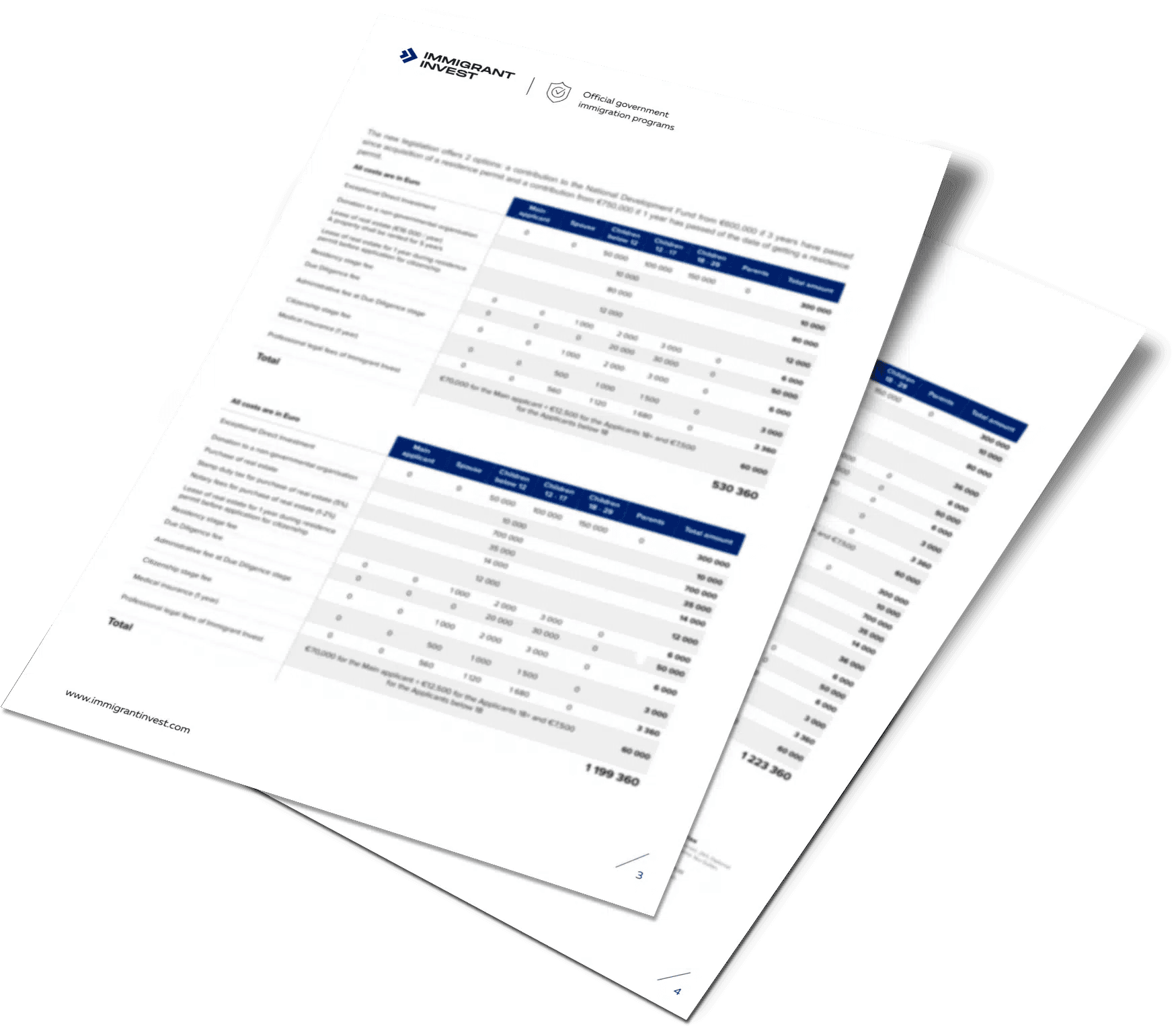
Foreigners cannot apply for the investment residence permit under the MGRP on their own — they must be represented by a licensed agent, such as Immigrant Invest. Lawyers assist applicants throughout the entire procedure, from preparing documents to obtaining residence permit cards.
The process takes at least 3 months, according to Immigrant Invest’s experience.
1 day
Preliminary Due Diligence
Immigrant Invest first conducts an internal Due Diligence review to identify any issues that could prevent approval under the programme. Once the check is complete and no concerns arise, a service agreement is drawn up to formalise cooperation.
All verification procedures are handled discreetly and remain fully confidential.
Immigrant Invest first conducts an internal Due Diligence review to identify any issues that could prevent approval under the programme. Once the check is complete and no concerns arise, a service agreement is drawn up to formalise cooperation.
All verification procedures are handled discreetly and remain fully confidential.
4—5 weeks
Document preparation
Lawyers assist the applicant in collecting, translating, and certifying all required documents according to Maltese regulations. Most translations are arranged in Malta, though applicants may also translate documents in their home country, provided they are properly apostilled or legalised.
Once complete, the full application is submitted to the Inland Revenue Department, IRD.
Lawyers assist the applicant in collecting, translating, and certifying all required documents according to Maltese regulations. Most translations are arranged in Malta, though applicants may also translate documents in their home country, provided they are properly apostilled or legalised.
Once complete, the full application is submitted to the Inland Revenue Department, IRD.
2—4 months
Official Due Diligence
The IRD carefully reviews all submitted documentation for the investor and family members. If the department needs clarification or additional materials, the lawyers coordinate responses with the applicant before submission.
The IRD carefully reviews all submitted documentation for the investor and family members. If the department needs clarification or additional materials, the lawyers coordinate responses with the applicant before submission.
At least 2 weeks
Online interview and special tax status approval
The applicant participates in an online interview with the Director of the Inland Revenue Department. If approved, the investor receives a Letter of Intent confirming eligibility for the programme.
The investor then pays the required minimum tax and submits proof of accommodation. Once these conditions are met, the special tax status is officially granted, typically within 2 to 4 weeks.
The applicant participates in an online interview with the Director of the Inland Revenue Department. If approved, the investor receives a Letter of Intent confirming eligibility for the programme.
The investor then pays the required minimum tax and submits proof of accommodation. Once these conditions are met, the special tax status is officially granted, typically within 2 to 4 weeks.
At least 2 weeks
Residency application and biometric submission
After receiving tax clearance, the residence application is filed electronically through the Maltese government portal. If no additional documents are needed, applicants typically receive an invitation to submit biometrics within 2—4 weeks. Applicants can then book their fingerprinting appointment in Malta at their convenience.
After receiving tax clearance, the residence application is filed electronically through the Maltese government portal. If no additional documents are needed, applicants typically receive an invitation to submit biometrics within 2—4 weeks. Applicants can then book their fingerprinting appointment in Malta at their convenience.
4—6 weeks
Issuance of residence cards
The Identity Malta Agency reviews the case and, once approved, sends a written notice confirming that the residence cards are ready. The investor and family must travel to Malta personally to collect them. In most cases, residence cards are issued within 4 to 6 weeks after biometrics submission.
The first residence permit under the MGRP is granted for 1 year.
The Identity Malta Agency reviews the case and, once approved, sends a written notice confirming that the residence cards are ready. The investor and family must travel to Malta personally to collect them. In most cases, residence cards are issued within 4 to 6 weeks after biometrics submission.
The first residence permit under the MGRP is granted for 1 year.
Tax return every year; residence card in 1—2 years
Renewal
Holders of special tax status must file an annual tax return through their Agent to the Malta Revenue Service by June 30th each year. The return must include any updates affecting their GRP status.
The payment covers the previous fiscal year, regardless of when the GRP was granted. Confirmation of valid GRP status is typically issued within 2 weeks.
Once tax compliance is confirmed, applicants renew their residence card online through Identità. Biometrics must be retaken in person, and the new card is usually issued within 2—6 weeks.
After the first renewal, residence permit cards are issued for 2-year periods.
Holders of special tax status must file an annual tax return through their Agent to the Malta Revenue Service by June 30th each year. The return must include any updates affecting their GRP status.
The payment covers the previous fiscal year, regardless of when the GRP was granted. Confirmation of valid GRP status is typically issued within 2 weeks.
Once tax compliance is confirmed, applicants renew their residence card online through Identità. Biometrics must be retaken in person, and the new card is usually issued within 2—6 weeks.
After the first renewal, residence permit cards are issued for 2-year periods.
Why can a visa or a residence permit application be rejected?
The reasons for rejection depend on the type of visa or residence permit but the most common include problems with documents and background, unclear purposes, or insufficient financial means.
Schengen Visa rejection
A Schengen short-stay visa for Malta may be refused if the applicant fails to prove the purpose of the visit, travel plans, or financial stability. The most common reasons include:
- incomplete documents — missing travel insurance, flight bookings, or accommodation proof;
- unclear travel purpose — lack of supporting evidence for business, tourism, or family visit;
- insufficient funds — inability to demonstrate that the applicant can cover all expenses during the stay;
- invalid passport — damaged, expired, or not valid for three months beyond departure;
- previous visa violations — overstays or Schengen Area immigration breaches;
- security concerns — if the applicant is deemed a public-order or migration risk.
D visa rejection
A D visa can be rejected if the applicant does not meet the conditions tied to the purpose of residence, such as work, study, or family reunification. Main reasons include:
- failure to prove eligibility — missing employment offer, school enrolment, or proof of family relationship;
- financial insufficiency — inadequate income or savings to support stay in Malta;
- inaccurate or false information — inconsistencies in application details or forged documents;
- health or insurance issues — lack of valid health insurance covering the entire period of stay;
- negative background checks — criminal records or adverse security findings.
Investment residence permit rejection
Applications for residence under the Malta Global Residence Programme may be refused if the applicant fails to meet investment or tax obligations. Common grounds include:
- failure to meet property criteria — not maintaining qualifying rental or owned property;
- unpaid taxes — failure to pay the minimum annual €15,000 tax or submit the required tax return;
- unverified source of funds — inability to prove the legality of income used for investment or rent;
- adverse Due Diligence results — connections to financial crime or reputational risk;
- incomplete or inaccurate documentation — missing health insurance, identification, or translations.
How to obtain Malta permanent residency without a temporary visa?
Investors can apply for Malta permanent residence through the Malta Permanent Residence Programme, MPRP. This route allows investors to obtain permanent residence directly, bypassing temporary permits[8].
To apply for the MPRP, foreigners must meet specific eligibility and investment requirements.
Eligibility requirements for investors and family members
The main applicant must meet the following requirements:
- be at least 18;
- have no criminal record;
- not be subject to international sanctions;
- have no previous visa refusals;
- demonstrate the legality of their income;
- possess assets worth at least €500,000, of which €150,000 must be in financial assets, or alternatively, assets of at least €650,000, of which €150,000 must be in financial assets.
Eligible dependants include the spouse or partner, including same-sex partners, unmarried children under 29, and parents or grandparents who are financially dependent on the investor or their spouse.
Investment requirements
Applicants must fulfil a combination of property, contribution, and donation conditions.
If the investor rents a property, the minimum cost must be €14,000 per year for 5 years. If the property is purchased, its value must be at least €375,000, and it must be owned for a minimum of 5 years.
Additional obligations for both options include:
- administrative fee — €60,000 for the main applicant and €7,500 for each additional adult family member, excluding the spouse;
- government contribution — €37,000;
- donation — €2,000 to a Maltese charitable organisation.
Application process and timeline
The full process takes at least 6 months and does not require prior residence in Malta. Each applicant undergoes the following steps:
- Preliminary Due Diligence. A licensed agent conducts a confidential internal background check, which reduces risks of rejection.
- Document collection. Lawyers provide a list of required documents and assist in preparing them for submission, including certification and arranging translations.
- Application submission. The licensed agent files the application to the Residency Malta Agency.
- Main Due Diligence. The Residency Malta Agency conducts a detailed assessment of the investor’s financial and personal background.
- Approval in Principle. After approval, the investor fulfils all investment and donation obligations.
- Biometrics and issuance of residence permit cards. Applicants visit Malta to submit biometrics and receive residence cards valid for 5 years.

Julia Loko,
Investment programs expert
While Maltese permanent residence is valid for life, the residence card is valid for 5 years. After this period, holders must renew it by confirming continued compliance with the programme’s conditions.
For renewal, investors must provide proof of a residential address in Malta — either a lease or a purchase agreement in their name — along with evidence of regular income or sufficient funds to support themselves and their dependants without relying on public assistance.
We help investors to prepare the required documents for card renewal and to communicate with the Maltese authorities.
Required documents
Applicants for the MPRP must prepare the following:
- valid passports and birth certificates for all family members;
- proof of income and assets, including bank statements and asset certificates;
- police clearance certificates for adults;
- health insurance policy covering the EU;
- lease or property purchase agreement in Malta;
- completed government forms and signed authorisations, submitted through a licensed agent.
All copies must be certified by a notary, and translations must be carried out by an accredited translator. Applicants can choose one of the following:
- have documents translated and certified in Malta under local notarial supervision;
- provide translations completed in their country of residence, apostilled or legalised according to international standards.
How do Malta's visa types compare?
Malta offers several visa and residence options, each designed for different purposes and durations. The C visa and D visa cover short- and long-term stays.
The Malta Global Residence Programme and the Malta Permanent Residence Programme offer residence permits but are not considered D visas.
C Visa vs. D Visa vs. MGRP vs. MPRP: comparison
Key takeaways
- Malta has two main types of visas: C Schengen visas for stays of up to 90 days and D National visas for stays of over 90 days.
- C visas are granted mainly for tourism and allow travel within the entire Schengen Area.
- D visas are granted for purposes such as employment, study, or family reunification, and allow foreigners to obtain Maltese residence permits.
- Wealthy foreigners can also obtain residence permits in Malta by investment under the Global Residence Program or the Permanent Residence Programme.
- The process of obtaining a C visa takes around 15 days, and a D visa takes at least 1 month. A temporary residence permit is granted in approximately 3 months, while permanent residence takes around 6 months.
Immigrant Invest is a licensed agent for citizenship and residence by investment programs in the EU, the Caribbean, Asia, and the Middle East. Take advantage of our global 15-year expertise — schedule a meeting with our investment programs experts.
Will you obtain permanent residence in Malta?
-
Master the residency process
-
Get expert tips and documents
-
Estimate costs accurately
 Trusted by 5000+ investors
Sources
- Source: Full list of the Schengen countries
- Source: List of countries whose nationals need the Schengen visa to Malta
- Source: Requirements for employees under the Key Employee Initiative
- Source: Requirements for employees under the Specialist Employee Initiative
- Source: EU Blue Card requirements
- Source: Requirements for the Nomad Residence Permit in Malta
- Source: Government portal for Maltese residents and citizens
- Source: Malta Permanent Residence Programme legal framework