









In 2024, Turkish nationals submitted 1,173,917 Schengen visa applications, one of the highest volumes globally, with a refusal rate of 14.5%[1]Source: Official figures by the European Commission. Processing timelines and refusals disrupted travel plans, at times resulting in missed business meetings and cancelled procurement trips.
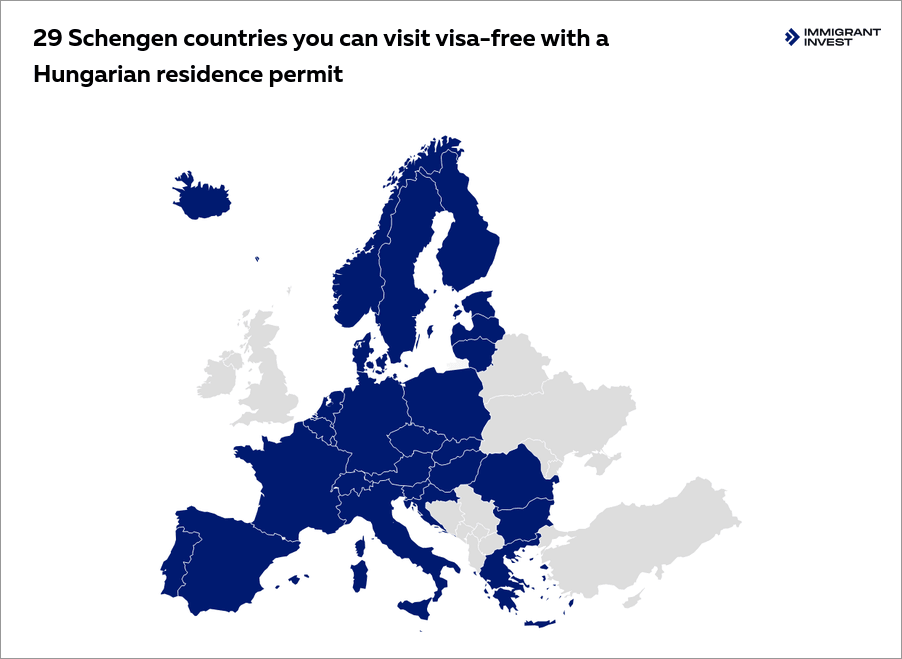
Against this backdrop, the Hungary Golden Visa offers a predictable alternative to high-net-worth individuals. It grants a 10-year residence permit in exchange for an investment starting at €250,000. As the permit requires no minimum stay, Turkish nationals may live in their home country while travelling across 29 Schengen states without repeated visa applications.
The Golden Visa also provides the option to relocate to Hungary, access to European healthcare and education, and a potential path to EU citizenship.
What is the Hungary Golden Visa?
The Hungary Golden Visa, officially known as the Guest Investor Residence Permit[2]Source: National Directorate-General for Aliens Policing: Guidelines on the Guest Investor Residence Permit, is a legal pathway for non-EU, non-EEA, and non-Swiss nationals to obtain temporary residency in Hungary. The legal basis is Act XC of 2023, which introduced this permit for investors whose presence is considered to be in Hungary’s economic interest[3]Source: Act XC of 2023: Full text in Hungarian.
Investors have two options to choose from:
- €250,000 — purchase of investment fund units;
- €1,000,000 — non-refundable donation to a higher educational institution.
The residence permit is valid for 10 years and is renewable for a further 10 years, giving investors up to 20 years of continuous EU residence. There is no minimum stay requirement to maintain the permit.
The Hungary Golden Visa differs from a Schengen visa to Hungary in purpose and scope. A Schengen visa is a short-term travel document that does not grant residence or work rights in any Schengen state. By contrast, the Hungary Golden Visa is a residence permit that allows applicants to live in Hungary for up to 10 years, work and run a business there, and avoid repeated short-stay visa applications.

Trusted by 10,000+ investors
Check your eligibility for the Hungary Golden Visa
10 benefits of the Hungary Golden Visa for Turkish citizens
The Hungary Golden Visa offers many benefits for Turkish citizens, including visa-free travel within the Schengen Area, long residence permit validity, and a clear path to EU citizenship.
1. Access to the Schengen Area
Hungary is part of the Schengen Area, allowing its residents to travel visa-free within the region for up to 90 days in any 180-day period without a separate short-stay visa. For Turkish nationals, this removes the need for repeated visa applications and ongoing paperwork.
Although the EU’s July 2025 cascade rule[4]Source: European Commission: New rules for Turkish citizens is designed to facilitate access to longer-term multi-entry visas, progressing from 1-year to 3-year and then 5-year ones, Turkish nationals still remain subject to visa requirements, including regular renewals and proof of travel history. By contrast, the Hungary Golden Visa leads to a residence permit and does not require reapplication for each trip or on an annual basis.
2. Post-approval investment
Applicants transfer the investment only after obtaining the national D visa issued for entry to Hungary. Before granting this visa, Hungarian authorities conduct Due Diligence checks on the applicant. If no issues are found and the D visa is granted, the likelihood of residence permit refusal decreases significantly. This means the risk of losing the investment due to application rejection is low.
3. 10-year validity
Under the Hungary Golden Visa programme, investors obtain 10-year residence permits. No other EU country grants residence permits to investors with such a long validity. By comparison, Portugal issues 2-year permits, while Greece and Latvia issue 5-year ones.
Hungarian residency can be extended once for an additional 10 years. This means that a Turkish national who obtains the permit in 2026 can hold EU residence status until 2036, and until 2046 upon renewal.
4. No minimum stay requirement
Residency remains valid regardless of how much time the holder spends outside Hungary, provided the investment is maintained and the permit is renewed on time. Turkish nationals can maintain their lives in Türkiye without jeopardising their Hungarian permit.
5. Work and business rights in Hungary
The Golden Visa allows the main applicant to work and conduct business in Hungary without switching to another residence category. For Turkish entrepreneurs, this has clear practical advantages. A permit holder may register a Hungarian company, operate within the EU legal and banking environment, invoice European clients more easily, and use Hungary as a base for regional expansion.
Hungary is fiscally attractive: the standard corporate income tax rate is 9%, which remains the lowest headline rate in the EU.
6. Residency for the entire family
The Hungary Golden Visa rules allow investors to add close family members to the application. Spouses or registered partners and children under 18 can be included without any additional requirements. Parents can be included if they are financially dependent on the investor.
All family members are granted the same 10-year residence permit at the same time, with no need for separate applications. Dependants enjoy the same rights as the main applicant, including the ability to live, work, study, and run a business in Hungary.
7. Access to European healthcare
Hungary gives residence permit holders access to a public healthcare system, with the option to use private care for faster appointments or English-speaking doctors. The country offers universal coverage and a wide range of services, including primary care, specialist treatment, hospital care, and pharmaceuticals.
If insured under the Hungarian public system, permit holders may apply for a European Health Insurance Card, EHIC, through the National Health Insurance Fund. The EHIC provides access to medically necessary state healthcare during temporary stays in EU and EEA countries, Switzerland, and the UK, under the same conditions and cost as for local residents. However, it does not replace private travel insurance or cover planned treatment abroad.
8. European education for children
Golden Visa holders can study in Hungary without the need to switch to a student residence permit. The country has several universities, with five of them ranked among the top 1,000 worldwide. The leading institutions include the University of Debrecen, Eötvös Loránd University in Budapest, and the University of Szeged[5]Source: QS World University Rankings 2026: Best Hungarian universities.
Hungarian universities participate in the Erasmus+ programme, which allows students to spend a semester or a year at partner institutions across Europe. This provides access not only to Hungarian education but also to a broader academic network and international study opportunities.
9. Relocation to a country with high quality of life
Hungary offers Turkish investors a practical relocation base within the EU, rather than just a formal residence document. In the Global Peace Index 2025[6]Source: Global Peace Index 2025 report: Full text, Hungary ranks 17th worldwide, placing it among the more peaceful countries globally.
According to the OECD’s latest country note, Hungary performs above the OECD average in work-life balance and social connections, ranking higher than countries such as Greece, the UK, the US, and Canada[7]Source: OECD Better Life Index: Hungary’s overview.
For many Turkish families, this translates into a more stable day-to-day environment, lower pressure than in some larger Western European cities, and access to a centrally located country well positioned for business, study, and travel across Europe.
10. Path to EU permanent residence and citizenship
The Hungary Golden Visa is one of the very few residence permits that can serve as a first step towards Hungarian permanent residence and citizenship.
Permanent residence may be obtained after 3 years of continuous residence in Hungary. After a further 8 years, permit holders may apply for Hungarian naturalisation, provided they meet all requirements.
Eligibility requirements for Turkish citizens applying for the Hungary Golden Visa
Turkish nationals qualify for the Hungary Golden Visa as third-country nationals, provided they meet all requirements. The investor may include close family members in the application.
Requirements for the main applicant
Turkish applicants must meet the following eligibility criteria:
- be over 18;
- prove a legitimate and fully documented source of funds;
- have a clean criminal record, confirmed by an Adli Sicil Belgesi;
- obtain health insurance;
- provide proof of sufficient funds to cover living expenses in Hungary;
- not be listed in the Schengen Information System for expulsion or entry bans;
- not pose a threat to public order, national security, or public health.
Requirements for family members
Family members may be included in the same application. Eligible family members are:
- spouse or registered partner;
- children under 18;
- parents.
Parents must be financially dependent on the main applicant, with pension as their only source of income.
All included family members receive the same 10-year permit simultaneously. Additional administrative costs apply per dependent.
Hungary Golden Visa investment options for Turks
There are currently two valid investment routes for the Hungary Golden Visa. A third route, direct real estate purchase, was announced but never came into force.
Option 1: Purchase of real estate investment fund units
The applicant acquires fund units for at least €250,000 in a real estate fund registered with the Hungarian National Bank. To qualify, the fund must allocate at least 40% of its net asset value to residential real estate projects within Hungary.
As of early 2026, two funds are registered and approved for this purpose by the Hungarian National Bank:
- Sprint Fund, managed by SPRINT ASSET Hungária Zrt.[8]Source: Hungarian National Bank website: General data of investment fund.
- Gravitas Fund, managed by Gránit Alapkezelő[9]Source: Official website of the Gránit Alapkezelő.
Investors must hold fund units for a minimum of 5 years. Capital can be recovered after this period. However, if the investor chooses to renew their residence permit for an additional 10 years, they must reinvest €250,000.
Option 2: Donation
The applicant makes a non-refundable financial donation of at least €1,000,000 to a state-recognised higher education institution in Hungary maintained by a foundation engaged in public functions.
The donation route is best suited for investors prioritising simplicity and no ongoing obligations as there is no minimum holding period and no reinvestment obligation upon renewal.

Full cost breakdown for Turkish citizens applying for the Hungary Golden Visa
The investment amount is not the only cost applicants should expect; there are additional expenses to consider.
Additional costs for Turkish applicants include:
- administrative fee — €25,000 for the main applicant, plus €1,000 for each dependent included in the application;
- brokerage account management for five years — €8,700.
The investment amount itself is fixed and does not vary with family composition.
Below is a table showing the total cost under the fund option, which is the more popular choice among investors.
Total cost for a single applicant and a family of 4 under the fund route
Step-by-step process of obtaining the Hungary Golden Visa for Turkish citizens
The application process for Turkish nationals has two phases. The first phase takes place in Türkiye and involves preparing documents and obtaining a Guest Investor D visa, which allows investors to enter Hungary. The second phase occurs in Hungary and covers completing the investment, submitting the residence permit application, and attending biometrics.
In Immigrant Invest’s experience, the average time to obtain the Hungary Golden Visa is at least 5 months. Lawyers and managers guide investors through every step of the process.
1 day
Preliminary Due Diligence
Immigrant Invest conducts an initial background check to identify any risks that may affect eligibility for the programme. The check is confidential and based on international compliance databases. Once cleared, the investor proceeds to the application stage.
Immigrant Invest conducts an initial background check to identify any risks that may affect eligibility for the programme. The check is confidential and based on international compliance databases. Once cleared, the investor proceeds to the application stage.
2+ weeks
Document preparation
Legal specialists prepare the application file, including forms and supporting documents. The investor provides originals, while the team assists with certified translations, notarisation, and compliance with Hungarian requirements.
Legal specialists prepare the application file, including forms and supporting documents. The investor provides originals, while the team assists with certified translations, notarisation, and compliance with Hungarian requirements.
≈ 1 month
Guest Investor Visa issuance
Turkish passports do not allow visa-free entry to Hungary, so Turkish investors must first obtain a national D visa, called the Guest Investor Visa. The application for it is filed in person at the Hungarian Embassy in Ankara or the Consulate General in Istanbul.
The Guest Investor Visa is granted for 6 months. Within this period, the applicant must travel to Hungary, make an investment, and submit the residence permit application.
Turkish passports do not allow visa-free entry to Hungary, so Turkish investors must first obtain a national D visa, called the Guest Investor Visa. The application for it is filed in person at the Hungarian Embassy in Ankara or the Consulate General in Istanbul.
The Guest Investor Visa is granted for 6 months. Within this period, the applicant must travel to Hungary, make an investment, and submit the residence permit application.
Within 3 months
Fulfilment of investment
After receiving the Guest Investor Visa, the applicant travels to Hungary and completes the investment. This includes opening a bank and securities account, passing KYC checks, and signing a subscription agreement with an approved fund or arranging the donation. The required amount is then transferred.
The investment must be completed within 93 days of the first entry to Hungary with the Guest Investor Visa.
After receiving the Guest Investor Visa, the applicant travels to Hungary and completes the investment. This includes opening a bank and securities account, passing KYC checks, and signing a subscription agreement with an approved fund or arranging the donation. The required amount is then transferred.
The investment must be completed within 93 days of the first entry to Hungary with the Guest Investor Visa.
2+ business days
Residence permit application
Once the investment is completed or confirmed, the investor submits a residence permit application in Hungary via the EnterHungary platform or in person.
Biometric data collection is mandatory and requires personal attendance.
Once the investment is completed or confirmed, the investor submits a residence permit application in Hungary via the EnterHungary platform or in person.
Biometric data collection is mandatory and requires personal attendance.
1+ month
Issuance of residence permit cards
The residence permit application is reviewed within 21 to 30 days. Once approved, the physical permit card is issued within 7 days.
To keep the permit, the investor must maintain fund units for at least 5 years.
The residence permit application is reviewed within 21 to 30 days. Once approved, the physical permit card is issued within 7 days.
To keep the permit, the investor must maintain fund units for at least 5 years.
After 10 years
Residence permit renewal
Once the Hungary Golden Visa approaches an expiration date, the investor can extend it for an additional 10 years.
To be eligible for an extension, investors on the fund route must demonstrate holding the qualifying investment. If fund units have been redeemed after 5 years, a new investment must be made; if the units are still held, the investor only needs to provide documentation confirming this.
Applicants who obtained the Golden Visa via the non-refundable donation route are exempt from reinvestment obligations and receive extension upon request.
Once the Hungary Golden Visa approaches an expiration date, the investor can extend it for an additional 10 years.
To be eligible for an extension, investors on the fund route must demonstrate holding the qualifying investment. If fund units have been redeemed after 5 years, a new investment must be made; if the units are still held, the investor only needs to provide documentation confirming this.
Applicants who obtained the Golden Visa via the non-refundable donation route are exempt from reinvestment obligations and receive extension upon request.
How can Turkish investors obtain Hungarian PR and citizenship after a Golden Visa?
The Hungary Golden Visa may be the first step toward both permanent residence and citizenship in Hungary, provided investors meet the eligibility requirements.
Permanent residency
Not all types of residence permits in Hungary lead to permanent residency[10]Source: National Directorate-General for Aliens Policing: Requirements for the National Residence Card, but the Golden Visa is one of the permits that does. Its holders are eligible to apply for permanent residency after continuously living in Hungary for 3 years. This period starts from the date of issuance of the initial permit.
Additional mandatory conditions include the following:
- confirming housing and means of subsistence in Hungary;
- having health insurance;
- passing Hungarian cultural knowledge exam;
- proving that granting permanent residency to the applicant serves Hungary’s national interest;
- not being threat to public or national security;
- not being subject to expulsion, entry ban, or SIS alert;
- having no criminal record.
The validity of the permanent residence card is up to 10 years, and it can be extended for further 10-year periods through. The renewal application must be submitted via the EnterHungary platform to the competent Regional Directorate of the National Directorate-General for Aliens Policing, according to the person’s place of residence.
Citizenship
To be eligible for Hungarian citizenship[11]Source: Requirements for the acquisition of Hungarian nationality, investors must meet the following requirements:
- 8 years of continuous lawful physical residence in Hungary with valid permits;
- Hungarian language proficiency at approximately B2 level;
- passing the constitutional and cultural knowledge examination;
- clean criminal record throughout the residence period;
- stable and regular income sufficient to support oneself and dependents.
The Hungarian passport is one of the strongest in the world, providing visa-free access to over 170 countries and allowing its holder to live and work in any EU member state.
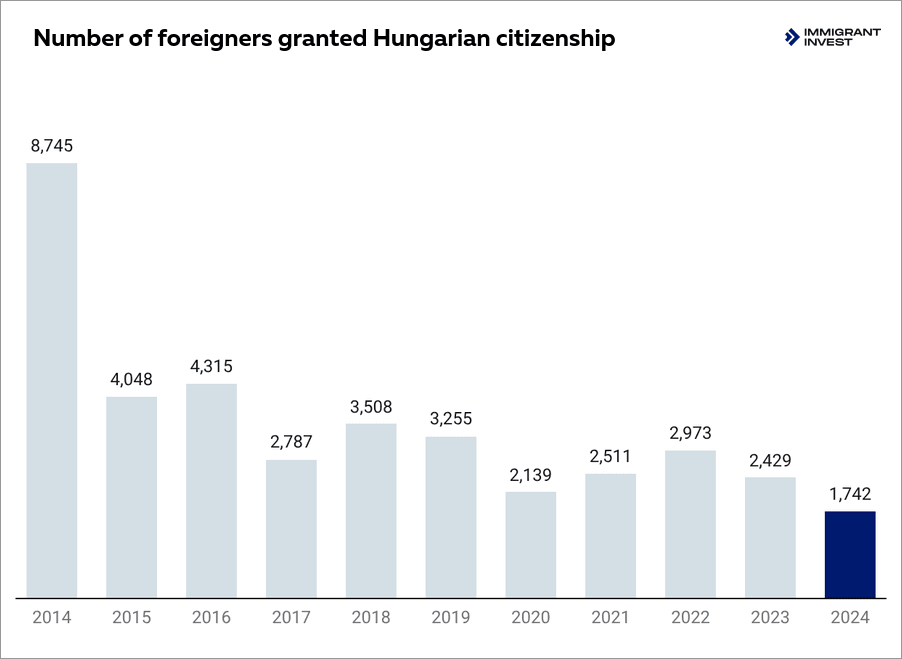
In 2011, Hungary simplified access to citizenship for ethnic Hungarians, which led to high numbers of new citizens in the first years, including 2014. The figures declined as the initial wave passed. Now, foreigners mainly obtain Hungarian citizenship by naturalisation
Tax implications for Turkish citizens holding the Hungary Golden Visa
Holding a residence permit does not automatically make a Turkish investor a Hungarian tax resident. Residency depends on factors like permanent home, centre of vital interests, and habitual abode. Spending 183+ days in Hungary is only one indicator, not decisive. If the investor’s home, business, and family remain in Türkiye, this will outweigh short stays in Hungary.
Investors who visit Hungary only for application procedures and occasional trips will almost certainly remain Turkish tax residents.
Taxes for individuals
Personal income tax. Hungary applies a flat personal income tax rate of 15%[12]Source: Worldwide Tax Summaries: Taxes on personal income in Hungary.
For Hungarian tax residents, personal income tax generally applies to worldwide income. Non-residents are generally taxed only on Hungarian-source income.
Income from employment physically performed in Hungary may be treated as Hungarian-source income even if paid from abroad, depending on the applicable tax treaty rules.
Hungary also provides several personal tax allowances that may reduce the tax base, including allowances for the following categories:
- families with qualifying children;
- young couples in a first marriage;
- mothers under 30;
- mothers raising 2 or more children;
- individuals with severe disabilities;
- young people under 25[12]Source: Worldwide Tax Summaries: Taxes on personal income in Hungary.
These personal income tax allowances are relevant for Hungarian tax residents.
Social security contributions. For Turkish nationals, social security is governed not only by Hungarian domestic law, but also by the bilateral agreement between Türkiye and Hungary, in force since April 1st, 2018[13]Source: Full text of the agreement between Türkiye and Hungary. The agreement covers key areas including healthcare, sickness and maternity benefits, work-related injuries, and pensions for old age, disability, and survivors.
Contributions are paid in only one country at a time, which prevents double social security liabilities for the same period of work. If a Turkish investor is temporarily assigned from Türkiye, they may remain within the Turkish system for up to 24 months, with a possible extension to 60 months.
The agreement allows insurance periods to be combined across both countries. If the contribution history in one country is not sufficient to qualify for a pension, non-overlapping periods completed in the other country can be taken into account. This ensures that Turkish nationals can build pension eligibility across both jurisdictions without losing entitlement due to fragmented work histories.
If Hungarian social security applies, the employee generally pays an 18.5% social security contribution, while the employer or payer is liable for a 13% social contribution tax[14]Source: Worldwide Tax Summaries: Social security contributions in Hungary.
Wealth tax. Hungary does not impose wealth tax.
Taxes for companies
Corporate tax. Hungary’s corporate income tax rate is 9%, which remains the lowest standard headline corporate tax rate in the EU. However, the real tax burden can be slightly higher in practice. Hungarian municipalities may levy a local business tax on permanent business activity at a rate of up to 2%.
Value-added tax. Hungary's VAT standard rate is 27%, the highest in the EU. However, in some cases reduced tax rates of 18% and 5% may apply.
The 18% rate usually applies to selected essential goods and services, such as certain food products, dairy and bakery items, and hotel accommodation.
The 5% rate applies more broadly to priority sectors and essential consumption categories, such as for instance:
- certain basic foodstuffs and agricultural products;
- medicines and medical devices;
- books and newspapers;
- internet access services.
In addition, Hungary applies a 0% VAT rate in limited cases, such as exports outside the EU and some specific publications like daily newspapers.
Property-related taxes
Annual property tax. There is no single nationwide annual property tax in Hungary. Instead, municipalities may impose local building tax and land tax. Owners are liable for these taxes.
The annual maximum building tax is HUF 1,100, ≈ €3, per m² or up to 3.6% of market value, while the annual maximum land tax is HUF 200, ≈ €0.5, per m² or up to 3% of market value.
Taxes when buying property. In Hungary, the main tax cost when buying real estate is usually the transfer duty, which is generally paid by the purchaser. As a rule, the duty is 4% of the market value, although for high-value property it is 4% up to HUF 1 billion, or ≈ €2.66 million, and 2% on the part above that, subject to a HUF 200 million, or ≈ €530,000, cap per property.
For private individuals, there are relief mechanisms in some residential transactions. For example, if the buyer sells another residential property within 5 years before or 1 year after the purchase, the duty may be calculated on the difference between the market values of the purchased and sold properties. In some cases, if the newly acquired residential property is worth less than the one sold, no duty is payable.
Taxes when selling property. When a private individual sells Hungarian real estate, personal income tax is charged on the taxable income from the sale rather than on the full sale price. The applicable personal income tax rate is 15%.
Hungary also provides time-based relief: no taxable income arises if the property is sold in or after the 5th calendar year following acquisition. For instance, a property acquired in 2021 or earlier and sold in 2026 would not generate any taxable income[15]Source: National Tax and Customs Administration of Hungary: Booklet No. 9.
Tax on rental income. An individual can choose between two methods to calculate taxable rental income.
The first option is a standard deduction: 10% of rental income is treated as expenses automatically, and the remaining 90% is taxed at the flat 15% personal income tax rate. The second option is to deduct actual, documented expenses, such as maintenance, utilities, or management costs, and pay 15% tax on the net profit.
In most cases, renting out residential property is exempt from VAT. However, VAT may apply if the landlord opts into VAT taxation or if the rental falls into specific categories, such as leasing parking spaces or providing short-term accommodation similar to hotel services.
Hungary-Türkiye double tax treaty
The Hungary-Türkiye Double Taxation Treaty, signed on March 10th, 1993, promulgated as Act CI of 1996, and in force from January 1st, 1996, prevents double taxation on the same income stream[16]Source: Hungary-Türkiye double tax treaty: Full text. Where income is taxed in Hungary under the treaty allocation rules, it is not re-taxed in Türkiye, and vice versa.
Best cities to live in Hungary for Turkish citizens
For Turkish citizens relocating to Hungary, the ideal city depends on personal priorities such as business opportunities, schooling, university options, transport, or a quieter lifestyle. In most cases, Budapest is the preferred choice, though other cities may also appeal to those seeking to settle in Hungary.
Budapest, the capital of Hungary and the country’s largest city, is the best option for most Turkish applicants because it offers the widest choice of schools, services, jobs, and international connections. It is the easiest city for a new arrival to navigate, especially for families and entrepreneurs, but it is also the most expensive place to live in the country.
Budapest also remains Hungary’s main international air hub, which is important for investors and families who expect to travel frequently.
Debrecen is a strong choice for Turkish citizens who want a more affordable city without giving up economic opportunities. It is Hungary’s second-largest city and has a solid business base, a large university, and growing industrial activity, which makes it attractive for professionals, students, and families who want a calmer environment than Budapest.
Szeged is often the best fit for those who want a relaxed pace of life. It is known as a university city, has a more youthful and open atmosphere, and is generally seen as one of the most pleasant places to live in Hungary outside the capital. For Turkish students, academics, and families who prioritise affordability and quality of life over business intensity, Szeged is often one of the most balanced options.
Pécs suits people who want a softer climate, a more artistic atmosphere, and lower living costs. It is a comfortable choice for retirees, remote workers, and families who do not need to be in Hungary’s main business centre. The city feels slower and more residential than Budapest, and that can be a real advantage for those relocating from a more hectic urban environment.
The city is also recognised for its cultural heritage. UNESCO describes Pécs as a place of cultural diversity, and it has been designated a European Capital of Culture.

The cost of living in Hungary is around 15—17% higher than in Türkiye. For instance, a family of 4 would need about €2,600, or ₺135,000, per month, excluding rent, to live in Budapest[17]Source: Numbeo database: Cost of living in Budapest
Risks and pitfalls of obtaining the Hungary Golden Visa for Turks
Turkish applicants should be aware of several risks before committing to the programme, based on common application issues.
1. 93-day investment deadline. After receiving the D visa, the investment must be completed within 93 days of the first entry on the Guest Investor Visa. Delays in bank account opening, KYC checks, or document preparation can put pressure on this timeline.
2. 5-year holding period. The €250,000 fund investment must be maintained for at least 5 years. It is not a liquid position, and management fees will affect overall returns.
3. Source-of-funds scrutiny. Applicants must provide clear, traceable documentation for investment funds, including tax records, bank statements, and supporting documents, all properly certified and translated. Failure to disclose any source of funds or providing incomplete information will be detected during review and lead to refusal.
To minimise this risk, Immigrant Invest’s clients undergo a thorough pre-check, with lawyers guiding document collection and certification to ensure full compliance with EU standards.
4. Mandatory in-person procedures. The process of obtaining the Hungary Golden Visa requires attendance at the Hungarian consulate in Istanbul and later in Hungary for banking, investment, and biometric procedures. Even if the residence permit application is submitted online, the investor must still be physically present in Hungary.
5. Limited family inclusion. Spouses and children under 18 are generally included, but parents must prove dependency. Siblings cannot be included and must apply separately.
6. Policy changes. The termination of the direct real estate purchase route in January 2025 demonstrates that programme terms can change with limited notice. Turkish investors with long-horizon planning should account for the possibility of future rule changes regarding approved fund criteria, administrative fee levels, and renewal conditions.
7. Tax residency exposure. Spending 183 days or more in Hungary within a year may trigger tax residency, potentially leading to taxation on worldwide income.
8. No immediate path to citizenship. The Hungary Golden Visa grants a residence permit, not citizenship. Naturalisation requires at least 11 years of residence, language proficiency, and other conditions set by Hungarian authorities. Citizenship should be treated as a separate, uncertain outcome.
Hungary Golden Visa vs. alternative residence permits for Turkish investors
Alongside Hungary, other European countries also offer residence permits by investment, with requirements and processing times varying by country.
Below are the key features of the EU investment residency options available to Turkish nationals.
Residence permits by investment in the EU: key features

Country

Minimum investment
€250,000
Processing time
5+ months
Initial permit validity
10 years
Minimum stay requirement
None
Country

Minimum investment
€250,000
Processing time
4+ months
Initial permit validity
5 years
Minimum stay requirement
None
Country

Minimum investment
€250,000
Processing time
12+ months
Initial permit validity
2 years
Minimum stay requirement
7 days per year
Country

Minimum investment
€169,000
Processing time
6+ months
Initial permit validity
Indefinite
Minimum stay requirement
None
Country

Minimum investment
€250,000
Processing time
4+ months
Initial permit validity
2 years
Minimum stay requirement
None
Country

Minimum investment
€50,000
Processing time
3+ months
Initial permit validity
5 years
Minimum stay requirement
One visit per year
Country | Minimum investment | Processing time | Initial permit validity | Minimum stay requirement |
|---|---|---|---|---|
€250,000 | 5+ months | 10 years | None | |
€250,000 | 4+ months | 5 years | None | |
€250,000 | 12+ months | 2 years | 7 days per year | |
€169,000 | 6+ months | Indefinite | None | |
€250,000 | 4+ months | 2 years | None | |
€50,000 | 3+ months | 5 years | One visit per year |
How Immigrant Invest helps Turks obtain Hungary Golden Visa
Immigrant Invest is a consulting company specialising in residence and citizenship by investment, including support for Turkish HNWIs applying for the Hungarian Golden Visa.
Our company operates under government licences where required and is a member of the Investment Migration Council, reflecting adherence to recognised industry standards. Each case is handled by a dedicated adviser supported by legal and compliance specialists, ensuring coordination throughout the process.
Before signing a contract, we conduct a pre-check covering background and source of funds, helping identify risks early. Our in-house compliance department with certified AML officers reviews documentation in line with EU standards, which is particularly relevant for applicants facing strict source-of-funds scrutiny.
We have an office in Istanbul with Turkish-speaking managers, which allows clients to communicate in their native language and receive personalised guidance locally. This presence also facilitates smoother document handling, meetings, and overall support for applicants based in Türkiye.
Our support also continues after approval, including renewals and long-term planning.
Key takeaways on Hungary Golden Visa for Turkish nationals
- The Hungary Golden Visa grants a 10-year residence permit, renewable for a further 10 years, in exchange for investment of €250,000+. Turks, as non-EU citizens, are eligible to participate in the programme.
- The application process takes at least 5 months and includes mandatory in-person steps in Hungary.
- The residence permit eliminates recurring Schengen visa applications for short EU trips, allowing Turks to travel within the Schengen Area for up to 90 days in any 180-day period.
- The Hungary Golden Visa offers several core benefits, including long-term EU residence without relocation, access to European healthcare and education, opportunity to work and do business in Hungary, and inclusion of close family members.
- Most Turkish investors who maintain their primary habitual abode and centre of vital interests in Türkiye will not trigger Hungarian tax residency.
Immigrant Invest is a licensed agent for citizenship and residence by investment programs in the EU, the Caribbean, Asia, and the Middle East. Take advantage of our global 15-year expertise — schedule a meeting with our investment programs experts.

 Trusted by 10,000+ investors