

Summary
Portugal offers one of the most flexible tax systems in Europe, where the real burden depends on headline rates, residency status, available deductions, and access to international tax treaties.
With the IFICI regime offering a 20% flat tax for certain professionals and Madeira’s corporate rate set at just 5%, smart planning can make a big difference. In practice, many end up paying less than the standard tax brackets would suggest.
For those applying for Portugal’s Golden Visa, D7 visa, or Digital Nomad visa, it’s important to know how income is taxed and how to avoid being taxed twice.
How does the tax system work in Portugal?
Portugal’s tax system combines progressive personal rates with targeted incentives designed to attract investors, professionals, and retirees. Tax optimisation depends on three main factors: residency status, the composition of income, and double tax treaty coverage, but also on structural features that make Portugal distinct among EU countries.
Portugal was long seen as tax-friendly, largely thanks to the Non-habitual Resident regime. NHR peaked in 2012—2018, drawing thousands of foreigners, especially pensioners from France, Italy, and Brazil, with pensions first tax-free then taxed at a flat 10% from 2020; foreign residents reached about 480,000 and surpassed 500,000 by 2019[1].
Portugal tax optimisation is shaped by residency status, the mix of income, and the treaty network, but it also reflects structural Portugal tax benefits that matter to individuals and families.

Trusted by 5000+ investors
Will you obtain residence by investment in Portugal?
Core structural advantages
Portugal has no general wealth tax, and no separate inheritance or gift tax. Instead, a stamp duty applies to gratuitous transfers, but transfers between spouses, parents, and children are fully exempt.
Property owners benefit from relatively low annual municipal rates, and primary residences below set thresholds can qualify for reduced or zero IMI, municipal property tax.
Main categories of taxation:
- Personal income tax: progressive from 12.5 to 48%[2], with deductions and credits that significantly lower effective rates.
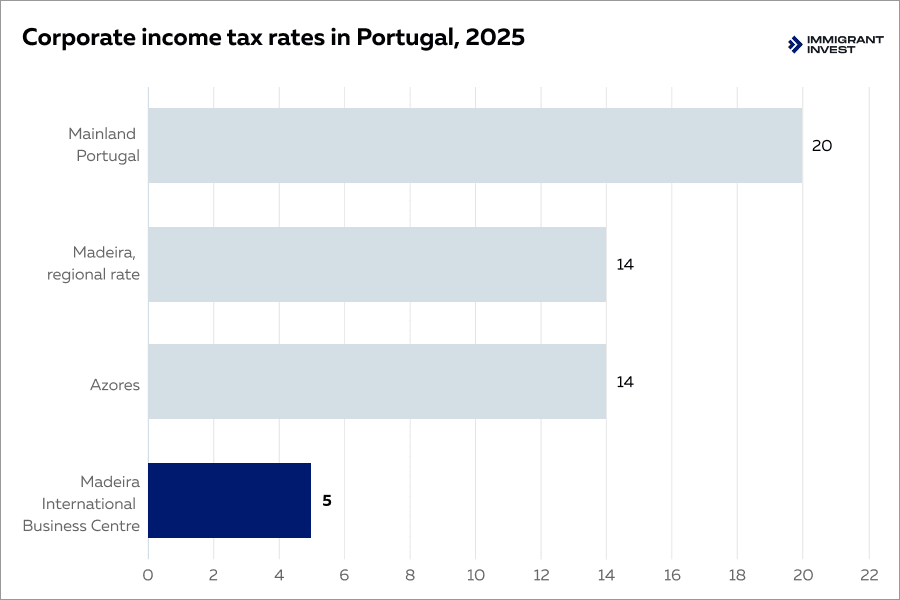
- Corporate tax: 20% on the mainland, reduced to 14% in Madeira and the Azores, and just 5% within the Madeira International Business Centre[3].
- Value-added tax: standard rate 23%, with reduced rates of 13% and 6% for specific goods and services[4].
- Property taxes: IMT transfer tax up to 7.5%[5] and IMI annual tax between 0.3 and 0.45%[6], depending on property value and location.
From NHR to IFICI — the new regime
The former Non-habitual Resident regime, which offered flat rates and foreign income exemptions for 10 years, closed to new entrants at the end of 2023. It was replaced by the IFICI regime, Incentivo Fiscal à Investigação Científica e Inovação, launched in 2024.
IFICI grants a 20% flat personal income tax rate for up to 10 years on eligible Portuguese earnings and exempts most foreign dividends, interest, rental income and capital gains from taxation — unless sourced from blacklisted jurisdictions.
Together, these elements show that Portugal’s tax optimisation framework is not limited to families: it benefits investors, entrepreneurs and skilled professionals alike through a combination of transparent rules, treaty protection and predictable incentives.
Comparison of de jure tax rates with the effective rates
De jure rates are the statutory bands and flat rates set by law. The effective rate is the share of income actually paid in tax after allowances, deductions, credits and timing are taken into account. The two figures often diverge.
What shapes the effective rate:
- Personal allowances and targeted deductions reduce the taxable base.
- Income categories follow different schedules or withholdings such as salary, dividends, interest, rentals and gains.
- Municipal and regional features can add to or offset the bill.
- Social security is calculated under separate rules yet changes the overall burden for employed and self-employed workers.
- Timing of distributions and realisations affects which band applies in a given year.
Example: effect of income timing on Portuguese tax bands, 2025
If instead the €15,000 gain is deferred to 2026, for example, by reinvesting within the fund until redemption, the 2025 taxable income remains €35,000, which sits in the 6th band with a marginal rate around 39% and a total tax of about €7,700.
By staggering income across years, the investor saves roughly €4,300 in tax and stays within a lower effective band. Many regulated funds designed for Portugal Golden Visa investors use this mechanism: income is not distributed annually but only at exit, allowing non-residents and temporary residents to defer taxation and lower the lifetime effective rate.
Illustrative outcomes
Portugal digital nomad tax outcomes can show a gap between top statutory bands and the effective burden once the tax-free allowance and permitted deductions are applied.
Investors using fund routes linked to Portugal Golden Visa tax benefits often see income deferred toward exit, which can lower the lifetime effective rate compared with de jure schedules
Double taxation
Double taxation arises when the same income is taxed in two jurisdictions. Portugal addresses this through domestic credit rules and an extensive network of double tax treaties.
Portuguese residents are taxed on their worldwide income. When foreign income has already been taxed abroad, the resident may claim a foreign tax credit. Under Portuguese rules this credit is limited to the lower of the Portuguese tax due on that foreign income or the foreign tax actually paid.
For non-residents, taxation normally applies only to Portuguese-source income. Domestic legislation may also provide unilateral relief when no treaty exists, but relief is more limited.
Portugal has signed 79 double tax agreements, of which 78 are currently in force[7]. These treaties allocate taxing rights between Portugal and the partner country by income type like employment, dividends, interest, royalties, capital gains. They typically reduce withholding tax rates on dividends, interest and royalties.
If you are a resident in Portugal and you earn dividends from Germany, you declare them on your Portuguese tax return, but you deduct the tax paid in Germany up to the Portuguese tax due.
If you are still non-resident for Portuguese tax, you often pay tax only in Portugal on Portuguese-source income, and your home country may provide credit relief under its treaty with Portugal[8].
Treaty benefits can be compromised if income arises from a jurisdiction on Portugal’s “blacklist” of privileged tax regimes; higher tax rates may apply.
Tax considerations for Portugal Golden Visa and D3 Visa holders
Golden Visa residents enjoy broad flexibility: they can live in Portugal or abroad while holding residence rights. Most investors initially keep non-resident tax status, paying Portuguese tax only on local income, typically at a 25% flat rate. Those who choose to become tax residents are subject to the standard progressive rates of 12.5—48%, yet may access treaty reliefs and Portugal’s new IFICI incentives.
The Portugal Global Talent Program or D3 Visa is a pathway that allows highly qualified professionals to obtain a residence permit in Portugal. Holding a D3 Visa residence permit does not require spending 183 days per year in Portugal, and it is possible to maintain residence status with limited physical presence.
Tax residency
Golden Visa holders have a light physical-presence rule. The law sets a minimum stay of 7 days in the first year and 14 days in each following 2-year period, which is why many investors remain non-resident for tax purposes.
Tax residency follows the national income tax code. A person is a tax resident if they spend more than 183 days in Portugal in any rolling twelve-month period that starts or ends in the tax year, or if they have a habitual home there that indicates an intention to keep and occupy it[9].
Tax rates
Residents are taxed at progressive rates from 12.5 up to 48%. Non-residents face a flat 25% rate on employment, self-employment and pension income that is sourced to Portugal, subject to treaty relief.
Portuguese law also sets final withholding rates on many types of investment income, with residents typically at 28% and non-residents often at 25%, again with treaty reductions where applicable.
Golden Visa holders who obtain residency by investing in or establishing a company in Portugal may also be subject to corporate taxation on the company’s profits. The corporate income tax rate is 20%, and the standard value-added tax, VAT, is 23%, with reduced rates of 13% and 6% applied to specific goods and services.
Those who invest in qualifying investment funds may be subject to withholding tax on distributed income. The typical rate ranges from 10 to 28%, depending on the type of income and any relevant double tax treaties with the investor’s country of residence.

Célia Castilho,
Head of the Portuguese office
Many Golden Visa-eligible funds are structured to defer income until the end of the investment period, which allows non-resident investors to minimise or postpone any Portuguese tax exposure. Since Portugal does not levy a wealth tax, there’s also no annual tax on the value of the investment itself.
As long as you remain a non-resident, you’re not required to file a Portuguese tax return, unless you receive Portuguese-source income. Even in those cases, filing is only required when the income is actually paid out. If the fund defers returns until exit, you may avoid any tax reporting throughout the investment period.
The tax treatment for Portugal Golden Visa holders depends on whether they are tax-resident and on the nature of their income. Non-residents pay a flat rate on Portuguese-source earnings, while residents face progressive personal rates but can often apply treaty relief or IFICI benefits.
The table below summarises how different income categories are typically taxed for both groups.
Illustrative tax outcomes for Portugal Golden Visa investors
How to apply for a Portugal Golden Visa?
To apply for the Portugal Golden Visa, applicants must hold citizenship of a non-EU and non-EEA country and make a qualifying investment through one of the approved options.
Investment options currently eligible under the Golden Visa program include:
- €250,000 in arts, culture, or heritage preservation;
- €500,000+ in a qualified investment fund;
- €500,000+ in research and development activities;
- €500,000+ in shares of Portuguese companies with the creation of at least 5 jobs;
- setting up a company that creates at least 10 jobs.
Family members who can be included in the application are the applicant’s spouse, children under 26, and parents. Children over the age of 18 and parents must be financially dependent on the main applicant.
The Portugal Golden Visa grants the right to live, study, and work in Portugal, as well as travel freely in the Schengen Area, and may lead to permanent residency after 5 years.

Banele, 34
Furniture factory owner
From visa struggles to European freedom
Banele, an entrepreneur from Soweto, realised he needed unrestricted access to European suppliers. Tired of visa delays and closed borders, he turned to Portugal’s Golden Visa as a long-term solution.
He invested in a regulated Portuguese investment fund. The investment ensured Schengen mobility for him and his family and a clear route to permanent residency after 5 years.
Today, the family enjoys the freedom to travel, expand business ties across the EU, and plan for future relocation to Portugal, proof that the fund option under the Golden Visa remains a flexible and efficient path to European residence.
Tax implications for digital nomads in Portugal
Digital nomads living and working from Portugal are subject to local tax rules depending on their length of stay and residence status. The framework allows for reliefs, deductions, and treaty benefits that can make Portugal a practical base for remote professionals.
Tax residency
Digital nomads often earn from foreign sources. While they are not Portuguese tax residents, that foreign income is not taxed in Portugal.
Digital nomads in Portugal often earn income from foreign sources. While they are not taxed on this income unless they become residents, maintaining non-resident status over several years is difficult in practice.
To renew or extend a residence permit, digital nomads must spend a minimum number of days in the country, which almost always triggers tax residency under Portugal’s 183-day rule. In other words, those who plan to keep their legal status long-term inevitably become tax residents.
Célia Castilho,
Head of the Portuguese office
The residence permit for digital nomads comes with minimum stay requirements: the initial permit is valid for 2 years and requires at least 16 months of physical presence in Portugal within that period. Upon renewal, the permit is extended for 3 years, during which the holder must reside in Portugal for at least 28 months.
Income tax
In Portugal, personal income is taxed on a progressive scale from 12.5 to 48%. The digital nomad residence route sets income at four times the national minimum wage of €920 a month, so the qualifying threshold is €3,680 per month, equal to €44,160 a year.
At €44,160 of taxable income, the taxpayer sits well inside the 7th band, where the marginal rate is 43.1%.
Using the official 2025 band formula, applying the marginal rate to income within the band and subtracting the quick deduction, the gross tax before deductions is approximately €11,220[10].
Using standard deductions typically claimed by a single filer with no dependants, the payable is roughly €9,930, which implies an effective rate near 23.8%.
The effective rate rises with income and falls when eligible deductions and credits are higher. Exact results depend on each taxpayer’s profile, including recognised expenses recorded via e-Fatura and any treaty relief on foreign income.
The figures below show illustrative income tax after basic statutory mechanics. For Portugal we reflect the 2025 band method; for Spain we apply state plus regional scales; for Italy we apply the national IRPEF scale. Local surcharges, social security and personal credits beyond the basic personal allowance are excluded unless noted. Rates and bands are 2025.
Income tax burden for digital nomads earning €44,160 a year
Country

Portugal
Region and notes
National bands 2025, taxable income €44,160
Illustrative tax, €
10,570
Effective rate
23.9%
Country

Spain
Region and notes
Madrid: state + Madrid scales, minus €5,550 personal allowance
Illustrative tax, €
8,528
Effective rate
19.3%
Country
Spain
Region and notes
Catalonia: state + Catalonia scales, minus €5,550 allowance
Illustrative tax, €
9,352
Effective rate
21.2%
Country

Italy
Region and notes
National IRPEF only: no regional or municipal add-ons
Illustrative tax, €
11,256
Effective rate
25.5%
Country | Region and notes | Illustrative tax, € | Effective rate |
|---|---|---|---|
Portugal | National bands 2025, taxable income €44,160 | 10,570 | 23.9% |
Spain | Madrid: state + Madrid scales, minus €5,550 personal allowance | 8,528 | 19.3% |
Spain | Catalonia: state + Catalonia scales, minus €5,550 allowance | 9,352 | 21.2% |
Italy | National IRPEF only: no regional or municipal add-ons | 11,256 | 25.5% |
Social security contribution
If you are employed by a foreign company, the employer must pay Portuguese social security[11]. They deduct 11% from your pay and add 23.75% from their own funds, paying a total of 34.75%. Based on minimum earnings of €3,680 a month, your share is at least €405 per month.
However, you might be exempt if you can show you’re still covered by your home country’s social security system. This may apply if you have an EU A1 certificate or your country has a bilateral agreement with Portugal, such as the UK or the US.
If you’re self-employed in Portugal, the standard social security rate is 21.4%, but there are allowances:
- 1st year: no social security contributions;
- from the 2nd year: only 70% of your income is considered for contributions, lowering the real rate to around 15%;
- you may also reduce your payments by up to 25%, in 5% steps.
Given your monthly earnings of at least €3,680, your social security contributions would be no less than €404.
Obtaining a Digital Nomad Visa
To apply for the Portugal Digital Nomad Visa, applicants must:
- be at least 18 years old;
- originate from a non-EU and non-EEA country;
- work remotely, either through an employment contract, a freelance agreement, or a service contract, and their clients or employers must be based outside Portugal.
Family members who can be included in the application are the applicant’s spouse, children, and parents. Any parent or child over the age of 18 must be financially dependent on the main applicant.
The minimum income requirement is set at four times the national minimum wage. It means earning at least €3,680 per month from all sources.
Applicants must also provide proof of accommodation in Portugal and demonstrate sufficient financial savings. The minimum is €11,040, which equals 12 Portuguese minimum wages. If applying with family members, the required savings increase: €5,520 for each spouse or parent and €3,312 for each dependent child.

Tax liabilities for retirees and other Portugal D7 Visa holders
Holders of the D7 visa who make Portugal their main place of residence become subject to local tax rules once they meet residency criteria. Their income, whether from pensions, investments, or other sources, is assessed under Portugal’s progressive tax system, but numerous reliefs and exemptions can reduce the effective burden.
The D7 framework is often viewed as favourable for retirees seeking a stable and transparent tax environment within the European Union.
Tax residency
A D7 Visa holder becomes a tax resident if they spend more than 183 days in Portugal within any 12-month period that starts or ends in the tax year, or if they keep a habitual home there that indicates an intention to occupy it.
Residents are taxed on worldwide income, while non-residents are taxed only on Portuguese-source income.
Recent data show that Americans are turning to the Portugal D7 visa in record numbers[12]. In late 2024, applications from the United States grew almost fourfold compared with the previous three months, and nearly 90% of American applicants were interested specifically in the D7 rather than Digital Nomad or Golden Visa options.

Trusted by 5000+ investors
Will you obtain the Portugal Passive Income D7 Visa?
Pensions and investment income
Retirement income is taxed as Category H and follows the personal income tax scale, reflecting a top marginal rate close to 48%. Actual liability depends on allowances and the final assessment.
Portugal does not levy a separate inheritance or gift tax. Instead, stamp duty may apply to gratuitous transfers, but transfers to a spouse, descendants and ascendants are exempt, which many retirees view as part of the Portugal tax benefits for families.

Jeremy Alson,
Investor
From safety to strategy for a tax win
A UK family of four obtained Portugal’s D7 visa for stability and safety within the EU. Once they spent over 183 days a year in the country, they became tax residents and discovered Portugal’s family-friendly tax system.
With no inheritance or gift tax and stamp duty exemptions between spouses, parents and children, succession planning became simpler. Aligning their income with double tax treaties reduced overlaps and improved clarity on withholding.
As a result, the family achieved a lower effective rate, predictable annual filings and a smoother long-term residence path — proof of Portugal’s practical tax benefits under the D7 visa.
Social security and healthcare
Portuguese social security contributions apply to employment and self-employment. Most retirees with only pension income have no Portuguese contributions to pay.
If a retiree starts self-employment in Portugal, the independent-worker regime generally charges 21.4% on a contributory base that is usually 70% of recent billed income, with standard reliefs. Access to state healthcare follows residence status and enrolment.
Obtaining a D7 Visa
To apply for the Portugal D7 Visa, applicants must:
- be at least 18 years old;
- originate from a non-EU and non-EEA country;
- show a stable passive income or pension that meets the minimum thresholds of €920;
- provide proof of accommodation in Portugal and health insurance.
Spouse or partner, children under 26, and parents of the main applicant. Adult children and parents must be financially dependent to qualify.
Applicants must demonstrate regular passive income equal to or above the Portuguese minimum wage. A single applicant should show at least €11,040 per year, plus additional amounts for family members: €5,520 for each spouse or parent and €2,760 for each dependent child.
Applicants must also maintain savings in a Portuguese or foreign bank account. The baseline is twelve times the minimum wage, €11,040, with the same add-ons for family members.
Income tax burden for D7 visa retirees earning €11,040 a year
Country
Portugal
Region and notes
National bands 2025, taxable income €11,040 Category H pensions
Illustrative tax
€950
Effective rate
8.6%
Country
Spain
Region and notes
Madrid: state + regional scales, after €5,550 allowance
Illustrative tax
€1,180
Effective rate
10.7%
Country
Italy
Region and notes
IRPEF national scale only
Illustrative tax
€1,380
Effective rate
12.5%
Country | Region and notes | Illustrative tax | Effective rate |
|---|---|---|---|
Portugal | National bands 2025, taxable income €11,040 Category H pensions | €950 | 8.6% |
Spain | Madrid: state + regional scales, after €5,550 allowance | €1,180 | 10.7% |
Italy | IRPEF national scale only | €1,380 | 12.5% |
How to pay taxes in Portugal: step-by-step procedure
Paying taxes in Portugal is a structured process that combines registration, filing and payment.
The tax year runs from January 1st to December 31st. Deductions are tracked through the year via e-Fatura with a review in February. The tax return is filed online between April 1st and June 30th.
Below is a clear pathway that expats, digital nomads, Golden Visa and D7 holders typically follow.
10 days
Obtain a tax identification number
Every taxpayer needs a Número de Identificação Fiscal, NIF, to interact with the tax system. This number is required for opening a bank account, signing contracts, buying or renting property and, of course, filing taxes.
Immigrant Invest can help Golden Visa and other long-term visa holders obtain a NIF remotely.
Every taxpayer needs a Número de Identificação Fiscal, NIF, to interact with the tax system. This number is required for opening a bank account, signing contracts, buying or renting property and, of course, filing taxes.
Immigrant Invest can help Golden Visa and other long-term visa holders obtain a NIF remotely.
1 day
Register on the finance portal
After receiving your NIF, you must register with Portal das Finanças, the online platform of the Portuguese tax authority, Autoridade Tributária e Aduaneira. Registration provides access to your personal tax area, where you can review deductions, download receipts and file returns.
After receiving your NIF, you must register with Portal das Finanças, the online platform of the Portuguese tax authority, Autoridade Tributária e Aduaneira. Registration provides access to your personal tax area, where you can review deductions, download receipts and file returns.
During the fiscal year
Track expenses with your NIF
Portugal’s deduction system is linked to your NIF. When you pay for health, education or other deductible services, always request an invoice with your NIF. These invoices appear automatically in the e-Fatura system and are used to calculate deductions at the end of the year.
Portugal’s deduction system is linked to your NIF. When you pay for health, education or other deductible services, always request an invoice with your NIF. These invoices appear automatically in the e-Fatura system and are used to calculate deductions at the end of the year.
1—2 days
Prepare the annual IRS return
The annual personal income tax return, Declaração Modelo 3, must be filed online between April 1st and June 30th for the previous tax year. Residents declare worldwide income, while non-residents declare only Portuguese-source income.
The system pre-fills much of the data, but it is essential to check accuracy and add foreign income or deductions.
The annual personal income tax return, Declaração Modelo 3, must be filed online between April 1st and June 30th for the previous tax year. Residents declare worldwide income, while non-residents declare only Portuguese-source income.
The system pre-fills much of the data, but it is essential to check accuracy and add foreign income or deductions.
During the fiscal year
Review and confirm deductions
Before submitting, taxpayers can verify deductions on the e-Fatura portal. Health, education, housing and general family expenses are automatically aggregated, but you may correct or contest entries during the review period in February.
Before submitting, taxpayers can verify deductions on the e-Fatura portal. Health, education, housing and general family expenses are automatically aggregated, but you may correct or contest entries during the review period in February.
1 day
Settle payments or receive refunds
Once the tax return is processed, the tax authority calculates the balance. If you owe tax, you will receive an electronic payment reference to pay via Portuguese bank account or ATM.
Refunds are typically transferred directly to your bank account within weeks of assessment.
Once the tax return is processed, the tax authority calculates the balance. If you owe tax, you will receive an electronic payment reference to pay via Portuguese bank account or ATM.
Refunds are typically transferred directly to your bank account within weeks of assessment.
July, September and December
Pay advance tax and social security, if required
Self-employed individuals must also make quarterly advance tax payments in July, September and December, based on previous income. Social security contributions are declared and paid separately via the social security portal, with deadlines usually on the 20th of the following month.
Self-employed individuals must also make quarterly advance tax payments in July, September and December, based on previous income. Social security contributions are declared and paid separately via the social security portal, with deadlines usually on the 20th of the following month.
Reducing income tax in Portugal through exemptions and deductions
Portugal offers deductions, credits and exemptions that can reduce your effective income tax burden. Tax figures are illustrative. For a tailored position, we will connect you with a licensed Portuguese tax adviser.
New real-estate relief for young buyers
Buyers aged 18—35 purchasing their first permanent home are exempt from both property transfer tax and Stamp Duty on homes up to €324,058[13].
For homes priced between €316,772 and 633,453, partial exemption applies: municipal property transfer tax is charged only on the excess above the threshold, at 8%.
By May 2025, nearly 43,000 young people had used this exemption, saving upfront transaction taxes. The average purchase price was around €180,000.
Personal deductions and credits
In Portugal, taxpayers can lower their annual income tax bill by claiming deductions and credits for everyday expenses. These allowances recognise essential costs such as healthcare, education and housing, as well as family responsibilities.
Below are the key categories with their respective limits:
- Health expenses: up to 15% of eligible costs, capped at around €1,000 per household.
- Education costs: up to 30% of expenses, with a ceiling of €800 per dependent.
- Housing: mortgage interest on primary residence loans contracted before 2011 — up to 15% of interest paid, maximum €296.
- General family expenses: a broad allowance of 35% of household spending, capped at €250 per taxpayer.
- Dependents: each child under 3 years old gives a deduction of €726, older dependents €600.
Rental and property income
Maintenance and repairs deductible at 30% of gross rental income, provided costs are evidenced with invoices linked to your NIF.
Pre-rental work expenses up to 24 months before a lease begins may also be deducted.
Overview of Portugal’s new IFICI special tax regime
Portugal has closed the Non-habitual Resident regime for new entrants and replaced it with a new incentive aimed at qualified talent. The 2024 State Budget created the Tax Incentive for Scientific Research and Innovation, IFICI, under article 58-A of the Tax Benefits Statute, and detailed rules were issued by Regulation 352‑2024‑1 in December 2024[14].
What IFICI offers
The IFICI regime grants a 20% flat personal income tax rate on employment and self-employment income earned in Portugal from eligible activities. The benefit applies for 10 consecutive years, starting from the year the individual becomes tax resident. Employers and clients apply withholding at the 20% rate once registration under the regime is confirmed.
Foreign-sourced income in categories E, F and G, including dividends, interest, rental income and capital gains, is exempt from Portuguese taxation while the regime applies. The only exception concerns income from blacklisted jurisdictions, which is subject to a 35% rate.
Who can qualify
You must become a Portuguese tax resident, not have been resident in any of the previous five years, and perform an eligible activity. The law lists higher education and scientific research, qualified roles in productive investment, highly qualified professions in exporting or investment-supported companies, and activities recognised by AICEP or IAPMEI as relevant to the economy.
Sector lists and competency checks are set out in the regulation and in subsequent notices by AICEP, IAPMEI, FCT, ANI and Startup Portugal.
How to join
The IFICI regime must be requested after acquiring Portuguese tax residency and before submitting the first annual tax return in which the incentive is claimed.
Registration is completed through the official Finance Portal, which sets out the list of documents required and identifies the competent agencies, AICEP, IAPMEI, FCT, ANI or Startup Portugal, depending on the activity.
How expats can avoid double taxation
Portugal relies on double tax treaties and domestic credit rules to prevent the same income being taxed twice. Treaties set who is treated as resident, which state taxes first, and how the other state must relieve the tax by credit or exemption.
Portugal has long-standing treaties with both the United States and the United Kingdom, and the European Commission provides an overview of how double tax conventions work across the EU.
A common pathway to avoid double taxation involves:
- confirming tax residence in Portugal or in the home country, depending on the number of days spent and other tie-breaker criteria;
- applying the treaty tie-breaker if both states consider the person a tax resident, to determine which country has primary taxing rights;
- ensuring the correct rate of withholding at source under the treaty, for example, reduced rates on dividends or interest when treaty relief is claimed;
- claiming a credit or exemption in the other country when filing the annual tax return, to offset tax already paid and avoid double taxation.
The United States and the United Kingdom each publish official guidance on how credits are calculated and how relief interacts with domestic rules.
US citizens are taxed on worldwide income even when living in Portugal. Double taxation is mitigated through the foreign tax credit claimed on Form 1116 and through the foreign earned income exclusion and housing provisions claimed on Form 2555 when eligibility tests are met[15].
The Internal Revenue Service, iRS notes that income excluded under the foreign earned income exclusion does not also generate a foreign tax credit.
The United States and Portugal have a comprehensive income tax treaty signed in 1994 and in force since 1995, which allocates taxing rights by income type and supports credit relief.
UK residents with foreign income can claim foreign tax credit relief so that UK tax is reduced by tax correctly paid in Portugal, subject to treaty limits and UK caps. HMRC’s help sheet HS263 explains the calculation of credit relief, and the Double Taxation Relief Manual provides country-specific guidance for Portugal[16].
The United Kingdom and Portugal have a double taxation convention that has been in force since 1970 and remains the framework for allocating taxing rights between the two states.
Tax optimisation for businesses in Portugal
Headline rates and surcharges. Mainland corporate income tax is 20% for financial years beginning on or after January 1st, 2025. Municipal surtax can add up to 1.5%. A state surtax applies in tiers of 3%, 5% and 9% above profit thresholds[17].
Regional rates. Madeira and the Azores apply a 30% reduction to the mainland rate[18]. In 2025 that results in 14% headline corporate tax in both regions, with further local measures in Madeira confirming the 14% rate.
Participation exemption. Portugal exempts qualifying dividends and capital gains from corporate tax under the participation exemption regime, set in the Corporate Income Tax Code[19]. Key conditions include minimum holding periods and other tests in articles 51 to 51-C.
R&D tax credit SIFIDE II. Companies can credit 32.5% of eligible R and D costs against corporate tax, plus an incremental 50% on the increase over the prior two-year average up to €1.5[20]. The scheme is managed through the National Innovation Agency with guidance available in its practical guide.
Patent box. Income from eligible intellectual property benefits from an 85% exemption aligned with the OECD nexus approach, which significantly reduces the effective tax on that IP income.
Tax losses. Tax losses carried forward have no time limit. The deduction in any one year is capped at 65% of taxable profit, with detailed rules in article 52 of the Corporate Income Tax Code[21].
VAT considerations. Portugal’s VAT has a standard rate of 23%, with reduced and intermediate rates for specific supplies. Optimising supply chains, export treatment and intra-EU procedures can improve cash flow.
5% corporate tax for Madeira residents. Madeira’s International Business Centre, MIBC, offers a headline 5% corporate income tax on qualifying profits, available to newly licensed entities through December 31st, 2026, with the 5% rate applying until December 31st, 2028[22].
For activity outside the MIBC, Madeira’s general regional corporate rate is 14% in 2025 and 11.2% for the first €50,000 of taxable profit for qualifying SMEs.
Export-oriented service hubs, holding and treasury centres using Portugal’s participation exemption, and mid-caps scaling teams on the island can materially reduce their effective tax rate while remaining inside Portugal’s treaty network and EU law.
Madeira combines the lifestyle of an Atlantic island with one of the most competitive corporate tax regimes in the EU
Final thoughts on Portugal tax optimisation
- Your tax outcome in Portugal hinges first on residency status and on how your income is sourced. Residents face progressive income tax bands from about 12.5 to 48%, while non-residents are generally taxed at 25% on Portuguese-source income.
- The newer IFICI regime can fix eligible employment and self-employment income at 20% for 10 years, while foreign dividends, interest, rentals and gains are usually exempt if they are not from blacklisted jurisdictions.
- Golden Visa investors often stay non-resident and use fund structures that defer income until exit.
- Digital nomads must plan around the 183-day test and minimum-presence rules on their residence permit, then use treaty relief once resident.
- D7 retirees focus on pension taxation and on Portugal’s family-friendly framework with no standalone inheritance or gift tax and exemptions for transfers between spouses, parents and children.
- Madeira adds a distinct advantage through the International Business Centre, where qualifying profits can be taxed at 5%, alongside broad reliefs on withholding and local taxes.
Immigrant Invest is a licensed agent for citizenship and residence by investment programs in the EU, the Caribbean, Asia, and the Middle East. Take advantage of our global 15-year expertise — schedule a meeting with our investment programs experts.
Will you obtain residence by investment in Portugal?
-
Master the residency process
-
Get expert tips and documents
-
Estimate costs accurately
 Trusted by 5000+ investors
Sources
- Source: The number of foreigners residing in Portugal, Minister of Internal Affairs, Portugal
- Source: Personal Income Tax, Portuguese Government
- Source: Corporate Income Tax, Portuguese Government
- Source: Value Added Tax, Portuguese Government
- Source: Imposto Municipal sobre as Transmissões Onerosas de Imóveis, IMT, PWC
- Source: Imposto Municipal sobre Imóveis, IMI, PWC
- Source: DTA signed by Portugal, Financial Portal
- Source: Personal income tax in Portugal, Portuguese Government
- Source: Tax residency rule, Portuguese Government
- Source: Key takeaways on Portugal tax residency for Digital Nomads, Digital Nomad Tax
- Source: Social security contributions, PWC
- Source: Americans interest in Portugal's D7 Visa, Schengenvisainfo
- Source: Tax exemptions for young buyers, Idealista
- Source: Source: IFICI Regulation, Government Order No. 352/2024/1
- Source: Foreign Tax Credit, IRS
- Source: Relief of foreign tax paid, GOV UK
- Source: Taxes on corporate income, PWC
- Source: Tax benefits in Madeira, MIBC
- Source: Income determination, PWC
- Source: Tax credits and incentives, PWC
- Source: Tax guide, PWC
- Source: Madeira tax regime, MIBC