

Summary
The number of operating companies and entrepreneurs in Hungary keeps rising. As of early 2026, Hungary has 1.8 million enterprises in total[1], including 15,888 foreign-controlled affiliates[2].
Foreign entrepreneurs can obtain a Hungarian residence permit by registering a company and becoming a founder. This guide covers eligibility, company types, taxes, and the key practical steps and risks.
What is Hungary business residency and its key features?
Hungary offers a residence permit for guest self-employment for third-country nationals who set up and run a business in the country. The legal basis is Act XC of 2023 on the General Rules for the Admission and Right of Residence of Third-country Nationals[3].
Foreign nationals can register a company in Hungary under the same general legal framework as Hungarian citizens. The company’s legal form does not affect immigration eligibility: founders can apply whether they run a limited liability company, a joint-stock company, or a partnership.
Qualification requirements
The Hungarian residence permit for guest self-employment can suit entrepreneurs who work as self-employed or act as a company’s chief executive. Applicants must:
- be over 18;
- be an owner or co-owner of a Hungarian company;
- have no entry ban to Hungary or other Schengen Area countries;
- have no criminal record in Hungary or other Schengen Area countries.
A residence permit for guest self-employment may be granted under two routes.
1. Self-employment route. Annual income proven via the tax authority must exceed 24× the current minimum wage. In 2026, the minimum wage is HUF 322,800, ~ €855 per month, resulting in an annual threshold of ~ €20,500.
2. Сompany executive route. Chief executives of a business organisation have greater flexibility. One of the following may be proved:
- The business has legally employed at least 5 people who are Hungarian nationals or persons with EU free-movement rights, full-time, for at least 6 consecutive months without interruption.
- The applicant’s residence in Hungary is essential to the company’s operations and the business generates sufficient income for both the company and the applicant[4].
Applicants who are employed by the company in a capacity other than CEO are not eligible for residency by business registration. If they intend to perform day-to-day operational duties outside the chief executive scope, a different permit category applies — typically an employment-based one.
Residence permit validity
Business residence permits in Hungary are issued initially for a period of 1 year with the right to renew once for up to 2 additional years, providing a total maximum validity of 3 years.
After the maximum 3-year period, the foreign national must leave Hungary. A new residence permit can then be obtained either with the same company or with a different one. The Hungary residency by opening a company pathway does not lead to permanent residency or Hungarian citizenship.
Family inclusion
Upon the first residence permit renewal, a Hungarian resident can include their family members in the application:
- spouse;
- minor children;
- financially dependent parents.

Why open a company in Hungary?
Hungary presents significant economic and tax advantages for foreign entrepreneurs seeking to establish a business presence within the EU.
Tax advantages for Hungarian companies
Hungary maintains the lowest standard corporate income tax rate in the EU at 9%[5]. Only Montenegro offers an equivalent rate outside the EU.
By comparison, Germany’s effective corporate tax rate is approximately 30 to 33% when federal corporate tax, solidarity surcharge, and municipal trade tax are combined. Spain’s standard corporate income tax stands at 25%.
Hungary applies a flat personal income tax rate of 15%[6]. Other EU countries use progressive scales: in Germany the rate reaches up to 42%, and in Spain up to 45%.
Hungary vs. other EU countries taxes
Economic growth and stability
Hungary offers a stable economic base and has grown faster than the EU average over the past decade.
In 2024, Hungary’s GDP reached HUF 81,447.7 billion, ~ €206 billion[7]. Real GDP increased by about 0.6% that year. Over the longer period 2014—2024, Hungary’s nominal GDP rose by 57.8%, compared with 23.7% for the EU aggregate[8].
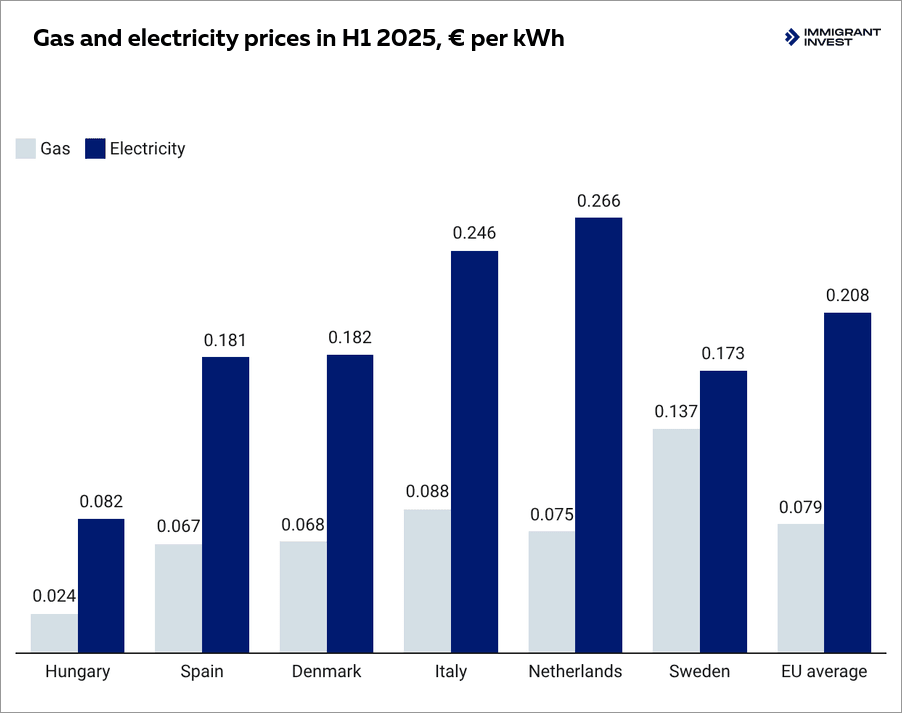
Hungary benefits from competitive electricity and gas prices, which remain among the lowest in the EU, supporting industrial and manufacturing competitiveness[9][10].
Living in Hungary and Schengen access
Business residence permit holders can live in Hungary for up to 3 years and gain access to key public services. They can join the national health insurance system and receive public healthcare. Children have the right to enrol in state schools under the same conditions as Hungarian citizens.
One of the key advantages of living in Hungary is the relatively low cost of living compared to many EU countries. Overall prices are about 25% below the EU average, and rental costs can be up to 50% lower. A single person needs around €1,000 per month, including rent.
The Hungarian residence permit also offers visa-free access to the Schengen Area, allowing holders to travel to other Schengen countries for up to 90 days within any 180-day period. It’s especially convenient for entrepreneurs, who travel frequently across Europe for meetings, events, and short business trips.
Business owners can manage operations remotely, as long as they spend at least 90 days in Hungary within each 180-day period to remain eligible for renewal.

Ferenc Tihánszky,
Head of the Hungarian office
A Hungarian business residence permit authorises residence and business activity in Hungary only. It does not grant the right to work or operate a business in other EU member states. Travel within Schengen remains limited to short stays and does not change work authorisation.
Which company type should I choose in Hungary?
Hungarian law recognises several organisational forms for commercial enterprises. The most common structures are the limited liability company, or Kft, joint-stock company, or Rt, and partnerships — Kt and Bt.
Limited liability company
The limited liability company, known in Hungarian as Korlátolt Felelősségű Társaság, Kft, is the most prevalent company structure in Hungary. Approximately 80% of all registered commercial organisations are Kft entities[11].
A Hungarian Kft has several features to keep in mind:
- Share capital: at least HUF 3,000,00, ~ €7,300.
- Minimum stake per founder: at least HUF 100,000, ~ €250.
- Contributions: cash or in-kind assets, such as real estate, intellectual property, or equipment.
- Liability: shareholders are liable only up to the amount of the share capital, so personal assets remain separate from company obligations.
- Governance: the general meeting is the top decision-making body, and voting power is proportional to shareholding.
- Management: shareholders appoint one or more managing directors to run day-to-day operations; directors do not need to be shareholders.
Joint-stock company
Share capital. Joint-stock companies, or Részvénytársaság, Rt, may be established as public or private entities, with minimum share capital of:
- HUF 5,000,000, ~ €12,100, for a Zrt;
- HUF 20,000,000, ~ €48,500, for an Nyrt.
Liability. Shareholders are liable only up to the amount of their subscribed capital.
Corporate governance. The general meeting of shareholders is the highest governing body. Shareholders appoint a board of directors with at least three members, and decisions are taken collectively by simple majority. Non-public joint-stock companies may appoint a single director instead of a board.
The joint-stock company’s structure is typically chosen when a company plans to bring in multiple investors or, in the Nyrt format, access public markets.
Partnerships
Partnerships may be established as general partnerships or limited liability partnerships.
Key features include:
- Founders: at least two partners.
- Share capital: no fixed minimum — partnerships can be formed with any amount of capital.
- Governance: the general meeting of partners is the highest governing body and appoints managing directors from among the partners.
- Voting: each partner has equal voting rights, regardless of capital share.
- Liability structure. In a general partnership, all partners have unlimited personal liability for the partnership’s obligations. In a limited partnership, general partners have unlimited liability, while limited partners are liable only up to their capital contribution.
Partnerships represent a smaller share of the Hungarian business landscape, comprising around 17% of all commercial organisations[11].
Hungarian company types at a glance
Documents required for Hungary residence permit though company formation
General documents required for the Hungarian business residency application include valid passport, proof of accommodation in Hungary, health insurance valid, and bank statements showing an account balance of at least €10,000 and a 6-month transaction history.
Evidence of self-employment and income usually includes:
- proof of registration of the self-employed activity;
- detailed declaration describing the business activity;
- contracts supporting the activity, such as service or business agreements signed as a private individual;
- headquarters or premises lease agreement, where relevant;
- tax authority certificate confirming annual income from self-employment exceeds 24 times the current minimum wage;
- certificate confirming there are no outstanding taxes or social contributions.
If the applicant applies as managing director and shareholder, they must show either that their residence in Hungary is essential for the company’s operations and the business is likely to generate sufficient income for the company and the applicant, or that the company has legally employed at least 5 Hungarian nationals or persons with EU free-movement rights on a full-time basis for at least 6 consecutive months without interruption.
The supporting package usually includes:
- company registration documents;
- documents confirming the applicant’s role in ownership and management;
- detailed description of the planned business activity and how the company will operate in practice;
- headquarters or premises lease agreement, where relevant;
- tax authority certificate confirming no tax or contribution debts and no enforcement or liquidation proceedings;
- proof the company has met obligations related to employee registration and payment of taxes and contributions, where applicable;
- business evidence supporting the declared activity, such as contracts and agreements.
How to open a company and obtain a residence permit in Hungary?
Company registration in Hungary goes through the official company register and must be filed by a licensed Hungarian lawyer. Founders cannot submit the registration directly.
The register of legal entities and individual entrepreneurs is maintained by the competent registry authority under the supervision of the National Tax and Customs Administration[12].
1 day
Preliminary Due Diligence
Immigrant Invest reviews the applicant’s background to spot potential refusal risks early. Due Diligence checks are run through international legal and business databases. This stage reduces the probability of refusal of residence permit to around 1%.
Immigrant Invest reviews the applicant’s background to spot potential refusal risks early. Due Diligence checks are run through international legal and business databases. This stage reduces the probability of refusal of residence permit to around 1%.
10+ days
Company registration
A Hungarian licensed lawyer files the registration. Founders sign the paperwork either in Hungary or by video call. If signing remotely, the originals are sent by post.
A Hungarian licensed lawyer files the registration. Founders sign the paperwork either in Hungary or by video call. If signing remotely, the originals are sent by post.
1+ month
Opening a company current account
The company’s current account is opened in person. Remote opening is not available, so the founder travels to Hungary with a valid Schengen visa. Requests can be submitted to several banks in parallel.
The company’s current account is opened in person. Remote opening is not available, so the founder travels to Hungary with a valid Schengen visa. Requests can be submitted to several banks in parallel.
1+ days
Applying for a residence permit
Founders lodge the application at the Hungarian consulate in their country of citizenship or legal residence. Submission is done in person and usually requires an appointment.
Founders lodge the application at the Hungarian consulate in their country of citizenship or legal residence. Submission is done in person and usually requires an appointment.
2+ months
Government Due Diligence
Authorities verify that the applicant meets the permit conditions, the business is expected to benefit Hungary, and the applicant does not present public order or national security risks. If approved, a D visa is issued for entry to Hungary to complete the process.
Authorities verify that the applicant meets the permit conditions, the business is expected to benefit Hungary, and the applicant does not present public order or national security risks. If approved, a D visa is issued for entry to Hungary to complete the process.
1+ month
Submitting biometrics and receiving a residence permit card
The applicant enters Hungary within 3 months, provides biometrics, and the residence card is produced. The card is delivered to the registered Hungarian address or collected via an authorised representative.
The applicant enters Hungary within 3 months, provides biometrics, and the residence card is produced. The card is delivered to the registered Hungarian address or collected via an authorised representative.
After 1 year
Residence permit renewal
The residence permit is issued for 1 year and may be extended once for a further 2 years. The extension application can be submitted no earlier than 90 days before the permit expires.
Applications can be filed only in Hungary via the Enter Hungary platform. Extension is possible only if the applicant:
- holds a valid residence permit at the time of submission;
- has resided in Hungary for at least 90 days in the 180 days before applying;
- has complied with the regular reporting obligation to the immigration authorities;
- proves that the company remains operational and continues to generate at least €1,500 per month as the applicant’s income.
A permit can be extended only once for the same purpose.
The residence permit is issued for 1 year and may be extended once for a further 2 years. The extension application can be submitted no earlier than 90 days before the permit expires.
Applications can be filed only in Hungary via the Enter Hungary platform. Extension is possible only if the applicant:
- holds a valid residence permit at the time of submission;
- has resided in Hungary for at least 90 days in the 180 days before applying;
- has complied with the regular reporting obligation to the immigration authorities;
- proves that the company remains operational and continues to generate at least €1,500 per month as the applicant’s income.
A permit can be extended only once for the same purpose.
Which business sectors are most popular in Hungary?
Certain sectors attract a disproportionately high share of foreign investment and entrepreneurial activity within Hungary.
The five most popular industries by number of registered individual entrepreneurs and companies are:
- Professional, scientific, and technical activities: 16.3%.
- Wholesale and retail trade; repair of motor vehicles and motorcycles: 15.2%.
- Construction: 13.0%.
- Repair, beauty, laundry, funeral, physical well-being: 8.3%.
- Administrative and support service activities: 6.1%.
Among companies with foreign participation, the most popular sector is wholesale and retail trade combined with vehicle repair services, accounting for approximately 31% of all foreign-invested companies.
The five economic sectors with the largest contributions to Hungary’s GDP, other than industrial production, are:
- Real estate, financial and other business services: 26.8%.
- Trade, transport, tourism, information: 23.4%.
- Education, health, social security, arts, recreation: 19.3%.
- Construction: 6.0%.
- Agriculture: 2.8%[13].
Don’t know where to start?
Download our one-page pathways navigator to compare the options and pick the best one
What are the tax obligations for Hungarian companies?
Hungarian businesses deal with corporate taxes, payroll-related charges, and value added tax[14]. The exact mix depends on whether the activity runs through a company or as a sole proprietor.
Basic tax regime for companies
Under the basic tax regime, companies pay the following taxes:
- corporate income tax — 9% of the positive tax base;
- municipal business tax — up to 2% of net sales revenue, set by individual municipalities.
If the company has employees, payroll creates additional obligations:
- employer social contribution tax: 13% paid by the employer;
- employee social security contribution: 18.5% withheld from the employee’s gross pay.
For founders and directors, the way funds are taken out also matters. If remuneration is treated as employment income, the same payroll rules apply. Dividends are taxed differently. A 15% personal income tax applies to the full amount. A 13% social contribution tax may also apply, up to an annual cap linked to 24 times the monthly minimum wage. Any social contribution tax already paid during the year reduces the remaining amount payable on dividends.
Simplified tax regimes for sole proprietors and KATA
Hungary offers separate simplified tax regimes for sole proprietors and companies. The right choice depends on whether the activity runs as an individual entrepreneur or through a corporate vehicle.
Flat-rate taxation for sole proprietors. This option lets a sole proprietor calculate taxable income using standard expense rates instead of detailed cost accounting, as follows:
- most activities: taxable income is 60% of revenue;
- certain activities with higher standard costs: taxable income is 20% of revenue;
- retail-only activity: taxable income is 10% of revenue.
Eligibility is tied to annual revenue caps expressed as multiples of the annual minimum wage. In 2024, that meant:
- general cap: HUF 32,016,000, ~ €81,500;
- retail-only cap: HUF 160,080,000, ~ €407,400[15].
KATA itemised tax for sole proprietors. KATA is a fixed monthly tax for sole proprietors who qualify as being in the main occupation. The core conditions are:
- Fixed monthly payment: HUF 50,000, ~ €127.
- Annual amount that triggers extra tax: income above HUF 18 million, ~ €45,800, is subject to a 40% special tax on the excess.
- Client restriction: if the entrepreneur earns income from a payer, KATA generally ends, with narrow exceptions such as certain taxi passenger transport income[16].
KIVA for companies. If the business operates through a company, KIVA is the simplified corporate option which replaces corporate income tax and social contribution tax. Instead of taxing accounting profit in the traditional way, KIVA applies a 10% rate to a specific KIVA tax base[17].
The KIVA base is not the company’s revenue. It is mainly the company’s payroll costs plus retained profits that stay in the business and increase its cash position. In practice, KIVA mainly taxes:
- payroll costs;
- profits retained in the company rather than paid out.
Dividends are generally not included in the KIVA base at the company level.
KIVA is not 10% of turnover. The effective burden as a share of revenue depends on the business model: companies with high payroll or profits kept in the company pay more, while companies with low payroll and limited retained profit may pay much less relative to revenue.
VAT rates
If annual turnover of the Hungarian company stays below HUF 20 million, ~ €50,600, the business can generally stay outside the VAT system[18]. Once turnover exceeds the limit, VAT normally becomes part of pricing, invoicing, and reporting.
Hungary applies the following VAT rates:
- 27% — standard rate;
- 18% — for essential food products;
- 5% — for medicines, medical equipment, and heating.
For cross-border EU trade in goods, a Hungarian seller may issue an invoice with 0% VAT when the buyer is VAT-registered in another EU member state and the goods are transported to that country. The buyer then accounts for VAT in their own country[19].
What are the annual reporting and audit requirements under Hungary business residency?
All Hungarian companies must prepare and submit annual financial statements electronically with the Company Information Service under the Ministry of Justice[20].
Simplified annual financial report
A simplified annual financial report may be submitted if the company meets two of the following three criteria over 2 consecutive financial years:
- balance sheet total below HUF 2 million, ~ €5.25 million;
- net sales revenue below HUF 4 million, ~ €10.5 million;
- average number of employees below 50.
If the company exceeds the limits — meaning two out of three indicators are over the caps in 2 consecutive years — it must prepare an annual financial report rather than the simplified one[20].
Mandatory audit
Mandatory independent audits are required for companies that exceed both of the following thresholds, averaged over the 2 preceding financial years:
- average annual net sales revenue: HUF 600 million, ~ €1.57 million;
- average number of employees: 50[21].
Audits must be conducted by licensed independent auditors registered with the Hungarian Chamber of Auditors under Act LXXV of 2007[22].
What are the labour rules for hiring employees in Hungary?
Hungarian companies hiring employees must comply with the Labour Code Act I of 2012, which governs employment relationships for all workers in Hungary, including third-country nationals[23].
All employment contracts must be concluded in writing and include the following essential terms:
- full names and addresses of the employer and employee;
- job title and description of duties;
- place of work;
- duration of employment, permanent or fixed-term;
- wage and payment terms, with at least the statutory minimum wage;
- standard working hours and leave entitlements;
- notice periods and termination provisions.
The standard working time is 40 hours per week, typically distributed over 5 working days of 8 hours each. Daily working time may not exceed 12 hours, including overtime.
Overtime is limited to a maximum of 250—400 hours per year. Employees must be compensated at 150% of their regular wage for overtime work or granted compensatory leave.
Employers wishing to hire non-EU citizens apply via the single application procedure, which covers both the residence right and the right to work. Where a labour market test applies, the competent authorities check whether suitable Hungarian or EU candidates are available. This test requires the employer to advertise the vacancy publicly for 15—60 days[24].
Once a work permit is granted, the third-country national may apply for a residence and work permit from the National Directorate-General for Aliens Policing.
Can foreigners register as individual entrepreneurs in Hungary?
Foreigners can register as individual entrepreneurs in Hungary, but the rules differ by nationality and immigration status:
- EU and EEA citizens can register as individual entrepreneurs under broadly the same conditions as Hungarian nationals. If they stay in Hungary for more than 90 days, they complete local registration as an EEA national[25].
- Non-EU nationals generally need a Hungarian residence status that allows self-employment before registering as an individual entrepreneur. Hungary provides a residence route for self-employed workers, and other residence titles may allow self-employment depending on their conditions[26].
Operating through a Hungarian company is legally different from working as an individual entrepreneur. Establishing a company and later applying for residency does not equal registration as a sole trader and does not automatically grant the right to carry out activity as an individual entrepreneur.
How registration works. Individual entrepreneurs register through the Hungarian tax authority’s individual entrepreneur registry, which is separate from company registration for legal entities, and registration is generally free of charge[27].
Liability. An individual entrepreneur bears unlimited personal liability for business obligations, unlike owners of a limited liability company[28].
What is the difference between a Hungary business visa and a business residence permit?
A Hungary business visa is meant for visiting for business, while a business residence permit is meant for living in Hungary. The Type D visa is usually the entry visa linked to a residence-permit procedure.
Schengen short-stay visa, Type C. Business travellers who obtain a Schengen visa can visit Hungary and other Schengen states for up to 90 days within any 180-day period. It fits meetings, conferences, negotiations, and short trips. It does not give a right to live in Hungary long term or take up employment there[29].
National visa, Type D. In Hungary, this is commonly issued after a residence permit is approved as a short-validity entry visa that lets the applicant enter Hungary to collect the residence permit card. During its 30-day validity, it also allows travel within the Schengen Area under the general short-stay limits[30].
Business residence permit. This is the status that allows the holder to live in Hungary for business purposes for an extended period. For the guest self-employment track, the extensions cannot push the total beyond 3 years counted from the first issuance.
With a valid Hungarian residence permit, the holder can also make short trips to other Schengen states under the 90 days within any 180-day period rule that applies outside the issuing country.
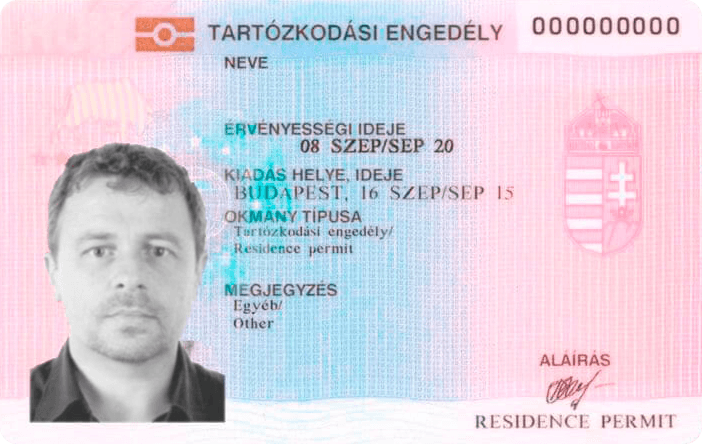
Hungary issues residence permit cards of the unified EU standard
Risks and pitfalls: what can go wrong with Hungary business residence?
Applicants for Hungary business residence permits should expect practical risks that can derail approval, renewal, or long-term plans.
1. Hungary business residency ends without any route to permanent status. After the maximum 3-year cycle, it ends. Other residency options are needed for permanent residence or citizenship.
2. Renewal can fail if the business or stay requirements are weak. Renewal is not automatic. Authorities check whether the company genuinely operates and produces steady income of at least €1,500 per month. Physical presence also matters: at least 90 days per 6 months in Hungary.
3. Family reunification can be slow and limited. Family members often cannot apply immediately. Eligibility starts only after the first renewal, which can mean around a year apart. If immediate relocation for the whole family is a priority, the Hungary Golden Visa can be a faster alternative.
4. Proof of funds can exceed business income. Authorities may ask for personal savings, alongside business viability, showing at least €10,000 in a bank account. Applicants who spend everything on setup costs can get stuck.
5. The wrong company form can expose personal assets. A limited liability company protects personal property. A general partnership or limited partnership can create unlimited liability for some founders, allowing creditors to pursue personal assets.
6. Banking issues can delay or block the process. A Hungarian bank account is typically required, but banks can refuse applicants. Non-EU nationals may face extra checks, more paperwork, and mandatory in-person steps. Non-Hungarian banking alternatives are usually not accepted.
7. Paperwork mistakes can trigger delays or refusal. The process involves formal documents, notarisation, apostilles, proof of housing, business records, and sometimes police certificates. Incorrect format, expired papers, or missing items can sink the case. Certified Hungarian translations are often required.
8. The initial national visa can be refused. Many applicants must secure a national long-stay visa before the permit. Limited Schengen travel history or a higher-risk nationality can increase scrutiny and refusal risk.
9. A “paper company” can be rejected. Authorities expect real substance, not a shell created for immigration. A credible plan, evidence of activity, and sometimes premises, contracts, or hiring can be needed. Weak substance risks refusal or non-renewal.
10. Language and admin friction can cause costly errors. Most procedures run in Hungarian. Without local legal, accounting, and translation support, missed deadlines and misunderstandings become more likely.
11. Accommodation proof can fail. Applications require valid evidence of a Hungarian address, such as a lease agreement, a courtesy accommodation statement, a title deed, or other accepted documents. If the paperwork is incomplete or the address cannot be properly registered, the process can stall. This is especially relevant when accommodation is arranged through a property purchase.
How Immigrant Invest can help with Hungary residency by opening a company
Immigrant Invest has worked in investment migration since 2006 and supports applicants with Hungary business residence cases end to end. With an office in Hungary, the company relies on local, Hungary-based legal expertise and day-to-day coordination on the ground. This helps align applications with local rules, documentation standards, and practical requirements such as address proof and banking.
Key areas of support include:
- eligibility screening and internal Due Diligence;
- clear document checklist and realistic case positioning;
- coordination in Hungary;
- compliance-led case preparation, including AML review and alignment with EU standards;
- transparent fees and refund terms discussed early;
- support after approval, including renewals and alternative residence or citizenship planning.
Key takeaways about the Hungary business residency
- Foreign nationals can obtain a Hungarian residence permit by setting up and running a company. The most common structure is a Kft, with €7,300 minimum share capital.
- Only founders with an ownership stake qualify; hired directors without equity do not.
- Business owners need to show a minimum monthly income of around €1,500 to support residency.
- Hungary business residence permit is issued for 1 year and can be renewed once for up to 2 more years. This route does not lead to permanent residence or citizenship.
- Hungary levies 9% corporate tax and a 15% flat personal income tax.
- Family reunification is available after 1 year as a permit holder, for a spouse, minor children, and dependent parents.
Immigrant Invest is a licensed agent for citizenship and residence by investment programs in the EU, the Caribbean, Asia, and the Middle East. Take advantage of our global 15-year expertise — schedule a meeting with our investment programs experts.
Sources
- Source: Hungarian Central Statistical Office — Number of registered economic corporations and unincorporated enterprises by legal forms
- Source: Hungarian Central Statistical Office — Number and share of foreign-controlled affiliates by section and the residence of the ultimate owner
- Source: XC of 2023. Law on the general rules for the entry and residence of third-country nationals
- Source: National Directorate-General for Aliens Policing — Residence permit for guest self-employment
- Source: NAV — A short summary on the taxation of business associations
- Source: PwC — Taxes on personal income in Hungary
- Source: Hungarian Central Statistical Office — Main data of macroeconomy
- Source: World Bank Group — GDP Growth in Hungary
- Source: Eurostat — Electricity prices
- Source: Eurostat — Gas prices
- Source: Hungarian Central Statistical Office — Number of newly registered economic corporations and unincorporated enterprises by legal forms
- Source: Hungarian National Tax and Customs Administration
- Source: Hungarian Central Statistical Office — Business demography by industries
- Source: NAV — Guidelines, summaries on taxation
- Source: NAV — Information booklet no. 100 2024
- Source: NAV — Booklet no. 99: Itemised tax for small taxpayers (KATA rules)
- Source: NAV — Information booklet no. 92
- Source: NAV — Changes to the individual tax exemption threshold in Hungary, as of 1 January 2026
- Source: NAV — Community transactions: general rules of VAT
- Source: National Legislation Register, Hungary — Act C of 2000 on Accounting
- Source: Hungarian Chamber of Auditors — The law amending the statutory audit threshold has been published
- Source: Act LXXV of 2007 on the Hungarian Chamber of Auditors, statutory audit activity, and the public oversight of auditors
- Source: Act I of 2012 on the Labour Code
- Source: The Government of the UK — Travel to Hungary for work
- Source: National Directorate-General for Aliens Policing — Registration Certificate for EEA Nationals
- Source: European Commission — Self-employed worker in Hungary
- Source: NAV — Individual entrepreneurs registry
- Source: Budapest Chamber of Commerce and Industry — Starting and being registered as a solo entrepreneur
- Source: Embassy of Hungary — Schengen (C type) Visa
- Source: National Directorate-General for Aliens Policing — D” type visa picking up the first residence permit
 Trusted by 5000+ investors