Summary
Greece has already granted nearly 50,000 Golden Visas, and Portugal over 30,000 — testament to their long-standing appeal among global investors. Hungary, with its recently relaunched program, is quickly gaining attention as a fresh, accessible alternative.
As interest in diversified and professionally managed assets grows, the investment fund route is emerging as one of the leading options for obtaining European residency.
This comparison breaks down the key differences between the programs in Greece, Portugal, and Hungary — from fund strategies and thresholds to taxes and residency terms — to help investors make an informed and strategic choice.
5 reasons why fund investments are gaining popularity under Golden Visa programs
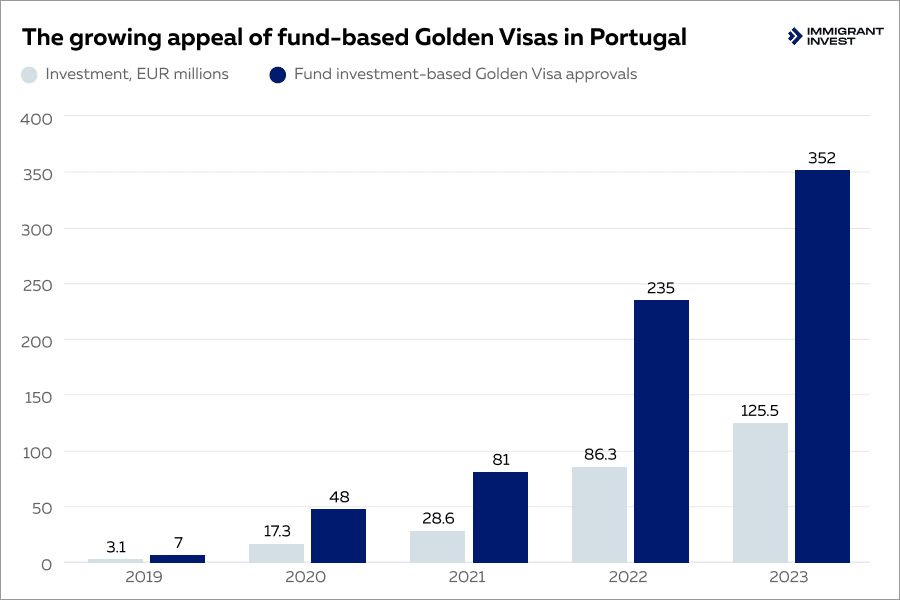
Investment funds are becoming a preferred route under Golden Visa programs. In Portugal alone, approvals rose from just 7 in 2019 to 352 in 2023, with over €125 million invested that year. This growing trend reflects broader shifts in investor priorities and government policy.
1. Real estate restrictions have redirected demand
Countries such as Portugal and Hungary have removed real estate from their Golden Visa programmes, while Greece has significantly raised its minimum investment threshold. These changes have redirected demand toward fund-based options.
In response, governments and asset managers are offering specialised funds focused on sectors like green energy, AI, and tourism — aligning with both national economic goals and modern investor values.
2. Predictable capital exit
Exiting a direct property or business investment depends on market timing and finding a buyer, which can take months and involve inspections, listings, and legal procedures.
In contrast, while fund units must be held for a minimum period, they often allow for smoother exits through planned redemptions or secondary market mechanisms — offering more predictable liquidity once the lock-in period ends.
3. Professional diversification
Fund portfolios are managed by licensed professionals and typically spread across multiple sectors and asset types. This diversification reduces risk and removes the burden of individual asset selection, offering investors a hands-off alternative to managing physical property or business.
4. Generating passive income
Many other Golden Visa routes require non-refundable contributions or active business involvement. In contrast, funds are designed to generate passive returns.
Investors not only secure residency but also retain the potential to earn income during the holding period — allowing their capital to remain productive without day-to-day engagement.
5. Transparency and investor protection
Funds approved for Golden Visa participation must comply with strict financial and legal standards. They operate under clear frameworks for eligibility, reporting, and investment governance. This adds transparency and reduces uncertainty.
While fund-based residency is available in Greece, Portugal, and Hungary, each country sets distinct legal, geographic, and sectoral requirements that directly impact investor outcomes. The comparison below outlines how much you need to invest, where your capital can go, which fund structures are permitted, and what investment strategies dominate in each market.
Comparison of eligible fund requirements under Golden Visa programs
Greece: diversify locally through real estate and bond funds
While Greece’s Golden Visa program is best known for its real estate route, investment in qualifying funds is becoming a strong alternative — offering the same residency benefits with fewer ownership burdens and more diversified capital allocation.
Unlike direct property purchases, fund participation eliminates the need to manage, maintain, or resell a specific asset. Investors gain exposure to professionally managed portfolios and benefit from reduced concentration risk across multiple sectors.
Investment threshold — €350,000
The minimum investment for Golden Visa eligible funds is €350,000 — below the €400,000 or €800,000 thresholds now applied to most property purchases. The lower €250,000 tier is restricted to renovation projects, often with complex approval procedures and resale constraints.

Trusted by 5000+ investors
Will you obtain residence by investment in Greece?
Eligibility
To qualify for the Greece Golden Visa program, a fund must:
- maintain a minimum net asset value, NAV, of €3 million;
- be managed by a company licensed by an EU-recognised capital market authority;
- be established in Greece or another EU country, but invest exclusively in Greece;
- use a Greek-based custodian bank to hold investor funds and ensure local compliance.
These safeguards are designed to ensure transparency and regulatory oversight at every stage, reducing legal and counterparty risks for foreign investors.
Fund types
Two types of funds qualify under the Greek Golden Visa:
- Mutual Funds, which must invest solely in financial instruments listed on regulated Greek markets — including domestic equities, corporate bonds, and sovereign debt.
- Alternative Investment Funds, AIFs, which are restricted to Greek real estate, covering residential, commercial, or hospitality assets.
Minimum holding period — 5 years
To retain residency, fund units must be held for a minimum of 5 years. Early redemption or exit from the investment may result in loss of resident status.

Albert Ioffe,
Legal and Compliance Officer, certified CAMS specialist
Greece does not maintain a public registry of approved funds. Detailed information — including investment strategies, asset allocation, and performance projections — is available on a case-by-case basis. Once an investor confirms interest, the Immigrant Invest legal team can provide the full set of fund materials and compliance documentation
Portugal: build a tailored portfolio under the Golden Visa
Among the five investment routes available under Portugal’s Golden Visa, fund investment has become the most popular. This route requires a minimum of €500,000 in qualifying fund units and offers flexibility, diversification, and strong regulatory oversight.
Investors can allocate their capital across multiple eligible funds, as long as the total investment meets the €500,000 threshold. This flexibility — not available in the Greek or Hungarian programmes — allows applicants to tailor portfolios by risk, sector, or strategy.
Fund strategies
Portuguese funds span a wide spectrum of strategies. Many focus on foundational sectors — such as infrastructure, energy, agriculture, and hospitality — aligned with government development priorities. Others operate in higher-growth or niche segments, including technology, data centres, football management, and digital assets.
Eligibility
All funds must be managed by licensed companies under the supervision of the Portuguese Securities Market Commission, CMVM. Compliance with EU-level Anti-Money Laundering and Know Your Customer regulations is also mandatory.
To qualify for the Portugal Golden Visa program, a fund must:
- invest at least 60% of its capital in Portuguese companies;
- avoid residential real estate in Lisbon, Porto, and other high-density urban areas, where such investment is explicitly prohibited under Golden Visa to prevent market distortion.
Fund types
Most eligible vehicles are closed-end funds, which follow a defined lifecycle: capital is raised, deployed, managed, and divested over a fixed term, typically 8 to 12 years. These funds are illiquid by design — units cannot be redeemed before maturity — but offer structured, exit-driven returns.
Open-end funds are less common but available. These continuously issue and redeem units at net asset value, NAV, allowing for rolling entry and exit. While they provide greater liquidity, they often cap exposure to higher-risk or shorter-duration strategies.

Trusted by 5000+ investors
Practical guide to the Portugal Golden Visa and its funds
Minimum holding period — 5 years
To maintain residency, fund units must be held for at least 5 years.
In practice, however, most closed-end funds have longer life cycles. Investors commit capital for 8—12 years, with exit possible only after assets are sold and returns distributed.
Yields — 2 to 20% per year
Portuguese Golden Visa funds vary widely in structure and ambition. Understanding how risk maps to expected return is essential:
- Low-risk funds invest in diversified, stable sectors — often government-aligned. They prioritise capital preservation and may deliver steady returns around 2—5% per year.
- Medium-risk funds target sectors with higher growth potential. These typically aim for 5—10% annual yields, balancing opportunity with moderate volatility.
- High-risk funds pursue aggressive strategies in areas like startups, crypto, or single-asset exposure. With targeted yields of 10—20%, they demand a tolerance for illiquidity, delayed exit, and elevated downside risk.
In this spectrum, investors must weigh long-term residency goals against their own return expectations, liquidity needs, and risk appetite. The Portugal fund route offers unmatched diversity — but extracting its value requires careful portfolio construction and regulatory alignment.
Selection of Portuguese investment funds eligible for the Golden Visa
In Portugal, subscription and maintenance fees are built into the fund unit price, so investors don’t pay them separately
Hungary: capital-preserving fund entry with low volatility
Hungary offers two investment routes under its Golden Visa program, one of which is via licensed investment funds. With a minimum threshold of €250,000, it is currently the most affordable fund-based residency option in the EU.
Eligibility
All Golden Visa funds must be pre-approved by the Hungarian government. The full list of licensed funds is published by the National Bank of Hungary and regularly updated. In addition, these funds are bound by EU regulatory standards, including strict Anti-Money Laundering and Know Your Customer obligations.
To qualify, funds must allocate at least 40% of capital to Hungarian real estate — including residential developments, logistics centres, hotels, and commercial properties. The remaining portfolio may include bonds, debt instruments, collective investment schemes, and derivatives. This blend supports a conservative strategy focused on capital stability rather than aggressive growth.

Trusted by 5000+ investors
Will you obtain residence by investment in Hungary?
Yields — up to 6%
Authorised funds are positioned as low-risk vehicles. Annual returns are capped at 6%, with most funds designed to preserve principal rather than maximise yield. This makes the Hungarian option appealing to risk-averse investors seeking predictable outcomes.
Exit options
The statutory minimum holding period for fund investments is 5 years, but real-world liquidity is more limited. At present, only two funds are available: one is open-ended, offering redemptions at fixed intervals, and the other is closed-ended, with a 20-year maturity and no early exit mechanism.
Hungarian investment funds eligible for the Golden Visa
Comparing Golden Visa rules: Greece vs. Portugal vs. Hungary
Eligibility requirements for applicants
Main applicant. Across all three Golden Visa programs — Greece, Portugal, and Hungary — baseline investor criteria are consistent. Applicants must be over 18, possess a clean criminal record, and prove a legal, verifiable source of income.
Hungary adds one procedural condition: investors must either rent or purchase real estate to register a local address before submitting the application.
Family members. All three programs allow investors to include close family members — namely, spouses or partners, dependent children, and parents — but the scope and thresholds differ.
Family eligibility and age limits
Country

Greece
Spouse or partner
In an official marriage, or recognised cohabitation agreement signed in Greece
Same-sex couples included
Children
Under 21. If over 18, must be unmarried
Parents
No age limit or financial dependency requirement
Country

Portugal
Spouse or partner
In an official marriage, or proven relationship of over 2 years
Same-sex couples included
Children
Under 26. If over 18, must be unmarried, financially dependent, and either living with the investor or enrolled in higher education
Parents
Must be over 65 or financially dependent
Country

Hungary
Spouse or partner
In an official marriage or registered partnership
Children
Under 25. If over 18, must be unmarried, financially dependent, and in full-time education
Parents
Must be financially dependent and have no income other than pension
Country | Spouse or partner | Children | Parents |
|---|---|---|---|
Greece | In an official marriage, or recognised cohabitation agreement signed in Greece Same-sex couples included | Under 21. If over 18, must be unmarried | No age limit or financial dependency requirement |
Portugal | In an official marriage, or proven relationship of over 2 years Same-sex couples included | Under 26. If over 18, must be unmarried, financially dependent, and either living with the investor or enrolled in higher education | Must be over 65 or financially dependent |
Hungary | In an official marriage or registered partnership | Under 25. If over 18, must be unmarried, financially dependent, and in full-time education | Must be financially dependent and have no income other than pension |
Residence permit validity
Hungary offers the longest initial residence permit — 10 years — but it can only be renewed once. Children over 18 are granted shorter 3-year permits, renewable for another 3 years.
Greece grants 5-year permits with unlimited renewals, giving investors long-term security without frequent administrative burdens.
Portugal takes a more fragmented approach, issuing permits in 2-year increments. Although this requires more frequent renewals, it aligns with the country’s flexible stay requirements.
Stay requirements
For maintaining Golden Visa residency, none of the three programmes impose physical presence requirements — except Portugal, which mandates 7 days per year.
However, for investors targeting citizenship, residency obligations change significantly:
- Greece and Hungary require applicants to reside in the country most of the year throughout the naturalisation period;
- Portugal, by contrast, maintains the 7-day-per-year rule even for citizenship eligibility — making it the most lenient option for globally mobile investors seeking a second passport.
Additional Golden Visa costs
Investors must also factor in application fees and health insurance. Health coverage costs around €300—400 per person, while application fees vary by country: €110 in Hungary, €605 in Portugal, and €2,000 in Greece.
Portugal also charges a Golden Visa residence permit issuance fee of €6,045 per applicant.
Hungary imposes an additional administrative fee of €65,000 for a family of up to four, plus €10,000 for each extra dependent starting from the fifth and €15,000 for each child over 18.
Golden Visa conditions compared side by side
Features
Processing time
Greece
4+ months
Portugal
12+ months
Hungary
5+ months
Features
Permit validity
Greece
5 years, renewable indefinitely
Portugal
2 years, renewable indefinitely
Hungary
10 years, renewable once
Features
Stay requirements
Greece
None
Portugal
7 days per year
Hungary
None
Features
Additional expenses
Greece
€2,300+
Portugal
€7,050+
Hungary
€65,410+
Features
Family inclusion
Greece
Spouse, children under 21, parents
Portugal
Spouse, children under 26, parents
Hungary
Spouse, children under 25, parents
Features
Time to citizenship
Greece
7 years
Portugal
5 years
Hungary
11 years
Features | Greece | Portugal | Hungary |
|---|---|---|---|
Processing time | 4+ months | 12+ months | 5+ months |
Permit validity | 5 years, renewable indefinitely | 2 years, renewable indefinitely | 10 years, renewable once |
Stay requirements | None | 7 days per year | None |
Additional expenses | €2,300+ | €7,050+ | €65,410+ |
Family inclusion | Spouse, children under 21, parents | Spouse, children under 26, parents | Spouse, children under 25, parents |
Time to citizenship | 7 years | 5 years | 11 years |
Step-by-step procedure of obtaining a Golden Visa through fund investment
While the Golden Visa application process is broadly similar across Greece, Portugal, and Hungary, each country has its own procedural specifics.
Based on Immigrant Invest’s legal practice, minimum processing times are as follows:
- 4 months in Greece;
- 5 months in Hungary;
- 12+ months in Portugal.
Despite these differences, all three programs follow a clearly defined sequence
1 day
Preliminary Due Diligence
Every application begins with a confidential background check to assess eligibility. This internal screening is conducted by Immigrant Invest using international compliance databases and helps identify any potential red flags before proceeding.
At this stage, the only document required is the applicant’s valid passport.
Every application begins with a confidential background check to assess eligibility. This internal screening is conducted by Immigrant Invest using international compliance databases and helps identify any potential red flags before proceeding.
At this stage, the only document required is the applicant’s valid passport.
Up to 2 months
Document preparation
Applicants receive a personalised list of required documents. Immigrant Invest handles the entire collection and legalisation process, ensuring compliance with country-specific standards.
This stage also includes administrative steps:
- in Portugal and Greece, applicants must obtain a tax ID number. Portugal additionally requires opening a local bank account;
- in Hungary, investors must travel to the country to invest and apply for residency. If they do not have visa-free access, they receive a Guest Investor Visa at the Hungarian consulate.
Applicants receive a personalised list of required documents. Immigrant Invest handles the entire collection and legalisation process, ensuring compliance with country-specific standards.
This stage also includes administrative steps:
- in Portugal and Greece, applicants must obtain a tax ID number. Portugal additionally requires opening a local bank account;
- in Hungary, investors must travel to the country to invest and apply for residency. If they do not have visa-free access, they receive a Guest Investor Visa at the Hungarian consulate.
Up to 3 months
Investment
Once documents are in order, the applicant acquires fund units in a licensed investment vehicle. Immigrant Invest prepares all transaction records and proof of investment for submission.
In Hungary, this must be done in person after arrival. In Portugal and Greece, the full investment process can be completed remotely
Once documents are in order, the applicant acquires fund units in a licensed investment vehicle. Immigrant Invest prepares all transaction records and proof of investment for submission.
In Hungary, this must be done in person after arrival. In Portugal and Greece, the full investment process can be completed remotely
1 day
Application submission
The complete application package is filed through the relevant government portal. Digital copies of all supporting documents are uploaded alongside the official form.
The complete application package is filed through the relevant government portal. Digital copies of all supporting documents are uploaded alongside the official form.
Up to 10 months
Biometric submission and residence card issuance
Applicants are required to visit the country to provide biometric data and present original documents.
In Hungary, residence cards are delivered directly to the investor’s registered local address. In Greece and Portugal, cards can be collected in person or issued to a legal representative via power of attorney.
Applicants are required to visit the country to provide biometric data and present original documents.
In Hungary, residence cards are delivered directly to the investor’s registered local address. In Greece and Portugal, cards can be collected in person or issued to a legal representative via power of attorney.
Taxes for fund investors in Greece, Portugal, and Hungary
Golden Visa investors are taxed on dividends and capital gains earned from qualifying funds. None of the countries levy a wealth tax on fund investments. However, tax treatment varies significantly depending on the country and whether the investor is a tax resident there.
Greece
A uniform 15% withholding tax applies to both dividends and capital gains from Golden Visa-eligible funds, regardless of tax residency. This tax is withheld at source, meaning investors typically do not need to file a Greek tax return unless they earn additional Greek income. No social contributions apply to fund investments.
Tax residency remains key. To avoid double taxation, investors should ensure a tax treaty exists between their home country and Greece. These treaties often allow Greek withholding taxes to be credited or exempted in the investor’s country of residence.
Portugal
Portuguese tax residents must declare all fund income in their annual tax return. Depending on their income bracket, returns are taxed progressively between 12.5 and 48%.
Non-residents benefit from deferral: as long as fund earnings are reinvested and not distributed, no Portuguese tax applies during the holding period. When income is eventually paid out, it is subject to a 28% withholding tax. This rate may be reduced under a double tax treaty. Non-residents are only required to file a Portuguese tax return if they receive Portuguese-source income.
Hungary
All investors are subject to a flat 15% tax on income from fund units. Hungarian tax residents must also pay a 13% social contribution, bringing the effective tax rate to 28%.
Non-residents are taxed only at the flat 15% rate. Filing is not required unless Hungarian-source income is received separately.
7 benefits of residence permits in Greece, Portugal, and Hungary
1. Reliable Plan B
A residence permit in the EU offers a long-term safety net in times of political instability, economic uncertainty, or personal transition. It allows investors and their families to relocate on short notice, live and work legally within the EU, and maintain access to stable healthcare, education, and banking systems — even if circumstances change in their home country.
2. Visa-free movement across Europe
Golden Visa holders enjoy unrestricted travel throughout the 29 countries of the Schengen Area. There’s no need to apply for short-term visas — a valid residence card allows effortless movement for business, leisure, or family visits.
Each country also serves as a gateway to its region:
- Greece — Athens is a major flight hub with extensive connections across Europe and the Mediterranean. Frequent ferries link the mainland to the Greek islands and Italy, offering scenic maritime routes;
- Portugal — Coastal highways from the Algarve lead seamlessly into Spain, enabling road trips toward Andalusia and the Costa del Sol;
- Hungary — Budapest sits in the heart of Central Europe — a few hours’ drive from Vienna, Bratislava, and Zagreb — ideal for overland travel within the region.
3. Favourable business environment
Each programme connects investors to a favourable business climate — but with different strengths.
Portugal combines policy stability with strategic sectors. In 2025, it climbed 4.5% in the Foreign Direct Investment Report, driven by tech, renewables, and sustainable tourism. Corporate tax rates remain competitive at 21% on the mainland, 20% in Madeira, and just 16.8% in the Azores.
Hungary offers the EU’s lowest corporate tax rate — a flat 9% — with strong growth in logistics, real estate, automotive manufacturing, and ICT, especially around Budapest’s industrial corridor.
Greece remains a global force in tourism and shipping. Tourism contributes 16.8% of GDP, while the broader services sector accounts for over 68%, well above the global average. Hospitality-focused funds benefit from robust demand, with Greece welcoming 40 million visitors annually.

Greece welcomes around 40 million tourists annually, driving steady demand in the hospitality sector and making hospitality-focused real estate funds a strong investment choice
4. Potential for investment returns
Golden Visa investment options are structured to generate returns of 4—5% — not just access. In Portugal, fund yields range from 2 to 20% annually, depending on risk level and sector. Hungarian funds are lower-risk, offering returns of up to 6%.
5. Quality of life beyond investment
Each destination offers its own lifestyle rhythm:
- Greece is defined by its island tempo — sailing, quiet beaches, and living near ancient landmarks that still shape the culture;
- Portugal offers a relaxed coastal lifestyle — Atlantic surfing, seafood by the sea, and compact cities where nature and tradition coexist;
- Hungary is more grounded and central-European: think thermal spas in Budapest, countryside vineyards, historic castles, and communities where tradition is lived rather than curated.
6. Access to public services and international education
Golden Visa holders and their families are eligible for free public healthcare and state-funded schooling. Dependents can also enrol in international schools with bilingual instruction, while adults have access to accredited universities and EU-wide vocational programs.
7. Comfortable climate and year-round outdoor living
Greece and Portugal offer Mediterranean weather — mild winters, dry summers, and long hours of sunshine. Hungary has a temperate continental climate, with four distinct seasons.
All three support an outdoor-oriented lifestyle, with alfresco dining, weekend travel, and seasonal festivals woven into everyday life.
Summary: which country offers the best fund investment opportunity?
Each Golden Visa fund route offers a different trade-off between investment threshold, diversification options, and long-term flexibility.
Hungary
Lowest entry point, with a minimum fund investment of €250,000. This route appeals to those prioritising affordability and regulatory simplicity.
However, only two funds are currently authorised: one is open-ended, and the other is a closed-ended vehicle with a 20-year maturity. Annual yields are modest, capped at 6%, reflecting the funds’ conservative and capital-preserving strategies.
Portugal
Highest investment threshold at €500,000 but unmatched variety. Investors can choose from dozens of regulated funds spanning sectors such as hospitality, sustainable agriculture, AI, renewable energy, infrastructure, and even sports management.
Yields vary widely, from 2% in low-risk funds to as high as 20% in high-risk, niche strategies. Most funds are closed-end and require a holding period of 6 to 12 years.
Greece
Middle ground with a €350,000 minimum investment. The fund market is less transparent: eligible fund names and performance data are not publicly disclosed. However, the funds presented to investors by licensed advisors often focus on income-generating commercial real estate — including logistics centres, hospitality projects, and office developments.
All three programs provide the same core benefits: visa-free travel across the 29 Schengen countries, access to public healthcare and education, no mandatory stay requirements, and the option to include family members.
Ultimately, the choice depends on the investor’s priorities — whether it’s cost-efficiency in Hungary, fund diversification and potential in Portugal, or real estate-backed stability in Greece.
Immigrant Invest is a licensed agent for citizenship and residence by investment programs in the EU, the Caribbean, Asia, and the Middle East. Take advantage of our global 15-year expertise — schedule a meeting with our investment programs experts.

 Trusted by 5000+ investors