

Summary
At a time when mobility, tax exposure, and long-term security are increasingly uncertain, European Golden Visa programs offer a lawful way to secure residence abroad through investment, without giving up US citizenship.
Countries such as Portugal, Greece, and Italy offer residency-by-investment pathways starting at €250,000. With a residence permit, you get legal stability, access to healthcare and education systems, and, in some cases, a route to permanent residence or citizenship.
This article explains how Golden Visas work for Americans, which EU programs remain open, what investment routes are available, and which legal and financial factors should be carefully assessed before applying.
What is a Golden Visa?
Golden Visa is a term for residence-by-investment programs in the European Union. Sometimes, Golden Visa is also used to define citizenship-by-investment programs in other parts of the world, such as the Caribbean, the Middle East, or West Asia. In this article, we will focus on European residence-by-investment programs.
Golden Visas in Europe are established by national legislation and administered by immigration authorities. They do not grant citizenship automatically but provide the right to reside in the country, along with benefits such as long-term visiting the Schengen Area and access to local infrastructure and social services. Over time, a residence permit may also lead to permanent residence or citizenship.
Multiple countries in Europe offer residence by investment, including:
Malta and Cyprus are the only countries on this list that grant permanent residence by investment, a lifetime status that does not require renewal. All other countries mentioned issue residence permits valid for 2—10 years, which are then subject to renewal or resubmission.
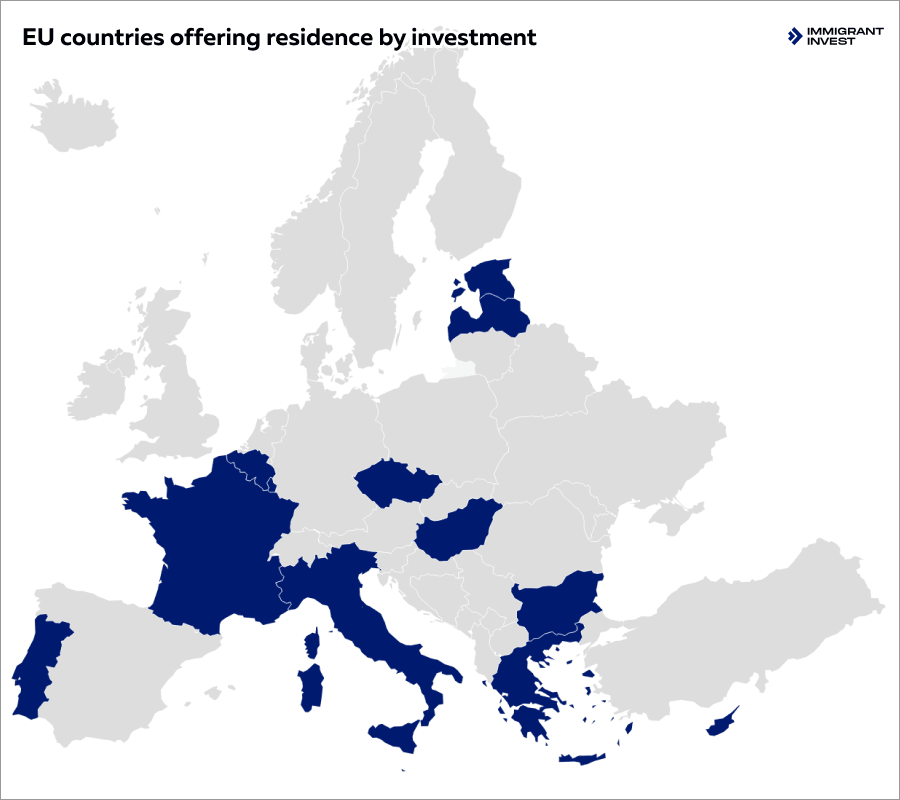
Here’s how Golden Visa programs work: non-EU nationals contribute to the country’s economy, following one of the investment routes. The investment is usually directed into real estate, government bonds, regulated investment funds, or business development.
To get a residence permit, candidates pass strict background checks, prove the legality of their income, and pay legal fees. Generally, the whole process takes 4 to 12 months or more.
The exact rules, requirements, thresholds and timelines depend on the chosen country and program.
Benefits of obtaining the Golden Visa for Americans
For US citizens, a Golden Visa is not only an immigration status but also a practical legal instrument for long-term planning that comes with multiple advantages. Below are the main benefits that make investment-based residency attractive to Americans seeking stability, mobility, and access to Europe.
1. Legal residence outside the US as a plan B
A Golden Visa allows American citizens to obtain residence abroad while retaining their passport, as US law places no restrictions on holding a residence permit in another country.
For many investors, a Golden Visa becomes a Plan B, as it creates a right to enter and stay in a second jurisdiction if circumstances change, whether due to travel disruptions, policy shifts, or broader instability.
2. Access to the Schengen Area for long-term stays
US citizens have visa-free access to the Schengen Area for up to 90 days in any 180-day period. A residence permit allows its holder to stay in the issuing country for years, as long as the permit is valid.
Golden Visa holders are not obliged to spend a lot of time in the host country, but they have the freedom to stay there for as long as they wish. They also keep the right to travel to other Schengen states for up to 90 days within every 180-day period.
3. Flexible residence requirements
Golden Visas suit investors who do not plan to relocate immediately. In most cases, renewals do not depend on living in the country or visiting it frequently. Portugal is an exception: to maintain its Golden Visa, investors must spend at least 7 days per year in the country.
Relocation becomes relevant only for investors who aim to obtain permanent residence or citizenship.
4. Pathway to permanent residence or citizenship
In several countries, Golden Visa holders may become eligible for permanent residence or citizenship by naturalization after living there for a few years. Permanent residency typically grants access to social benefits and permission to work. Citizenship goes further, including stronger global mobility and voting rights.
In many cases, once an investor secures permanent residence or citizenship, they can withdraw their Golden Visa investment.
5. All family members in one application
Residence-by-investment routes allow the main applicant to include immediate family members, usually a spouse and dependent children. Some jurisdictions permit dependent parents, siblings, and adult children.
Malta’s Permanent Residence Programme is among the most generous in that sense. It allows investors to include children up to 29 years old, as well as parents and grandparents of both the main applicant and the spouse.
Family members receive residence rights linked to the main permit, reducing the need for separate immigration procedures.
6. Access to universal healthcare and European education
A Golden Visa grants lawful residence in the issuing country, which may allow access to national healthcare systems, public or private education, and local infrastructure, depending on domestic regulations.
In European countries, residents can receive medical care for free or at a small co-payment within local universal healthcare systems. Besides, they can obtain private insurance on local terms, which is significantly more affordable than in the US. For instance, in Italy, private insurance costs start at €1,300 per year.
Children may attend schools or universities under the same rules that apply to other residents. Tuition fees in Europe are also substantially lower than those in the US and start at around €2,000 per year.

Europe is home to many of the world’s oldest and most prestigious universities. The University of Bologna in Italy is widely regarded as the oldest university still operating continuously
7. Predictable legal framework and investment transparency
Golden Visas operate under published laws, government decrees, and official guidance. Investment thresholds, eligible asset types, and renewal rules are defined in advance.
Working with an experienced consulting company such as Immigrant Invest adds an extra layer of control. Lawyers help verify eligibility, structure the investment correctly, and manage the application process in a clear and compliant way.
Available investment options in Golden Visa programs
Golden Visas usually limit eligible investments to categories defined by law. The specific conditions, minimum amounts, and holding periods vary by country and are set out in national legislation or government regulations.
Below are the most common investment routes available to American applicants.
Financial thresholds under EU Golden Visas 
Country

Portugal
Real estate
—
Fund units
€500,000+
Capital transfer
—
Business investment
€500,000+
Support of local projects
€250,000+
Country

Greece
Real estate
€250,000+
Fund units
€350,000+
Capital transfer
€500,000+
Business investment
—
Support of local projects
—
Country

Hungary
Real estate
—
Fund units
€250,000+
Capital transfer
—
Business investment
—
Support of local projects
€1,000,000+
Country

Italy
Real estate
—
Fund units
—
Capital transfer
—
Business investment
€250,000+
Support of local projects
—
Country

Latvia
Real estate
€250,000+
Fund units
—
Capital transfer
—
Business investment
€50,000+
Support of local projects
—
Country | Real estate | Fund units | Capital transfer | Business investment | Support of local projects |
|---|---|---|---|---|---|
Portugal | — | €500,000+ | — | €500,000+ | €250,000+ |
Greece | €250,000+ | €350,000+ | €500,000+ | — | — |
Hungary | — | €250,000+ | — | — | €1,000,000+ |
Italy | — | — | — | €250,000+ | — |
Latvia | €250,000+ | — | — | €50,000+ | — |
Real estate
Property investment has historically been one of the most widely used Golden Visa routes. Where permitted, the law specifies minimum property values, eligible locations, and ownership formats.
Investors are usually required to retain ownership for the duration of the residence permit. Additional costs, such as transfer taxes, notary fees, and ongoing property expenses, must be factored in.
As one of the most popular investment routes among Golden Visa applicants, this option can push up local property prices. For that reason, some governments have withdrawn property purchase from their residence-by-investment programs. Portugal, for example, closed its real estate route in 2023.
Greece and Latvia Golden Visas currently offer a real estate route with a financial threshold of €250,000.
Investment funds
Many European Golden Visa programs allow investment through government-approved or regulated funds. These are usually alternative investment funds, private equity funds, or venture capital structures registered and supervised by national financial authorities.
Funds are overseen by management companies. The investment must be maintained for a minimum period set by law, typically at least 5 years. Early exit may result in the loss of residence status.
Portugal, Greece, Hungary, and Cyprus allow Golden Visa applicants to qualify through the purchase of selected investment fund units. Among these options, Hungary offers the lowest entry threshold of €250,000 through its real estate investment fund route.

Mohamed Zakaria,
Senior Investment Migration Expert
Along with real estate, investment funds are one of the most preferred routes in residence-by-investment programs. These options are structured and easy to document for immigration purposes, as ownership and compliance can be confirmed through formal subscription and custody records.
Both routes may offer clear exit conditions through legally defined holding periods and transfer rules, and both can generate passive income, depending on the asset, rental yield in real estate, or distributions from a fund.
Business investment
Some countries grant Golden Visas to investors who contribute capital to an existing business or establish a new company that meets statutory criteria. Requirements may include a minimum investment amount, job creation, or proof that the business activity benefits the national economy.
This route involves higher operational responsibility. Investors must comply not only with immigration law but also with the corporate, tax, and labour regulations of the host country. Business performance, reporting obligations, and ongoing activity may be reviewed during permit renewals.
Latvia, Italy, Cyprus, and Portugal have the business investment option available within their Golden Visa programs. The most affordable path is offered by Latvia, starting at €50,000.
Capital transfer
Some Golden Visas allow participation through a capital transfer, usually by opening a bank deposit. The exact format, minimum amount, and documentation requirements are defined by national law and may include additional conditions, such as maintaining the funds for a set period and confirming the lawful origin of the capital.
Based on Immigrant Invest experience, the capital transfer route is used less often because it ties up liquidity without offering the same long-term investment potential as real estate or funds.
Greece offers a capital transfer route under its Golden Visa with the threshold of €500,000.
Support of local projects
A few Golden Visa programs include investment routes linked to public-interest projects, such as culture, education, research, or heritage preservation. These options are usually regulated and may take the form of a direct contribution, a donation, or financing approved initiatives, depending on the country’s legal structure.
This route often comes with limited liquidity, as contributions are typically non-refundable and eligible projects may be available only during certain periods.
Portugal, for example, offers an option to support arts, culture, or heritage preservation with an investment starting at €250,000.
Hungary also offers a contribution-based route through a €1,000,000 donation to a public trust supporting higher education institutions.
Best residence by investment options in Europe for Americans
European residence-by-investment routes vary widely in structure, thresholds, and long-term residence prospects.
Below are the EU countries that continue to offer residence options under clearly defined legal frameworks, together with their key conditions.
Residence by investment programs in Europe: overview
Greece Golden Visa — €250,000+
Greece grants a renewable 5-year residence permit under its Golden Visa. It remains one of the few EU countries where real estate purchases are still an eligible investment.
The investment threshold depends on the property type and location:
- €800,000+ for real estate in high-demand areas, such as Athens, Thessaloniki, Santorini, Mykonos, and other popular islands;
- €400,000 for properties outside of those areas;
- €250,000 for specific projects, including renovation or the conversion of an industrial building into residential property.
Other routes include the purchase of investment fund units starting at €350,000 or the opening of a fixed-term bank deposit of €500,000[1].
Greece does not require Golden Visa holders to relocate. As long as the investment is maintained, the residence permit can be renewed.
Along with the main applicant, their family members can also obtain a residence permit. The investor’s spouse, children under 21, and parents can be included as dependents.
If the investor chooses to live in Greece, they may become eligible for permanent residence after 5 years and for citizenship after 7 years. After obtaining permanent residence or citizenship, the asset may be sold.
Portugal Golden Visa — €250,000
Portugal’s Golden Visa offers non-real-estate investments, following legislative changes that removed property purchases from the list of eligible options in late 2024.
The main route is an investment of at least €500,000 in units of Portuguese funds. These funds must be regulated, invest primarily in the Portuguese economy, and have a minimum maturity period of at least 5 years.
Other options include a €250,000 contribution to support arts, culture, or heritage preservation, as well as a €500,000 investment in local scientific projects or in a business that creates at least 5 jobs.
Golden Visa investors are required to visit Portugal for only 7 days per year, allowing Americans to maintain the permit without relocating. After 5 years, they may become eligible for permanent residence, if they reside in the country[2].
Investors can include family members to the application and provide them with residence permits as well. This applies to the applicant’s spouse, children under 26, and parents.
Malta Permanent Residence Programme — €169,000+
Malta offers investors residence under the Permanent Residence Programme. Unlike most investment routes in Europe, the Maltese one grants residence status indefinitely.
This Golden Visa program is the only one that allows investors to include grandparents as dependants. Other eligible family members include the main applicant’s spouse, children under 29, and parents.
To qualify, applicants must meet three mandatory requirements[3].
- Invest in real estate. There are two ways an investor can fulfil this requirement: purchase a property worth at least €375,000 or commit to a 5-year rental agreement with a minimum annual rent of €14,000.
- Pay contribution and administrative fees. The contribution fee is €37,000, and the administrative fee is €60,000 for a single investor. If family members are included in the application, the administrative fee increases by €7,500 for each dependent over 18, except for the spouse.
- Make a charitable donation. Investors donate at least €2,000 to a Maltese NGO.
Malta does not impose minimum residence day requirements to maintain permanent residence.
After 5 years of holding the permit, investors are no longer required to maintain their real estate investment: purchased properties may be resold and lease agreements terminated. However, residents must still maintain a registered address in Malta even after the initial 5-year period.
Hungary Golden Visa — €250,000+
Hungary reintroduced its investment residence framework in 2024 through the Guest Investor Program, granting a residence permit valid for 10 years.
The primary route requires an investment of €250,000 in units of a Hungarian real estate fund approved under the program. An alternative option is a €1,000,000 donation to a public trust supporting higher education institutions in Hungary.[4].
Investors’ spouses, children under 18, and parents can obtain residence permits as well.
Investors and their family members are not required to reside in Hungary to maintain their residence permits. However, those who choose to relocate and live in the country may become eligible for permanent residence after 3 years. Citizenship may be applied for after a further 8 years, provided Hungary remains the investor’s main place of residence.
Cyprus permanent residence by investment — €300,000+
Cyprus offers permanent residence by investment with a minimum contribution of €300,000, excluding VAT.
Investment options include the purchase of new residential or commercial real estate, shares of Cypriot companies employing local staff, or units in approved investment funds. Applicants must demonstrate a stable annual income of at least €50,000.
Along with the main applicant, permanent residence can be issued for their spouse and children.
Permanent residence in Cyprus does not require continuous residence, although permit holders must visit the country at least once every 2 years.
Italy Golden Visa — €250,000+
Italy operates the Investor Visa, which grants a 2-year residence permit. The permit can then be renewed for 3-year periods.
Eligible investment options include:
- €250,000+ — an investment in an innovative startup;
- €500,000+ — an investment in a company;
- €1,000,000+ — a charitable donation;
- €2,000,000+ — a purchase of government bonds[5].
Investors are not required to reside in Italy in order to maintain their residence permits. However, if they choose to relocate, they may apply for permanent residence after 5 years of residence and for citizenship after 10 years.
The Italy Golden Visa allows investors to include their spouses, children, and parents in the residence application.
For Americans, Italy Golden Visa offers a number of benefits, including a safe plan B for their families in one of the world’s most sought-after destinations.
Latvia Golden Visa program — €50,000+
Latvia operates a Golden Visa that grants a 5-year residence permit and has one of the lowest entry thresholds among EU states.
The main routes include a business investment starting at €50,000, a real estate purchase valued at least €250,000, or a bank deposit of €280,000.
In addition to the investment, applicants must pay a state fee, the exact amount of which depends on the chosen investment option. For business investments, for example, the fee is €10,000.
Latvia residence can be also provided to an investor’s spouse and children under 18.
Investors are not required to live in Latvia, but they must visit the country at least once a year to submit biometrics and renew their permits.
Closed Golden Visas in the EU
Several EU countries have terminated their Golden Visa programs or closed specific investment routes in recent years. These decisions were formalized through legislative amendments or government resolutions and apply regardless of the applicant’s nationality, including US citizens.
The following programs were terminated recently:
- Ireland closed its Immigrant Investor Program in 2023 by decision of the Irish government, citing policy and economic considerations.
- The Netherlands ended its investor residence initiative in early 2024.
- Spain’s Golden Visa was terminated in 2025.
In other countries, Golden Visas continue to exist but in a significantly restricted form. For example, Portugal removed real estate as an investment route.
Сosts beyond the investment
In addition to the investment amount, applicants should budget for mandatory and ancillary expenses that arise during the application and renewal process. Additional costs vary by country and investment route. For example, in Portugal, expenses related to issuing a residence permit through the fund investment option total around €7,000.
State and processing fees
Most Golden Visas require the payment of government fees for application processing, issuance of residence cards, and renewals. These fees are set by national authorities and may differ for the main applicant and family members.
For instance, in Italy, the residence permit fee in Italy is €3,400 for the main applicant and €570 for each adult family dependent.
In some countries, fees are paid once at the initial stage, while in others they recur at each renewal. State fees are non-refundable, regardless of the outcome of the application.
Health insurance
Health insurance is a standard requirement for Golden Visa applicants and their family members. Policies must usually be valid in the host country and meet minimum coverage requirements defined by immigration law. In general, Schengen countries require coverage of at least €30,000.
Insurance costs depend on age, coverage level, and the duration of the residence permit. On average, Golden Visa investors pay around €400 per applicant.
Accommodation
Even where physical residence is not mandatory, applicants are required to confirm a legal address in the host country. This may involve renting or purchasing residential property. Rental agreements, property ownership documents, or registration certificates may be required at the application or renewal stage, creating additional ongoing costs.
On average, minimum rental costs for an apartment in the capital’s city center range from €350 in Latvia to €1,370 in Lisbon.
If a program allows the purchase of residential real estate as an investment, that property can usually be registered as the applicant’s address.
How to obtain a Golden Visa as an American
Golden Visa procedures vary by country, but the overall workflow is broadly similar across the EU. Depending on the jurisdiction, obtaining a residence permit by investment takes between 3 and 12 months.
In Immigrant Invest’s practice, processing times can also depend on where the application is handled within the country. For example, cases processed through Lisbon’s immigration office may take longer than those handled in some regional locations.
1 day
Golden Visa selection
Compare your options and select a Golden Visa that meets your goals, whether that is relocation to a more stable country, business expansion, or a plan B residence for family.
If you are unsure which option suits you best, you can book a one-on-one meeting with one of our experts.
Compare your options and select a Golden Visa that meets your goals, whether that is relocation to a more stable country, business expansion, or a plan B residence for family.
If you are unsure which option suits you best, you can book a one-on-one meeting with one of our experts.
1 day
Preliminary Due Diligence
Before proceeding with the application, Immigrant Invest conducts a preliminary Due Diligence assessment. Lawyers analyze the applicant’s background, source of funds, and potential risk factors against the requirements of the selected program.
This step helps identify issues that could lead to refusal and allows risks to be addressed before any investment is made or documents are submitted. Preliminary Due Diligence requires only the investor’s passport and takes one business day.
Before proceeding with the application, Immigrant Invest conducts a preliminary Due Diligence assessment. Lawyers analyze the applicant’s background, source of funds, and potential risk factors against the requirements of the selected program.
This step helps identify issues that could lead to refusal and allows risks to be addressed before any investment is made or documents are submitted. Preliminary Due Diligence requires only the investor’s passport and takes one business day.
1—2 weeks
Preparing the documentation package
Typical documents include passports, civil status records, criminal record certificates, proof of address, evidence of income or funds, and investment-related documentation. Many documents must also meet formal requirements such as notarization, apostille, or legalization, and certified translation, depending on the rules of the receiving country.
When working with Immigrant Invest, investors receive a detailed, personalised document checklist at this stage. Once the documents are collected, the team prepares them for submission, ensuring they meet the formal requirements of the chosen route.
Typical documents include passports, civil status records, criminal record certificates, proof of address, evidence of income or funds, and investment-related documentation. Many documents must also meet formal requirements such as notarization, apostille, or legalization, and certified translation, depending on the rules of the receiving country.
When working with Immigrant Invest, investors receive a detailed, personalised document checklist at this stage. Once the documents are collected, the team prepares them for submission, ensuring they meet the formal requirements of the chosen route.
Up to 1 month
Fulfilling the investment condition
Golden Visas differ in when the qualifying investment must be completed. In some countries, including Greece and Portugal, applicants are required to make the investment before submitting the residence application. In such cases, proof of the completed investment forms part of the initial application package.
Other jurisdictions apply a two-stage approach. Countries such as Hungary and Malta first assess the applicant’s eligibility. Only after preliminary approval do authorities allow the investor to proceed with the qualifying investment.
Golden Visas differ in when the qualifying investment must be completed. In some countries, including Greece and Portugal, applicants are required to make the investment before submitting the residence application. In such cases, proof of the completed investment forms part of the initial application package.
Other jurisdictions apply a two-stage approach. Countries such as Hungary and Malta first assess the applicant’s eligibility. Only after preliminary approval do authorities allow the investor to proceed with the qualifying investment.
1 day
Application for residence
Residence applications are submitted to the national migration or immigration authority. Depending on the country, the applicant may need to appear in person or may apply through an authorised legal representative under a power of attorney. Some jurisdictions accept applications online via official government platforms.
Residence applications are submitted to the national migration or immigration authority. Depending on the country, the applicant may need to appear in person or may apply through an authorised legal representative under a power of attorney. Some jurisdictions accept applications online via official government platforms.
Up to 6 months
Due Diligence
Golden Visa application processing includes a thorough background check of the investor by the country’s authorities. Due Diligence aims to confirm eligibility, the lawful origin of funds, and the absence of a criminal record.
Golden Visa application processing includes a thorough background check of the investor by the country’s authorities. Due Diligence aims to confirm eligibility, the lawful origin of funds, and the absence of a criminal record.
1 day
Receiving residence permits
Once approved, the residence permit is issued for its initial validity period. Ongoing compliance usually includes maintaining the qualifying investment, holding valid health insurance, keeping a registered address, and observing minimum presence requirements.
Once approved, the residence permit is issued for its initial validity period. Ongoing compliance usually includes maintaining the qualifying investment, holding valid health insurance, keeping a registered address, and observing minimum presence requirements.
Every 2—10 years
Residence permit renewal
Golden Visa residence permits are issued for a limited validity period and must be renewed at intervals defined by national law. Depending on the country and permit type, renewal periods range from 2 to 10 years. Renewal is conditional on confirming continued compliance with program requirements.
Golden Visa residence permits are issued for a limited validity period and must be renewed at intervals defined by national law. Depending on the country and permit type, renewal periods range from 2 to 10 years. Renewal is conditional on confirming continued compliance with program requirements.
Risks tied to Golden Visas and how to reduce them
Golden Visas are governed by immigration and financial regulations rather than discretionary decisions. Even so, certain risks remain. Understanding these in advance allows applicants to structure the process correctly and reduce avoidable exposure.
Risk of application refusal
Applications may be refused if the applicant does not meet the requirements or if authorities identify compliance concerns.
Common grounds include:
- incomplete documentation;
- inconsistencies in declared information;
- insufficient proof of the lawful source of funds;
- adverse findings during background checks.
At Immigrant Invest, we flag potential issues during preliminary Due Diligence and address them by requesting additional documentation where needed or recommending a more suitable program for the applicant.
Ongoing compliance and renewal risks
Typical obligations of Golden Visa holders include keeping the investment, renewing health insurance, maintaining a local address, and providing updated documents on request.
Practical risk often arises in the details. Missed renewal deadlines, changes in family circumstances, or incomplete documentation updates can lead to non-renewal even if the original investment remains valid. At Immigrant Invest, we support our clients during the five years after they obtain their residence permits — this includes timely reminders to update documents before permit renewal or legal checks.

Malta permanent residence for a family of 3: renewing residence cards on time
Lizhong’s family secured permanent residence in Malta in 2016. Although the status is indefinite, the residence cards must still be renewed every five years, and that renewal comes with specific formalities.
In 2021, as the renewal date approached, an Immigrant Invest lawyer managing the case contacted the family ahead of time and flagged a key requirement: confirming that the qualifying investment remained in place. With the documents prepared in advance, the renewal was completed smoothly, on schedule, and without additional queries from the authorities.
Investment and liquidity risk
Golden Visa investments carry the same market and liquidity risks as any other investment. Real estate may be difficult to sell quickly or may lose value, regulated funds can fluctuate and may restrict redemptions until a defined date, and business investments involve operational and commercial risk. Early exit from the investment can also jeopardize residence status.
Double taxation risk
US citizens generally remain subject to US tax rules on worldwide income and to ongoing reporting requirements, even while living abroad. This typically includes filing US tax returns and reporting certain foreign bank accounts and assets.
At the same time, spending enough time in the Golden Visa country can create tax residency there. A common threshold is 183 days in a year. Once a person becomes a tax resident, that country may also tax their income under its local rules.
The good news is that the US has double tax treaties with all of the Golden Visa countries mentioned in this guide. In practice, this means that, when filings are done correctly, investors generally do not pay tax twice on the same income, and they can often structure their affairs to benefit from the more favourable rules.
For example, in Greece, investors who become tax residents may qualify for a €100,000 annual flat tax on foreign-sourced income, regardless of the taxed amount.
How to choose a Golden Visa program as an American
Selecting a Golden Visa program requires a legal and financial assessment rather than a comparison of marketing claims. For US citizens, the choice should be based on clear objectives, statutory conditions, and long-term consequences under both US and foreign law.
Define the purpose of residence
The first step is to clarify why residence abroad is needed. Some options work well as a mobility tool for occasional stays in Europe, while others are more suitable for long-term plans such as relocation, family settlement, or a future move towards permanent residence.
For example, permanent residence in Cyprus or Malta may suit Americans who want a stable status with fewer renewal cycles and no strict day-count obligations. Portugal, with its 7-day-per-year requirement, is often chosen by those who want a structured residence route that can support a future naturalization plan.
Review investment options and legal structure
Each Golden Visa defines eligible investments in national legislation. These may include real estate, regulated investment funds, business investments, or state-approved financial instruments.
It is essential to understand not only the minimum investment amount but also ownership rules, holding periods, exit conditions, and whether the investment generates income or remains passive.
Consider tax and reporting implications
A residence permit does not automatically create tax residency, but in some jurisdictions it can lead to tax obligations if certain conditions are met. US citizens remain subject to worldwide taxation and reporting requirements regardless of residence.
Before applying, it is important to assess how the chosen investment and new residence status may interact with US tax law, applicable double taxation treaties, and local tax rules. For example, some assets may generate passive income, such as dividends, interest, or fund distributions. This type of income may be taxable in the host country and still reportable in the United States.
Work with a qualified immigration lawyer and rely on official information
Golden Visa rules can be nuanced and complex, and they change regularly. Eligibility criteria, investment options, renewal procedures, and timelines are all subject to updates, and for a lay applicant might be hard to follow.
A practical approach is to work with an experienced immigration lawyer who tracks legislative updates, confirms requirements against official government sources, and explains how the rules apply to a specific case before any investment is made. This reduces the risk of choosing an option that looks attractive on paper but does not match personal goals or current regulatory practice.
At Immigrant Invest, we support clients through this review and help select a residence route that aligns with their objectives while improving mobility and tax planning opportunities.
Why choose Immigrant Invest as a Golden Visa expert
Immigrant Invest works in the field of investment-based residence and citizenship as a regulated legal practice, with a focus on compliance, risk assessment, and long-term outcomes rather than one-time approvals.
The process begins with Preliminary Due Diligence, conducted by the company’s lawyers before any investment is made. This stage identifies potential refusal risks, assesses the source of funds, and checks the applicant’s profile against the formal criteria of the chosen program. As a result, Immigrant Invest maintains a 99% approval rate.
Immigrant Invest provides end-to-end legal support. The team assists with selecting a suitable investment route, structuring the investment in line with immigration requirements, preparing and submitting documentation, and communicating with migration authorities. Where permitted, applications can be handled under a power of attorney, reducing the need for repeated travel.
Key takeaways on residence by investment for Americans
- Golden Visas allow US citizens to secure lawful residence in Europe through a regulated investment route.
- Residence by investment is available in Portugal, Greece, Italy, and Hungary with a minimum contribution of €250,000. In Latvia, the entry threshold starts at €50,000.
- Permanent residence is available in Cyprus with an investment of at least €300,000. In Malta, investors can obtain permanent residence with a minimum contribution of €169,000.
- Most options do not require relocation, but permanent residence or citizenship usually depends on real physical presence and additional legal criteria.
- The total budget should include state fees, insurance, accommodation, and document preparation, not only the investment. For example, in Portugal, expenses related to issuing a residence permit through the fund investment option total around €7,000.
- US citizens remain subject to US worldwide taxation and reporting, and may also face host-country tax exposure if local tax residency thresholds are met.
Immigrant Invest is a licensed agent for citizenship and residence by investment programs in the EU, the Caribbean, Asia, and the Middle East. Take advantage of our global 15-year expertise — schedule a meeting with our investment programs experts.
Quick and easy citizenship and residency for US investors
-
Master the obtaining process
-
Get expert tips and documents
-
Estimate costs accurately
 Trusted by 10,000+ investors