
Summary
Dual citizenship liberalisation, military service debates, and rising geopolitical tension have become key triggers for Germans to look abroad.
The June 2024 reform allowing dual citizenship without renunciation the German one removed a major barrier. As a result, citizenship by investment programmes have become a realistic option for Germans seeking long-term security.
Can Germans have dual citizenship?
German nationals can now legally hold dual or multiple citizenships without giving up their German passport following a reform of Germany’s nationality law.
The reform was published in the Federal Law Gazette in March 2024 and represents the most significant change to German nationality law in decades[1]. The Act to Modernise Nationality Law entered into force on June 27th, 2024[2].
What changed
Before June 27th, 2024, dual citizenship Germany rules generally required citizens to renounce their German nationality when voluntarily acquiring another citizenship. Under § 25 of the Nationality Act, StAG, German citizenship was automatically lost unless a retention permit was granted in advance[3].
The 2024 reform repealed § 25 StAG in full. As a result, Germans who acquire a foreign citizenship no longer lose their German nationality automatically, and no retention permit is required[4]. This reform clarified how to get dual citizenship in Germany without risking the loss of German nationality.
Who benefits
The dual citizenship reform applies to German citizens acquiring a foreign nationality. At the same time, related changes shortened the naturalisation period for foreigners from 8 to 5 years and removed the renunciation requirement for most applicants.
German nationals who obtained another citizenship before June 27th, 2024 under the previous rules may have lost their German nationality and should verify their status with the competent nationality authority. By contrast, those acquiring foreign citizenship on or after June 27th, 2024 retain their German passport by operation of law.

Zlata Erlach,
Head of the Austrian office
German law imposes a notification duty on German passport holders who acquire an additional nationality. Specifically, Passport Act §15 No. 4 requires the passport holder to inform the competent passport authority without undue delay if they acquire a foreign nationality.
Practical implications
Multiple citizenship permitted. German law no longer restricts the number of foreign citizenships a German national may hold. As a result, many German nationals have begun to consider a second passport through citizenship by investment programmes, particularly in the Caribbean.
EU citizenship fully preserved. Acquiring a non-EU second citizenship does not affect German citizenship, EU citizenship status, or rights under EU freedom of movement and Schengen rules.
Social security and pension rights unchanged. German statutory pension and health insurance entitlements remain unaffected unless tax residency or habitual residence changes. Applicable bilateral or EU social security coordination rules continue to apply.

Why German nationals are seeking second citizenship
German nationals pursue second citizenship for strategic reasons rather than lifestyle improvement. Geopolitical risk, regulation, and long-term security are the main drivers, while lifestyle considerations serve as an additional layer of flexibility.
1. Geopolitical hedging and security
In 2025, debates on military service intensified in the Bundestag. Lawmakers adopted measures aimed at expanding Germany’s armed forces in response to NATO pressure and the ongoing Russia–Ukraine conflict. Germany set a target of expanding its armed forces from around 180,000 to 260,000—460,000 by 2035[5].
In December 2025, compulsory registration for males aged 18 was also introduced[6]. Although full conscription has not returned, these steps have increased concern among families with sons nearing military age. Uncertainty around NATO cohesion and long-term US security commitments has added to these concerns.
As a result, many German high-net-worth individuals now look for options outside EU defence structures. Neutral or non-aligned jurisdictions such as Caribbean countries are often seen as more insulated from European geopolitical risks.
2. Diversification
For German investors, second citizenship serves as a strategic safeguard. It may never need to be exercised, yet its value lies in being immediately available when circumstances change. This perspective is typical among individuals accustomed to structured risk management in business and finance.
Zlata Erlach,
Head of the Austrian office
German nationals do not pursue second citizenship for mobility. Germany already offers visa-free or visa-on-arrival access to over 170 countries. Instead, second citizenship serves a different purpose: it creates an alternative legal anchor if conditions at home change.
Most citizenship by investment programmes, CBI, extend to dependent children, up to age 25—30. This allows families to secure long-term alternatives across multiple countries and build lasting resilience across generations, without depending solely on a single national system.
3. Tax optimisation
High personal income tax rates in Germany — up to 45%, plus the solidarity surcharge and, in some cases, church tax — prompt some German nationals to consider jurisdictions with simpler tax structures.
Caribbean CBI countries generally do not tax worldwide income. St Kitts and Nevis, Antigua and Barbuda, and Vanuatu levy no personal income tax at all. In jurisdictions where personal income tax does apply, top rates typically remain below 35%.
4. Lifestyle and quality of life
Climate, lifestyle, and work-life balance motivate relocation and citizenship acquisition. Warm weather in the Caribbean is predictable across the year, with a drier season around January—April and a wetter period around June—November. Daylight stays long and stable, reaching roughly 13 hours in summer. English is widely used in government and business, which simplifies day-to-day administration for new residents.
5. Bureaucratic load
Entrepreneurs and business owners in Germany face heavy administrative workloads and slow approval processes. For example, German businesses spend about 218 hours per year on tax compliance. In comparison, several CBI jurisdictions show lower ongoing compliance time: around 110—140 hours in St Lucia, Dominica, and Grenada, 177—203 hours in Antigua and Barbuda and St Kitts and Nevis, and about 120 hours in Vanuatu[7].

A predictable currency environment also supports long-term planning: the Eastern Caribbean dollar has been pegged to the US dollar at EC$2.70 = US$1.00 since 1976
Top countries with citizenship by investment programmes for Germans
CBI programmes grant citizenship directly in exchange for a qualifying investment and usually involve minimal or no physical residence requirements. Applicants are not required to pass language tests, history exams, or integration assessments.
Within the Organisation of Eastern Caribbean States, five countries operate active CBI programmes: Antigua and Barbuda, Grenada, St Kitts and Nevis, Dominica, and St Lucia. Additional CBI options are available in Vanuatu, São Tomé and Príncipe, and Türkiye.
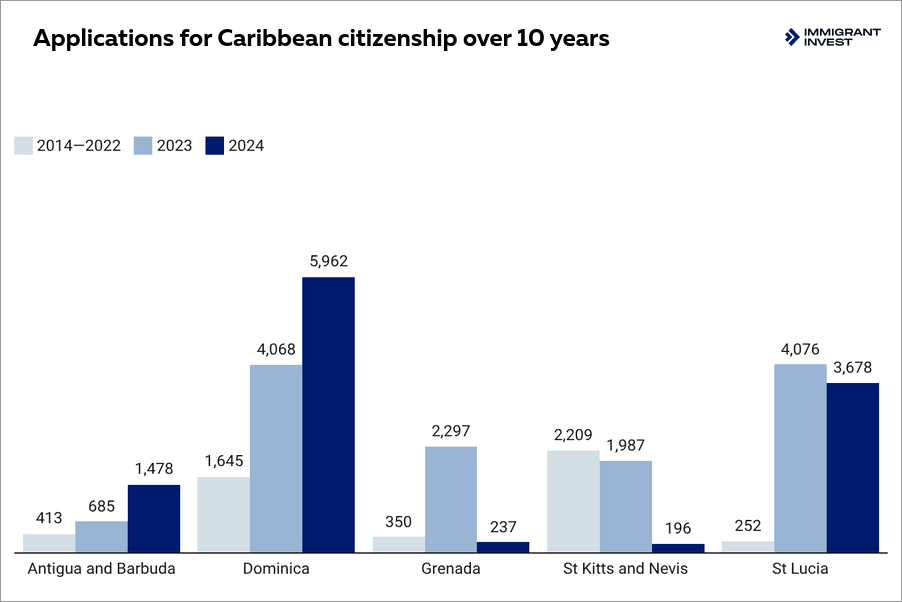
By the first half of 2024, the five Caribbean programmes received 59,258 applications and issued at least 100,269 passports
St Kitts and Nevis
St Kitts and Nevis operates the world’s oldest CBI programme and consistently ranks at the top of the CBI Index, particularly for Due Diligence and governance[8]. Established in 1984, the programme is widely regarded as the benchmark for compliance and programme integrity[9].
Three investment routes are available under St Kitts and Nevis CBI programme:
- Sustainable Island State Contribution — $250,000. A non-refundable contribution to the Federal Consolidated Fund, supporting healthcare, education, tourism, culture, and green energy initiatives.
- Real estate investment — $325,000 on shares and condos, or $600,000 on a private home. Purchase of approved property with the option to generate rental income, with annual yields averaging 4%. The property must be held for 7 years, after which it may be resold, allowing capital recovery.
- Public Benefit Option — $250,000. Investment into government-approved infrastructure and national development projects.
The processing time starts at 4 months. Applicants are required to visit St Kitts and Nevis in person to collect their passports.
Family inclusion is permitted and covers a spouse, children under 25, and parents aged 55 and above.
Dominica
Dominica ranks 2nd among global CBI programmes. It combines affordability with an earlier resale opportunity, which makes it particularly attractive for applicants seeking a low-profile, well-regulated option[10].
The minimum investment in Dominica is $200,000, lowest in the Caribbean and applicable to both available routes: a non-refundable contribution to the national fund or the purchase of approved real estate.
Dominica offers one of the shortest mandatory holding periods for property investments — 3 years, after which the asset may be resold. If the buyer is another CBI applicant, the holding period increases to 5 years.
Processing time is 6 months or longer, and the application is completed without in-person visits.
Family members may be included in the application, covering a spouse, children under 30, and parents or grandparents aged 65 and above.
Grenada
Grenada CBI programme ranks 3rd in the global CBI Index, offering two investment routes[11]:
- National Transformation Fund contribution — $235,000. A non-refundable contribution supporting national development projects.
- Real estate investment — $270,000. This applies when at least two investors jointly invest $440,000 or more in a government-approved tourism project. In all other cases, the minimum real estate threshold is $350,000.
Real estate investors may generate passive rental income, with average yields of around 4% per year. To retain citizenship, the property must be held for 5 years, after which it may be resold, allowing capital recovery.
The application process takes 8 months or more and is conducted entirely remotely, with no travel required.
Family inclusion is broad and covers a spouse, children under 30, parents and grandparents of any age, and siblings aged 18 and over.
St Lucia
St Lucia ranks 4th in the global CBI Index and is distinguished by the breadth of its investment routes, offering flexibility for applicants with different asset profiles and risk preferences[12].
St Lucia CBI programme provides five investment options:
- National Economic Fund contribution — $240,000. A non-refundable contribution supporting public-sector development.
- Government bonds — $300,000. The bonds carry no interest and may be redeemed after 5 years.
- Approved real estate — $300,000. Property must be held for 5 years, after which it can be sold.
- Infrastructure investment — $250,000. Investment into government-approved infrastructure projects.
- Enterprise investment — $1,000,000. Either a solo investment of at least $3.5 million in a government-approved business or participation in a group investment of $6 million, with a minimum individual contribution of $1 million.
Applications are processed in 6 months or more, with all steps handled remotely.
Family members may be included, covering a spouse, children up to age 30, parents over 55, and siblings under 18.
Antigua and Barbuda
Antigua and Barbuda completes the Caribbean top 5, ranking 5th in the CBI Index, and is notable for a dedicated option tailored to large families, which differentiates it from other Caribbean programmes[13].
Antigua and Barbuda CBI programme offers four investment routes:
- National Development Fund contribution — $230,000. A non-refundable contribution supporting public-sector initiatives.
- Approved real estate — $300,000. Purchase of government-approved property.
- Higher education donation — $260,000. Designed for families of 6 or more. One family member under 29 is entitled to 1 year of tuition-free study at a local university.
- Business investment — $400,000. Either a sole investment of at least $1.5 million in a local business or participation in a group investment of at least $5 million, with a minimum contribution of $400,000 per investor.
The application process takes around 6 months and is handled entirely remotely. To maintain citizenship, individuals must spend at least 5 days in Antigua and Barbuda within the first 5 years after naturalisation.
Family inclusion is broad and covers a spouse, children under 30, parents and grandparents aged 55 and above, and siblings of any age.
Vanuatu
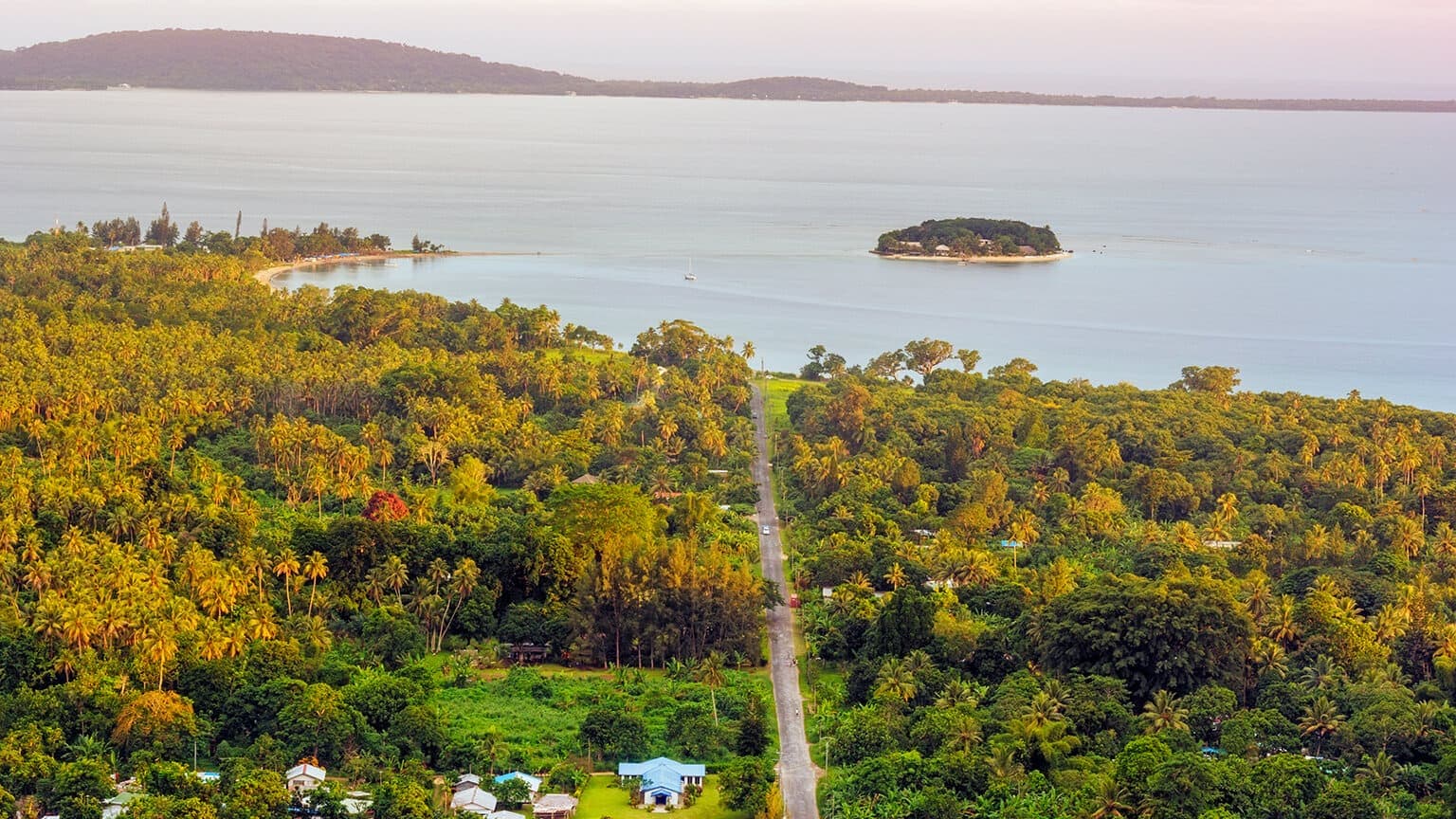
Vanuatu is an island nation in the South Pacific, located east of Australia and north of New Zealand. It is a Commonwealth member, uses English as one of its official languages, and sits on major Pacific air and shipping routes.
Vanuatu CBI investment options include a non-refundable contribution starting at $130,000[14]. The contribution supports national development and disaster recovery efforts, including rebuilding after major events such as Tropical Cyclone Harold. The contribution does not generate income.
Vanuatu also offers an investment-linked option at $157,000. Under this route, the investor purchases shares in the CNO Future Fund holding company, established to promote sustainability through coconut oil production as a renewable energy source. The coconut oil option is described as generating approximately 5% annual yield. Over 5 years, the projected total return is about $50,000.
Vanuatu citizenship is issued in just over 2 months, making this one of the world’s fastest CBI routes. Investors are required to visit Vanuatu or one of the responsible embassies to submit biometrics.
Family members can be included. The application covers a spouse, children under 25, and parents over 50.

Practical Guide
Compare the Caribbean and Vanuatu citizenship by investment programs
São Tomé and Príncipe
São Tomé and Príncipe is a small island state in the Gulf of Guinea, located off the west coast of Central Africa. It is a former Portuguese territory with a stable political system, no military alliances, and limited exposure to global geopolitical tensions. The country positions itself as a low-profile jurisdiction with a policy focus on renewable energy, education, and sustainable development
São Tomé and Príncipe offers a CBI programme with a minimum contribution of $90,000, currently the lowest threshold among CBI countries[15]. The contribution is non-refundable and paid to the National Transformation Fund, which finances national projects in renewable energy, education, and infrastructure.
The application process takes around 2 months. Physical presence is not required.
Family members may be added, including a spouse or a partner, children under 30, and parents or grandparents over 55.
Türkiye
Türkiye CBI programme offers five qualifying investment routes[16]:
- Purchase of real estate — $400,000.
- Business investments — $500,000.
- Bank deposit — $500,000.
- Purchase of government bonds — $500,000.
- Purchase of units in an investment fund — $500,000.
In practice, most applicants select real estate, because Türkiye has shown strong nominal house price growth in recent years — for example, the BIS-linked series reported year-on-year nominal growth above 30% in 2025[17]. After the mandatory holding period of 3 years, the property may be sold.
The process takes at least 8 months, and it can be handled remotely.
Family inclusion covers a spouse and children under 18.
Best CBI programmes for Germans at a glance
Country

Minimum investment
$250,000
Processing time
4+ months
Physical presence
To collect passports
Family inclusion
Spouse, children under 25, parents over 55
Country

Minimum investment
$240,000
Processing time
6+ months
Physical presence
Not required
Family inclusion
Spouse, children under 30, parents over 55, siblings under 18
Country

Minimum investment
$235,000
Processing time
8+ months
Physical presence
Not required
Family inclusion
Spouse, children under 30, parents and grandparents, siblings over 18
Country

Minimum investment
$230,000
Processing time
6+ months
Physical presence
5 days within the first 5 years after obtaining citizenship
Family inclusion
Spouse, children under 30, parents over 55, siblings
Country

Minimum investment
$200,000
Processing time
6+ months
Physical presence
Not required
Family inclusion
Spouse, children under 30, parents and grandparents over 65
Country

Minimum investment
$130,000
Processing time
2+ months
Physical presence
To submit biometrics
Family inclusion
Spouse, children under 25, parents over 50
Country

Minimum investment
$90,000
Processing time
2+ months
Physical presence
Not required
Family inclusion
Spouse, children under 30, parents and grandparents over 55
Country
Minimum investment
$400,000
Processing time
8+ months
Physical presence
Not required
Family inclusion
Spouse, children under 18
Country | Minimum investment | Processing time | Physical presence | Family inclusion |
|---|---|---|---|---|
$250,000 | 4+ months | To collect passports | Spouse, children under 25, parents over 55 | |
$240,000 | 6+ months | Not required | Spouse, children under 30, parents over 55, siblings under 18 | |
$235,000 | 8+ months | Not required | Spouse, children under 30, parents and grandparents, siblings over 18 | |
$230,000 | 6+ months | 5 days within the first 5 years after obtaining citizenship | Spouse, children under 30, parents over 55, siblings | |
$200,000 | 6+ months | Not required | Spouse, children under 30, parents and grandparents over 65 | |
$130,000 | 2+ months | To submit biometrics | Spouse, children under 25, parents over 50 | |
$90,000 | 2+ months | Not required | Spouse, children under 30, parents and grandparents over 55 | |
$400,000 | 8+ months | Not required | Spouse, children under 18 |
CBI programmes application: step-by-step procedure for Germans
The CBI application process takes 2—8 months from initial engagement to passport issuance, based on Immigrant Invest’s experience. For Germans exploring how to obtain dual citizenship, this provides a clear and time-efficient route to securing a second passport. Actual timelines depend on the selected programme, document readiness, and Due Diligence requirements.
Immigrant Invest supports clients at every stage of the process, from programme selection and compliance checks to application submission and approval. Assistance continues after citizenship is granted, including passport renewal after 5—10 years and ongoing administrative support.
1—2 weeks
Choosing programme and investment route
Germans seeking second citizenship should evaluate programmes across six core factors:
- budget,
- timeline,
- tax neutrality,
- long-term strategic goals,
- programme reputation,
- family inclusion.
Immigrant Invest supports programme selection based on the applicant’s personal, family, and financial circumstances.
Germans seeking second citizenship should evaluate programmes across six core factors:
- budget,
- timeline,
- tax neutrality,
- long-term strategic goals,
- programme reputation,
- family inclusion.
Immigrant Invest supports programme selection based on the applicant’s personal, family, and financial circumstances.
1 day
Preliminary Due Diligence
Before any documents are collected or funds are committed, Immigrant Invest initiates its Anti-Money Laundering compliance procedures. These include preliminary Due Diligence and KYC checks to assess approval probability and reduce the risk of rejection before a contract is signed.
The internal compliance team reviews criminal exposure, sanctions lists, politically exposed person status, adverse media, source-of-funds logic, and prior visa or immigration refusals, allowing potential risks to be identified early and strategies adjusted if needed.
Before any documents are collected or funds are committed, Immigrant Invest initiates its Anti-Money Laundering compliance procedures. These include preliminary Due Diligence and KYC checks to assess approval probability and reduce the risk of rejection before a contract is signed.
The internal compliance team reviews criminal exposure, sanctions lists, politically exposed person status, adverse media, source-of-funds logic, and prior visa or immigration refusals, allowing potential risks to be identified early and strategies adjusted if needed.
2—5 weeks
Preparation of documents
Immigrant Invest lawyers help applicants collect, certify, apostille, and translate the documents required by CBI authorities.
Core documents include:
- Valid passports.
- Civil status documents — birth and marriage certificates.
- Police clearance certificates, issued by the Bundesamt für Justiz for Germany.
- Bank reference letters, confirming account standing, balances, and relationship duration.
- Source of funds and wealth evidence, such as German tax assessments, employment contracts, dividend statements, business sale agreements.
- Professional references.
- Curriculum vitae.
- Medical certificates.
Apostilles are issued by the competent Landgericht or Oberlandesgericht. German-language documents must be translated into English by a sworn translator.
Immigrant Invest lawyers help applicants collect, certify, apostille, and translate the documents required by CBI authorities.
Core documents include:
- Valid passports.
- Civil status documents — birth and marriage certificates.
- Police clearance certificates, issued by the Bundesamt für Justiz for Germany.
- Bank reference letters, confirming account standing, balances, and relationship duration.
- Source of funds and wealth evidence, such as German tax assessments, employment contracts, dividend statements, business sale agreements.
- Professional references.
- Curriculum vitae.
- Medical certificates.
Apostilles are issued by the competent Landgericht or Oberlandesgericht. German-language documents must be translated into English by a sworn translator.
1—2 weeks
Making qualifying investment
The investor completes the required investment, such as a contribution to a state fund or the purchase of real estate. Depending on the country, this may take place either before or after the main Due Diligence process.
The investor completes the required investment, such as a contribution to a state fund or the purchase of real estate. Depending on the country, this may take place either before or after the main Due Diligence process.
3—6 months
Submitting application and undergoing Due Diligence
Immigrant Invest submits the completed application to the relevant Citizenship by Investment Unit or equivalent authority. A Due Diligence check is mandatory for all applicants over 18. In several jurisdictions, screening starts at a younger age:
- 17 and over — Grenada;
- 16 and over — St Kitts and Nevis, Dominica, St Lucia;
- 12 and over — Antigua and Barbuda.
All Caribbean CBI programmes require applicants to pass a mandatory Due Diligence interview. The interview is usually conducted online and focuses on the applicant’s background, source of funds, business activities, travel history, and reasons for seeking second citizenship. Its purpose is to verify information provided in the application and assess overall credibility.
Due Diligence fees typically range from $5,000 to 10,000 per person, depending on the programme and the applicant’s age.
Applicants also submit biometrics. In Vanuatu, biometrics require an in-person appointment.
For Türkiye, Due Diligence is carried out by the competent state authorities as part of the citizenship application process. There is no separate paid Due Diligence stage, unlike in Caribbean CBI programmes.
Immigrant Invest submits the completed application to the relevant Citizenship by Investment Unit or equivalent authority. A Due Diligence check is mandatory for all applicants over 18. In several jurisdictions, screening starts at a younger age:
- 17 and over — Grenada;
- 16 and over — St Kitts and Nevis, Dominica, St Lucia;
- 12 and over — Antigua and Barbuda.
All Caribbean CBI programmes require applicants to pass a mandatory Due Diligence interview. The interview is usually conducted online and focuses on the applicant’s background, source of funds, business activities, travel history, and reasons for seeking second citizenship. Its purpose is to verify information provided in the application and assess overall credibility.
Due Diligence fees typically range from $5,000 to 10,000 per person, depending on the programme and the applicant’s age.
Applicants also submit biometrics. In Vanuatu, biometrics require an in-person appointment.
For Türkiye, Due Diligence is carried out by the competent state authorities as part of the citizenship application process. There is no separate paid Due Diligence stage, unlike in Caribbean CBI programmes.
Up to 5 months
Approval, oath, and passport issuance
Once Due Diligence is successfully completed, the competent authority notifies Immigrant Invest and issues a formal approval letter confirming the grant of citizenship. In St Lucia and Antigua and Barbuda, applicants are required to take an oath of allegiance.
Following approval, a citizenship certificate is issued as official proof of nationality. Passport applications are processed within 2—4 weeks, and passports are issued with a validity of 5 to 10 years.
St Kitts and Nevis requires applicants to collect their passports in person.
Once Due Diligence is successfully completed, the competent authority notifies Immigrant Invest and issues a formal approval letter confirming the grant of citizenship. In St Lucia and Antigua and Barbuda, applicants are required to take an oath of allegiance.
Following approval, a citizenship certificate is issued as official proof of nationality. Passport applications are processed within 2—4 weeks, and passports are issued with a validity of 5 to 10 years.
St Kitts and Nevis requires applicants to collect their passports in person.
Tax and compliance for Germans under CBI programmes
Second citizenship opens new planning options, but it does not, by itself, change tax obligations. For German nationals, tax outcomes depend on where tax residency is established, how assets are structured, and how both German and destination-country rules interact.
Tax residency vs. citizenship
Acquiring second citizenship does not change tax residency. German nationals remain subject to German taxation as long as they maintain a habitual abode in Germany or spend more than 183 days per year there.
Tax residency is determined by domestic law and double taxation treaties. To shift tax residency to another jurisdiction, an individual must establish habitual residence abroad and sufficiently sever ties with Germany. This often includes deregistering with the local population office, selling or leasing out property, and reducing personal and economic ties.
German exit tax
Germany imposes an exit tax under § 6 of the Foreign Tax Act[18]. It applies when an individual ends unlimited tax liability after having lived in Germany for at least 7 of the previous 12 years and holds qualifying assets.
The exit tax applies to unrealised gains in the following cases:
- shareholdings of 1% or more in a corporation held at any time during the previous 5 years;
- investment fund units, where either at least 1% of the fund units was held in the last 5 years, or the acquisition cost exceeded €500,000 per fund, regardless of the ownership percentage.
Foreign account reporting
German residents must report cross-border payments exceeding €50,000 to the Deutsche Bundesbank under the Foreign Trade and Payments Regulation[19].
Germany also participates in international tax transparency frameworks. The Bundeszentralamt für Steuern administers information exchange under the Common Reporting Standard and FATCA, meaning foreign financial accounts and assets are routinely reported to German tax authorities[20].
Destination country taxation
Across the Caribbean CBI jurisdictions**, ** there are generally no taxes on worldwide income, capital gains, inheritance, or wealth. Dividends, interest, and royalties are not taxed for tax residents, except for St Lucia, where foreign-source income is taxed. The specific scope of exemptions varies by country:
- St Kitts and Nevis — no personal income tax.
- Grenada — no stamp duty.
- Antigua and Barbuda — no personal income tax.
- Dominica — no tax on gifts; only non-residents are taxed on locally sourced income.
Local income tax in St Lucia is progressive:
- up to EC$15,000 — 15%;
- EC$15,000—30,000 — 20%;
- over EC$30,000 — 25%[21].
Dominica applies a similar progressive scale, but with different thresholds:
- up to EC$20,000 — 15%;
- EC$20,000—40,000 — 25%;
- over EC$40,000 — 35%[22].
In Grenada, residents pay local income tax at 30%. However, a resident allowance of up to EC$60,000 is deducted when calculating chargeable income, so only income above the allowance is taxed.
Non-residents are taxed only on Grenada-source income as well, but many non-business payments are typically taxed via withholding tax — 15% of the gross amount as a final tax. Non-residents carrying on business in Grenada may be taxed through the standard chargeable-income calculation[23].
Corporate tax across the Caribbean is the following:
- 25% — Dominica, Antigua and Barbuda, St Kitts and Nevis;
- 30% — St Lucia and Grenada[24].
Vanuatu operates a fully tax-neutral system, with no personal income, capital gains, inheritance, or wealth charges.
In addition, German entrepreneurs can use Vanuatu’s special regime for international business companies. Under this framework, profits and distributions are exempt from local taxes, and the exemption is granted for 20 years[25].
In Türkiye, there is no wealth tax. Foreign-source income is not taxed unless remitted to Türkiye. If a German establishes tax residency in Türkiye, the following local tax regime applies:
- personal income tax — 15 to 40%, depending on income level[26];
- corporate tax — 25%, and 30% for the financial sector[27].
The minimum 10% corporate tax applies to very large multinational groups with annual consolidated revenues of €750 million or more. If such a group pays less than 10% in corporate tax in Türkiye due to incentives or exemptions, an additional charge is applied to bring the total tax paid up to the 10% level[27].
In São Tomé and Príncipe, there is no wealth or inheritance tax. Personal income is not taxed up to $530,000 per year, after which progressive rates apply, with a maximum rate of 25%. Foreign-source income is outside the tax base for non-residents[28].
Corporate tax in São Tomé and Príncipe is 25%[29].
CBI tax jurisdictions comparison
Risks and сommon pitfalls for Germans seeking second citizenship
For Germans exploring how to get dual citizenship in Germany, citizenship by investment should be viewed not as a transactional purchase. It is a regulated legal process with multiple decision points, time-sensitive requirements, and compliance risks that require careful management from the outset.
1. Risk of unintended loss of German citizenship under old rules
German nationals who acquired a foreign citizenship before June 27th, 2024 may have automatically lost their German citizenship under the previous legal framework, often without realising it. Some may discover the issue only years later, for example when renewing a German passport or dealing with German authorities.
Zlata Erlach,
Head of the Austrian office
Before making assumptions or travel plans, affected individuals should verify their current status with the competent authority, either the Bundesverwaltungsamt or the local Staatsangehörigkeitsbehörde. Resolving such cases often requires collecting historical records, including naturalisation documents and timelines, and may involve legal assistance to clarify or regularise status.
2. CBI programme rule changes and shifting requirements
CBI programmes may adjust rules, including minimum investment thresholds, enhanced vetting, and additional procedural requirements. For example, the Caribbean CBI countries signed a regional agreement in 2024 that established higher minimum investment levels — $200,000 and above — and introduced stronger Due Diligence standards, including mandatory interviews and expanded background checks.
3. Discretionary approval, even with a compliant application
Meeting the published investment and document requirements does not guarantee approval. Final decisions remain discretionary and are made by the host country’s citizenship or immigration authority. They may consider whether the applicant’s rationale for seeking the status raises risk concerns.
4. Source-of-funds documentation complexity
Investment migration authorities and banks require applicants to clearly document the lawful origin of the invested funds. Incomplete records, inconsistencies, or weak supporting evidence — such as missing contracts, tax returns, bank statements, or notarised declarations — are among the most common reasons for additional information requests, delays, or rejection.
Zlata Erlach,
Head of the Austrian office
Source-of-funds and source-of-wealth documentation should be prepared before selecting a programme or committing funds. Where finances involve multiple jurisdictions, corporate structures, or inheritance chains, our team’s experience in AML compliance and evidence preparation helps reduce avoidable risks.
5. Dependent inclusion nuances
CBI programmes apply strict age and dependency rules when including children and other family members. Parents must be fully financially dependent on the main applicant.
Requirements for children vary by programme:
- St Kitts and Nevis: in full-time attendance at a recognised secondary or tertiary educational institution.
- Dominica: enrolled at a university; daughters — unmarried and under 25.
- São Tomé and Príncipe: unmarried.
- Vanuatu: full-time students.
Children must also meet dependency criteria, with Antigua and Barbuda as an exception.
Where siblings are eligible, they must be unmarried, and in Grenada, siblings must also have no children.
6. Real-estate investment risks
Property-based options can carry specific risks. These include unclear title or encumbrances, restrictions on resale or rental use, limited liquidity in small island markets, and higher-than-expected maintenance, insurance, or management costs. For example:
- In Türkiye, qualifying property cannot be resold to another future programme participant.
- In Dominica, the minimum holding period is 3 years, but resale to another CBI applicant is permitted only after 5 years.
Across most programmes, qualifying property must be held for a defined period to retain citizenship. This requirement can limit exit flexibility and should be factored into investment planning.
In addition, not all properties on the open market are eligible for CBI purposes, and purchasing a non-approved asset can invalidate an application. Immigrant Invest works exclusively with government-approved property lists, ensuring legal compliance and reducing the risk of purchasing ineligible or encumbered real estate.
Examples of real estate in St Kitts and Nevis


St Kitts & Nevis, Basseterre
$350,000+
Apartments in modern style, Basseterre
 223 m²
 3
3  2
2 
St Kitts & Nevis, Basseterre
$385,000+
Elegant apartments, Basseterre, St Kitts and Nevis
149 m²3 3 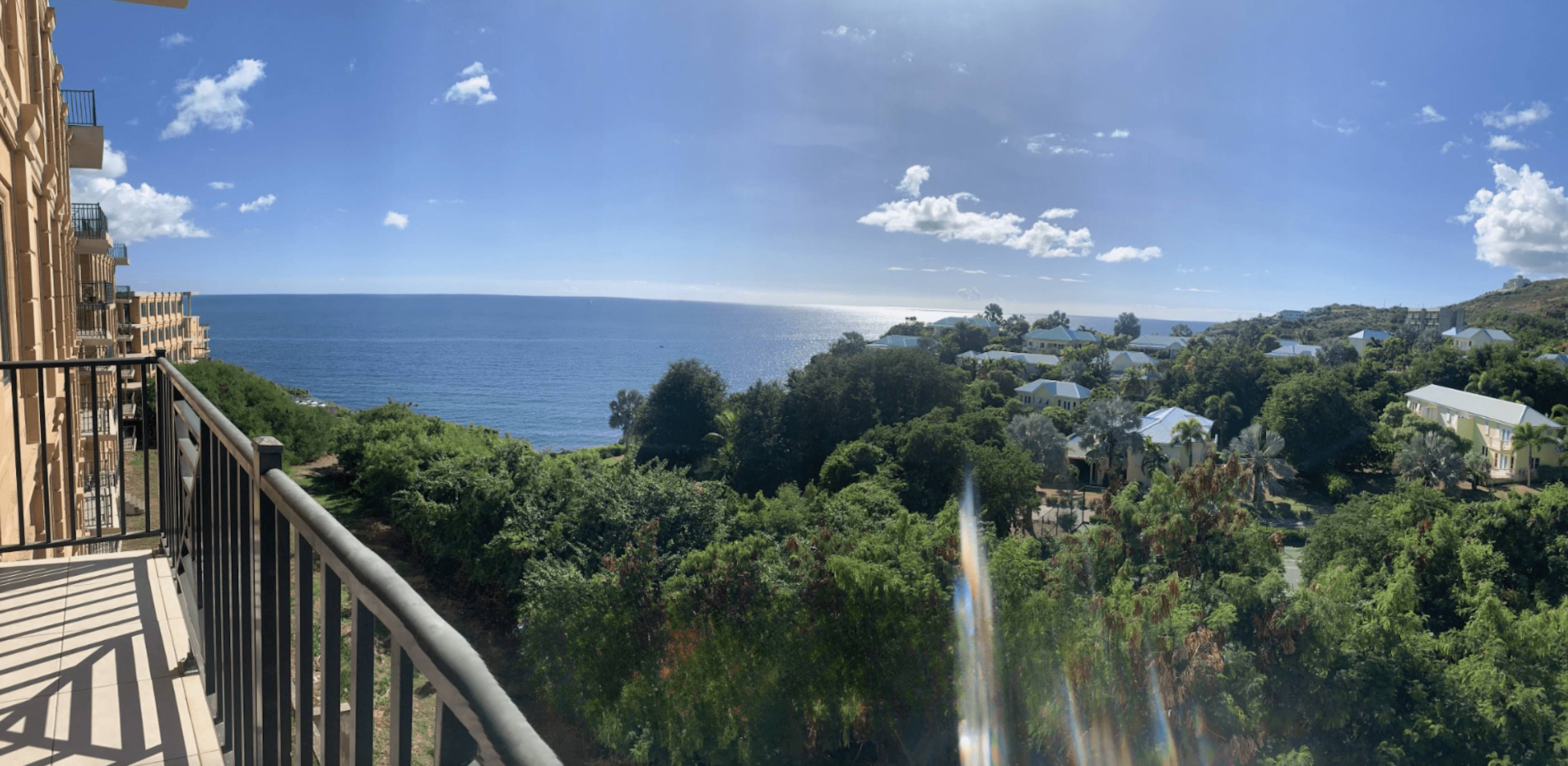
St Kitts & Nevis, Basseterre
$400,000+
Stylish apartments, Basseterre
149 m²3 3 7. Banking and reputational scrutiny
Holding a second passport can trigger enhanced scrutiny from banks and other financial institutions. Clients may face prolonged KYC reviews, repeated document requests, video-verification checks, or delays in opening personal and corporate accounts. In some cases, banks may decline onboarding or reassess existing relationships.
Applicants should be prepared to clearly explain the legitimate purpose of the second status, such as asset diversification, family mobility, or business structuring.

8. Additional expenses
Additional costs are a common CBI pitfall. The qualifying investment is not the total cost: non-refundable contributions usually increase with the number of applicants, real-estate routes include government and administrative fees that also depend on family composition. All programmes charge Due Diligence, processing, and passport fees. In practice, these extras can add up to $100,000, and up to $200,000 for larger families, on top of the core investment.
9. Document validity windows and rework risk
Many required documents — such as police clearance certificates, medical reports, and bank reference letters — have short validity periods, often 3 months from issuance, and must be valid at the time of submission.
Processing delays caused by backlogs, missing information, or appointment constraints can result in documents expiring mid-process, forcing re-issuance, re-translation, and re-apostille, with added time and cost.
Immigrant Invest mitigates risks through structured document planning and compliance-led preparation. With an in-house Legal and AML Compliance Department, the team aligns documentation with EU 6th Anti-Money Laundering Directive standards, tracks document validity periods and plans submissions to reduce rework. Certified AML specialists oversee each case to ensure applications meet regulatory requirements at every stage.
Why obtain second citizenship with Immigrant Invest
Immigrant Invest is a legal consulting company specialising in second citizenship and residence by investment. With nearly 20 years of experience, the team supports high-net-worth individuals and their families in navigating complex investment immigration pathways. All solutions are based on government-approved programmes in the EU, the Caribbean, and other regions.
Over the years, the Immigrant Invest team has secured thousands of passports and residence permits for investors from more than 100 countries. This work combines legal expertise, compliance oversight, and personalised support to align immigration outcomes with broader personal and financial objectives.
Key takeaways for German nationals seeking second citizenship
- Since June 27th, 2024, Germans are allowed to hold dual citizenship. This removes the need to renounce German nationality when acquiring another passport.
- Caribbean CBI programmes offer the most balanced pathway to second citizenship. Investments start at $200,000, with processing in 4—8 months.
- Vanuatu and São Tomé and Príncipe focus on speed and cost. Processing takes around two months, with entry thresholds of $130,000 and $90,000.
- Türkiye CBI programme stands out for real estate exposure. Residential property prices grew by around 30% in 2025.
- Due Diligence is rigorous. Applicants must provide source-of-funds evidence, bank references, apostilled documents, and police clearances.
- Programme stability is essential. Caribbean countries consistently rank in the top 5 of the CBI Index due to strong governance and oversight.
- Second citizenship does not change tax residency. Tax residence is determined after spending at least 183 days in the country and shifting the centre of vital interests abroad.
Immigrant Invest is a licensed agent for citizenship and residence by investment programs in the EU, the Caribbean, Asia, and the Middle East. Take advantage of our global 15-year expertise — schedule a meeting with our investment programs experts.
40+ options in different countries by 25 criteria