

Summary
Portugal has quietly become one of the world’s favourite places to settle. In the Expat Insider Survey 2025, it ranks 9th globally among most popular countries of residence for foreigners[1].
The real challenge is not whether to choose Portugal, but how to become a resident. The Globat Talent Programme for highly qualified professionals is entering the scene with a 100% approval rate. How does it differ from the D3 Visa and EU Blue Card for professionals? And when is it smarter to choose the D7 route for freelancers or the D8 for remote workers?
This guide breaks down the differences so each goal can be matched to the right status.
Is the Portugal Global Talent Programme the same as the D3 and HQA visa?
The Portugal Global Talent Programme is designed for non-EU, non-EEA and Swiss nationals engaged in teaching, research, cultural or other highly qualified work based on a structured collaboration with a Portuguese university or R&D institution[2].
The HQA Visa is a D3 Visa based on direct employment with a Portuguese host[3].
University collaboration vs. employment route
The university route under the Global Talent Programme is based on a hosting agreement with a recognised institution[4]. Files include a university Letter of Commitment and a concise project plan covering goals, timeline, tasks, and resources.
Current partners include institutions such as Coimbra, Évora, Algarve, Beira Interior, ISTEC, and NOVA Medical School. This track suits candidates whose stay is tied to a defined academic or research project.

Pedro Barata,
Senior Investment Migration Advisor
University collaboration is especially attractive to founders, scientists, and consultants who want to remain globally mobile. The D3 visa normally expects residents to spend more than half the year in Portugal. However, for the Global Talent Programme under Article 85(4), those who continue working or doing research for a Portuguese institution while abroad can keep their residence status even during extended periods outside the country.
Each participant joins a Portuguese university or R&D institution, gaining recognised academic affiliation within the EU. Through lectures, mentorship, or project oversight, they contribute a global perspective to Portugal’s innovation and talent landscape.
The employment route under the HQA visa relies on a Portuguese employer hiring the applicant into a senior or specialised role[5]. Application must be supported by one of the following:
- signed contract;
- formal promise of employment stating title, duties, salary, location, and start date.
Senior hires, tech leads, executives, and specialised professionals choose an employment path. It’s straightforward, role-driven, and suited for those looking to join an established organisation.
Eligibility criteria and financial requirement
Global Talent Programme applicants are considered highly qualified if they hold both:
- ISCED 6+ degree — bachelor’s, master’s, PhD;
- and 3—5 years of specialised experience evidencing equivalent expertise, aligned with AIMA’s Tech Visa standards[6].
The programme fee is €170,000, covering legal and residence services for 5 years for the main applicant plus up to three dependants. Each additional dependent from the 5th onward adds €5,000.
The HQA Visa is for qualified specialists in intellectual professions immigrating to Portugal. To apply, you'll need a higher education diploma and a work contract or written guarantee with a Portuguese employer for a minimum of 1 year.
Salary must be at least 1.5× the average gross salary in Portugal, or 3× the social support index IAS. With the IAS at €537.13 per month in 2026[11], the minimum salary is €1,612. For in-demand professions — e.g. managers of public or commercial organisations, — the threshold drops to 1.2× the average.
Family inclusion
Eligible family members under the Portugal Global Talent Programme are:
- spouse or registered partner;
- children under 18;
- dependent full-time students under 26.
Family members may work in Portugal, in employment or self-employment, without needing any additional work authorisation.
The HQA Visa application may include a spouse and children under 18. Children over 18 if single and studying in Portugal and parents may also apply, provided they are financially dependent on the main applicant.
Quick comparison of the Global Talent and HQA Visas
How does the Portugal Global Talent Programme compare to the Golden Visa?
Portugal’s GTP and Golden Visa serve different ambitions: one rewards talent, the other welcomes capital. GTP residency is built for professionals making a mark through research or innovation.
The Portugal Golden Visa, by contrast, grants residency through investment — most often in regulated funds or cultural initiatives.
What each route is built on
GTP residency is grounded in activity. It’s about what the applicant brings to Portugal: a research project, a founder-led initiative. The application reflects the individual’s expertise and the role or partnership that connects them to Portugal’s science or education sectors.
The Golden Visa is all about financial contribution. It allows individuals to secure Portuguese residency through investments[7]. The most common choices today are:
- regulated venture capital funds with a minimum threshold of €500,000;
- cultural support initiatives starting at €250,000.
No job or local involvement is needed — just proof that the funds are in place and legally sourced.
Costs and control
Both visas involve significant expenses, but the way funds are handled is very different.
The GTP route costs €170,000, spread across three milestones:
- €20,000 is the first non-refundable onboarding payment.
- €75,000 is due once the appointment with Portuguese immigration is secured, and is refundable if the application is denied.
- €75,000 is paid when the residence card is issued and may be refunded if renewal is refused in year 2.
The Golden Visa minimum investment is €250,000. It is made in full at the beginning and held for at least 5 years. There’s no refund mechanism if the applicant withdraws, but returns under the fund route are possible — ranging from 2 to 20% annually depending on the fund.

Flexibility of presence
Both visas support international mobility, but through different mechanisms. The GTP offers legal exemptions tied to professional engagement. The Golden Visa offers minimal stay by design.
The Global Talent Programme usually implies active participation in the country’s knowledge sector, but may build in flexibility for those whose work takes them abroad.
If the applicant is engaged in recognised professional, academic, or cultural activity outside Portugal, they may be exempt from the usual stay requirement. This means they can legally maintain their residence status without living in the country for half a year.
The Golden Visa, by comparison, is even more hands-off. It requires just 7 days of presence per year in Portugal. There’s no link to professional activity, no need to justify absences, and no obligation to maintain a host relationship. It only comes with the need to maintain investments.
Speed and reliability
The Global Talent Programme is currently the fastest Portuguese residence route. The entire process takes around 4 months, based on Immigrant Invest’s track record.
The key reason for this speed is that GTP residency is granted directly by AIMA, without first requiring a national D-type visa through a consulate abroad. Once the application is approved, the applicant travels to Portugal for biometrics and residence card issuance.
In the university-structured Global Talent Programme, applications have so far reached a 100% approval rate. This track is built in close coordination with AIMA, so once the agreement with the partner university is signed, the case is pre-aligned with AIMA’s criteria and moves through a vetted pathway.
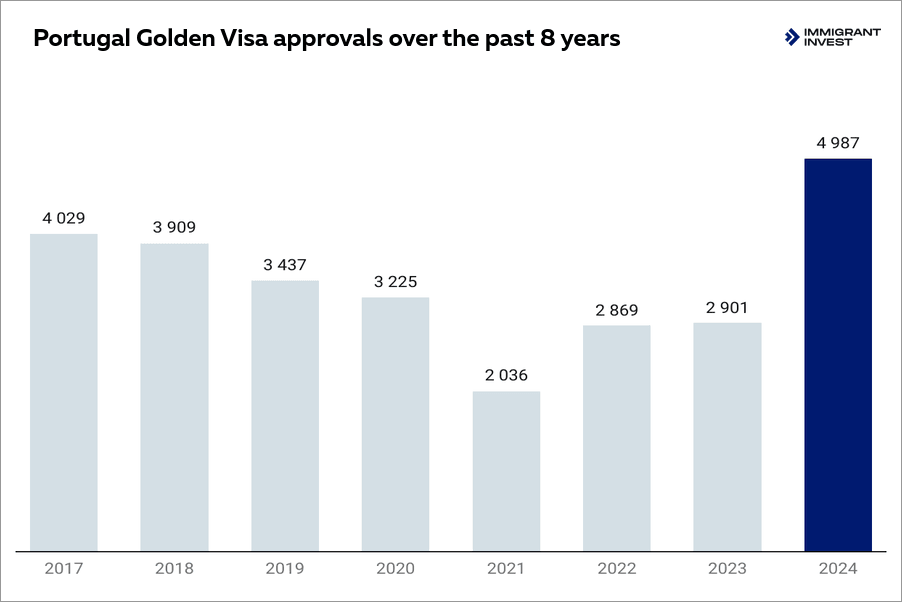
The Golden Visa follows a much slower path, although it also doesn’t require an entry visa. Investment-based applications are now part of a large administrative backlog: AIMA has publicly acknowledged more than 45,000 pending cases[8].
The average Golden Visa processing time in Portugal reached 40.6 months. With Immigrant Invest, the total obtaining time takes at least 12 months.
Family eligibility
Both the GTP and Golden Visa offer clear family pathways, but the structure and timing of how family members are included vary.
With the Golden Visa, the application is submitted as a single family file. The main applicant, spouse, children under 26, and dependent parents can all be included from the outset. This makes the process streamlined for families applying together.
The Global Talent Programme takes a sequential approach. First, the main applicant applies and obtains residence status. Once that’s granted, family reunification can be initiated for a spouse or registered partner, as well as children under 26. Parents and children over 26 are eligible for the family reunification route.
Portugal GTP vs. Golden Visa at a glance
What is the difference between Portugal GTP, D3, D7, and D8 Digital Nomad visas?
The D7 and Digital Nomad visas are lifestyle-driven options, ideal for those with offshore income or remote work setups. The D3 visa and the GTP are designed for professionals with a clear role or project in Portugal.
Remote founders can start with D7, but later shift toward Portugal-based activity for family or long-term plans. In those cases, the GTP structured through a university can offer a better fit. But if the income remains fully offshore and there’s no local engagement, D7 or Digital Nomad may still be the natural choice — provided the presence rules and tax exposure are acceptable.
What the visas are based on
Both the D7 and Digital Nomad visas are tied to income, but the type, amount, and proof required vary. In both cases, the income is linked to minimum thresholds based on Portugal’s national minimum wage, which is €920 per month in 2026.
Applicants are also expected to maintain a Portuguese bank deposit covering at least one year of income — €11,040 in 2026.
The Portugal D7 visa is designed for those with passive, stable income, such as pensions, dividends, royalties, or rental yields. The minimum required sum is based on household size:
- main applicant: €920 per month;
- spouse or dependent parent: 50% — €460 per month;
- dependent child: 30% — €276 per month.
The Portugal Digital Nomad visa is for remote employees or freelancers with contracts from foreign companies. Applicants must earn four times the national minimum wage, or €3,680 per month in 2026.
Digital Nomads don’t need to show additional income for family members, but the bank deposit requirement increases: by 50% for a spouse or parent, and 30% for each child.
The Portugal Global Talent Programme does not set a fixed income threshold. What matters is the value of the applicant’s role or project.
The D3 visa has a salary involved, it should meet the national standard for highly qualified professionals — typically 1.5× the minimum wage or more, though this can vary depending on the role and sector.

Lisbon ranks 1st worldwide as the best city for digital nomads, according to the remote-work platform Flatio[9]
Work rights and professional access
The D3 visa gives full access to Portugal’s job market from the start. It’s designed for professionals taking on roles in the country’s economy.
The Global Talent Programme has an approach similar to the D3 visa but involves cooperation in academia or research.
D7 and Digital Nomad holders, on the other hand, are expected to remain financially independent or tied to non-Portuguese income. While informal remote work is tolerated, taking up local employment may require switching residence types. However, freelancers and digital nomads are allowed to conduct business in Portugal.
All three visas allow spouses to apply for reunification. Once granted, they are allowed to work in Portugal, regardless of whether the principal applicant does.
Pedro Barata,
Senior Investment Migration Advisor
It is possible to move from D7 to D3 or back the other way, but it always requires a fresh application and full compliance with the new route’s rules. In practice, this might mean shifting from D7 to D3 after securing a formal role or project in Portugal, or from D3 to D7 when local activity stops and the focus becomes passive or offshore income.
Application and time spent in Portugal
D3, D7, and Digital Nomad visas require consistent time on the ground: absences cannot exceed 6 consecutive months or 8 months total during the residence permit validity. There is no built-in flexibility, and long absences can put the status at risk.
The Global Talent Programme is more flexible. If the holder does research for a Portuguese institution while abroad, they may keep their residency even with long stays outside Portugal.
The GTP is also more attractive in terms of process. Unlike standard D-type visas, it does not require an entry visa from a consulate first; the application starts directly with AIMA.
Portugal GTP vs. D3 vs. D7 vs. D8 visas at a glance
How does Portugal GTP and D3 compare to the EU Blue Card?
The EU Blue Card is ideal for non-EU citizens with a high salary and a fixed job offer[10]. The GTP and D3 visa are more flexible — allowing academic, research, or employment-based routes. For some founders or researchers, GTP or D3 can turn out to be more achievable and faster.
Salary and eligibility
For the EU Blue Card in Portugal, the application must meet several formal conditions. In practical terms, authorities look for:
- binding job offer or employment contract for a highly qualified position in Portugal, normally lasting at least 12 months;
- gross salary that meets Portugal’s Blue Card threshold, set at 1.5 times the national average salary, or 1.2 times for officially recognised shortage occupations;
- higher‑education degree, or proof of high‑level professional experience for unregulated roles, typically at least 5 years.
Minimum threshold for the EU Blue Card in Portugal is €1,750 per month in 2026.
The D3 visa applicant must earn at least €1,612 per month in 2026, which is 3× the social support index — Indexante dos Apoios Sociais, IAS.
The GTP routedoes not rely on a single fixed salary threshold. Instead, it is assessed through the quality of the highly qualified activity itself, supported by a contract or hosted project.
Pedro Barata,
Senior Investment Migration Advisor
For the D3 and the Blue Card, a serious drop in salary or loss of the original position can endanger the permit unless another qualifying job is secured. With a project-based GTP, any change to the project should be aligned with the Portuguese host and recorded in writing so it clearly remains a highly qualified activity.
Application and timelines
The Blue Card process is employer-led. Once a job offer is secured, the applicant must go through the standard consulate and AIMA route, which can take 5 to 7 months depending on the case.
The D3 visa is often faster. Residence cards can be issued within 6 months.
The Global Talent Programme requires as little as 4 months, with no need to apply for a separate consular visa beforehand.
Presence and mobility
Blue Card and D3 holders must spend most of their time in Portugal. Absences cannot exceed 6 consecutive months or 8 months total during the validity of the residence permit. While short-term travel within the Schengen Area is allowed, the real benefit of the Blue Card lies in long-term mobility.
After 18 months of legal residence in Portugal with a Blue Card, the holder gains access to simplified relocation to another EU country — applying directly for a new Blue Card there without needing to return home. This right is exclusive to Blue Card holders and only activates after 18 continuous months of residence in the first EU country.
The D3 visa and GTP residency do not offer this EU-wide settlement mobility. They are designed for flexible residence in Portugal. However, it remains suitable for internationally active professionals, as it allows reasonable time abroad when the applicant’s work continues under a Portuguese entity.
Portugal GTP vs. D3 vs. EU Blue Card at a glance
Which Portugal visa suits different goals best?
Beyond the basics, many applicants have more personal or strategic goals when choosing their visa. Here’s how Portugal’s main residence options align with real-life priorities:
- Building EU residency without interrupting a global lifestyle → Golden Visa.
- Gaining EU status while developing a startup idea → D3 visa.
- Living in Portugal while working fully online for foreign clients or employers → Digital Nomad visa.
- Moving for family reasons while still working remotely → Digital Nomad visa.
- Relocating on a budget, with no large upfront investment → D7 visa.
- Planning to move between EU countries later → EU Blue Card.
- Seeking faster, more predictable residency processing → the Global Talent Programme.
- Combining professional engagement in Portugal with freedom to work globally → the Global Talent Programme.
Any Portuguese residence visa opens the door to permanent residency after 5 years and citizenship 5 years after that.
Portugal residence visas comparison at a glance
What are the documents and costs for Portugal residency visas?
Most Portugal residence routes ask for a similar core package of papers, then add visa-specific evidence on top. Fees depend on the residence route chosen.
Basic list of documents
For the GTP, D3, D7, Digital Nomad, Golden Visa, and EU Blue Card, applicants usually prepare:
- Valid passport.
- Completed visa or residence application forms.
- Recent biometric photos.
- Criminal record certificate from the country of residence.
- Proof of legal stay in the country where the application is filed.
- Health insurance or proof of coverage in Portugal.
- Proof of accommodation in Portugal — rental contract, property deed, or hosting statement.
- Portuguese taxpayer number.
- Proof of payment of state fees.
All foreign documents must be apostilled or legalised and translated into English.
Additional documents for the Global Talent Programme
For the Global Talent visa, applicants also need:
- higher-education diploma;
- detailed CV showing specialised experience;
- project description or activity outline;
- letters from the host confirming role, tasks, and salary or programme terms.
Documents required for D7 and Digital Nomad visas
For the D7 and Digital Nomad visas, foreigners also provide:
- proof of sufficient income that matches the route, supported by bank statements and contracts where relevant;
- and a Portuguese bank account showing a balance that normally covers about 12 months of required funds for the household.
Golden Visa supporting documents
For the Golden Visa, investors prepare the following documents:
- proof of a qualifying investment, such as fund subscription documents or cultural and heritage support agreements;
- evidence of the legal origin of funds, such as tax returns, sale contracts, bank letters;
- bank transfer receipts showing the investment sent through a Portuguese bank;
- Portuguese bank account documentation.
EU Blue Card document package
For the EU Blue Card in Portugal, professionals provide:
- binding employment contract for highly qualified work, normally at least 12 months;
- proof that the salary meets the Blue Card threshold in Portugal;
- higher-education diploma relevant to the role;
- Portuguese recognition or professional licence — for regulated professions;
- evidence of professional experience where required, such as reference letters or employment confirmations.
What are the most common visa myths and mistakes?
The Global Talent Programme issues a D visa. Foreigners conclude an agreement with a pre-approved Portuguese university or R&D institution and apply directly to AIMA, skipping the consulate stage and obtaining a D visa entirely.
HQA is a different visa. HQA is simply a structured way to package a D3 application around a project with a Portuguese host, and the residence permit is still issued on the highly qualified activity basis.
The Global Talent Programme requires full time living in Portugal. Long absence can cause problems, but Article 85(4) allows justified time abroad if you work, teach, or carry out activity under a Portuguese institution and keep records for renewal.
The Blue Card is always better for engineers. It depends on salary thresholds and how tightly you are tied to one employer; for some senior engineers, a D3 with a research component is both more achievable and faster.
Golden Visa is the safest path. It suits investors who prefer to rely on capital instead of activity, but it is not automatically safer and carries its own compliance checks and policy changes that need to be monitored.
D7 or Digital Nomad is always easier than D3. These routes can be simpler on the activity side, but they demand strict income and bank balance proofs and are not designed for taking a full local role in Portugal.
The Global Talent Programme is just another investment route. The legal basis for the GTP is qualification and activity; program fees under Global Talent do not turn it into a classic investment visa like a fund based Golden Visa.
Family members cannot work in Portugal. Once family reunification is granted, spouses and adult family members may work in Portugal as employees or self-employed; a separate work permit is not needed.
Quick overview of popular Portugal residency visas
- The Global Talent Programme suits those who want Portugal to be a professional base, with a clear role, project, and university collaboration. The total cost is €170,000.
- The Golden Visa fits investors who prefer capital over activity and are ready to accept higher costs and slower processing. Minimum investment is €250,000.
- The D7 works best for financially independent people whose income comes from pensions, rent, or other passive sources, and is at least €920 per month.
- The Digital Nomad visa is built for remote workers who want to live in Portugal but keep foreign clients and employers, with a monthly income of €3,680.
- The EU Blue Card is the right tool when a high salary and classic employment contract are in place and future EU mobility is a priority.
- All routes allow Schengen visa-free travel and lead to the same long-term outcome: a possible path to permanent residence and citizenship.
Immigrant Invest is a licensed agent for citizenship and residence by investment programs in the EU, the Caribbean, Asia, and the Middle East. Take advantage of our global 15-year expertise — schedule a meeting with our investment programs experts.