
Summary
Turkish high-net-worth individuals are increasingly exploring European residency. Lira volatility, travel restrictions, and global mobility considerations have made EU residence by investment routes particularly relevant for internationally active Turkish investors.
One of the options attracting interest is the Portugal Golden Visa, which offers Turks citizens a route to EU residence. Since its launch in 2012, the programme has attracted more than €7.3 billion in foreign investment and granted residence permits to more than 37,000 applicants, including family members.
For many Turkish applicants, the Portugal Golden Visa functions as a strategic long-term residency option in the European Union.
What is the Portugal Golden Visa?
The Portugal Golden Visa, officially called Autorização de Residência para Investimento, ARI, is a residence by investment programme introduced by the Portuguese government. It allows non-EU, non-EEA, and non-Swiss nationals to obtain residence in Portugal by investment[1].
The most popular options currently available to Turkish investors are €500,000 investment funds and €250,000 cultural donations. Other routes include business investment with job creation, investment in scientific research, or direct job creation.
The Golden Visa can also cover eligible family members, such as spouses, children, and dependent parents.

5 benefits of Portugal Golden Visa for Turkish сitizens
For Turkish high-net-worth individuals and families, the Portugal Golden Visa offers a combination of mobility, flexibility, and long-term security. Its appeal lies not only in residence rights but also in the relatively light stay requirement and the potential path to Portuguese citizenship.
1. Visa-free travel within the Schengen Area
Golden Visa holders may travel across the Schengen Area without a visa for up to 90 days within any 180-day period. For Turkish nationals, this removes the need for repeated Schengen visa applications and makes business and family travel within Europe more predictable.
2. Residence rights for the whole family
The Golden Visa allows family reunification, meaning eligible family members can obtain residence status together with the main applicant. This includes a spouse or partner, children under 26, and parents.
Golden Visa holders and their families may also live and work in Portugal, giving spouses and children greater flexibility over time.
3. Low physical presence requirement
One of the most practical advantages for Turkish investors is the minimal stay requirement. Golden Visa holders need to spend only 7 days in Portugal in the first year and 14 days in subsequent two-year periods, which makes it suitable for people who want EU residence without relocating full-time.
The low physical presence requirement sets the Portugal Golden Visa apart from other residence permits in Portugal. For example, both the D7 Visa for the financially independent and the Digital Nomad Visa require their holders to reside in the country for most of the year.
4. Path to Portuguese permanent residence and citizenship
After 5 years of legal residence, Golden Visa holders may apply for Portuguese permanent residence[2]. They may also become eligible for citizenship by naturalisation after the same period, provided they meet the legal requirements, including language knowledge. This makes the Portugal Golden Visa attractive to Turkish families looking for a long-term route to an EU passport rather than only temporary residence.
5. Dual citizenship for Turkish nationals
Both Türkiye and Portugal allow dual citizenship, so Turkish nationals who acquire Portuguese citizenship may generally retain their original nationality. This enables families to maintain their legal and personal ties to their home country while adding second citizenship in the European Union.
Portugal Golden Visa investment options for Turkish citizens
Following the October 2023 reforms, the Portugal Golden Visa no longer includes real estate acquisition or direct capital transfer as qualifying routes. Turkish investors can apply through investment funds, cultural support, business investment, contribution to scientific research, or direct job creation.
Investment in fund units — €500,000+
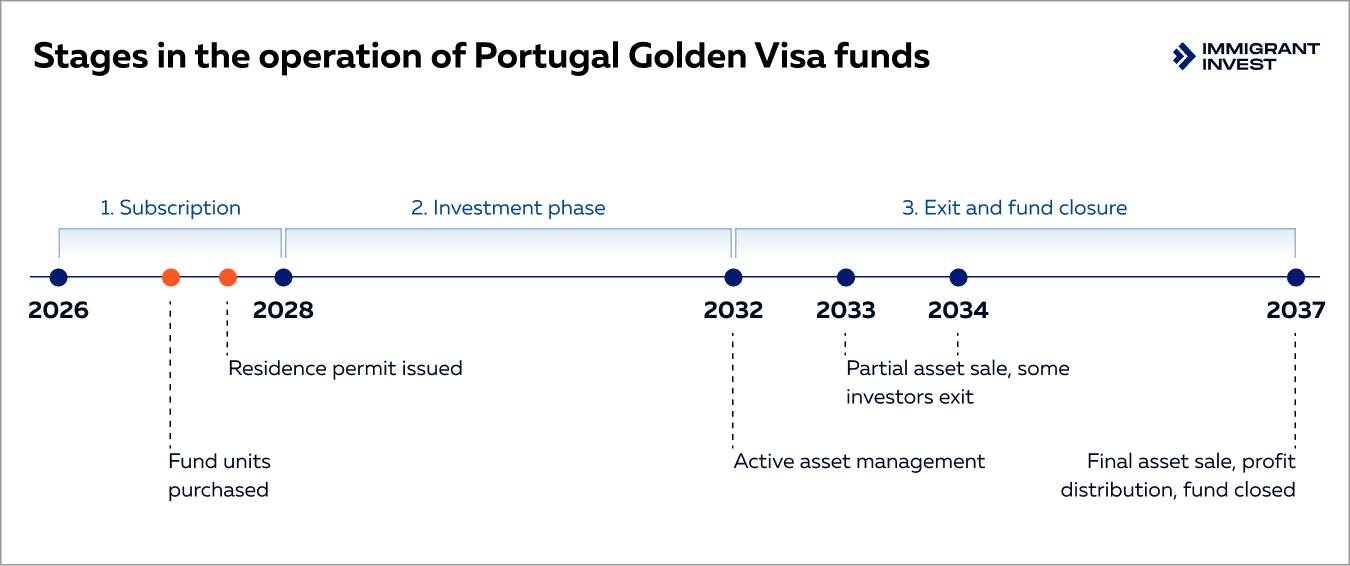
The investment fund route is the most common option for applicants seeking a recoverable investment. Applicants must transfer at least €500,000 into an eligible Portuguese investment fund.
The fund must be registered with Portuguese authorities, have a minimum maturity of 5 years, invest at least 60% of their capital in Portuguese companies, and not focus on real estate.
Investment in culture — €250,000+
Applicants may qualify by making a donation of at least €250,000 to support artistic production or the preservation of Portuguese cultural heritage. This is the lowest entry threshold under the Portugal Golden Visa, but the contribution is non-refundable. It is usually chosen by investors who prioritise residence rights and a future citizenship pathway over capital return.
Investment in scientific research — €500,000+
Investors may also qualify by contributing at least €500,000 to research activities carried out by public or private institutions that are part of Portugal’s scientific and technological system. In low-density areas, the threshold may be reduced to €400,000[3].
This route is less common and is usually more relevant for applicants with a specific interest in research, innovation, or academic partnerships. It is treated as a non-recoverable contribution rather than a standard return-generating investment.
Business investment with job creation — €500,000+
Investors can obtain the Golden Visa by investing at least €500,000 in a Portuguese company and creating at least 5 permanent jobs, or by reinforcing the capital of an existing company while maintaining or creating at least 5 permanent jobs for 3 or more years.
This route may suit entrepreneurs with a genuine business interest in Portugal, but it is more complex than the fund route because it requires ongoing operational and employment compliance.
Job creation route — no minimum investment
The Portugal Golden Visa programme also allows applicants to qualify by creating at least 10 jobs in Portugal, or 8 jobs in low-density areas.
While this route does not depend on a fixed investment amount in the same way as the others, it requires a significant operational commitment and is usually more suitable for applicants who already plan to run an active business in the country.
What to consider when choosing an investment fund for the Portugal Golden Visa as a Turkish citizen?
Many Turkish investors choose the investment fund route because it offers a balance between residence rights and the possibility of recovering the invested capital after the holding period.
Unlike the most affordable cultural donation route, the fund option is not purely a cost. At the same time, it is generally easier to manage than business investment or job creation, which require ongoing operational involvement in Portugal.
Not all eligible funds have the same strategy, risk profile, or exit structure. For Turkish investors, the key points to assess include the type of fund, the level of risk, the manager’s track record, liquidity terms, fees, and the quality of investor reporting.
Fund structure
Portugal Golden Visa funds are typically structured as either open-end or closed-end investment funds.
Open-end funds allow subscriptions and redemptions on an ongoing basis, which can make entry and exit more flexible.
Closed-end funds operate with a fixed number of units and a defined lifecycle. Investors often remain in the fund until maturity or sell their units to another buyer if they want to exit earlier.
Fund types
Private equity funds usually invest in established Portuguese companies and are generally seen as lower-risk vehicles with more stable but moderate target returns, often in the 3 to 7% annual range.
Venture capital funds focus on Portuguese startups and growth-stage businesses, which may offer higher upside, often around 8 to 15% annually, but also involve greater volatility and a higher risk of capital loss.
Hybrid funds combine elements of private equity and venture capital and may offer a more balanced risk-return profile.
Fund size and institutional quality
Established funds with more than €1 billion in assets tend to offer stronger governance, a more transparent track record, and lower execution risk.
Boutique Golden Visa funds, often with less than €100 million in assets may be more specialised, but they can also present higher liquidity risk or less predictable performance. This makes Due Diligence on the management team, portfolio, and past exits especially important.
Liquidity and exit term
After the required 5-year holding period, most investors expect to exit the fund and recover their capital. In many cases, the actual exit takes place closer to 6—10 years, depending on the fund’s lifecycle, asset disposal schedule, and redemption structure.
Some funds offer annual or semi-annual redemption windows, while others require advance notice, often 90 to 180 days.
Where no formal redemption mechanism exists, investors may need to sell their units on a secondary market, sometimes at a discount. For this reason, exit terms should be confirmed in writing with the fund manager before investing.
Track record and portfolio composition
Investors are usually advised to review the fund’s historical performance over the past 5 to 10 years, where available, and request audited financial statements. It is also important to examine the track record of the fund manager and the performance of previous funds managed by the same team.
A consistent history of realised exits and returns can provide a clearer indication of the manager’s investment discipline and ability to generate value.
Portfolio composition
It is also important to understand the portfolio composition of the chosen fund. Diversified exposure across sectors such as technology, manufacturing, and services is generally viewed as more resilient than concentrated strategies.
Investors may also review the number of portfolio companies, the stage of investment, and the geographic focus of the fund to better understand how risk is distributed across the portfolio.
Fees and net returns
Management fees, often around 1.5 to 2% per year, together with any performance fee, can materially reduce net returns over time. For this reason, investors should assess the full fee structure carefully before subscribing.
Reporting and investor support
Many Turkish investors prefer funds that provide English-language reporting and responsive investor relations. Where possible, it is useful to ask for references from other international investors who have already used the fund for Golden Visa purposes.
Immigrant Invest supports clients throughout the fund selection process. Our team helps review fund documents, compare fee structures and exit terms, and assess the quality of investor reporting.
In Portugal, the market is relatively broad, with more than 30 funds currently available under the Golden Visa. This list changes over time as some funds stop accepting subscriptions while others reach the end of their investment cycle.
The table below provides examples of Portugal Golden Visa funds, including their main sector, subscription fee, annual management fee, and maturity.
Portugal Golden Visa investment funds list
Eligibility requirements for Turkish citizens who apply for the Portugal Golden Visa
To qualify, the main applicant must meet the programme’s legal requirements, make an investment, and maintain compliance throughout the residence period.
Eligibility for the main applicant
The main applicant must be at least 18 years old and complete one of the investments available under the Portugal Golden Visa. They must also meet the following core requirements:
- have no criminal record and no pending criminal proceedings;
- use investment funds earned outside Portugal;
- have no outstanding debts in Portugal;
- be able to confirm the lawful origin of their income;
- hold valid medical insurance;
- provide supporting documents in the correct legal form.
Eligibility for family members
Turkish applicants may include family members in the application through Portugal’s family reunification rules. Included family members receive the same residence status and may live, study, and work in Portugal.
The following dependants can usually be included:
- spouse or partner;
- minor children;
- adult children under 26 who are unmarried, financially dependent, and enrolled in full-time education;
- dependent parents of the main applicant or spouse.
This structure is often relevant for Turkish families, especially where adult children remain financially dependent during university studies or where parents are supported by the main applicant.
Required documents for Turkish citizens seeking Portugal Golden Visa
Turkish applicants for the Portugal Golden Visa must prepare a document package covering identity, investment, compliance, and, where applicable, family relationships and the source of funds. Some documents are standard for all applicants, while others depend on the investor’s family structure or source of wealth.
Main applicant’s documents
A typical document checklist for the main applicant includes the following:
- Valid Turkish passport, with at least 6 months of validity remaining.
- Portuguese NIF certificate.
- Clean criminal record certificate from Türkiye, issued within the previous 3 months.
- Health insurance certificate, valid in Portugal, with coverage of at least €30,000.
- Proof of investment, such as a fund subscription agreement or cultural donation receipt.
- Declaration to maintain the investment for 5 years, usually prepared by the lawyer handling the application.
- Supporting source-of-funds documentation, including a bank reference letter from a Turkish bank.
Family documents
If family members are included in the application, additional civil status documents are required. These usually include:
- Marriage certificate for a spouse;
- Birth certificates for dependent children;
- Birth certificate of the main applicant or spouse, where parents are included in the application, in order to confirm the parent-child relationship;
- Proof of dependency for adult children or dependent parents, such as financial statements, bank transfer records, or school enrolment certificates;
- Name change certificates, if applicable, where the current name differs from the name shown in the birth or marriage certificate.
Additional documents for business owners
Applicants whose investment capital comes from business activities may also need to provide corporate documents to support the source of funds. These may include:
- company bylaws, or ana sözleşme;
- shareholder agreements;
- audited financial statements.
Turkish official documents must usually be legalised under the Hague Apostille Convention before they can be used in a Portugal Golden Visa application. Administrative documents are apostilled by the local Governorate, while judicial documents are apostilled by the courthouse.
All Turkish-language documents must be translated into Portuguese by a certified translator. As a rule, apostilled Turkish documents are accepted in Portugal after sworn translation[4].
Source-of-funds documentation for Turkish investors
The source-of-funds documentation is the set of financial records that shows how an investor earned, accumulated, and transferred the capital used for the Golden Visa application. For Turkish investors, it is one of the most important parts of the Portugal Golden Visa process.
Portuguese banks and AIMA require clear evidence showing where the investment capital comes from and how it moved from its original source to the final investment. If the file is incomplete or inconsistent, the application may face delays or additional scrutiny.
Key challenges in source-of-funds preparation
For Turkish investors, the source-of-funds document preparation is often more complex because of several factors:
- Turkish lira volatility, which makes historical asset values harder to explain in euro terms;
- corporate structures, where supporting documents are often available only in Turkish and must be translated and legalised;
- international transfers, as SWIFT payments from Türkiye to Portugal may trigger extra AML checks by intermediary banks.
SWIFT transfers from Turkish banks to Portugal may require additional supporting documents. In practice, it helps to prepare a short cover letter in English explaining the purpose of the transfer and linking it to the source-of-funds documentation.
Documents accepted as source-of-funds proof
The exact package depends on how the capital was accumulated, but common supporting documents include:
- bank statements for the previous 6—12 months;
- tax returns for the past 3 years;
- employment contracts and payslips for salaried applicants;
- property sale documents, if the funds come from real estate;
- inheritance or gift records, where relevant;
- business valuation reports for company owners.

Pedro Barata,
Senior Investment Migration Advisor
Because the source-of-funds documents preparation often involves tax, legal, and banking issues, many Turkish applicants work with both a Portuguese immigration lawyer and a Turkish tax adviser. The total budget for preparing the full source-of-funds package depends on the complexity of the case.
Estimated Portugal Golden Visa costs for Turkish citizens over 5 years
The total cost of a Portugal Golden Visa application for Turkish investors depends on the investment route, the number of family members included, and the complexity of the source of funds file.
For both a solo applicant and a family of four, the minimum investment remains the same: for instance, €500,000 for the fund route.
The main AIMA government fees are charged per applicant and are as follows[5]:
- €632.1 — application processing fee;
- €6,314.2 — initial residence permit issuance fee;
- €3,157.1 — renewal fee for each subsequent residence card.
At the application stage, AIMA fees total €6,946.30 per applicant, or €27,785.20 for a family of 4.
Over 5 years, assuming two renewals, the total renewal cost is €6,314.20 per applicant and €25,256.80 for a family of 4.
Beyond government fees, applicants should budget for health insurance and legal and consulting services, which usually cover NIF and bank account setup, document preparation, investment support, application submission, and renewal assistance.
Translation and document preparation costs depend on the number of documents in the file, the number of family members included, and the complexity of the applicant’s source-of-funds documentation.
Portugal Golden Visa costs over the first 5 years under the fund route
Portugal Golden Visa obtaining process for Turkish applicants
The Portugal Golden Visa process for Turkish citizens usually involves seven main stages, from obtaining a Portuguese tax number to receiving the first residence card.
The full process usually takes at least 12 months, depending on the investment route, document preparation, and AIMA’s current processing backlog.
1 day
Preliminary Due Diligence
Immigrant Invest conducts a preliminary Due Diligence check to identify any circumstances preventing the applicant from participation in the selected programme. The process is fully confidential.
Immigrant Invest conducts a preliminary Due Diligence check to identify any circumstances preventing the applicant from participation in the selected programme. The process is fully confidential.
Up to 2 weeks
Document preparation
Before starting the process, applicants need to prepare a basic set of documents. This often includes a valid passport, proof of residential address in Türkiye, a Turkish tax number where applicable, and a power of attorney for the Portuguese lawyer or licensed representative.
Before starting the process, applicants need to prepare a basic set of documents. This often includes a valid passport, proof of residential address in Türkiye, a Turkish tax number where applicable, and a power of attorney for the Portuguese lawyer or licensed representative.
Up to 2 months
Obtaining a NIF and opening a bank account
To make the investment, open a bank account, and apply for a Golden Visa, the investor needs a Portuguese tax identification number, or NIF.
Turkish applicants can complete this stage remotely by granting power of attorney to a Portuguese lawyer or licensed immigration consultant.
To obtain a NIF, the investor provides:
- valid Turkish passport;
- proof of residential address in Türkiye;
- Turkish tax number, where applicable.
After the NIF is issued, the next step is to open a Portuguese bank account. This account is used to transfer the investment funds and pay related application costs.
To make the investment, open a bank account, and apply for a Golden Visa, the investor needs a Portuguese tax identification number, or NIF.
Turkish applicants can complete this stage remotely by granting power of attorney to a Portuguese lawyer or licensed immigration consultant.
To obtain a NIF, the investor provides:
- valid Turkish passport;
- proof of residential address in Türkiye;
- Turkish tax number, where applicable.
After the NIF is issued, the next step is to open a Portuguese bank account. This account is used to transfer the investment funds and pay related application costs.
1—2 months
Complete the investment
For the investment fund route, the usual process is to select an eligible fund, review its track record and fees, and transfer the required capital from the Portuguese bank account.
For the cultural donation route, the applicant transfers the required amount to an approved Portuguese cultural entity.
For the investment fund route, the usual process is to select an eligible fund, review its track record and fees, and transfer the required capital from the Portuguese bank account.
For the cultural donation route, the applicant transfers the required amount to an approved Portuguese cultural entity.
5—6 months
Submit the application to AIMA
The application is submitted online through the AIMA ARI portal, usually by the applicant’s Portuguese lawyer or licensed representative.
At this stage, AIMA reviews the file for completeness and checks whether the investment and supporting documents meet the Portugal Golden Visa rules. The authority also reviews anti-money laundering and due diligence aspects of the case.
The application is submitted online through the AIMA ARI portal, usually by the applicant’s Portuguese lawyer or licensed representative.
At this stage, AIMA reviews the file for completeness and checks whether the investment and supporting documents meet the Portugal Golden Visa rules. The authority also reviews anti-money laundering and due diligence aspects of the case.
1—2 weeks
Attend the biometrics appointment in Portugal
Once the application moves forward, AIMA schedules a biometrics appointment in Portugal, most often in Lisbon or Porto.
All applicants must attend in person, including dependants. During the appointment, AIMA collects fingerprints, photos, and signatures.
For Turkish families, this stage can be combined with a short visit to Portugal for practical planning, such as viewing neighbourhoods, schools, or service providers.
Once the application moves forward, AIMA schedules a biometrics appointment in Portugal, most often in Lisbon or Porto.
All applicants must attend in person, including dependants. During the appointment, AIMA collects fingerprints, photos, and signatures.
For Turkish families, this stage can be combined with a short visit to Portugal for practical planning, such as viewing neighbourhoods, schools, or service providers.
Within 6 months after biometrics
Approval and issuance of residence permit cards
After biometrics, AIMA carries out the final review of the application and issues its decision. If the application is approved, the applicant pays the applicable government fees for residence permit cards issuance.
When cards are ready, they may be collected in person or delivered to a Portuguese address, depending on the case and the current administrative procedure.
The initial cards are issued for 2 years.
After biometrics, AIMA carries out the final review of the application and issues its decision. If the application is approved, the applicant pays the applicable government fees for residence permit cards issuance.
When cards are ready, they may be collected in person or delivered to a Portuguese address, depending on the case and the current administrative procedure.
The initial cards are issued for 2 years.
Investment maintenance and stay requirement for Portugal Golden Visa holders
To keep the residence permit valid, investors must maintain the investment for at least 5 years.
They must also meet the Golden Visa’s minimum physical presence requirement of at least:
- 7 days in Portugal during the first year;
- 14 days during each following two-year period.
This requirement makes the Portugal Golden Visa especially attractive to Turkish investors who want to keep their personal and business life in Türkiye while securing residence in the European Union.
The residence permit must be renewed every 2 years. To renew it, the investor must continue to hold the investment, comply with the stay requirement, and provide updated supporting documents.
Starting February 2026, Portugal Golden Visa renewal applications are submitted through AIMA’s online renewal system, which allows applicants to file the renewal request and pay the applicable fees digitally[6].
How can Turkish nationals obtain Portuguese citizenship after a Golden Visa?
For many Turkish investors, the main long-term advantage of the Portugal Golden Visa is the opportunity to apply for Portuguese citizenship after 5 years of legal residence. Under the current framework, this period is counted from the start of legal residence, provided the applicant continues to meet the Golden Visa conditions.
Main requirements
To apply for Portuguese citizenship, Golden Visa holders need to meet several requirements:
- Maintain the Golden Visa for 5 years in compliance with the programme requirements.
- Demonstrate basic knowledge of Portuguese, including reading, writing, listening, and speaking.
- Have a clean criminal record.
Application process
After completing the required residence period, the applicant may file for citizenship through the Portuguese civil registry[7]. In practice, many investors submit the application with legal assistance to make sure that the residence records, language certificate, and supporting documents are in order.
The typical citizenship processing time is around 6 to 12 months, although this may vary depending on the case and administrative workload. Legal fees for citizenship assistance are commonly estimated at €1,500—3,000.
Benefits of Portuguese citizenship
Once naturalised, the applicant receives much broader rights than residence alone. The main benefits include:
- right to live, work, and study anywhere in the European Union;
- visa-free or visa-on-arrival access to more than 170 destinations worldwide;
- right to vote in Portuguese and European elections;
- access to Portuguese consular protection abroad.
Possible changes to the Portuguese citizenship rules
In 2025, certain Portuguese parties proposed amendments to the Portuguese nationality law which included a longer residence period of 10 years for most applicants. However, the Constitutional Court found some of these provisions unconstitutional.
Currently, the previous rules continue to apply, including the 5-year route relevant to Golden Visa holders[8].
Tax implications for Turkish Golden Visa holders
The Golden Visa does not automatically make a Turkish investor a Portuguese tax resident. In most cases, investors remain outside Portuguese tax residency and are taxed only on Portuguese-source income, not on worldwide income[9].
Criteria for Portuguese tax residency
Under Portuguese tax rules, an individual is generally treated as a tax resident if they:
- spend more than 183 days in Portugal in any 12-month period beginning or ending in the relevant tax year;
- have a home in Portugal that indicates an intention to keep and occupy it as their habitual residence.
Because Golden Visa holders usually need to spend only 7 days in the first year and 14 days in each following two-year period, they normally do not become Portuguese tax residents unless they move to Portugal on a more permanent basis.
Taxes for tax residents in Portugal
If a Turkish Golden Visa holder becomes a Portuguese tax resident, employment income and most other general personal income are taxed at Portugal’s progressive rates[10]. In 2026, the main rates are:
- 12.5% — up to €8,342;
- 15.7% — €8,342 to 12,587;
- 21.2% — €12,587 to 17,838;
- 24.1% — €17,838 to 23,089;
- 31.1% — €23,089 to 29,397;
- 34.9% — €29,397 to 43,090;
- 43.1% — €43,090 to 46,566;
- 44.6% — €46,566 to 86,634;
- 48% — above €86,634.
For residents, some forms of investment income are usually taxed at flat rates unless the taxpayer opts for aggregation. In general, interest and dividends are taxed at 28%[11].
Residential rental income is taxed at 25%, with possible reductions for certain longer-term qualifying leases[12].
Taxes for non-residents
If a Turkish Golden Visa holder remains a non-resident for tax purposes, Portugal usually taxes only income sourced within its territory. This means that foreign salary, overseas business profits, and most non-Portuguese income are not subject to local taxation.
For non-residents, Portuguese-sourced employment income is taxed at a 25% flat rate. Capital gains on certain local assets are taxed at 28%, while residential rental income is taxed at 25%.
In practical terms, a non-resident Golden Visa holder who owns income-producing assets in Portugal will still have a tax filing or withholding obligation, even without becoming a tax resident.
Portugal-Türkiye double tax treaty
Portugal and Türkiye are covered by a double taxation treaty, which helps prevent the same income from being taxed twice[13]. Where both countries could claim tax residency under their domestic rules, treaties of this kind typically use tie-breaker tests based on factors such as:
- permanent home;
- centre of vital interests;
- habitual abode;
- nationality.
This means that tax paid in one country may often be credited or otherwise taken into account in the other, depending on the nature of the income and the treaty rules applied in the case.
CRS and reporting obligations
Portugal and Türkiye both participate in the Common Reporting Standard, the OECD framework for the automatic exchange of financial account information. As a result, Portuguese financial institutions may report relevant account information to the Portuguese tax authority. That information may then be exchanged with the Turkish tax authority if the account holder is a tax resident in Türkiye.
For Golden Visa holders who remain tax residents in the country of origin, this means Portuguese bank accounts and certain financial assets should be treated as part of their broader cross-border tax compliance.
Risks and pitfalls of the Portugal Golden Visa for Turks
Turkish investors considering the Portugal Golden Visa should assess all the practical risks involved. Most challenges relate to changing rules, fund structure, banking checks, family eligibility, and AIMA processing delays.
Rule changes
Portugal has already changed the Golden Visa several times, including the closure of the real estate route in 2023. Future changes may affect investment thresholds, residence conditions, or the citizenship timeline. For this reason, applicants should monitor official updates and work with advisers who can explain transitional rules.
Limited liquidity and fund risk
Golden Visa funds usually require investors to keep their capital committed for at least 5 years, and in practice the full fund cycle may last longer. Early exit is often difficult and may involve discounts or penalties.
Returns are not guaranteed either. Fund performance may be affected by market conditions, weak management, or high fees. Turkish investors also face currency risk when converting lira into euros.
Compliance risk at renewal
Some applicants assume that transferring the minimum investment once is enough. In practice, the investment must remain compliant throughout the residence period. Depending on the fund structure, investors may need to maintain a certain number of units or prove that the investment remains in place at each renewal.
Banking delays and compliance check
Portuguese banks apply strict AML and KYC checks, and Turkish applicants may face additional questions about the source of funds, business structure, or document format. Bank account opening may take longer than expected, and some banks may decline the case altogether.
International transfers may also be delayed by intermediary banks, especially where large sums or multiple accounts are involved.
Timing issues in the application process
The investment must be completed before the Golden Visa application can be filed. If fund subscription or a bank transfer is delayed, other documents such as criminal record certificates may expire and need to be issued again. A clear sequence of steps helps avoid rework and missed deadlines.
Source-of-funds scrutiny
Source-of-funds documentation is one of the most sensitive parts of the application. Missing links in the financial trail, undocumented transfers, or poorly explained corporate income may lead to delays or refusal. This is especially relevant for Turkish investors using business profits, property sales, inheritance, or multi-step currency transfers.
AIMA backlog and long processing times
Official timelines may sound shorter, but in practice many applicants face delays. For 2024—2026 cases, a realistic timeframe is often 12 to 24 months from submission to residence card issuance[14]. Investors should avoid making relocation, schooling, or business decisions based on overly optimistic timelines.
Comparison of the Portugal Golden Visa with other residency routes
For Turkish applicants, the right residency route depends on their priorities, investment strategy, and long-term plans. The Portugal Golden Visa is often chosen by investors who want a flexible residence option with a relatively low physical presence requirement and a potential path to citizenship.
As an alternative, Turkish investors may consider similar investment pathways in Greece, Italy, Malta, Latvia, or Hungary, depending on whether they prioritise real estate, business activity, relocation, or long-term residence planning.
Each route differs in its investment model, residence conditions, and renewal structure. A more detailed comparison is provided in the table below.
Investment routes: key features comparison
Living in Portugal as a Turkish Golden Visa holder
Many Turkish Golden Visa holders use Portugal as a second base, visiting for short stays, school planning, banking, healthcare, or future relocation preparation.
Safety and quality of life
Portugal is widely regarded as one of the safest countries in Europe. It ranked 7th globally in the 2025 Global Peace Index, which is one of the strongest quality-of-life arguments for families considering relocation or part-time residence[15].
The country offers a Mediterranean lifestyle, strong family orientation, a mild Atlantic climate, and a large expat and digital nomad community, especially in Lisbon and the Algarve.
Most popular places to live
Lisbon is usually the first choice for families who want international schools, direct flights to Istanbul, and a larger expat community. It is Portugal’s business and cultural centre, but also the most expensive city. A two-bedroom apartment in central areas usually costs approximately €1,500 to 2,500 per month.
Porto is popular with families who prefer a slower pace of life and lower living costs than Lisbon. The city offers international schools, good healthcare, and a strong quality-of-life balance. A two-bedroom apartment usually costs around €1,000 to 1,800 per month.
The Algarve attracts families looking for a coastal lifestyle, warm weather, and a more relaxed environment. It is especially popular with retirees. Rental costs for a two-bedroom apartment are often around €800 to 1,500 per month.
Madeira appeals to applicants who value the climate, scenery, and a quieter island setting. It is less common for Turkish families than Lisbon or Porto, but it can suit investors looking for part-time residence. Rental costs are often around €700 to 1,200 per month.

Porto is a popular choice for families who prefer a more relaxed pace of life than in Lisbon while still having access to international schools, healthcare, good transport links, and a balanced cost-to-quality-of-life ratio[16]
Healthcare
Golden Visa holders may access Portugal’s public healthcare system after registering with a local health centre. Healthcare quality is strong, although waiting times for specialist appointments can be long.
For faster access, many families choose private cover. Comprehensive private health insurance usually costs around €50 to 150 per month per person.
Education
Many international families prefer private international schools because they offer instruction not only in Portuguese but also in English, French, or German. This is particularly attractive for Golden Visa holders whose families may not plan a full transition into the Portuguese public school system.
In Lisbon, several well-known international schools include:
- St Julian’s School, which offers English and bilingual English–Portuguese pathways;
- Carlucci American International School, which teaches in English and follows an American or IB curriculum;
- Lycée Français Charles Lepierre, which follows the French education system;
- Deutsche Schule Lissabon, which provides German-language education with Portuguese integration.
Annual tuition in international schools is usually in the €8,000 to 20,000 range.
Turkish community and transport links
Portugal has a relatively small but visible Turkish community, estimated at around 5,000 to 10,000 people. It is most noticeable in Lisbon, where Turkish restaurants, shops, and informal community networks can be found, especially in areas such as Martim Moniz and Intendente.
Direct flights between Istanbul and Lisbon operate daily, which makes regular travel practical for investors who divide their time between Türkiye and Portugal.
Language and integration
Portuguese is the official language, but English is widely spoken in Lisbon, Porto, and the Algarve, especially in international schools, expat-friendly neighbourhoods, and service sectors. Turkish-speaking residents are relatively rare outside the diaspora community.
For day-to-day life, many families can manage with English at first. However, learning Portuguese becomes more important over time, especially for long-term integration and citizenship planning. Language courses are available both online and in person, and a 50-hour course in Lisbon or Porto often costs around €500 to 1,500.
Why trust Immigrant Invest when obtaining Portugal Golden Visa
Immigrant Invest supports Turkish applicants through the Portugal Golden Visa process with a strong focus on compliance and risk reduction.
Before taking on a case, our team conducts internal preliminary Due Diligence and AML screening, including checks for criminal records, sanctions exposure, PEP status, court proceedings, and past visa refusals.
The process follows the correct legal sequence: first, the required documents are collected, then the applicant obtains a NIF and opens a bank account, then completes the investment, and only after that files the application with AIMA. This approach helps applicants avoid common mistakes, such as submitting short-validity documents too early.
Another key advantage is direct access to Portuguese legal expertise and end-to-end guidance through a single point of contact. Immigrant Invest helps clients with cost transparency, bank onboarding, notarisation, apostilles, biometrics, and renewals, while also providing realistic guidance on timelines based on current AIMA practice.
Immigrant Invest has an office in Türkiye and Turkish-speaking managers. It helps applicants communicate more comfortably throughout the process and reduces the risk of misunderstandings caused by language barriers.
Final thoughts on Portugal Golden Visa for Turkish citizens
- Turkish citizens are eligible for the Portugal Golden Visa as non-EU nationals and can obtain residence in Portugal by investment of at least €250,000.
- The Portugal Golden Visa combines several advantages, including visa-free access to the Schengen Area, the right to include close family members in one application, and a path to Portuguese citizenship in the long-term.
- The full process of obtaining the Portugal Golden Visa usually takes 12+. After 5 years of legal residence, applicants may apply for Portuguese permanent residence or citizenship.
- The first residence card is valid for 2 years and must be renewed while the investment is maintained.
- The Portugal Golden Visa does not automatically create Portuguese tax residency. In most cases, investors who keep to the minimum stay requirement remain taxable in Portugal only on Portuguese-source income.
Immigrant Invest is a licensed agent for citizenship and residence by investment programs in the EU, the Caribbean, Asia, and the Middle East. Take advantage of our global 15-year expertise — schedule a meeting with our investment programs experts.
 Trusted by 10,000+ investors