

Summary
Moving to Portugal under the Global Talent Programme opens the door to residence and long-term planning in the EU, but it also raises important tax questions.
A residence permit does not automatically mean tax residency, yet once the thresholds are crossed, Portugal may start taxing worldwide income.
Understanding when tax obligations begin, how different types of income are treated, and where the main risks lie helps avoid costly surprises.
How holding a Portugal Global Talent permit affects tax residency?
The Portugal Global Talent Programme itself is not a tax regime. Tax residency arises separately, usually when an individual spends 183 days or more in Portugal in a calendar year, or establishes a habitual home in the country. Until these thresholds are met, a residence permit holder may remain a non-resident for tax purposes.
Holding a Global Talent Visa residence permit does not require spending 183 days per year in Portugal, and it is possible to maintain residence status with limited physical presence[1].
Once Portuguese tax residency is triggered, Portugal may tax worldwide income, subject to applicable exemptions, special tax regimes and double taxation treaties. This distinction is particularly relevant in the first year, when residence status and tax status often do not start at the same time.

Portugal Global Talent Programme requirements
AIMA treats the Global Talent route as a specific residence permit pathway under Article 90 of Portuguese immigration law[2]. This article provides the legal basis for granting residence to individuals considered relevant for the Portuguese economy.
The Global Talent Programme targets professionals whose skills and experience are considered valuable for the Portuguese economy. Typical profiles include:
- senior managers and executives;
- technology leaders and highly skilled specialists;
- founders and business owners managing operations from Portugal;
- researchers and academic professionals.
The Global Talent Programme is structured around formal cooperation with a Portuguese university or recognised R&D institution.
Applicants must show that they can contribute to Portugal’s innovation and education sectors and apply for collaboration with a Portuguese university or research institution. This cooperation is formalised through a Letter of Commitment and a hosting agreement issued by the institution.
The total programme cost is €170,000 for the main applicant with up to 3 dependants, with an additional €5,000 for each extra dependant. These payments are made in stages throughout the application process.

Albert Ioffe,
Legal and Compliance Officer, certified CAMS specialist
Many Global Talent applicants plan to fund their move to Portugal using existing savings or retirement assets, such as US Roth IRAs or similar long-term investment accounts.
From an immigration perspective, these funds can usually be used to demonstrate financial capacity.
Tax base for Portugal Global Talent Visa holder
Tax payer profiles often have multiple income streams, including foreign salary, management fees, dividends or equity-related income, which makes tax residence planning particularly important.
Global Talent holders do not need to live in Portugal full time to keep their residence permit. However, once physical presence or living arrangements cross the tax residency thresholds, Portuguese taxation of worldwide income may apply.
Level map from status to tax consequences
When do Portugal Global Talent Visa holders become Portuguese tax residents?
Portugal applies three core concepts when assessing tax residency[3]. Meeting any of these conditions can be sufficient to trigger Portuguese tax residency:
- The 183-day rule. An individual is usually considered a Portuguese tax resident if they spend 183 days or more in Portugal during a tax year. The days do not need to be consecutive.
- Habitual home. Even with fewer than 183 days, a person may still be treated as a tax resident if they maintain a habitual home in Portugal. This generally means having accommodation available on a stable basis and using it as a place of regular residence.
- Centre of vital interests. Tax authorities may also look at where an individual’s personal and economic ties are strongest. This includes family location, business activities, management functions and the overall pattern of life. This test becomes especially relevant for internationally mobile professionals.
What happens in your first tax year in Portugal and how does the split year work?
The first tax year after relocating to Portugal is often the most complex from a tax perspective. In the year of arrival, an individual may be treated as a Portuguese tax resident only for part of the year, while the earlier part of the year remains linked to the previous country of residence.
This creates a split-year situation, where income is effectively allocated between two tax jurisdictions based on timing and tax residency status.
Portugal does not formally use the term split-year in its tax legislation, but in practice the tax authorities apply a similar logic.
Typical split-year scenarios for Global Talent holders
For Portugal Global Talent residence permit holders, common first-year scenarios include:
- arrival in Portugal partway through the year, followed by reaching the 183-day threshold later in the same year;
- establishing a habitual home in Portugal before spending 183 days in the country;
- holding a residence permit while remaining a non-resident for the first part of the year.
In all these cases, the exact date on which tax residency starts is critical for determining which income falls into the Portuguese tax net.
Practical planning timelines around relocation
For Global Talent professionals, first-year tax planning often starts well before arrival in Portugal. Typical planning steps include:
- reviewing bonus cycles and payment dates;
- assessing vesting and exercise schedules for equity compensation;
- considering the timing of major disposals or liquidity events;
- mapping the expected date of Portuguese tax residency.
Because small changes in timing can significantly affect the effective tax rate, the first tax year is usually the moment when coordinated planning with a tax adviser delivers the greatest value.
Double tax treaties and dual residency
Portugal has an extensive network of double tax treaties with 79 countries, including the UK, EU states and the US[4]. These treaties are designed to prevent the same income from being taxed twice when Portugal Global Talent Visa holders earn income across borders.
Double taxation treaties apply tie-breaker rules to determine a single country of tax residence for treaty purposes. These rules typically assess, in sequence:
- permanent home;
- centre of vital interests;
- habitual abode;
- nationality.
In practice, treaties determine which country has the right to tax a specific type of income and require the country of residence to provide relief if tax has already been paid abroad.
For example, a Global Talent professional working remotely from Portugal for a UK employer will usually be taxed in Portugal, with any UK tax withheld credited against Portuguese tax. Similarly, dividends received from a foreign company may be taxed at source abroad, but that foreign tax can often be offset against Portuguese tax.
Albert Ioffe,
Legal and Compliance Officer, certified CAMS specialist
UK-based clients often worry that moving to Portugal will automatically expose them to double taxation, especially on salary, dividends, and investment income.
Portugal and the UK have a double taxation treaty, which is designed to ensure that the same income is not taxed twice and to define which country has taxing rights over different types of income.
However, applying the treaty correctly requires a detailed review of personal circumstances and income structure, so professional tax advice is usually essential.
How does the Portuguese income tax system work for residents and non-residents?
Portugal taxes individuals under a personal income tax system that combines progressive rates for tax residents with flat rates for non-residents and for most categories of capital income. The applicable treatment depends on tax residency and income type, not on holding a Global Talent residence permit.
Progressive income tax rates for Portuguese tax residents
Portuguese tax residents are generally taxed on their worldwide income under progressive IRS bands set out in Article 68 of the Personal Income Tax Code[6].
The current progressive rates range from 12.5 to 48%, applied on a marginal basis as income increases. In addition, a solidarity surcharge applies to high incomes:
- 2.5% on taxable income exceeding €80,000;
- 5% on taxable income exceeding €250,000.
As a result, the effective top marginal rate for high earners exceeds 50%, unless a special regime such as IFICI applies.
Flat tax rates for non-residents
Non-residents are taxed only on Portuguese-source income and, in most cases, at flat rates, without access to the progressive scale.
The standard flat rates include:
- 25% on employment income from work performed in Portugal;
- 25% on rental income from Portuguese real estate;
- 28% on dividends and interest from Portuguese sources;
- 28% on most Portuguese-source capital gains.
The rates generally apply regardless of income level and are final in most cases.
Capital income and optional aggregation for residents
Portugal applies separate flat rates to most categories of capital income, both for residents and non-residents. In practice, dividends, interest and capital gains from shares and similar securities are generally taxed at a 28% flat rate, unless a Portuguese tax resident opts to aggregate this income into the progressive scale.
Portuguese tax residents may usually opt to aggregate this income into the progressive IRS scale instead of applying the flat rate. This option is elected annually and may be beneficial where total income is low or where deductions or losses apply.
Capital gains from Portuguese real estate follow specific rules and may be partially aggregated, requiring individual assessment.
Overview of Portuguese income taxation
How do social security contributions work for Global Talent Visa holders?
Social security contributions in Portugal fund public pensions, healthcare, and other social benefits. Most employees and many self-employed professionals are required to contribute, regardless of whether they hold Global Talent residence status. The obligation depends on how the activity is carried out, not on the residence permit itself.
Key social security rates for employment
For standard employment relationships, social security contributions are shared between the employer and the employee:
- Employer contribution: 23.75% of gross salary.
- Employee contribution: 11% of gross salary.
These contributions are calculated on most forms of cash remuneration and are withheld and paid monthly through payroll.
Social security for independent workers
Self-employed professionals and freelancers are generally required to pay their own social security contributions.
Key features include:
- contributions are calculated based on assessed income, not on gross turnover;
- standard contribution rate is 21.4%;
- taxable base is typically a percentage of declared income, depending on the activity type.
Certain temporary exemptions may apply, for example in the first period of activity or where the individual is already covered by another mandatory social security system.
Registration with the Portuguese social security system
Global Talent holders who work or carry out activity in Portugal must register with the social security system. The process usually involves:
- obtaining a social security identification number;
- registering as an employee or independent worker;
- confirming the correct contribution category.
Registration is separate from tax registration and should be completed as soon as employment or self-employment starts.
International coordination and social security agreements
Portugal applies EU social security coordination rules and has bilateral agreements with several non-EU countries.
These rules are designed to:
- prevent double social security contributions;
- determine which country’s system applies;
- allow continued coverage in another country for a limited period.
Within the EU, portable certificates such as A1 can confirm continued coverage in another member state. Similar certificates may apply under bilateral agreements with non-EU countries.
How are stock options, RSUs and other equity rewards taxed after for Global Talent Visa holders?
Equity compensation is a common part of remuneration for Global Talent professionals, especially in technology companies, start-ups, and multinational groups. In Portugal, the tax treatment depends on the type of equity plan, the relevant tax event and the timing of the move.
RSUs stands for Restricted Stock Units. These are rights to receive shares in the future, usually subject to vesting conditions.
Main types of equity plans
The most common equity plans encountered by Global Talent Visa holders include:
- Stock options, which give the right to acquire shares at a fixed price.
- Restricted Stock Units RSUs, which convert into shares once vesting conditions are met.
- Employee Share Purchase Plans, which allow employees to buy shares, often at a discount.
- Founder and management equity, including shares received at incorporation or through capital increases.
Each plan type has different tax points and valuation rules.
Tax points and taxable base
Equity income is not always taxed when the award is granted. The taxable moment depends on the plan design and Portuguese tax rules:
- stock options are commonly taxed on exercise, when the option is used to acquire shares. The taxable amount is typically the difference between the market value and the exercise price;
- RSUs are usually taxed on vesting, when the shares are delivered or become freely disposable, the taxable amount is the market value of the shares at that time;
- Employee share purchase plans may trigger taxation on acquisition if shares are acquired at a discount, and again on sale if a capital gain arises.
Subsequent sale of shares may also trigger capital gains tax, calculated separately.
Equity income in the year of relocation
The year of relocation is critical for equity compensation. Many equity awards vest or are exercised over several years. Where the award relates to work performed partly before and partly after moving to Portugal, income may need to be allocated between jurisdictions.
Portugal crypto taxes explained: holding, trading and reporting rules
Portugal applies different tax treatment to crypto assets depending on how they are held and used. The key distinction is between private investment activity and business-like or professional trading. Global Talent status does not change these rules.
Private holding and long-term investment
For individuals who hold crypto assets as a private investment, taxation is generally lighter than for other types of investment income.
Long-term holding may result in reduced or no income tax, depending on how and when the asset is disposed of. Occasional transactions by private investors are usually treated differently from active trading.
The tax outcome depends on holding period, transaction frequency and the overall investment pattern.
When crypto activity becomes a business
Crypto activity may be treated as business or professional income where trading is frequent, organised or forms a regular source of income[7].
Indicators include:
- high transaction volume or frequency;
- short holding periods;
- use of trading tools or strategies similar to professional activity.
In these cases, income may be subject to personal income tax and social security contributions, and the activity must be formally registered and declared[8].
Reporting obligations and foreign platforms
Portuguese tax residents must report crypto transactions, including those carried out on foreign exchanges or through decentralised platforms[9].
Even where income is lightly taxed or exempt, disclosure obligations still apply. Failure to report can lead to penalties.
Transparency and anti-money laundering rules
Crypto activity is increasingly covered by anti-money laundering rules and international transparency frameworks[10].
Information on crypto holdings and transactions may be shared under automatic exchange of information mechanisms. This increases the importance of consistent reporting across jurisdictions.
When do Global Talent holders need to deal with Portuguese VAT?
Value added tax applies to many goods and services in Portugal. Global Talent Visa holders usually encounter VAT when they carry out self-employment or business activities, rather than through employment. VAT obligations depend on the type of service, place of supply and client location, not on immigration status.
VAT rates in mainland Portugal
Mainland Portugal applies the following VAT rates:
- 23% standard rate, which applies to most services;
- 13% reduced rate for specific goods and services;
- 6% super-reduced rate for limited categories.
Some activities may be exempt from VAT, but exemption does not always remove reporting obligations.
When VAT registration is required
Self-employed Global Talent holders may need to register for VAT if they:
- supply taxable services in Portugal;
- exceed the VAT exemption threshold for small businesses;
- provide digital, consultancy or professional services that are taxable in Portugal or elsewhere in the European Union.
VAT registration may be required even where clients are located abroad, depending on the place-of-supply rules.
Special tax regimes and incentives available to Portugal Global Talent Visa holders
Portugal does not grant tax benefits based on immigration status alone. Global Talent Visa holders may access tax incentives only after becoming Portuguese tax residents and only if they meet the conditions set out in tax legislation.
IFICI regime for scientific research and innovation
The IFICI regime is the main special personal tax regime currently available to new tax residents in Portugal[5]. It replaced the former Non-habitual Resident regime for new applicants and is often referred to as NHR 2.0.
IFICI is established under Portuguese tax law and applies for up to 10 consecutive years. To qualify, an individual must:
- become a Portuguese tax resident;
- not have been a Portuguese tax resident in the previous 5 years;
- carry out eligible professional activities linked to scientific research, innovation or other recognised high value-added functions;
- apply for the regime within statutory deadlines.
For eligible Global Talent professionals, IFICI may provide a flat 20% personal income tax rate on qualifying employment or self-employment income from eligible activities carried out in Portugal. Pensions are generally excluded and taxed under standard rules. All income must still be reported.
Corporate tax incentives in Madeira
In addition to personal regimes, corporate tax incentives may be relevant where Global Talent professionals operate through companies.
Madeira’s International Business Centre MIBC offers a 5% corporate income tax rate on qualifying profits for newly licensed entities. New licences are available until December 31th, 2026, with the 5% rate applying until December 31th, 2028, subject to substance and activity requirements.
For activities outside MIBC, Madeira applies reduced regional rates:
- 13% general corporate income tax rate in 2026;
- 11.2% on the first €50,000 of taxable profit for qualifying SMEs.
The aforementioned regimes apply at the company level, not to personal income.
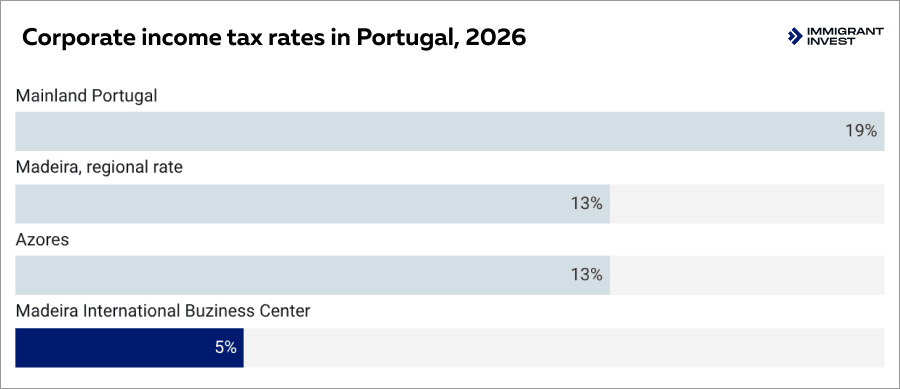
In 2026, Portugal reduced its general corporate income tax rate to 19%, down from 20% in 2025, as part of a phased, three-year reduction plan
What is the compliance calendar for Portugal Global Talent Visa holders?
Portugal follows a calendar tax year, running from January 1st to December 31st[11]. Global Talent Visa holders must comply with fixed deadlines for income tax, social security and, where applicable, VAT. Missing deadlines may result in penalties, interest and compliance issues with the tax authority.
In addition to annual filing, compliance obligations begin as soon as tax residency or economic activity starts. New residents must register with the Portuguese tax authority, update their tax address and, where applicable, enrol with the social security system.
Key annual deadlines at a glance
How to apply for the Portugal residence permit under the Global Talent Programme
Among Portugal residence options, the Global Talent route is the fastest. Based on Immigrant Invest’s legal practice, the process usually takes a little over 4 months. It includes 6 key stages, beginning with an initial Due Diligence check and ending with residence cards issued to all family members.
The Global Talent Programme maintains a 100% approval rate through coordination with AIMA and accredited universities. Each application is verified for eligibility and compliance before submission. The sequence below outlines the typical procedure.
1 day
Preliminary Due Diligence
Immigrant Invest performs an initial Due Diligence screening to detect any factors that might prevent participation in the selected programme.
Once the verification is successfully completed, a service agreement is drafted to formalise continued legal support. The review remains strictly confidential.
Immigrant Invest performs an initial Due Diligence screening to detect any factors that might prevent participation in the selected programme.
Once the verification is successfully completed, a service agreement is drafted to formalise continued legal support. The review remains strictly confidential.
Up to 1 month
Document preparation
All required papers are gathered, legalised, and checked before being submitted to AIMA.
The Immigrant Invest legal department examines every document for validity and expiry before uploading it to the shared system. If any item is incomplete or missing, submission to AIMA is postponed.
All required papers are gathered, legalised, and checked before being submitted to AIMA.
The Immigrant Invest legal department examines every document for validity and expiry before uploading it to the shared system. If any item is incomplete or missing, submission to AIMA is postponed.
2—3 weeks
University matching and Letter of Commitment
After all papers are received, the legal team circulates the client’s CV and professional summary among more than ten partner universities. Institutions assess the profile and propose possible collaborations in fields such as research, mentoring, or executive education.
The client reviews available options. Once a match is confirmed, the chosen university issues a Letter of Commitment confirming participation and project details.
After all papers are received, the legal team circulates the client’s CV and professional summary among more than ten partner universities. Institutions assess the profile and propose possible collaborations in fields such as research, mentoring, or executive education.
The client reviews available options. Once a match is confirmed, the chosen university issues a Letter of Commitment confirming participation and project details.
Up to 3 months
Submission to AIMA
Lawyers file the full case with AIMA under a power of attorney. The agency then sets a date for biometrics and issues a written appointment confirmation.
Visit #1 — bank and university procedures. During the first trip to Portugal, applicants present original documents, meet university representatives to sign the hosting agreement, and open a bank account with in‑person KYC.
Lawyers file the full case with AIMA under a power of attorney. The agency then sets a date for biometrics and issues a written appointment confirmation.
Visit #1 — bank and university procedures. During the first trip to Portugal, applicants present original documents, meet university representatives to sign the hosting agreement, and open a bank account with in‑person KYC.
1—1.5 months from appointment to card delivery
Biometrics and residency approval
Applicants travel to Portugal for the scheduled AIMA appointment, accompanied by legal counsel and an interpreter, to provide biometrics.
Following submission, AIMA finalises the review and issues the residence card within 4—6 weeks.
Visit #2 — final approval and card issuance. During the second visit, applicants provide originals and complete biometrics. As residence is usually pre‑approved, cards are produced within roughly 45—90 days. The card is sent to the Lisbon office for collection or courier delivery.
Applicants travel to Portugal for the scheduled AIMA appointment, accompanied by legal counsel and an interpreter, to provide biometrics.
Following submission, AIMA finalises the review and issues the residence card within 4—6 weeks.
Visit #2 — final approval and card issuance. During the second visit, applicants provide originals and complete biometrics. As residence is usually pre‑approved, cards are produced within roughly 45—90 days. The card is sent to the Lisbon office for collection or courier delivery.
2—3 months after the main applicant’s approval
Family reunification
Relatives may apply for residence through the family reunification procedure once the principal applicant’s card has been issued.
Additional costs apply for health insurance, biometrics, card production, and translation or notarisation of supporting documents.
Relatives may apply for residence through the family reunification procedure once the principal applicant’s card has been issued.
Additional costs apply for health insurance, biometrics, card production, and translation or notarisation of supporting documents.
What are the main tax risks and common objections for Global Talent holders?
Most tax risks for Global Talent Visa holders come from how activities and assets are structured, not from the residence permit itself. Understanding these risks early helps avoid unexpected tax exposure.
Changing tax residence may trigger exit taxes in the country of origin
Some countries tax unrealised capital gains when an individual leaves, even if assets are not sold. This can affect shares, options and other investments and should be reviewed before relocation.
Financial transparency between countries is increasing
Banks and financial platforms report information under automatic exchange frameworks, allowing tax authorities to share data on accounts and income. Inconsistent reporting or undeclared foreign income is more likely to be detected.
Tax audits often focus on gaps in documentation rather than aggressive planning
Common triggers include unexplained income, unclear equity allocations around the move year and lifestyle indicators that do not match declared income. Maintaining contracts, payslips, bank statements and proof of foreign taxes paid makes audits more predictable and manageable.
Final thoughts about taxes for Portugal Global Talent Programme holders
- Obtaining Portugal Global Talent Visa does not automatically make you a Portuguese tax resident. Tax residency usually starts when you spend 183 days or more in Portugal in a calendar year, or when you establish a habitual home in the country, even with fewer days.
- The main tax challenges arise from the moment tax residency begins. From that point, Portugal may tax worldwide income, including foreign salary, equity income and investment returns.
- Funds used to cover programme fees and living costs may also fall into the tax net, depending on their source and structure.
- Most mistakes happen because people confuse holding a residence permit with becoming a tax resident. Once the residency thresholds are crossed, tax obligations change significantly, and planning before that moment is what keeps taxes manageable.
 Trusted by 10,000+ investors