

Summary
Portugal offers a residency by investment known as the Golden Visa, but it does not automatically grant citizenship. However, after holding residency for 5 years, individuals may become eligible to apply for Portuguese citizenship by naturalisation.
Portuguese citizens enjoy a wide range of benefits, such as visa-free access to over 170 countries, a high quality of life at relatively low prices, a warm climate, comfortable conditions for expats, and a high safety level.
Portugal citizenship: an overview
Portuguese citizenship by naturalisation is governed by Lei n.º 37/81, the Portuguese Nationality Law[1], which establishes the legal basis for acquiring citizenship through residence.
The law applies to all pathways leading to citizenship by naturalisation, including those who obtain residence through national residence permits, as well as the D7 Visa, the Digital Nomad Visa, and the Golden Visa.
The legal framework ensures that applicants have demonstrated a genuine connection to Portugal before acquiring full citizenship rights.
Main pathways to acquiring Portuguese citizenship
Portugal offers several routes to citizenship, including citizenship by naturalisation after 5 years of legal residence, citizenship by marriage after 3 years, citizenship by origin for those with Portuguese grandparents, and citizenship by birth for children born in Portugal. Each pathway has specific eligibility criteria and timelines.
Acquiring Portugal citizenship provides individuals access to various rights, freedoms, and opportunities within Portugal, the EU, and internationally.
When a person may apply for Portugal citizenship:
- anytime — citizenship by origin or birth;
- after 3 years of marriage — citizenship by marriage;
- after 5 years of legal residence — citizenship by naturalisation.
Common requirements
Residing in the country. The applicant for naturalisation must have legally resided in Portugal for a certain period. The duration can vary depending on the circumstances, but it is at least 5 years in most cases.
In 2025, the Portuguese authorities proposed increasing the minimum residency period for naturalisation. If adopted, the new law would set a 10-year period, reduced to 7 years for citizens of CPLP countries and EU member states. As the law has not yet been adopted, the current period remains 5 years.
There are several ways for foreigners to obtain a residence permit in Portugal to qualify for citizenship by naturalisation[2]; some of the most popular are the D7 Visa and the Golden Visa.
Language proficiency. Applicants must demonstrate proficiency in the Portuguese language at A2 level[3]. This requirement can be fulfilled through a language test.
Clean criminal record. Applicants must have no serious criminal convictions.

Trusted by 5000+ investors
Will you obtain residence by investment in Portugal?
How to get Portugal citizenship by naturalisation as an investor
To obtain citizenship by naturalisation, investors must first secure a residence permit, which can be granted by contributing to the country’s economy under the Portugal Golden Visa[4].
After a certain period of residency, they become eligible for citizenship. Golden Visa holders must spend an average of 7 days per year in Portugal and meet language and criminal record requirements to qualify for naturalisation.
Understand investment requirements
The Portugal Golden Visa best suits investors ready to contribute substantially to the country's economy. The initial investment may be returnable in 5 years.
There are five investment options:
- supporting culture, art, or reconstruction of national heritage — €250,000+;
- purchasing of investment fund units — €500,000+;
- contributing to research programs — €500,000+;
- investing in a business with the creation of at least 5 jobs — €500,000+;
- opening of a company with the creation of at least 10 jobs — no minimum investment requirement.
The investor will also need to pay mandatory fees. These include the application fee, medical insurance, the residence permit card issuance fee, and fees and commissions related to bank account maintenance.
Under some of the investment options, other taxes and commissions may apply, such as under the fund share option.
Obtain the Golden Visa
It usually takes 12+ months to obtain Portuguese residence by investment, provided the applicant has legal support helping them through the procedure.
The process includes such steps as obtaining a tax ID number, opening a bank account in a Portuguese bank, making an investment, Due Diligence by Portuguese authorities, submission of biometric data, and obtaining of residence permit cards.
The Golden Visa allows investors to include immediate family members in their application, granting them the same residence rights and eventual citizenship eligibility.
Eligible family members include:
- spouse or legally recognised partner, including same-sex partners and non-marital partnerships registered or proven under Portuguese law;
- dependent children, including minor children under 18 and adult children up to age 26 if unmarried and enrolled in full-time education;
- dependent parents of the main applicant or spouse, including parents-in-law, if financially dependent on the main applicant.
Renew residence permit
The residence permit under the Golden Visa is granted for 2 years and subject for indefinite 2-year extensions. The investor must spend an average of 7 days per year in Portugal to maintain and renew their residency.
Renewal requires:
- proof of maintaining the qualifying investment for the full period;
- evidence of the required minimum stay;
- valid travel document;
- proof of accommodation in Portugal, either owned or rented;
- payment of renewal fees, currently €3,700 per applicant.
Failure to meet the minimum stay requirement or to maintain the investment can result in refusal of renewal and loss of eligibility for citizenship.
What are the D Visa routes to Portuguese citizenship?
D Visa holders, including D7, D8, and Startup Visa holders, may apply for Portuguese citizenship after 5 years of legal residence.
Unlike Golden Visa holders, D Visa holders must meet higher physical presence requirements, typically 16 months over the first two years, and must demonstrate stable income or business activity.
To obtain Portuguese citizenship by naturalisation, the Visa D holders must:
- Obtain a Portugal residence permit.
- Maintain the status for 5 years, observe the conditions for the mandatory periods of stay in the country, and renew the residence permit card every two years.
- After 5 years, apply for Portuguese citizenship by naturalisation.
D7 Visa
The D7 Visa is suitable for individuals with a stable passive income[5]. Foreigners obtain a D7 Visa if they receive dividends, interest, royalties, pensions, and rentals.
Applicants must demonstrate sufficient financial means to support themselves and any family members included in the application. The minimum required income depends on the minimum wage in Portugal and, as of 2026, stands at €920 per month. The total income required increases proportionally with the number of dependants.
Applicants must also have savings of €11,040 rent or buy accommodation of any value where they and their family will live.
D7 visa holders must spend at least 16 months in total over the first 2 years to maintain the status.

Trusted by 5000+ investors
Will you obtain the Portugal Passive Income D7 Visa?
D8 Visa
The D8 Visa, also known as the Digital Nomad Visa, is issued to freelancers, remote employees of foreign companies, self-employed individuals, and individual entrepreneurs[6].
Digital nomads confirm a monthly income of at least €3,680 and savings of at least €11,040. They also need to buy or rent residential property in Portugal though the minimum price of the property is not established.
The Digital Nomad Visa gives the right to obtain a Portugal residence permit for 2 years with the opportunity to renew the status for additional 3 years. Digital nomads must reside in the country to keep and renew their permits.

Startup Visa for entrepreneurs
The Startup Visa is intended for entrepreneurs launching innovative projects in Portugal[7]. To qualify, applicants must obtain endorsement from IAPMEI, which also provides the official list of certified incubators and accelerators across major cities such as Lisbon, Porto and Coimbra, covering sectors like technology, fintech, health tech, and clean energy.
The endorsement process requires:
- detailed business plan demonstrating innovation, scalability, and potential economic impact;
- partnership with a certified Portuguese business incubator or accelerator;
- proof of sufficient capital to support the business and the applicant’s personal expenses during the initial phase.
The Startup Visa grants a residence permit valid for 2 years, renewable for an additional 3 years. During this period, the entrepreneur must demonstrate progress in developing the business, including milestones such as product development, customer acquisition, and job creation.
Startup Visa holders are subject to physical presence requirements similar to D7 visa holders and must reside in Portugal for a significant portion of each year to maintain their residence status. After 5 years of legal residence, Startup Visa holders may apply for Portuguese citizenship by naturalisation, provided they meet language proficiency and other naturalisation criteria.
The Startup Visa is particularly suitable for entrepreneurs who wish to establish a business base in the EU and benefit from Portugal’s competitive tax environment, skilled workforce, and access to European markets.
Alternative routes to Portuguese citizenship besides naturalisation
Beyond the naturalisation pathway, Portugal offers citizenship by marriage, origin, and birth. Each route has distinct requirements and timelines[1].
Marriage
Spouses of Portuguese citizens may apply for citizenship after 3 years of marriage. Portugal also recognises long-term, proven partnerships even if the marriage is not formally registered.
Applicants must demonstrate the existence and duration of the relationship, usually through a marriage certificate or court-recognised proof of a stable union, along with evidence of an effective connection to the Portuguese community where required.
Origin
Certain individuals may apply for Portuguese citizenship at any time based on descent. This includes people with at least one Portuguese parent or grandparent. Applicants must prove lineage through official civil status documents, such as birth certificates establishing the family link to a Portuguese citizen.
A separate category applies to descendants of Sephardic Jews expelled from Portugal and Spain in the 15th century. Eligibility is based on documented ancestral ties to Sephardic communities of Portuguese origin, usually supported by genealogical reports and certificates issued by recognised Jewish communities in Portugal.
Birth
Anyone born in Portugal obtains Portugal citizenship automatically if at least one parent is a Portuguese citizen. Even persons born outside of Portugal are eligible to obtain citizenship if one of the parents is a Portuguese citizen and the child was registered at a Portuguese consulate.
If a child is born in Portugal to foreign parents, citizenship may be granted only if at least one parent has legally lived in the country for at least 5 years at the time of birth.
Requirements and documents needed for Portuguese citizenship by naturalisation
To apply for Portuguese citizenship by naturalisation, applicants must have held legal residence for at least 5 years and meet qualification requirements.
General eligibility criteria
To be eligible for applying for citizenship, the applicant must fulfil several Portugal citizenship requirements:
- resident status for at least 5 years;
- no criminal record;
- age of 18 or older;
- Portuguese language knowledge certificate, confirming A2 level;
- not a threat to national security.
Required documents
Required documents for applying for citizenship in Portugal include the following:
- application form filled out in Portuguese;
- two identical passport photos;
- valid passport or certified copy;
- evidence of stable and regular resources sufficient for the investor’s own existence and their relatives;
- proof of accommodation in Portugal, such as property deed, rental agreement, or utility bills in the applicant’s name;
- certificate of no criminal record from the country of origin and the country where the applicant has lived continuously for more than one year;
- proof of knowledge of basic Portuguese.
- birth certificate;
- marriage certificate or proof of registered partnership, if applicable;
- Portuguese residence permit card, showing at least 5 years of legal residence.
- tax identification number, NIF;
- health insurance.
There is no need to confirm that the applicant has no criminal record in Portugal. This information will be automatically provided to the Migration Service by the Ministry of Internal Affairs of Portugal.
All foreign documents must be translated into Portuguese by a certified translator and notarised or certified by a Portuguese consulate. Translations and legalisations can add significant time and cost to the application process, so applicants should begin gathering documents well in advance.
Registry offices may request additional documents or clarifications during the review process, and applicants have 20 days to provide any missing items once notified.
Portuguese language requirements
Portuguese language proficiency at A2 level is a mandatory requirement for naturalisation[3]. The A2 level corresponds to elementary competence, allowing basic communication in everyday situations.
Applicants can demonstrate language proficiency through two main exam providers:
- CAPLE, the Centre for Evaluation of Portuguese as a Foreign Language, administered by the University of Lisbon. CAPLE offers the CIPLE exam, Certificado Inicial de Português Língua Estrangeira, which tests A2 level competence;
- other accredited language testing centres recognised by the Portuguese Ministry of Education.
The CIPLE exam costs approximately €85 and is offered at testing centres in Portugal and at Portuguese consulates and cultural centres worldwide. The exam includes sections on reading comprehension, writing, listening, and speaking.
Exemptions from the language exam are available for:
- children under 12 years old;
- applicants over 60 years old, who may be exempt depending on the discretion of the registry office;
- applicants who have completed formal education in Portuguese at a recognised Portuguese or CPLP country institution.
Applicants are advised to book the exam well in advance of their planned citizenship application, as test availability can be limited, particularly at consulates outside Portugal. The language certificate remains valid indefinitely for citizenship application purposes.
Preparation courses for the CIPLE exam are available through Portuguese language schools in Portugal and online, with costs ranging from €200 to 500 depending on course length and format.
How long does it take to get Portuguese citizenship?
After maintaining residence for 5 years, applicants may apply for Portuguese citizenship.
Obtaining Portugal citizenship typically takes 7—12 months. The application can be made at different places upon the applicant’s choice:
- registry office at the place of residence;
- offices of the National Centre for the Integration of Immigrants in Lisbon and Porto;
- registration centres of the Institute of State Registration and Notaries;
- consulates and representations of Portugal all over the world;
- by mail to the Central Registry Office.
If not all the necessary documents have been provided at once, the Central Registry Office will request the missing documents. The applicant has 20 days to complete the application.
Costs of obtaining Portuguese citizenship
The government fees for Portuguese citizenship are:
- €250 for the citizenship application fee;
- €65+ for the first Portuguese passport.
These fees are paid directly to the Portuguese government at the time of application submission and passport issuance.
Additional costs include certified translations, apostille or consular legalisation of foreign documents, and legal or advisory fees, which can range from €1,500 to 5,000 depending on the complexity of the case and the service provider.
How to obtain Portugal citizenship after a Golden Visa: step-by-step application process
Based on Immigrant Invest’s experience, the process of obtaining Portuguese citizenship after a Portugal Golden Visa takes around 6.5 years, including a 5-year residence period.
The procedure consists of eight mandatory steps. For the most successful, quick, and smooth outcome, it is recommended to enlist high-quality legal support.
1 day
Preliminary Due Diligence
The check is obligatory, and Immigrant Invest signs the contract with an investor only after conducting the Due Diligence.
During it, our lawyers check the investor against international databases and on the Internet. This procedure helps to decrease the risk of visa refusal to 1%.
The preliminary Due Diligence is confidential, and the investor only provides their passport.
The check is obligatory, and Immigrant Invest signs the contract with an investor only after conducting the Due Diligence.
During it, our lawyers check the investor against international databases and on the Internet. This procedure helps to decrease the risk of visa refusal to 1%.
The preliminary Due Diligence is confidential, and the investor only provides their passport.
1—2 weeks
Obtaining a tax number
To be able to invest, the applicant must obtain a Portuguese tax number — Número de Identificação Fiscal, or NIF. Opening a bank account in the country is required to help ease many other transactions.
Immigrant Invest accompanies the investor during the process of obtaining a tax number.
To be able to invest, the applicant must obtain a Portuguese tax number — Número de Identificação Fiscal, or NIF. Opening a bank account in the country is required to help ease many other transactions.
Immigrant Invest accompanies the investor during the process of obtaining a tax number.
1—1.5 months
Opening of a bank account
Under the Golden Visa Program, the investment is made from a Portuguese bank account. Immigrant Invest lawyers help investors open and activate an account.
Under the Golden Visa Program, the investment is made from a Portuguese bank account. Immigrant Invest lawyers help investors open and activate an account.
2—3 weeks
Investing
When the bank account is ready, the investor transfers the required money and invests. To prove the investment, lawyers collect supporting documents.
When the bank account is ready, the investor transfers the required money and invests. To prove the investment, lawyers collect supporting documents.
5—6 months
Collecting documents
The lawyers provide the investor with a list of documents they should prepare. The required papers depend on the applicant’s situation.
When the documents are collected, lawyers fill out government forms and notarise and translate the papers provided. They also send electronic copies of documents to the AIMA, Agency for Integration, Migrations and Asylum of Portugal.
The lawyers provide the investor with a list of documents they should prepare. The required papers depend on the applicant’s situation.
When the documents are collected, lawyers fill out government forms and notarise and translate the papers provided. They also send electronic copies of documents to the AIMA, Agency for Integration, Migrations and Asylum of Portugal.
1—2 weeks
Submitting biometrics
While previous steps can be made remotely, the investor and their family members must visit Portugal to have their fingerprints taken. The appointment for the procedure is booked online in advance.
While previous steps can be made remotely, the investor and their family members must visit Portugal to have their fingerprints taken. The appointment for the procedure is booked online in advance.
6—8 months
Getting residence permit cards
The consideration of the application can take up to 8 months from submitting documents and biometrics.
When a favourable decision is made, the investor pays fees for issuing residence permit cards for all family members and waits up to two weeks to obtain them.
The cards can be collected personally by the investor or the lawyer by proxy.
The consideration of the application can take up to 8 months from submitting documents and biometrics.
When a favourable decision is made, the investor pays fees for issuing residence permit cards for all family members and waits up to two weeks to obtain them.
The cards can be collected personally by the investor or the lawyer by proxy.
5 years
Applying for citizenship
Holders of the Golden Visas in Portugal can apply for citizenship after 5 years of being a resident. Golden Visa holders must pass a Portuguese language proficiency exam to get a passport.
Holders of the Golden Visas in Portugal can apply for citizenship after 5 years of being a resident. Golden Visa holders must pass a Portuguese language proficiency exam to get a passport.
Main risks and challenges for Golden Visa applicants seeking citizenship
Golden Visa applicants face several compliance and procedural risks. Key issues include strict source-of-funds checks, automatic CRS reporting, difficulties opening Portuguese bank accounts for certain nationalities, and uncertainty caused by policy changes such as the 2023 real estate route abolition.
Incomplete documentation, failure to maintain the qualifying investment for five years, misunderstanding physical-presence rules, and relying on unqualified advisers are among the most common pitfalls. Most of these risks can be mitigated through thorough preparation, strong source-of-funds evidence, and support from licensed Portuguese legal advisers.
Key compliance risks
Investors should be aware of the following when planning and maintaining their residency:
- Source of funds scrutiny. Authorities and banks carefully examine fund origin, particularly for applicants from high-risk jurisdictions. Weak documentation can lead to delays or refusals.
- CRS reporting. Portugal participates in OECD information exchange, and banks automatically report account details to the applicant’s country of tax residence.
- Golden Visa program instability. Recent reforms show that eligibility rules can change, affecting long-term planning for investors.
Banking compliance risks
Opening and maintaining a Portuguese bank account has become more difficult due to strict AML and CRS requirements. Applicants from countries such as Iran, Venezuela and parts of Africa and the Middle East often face more extensive checks or refusals. Banks may also close accounts if transactions or documentation raise compliance concerns.
Strategies to improve success include applying through a lawyer with banking contacts, preparing comprehensive source-of-funds documentation, applying to multiple banks, and considering digital banks where permitted.
Additional risks for US investors
US citizens and Green Card holders face extra reporting obligations:
- FATCA requires disclosure of foreign assets above certain thresholds.
- FBAR reporting is mandatory for foreign account balances above $10,000, with severe penalties for non-compliance.
- PFIC rules often apply to Portuguese investment funds, creating punitive tax consequences unless carefully managed.
- Double taxation and US estate tax considerations also apply.
US investors should obtain specialist cross-border tax advice to ensure proper reporting and tax-efficient structuring.
Citizenship application success rates and rejection reasons
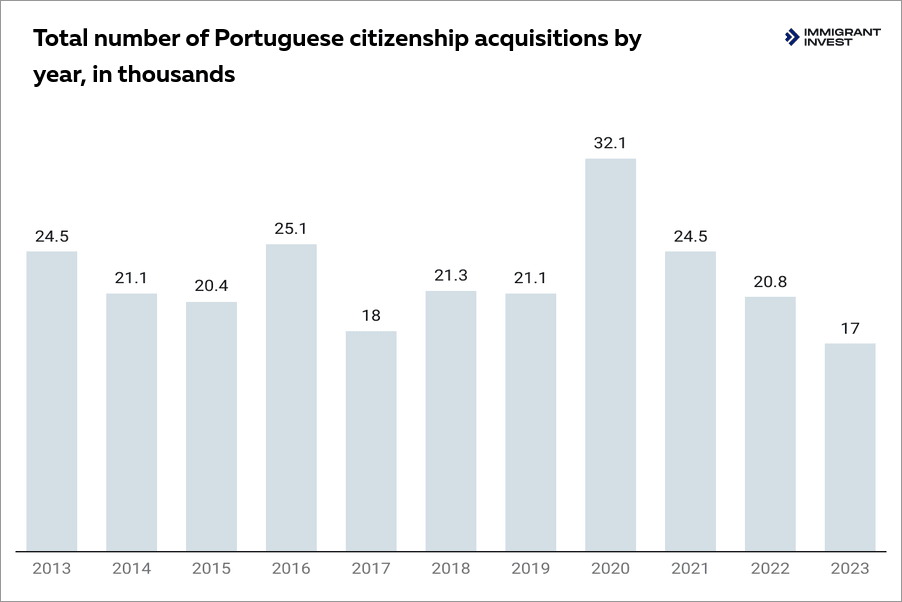
Portuguese citizenship applications through the naturalisation pathway have a high success rate, particularly for applicants who meet all legal requirements and submit complete documentation.
For instance, in the first half of 2025, around 96% of concluded nationality decisions were approvals, based on the number of approvals and refusals recorded in the Justice Portal statistics[8].
Common reasons for rejection or delay include:
- incomplete or missing documentation, such as failure to provide all required criminal record certificates or proof of financial resources;
- insufficient language proficiency, including failure to provide a valid A2 language certificate or exam results that do not meet the minimum threshold;
- criminal record issues, including convictions for serious crimes or pending criminal investigations in Portugal or abroad;
- failure to meet the minimum residency requirement, such as inability to demonstrate the required seven days per year for Golden Visa holders or 16 months over two years for D7 holders;
- irregularities in the investment, such as failure to maintain the qualifying Golden Visa investment for the full 5-year period or non-compliance with fund investment requirements.
What are the options if a Portuguese citizenship application is rejected?
If a citizenship application is denied, the applicant may first file an administrative appeal to the Minister of Justice within 30 days. This written appeal must explain the grounds for contesting the decision and include any missing or updated documents.
Common grounds for appeal include:
- procedural errors by the registry office, such as failure to request clarification of ambiguous documents or failure to consider evidence submitted by the applicant;
- misinterpretation of legal requirements, such as incorrect calculation of the residency period or misunderstanding of dual citizenship provisions;
- new evidence that was not available at the time of the original application, such as updated criminal record certificates or corrected language proficiency documents.
If the Minister rejects the appeal, the applicant may then seek judicial review in the administrative courts. This challenges the legality of the decision and requires representation by a Portuguese lawyer. Court proceedings usually take 12—24 months.
In practice, most cases are resolved successfully during the administrative appeal, provided deficiencies are promptly corrected and the process is guided by experienced legal counsel.
5 main benefits of Portugal citizenship
Portuguese citizenship offers visa-free access to 172 countries, EU citizenship rights including freedom to live and work across 27 member states, access to comprehensive social services, a high quality of life at relatively low costs, and the ability to maintain dual citizenship.
1. Rights all over the EU
Portugal citizenship automatically confers EU citizenship, granting the passport holder the full range of rights and freedoms guaranteed under EU law.
Key EU citizenship rights include:
- living and working in any EU member state;
- studying in EU member states, often at reduced tuition rates or with scholarship eligibility;
- access to healthcare and social services all over the EU under the same terms as locals;
- voting and standing in European Parliament and local elections;
- consular protection from embassies and consulates of any EU member state if Portugal does not have diplomatic representation in that country.
2. Access to 172 visa-free destinations
The Portuguese passport is one of the most powerful travel documents in the world, offering extensive visa-free access and global mobility. Portuguese passport holders enjoy visa-free or visa-on-arrival access to 172 countries worldwide, including the Schengen Area states and Canada.
The mobility score reflects Portugal’s strong diplomatic relationships, EU membership, and commitment to international agreements.
The passport’s strength has remained stable in recent years, and Portugal’s continued EU membership and adherence to international norms ensure that its global mobility will remain robust in the foreseeable future.
3. High standard of living paired with the low cost
Portugal is known for its safety. For instance, it ranks 7th globally in the Global Peace Index 2025[9] due to low crime levels and strong social stability.
The country also shows strong healthcare outcomes, with life expectancy exceeding 82.7 years, which is approximately one year higher than the EU average[10].
Portugal remains a relatively affordable country by EU standards, with overall consumer prices below the EU average[11]. Prices in Portugal are around 4% lower than in neighbouring Spain.
4. Right to keep other citizenship
Portugal allows dual citizenship and does not require naturalised citizens to renounce their original nationality, making it appealing for investors seeking a second passport. Whether applicants may keep their first citizenship, however, depends on the laws of their home country, as some states prohibit dual nationality.
Portugal has bilateral agreements with countries such as Brazil and Cape Verde, and citizens of CPLP nations benefit from preferential arrangements that allow them to retain their citizenship when naturalising in Portugal. Applicants from countries like the United States, United Kingdom, Canada and most EU states can generally hold both nationalities.
5. No obligation to maintain the qualifying investment
Once the person obtains a Portuguese passport, they no longer need to maintain the investment used to secure residence. Assets may be sold or restructured without risk of losing a passport, as citizenship is independent of the Golden Visa or any other immigration regimes.

As a member of the EU, Portugal grants their citizens EU citizenship. It provides the passport holders with the right to live, work, and study in any of the EU member states
Which countries can Portuguese passport holders visit visa-free?
Portuguese citizens enjoy visa-free, visa-on-arrival, or eTA access to 172 countries and territories worldwide. This includes, for instance:
- visa-free travel to all 27 EU member states and the Schengen Area, allowing unrestricted movement for work, study, and residence;
- visa-free access to the United States for stays up to 90 days under the Visa Waiver Programme;
- visa-free entry to Canada for stays up to six months with an eTA, Electronic Travel Authorisation;
- extensive visa-free access to Asia, including Japan, South Korea, Singapore, and Malaysia;
- broad access to Latin America, the Middle East, and Africa, with visa-free or visa-on-arrival entry to most countries.
States that offer a visa on arrival or an electronic visa are included in the list because Portuguese citizens do not need to visit a consulate or make appointments to obtain a visa.
Visa-free, visa-on-arrival, and eTA countries for citizens of Portugal
Key takeaways on Portugal citizenship by investment
- Portugal does not offer direct citizenship by investment. Instead, foreigners must obtain residency and reside in Portugal for a required number of years.
- The Golden Visa grants residency through fund investment or other eligible routes but does not itself provide citizenship.
- Portuguese citizenship brings major advantages, including visa-free travel to over 170 countries, high quality of life at moderate cost, a warm climate and strong safety standards.
- The citizenship process usually takes 7—12 months and requires submitting documents proving language ability, clean criminal history and sufficient financial stability.
- Overall, Portugal offers several pathways to citizenship, including citizenship by naturalisation, marriage, origin, or birth. Each pathway has its own set of requirements.
Immigrant Invest is a licensed agent for citizenship and residence by investment programs in the EU, the Caribbean, Asia, and the Middle East. Take advantage of our global 15-year expertise — schedule a meeting with our investment programs experts.
Sources
- Source: Diário da República, the official gazette or Portugal — Portuguese Citizenship Law
- Source: AIMA, Agency for Integration, Migration and Asylum — Requirements for residence permit acquisition
- Source: Portuguese language test for acquisition of Portuguese nationality
- Source: AIMA, Agency for Integration, Migration and Asylum — Residence permit by investment
- Source: Portuguese public services portal — Residence permit for people with passive income
- Source: AIMA, Agency for Integration, Migration and Asylum — Residence permit for digital nomads
- Source: IAPMEI, Portuguese Agency for Competitiveness and Innovation — Startup Visa
- Source: As cites Diário de Notícias, a Portuguese weekly newspaper
- Source: According to the Global Peace Index 2025
- Source: State of Health in the EU Portugal report by the European Commission
- Source: According to the Trading Economics
 Trusted by 5000+ investors