Summary
Malta has long appealed to British citizens — and not just for the sunshine. As a former British colony, the island shares deep-rooted cultural, legal, and linguistic ties with the UK. English is an official language, driving is on the left, and many aspects of daily life feel comfortably familiar to Brits.
In recent years, that appeal has only grown. Nearly 10% of Malta’s foreign population are UK nationals, and the number keeps rising. One of the main reasons is Brexit: since leaving the EU, many British citizens have started looking for ways to regain access to European rights, including the freedom to live, work, and travel across the EU.
This guide explores why so many UK nationals are choosing Malta, and what it takes to obtain citizenship.
5 reasons to look into Malta citizenship as a UK national
1. Right to live and work in Malta. Since Brexit, UK citizens can no longer move freely within the European Union. That includes living and working in countries like Malta. To stay long term, you now need either residency or citizenship.
One practical route is citizenship by naturalisation for exceptional services, which gives you a Maltese passport and restores your full right to live, work, and travel within the EU.
2. Sunshine all year round. If you're tired of grey skies and damp weather, Malta could be a breath of fresh air. It gets over 300 sunny days a year, with hot summers and mild winters.
You can enjoy outdoor living for most of the year — from swimming and walking to eating outside or just soaking up the sun. For many UK nationals, this alone is reason enough to consider the move.
3. Safe, healthy, and easy-going lifestyle. Malta offers a relaxed pace of life, strong community values and modern services.
Malta is also safer than the UK, with a significantly lower crime rate — including half the homicide rate, according to the United Nations Office on Drugs and Crime.
Healthcare is excellent, too: Malta ranks in the top 20 worldwide, while the UK sits lower on the list. Both public and private healthcare options are available, with English-speaking staff and short wait times.
4. Easy to settle in as an expat. Roughly 1 in 5 people in Malta is a foreign national, so expats are a regular part of daily life. There are international communities, events, and support groups to help you settle in.
The island also attracts remote workers and entrepreneurs, thanks to its digital infrastructure, good travel links and welcoming business environment.
5. English is spoken everywhere. You won’t need to learn a new language to live comfortably in Malta. English is an official language, used in schools, government, healthcare and business. This makes everyday life — from setting up a phone contract to chatting with neighbours — simple and stress-free for UK citizens.
3 main ways to get Malta citizenship
If you’re a British national looking to become a citizen of Malta, there are three legal routes available: by registration, naturalisation, and naturalisation for exceptional services by direct investment.
Each of them suits different situations — from family ties to long-term residence or economic contribution.
1. If you have family ties — registration. This route is designed for people who already have a strong personal connection to Malta. You may qualify if you:
- are married to a Maltese citizen and have been for at least 5 years;
- are the widow or widower of a Maltese citizen, with a marriage that lasted 5 years or more;
- were born abroad to a Maltese mother — under certain conditions;
- used to be a Maltese citizen but gave up or lost your citizenship and now wish to restore it;
- are a descendant of someone who held Maltese citizenship.
This process confirms your existing link to the country and gives you a way to formalise it.
2. If you’ve lived in Malta for years — naturalisation. This route is for people who have made Malta their home over time. To apply, you’ll need to show that:
- you’ve lived in Malta legally for at least 5 years;
- you can speak either Maltese or English;
- you have a clean criminal record and a good reputation.
What matters here is not just time spent in the country, but how well you’ve integrated into local life. Authorities will look at your background and how connected you are to the community before making a decision.
3. If you’re ready to invest — naturalisation for exceptional services. This option is available to individuals who make a meaningful economic contribution to Malta. It’s a more demanding route, both financially and procedurally. To qualify, you must:
- make a financial contribution to Malta’s National Development and Social Fund;
- either buy or rent a property in Malta on a long-term basis;
- donate to a registered non-governmental organisation in the country.
In addition, you need to pass a thorough background check — Eligibility Assessment — and hold a Maltese residence permit for either 12 or 36 months, depending on how much you invest. Applicants must also apply through a licensed agent.
Citizenship in Malta by naturalisation for exceptional services: requirements for UK citizens
Citizenship by naturalisation for exceptional services is one of the ways for UK nationals to obtain a second passport in Malta. This path requires applicants to make a number of investments in the country’s economy and offers citizenship in 1 or 3 years of residence.
Eligibility criteria. To be eligible, the main applicant must meet several criteria:
- be at least 18 years old;
- have no criminal record or ongoing charges;
- not be subject to international sanctions;
- have no history of visa denials from countries that have visa-free access to Malta;
- be able to prove that their income and wealth come from legal sources.
Family members of the investor can also obtain Malta residency and passport. This may cover:
- spouses or long-term partners, including same-sex couples;
- children under 30, as long as they’re unmarried and financially dependent;
- parents and grandparents over 55, if they rely financially on the main applicant.
Everyone included must also meet health and background requirements.
Investment requirements. Foreigners aiming at Malta citizenship by naturalisation for exceptional services must fulfill three mandatory investment conditions:
- Make a contribution to the National Development Fund.
- Invest in real estate.
- Donate to charity.
For a single applicant, the total minimum investment starts at €690,000. The exact amount may vary depending on whether the applicant chooses the 12-month or 36-month residence option, and whether family members are included.

Investment terms and additional expenses for obtaining Malta citizenship as an investor
If you’re thinking about applying for Maltese citizenship, it’s essential to understand not just the overall cost, but also how each component fits together.
The process involves three required investments, plus additional legal and administrative fees. Depending on how you structure your application — especially whether you rent or buy property — the total spend can vary significantly.
Contribution to the National Development and Social Fund, NDSF. This is a government-mandated payment that directly supports Malta’s national projects and development initiatives. It’s non-refundable and tiered based on how soon you want to apply for citizenship:
- €600,000 if you’re prepared to wait 3 years before applying;
- €750,000 if you want to apply after just 1 year.
If you’re applying with family members, the cost rises by €50,000 per person — regardless of whether you’re on the 1-year or 3-year timeline. For a couple applying under the 1-year route, for example, the NDSF contribution would total €800,000.
Real estate investment. In addition to the NDSF contribution, every applicant must make a long-term real estate investment. You can either rent a property or buy one — but there are key differences beyond the upfront cost.
If you choose to rent, you’ll first need to rent for the duration of your chosen residency period, paying at least €12,000 per year. Before applying for citizenship, you must sign a new 5-year lease with a higher annual rent of €16,000. This rental must be maintained for the full 5 years after receiving citizenship.
If you choose to buy, you’ll need to purchase property worth at least €700,000. You must keep ownership for 5 years after you receive your passport. After that, you can sell the property and recover your investment.
With real estate prices in Malta rising by 53% over the past decade, and 5.7% growth in Q1 2025 alone, according to Eurostat, the property market may offer potential for capital appreciation.

Julia Loko,
Investment programs expert
It’s important to understand that the 5-year holding period starts not when you buy the property, but when you’re officially granted citizenship. So if you purchase an apartment in 2025 and get your passport in 2026 under the 1-year route, the earliest you can sell would be 2031.
Charitable donation. Alongside the main investments, you’re also required to make a €10,000 donation to a registered Maltese non-governmental organisation, NGO. The government selects eligible NGOs, and the donation must be completed before final approval.
Additional fees. Beyond investments, there are various fees related to eligibility checks, documentation, and legal processing:
- Eligibility Assessment — €15,000 for the main applicant and €12,000 for each family member aged 12 or older;
- residence card fee — €5,000 for the main applicant and €1,000 per family member;
- administrative fees — €1,500 per person;
- health insurance — €560+.
If you choose the real estate purchase route, factor in additional transaction costs:
- stamp duty of 5%;
- notary fees of up to 2%.
Minimum expenses to obtain Malta citizenship: in 3 years by renting property
How to obtain citizenship in Malta: step-by-step guide
Depending on the amount you contribute to the National Development and Social Fund, you can apply for citizenship after 12 or 36 months of legal residence.
Including preparation, document processing, and official reviews, the entire process typically takes 14 to 38 months from the initial check to receiving your passport.
1—2 days
Initial check
Before anything is submitted to the Maltese government, an internal pre-check is carried out to assess whether the investor is likely to pass all formal requirements. This early screening is confidential and based on the investor’s passport only. It helps reduce the risk of rejection later in the process to 1%.
Before anything is submitted to the Maltese government, an internal pre-check is carried out to assess whether the investor is likely to pass all formal requirements. This early screening is confidential and based on the investor’s passport only. It helps reduce the risk of rejection later in the process to 1%.
2 weeks
Security clearance
Once the investor proceeds, a basic background check is conducted by the Community Malta Agency. It applies to everyone over the age of 12 included in the application and involves checking databases like Europol and Interpol to ensure there are no red flags.
Once the investor proceeds, a basic background check is conducted by the Community Malta Agency. It applies to everyone over the age of 12 included in the application and involves checking databases like Europol and Interpol to ensure there are no red flags.
2+ weeks
Preparing documents
After passing clearance, the investor receives a detailed list of required documents from Immigrant Invest’s legal team. These include identification, proof of funds, family records, and other supporting paperwork. Once everything is gathered, the documents are prepared for submission — translated, certified and, where needed, legalised or apostilled.
After passing clearance, the investor receives a detailed list of required documents from Immigrant Invest’s legal team. These include identification, proof of funds, family records, and other supporting paperwork. Once everything is gathered, the documents are prepared for submission — translated, certified and, where needed, legalised or apostilled.
2+ weeks
Renting a property in Malta
Applicants who choose to meet the real estate requirement through renting will sign an initial lease agreement at this stage. Those planning to purchase can do so later, after receiving a residence permit.
Applicants who choose to meet the real estate requirement through renting will sign an initial lease agreement at this stage. Those planning to purchase can do so later, after receiving a residence permit.
1+ months
Residence application
The next step is to apply for residence permits for the investor and all adult family members. This permit proves legal residence in Malta and is a prerequisite for citizenship. Processing typically takes around one month.
The next step is to apply for residence permits for the investor and all adult family members. This permit proves legal residence in Malta and is a prerequisite for citizenship. Processing typically takes around one month.
4+ months
Eligibility Assessment
Once the residence permits are issued, the investor has up to 12 months to submit an Eligibility Assessment application. This stage involves a deeper round of Due Diligence by the Maltese authorities and takes about 4 to 5 months.
All supporting documents must be rechecked and finalised at this point. This includes translations, certifications, and proper formatting in line with Maltese legal standards.
Once the residence permits are issued, the investor has up to 12 months to submit an Eligibility Assessment application. This stage involves a deeper round of Due Diligence by the Maltese authorities and takes about 4 to 5 months.
All supporting documents must be rechecked and finalised at this point. This includes translations, certifications, and proper formatting in line with Maltese legal standards.
After 1 or 3 years of residence
Citizenship application
If the applicant passes the Eligibility Assessment, they can formally apply for citizenship once the required residence period has passed. The final review is carried out by the Minister for Citizenship. If approved, the investor receives a Letter of Approval.
If the applicant passes the Eligibility Assessment, they can formally apply for citizenship once the required residence period has passed. The final review is carried out by the Minister for Citizenship. If approved, the investor receives a Letter of Approval.
4+ months
Fulfilling investment conditions
Within the next four months, the applicant must complete all outstanding investment commitments — including any remaining contributions, property conditions, and the charitable donation.
Within the next four months, the applicant must complete all outstanding investment commitments — including any remaining contributions, property conditions, and the charitable donation.
2 months
Receiving the passports
All applicants over the age of 18 must visit Malta to take the Oath of Allegiance in person at the Community Malta Agency. This must be done within 6 months of receiving the Minister’s final approval.
After the oath is taken, applicants proceed to the Passport Office, where biometric data is collected. Children under the age of 6 are exempt from both biometric procedures and the requirement to travel to Malta.
Once all formalities are complete, Maltese passports are collected in person.
All applicants over the age of 18 must visit Malta to take the Oath of Allegiance in person at the Community Malta Agency. This must be done within 6 months of receiving the Minister’s final approval.
After the oath is taken, applicants proceed to the Passport Office, where biometric data is collected. Children under the age of 6 are exempt from both biometric procedures and the requirement to travel to Malta.
Once all formalities are complete, Maltese passports are collected in person.
List of documents for Malta citizenship
British investors looking to obtain Malta citizenship by naturalisation for exceptional services will need to prepare four sets of documents: for the residence application, for the Eligibility Assessment, for the citizenship application, and documents confirming the investments.
The list of documents for the residence permit includes:
- motivation letter highlighting the investor’s reasons for applying for residency;
- power of attorney;
- international passports and foreign residence cards of all applicants;
- 6-months bank statements;
- main applicant’s CV;
- evidence of relation and dependency for additional applicants — for example, a marriage certificate for a spouse or birth certificates for children;
- property rental agreement for at least 36 months or a purchase agreement;
- medical insurance for all applicants.
For the Eligibility Assessment, the investor prepares a similar package of documents with the addition of:
- tax residency declarations;
- police conduct certificate;
- Maltese e-residence cards;
- government-issued photographic identification documents;
- military records, if applicable;
- evidence of residential address;
- applicable affidavits;
- evidence of employment, source of funds and source of wealth.
The list of documents for citizenship application should include:
- investor’s agent’s cover letter;
- all required forms duly filled out;
- recent bank statements;
- evidence of residential address;
- recent police clearance certificates for all applicants over 16;
- affidavit confirming no changes in the applicant’s state of affairs;
- any updated documents and forms if the applicant’s state of affairs has changed.
Finally, the list of documents confirming the investments includes:
- copy of the receipt for the investment issued be the Community Malta Agency;
- copy of the rental contract or purchase agreements for the property investment;
- copy of the boarding passes or manifest of incoming and outgoing travel to and from Malta;
- receipt of the donation to a Maltese NGO;
- proof that any commitments stated in the motivation letter have been honoured.
Dual citizenship in Malta and the UK: key implications
If you’re a UK citizen thinking about getting Maltese citizenship, you won’t need to choose between the two. Both countries allow dual citizenship, which means you can legally hold passports from both the UK and Malta.
There’s no requirement to renounce your British nationality, and you don’t need to notify UK authorities after receiving Maltese citizenship. This makes the legal process relatively smooth for UK nationals.
Benefits. Holding two passports opens up a range of benefits. You can:
- live, work and travel freely in both the UK and Malta;
- access public healthcare and other state services in both countries;
- move between the UK, Malta and the rest of the EU more easily;
- make long-term plans without cutting ties to either country.
For example, some dual citizens choose to live in Malta full time while keeping a home or family base in the UK. Others divide their year between both countries, or send their children to school in one while running a business in the other.
Tax residency and obligations. Having dual citizenship does not automatically mean double taxation, but you might owe tax in both countries, depending on where you live and where your income comes from.
Whether you’re considered a tax resident in the UK or Malta depends on things like:
- how many days you spend in each country;
- where your home or business is based;
- your family and financial connections.
This residency status determines which country has the primary right to tax certain types of income. Normally, both the UK and Malta tax individuals on their worldwide income if they are considered tax residents, and on income earned within the country if they are non-residents.
How to avoid double taxation. Double Taxation Agreement between Malta and the UK exists to ensure you’re not taxed twice on the same income. In most cases, tax paid in one country can be used to offset what’s owed in the other. This doesn’t cancel your obligations entirely, but it helps prevent duplication.
Here’s a simple example: If you’re living in Malta and receive a UK pension, you might pay UK tax on that pension. Under the agreement, Malta would usually allow you to subtract the amount you’ve already paid in the UK from your Maltese tax bill — or in some cases, you might not owe anything further at all.
Yet, this tax relief is not automatic. You’ll need to fill out the right paperwork — often a form from HMRC, such as the Double Taxation Relief form — and submit it to the relevant tax office. Each case depends on your personal circumstances, so the paperwork and outcome can vary.
Life in Malta: important things to know
Living costs. Malta offers a relatively moderate cost of living compared to many Western European countries — including the UK. Everyday expenses like groceries, public transport, and dining out are generally affordable.
According to Numbeo, a single person following a modest but comfortable lifestyle will need about €780 per month, excluding rent. For the same lifestyle, someone in the UK would spend closer to €955.
Housing, however, can be expensive in popular locations. Renting a one-bedroom apartment in a central or coastal city can cost around €980 per month, especially in sought-after areas like Sliema or Valletta.
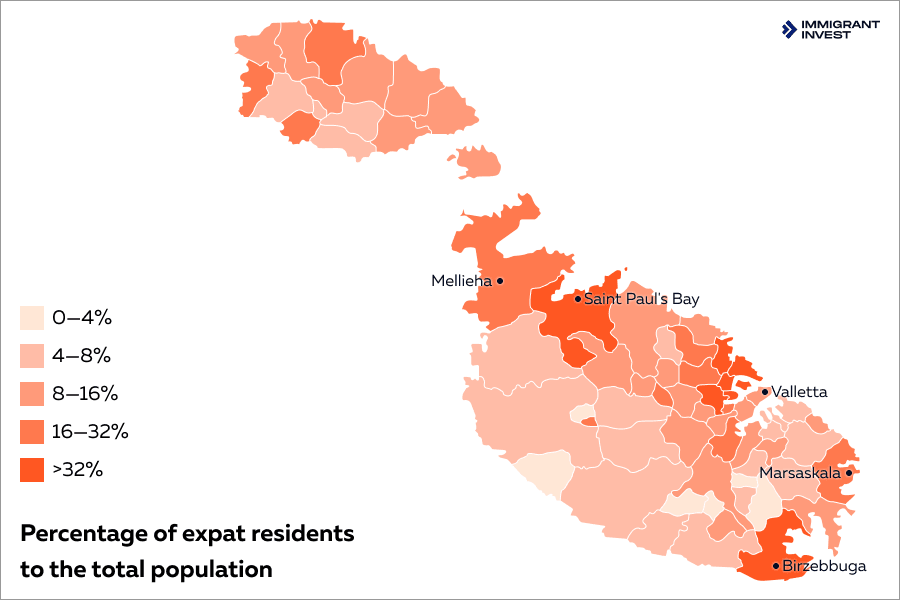
Where expats live. Many expats settle along the coast, favouring quiet yet well-connected towns. Among the most popular are Sliema, Birżebbuġa, and Saint Paul’s Bay, where foreign nationals make up about a third of the population.
Other areas like Valletta, the capital, and Mellieħa, known for its beaches, are slightly less expat-heavy, with 16% to 32% of residents being foreigners.
The British form one of the largest expat groups in Malta. Over 10,000 UK nationals hold a Maltese passport, and on the island of Gozo, British citizens account for 26% of the population, according to Malta’s National Statistics Office.
Healthcare. Malta has a dual system with both state-funded and private healthcare services. Citizens and residents are eligible for free public healthcare, which includes general medical care, hospital treatment, and emergency services.
Thanks to a Reciprocal Health Care Agreement, UK citizens are also entitled to free essential medical treatment in Malta during short visits of up to one month. For longer stays or broader coverage, private health insurance packages are available starting from around €250 per year, depending on the provider.
Education. Families in Malta can choose between public, private, and church-run schools.
Public education is free, and the primary language of instruction is Maltese — though English is widely used. Many expat families prefer private international schools, where English is the main teaching language.
For older students, Malta follows the Bologna system used across Europe. This makes it easier to transfer credits or continue studies abroad. A year of undergraduate study typically costs €3,000 to €10,000, depending on the university and programme.
Key takeaways on Malta citizenship for UK nationals
- Malta has become a popular destination for British nationals seeking greater mobility and long-term security in Europe.
- More than 10,000 UK citizens now hold Maltese passports, making the British community one of the largest expat groups in the country.
- Since the UK left the European Union, British passport holders no longer have automatic rights to live, work or travel freely within the EU. Obtaining Maltese citizenship restores those rights — not just in Malta, but across all EU member states.
- Malta citizenship by naturalisation for exceptional services is one of the ways for UK nationals to obtain a second passport. Applicants must first obtain a residence permit and then legally reside in Malta for 12 or 36 months, depending on their chosen level of contribution.
- The total minimum investment starts at €690,000.
Immigrant Invest is a licensed agent for citizenship and residence by investment programs in the EU, the Caribbean, Asia, and the Middle East. Take advantage of our global 15-year expertise — schedule a meeting with our investment programs experts.

Will you obtain Maltese citizenship?
-
Master the residency process
-
Get expert tips and documents
-
Estimate costs accurately
 Trusted by 10,000+ investors