

Summary
A 401(k) is often the biggest nest egg a US worker ever builds and for many, it becomes the backbone of life after work.
When the plan includes relocating to the EU with a Golden Visa or a retirement residence permit, that same 401(k) may need to do more: cover daily expenses and meet complex visa and tax rules abroad.
What is a 401(k) and why use it for a Golden Visa?
A 401(k) is a US retirement savings plan that is designed for long-term retirement saving, not short-term spending[1]. It is set up through an employer: when a job offers a 401(k), an employee can enrol and choose how much of each paycheck goes into the account.
Money is then invested in funds or other assets, and many employers also add extra money through matching contributions, which helps the balance grow more quickly.
Over time, savings can become a reliable source of funds for investment-based residence options, such as Golden Visas or financially independent visas.

How a 401(k) helps fund a Golden Visa
A 401(k) is designed to grow over time, and it does so with a few key advantages that can make it easier to save for a large investment, such as a Golden Visa:
- Tax advantages. Investment growth inside the account is not taxed each year, allowing the balance to accumulate faster than in a regular taxable account[2].
- Employer match. Many companies contribute extra money into the account, usually matching part of the employee’s contributions. This is like getting free money added to savings[3].
- Compounding. The money in the account earns returns, and those returns also earn more returns. Over many years, this snowball effect can lead to a much larger savings pot[4].
Due to these features, a 401(k) can grow into a strong financial base.
Key things to know before using 401(k) funds
When planning to utilise retirement savings for a Golden Visa or any international investment, it’s crucial to understand how 401(k) withdrawals work and what limits apply:
- Traditional vs. Roth accounts. Traditional 401(k) withdrawals are taxed as income, while Roth 401(k) withdrawals are tax‑free if age and time rules are met[5].
- Early withdrawal penalty. Taking money out before age 59½ usually results in a 10% penalty on top of regular income tax[5].
- Rollover options. Savings can often be transferred — rolled over — into an Individual Retirement Account, IRA, which allows more control over how the money is invested and withdrawn[6].
How a 401(k) works from sign-up to retirement
When joining a 401(k), an employee chooses how much of each paycheck goes into the plan and, if the option exists, whether contributions are Traditional, Roth, or a mix. Contributions plus any employer match are invested and stay inside the account, growing over many years.
Access is limited: taking money out before age 59½ usually triggers tax and a 10% penalty, so most people wait until later in life. In retirement, the account is used as an income source — money is withdrawn gradually under Traditional or Roth tax rules, or rolled to an IRA for more flexibility.

Trusted by 5000+ investors
Find your best-suited EU residency for financially independent people
How much income can a 401(k) provide and how it is calculated
In retirement, many people begin by withdrawing around 4% of their savings each year[7]. This is a common starting point designed to make the money last for many years. The actual percentage might be adjusted later depending on the economy or personal needs.
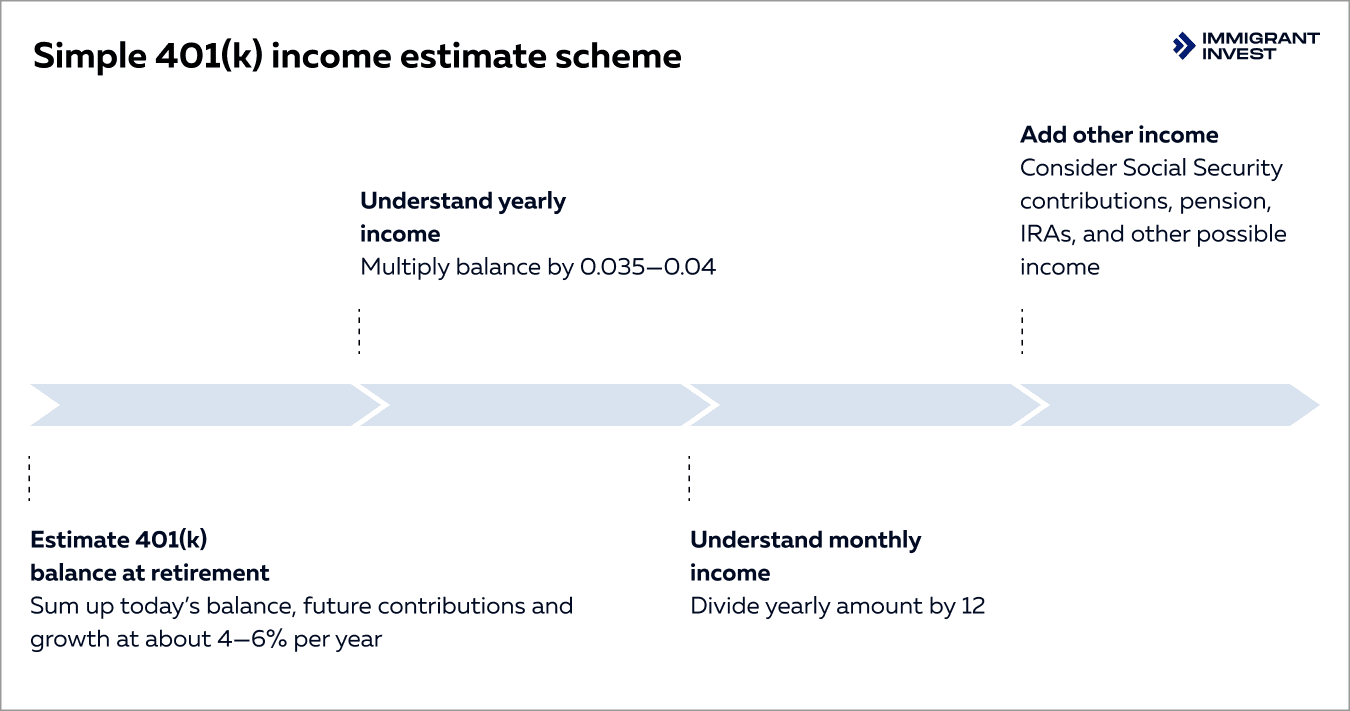
3 easy steps to estimate monthly income
It’s possible to get a rough idea of how much monthly income a 401(k) can provide in retirement. Here’s how to do it in three simple steps[8].
Step 1. Estimate total savings at retirement. Add up how much is likely to be in the account by the time retirement comes. This includes personal contributions, employer matching, and expected investment growth.
For a basic estimate, it’s okay to assume the savings will grow by around 4—6% each year before retirement.
Step 2. Use a 3.5 to 4% withdrawal rate. Take the total estimated balance and multiply it by 0.035 or 0.04. This gives a yearly income amount — how much could be safely withdrawn each year without running out too soon.
Using 3.5% is more cautious; 4% is the standard starting point many people use.
Step 3. Divide by 12 to get a monthly figure. Take the yearly amount from step 2 and divide it by 12. This shows how much monthly income the 401(k) might provide — a useful number for building a retirement or Golden Visa budget.
Quick examples
Here’s a rough idea of how much monthly income a 401(k) could give, based on different total savings amounts and using the 4% rule:
- $100,000 saved → about $4,000 per year, or $333 per month;
- $300,000 saved → about $12,000 per year, or $1,000 per month;
- $600,000 saved → about $24,000 per year, or $2,000 per month.
These numbers are estimates and don’t include taxes or market changes, but they give a basic sense of what’s possible when planning for a Golden Visa or retirement abroad.
Add other income
A 401(k) can form the core of a retirement plan, but it’s often just one piece of the full financial picture. To build a complete monthly budget — especially when planning for life abroad under a Golden Visa — it’s important to consider additional sources of income. Those may include:
- Social Security — provides monthly payments from the US government, based on lifetime earnings. For many retirees, this adds a few hundred to a few thousand dollars per month.
- Pensions — offer guaranteed monthly income from former employers, typically based on years of service and salary.
- IRAs — serve as an additional retirement account that can supplement 401(k) savings, especially when rolled over from a previous job.
- Other savings or rental income — contribute extra support through personal savings, investment accounts, or property income earned in the US or abroad.
How Traditional and Roth 401(k)s are taxed in the US and abroad
Taxes play a big role in how much money actually becomes available from a 401(k). This is especially important when planning to use those funds for a Golden Visa or to live abroad since taxes can reduce the amount left for investment or monthly expenses.
Two types of 401(k): choose the one that fits
There are two main types of 401(k) accounts: Traditional and Roth. They are taxed differently in the US[5].
Traditional 401(k) — withdrawals are taxed as ordinary income. Contributions are made with pre-tax income, which lowers taxable income in the year of contribution. When money is withdrawn in retirement, the full taxable amount is taxed as ordinary income at federal level.
This option can be helpful for those in a high tax bracket now but expecting a lower income in retirement, allowing for tax savings in the long run.
Roth 401(k) — qualified withdrawals are tax-free. Contributions are made with after-tax income, so they don’t lower taxes now. But if the account has been open for at least 5 years and the person is 59½ or older, withdrawals, including investment gains, are tax-free in the US.
This makes it easier to plan how much money will be available later, since no US federal tax will be taken out at withdrawal when the conditions are met.
US state tax. On top of these federal rules, some US states also tax retirement income, while others do not. Where state tax applies, it can slightly reduce the net amount from both Traditional and Roth withdrawals.
401(k) tax overview
What changes if the person moves abroad?
Moving abroad does not change US tax rules. The US continues to:
- tax Traditional 401(k) withdrawals as ordinary income;
- treat qualified Roth 401(k) withdrawals as tax-free.
A new country of residence may also tax 401(k) withdrawals. In many cases, that country treats 401(k) income as foreign pension income and includes it in local taxable income.
In practice, this often means:
- Traditional 401(k) withdrawals are taxable both in the US and, in principle, in the new country;
- Roth 401(k) withdrawals may still be taxed abroad, even if they are tax-free in the US, because many countries do not have a separate Roth concept;
- tax treaties and foreign tax credits are used to reduce double taxation, but they do not always eliminate it completely.
Due to the factors above, the same 401(k) balance can produce different net income depending on where retirement takes place. Later sections look at how specific EU regimes can change the local tax on 401(k) withdrawals.
401(k) taxation: US vs new country after moving abroad
How to retire in the EU with a 401(k) and Golden Visa or retirement residence permit
Countries like Portugal, Spain, Greece, Italy, Hungary, and Latvia offer two main paths to residence for Americans:
- Golden Visas, which require a one-time investment;
- retirement or financially independent person visas, FIP, which rely on proof of regular income.
A 401(k) can support both — but how it fits depends on the visa type.
Golden Visas: possible, but more complex with a 401(k)
Golden Visa programmes are based on large lump-sum investments, such as real estate or investment funds. To use 401(k) savings for this purpose:
- Large withdrawal or rollover is needed to fund the investment.
- If under age 59½, a 10% early withdrawal penalty applies, plus income tax.
- The investment must often be made through a self-directed IRA or similar structure, not directly from a Traditional 401(k).
While it’s possible, this approach is usually less comfortable. It involves more tax exposure, complex rules, and the need to manage retirement savings in a legally compliant way across borders. So non-retirement savings are often used first where available.
This route may work for:
- Retirees or pre-retirees over 59½.
- Individuals with high 401(k) balances.
- Those with a solid tax strategy for handling a large one-time distribution.
In more advanced cases, some investors roll old 401(k) savings into a self-directed IRA and let that plan own the Golden Visa property or fund. This keeps money inside the retirement system but requires strict rules: the plan, not the individual, must hold title and handle all income and expenses. Because mistakes can be costly, this option is generally used only for larger portfolios and with specialist legal and tax advice.
The table below summarises the main Golden Visa routes in selected EU countries and shows where 401(k) capital may be relevant.
Golden Visa options at a glance
Country
Minimum investment
€250,000
Popular investment options
Real estate, funds, bank deposit
First permit validity
5 years
Family inclusion
Spouse, children under 21, parents
Country
Minimum investment
€250,000
Popular investment options
Supporting arts and culture, funds
First permit validity
2 years
Family inclusion
Spouse, children under 26, parents
Country
Minimum investment
€250,000
Popular investment options
Innovative startups, business
First permit validity
2 years
Family inclusion
Spouse, children of any age, parents
Country
Minimum investment
€250,000
Popular investment options
Funds, donation to higher education institution
First permit validity
10 years
Family inclusion
Spouse, children under 18, parents
Country
Minimum investment
€50,000
Popular investment options
Business, real estate, bank deposit
First permit validity
5 years
Family inclusion
Spouse, children under 18
Country | Minimum investment | Popular investment options | First permit validity | Family inclusion |
|---|---|---|---|---|
€250,000 | Real estate, funds, bank deposit | 5 years | Spouse, children under 21, parents | |
€250,000 | Supporting arts and culture, funds | 2 years | Spouse, children under 26, parents | |
€250,000 | Innovative startups, business | 2 years | Spouse, children of any age, parents | |
€250,000 | Funds, donation to higher education institution | 10 years | Spouse, children under 18, parents | |
€50,000 | Business, real estate, bank deposit | 5 years | Spouse, children under 18 |
Retirement visas: a better fit for 401(k) income
Retirement visas and FIP permits are based on passive income, not investment. In these cases, a 401(k) often fits much better:
- Regular monthly withdrawals from the 401(k), plus Social Security, can meet the income requirements.
- There’s no need to empty the account, only scheduled withdrawals are used.
- The savings remain invested and growing, while the income supports daily life abroad.
For many retirees, the FIP route is simpler and safer. The 401(k) serves as a steady, predictable income source, while the visa relies on provable income rather than tying up capital in real estate or a fund. The structure is also easier for both US and local tax professionals to handle, with fewer legal complexities involved.
Financially independent visas in Portugal and Spain require minimum passive income of:
Both visas allow spouses and parents to join the application. Children under 21 can be included in Portugal, while Spain allows children of any age, provided they are financially dependent on the main applicant.

Portugal and Spain rank 3rd and 5th among the best countries for a comfortable retirement, according to US News & World Report[9]
How will the 401(k) be taxed under different EU visas?
Whether a 401(k) gets taxed in the EU depends mainly on one key factor: whether the person becomes a tax resident in the country or not.
If someone simply holds a Golden Visa and spends less than 183 days per year in the country, they are generally not considered a tax resident, so the local government does not tax foreign income, including 401(k) withdrawals. In that case, only the US taxes the 401(k), as usual.
With FIP and Golden Visas used for full-time living, people often do become tax residents. In this case, the country will:
- tax 401(k) withdrawals as foreign pension income;
- apply its standard income tax rates, which in many EU countries can reach 36—48%;
- still honour the US—local tax treaty, which helps avoid full double taxation by giving credits or exemptions[10].
Special tax regimes across the EU: when they help with 401(k)
Some countries offer flat-tax regimes or special rules for new residents. These can greatly reduce how much tax is paid on 401(k) income — especially if withdrawals are large. These regimes usually require becoming a tax resident, meeting specific conditions, and being formally accepted into the programme.
Flat tax in Hungary: 15%
Hungary doesn’t offer a special pension regime, but the regular personal income tax rate is just 15%[11]. This is already lower than most EU countries and applies to most foreign income types.
For example, if $40,000 a year is withdrawn from a 401(k), Hungarian tax at 15% would be $6,000 — simpler and lower than in Portugal, Spain, or Italy under standard rules.
7% pension tax in Greece and Italy
Greece and Italy offer a flat 7% tax on foreign pension income, including 401(k) withdrawals, for eligible new residents:
- in Greece, the regime lasts up to 15 years[12];
- in Italy, it lasts 10 years and is limited to small towns in southern regions[13].
For example, if $40,000 a year is withdrawn from a 401(k):
- under normal tax rules in Greece or Italy, the tax bill might be 30—40%, or $12,000—16,000;
- with the 7% regime, tax falls to $2,800 per year.
€100,000—200,000 flat tax in Greece and Italy for high income
Both countries also offer a flat annual tax for high-net-worth individuals:
- Greece: €100,000 per year[12];
- Italy: €200,000 per year[14].
This applies to all foreign income — not just pensions, but also capital gains, dividends, rental income, and large 401(k) withdrawals.
The regime is best for those with foreign income over €400,000 per year, where normal tax would exceed the flat rate. If you withdraw $600,000 a year from your 401(k) and other investments:
- under standard progressive tax, the annual bill might exceed $280,000;
- with the flat tax, the amount is capped at €100,000 in Greece and €200,000 in Italy, no matter how much is earned.
This approach only makes sense if foreign income is very high — otherwise, the person would pay less under regular rates.

Italy and Greece rank 12th and 14th among the best countries for a comfortable retirement, according to US News & World Report[9]
Is a 401(k) enough for retirement, and where is retirement more affordable?
A 401(k) might be enough to retire but it depends on a few key things:
- how much is saved in the 401(k);
- whether there’s other income, like Social Security or a pension;
- how much it costs to live in the country or city of choice;
- what kind of 401(k) it is — Traditional or Roth, since Roth withdrawals can leave more net income if they are tax-free in the US.
Living abroad in the EU is often cheaper than in the US, which is why many retirees consider moving. As a rough guide, a single person in the US may need at least about $2,500 per month, with more than half of that often going to rent in many cities.
It is realistic to reach around $3,500—4,500 per month in total income with a solid 401(k) and average Social Security payments. In many European countries, that level is usually enough not only to cover living costs but also to leave some room to save, especially outside the most expensive areas.
In places like Hungary, Portugal, Latvia, Greece, Spain, and Italy, daily expenses are lower, and healthcare and food are more affordable than in many parts of the US. The biggest difference comes from housing. Rent varies a lot by country and city — living in a small town can cost half as much as a capital.
How far a 401(k) goes: costs, residency, and tax in selected EU states
Country

Italy
Monthly costs for a single
$1,000
Monthly rent, 1-bedroom apartment
$650+
Who can obtain residency
Investors and FIPs
Income tax
Up to 43%
Special tax regime
7% pension tax + flat €200,000
Country

Spain
Monthly costs for a single
$815
Monthly rent, 1-bedroom apartment
$815+
Who can obtain residency
FIPs
Income tax
Up to 47%
Special tax regime
No
Country

Portugal
Monthly costs for a single
$770
Monthly rent, 1-bedroom apartment
$830+
Who can obtain residency
Investors and FIPs
Income tax
Up to 48%
Special tax regime
No
Country

Greece
Monthly costs for a single
$900
Monthly rent, 1-bedroom apartment
$450+
Who can obtain residency
Investors
Income tax
Up to 44%
Special tax regime
7% pension tax + flat €100,000
Country

Latvia
Monthly costs for a single
$920
Monthly rent, 1-bedroom apartment
$340+
Who can obtain residency
Investors
Income tax
Up to 36%
Special tax regime
No
Country

Hungary
Monthly costs for a single
$760
Monthly rent, 1-bedroom apartment
$450+
Who can obtain residency
Investors
Income tax
15%
Special tax regime
No
Country | Monthly costs for a single | Monthly rent, 1-bedroom apartment | Who can obtain residency | Income tax | Special tax regime |
|---|---|---|---|---|---|
Italy | $1,000 | $650+ | Investors and FIPs | Up to 43% | 7% pension tax + flat €200,000 |
Spain | $815 | $815+ | FIPs | Up to 47% | No |
Portugal | $770 | $830+ | Investors and FIPs | Up to 48% | No |
Greece | $900 | $450+ | Investors | Up to 44% | 7% pension tax + flat €100,000 |
Latvia | $920 | $340+ | Investors | Up to 36% | No |
Hungary | $760 | $450+ | Investors | 15% | No |
How to use a 401(k) for the Golden Visa, step-by-step
Using a 401(k) for a Golden Visa usually takes several months from first planning to making the investment — up to 9 months in total.
The steps below show what happens when part of a Golden Visa investment is funded from a 401(k). The simple route is to take a taxable withdrawal and invest personally; in some advanced cases, a self-directed IRA is used instead.
2—4 weeks
Check age, tax impact, and basic options
At this stage, the key questions are:
- Age: under or over 59½?
- Type of 401(k): Traditional, Roth, or both?
- How much tax can be tolerated in one year?
Two practical paths exist:
- Straight withdrawal from the 401(k) into a personal account — simple, but taxable and possibly penalised if under 59½.
- Rollover into an IRA or self-directed IRA and invest from there, if the programme and custodian allow plan ownership.
At this stage, the key questions are:
- Age: under or over 59½?
- Type of 401(k): Traditional, Roth, or both?
- How much tax can be tolerated in one year?
Two practical paths exist:
- Straight withdrawal from the 401(k) into a personal account — simple, but taxable and possibly penalised if under 59½.
- Rollover into an IRA or self-directed IRA and invest from there, if the programme and custodian allow plan ownership.
2—6 weeks
Choose the structure and amount
After the rough tax picture is clear, decide how much of the Golden Visa investment comes from 401(k) and how much from other savings.
Then choose one main structure, for example:
- option A: take a taxable withdrawal, move cash to a normal account, then invest personally in the property or fund;
- option B: roll the money to a self-directed IRA that buys the asset, if the programme and custodian allow plan ownership.
It is common to use partial withdrawals or several smaller withdrawals spread over 2 tax years, rather than one very large distribution in a single year.
After the rough tax picture is clear, decide how much of the Golden Visa investment comes from 401(k) and how much from other savings.
Then choose one main structure, for example:
- option A: take a taxable withdrawal, move cash to a normal account, then invest personally in the property or fund;
- option B: roll the money to a self-directed IRA that buys the asset, if the programme and custodian allow plan ownership.
It is common to use partial withdrawals or several smaller withdrawals spread over 2 tax years, rather than one very large distribution in a single year.
4—8 weeks
Set up the right account and custodian
If staying inside the retirement system:
- Open a traditional or self-directed IRA.
- Choose a custodian that allows foreign real estate or Golden Visa funds.
- Start the rollover from the old 401(k) to the new account.
If using a straight withdrawal:
- Arrange a distribution from the 401(k).
- Confirm withholding amounts.
- Move the net cash to a normal bank or brokerage account ready for transfer abroad.
Currency exchange and international transfer options can also be set up at this stage.
If staying inside the retirement system:
- Open a traditional or self-directed IRA.
- Choose a custodian that allows foreign real estate or Golden Visa funds.
- Start the rollover from the old 401(k) to the new account.
If using a straight withdrawal:
- Arrange a distribution from the 401(k).
- Confirm withholding amounts.
- Move the net cash to a normal bank or brokerage account ready for transfer abroad.
Currency exchange and international transfer options can also be set up at this stage.
2—8 weeks
Make a Golden Visa investment
Once funds are ready, reserve or purchase the chosen asset. Then make sure the legal owner name matches the chosen structure:
- personal name, if using a straightforward cash investment; or
- plan or IRA name, if the investment is held inside a self-directed account.
Collect all receipts, contracts, and bank transfer proofs; consulates and programme authorities usually need these for the Golden Visa file.
At this point the immigration lawyer or programme advisor can assemble and submit the Golden Visa application.
Once funds are ready, reserve or purchase the chosen asset. Then make sure the legal owner name matches the chosen structure:
- personal name, if using a straightforward cash investment; or
- plan or IRA name, if the investment is held inside a self-directed account.
Collect all receipts, contracts, and bank transfer proofs; consulates and programme authorities usually need these for the Golden Visa file.
At this point the immigration lawyer or programme advisor can assemble and submit the Golden Visa application.
Ongoing, every year
Plan ongoing withdrawals and annual tax filings
After the investment is in place and residence is granted or pending, decide on a regular withdrawal pattern from the 401(k) or IRA to cover living costs.
Keep in mind:
- US tax on all retirement withdrawals continues;
- the new country may also tax these withdrawals if a tax residence is established there.
File annual returns in the US and the Golden Visa country, if treated as tax resident.
After the investment is in place and residence is granted or pending, decide on a regular withdrawal pattern from the 401(k) or IRA to cover living costs.
Keep in mind:
- US tax on all retirement withdrawals continues;
- the new country may also tax these withdrawals if a tax residence is established there.
File annual returns in the US and the Golden Visa country, if treated as tax resident.
How to manage 401(k) taxes and paperwork while living abroad
Moving abroad does not remove US tax responsibilities. A 401(k) or IRA remains a US retirement account, and US rules continue to apply. The key questions are how to organise withdrawals and how to keep records clear for both countries.
Plan the order and timing of withdrawals
A simple way to think about withdrawals is:
- start with taxable savings — personal bank or brokerage accounts — where selling assets or using cash may be easier to control;
- then use Traditional 401(k) or IRA withdrawals as needed, knowing these are taxed as income;
- keep Roth 401(k) or Roth IRA funds for later years, since qualified withdrawals are tax-free in the US and flexible.
Some retirees also use lower-income years — for example, the period between stopping work and starting Social Security — to make small Roth conversions. This means moving money from a Traditional to a Roth account while the tax rate is lower.
Keep your paperwork clean and consistent
Living abroad adds reporting on both the US and local side. Good recordkeeping helps avoid problems with either tax authority:
- keep a US-based custodian or bank for the retirement accounts;
- avoid changing account titles unnecessarily, especially for any self-directed IRA used in advanced setups;
- save statements and confirmations for all contributions, rollovers, withdrawals, and Golden Visa investments;
- track and report foreign income and local taxes as required in the new country.
Since each country may treat 401(k) withdrawals differently — sometimes taxing them again, sometimes giving relief — it is usually worth having a tax adviser who understands both US rules and the rules in the chosen EU country.
What happens to a 401(k) after changing jobs or when multiple accounts exist?
Many people have more than one 401(k) after changing jobs. Old accounts stay where they are unless a decision is made to move them.
For Golden Visa and retirement planning, the main options are:
- Leave the old 401(k) where it is. Simple, but investment choices may be limited.
- Roll old 401(k)s into a current employer’s plan. It will help keep everything in one place if the new plan accepts rollovers.
- Roll old 401(k)s into an IRA. Gives more control over investments and, in some cases, access to funds or structures that work with Golden Visa programmes.
Consolidating several small 401(k)s into one main IRA or active plan can make it easier to see the total balance available for retirement and visas, plan withdrawals and tax, and provide clear documentation to banks, tax advisers, and immigration lawyers.
What if residency is funded with non-401(k) money or the holder has dual citizenship?
Not everyone uses retirement savings to pay for a Golden Visa or residence permit. In many cases, the investment comes from cash, savings, or business income, while the 401(k) is kept for retirement income.
If the visa is funded from non-retirement savings
If the Golden Visa or FIP visa is paid for with non‑401(k) money:
- the 401(k) or IRA stays completely separate as a US retirement account;
- it remains governed by US rules and keeps its tax treatment, even if the person moves abroad;
- withdrawals later can still be used to support living costs in the EU, subject to US and local tax rules.
This is a common setup: residency is funded from regular savings, and the 401(k) is left to grow and later provide income.
If the person has more than one passport or residence
Having dual citizenship or more than one residence permit does not remove US tax duties. US citizens and Green Card holders are taxed on worldwide income, including 401(k) withdrawals, wherever they live.
The new country of residence may also tax those withdrawals as foreign pension income. In practice, this means:
- US tax rules for the 401(k) always remain in place;
- local tax and any tax treaty then decide how much extra is due and how double taxation is reduced.
Even if the 401(k) is not used for the visa investment itself, it still needs to be included in overall tax and retirement planning.
Summary: what US retirees should know about using 401(k) plans
- A 401(k) is a US work pension that grows with tax breaks and employer match and can become a main pot of money for living or investing abroad.
- Traditional 401(k) withdrawals are taxed as income in the US, while qualified Roth withdrawals are tax-free.
- A simple check: take 3.5—4% of the 401(k) balance per year, divide by 12 for monthly income, then add Social Security and any pension or rental income.
- In Portugal, Spain, Greece, Italy, Hungary, and Latvia, costs are lower than in the US: $3,500—4,500 per month can usually support a comfortable life.
- Golden Visas need a big one-time investment and are harder to fund with a 401(k) because of tax and penalties.
- Retirement and FIP visas match better with steady 401(k) withdrawals as proof of income.
- If someone does not become a tax resident, only the US taxes the 401(k); once resident, local income tax applies, sometimes reduced by special regimes like 7% pension tax or flat-tax options.
Immigrant Invest is a licensed agent for citizenship and residence by investment programs in the EU, the Caribbean, Asia, and the Middle East. Take advantage of our global 15-year expertise — schedule a meeting with our investment programs experts.
40+ options in different countries by 25 criteria

Sources
- Internal Revenue Service — 401(k) plan overview
- Internal Revenue Service — 401(k) Resource guide plan: Participants 401(k) plan overview
- Internal Revenue Service — 401(k) plan overview
- The Financial Industry Regulatory Authority — The Beginner’s Guide to 401(k)s
- Internal Revenue Service — Traditional and Roth IRAs
- Internal Revenue Service — Rollovers of retirement plan and IRA distributions
- Pensionbee — The 4% Rule For Retirement
- Bankrate — 401(k) retirement savings calculator
- US News & World Report — Best Countries for Comfortable Retirement
- Internal Revenue Service — United States income tax treaties
- PwC — Taxes on personal income in Hungary
- Greek Independent Authority for Public Revenue — Tax incentives in order to attract new tax residents
- Agenzia Entrate — Optional scheme for non-national pensioners
- Agenzia Entrate — Neo residenti: Regime opzionale