



Malta TIN Application Assistance
Immigrant Invest helps you obtain a Maltese tax identification number, TIN, so you can open a bank account, rent out real estate, run a business, and access the benefits of the Maltese tax system

What is a Malta TIN?
A Tax Identification Number, or TIN, in Malta is a unique number issued by the Commissioner for Revenue, CFR, to identify individuals and entities for taxation purposes. It is essential for filing tax returns, paying taxes, and engaging in financial or business transactions within Malta.
For Maltese citizens, the TIN is normally the same as the ID card number. For non-citizens, it is a 9-digit number issued by the CFR after registration.
5 benefits of having a TIN in Malta for investors and residents
1
Compliance with Maltese tax laws
Holding a TIN confirms compliance with Maltese tax law, which is essential for maintaining residency, running a business, or owning property.
Holding a TIN confirms compliance with Maltese tax law, which is essential for maintaining residency, running a business, or owning property.
2
Avoidance of double taxation
Malta has signed around 80 double taxation agreements[1]. TIN holders can claim these treaty benefits and manage cross-border income efficiently.
Malta has signed around 80 double taxation agreements[1]. TIN holders can claim these treaty benefits and manage cross-border income efficiently.
3
Access to banking and financial services
A TIN is required to open a bank account, purchase real estate, or register a company in Malta.
A TIN is required to open a bank account, purchase real estate, or register a company in Malta.
4
Simplified administration
All tax filings, payments and official correspondence are processed using TIN. Having it ensures efficient communication with Maltese authorities.
All tax filings, payments and official correspondence are processed using TIN. Having it ensures efficient communication with Maltese authorities.
5
Legal and fiscal credibility
Holding a Maltese TIN strengthens one’s fiscal profile and builds trust with banks, regulators, and international partners.
Holding a Maltese TIN strengthens one’s fiscal profile and builds trust with banks, regulators, and international partners.
Who needs a Maltese tax number?
Both individuals and companies need a tax number in Malta if they become the country’s tax residents.
Individuals
A Maltese TIN is required for:
- Maltese citizens and foreign residents living in Malta for more than 183 days a year;
- foreign nationals applying for tax residency or participating in Global Residence Programme or Permanent Residence Programme;
- property owners earning rental income in Malta;
- individuals conducting business or employment activities in Malta.
Companies
Every company registered in Malta must obtain a TIN upon incorporation. This includes:
- local companies operating within Malta;
- holding or trading companies registered in Malta but managed from abroad;
- foreign entities with a permanent establishment or income in Malta.
Companies registered in Malta are automatically assigned a tax identification number upon registration with the Commissioner for Revenue.
Request assistance with obtaining a Maltese TIN
After sending your request, our migration expert will contact you to confirm the details and outline the next steps.

Material prepared by Zlata Erlach, Head of the Austrian office
Tax compliance in Malta
Malta upholds a well-regulated tax system that aligns with international standards. The country’s compliance framework ensures transparency, trust, and full integration with international reporting systems.
Compliance requirements for investors and companies
All residents and companies in Malta must meet clear legal and reporting obligations.
Individuals are required to:
- obtain a Tax Identification Number;
- file annual tax returns and make all payments to the Commissioner for Revenue;
- comply with remittance-based taxation rules, where applicable;
- keep accounting and tax records for the legally prescribed period.
Companies registered in Malta must also:
- submit an annual return to the Malta Business Registry;
- prepare and file audited financial statements every year;
- disclose details of their beneficial owners in the Register of Beneficial Owners;
- correctly calculate and pay corporate income tax, value-added tax, and social security contributions.
International tax transparency in Malta
Malta participates in several international systems for the automatic exchange of tax and financial information[2]:
- Common Reporting Standard, or CRS — an OECD initiative requiring Maltese banks and financial institutions to share information on financial accounts held by non-resident individuals and entities. The data is automatically sent to the tax authorities in the account holder’s country of residence.
- Foreign Account Tax Compliance Act, or FATCA — an agreement between Malta and the United States under which Maltese financial institutions report details of accounts held by US citizens and tax residents to the Commissioner for Revenue, who forwards the information to the US Internal Revenue Service.
- Administrative Cooperation Directives, or EU DAC — a set of EU regulations governing the automatic exchange of information on tax, income, ownership, and digital platform activity among EU Member States.
These mechanisms enable tax authorities to verify cross-border income and prevent tax evasion while maintaining Malta’s reputation as a cooperative and trusted jurisdiction.
How to get a Malta tax identification number with Immigrant Invest?
In Immigrant Invest experience, the process of obtaining Malta tax number takes around 2 weeks, with the issuance of the number itself after the submission taking 1 to 8 business days.
Immigrant Invest coordinates every step, from consulting on what TIN is to registration with the Commissioner for Revenue.
1 day
Initial consultation

Immigrant Invest assesses the investor’s personal or corporate situation to determine the correct TIN category. We also advise on how the TIN fits into your broader tax residency or investment migration strategy.
1+ weeks
Document preparation
We prepare and review all required documents, which may include:
- valid passport or residence card;
- proof of address in Malta or abroad;
- contact details;
- completed Expatriates Taxpayer Registration Form;
- corporate documents for company registration.
All paperwork is checked to meet the Maltese tax authority’s formal requirements before submission.
1 day
Application submission
Immigrant Invest files the application to the Commissioner for Revenue. This allows our clients to apply remotely, without visiting the tax office.
≈ 1 week
Issuance of the TIN
In most cases, the TIN is issued within 1 to 8 working days after submission. You will receive an official confirmation letter from the Commissioner for Revenue containing your unique Maltese TIN.
After obtaining your TIN, we can assist additional activities linked to taxation. For instance, we can file annual compliance forms for the Global Residence Programme participants, help open bank accounts or arrange professional tax advice from our partners.
What are the Maltese tax advantages?
1
No wealth, gift, inheritance, or property taxes
Malta has no wealth, gift, or inheritance tax[3], allowing investors to preserve assets across generations. Property owners pay no annual tax, only a 5% stamp duty on purchase and a transfer tax of 8% or 10%.
Malta has no wealth, gift, or inheritance tax[3], allowing investors to preserve assets across generations. Property owners pay no annual tax, only a 5% stamp duty on purchase and a transfer tax of 8% or 10%.
2
15% flat tax for investors
Under the Global Residence Programme, investors pay an annual tax of 15% or €15,000, depending on which one is higher. Income earned outside Malta that is not remitted to the country is exempt from taxes.
Under the Global Residence Programme, investors pay an annual tax of 15% or €15,000, depending on which one is higher. Income earned outside Malta that is not remitted to the country is exempt from taxes.
3
Remitted income taxation system
Malta applies a remittance-based tax system for residents who are not domiciled in the country. Local income and gains are fully taxable, foreign income is taxed only when remitted, and foreign capital gains are always exempt[4].
Malta applies a remittance-based tax system for residents who are not domiciled in the country. Local income and gains are fully taxable, foreign income is taxed only when remitted, and foreign capital gains are always exempt[4].
4
Refunds of corporate taxes
Malta’s 35% corporate tax can be reduced through shareholder refunds: 6/7ths for most cases giving an effective rate of about 5%, 5/7ths for passive income, 2/3rds with double tax relief, and full under the participation exemption[5].
Malta’s 35% corporate tax can be reduced through shareholder refunds: 6/7ths for most cases giving an effective rate of about 5%, 5/7ths for passive income, 2/3rds with double tax relief, and full under the participation exemption[5].
5
Double taxation relief
Malta has a network of around 80 double taxation treaties, which ensures that income is not taxed twice in different jurisdictions. These treaties cover dividends, interest, royalties, pensions, and other income categories.
Malta has a network of around 80 double taxation treaties, which ensures that income is not taxed twice in different jurisdictions. These treaties cover dividends, interest, royalties, pensions, and other income categories.
6
EU-compliant and stable environment
Malta’s tax system is fully aligned with EU directives and OECD transparency standards. It offers a clear legal framework, modern reporting systems, and active cooperation with international tax authorities.
Malta’s tax system is fully aligned with EU directives and OECD transparency standards. It offers a clear legal framework, modern reporting systems, and active cooperation with international tax authorities.
Why choose Immigrant Invest
Immigrant Invest is an officially licensed consulting company authorised to advise and represent clients in Malta’s residency by investment programmes and the Nomad Residence Permit.
The licence, granted by the Government of Malta, is a legal requirement that demonstrates our full compliance with the country’s rigorous standards for transparency, professionalism, and Due Diligence.
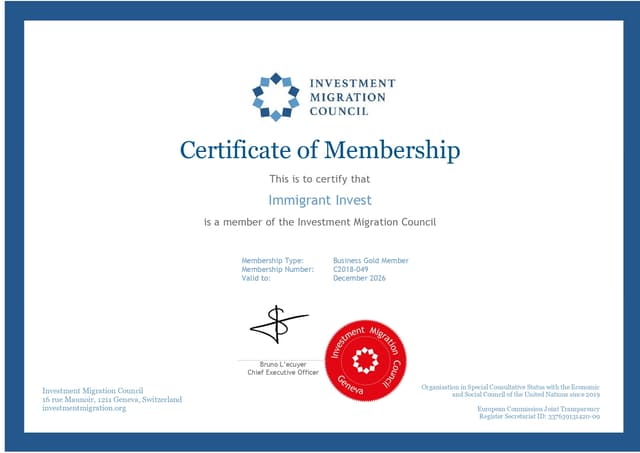
In addition, our Investment Migration Council certification confirms that Immigrant Invest is a recognised and trusted participant in the global investment migration industry, committed to ethical practices and client protection.
Your Immigrant Invest team
Our legal and migration experts know the Maltese law inside out and ensure a smooth residency renewal process.




Our clients’ reviews
Names and photos of investors have been changed to comply with non-disclosure agreements.