
Digital Nomad Visas are now mainstream: more than 50 countries offer dedicated remote-work residence visas as of 2025[1].
The 2026 Digital Nomad Visa Index ranks the best places for remote workers and compares the visas on living costs, tax treatment, and routes to longer-term residence. Spain takes the top spot, followed by Malta, Portugal, Germany, and Hungary.
This report was prepared by Immigrant Invest for fair use. Please cite us if any information is reproduced or referenced.
Summary
Spain tops the chart thanks to quality of life and a visa offering up to 5 years with a path to permanent residency, plus the “Beckham Law” with 0% tax on foreign income and a 24% flat rate on local earnings for up to 6 years[3].
Portugal scores as the 3rd: its D8 visa can be renewed up to 5 years and can lead to permanent residency, and applicants need about €3,680 per month, which is four times the 2026 minimum wage.
Hungary’s White Card stands out for low day-to-day costs of living in Hungary and a €3,000 per month income bar. The card lasts 1 year, can be renewed once, allows Schengen travel, and attracts no local tax if you stay under 183 days.
Italy offers a renewable 12-month visa for “highly skilled” applicants earning €32,400 a year, with permanent residency possible after 5 years of continuous residence.
Malta provides a 1-year Nomad Residence Permit, renewable up to 4 years in total; it does not lead to permanent residency, but a flat 10% tax on locally sourced work and a 12-month tax holiday strengthen its case despite higher costs.
Overall, the landscape splits between low-tax, simple-entry options, and European visas that trade on lifestyle and clearer residency pathways. Our findings rely on official government sources, legal texts, and current 2024—2025 expert reports to ensure accuracy.
About the Digital Nomad Visa Index 2026
The Digital Nomad Visa Index 2026 is a clear, no-frills ranking of countries for people who work online and want to live abroad on dedicated Digital Nomad Visas or permits.
The Index borrows the basic logic of long-running investment-migration benchmarks, such as the CBI Index for citizenship by investment programmes, and compares destinations using measurable pillars like living costs, taxes, legal rules, and day-to-day quality of life.
Purpose
We intended to cut through the sales talk and present solid, comparable facts so readers can see which places match their priorities — lower living costs, fair tax treatment, or a genuine route to longer-term residency.
Scope
Every country running a Digital Nomad Visa in Q4 2025 is included, with 50+ visas across Europe, the Americas, Asia, the Middle East, and Africa. New arrivals launched in 2024, like Italy’s Lavoratore da Remoto visa, are in the mix.
Standard visas not designed for remote workers — tourist stays or generic freelance permits — are left out unless, in practice, they work like a nomad visa. Each country appears once, even if it offers several routes.
How we did the research
1. Rank. We rank the best destinations in 2026 by combining scores across the factors remote workers actually care about.
2. Comparison. Next, we show each country’s strengths and trade-offs in plain language, with extra attention to five consistently strong examples — Hungary, Portugal, Spain, Italy, and Malta — to illustrate the range of benefits on offer.
3. Analysis. Then, we demystify the rules: income thresholds, what work is allowed, how long the visa lasts, how renewals work, and whether there’s a path to residency.
4. Finalisation. We present the results with straightforward visuals — bar charts for overall scores, radar charts for pillar performance, and simple graphics for key features like maximum stay and tax rates — so the comparisons are easy to grasp at a glance.
Digital Nomad Visa Index 2026: complete rankings
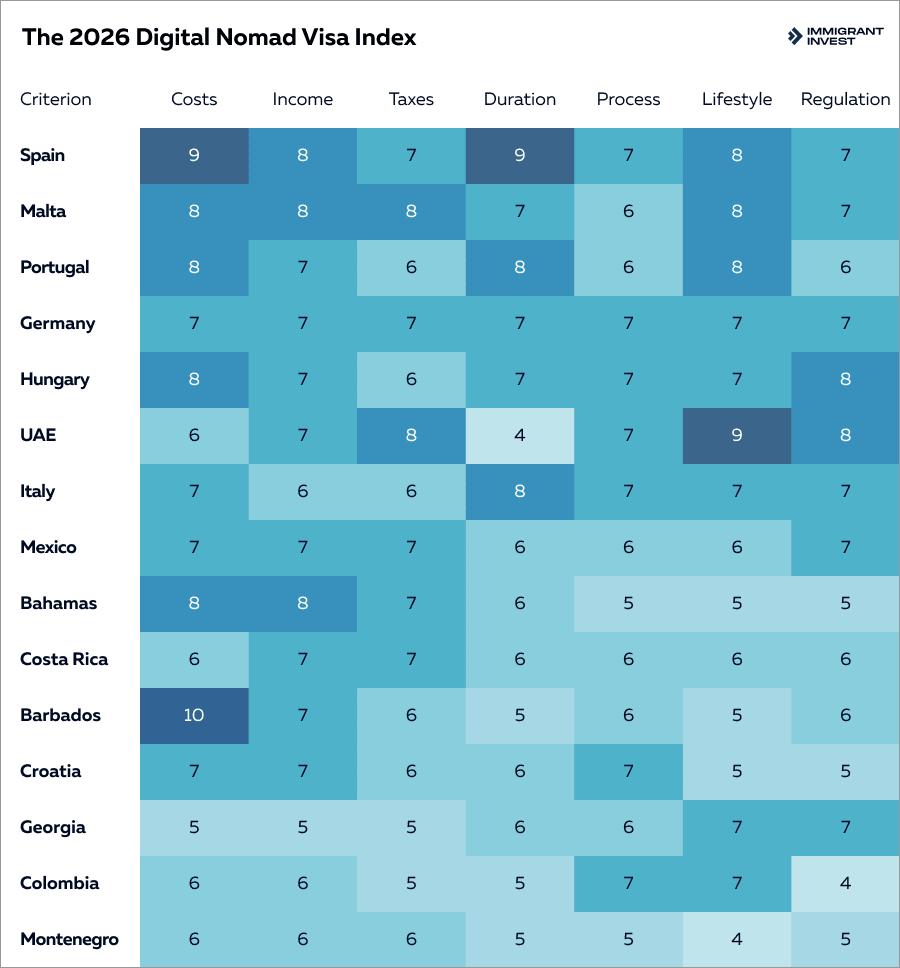
Based on the above methodology, Table 1 shows the overall ranking of the top 15 digital nomad visa destinations for 2026, along with key metrics. Each country’s score is the normalised result of our multi-factor evaluation. For brevity, we list here the leaders and selected others; the full index covers all operational programs

Country

Spain
Score
7.9
Visa
Visado para teletrabajadores
Income a month
€2,762
Tax for nomads
Beckham Law: 0% foreign income, 24% local
Residency duration
3 + 2 years
Path to residency or passport
PR eligible after 5 years
Country

Malta
Score
7.5
Visa
Nomad Residence Permit
Income a month
€3,500
Tax for nomads
0% foreign income if non-resident; 10% flat on local work
Residency duration
1-year, renewable thrice
Path to residency or passport
Does not lead to PR or citizenship
Country

Portugal
Score
7.05
Visa
D8 Remote Work Visa
Income a month
€3,680
Tax for nomads
IFICI+ if applicable
Residency duration
1-year or 2-year permit, up to 5 years
Path to residency or passport
PR after 5 years
Country

Germany
Score
7.0
Visa
Freiberufler Visa
Income a month
€1,100
Tax for nomads
Standard progressive
Residency duration
3 years
Path to residency or passport
PR after ~5 years, if integrated
Country

Hungary
Score
7.0
Visa
White Card
Income a month
€3,000
Tax for nomads
Tax exemption if <183 days in Hungary; 15% flat if resident
Residency duration
1 + 1 year
Path to residency or passport
PR after 2 years
Country

UAE
Score
6.9
Visa
Virtual Working Programme
Income a month
$3,500
Tax for nomads
0% personal income tax
Residency duration
1 year, renewable
Path to residency or passport
Does not lead to PR or citizenship
Country

Italy
Score
6.8
Visa
Visto per lavoratore da remoto
Income a month
€2,500
Tax for nomads
Standard progressive
Residency duration
1 year, renewable annually
Path to residency or passport
PR after 5 years if residing
Country

Mexico
Score
6.5
Visa
Temporary Resident Visa
Income a month
$2,600
Tax for nomads
0% tax on foreign income for non-tax residents
Residency duration
1 year, extend to 4 years max
Path to residency or passport
PR under specific conditions
Country

Bahamas
Score
6.3
Visa
BEATS
Income a month
$0, no minimum income required
Tax for nomads
0% income tax
Residency duration
1 year, renewable up to 3 years
Path to residency or passport
Does not lead to PR or citizenship
Country

Costa Rica
Score
6.3
Visa
Rentista, or Remote Worker Visa
Income a month
$3,000
Tax for nomads
0% tax on foreign income
Residency duration
1—2 years, renewable up to 4 years
Path to residency or passport
PR in 3 years
Country

Barbados
Score
6.2
Visa
Welcome Stamp
Income a month
$4,167
Tax for nomads
0% income tax
Residency duration
1 year, renewable
Path to residency or passport
Does not lead to PR or citizenship
Country

Croatia
Score
6.1
Visa
Digital Nomad Residence
Income a month
€2,250
Tax for nomads
0% tax on foreign income
Residency duration
1 year, non-renewable consecutively
Path to residency or passport
Does not lead to PR or citizenship
Country

Georgia
Score
5.8
Visa
Remotely from Georgia
Income a month
$2,000
Tax for nomads
0% tax if <183 days in Georgia; 20% otherwise
Residency duration
1 year
Path to residency or passport
Does not lead to PR or citizenship
Country

Colombia
Score
5.6
Visa
Remote Worker Visa
Income a month
$684
Tax for nomads
0% tax on foreign income for non-residents
Residency duration
2 years, non-renewable
Path to residency or passport
Does not lead to PR or citizenship
Country

Montenegro
Score
5.3
Visa
Remote Work Visa
Income a month
€1,350
Tax for nomads
0% foreign income; 9% local tax
Residency duration
1 + 2 years
Path to residency or passport
Does not lead to PR or citizenship
Country | Score | Visa | Income a month | Tax for nomads | Residency duration | Path to residency or passport |
|---|---|---|---|---|---|---|
Spain | 7.9 | Visado para teletrabajadores | €2,762 | Beckham Law: 0% foreign income, 24% local | 3 + 2 years | PR eligible after 5 years |
Malta | 7.5 | Nomad Residence Permit | €3,500 | 0% foreign income if non-resident; 10% flat on local work | 1-year, renewable thrice | Does not lead to PR or citizenship |
Portugal | 7.05 | D8 Remote Work Visa | €3,680 | IFICI+ if applicable | 1-year or 2-year permit, up to 5 years | PR after 5 years |
Germany | 7.0 | Freiberufler Visa | €1,100 | Standard progressive | 3 years | PR after ~5 years, if integrated |
Hungary | 7.0 | White Card | €3,000 | Tax exemption if <183 days in Hungary; 15% flat if resident | 1 + 1 year | PR after 2 years |
UAE | 6.9 | Virtual Working Programme | $3,500 | 0% personal income tax | 1 year, renewable | Does not lead to PR or citizenship |
Italy | 6.8 | Visto per lavoratore da remoto | €2,500 | Standard progressive | 1 year, renewable annually | PR after 5 years if residing |
Mexico | 6.5 | Temporary Resident Visa | $2,600 | 0% tax on foreign income for non-tax residents | 1 year, extend to 4 years max | PR under specific conditions |
Bahamas | 6.3 | BEATS | $0, no minimum income required | 0% income tax | 1 year, renewable up to 3 years | Does not lead to PR or citizenship |
Costa Rica | 6.3 | Rentista, or Remote Worker Visa | $3,000 | 0% tax on foreign income | 1—2 years, renewable up to 4 years | PR in 3 years |
Barbados | 6.2 | Welcome Stamp | $4,167 | 0% income tax | 1 year, renewable | Does not lead to PR or citizenship |
Croatia | 6.1 | Digital Nomad Residence | €2,250 | 0% tax on foreign income | 1 year, non-renewable consecutively | Does not lead to PR or citizenship |
Georgia | 5.8 | Remotely from Georgia | $2,000 | 0% tax if <183 days in Georgia; 20% otherwise | 1 year | Does not lead to PR or citizenship |
Colombia | 5.6 | Remote Worker Visa | $684 | 0% tax on foreign income for non-residents | 2 years, non-renewable | Does not lead to PR or citizenship |
Montenegro | 5.3 | Remote Work Visa | €1,350 | 0% foreign income; 9% local tax | 1 + 2 years | Does not lead to PR or citizenship |
It’s important to highlight that even countries ranked lower — outside the top 15 shown — may be attractive to certain nomads for specific reasons. For example, Thailand offers a 10-year LTR visa targeting wealthy remote workers, and Indonesia has announced plans for a long-term Second Home visa.
However, such visas as Thailand’s often cater to niche demographics — high net worth or retirees — and thus scored lower in our general index focusing on average remote professionals. The Index rewards a balance of accessibility and benefits: a country needs to perform well across the board to rank highly.
In the following sections, we dive deeper into how top countries achieved their scores, compare regional trends, and provide legal context for each program.
Methodology and ranking criteria
Immigrant Invest’s Digital Nomad Visa Index uses the most reliable data available through 2025, drawn from official government sources, published laws, and recent expert reports. The label says 2026, but the evidence behind it is the best verified information gathered across 2025.
Countries are scored across comparable pillars — cost of living, tax treatment, legal rights and work restrictions, visa eligibility, duration and renewal terms, residency pathways, and quality of life — with transparent weights applied and normalised to allow fair, like-for-like comparisons.
Research approach and data sources
To ensure accuracy and credibility, this index relies primarily on official sources and the latest available data — 2024 onward.
For each country, we gathered information from government websites, official gazettes, and immigration regulations regarding the digital nomad visa — or equivalent — program, including legal eligibility criteria, tax rules, and residency rights.
For example, Spain’s visa requirements were verified through the Spanish government publication and the text of Spain’s 2022 Startup Law that created the visa[13].
Similarly, details for Hungary’s White Card were confirmed via the Hungarian National Directorate for Aliens Policing[11], and Italy’s 2024 decree was referenced via official communications[7].
Whenever possible, legal texts and government announcements were used to extract quantitative metrics, e.g. minimum income amounts, visa fees, tax rates, allowable duration.
In addition to official databases, we consulted reputable aggregator platforms and expert analyses — such as VisaGuide.World’s Digital Nomad Index 2025, global mobility firms’ reports, and expat community forums — to gather comparative data like cost-of-living indexes, internet speeds, and real-world visa processing times[2].
The secondary sources were used only when they cited current data of 2024—2025 or when official data was not readily available, for example, global cost-of-living rankings or user-reported experiences on renewal processes.
We prioritised data recency: any insights predating 2024 were cross-checked for updates or omitted if no longer applicable. This approach ensures the index reflects the most up-to-date conditions in 2025. All source data points were cross-verified between multiple references to ensure consistency.
Ranking pillars
Following the model of established investment migration indices, we identified 7 key pillars to score each country’s digital nomad visa offering[12].
These pillars encapsulate both the practical aspects of the visa, such as costs, taxes, ease of obtaining, and the strategic advantages, such as quality of life and residency prospects. Each pillar is scored on a standardised scale — 0 to 10, with 10 being most favorable — based on quantitative benchmarks or qualitative assessment where necessary.
Pillar 1. Tax policy and benefits
This critical pillar assesses how a nomad’s foreign-sourced income is taxed locally, including any special tax incentives or exemptions offered to visa holders.
We consider whether the country imposes local income tax on remote workers’ earnings and if so, whether there are tax breaks, e.g. flat reduced rates, initial tax-free periods, or exemption on foreign income.
Weight: 20%.
Example: Zero-tax jurisdictions, such as the UAE or the Bahamas, or those with explicit exemptions score a full 10[2].
Spain scores very high due to the Beckham Law, under which digital nomads employed by foreign companies can pay a flat 24% on Spanish salary and 0% tax on foreign income for up to 5 years[4].
Malta also improved its score in 2025 after introducing a 10% flat tax for nomad visa holders, with a one-year tax holiday.
On the other hand, countries that immediately tax worldwide income at standard rates — with no relief — score lower. A summary table (Fig. 2) is provided, listing each country’s tax treatment for nomads. We relied on official tax codes and government releases for this data, ensuring accuracy.
Pillar 2. Visa duration and path to residency
This pillar examines the length of stay granted by the visa, its renewability, and whether time on the visa counts towards permanent residency or citizenship.
Longer initial validity and easier renewal processes yield higher scores, as do clear pathways to transition into long-term status.
Weight: 20%.
Example: Portugal and Spain excel here: Portugal’s nomad residence permit is renewable up to 5 years and then qualifies for permanent residency; Spain’s visa leads to a 3-year residence permit that can extend to 5 years, after which one can apply for permanent residency. These features earn top marks.
Malta, by contrast, allows a cumulative 4-year stay but explicitly does not count toward permanent residence, lowering its score despite multiple renewals.
Some countries, e.g. the UAE, allow renewals but have no foreseeable PR track, which is a trade-off for nomads who might want to settle.
We also note if family members can be included and whether family time counts towards residency — Spain and Italy allow family co-residence, and Spain lets spouses work locally on a family permit.
Pillar 3. Income and Financial Requirements
This pillar evaluates the minimum income or savings threshold applicants must demonstrate, as well as any proof-of-funds rules throughout their stay.
A lower requirement scores higher for accessibility. For context, we benchmark against local wage levels: e.g. requiring 4× the national minimum wage — as in Portugal’s case, €3,480 a month — is moderately stringent, whereas requiring only equal to the minimum wage would be very lenient.
Weight: 15%.
Example: Spain requires about €2,762 a month — 200% of its minimum wage — which is relatively accessible and thus Spain earns a strong score[13]. By contrast, Iceland’s proposed visa that is not in top 10 had an extremely high requirement — over $7,000 a month — which would score low. This criterion is visualised in a comparison chart of required monthly income vs. local median income, to show relative accessibility.
This pillar is illustrated by a timeline chart for top visas, showing initial visa length, total possible years on nomad status, and eligibility for PR or citizenship.
Pillar 4. Quality of life and infrastructure
Recognising that a visa’s appeal also depends on the country’s environment, this pillar includes an index of the country’s standard of living relevant to digital nomads. Factors include Internet speed and reliability, healthcare quality, personal safety, English proficiency, and the presence of a digital nomad community or co-working infrastructure.
While more qualitative, we assign scores using global indices, e.g. average broadband speed where higher equals a better score; World Bank or Numbeo health care index; Global Peace Index for safety.
Weight: 15%.
Example: Spain and Portugal score very high given their fast internet. Spain averages ~80 Mbps[2], excellent healthcare; both rank in top health system rankings[2], and vibrant expat communities. Thailand — not in our top 10 overall due to limited visa pathway — would have a strong life score for affordability and community, but Europe generally leads in infrastructure.
We also incorporate how “remote-work-friendly” the local culture is, e.g. availability of co-working spaces and cafes with Wi-Fi. This pillar is visualised with a radar chart for the top five countries, comparing sub-scores in internet, healthcare, safety, and expat community size.
Pillar 5. Visa costs and living expenses
This pillar combines the financial cost of obtaining and maintaining the visa with the local cost of living. It includes government visa fees, any required minimum funds or investment, and an index of living costs — such as rent, groceries and so on — in popular nomad hubs of the country.
Weight: 10% of total score.
Rationale: Affordability is a primary concern for remote workers; lower costs can be a big draw. Example: Countries like Hungary and Portugal score high here due to modest visa fees and below-average living costs[5][6], whereas expensive locales with high rents score lower despite other merits.
We use Numbeo’s Cost of Living index 2025 as a baseline for scoring living expenses, normalised to 10 for the lowest cost country in our list. Visa application fees and any mandatory insurance or deposit requirements are also factored in.
Pillar 6. Ease of application and processing
This pillar scores the bureaucratic complexity of obtaining the visa: documentation needed, processing speed, and the general user-friendliness of the process.
Fewer hurdles — simple online application, quick approval times, no onerous document legalisation — result in a higher score.
Weight: 10%.
Example: Estonia pioneered a straightforward e-application for its Digital Nomad Visa and typically processes applications in 30 days, giving it a high ease score. Italy, on the other hand, demands extensive documentation, e.g. degree or proof of high qualifications, background checks, and only began processing in 2024 with consular applications taking up to 90+ days; thus Italy’s score here is moderate.
We gathered data from official visa guidelines — application checklists and estimated timelines — and expat feedback on processing times. A flowchart in the report appendix outlines the application steps for a few representative countries, from initial application to final residence permit issuance.
Pillar 7. Legal and bureaucratic environment
This pillar reflects the stability and clarity of the visa’s legal framework, including any notable restrictions. It covers whether the visa is backed by solid legislation, and not just a temporary policy, consistency of rules or frequent changes, and additional legal perks or drawbacks, such as requirements to pay into local social security, or limits on local business activity.
It also looks at how the visa fits into the country’s broader immigration system, for instance, whether nomad visa holders are exempt from quotas or labor market tests, and whether the country has bilateral agreements impacting the visa, such as social security totalisation agreements.
Weight: 10%.
Example: United Arab Emirates scores well as it has a clear, codified Remote Work Visa program and a very business-friendly environment, though its lack of any long-term status reduces the desirability.
Greece offers a 50% income tax reduction for 7 years for remote workers who become tax residents, indicating government backing, but initially had some bureaucratic delays in implementation, affecting its score.
We gave high marks to countries that integrated their nomad visas into immigration law seamlessly, e.g. Italy’s visa was written into its immigration code with specific high-skill criteria, showing a deliberate legal framework.
Conversely, countries where rules are vague or constantly shifting lose points. This pillar’s assessment relied on legal analyses.
How we combined the weighted pillar scores

Mohamed Zakaria,
Senior Investment Migration Expert
Each pillar’s score for a country was calculated from the underlying data. For example, under Visa Costs, the country with the lowest combined cost — fee plus living index — got 10, the highest cost got 0, and others were interpolated.
For Tax, a simplified scoring: 10 if no tax or full exemption, 7—9 if flat low tax or long holiday, 5 if standard taxation with some treaty relief, and 0—4 if high taxation without relief.
Where qualitative judgment was needed, we assigned scores in consultation with immigration law experts on our team.
Finally, to produce the overall Digital Nomad Score, we combined the weighted pillar scores for each country.
The raw aggregate was then normalised to a 1—5 scale for simplicity, using a min-max normalisation anchored so that the top country = 5 and a baseline minimum score if a country met only basic criteria = 1. In practice, the top score was 5.0 and the lowest among included programs was 2.5, indicating even lower-ranked countries still meet the baseline needs of digital nomads.
Normalisation formula: Digital Nomad Score = 1 + 4 * ((Raw Score — Min Raw) / (Max Raw — Min Raw)). This ensures a user-friendly 5-point rating for each country in the index, which we present alongside a percentile score (0—100%) in the detailed rankings table.
Country spotlights: exemplary Nomad Visas in 2026
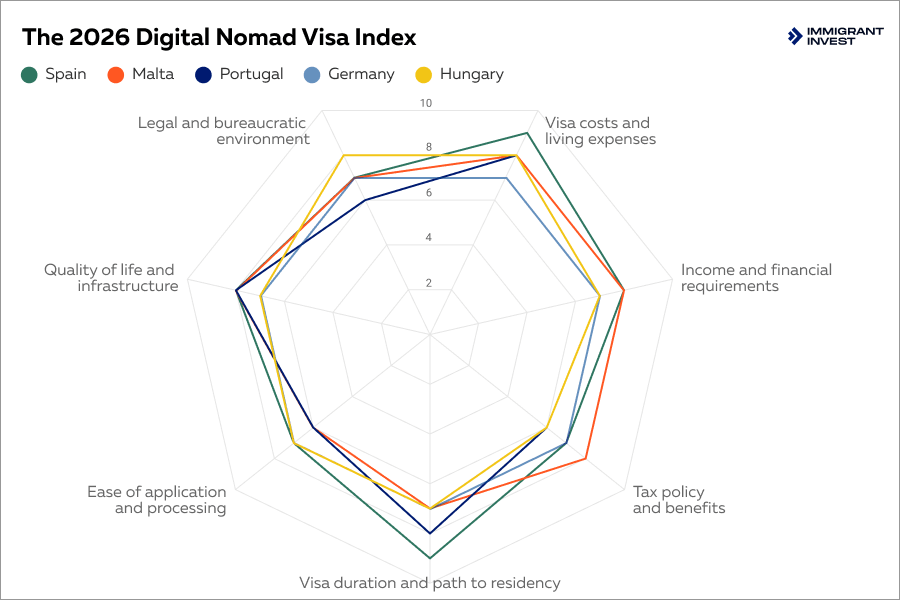
To put a more human lens on the numbers, we now zoom in on a selection of countries that exemplify the diverse approaches to digital nomad visas. In these spotlights, we summarise each country’s program, interpret key legal provisions, and discuss why they have or haven’t been successful.
We focus on five countries — Spain, Portugal, Hungary, Malta, and Germany — which have been identified throughout this report as notable players. Each offers a case study in how visa policy, economic strategy, and nomad culture intersect.
Spain: the all-rounder remote work haven
Visado para teletrabajo internacional, created by the Startup Law in December 2022, gives non-EU remote workers a legal way to live in Spain. It has quickly made Spain one of Europe’s top choices for digital nomads.
Key features. Applicants need either an employment contract or freelance clients outside Spain, plus a university degree or 3 years of work experience[13].
The income bar is set at 200% of Spain’s minimum wage, about €2,762 per month in 2025[31], which undercuts many peers, for example, Portugal’s €3,680 or Croatia’s €2,250.
The initial visa lasts 1 year. Spain also lets people apply from inside the country and then issues a 3-year residence permit[14]. A further 2-year renewal is possible, for a total of 5 years, after which long-term residence is on the table[9].
Work and family rules. Up to 20% of your income may come from Spanish sources[13], so limited local work is allowed.
Family reunification is possible, dependants receive residency cards, and spouses can work in Spain without a separate permit[7].
Tax and legal points. A major draw is the “Beckham Law.” Eligible employees of foreign companies — not freelancers — can choose to be taxed as non-residents: foreign income is exempt and Spanish income up to €600,000 is taxed at a flat 24%[4].
For many, that means no Spanish tax on their remote work, while they handle any home-country obligations. The regime lasts 5 years, aligning with the visa. Spain has aligned immigration and tax rules to attract remote workers[4].
Note that freelancers cannot use the Beckham regime and fall under standard tax rules, so some people switch to employee status to qualify[4].
Social security can also matter: without a bilateral agreement and certificate from your home system, you may need to contribute in Spain, though the law allows flexibility to stay in your home system or join Spain’s[13].
Why Spain excels. Spain mixes lifestyle — climate, culture, big-city amenities — with welcoming rules. It is effectively saying: live here, work for a foreign employer, we won’t overtax you, and there’s a path to stay.
Spain tops our ranking. Early numbers show strong interest by mid‑2024, especially from Americans, Britons, and Latin Americans.
Paperwork can be slow in Spain, but the government set up UGE — Unidad de Grandes Empresas — to process these cases[14], and lawyers report typical timelines of about 1—2 months. If delivery stays smooth, Spain should remain a magnet for digital nomads.
Portugal: sunny shores and a residency road to citizenship
Portugal introduced a dedicated Digital Nomad Visa in October 2022, known as the D8, alongside the long-standing D7 passive income route.
There are two tracks: a Temporary Stay Visa for up to 1 year and a Residency Visa that grants a 2-year residence permit, renewable for 3 more years[5].
Both paths require proof of remote work and income of at least four times the Portuguese minimum wage; that was €3,480 per month in 2025 and rises to €3,680 per month in 2026 as the minimum wage increases[5].
Applicants also show the last 3 months of income and 1 year of accommodation, such as a rental contract[15].
Key features. Requirements are straightforward — proof of remote employment or freelance activity and meeting the income bar, with no formal degree or experience rule stated.
Typical processing runs about 8—12 weeks[5], with applications made at a Portuguese consulate — or, in certain cases, inside Portugal if already there legally. Successful applicants receive a residence permit that allows travel across the Schengen Area, and family reunification is available.
The residence permit tied to the residency route is usually valid for 2 years and then renewable for 3 more, aligning with the 5-year mark used for permanent residency applications[6].
Tax and compliance. Portugal closed its Non-habitual Resident regime and replaced it with a narrower IFICI framework aimed at specific activities and profiles. The new rules are more targeted than NHR and do not operate as a broad, one-size-fits-all relief.
Nomad visa holders integrate into the system with a Portuguese NIF — tax ID — and a local bank account[15], and a recent 2025 update requests a Portuguese social security number during the process[5].
Why Portugal excels. Portugal combines a clear visa structure with strong day-to-day appeal — mild climate, coast, established nomad hubs in Lisbon, Porto and the Algarve, and widespread English in urban areas.
Regional policies also encourage settlement beyond the big cities, where living costs are lower. Portugal scores near the top across multiple pillars, even as rising demand occasionally creates administrative backlogs.
Hungary: Europe’s budget nomad option with a Schengen bonus
The White Card, launched in late 2021, is a residence permit made for digital nomads — legally, “third-country nationals performing remote work from Hungary.” It has become a quiet favourite for non-EU nomads who want a simple entry point to Europe. Hungary scores well on cost and simplicity.
Key features. The White Card is issued for one year and can be renewed once, for a maximum of 2 years.
Eligibility is straightforward: you work for an employer outside Hungary or own a foreign company, and you cannot work for or hold shares in a Hungarian company. The income requirement is €3,000 per month — low compared with many peers.
Applicants show proof of income, accommodation, and health insurance; there’s no degree or experience rule.
You can apply at a Hungarian consulate, or enter visa-free and file via the Enter Hungary online system; processing is typically around 30 days when documents are complete.
As a White Card holder, you have Hungarian residence and can travel in the Schengen Area for up to 90 days in any 180-day period. That makes Budapest a handy base for weekend trips across Europe without extra visas.
Tax and costs. Hungary’s flat personal income tax is 15%, among the lowest in Europe. Many nomads legally avoid tax in Hungary by staying fewer than 183 days, so they are not treated as Hungarian tax residents.
If you do pass 183 days, your global income is generally taxed at 15%, with treaties to avoid double taxation.
Everyday costs are a major draw: Budapest is roughly 50—60% cheaper than Western European capitals on average[6].
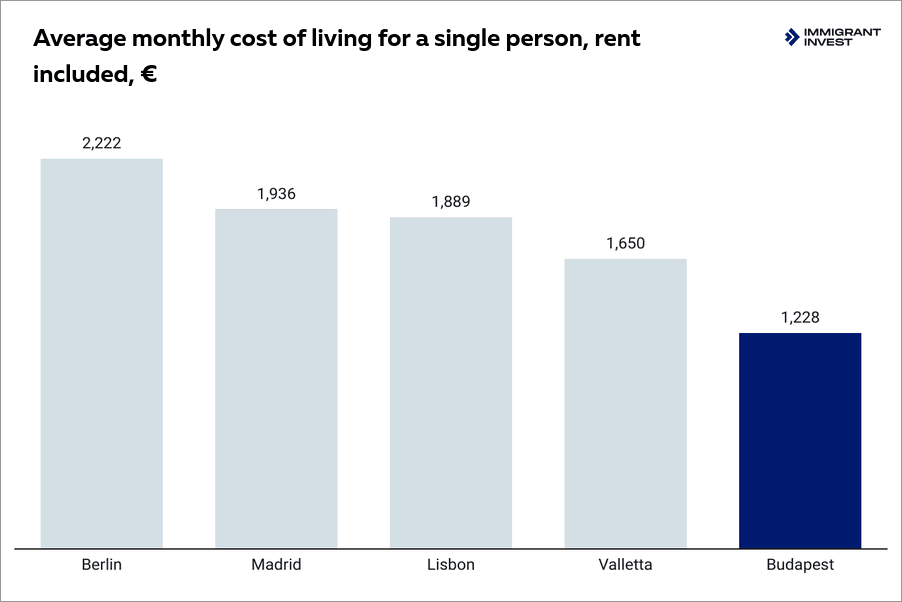
Limits and pathways. Time on the White Card does not count towards the 5 years needed for permanent residence unless you later switch status. Because the permit caps at 2 years, long-term stayers would need to transition to another route — work, family, business. That design keeps Hungary’s score modest on the “path” pillar, but the visa excels for a short, low-friction European stay.
Why Hungary excels. The appeal is simplicity, price, and location. Requirements are clearly listed on official sites with helpful FAQs[11], the online portal works in English, and many applicants manage without a lawyer.
Budapest offers a lively expat scene, strong public transport, decent healthcare, and a central hub for Europe. English is common in the capital, less so outside it.
Some note Hungary’s conservative politics and periodic tensions with the EU, which haven’t directly affected the White Card. In 2025, new rules appeared for foreign workers generally[16], but the White Card remains available.
For remote workers earning in USD or EUR, the €3,000 threshold keeps the door open to a wide range of professionals, even if permanent settlement isn’t the goal.
Malta: nomad life in the Mediterranean, with tax sweeteners
The Nomad Residence Permit, launched in mid‑2021, lets non-EU nationals live in Malta while working remotely. It’s a 1-year residence permit, renewable at the authority’s discretion up to a total of 4 years.
Malta stands out for its English-speaking environment, established expat services, and clear rules.
Key features. Applicants must earn at least €3,500 gross per month from remote work, show an employment contract or prove ownership of a business based outside Malta, and must not provide services to a Maltese employer.
Family members can join with a higher income threshold per dependant.
Residency Malta Agency handles the process and is known for responsive communication. The application is submitted online and by email; typical timelines are an initial response in 1—3 months and about four months end-to-end in practice.
The first permit is valid for 1 year, and renewals — up to three — are at the agency’s discretion, for a maximum of 4 years.
Presence rule. To keep renewing, holders must live in Malta for at least 5 months per year. Authorities do check actual time spent in the country, reflecting the policy goal that permit holders contribute to local life and the economy; community reports echo this practice.
Tax and new rules. Malta historically taxes non-domiciled residents on foreign income only if remitted, but from late 2023 there is a specific rule for this permit: a flat 10% tax on authorised remote-work income.
If you prove you have paid at least 10% on that same income elsewhere, Malta will not tax it again[10].
There is also a 12-month exemption at the start, or from January 1st, 2024, for existing holders. In short, the first year is tax-free; from year two, the cap is 10% — well below Malta’s standard rates.
Pathways and limits. Time on Malta’s nomad permit does not count towards permanent residency or citizenship[10]. After 4 years, those wishing to stay need a different status, which sits outside this overview. That said, Malta offers other well-trodden residence options separately.
Why Malta excels. English is an official language, day-to-day life is easy to navigate, and the island offers sea, sun, historic towns and modern services.
There is a visible professional community — from fintech to gaming — and plenty of co-working in Valletta, Sliema and nearby hubs.
Costs are higher than many places, especially housing, but the €3,500 income floor screens for affordability. Public transport and healthcare are solid, crime is low, summers are hot, and the lifestyle is relaxed.
The 10% regime signals a wish to keep the permit attractive beyond the first year while ensuring a predictable, modest tax take. The chief trade-offs are the 4-year cap, no direct PR track, and the realities of small-island living.
Overall, Malta scores strongly on tax and ease of process, and serves well as a secure, sun-drenched EU base — especially for those planning a defined, medium-term stay.
Germany: the Freiberufler route for independent professionals
Germany does not currently offer a standalone Digital Nomad Visa. For independent remote work, the closest legal pathway is the residence permit for freelance work under Section 21(5) of the Residence Act, which is designed for self-employed work in a liberal profession[17].
Key features. The Freiberufler route applies to recognised “liberal professions”, and examples in official guidance include doctors, interpreters, artists, writers, and architects. Depending on the profession, a professional licence may be required before permission is issued.
Core requirements. Official federal guidance summarises the freelancer-specific requirements as:
- sufficient funds to finance projects;
- any required professional licences;
- old-age pension provision if you are older than 45[17].
In practice, local immigration authorities often request evidence of real, viable work. For example, Berlin’s official checklist for a freelance residence permit includes a revenue forecast, fee contracts, and at least two letters of intent describing the planned collaboration.
Duration and renewals. Federal guidance states that residence permits for self-employment are issued for up to three years, with the possibility of extension where the activity is successful and livelihood is secured. BAMF also states that a permanent right of residence can be available after five years[18].
Family and work rules. Family reunification is available under German rules. BAMF explicitly states that family members who come for family reunification are allowed to work in Germany[19].
Why Germany excels. Germany’s proposition is credibility and durability: the Freiberufler route focuses on genuine professional practice often backed by contracts and letters of intent and can lead into long-term settlement on the general residence framework where conditions are met.
Noteworthy mentions
The United Arab Emirates combines zero income tax with cutting-edge infrastructure and has extended its Remote Work Visa to a 2-year permit. It’s a strong base for founders and frequent flyers between Asia and Africa, though living costs are high and there’s no long-term status on offer.
Montenegro, a 2022 entrant, offers a 1-year visa renewable twice, low taxes — roughly 9—15% — and Adriatic appeal. It isn’t in Schengen, so there’s no automatic EU free-movement.
Mexico doesn’t brand a Nomad Visa, yet its Temporary Residence option is a favourite with remote workers thanks to modest financial requirements and stays up to 4 years. Lifestyle draws are obvious — from Mexico City to Playa del Carmen — but with no special tax reliefs.
Colombia and Brazil both launched Digital Nomad Visas in 2022. Colombia’s low income threshold makes it accessible, though safety concerns dent quality-of-life scores. Brazil requires about $1,500 per month and allows up to 2 years; culture is a huge plus, but paperwork and language can slow things down.
Thailand isn’t a top scorer because its Long-Term Resident, or LTR, route targets higher earners and net-worth profiles — around $80,000 income or $250,000 in assets. That said, Thailand remains a beloved base on short-stay options; if thresholds drop, it could rank very highly given its low costs and well-established expat scene.
Mohamed Zakaria,
Senior Investment Migration Expert
More entrants are likely — Serbia and Malaysia are rumoured to be preparing Digital Nomad Visas, and Indonesia is still expected to tweak its rules.
For now, the focus countries sketched here show the range on offer: Spain’s well-rounded package, Malta’s targeted appeal, Hungary’s simplicity, and Italy’s higher bar with long-term promise.
Digital nomads in 2025—2026 have genuine choice: a sign of how fast work and migration rules are shifting.
Conclusion and future outlook
In only a few years, Digital Nomad Visas have shifted from novelty to mainstream policy, with over forty nations running such visas to attract foreign remote workers. After weighing costs, taxes, visa rules, and long-term options, several patterns stand out.
Europe leads on full packages. Countries such as Spain and Portugal balance short-term perks — tax reliefs and lifestyle — with real long-term prospects, including residency and even citizenship pathways.
Others in the EU are catching up in different ways: Hungary prioritises ease of entry, while Italy focuses on high-skill applicants. Europe’s edge is the value of an EU residence — mobility and stability — though this often comes with tighter procedures.
Tax policy is a major differentiator. In 2025, top performers either leave foreign income untaxed or apply low flat rates. Places that ignore this will likely need reforms to compete. More tailored regimes for remote workers are probable, as they attract talent without eroding the local tax base.
There’s no single best visa. Needs vary. A well-paid developer may favour Dubai or Abu Dhabi for a year of zero tax and high-end infrastructure, while a designer watching costs might pick Mexico or Hungary. A family aiming for a passport could prefer Spain or Portugal for clear long-term routes.
The movement is maturing beyond backpackers on tourist stamps; it now includes senior professionals, families, and founders, and countries are tuning their rules accordingly.
Legal frameworks are hardening. What began as pandemic pilots is now embedded in law by 2025 — see Italy’s detailed criteria and formal regulations in places like Colombia and Brazil.
Clearer rules are good for transparency, but they also raise standards and enforcement. Nomads need to keep up with duties such as maintaining income thresholds, carrying health insurance, and registering locally where required, for instance, Spain’s empadronamiento[14]. Choosing a country now goes hand-in-hand with basic tax planning.
The data cuts through hype. Some headline destinations did not place highly once the visa mechanics were scored. Thailand and Bali remain lifestyle favourites, but their specific nomad offers were either less competitive or still incomplete at the time of assessment. This could change if they adjust their visas.
For policymakers, the index is a scoreboard and a to-do list. Lower-ranked countries can see which pillar lags — residency pathways, internet reliability, or administrative speed — and update policy.
We’re already seeing tweaks, such as Malta’s new tax incentives responding to tax-free rivals. Expect further refinements, from lower income thresholds to more family-friendly measures as the nomad demographic broadens.
For digital nomads, the aim is clarity. We highlight, for example, that Italy’s visa is now live and that Spain’s route can lead to permanent residency. With that base, people can weigh hard factors — cost, tax, legal rights — against softer ones like climate, culture, and language to find the right fit.
Bigger picture, nomad visas reflect a shift in work and migration. Skilled people are less tied to one place, and countries are, quietly, competing for them because they bring spending, ideas, and skills without displacing local jobs. Regional coordination could follow — perhaps EU-level remote-work rules or ASEAN mutual recognition in time — but for now that remains speculative.
Final words
In conclusion, the Immigrant Invest Digital Nomad Visa Index 2026 shows a world more open than ever to remote workers.
For anyone willing to handle some paperwork, real options now exist: a Lisbon café, a Caribbean shoreline, a Budapest co-working hub, or a Dubai high-rise can all be lawful, relatively low-friction bases thanks to dedicated visas. What used to be short tourist stays is steadily becoming a stable, long-term residency path.
Mohamed Zakaria,
Senior Investment Migration Expert
Remote work is not a fad; countries are reshaping rules to attract it. The signal from our research is straightforward: top destinations aren’t merely tolerant of digital nomads, they are actively competing for them.
The savvy nomad of 2026 faces choices that simply didn’t exist a few years ago — a striking shift in how global mobility works.
Sources for analytical report
- Source: EU long-term residence standard used for PR framing where relevant.
- Source: VisaGuide.World — Digital Nomad Index, 2025 updated rankings.
- Source: Spain — legal basis for the “international telework” authorisation. Boletin Oficial del Estado (BOE) — Ley 28/2022.
- Source: Spain — special expat tax regime called “Beckham Law, ” official guidance. Agencia Tributaria (AEAT).
- Source: Portugal — residence permit for remote work. AIMA — residence authorisation for professional activity provided remotely.
- Source: Hungary — White Card rules. National Directorate-General for Aliens Policing (OIF) — White Card factsheet.
- Source: Italy — implementing decree, official Gazette. Gazzetta Ufficiale — Decreto 29 febbraio 2024 (24A01716).
- Source: Italy — consular guidance referencing the decree. Italian Embassy (Esteri) — “Visto per Nomadi digitali e Lavoratori da Remoto.”
- Source: Spain — official visa guidance. Ministry of Foreign Affairs.
- Source: Malta — programme overview and eligibility. Nomad Residence Permit, Residency Malta, official visa site.
- Source: Hungary — White Card, official factsheet.
- Source: Benchmark report used for index logic and risk framing. FATF/OECD — Misuse of Citizenship and Residency by Investment Programmes, approved October 2023.
- Source: Spain — Digital Nomad Visa, official website.
- Source: Spain — official legal basis. BOE — Ley 28/2022.
- Source: Portugal — official remote-work residence rules. AIMA — remote-work residence authorisation.
- Hungary — official decree texts. Nemzeti Jogszabalytar — Government Decree 450/2024.
- Source: Germany — official guidance on self-employment and freelancing. BAMF — “Self-employment and freelancing.”
- Source: Germany — official EU-country immigration rules for self-employed workers. EU Immigration Portal (European Commission, DG HOME) — “Self-employed worker in Germany.”
- Source: Germany — official guidance on family reunification, including work rights. BAMF — “Family.”
Request Expert Commentary or Custom Research
After sending the inquiry, we will call you back to agree on the cooperation terms and answer all your questions about the investment programs. If you are ready to refer the first client to us, we will offer possible solutions to the client’s tasks with details and cost calculations.

Material prepared by Elena Ruda, Chief Development Officer at Immigrant Invest