

Summary
Eymi Castro, an immigration expert with Immigrant Invest, has analysed the nuances of the current Portuguese citizenship law review, from the Government’s original proposal through parliamentary votes, constitutional review, and the President’s veto.
The parliamentary momentum for tightening citizenship requirements is real and numerically durable. In October 2025, the Assembly approved a substitution text with a commanding 157 votes in favour.
However, constitutional guardrails are actively shaping the reform. The Constitutional Court struck down several norms for vagueness, automatic penal effects, and retroactivity, leading to a mandatory presidential veto.
As of March 2026, the current 5-year naturalisation rule remains in force, making it critical for filing-ready applicants to expedite their document collection before the parliamentary reappraisal scheduled for April 1st, 2026.
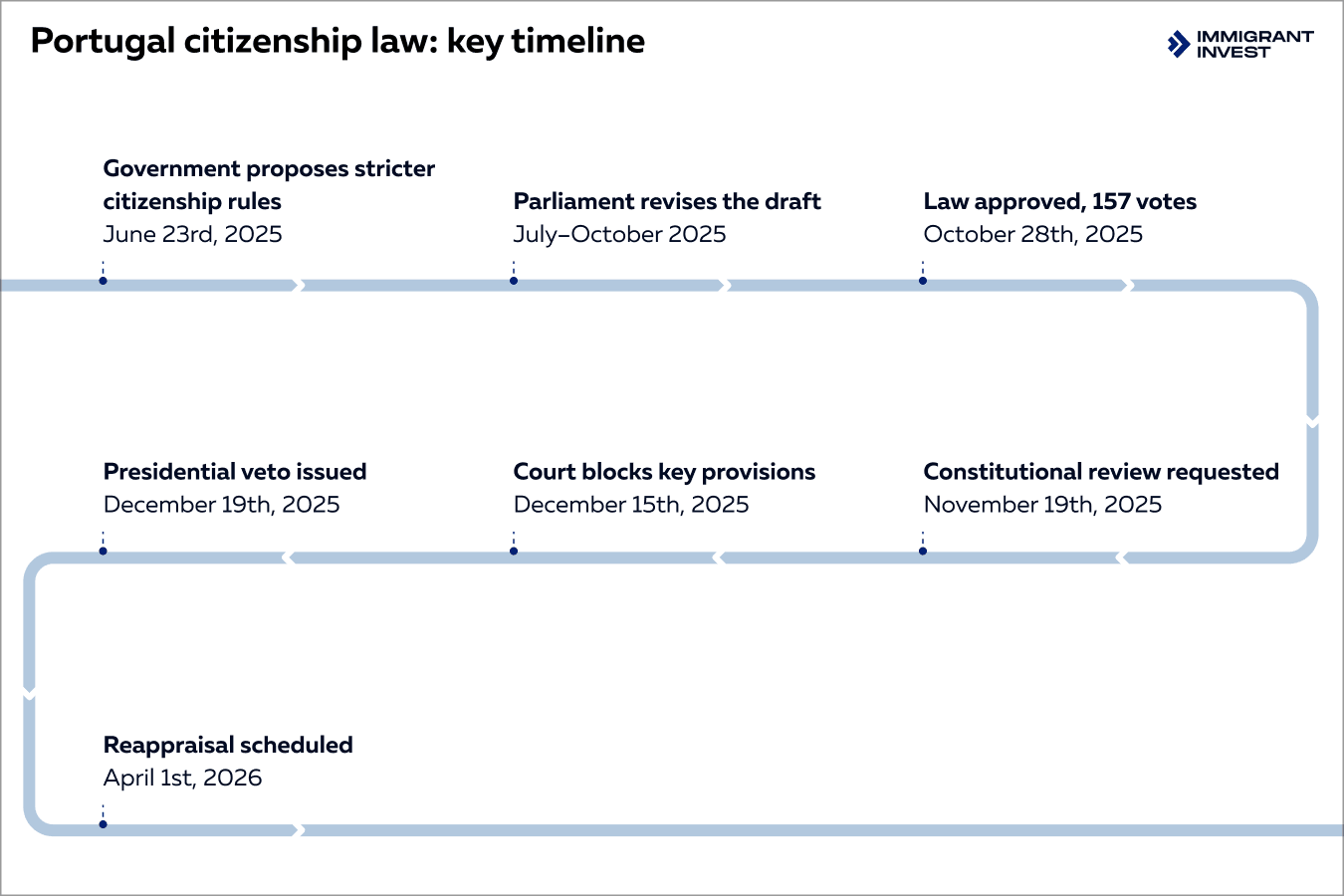
Early policy pivot: June 23rd, 2025
On June 23rd, 2025, the XXV Constitutional Government approved a legislative proposal to amend the Nationality Law n.º 37/81[1].
The official communiqué outlined the primary objective of introducing more demanding requirements for naturalisation to ensure a genuine, robust, and durable connection to the national community[2].
The initial proposal sought to increase the minimum legal residence period to 7 years for citizens from Lusophone countries, CPLP, and 10 years for other foreign nationals[1].
The proposal also aimed to introduce new mandates for applicants to demonstrate knowledge of Portuguese culture and the state’s political organisation, alongside a provision for the loss of nationality for naturalised citizens convicted of serious crimes[1]. This established the north star for the subsequent parliamentary bargaining.
Committee changes that shaped the final decree: July—October 2025
Following its submission to the Assembly of the Republic on June 25th, 2025, the government’s proposal underwent a comprehensive legislative process[3]. The bill was referred to the Committee on Constitutional Affairs, Rights, Freedoms and Guarantees, which conducted hearings with stakeholders and gathered expert opinions[3].
This committee work produced a substitution text that softened the optics but maintained the core tightening of the rules. The committee dropped the proposed “National Integration and Citizenship Test.”[3]. Notably, it also revoked the provision for granting nationality to descendants of Sephardic Jews[3].
Final vote and decree transmission: October 28th, 2025
On October 28th, 2025, during Plenary Meeting n.º 27, the substitution text was put to a final[3]. It was approved with 157 votes in favour and 64 against, becoming the Decree of the Assembly of the Republic n.º 17/XVII[4]. This decisive margin cleared the Assembly and moved the decree to the President for promulgation, setting the stage for the constitutional review.
Constitutional scrutiny begins: November 19th, 2025
Around this time, the decree faced its first major legal challenge. On November 19th, 2025, a group of 50 Deputies submitted a request for a preventive review of the constitutionality of Decree No. 17/XVII to the Constitutional Court[5].
Immigrant Invest released the video analysis concurrently to provide a concise walkthrough of what was in the approved decrees and what stakeholders needed to watch for during the constitutional review.
Constitutional court ruling: December 15th, 2025
On December 15th, 2025, the Constitutional Court issued Acórdão n.º 1133/2025, declaring four specific clusters of norms within the decree unconstitutional[6]. The court’s reasoning anchored heavily on the limits of restricting fundamental rights and the absolute need for legal certainty.
Presidential veto
On December 19th, 2025, President Marcelo Rebelo de Sousa vetoed Decree n.º 17/XVII and returned it to the Assembly of the Republic without promulgation[7]. This was not a political veto based on policy disagreement; rather, it was a strict constitutional obligation[8].
Under Article 279, paragraph 1, of the Portuguese Constitution, the President must veto any decree if the Constitutional Court declares any of its norms unconstitutional during a preventive review[8].

Eymi Castro,
Investment Migration Expert
As of now, nothing has changed, Portugal’s review of the Lei da Nacionalidade went through all the constitutional guardrails that protect fundamental rights like citizenship.
The next inflection point is the April 1st reappraisal, where Parliament can confirm, amend or let the decree lapse.
Five-year naturalisation remains in force as of March 2026
Because of the presidential veto, the proposed amendments to the Portuguese Nationality Law are not in force[3]. The existing framework, Law no. 37/81, remains fully operative[9].
Under this current law, individuals can still apply for and obtain Portuguese citizenship by naturalisation after maintaining legal residence in Portugal for a minimum of five years[10]. The stricter requirements proposed in the vetoed decree, such as increasing the residency period to 7 or 10 years, have not been enacted.
Reappraisal on April 1st, 2026
The next constitutionally mandated step is the reappraisal, or reapreciação, of the vetoed legislation. The official agenda for the 71st plenary session of the Portuguese Parliament confirms that this debate is scheduled for Wednesday, April 1st, 2026, starting at 15:00[11].
Possible outcomes of the reappraisal
What investors should do now?
Immigrant Invest is closely monitoring the developments surrounding the Portuguese Nationality Law.
At present, the proposed amendments have not been enacted due to the presidential veto, meaning that citizenship remains available after five years of legal residence under Law 37/8.
However, given the strong parliamentary majority that approved the stricter measures in October 2025, it is expected that more stringent requirements will be debated again following the parliamentary reappraisal on April 1st, 2026.

 Trusted by 10,000+ investors