
Summary
São Tomé and Príncipe is a small island state with a tax system that may appear simple at first glance but is more complex in practice. Personal income taxation depends on the type of income, the taxpayer’s status, and how the income is paid.
Interest in the country has grown after the launch of the São Tomé and Príncipe citizenship by investment programme, which allows investors to obtain citizenship with a contribution starting at $90,000.
This guide outlines how taxation in São Tomé and Príncipe works and how the citizenship by investment programme fits into the picture.
What are the main features of the São Tomé and Príncipe tax system?
São Tomé and Príncipe has a residence-based tax system, which means tax treatment depends first on whether a person is considered a tax resident of the country.
Core elements of the São Tomé and Príncipe tax system
The main taxes in São Tomé and Príncipe include:
- personal income tax, known as Imposto sobre o Rendimento das Pessoas Singulares, IRS;
- corporate income tax, known as Imposto sobre o Rendimento das Colectividades, IRC;
- value added tax, known as Imposto sobre o Valor Acrescentado, IVA;
- social security contributions;
- property transfer tax.
The tax authority is the Direcção Geral das Contribuições e Impostos, DGCI, which operates under the Ministry of Finance, Planning and Blue Economy. The DGCI’s official portal hosts the main legislative texts, including the IRS, IRC, and IVA codes[1].
All domestic tax thresholds are set in São Tomé and Príncipe’s currency — the São Tomé dobra, which is officially pegged to the euro at EUR 1 = STN 24.5.
Who pays taxes in São Tomé and Príncipe
Individuals are considered tax residents in São Tomé and Príncipe territory for the year to which the income relates if they meet any of the following conditions:
- stay in the territory for more than 180 days, whether consecutive or not;
- as of December 31st of that year, have a dwelling in the territory under conditions that indicate an intention to keep and use it as a permanent residence;
- their principal centre or base of professional or business activities, or their economic interests, is located in São Tomé territory;
- perform functions or hold public office abroad in the service of the Democratic Republic of São Tomé and Príncipe[2].
Residents are taxed on their worldwide income and must notify the tax authorities of their tax domicile. Non-residents are taxed only on income sourced in São Tomé and Príncipe.
For companies, those with their registered office or place of effective management in São Tomé and Príncipe are treated as resident companies and taxed under the local corporate income tax regime. Non-resident companies are taxed only on income earned in São Tomé and Príncipe, either through a permanent establishment or, in some cases, through withholding tax at source.
Tax implications for citizenship by investment holders
For citizenship by investment participants, the key point is simple: the São Tomé and Príncipe programme has no physical presence requirement, either before the application or after approval.
Obtaining a São Tomé and Príncipe passport does not trigger the 180-day residence test, does not establish habitual residence or relevant ties, and therefore does not make the investor a tax resident of São Tomé and Príncipe.
An investor who holds a São Tomé and Príncipe passport while living abroad does not incur São Tomé and Príncipe income tax on foreign-source income merely because of that citizenship, and holding the passport alone does not change their tax position in their country of residence.
If the investor earns São Tomé and Príncipe-source income, that local income falls within the domestic tax net and may trigger the corresponding local tax payment and filing obligations under São Tomé and Príncipe’s tax rules[3].
Taxes for individuals in São Tomé and Príncipe
Individuals in São Tomé and Príncipe are subject to personal income tax, social security contributions, and certain property-related taxes.
Residents pay personal income tax on their worldwide income, while non-residents are taxed only on São Tomé-source income[4].
Personal income tax
São Tomé and Príncipe divides taxable income into four categories:
- Category A — employment income and pensions.
- Category B — business and professional income.
- Category C — capital income.
- Category D — capital gains.
For tax residents, most income is combined at the end of the year and taxed under a progressive scale of up to 25%[5]. This applies to Categories A, B, and D. Category C follows a different treatment.
Category A income is also taxed under the progressive scale, but part of the tax is first withheld from salary during the year and later credited in the annual calculation.
2026 IRS progressive rate in São Tomé and Príncipe
Monthly withholding tax for employment income
Category A income is subject to monthly withholding tax at progressive rates of up to 23%[6]. The employer deducts the tax directly from salary based on the applicable bracket:
- STN 975.001—4,167, or ≈ €39.80—170.08, — 8%;
- STN 4,167.001—8,333, or ≈ €170.08—340.12, — 11%;
- STN 8,333.001—12,500, or ≈ €340.12—510.20, — 13%;
- STN 12,500.001—20,000, or ≈ €510.20—816.33, — 18%;
- STN 20,000+, or ≈ €816.33+, — 23%.
These withholdings are advance payments of personal income tax rather than a final tax. During the year, tax is deducted from employment income on a monthly basis, but the final liability is determined at year-end.
At that stage, employment income is aggregated with other taxable income and assessed under the annual progressive tax scale. The amounts already withheld are then credited against the total tax due.
If too much tax has been withheld, the taxpayer may receive a refund. If too little has been withheld, an additional payment is due.
15% withholding tax on capital income and certain gains
São Tomé and Príncipe applies a 15% withholding tax to specific types of income, mainly within Category C — capital income — and, in some cases, Category D — capital gains. The way this tax applies depends on the type of income and the taxpayer’s status[7].
For residents, the 15% withholding applies as a final tax on capital income, such as dividends, interest, and rental income, provided the income is not linked to a business activity. In these cases, the income is taxed at source and is not included in the annual progressive tax calculation.
However, business and professional income under Category B is also subject to a 15% withholding, but only as an advance payment, with final taxation under progressive rates.
For non-residents, the 15% withholding tax plays a broader role. It applies as a final tax to São Tomé and Príncipe-source income that is not attributable to a permanent establishment. This includes:
- capital income under Category C;
- certain capital gains under Category D;
- other types of local-source income covered by the withholding rules.
In such cases, the tax is deducted at source and no further tax filing is required. By contrast, income falling under Category A — employment — and Category B — business activities — is taxed under progressive rates of up to 25% where the individual carries out work or business activities in São Tomé and Príncipe.

Lyle Julien,
Investment programmes expert
To summarise, for residents, employment income and business or professional income are taxed in two stages.
First, when the income is paid, tax is withheld at source. For employment income, the employer applies monthly withholding at progressive rates of up to 23%. For business and professional income under Category B, a 15% withholding applies. In both cases, this withholding operates as an advance payment, not as the final tax.
Second, at the end of the year, this income is included in the resident’s annual personal income tax assessment, where progressive rates of up to 25% apply. The amounts withheld during the year are credited against the final liability.
In practice, tax is paid throughout the year via withholding, but the final tax is determined annually. If the final liability exceeds the amount withheld, the taxpayer pays the difference. If excess tax has been withheld, a refund may be claimed.
By contrast, certain types of income — primarily capital income under Category C and some capital gains — are taxed at a flat 15% through withholding at source. In these cases, the withholding is final, and the income is not included in the annual progressive tax calculation.
Social security contribution
For employees and other covered individuals, the social security contribution rate is 4%, while employers pay 6%[8].
For self-employed workers, social protection is available under two schemes:
- Mandatory scheme — a 10% contribution rate applies and covers old-age, disability, and survivor pensions.
- Extended scheme — a 14% contribution rate applies and covers old-age, disability, and survivor pensions, as well as sickness, parental, and funeral benefits[9].
Property taxes
Property transfer tax. Real estate purchases in São Tomé and Príncipe are subject to a transfer tax known as SISA. The standard rate is 8% of the property value[10].
A higher rate of 15% may apply if the buyer, or the buyer’s shareholders, are based in a low-tax jurisdiction, including offshore territories with very low or no taxation.
Urban property tax. São Tomé and Príncipe charges an annual Urban Property Tax on buildings and land designated for construction. The tax is relatively low, set at 0.1%, and is calculated based on the property’s official value recorded in the cadastral register rather than its market price[11].
Rental income. Rental income is generally treated as Category C capital income. If it is not connected with a business activity under Category B, it is taxed through a final 15% withholding tax on the gross amount. This applies to residents and also to non-residents, provided the income is not attributable to a permanent establishment.
Corporate taxation in São Tomé and Príncipe
The standard corporate income tax, IRC, in São Tomé and Príncipe is 25%[12]. Companies and investors should also take into account withholding tax rules, which may apply to certain types of income, as well as sector-specific regimes and incentives that can affect the overall tax position.
Withholding tax — 20%
Corporate income tax in São Tomé and Príncipe may, in certain cases, be collected through withholding tax. This means the payer deducts part of the payment and remits it directly to the tax authority.
A 20% withholding tax applies to specific types of income obtained in the territory of São Tomé and Príncipe where the payer is a corporate income tax taxpayer required to keep organised accounts or simplified bookkeeping.
The same rule applies where the payment is treated as an expense of a commercial, industrial, or agricultural activity carried out by personal income tax taxpayers with similar accounting obligations[13].
The main types of income that may be subject to withholding tax are:
- income from intellectual or industrial property;
- income from the use of agricultural, industrial, commercial, or scientific equipment;
- investment income;
- payments to members of corporate bodies;
- gambling and prize income;
- income earned by entertainers and sports professionals performing in São Tomé and Príncipe;
- income from services provided to a client in São Tomé and Príncipe that are similar to services normally carried out through a permanent establishment.
As a general rule, withholding tax operates as an advance payment of corporate income tax and is credited against the final tax liability.
Where the recipient is a non-resident entity without a permanent establishment in São Tomé and Príncipe, or the income is not attributable to such an establishment, the withholding tax is final, and no further corporate income tax is due on that income.
Reduced IRC — 10%
Investors with projects of at least €50,000 may qualify for tax incentives in São Tomé and Príncipe[14]. The main benefit is a reduced 10% corporate income tax rate for approved investments creating new activities[15].
Additional incentives include deductions from taxable income and tax due, accelerated depreciation, tax credits, and customs-duty exemption or reduction for imported goods approved by the competent authority.
VAT — 15%
The standard Imposto sobre o Valor Acrescentado, IVA, rate in São Tomé and Príncipe is 15%[16]. A reduced rate may apply in certain cases:
- 7% applies to taxpayers whose annual turnover did not exceed STN 1,000,000, or ≈ €40,800, and who have not opted out of the exemption regime;
- 2% applies as a fixed annual tax to taxpayers whose annual turnover did not exceed STN 100,000, or €4,080, and who have not opted out of the exemption regime[17].
If a taxpayer opts out of the exemption regime, the standard 15% IVA rate applies instead. The same standard rate also applies where annual turnover exceeds STN 1,000,000, or ≈ €40,800.
Businesses that exceed the IVA registration threshold of STN 1,000,000, or ≈ €40,800, must register with the DGCI, charge IVA on taxable supplies, file the required returns, and pay the tax to the authorities on an ongoing basis.
Free Trade Zones’ taxation
São Tomé and Príncipe approved a free trade zone law in October 2020 and launched a project for a free trade zone in Malanza, in Caué district, south of São Tomé city[18].
The broader investment framework is already in place. Certain areas, including Cantagalo, Lemba, Lobata, Caué, and Príncipe, are treated as special development or economic zones, and new investments established there may qualify for special incentives.
An update to the regime in Decree 6/2021 also allows the government to grant land for a free trade zone to an investor company for 50 years, and in exceptional cases for up to 90 years.
Oil and gas tax framework
Companies operating in São Tomé and Príncipe’s offshore oil blocks usually work under Production Sharing Agreements, PSAs, rather than under the standard corporate tax rules alone[19]. The country’s petroleum framework specifically includes a Petroleum Taxation Act and a Model Production Sharing Contract, which shows that the oil sector has its own contractual and fiscal structure.
In practice, the tax position of an offshore company is set mainly by the terms of its agreement with the government. Those terms can cover such issues as how petroleum income is taxed and what fiscal rules apply to a particular block. Because the agreements are made block by block, the tax provisions may differ from one project to another.
International tax positioning and global connectivity of São Tomé and Príncipe
São Tomé and Príncipe does not offer a broad domestic tax optimisation framework. Instead, its value lies in how it connects investors to external tax systems, markets, and compliance networks.
Double taxation treaties
São Tomé and Príncipe has a limited double taxation treaty network, with confirmed agreements with Portugal and Cabo Verde[20]. These treaties help reduce double taxation on the same income, lowering withholding taxes on dividends, interest, and royalties, and allowing taxpayers to claim foreign tax credits.
International agreements and market access
Although São Tomé and Príncipe is not part of a major global trade bloc, it participates in several international frameworks that support trade access and external economic ties[21].
The main agreements and frameworks include:
- EU arrangement, giving certain exports preferential access to the European market and improving price competitiveness.
- AGOA, opening access to the US market for eligible goods and supporting export opportunities.
- AfCFTA, strengthening access to African markets and supporting intra-African trade.
- ECCAS, helping deepen regional economic links and facilitating trade with neighbouring countries in Central Africa.
- OECD Common Reporting Standard, aligning São Tomé and Príncipe with international transparency rules, supporting access to global banking, and making the jurisdiction more suitable for compliant international structures.
Taken together, the frameworks improve São Tomé and Príncipe’s external connectivity, even though the country remains outside the world’s largest trade blocs.
How can São Tomé and Príncipe citizenship be used to optimise taxes?
Investors can obtain São Tomé and Príncipe citizenship by investment through a contribution to the National Transformation Fund, with entry-level pricing from $90,000.
The key point for tax planning is that citizenship is not the same as tax residence. Holding a São Tomé and Príncipe passport does not by itself create any tax liability there, because tax residence depends on the residence tests under domestic tax law, not on nationality.
Scenario A: the investor continues to live abroad
An investor may obtain São Tomé and Príncipe citizenship and continue living in another country, without becoming tax resident in São Tomé and Príncipe.
In this case, no São Tomé and Príncipe tax applies to foreign income. There is no obligation to register with the local tax authority or file tax returns solely due to holding citizenship.
For non-residents who receive São Tomé and Príncipe-source income, capital income and certain capital gains are generally taxed through final withholding at a flat 15%. This may also apply to other types of local-source income not attributable to a permanent establishment. In such cases, the withholding is final, and no further tax assessment is required.
This creates a relatively straightforward tax outcome, provided the investor does not carry on business through a permanent establishment or perform employment activities in the country.
In this scenario, São Tomé and Príncipe citizenship serves mainly as a mobility and structuring tool rather than a direct tax planning instrument.
Scenario B: investor relocates to São Tomé and Príncipe
An investor may relocate to São Tomé and Príncipe, spend sufficient time in the country, and register with the tax authority to become a tax resident. Once tax residence is established, the investor is taxed on worldwide income.
The tax treatment then depends on the type of income:
- Employment income → subject to monthly withholding at progressive rates of up to 23%, with final taxation under annual progressive rates of up to 25%.
- Business and professional income → subject to 15% withholding on account, with final taxation under progressive rates of up to 25%.
- Capital income and certain capital gains → generally taxed separately at a flat 15%, through final withholding.
This results in a mixed system: active income is taxed under progressive rates, while capital income is typically taxed at a lower flat rate.
However, if income arises in countries without a double tax treaty with São Tomé and Príncipe, the risk of double taxation increases, particularly for active income. In such cases, professional advice becomes essential. Anyone planning to relocate should review residence rules, treaty coverage, reporting obligations, and any exit tax implications in their home country before making the move.
São Tomé and Príncipe citizenship by investment requirements and eligibility criteria
São Tomé and Príncipe launched its Citizenship by Investment Programme on August 1st, 2025 under Decreto-Lei No. 07/2025[22]. It is one of the citizenship programmes with the lowest minimum investment thresholds currently available worldwide.
Investment threshold and government fees
The São Tomé and Príncipe citizenship by investment programme offers one route only: a non-refundable contribution to the National Transformation Fund.
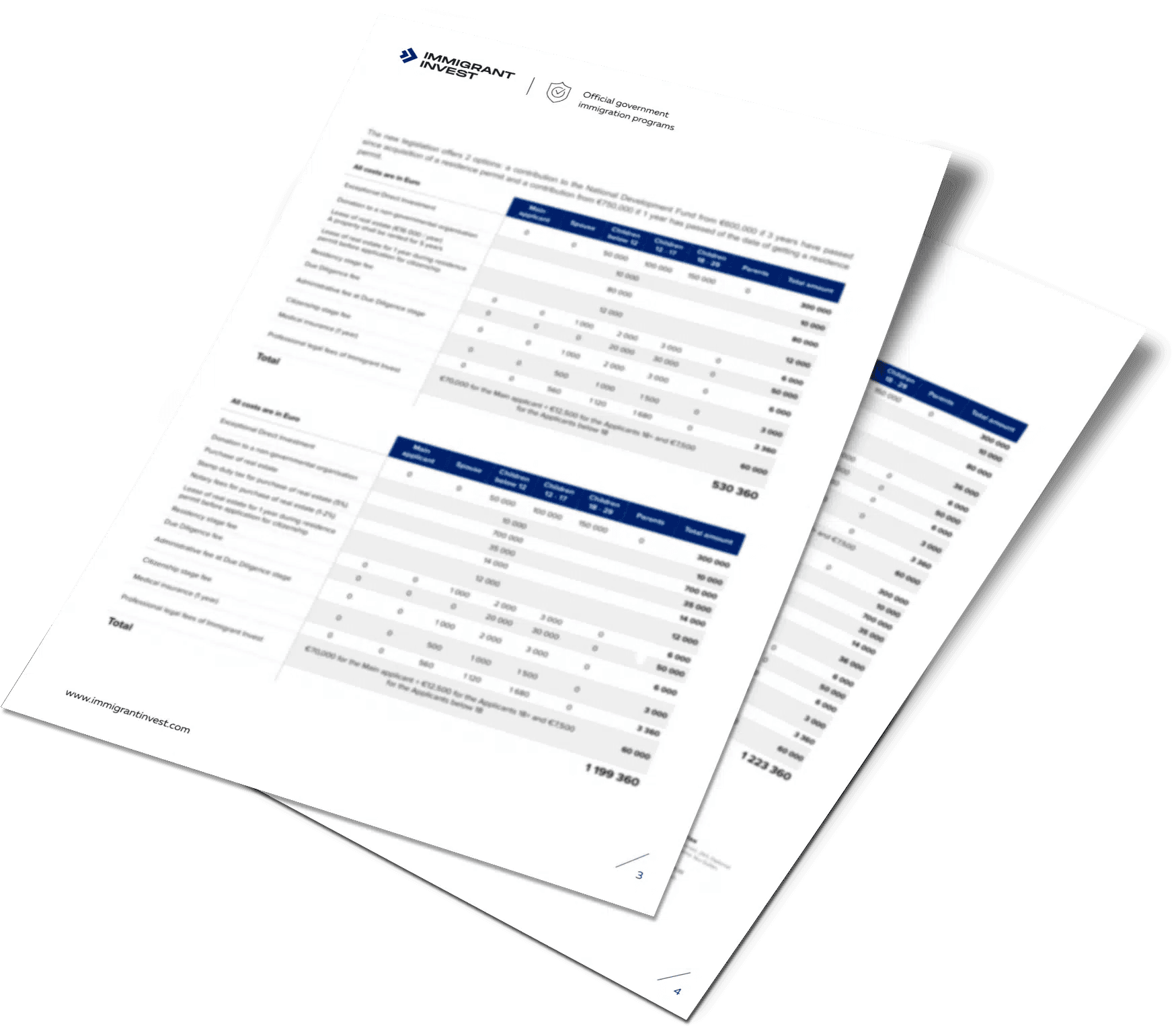
The minimum contribution is $90,000 for a single applicant or $95,000 for a family of up to four. Each additional family member adds $5,000. Applicants also need to cover government application and document issuance fees.
Minimum investment depending of family composition
Eligible family members
The following dependants may be included in the São Tomé and Príncipe citizenship application:
- spouse or civil partner, including de facto partners;
- children up to age 30 — unmarried, financially dependent;
- parents and grandparents over 55.
Required documents
São Tomé and Príncipe citizenship applicants must submit the following:
- certified copies of all valid passports;
- birth certificates and marriage certificate where applicable, or documents confirming cohabitation if partners are not officially married;
- clean criminal record certificates from countries of current and prior residence;
- evidence of source of funds and source of wealth;
- bank reference letter;
- health declaration;
- affidavit of support for adult dependants.
All documents must be translated into English. Translations should be completed by a certified translator or, if that is not possible, by a licensed professional translation company.
Step-by-step application process for São Tomé and Príncipe citizenship by investment and tax residency
Based on Immigrant Invest’s experience, the process of obtaining São Tomé and Príncipe citizenship by investment takes at least 2 months. The procedure follows a clear sequence of steps, from preliminary checks to the issuance of citizenship documents.
For investors considering relocation, it is also important to understand that obtaining citizenship is separate from obtaining tax residency, which requires spending more than 180 days in São Tomé and Príncipe.
1 day
Preliminary Due Diligence
Immigrant Invest carries out a preliminary Due Diligence check to identify any issues that could prevent the applicant from qualifying for the chosen programme. The review is conducted on a fully confidential basis.
Immigrant Invest carries out a preliminary Due Diligence check to identify any issues that could prevent the applicant from qualifying for the chosen programme. The review is conducted on a fully confidential basis.
2+ weeks
Collecting documents and applying for citizenship
A designated Immigrant Invest lawyer assists the applicant with preparing the required documents and filing the citizenship application.
Once the application package is complete, it is submitted to the CIU by email. The CIU then reviews the file and issues an application invoice, which the client must pay.
A designated Immigrant Invest lawyer assists the applicant with preparing the required documents and filing the citizenship application.
Once the application package is complete, it is submitted to the CIU by email. The CIU then reviews the file and issues an application invoice, which the client must pay.
Up to 2 months
Due Diligence
A full Due Diligence review is conducted to assess the applicant’s background and confirm eligibility.
Following this review, a recommendation is prepared and sent to the Ministry and the Cabinet for consideration. The Cabinet then decides on the application and notifies the CIU of its decision.
After the Cabinet has completed its review, the CIU sends either an Approval Letter or a Rejection Letter to the authorised representative, who then informs the applicant.
A full Due Diligence review is conducted to assess the applicant’s background and confirm eligibility.
Following this review, a recommendation is prepared and sent to the Ministry and the Cabinet for consideration. The Cabinet then decides on the application and notifies the CIU of its decision.
After the Cabinet has completed its review, the CIU sends either an Approval Letter or a Rejection Letter to the authorised representative, who then informs the applicant.
Up to 90 days
Investing
Once the application has been approved, the applicant completes the investment and pays the fees for issuing the passport and other citizenship documents. These payments must be made within 90 days.
After the payment is made, the client submits proof of payment to the CIU together with the Oath of Allegiance forms and passport application forms.
The CIU then begins issuing the Certificate of Registration and arranges the application for the São Tomé national ID card and passport.
Once the application has been approved, the applicant completes the investment and pays the fees for issuing the passport and other citizenship documents. These payments must be made within 90 days.
After the payment is made, the client submits proof of payment to the CIU together with the Oath of Allegiance forms and passport application forms.
The CIU then begins issuing the Certificate of Registration and arranges the application for the São Tomé national ID card and passport.
1+ weeks
Obtaining citizenship
Once all formal steps have been completed, the final documents, including the Certificate of Registration, national ID card, and passport, are delivered to the authorised representative for onward transfer to the applicant.
The passport is valid for 7 years and is renewable; the citizenship status itself does not expire.
Once all formal steps have been completed, the final documents, including the Certificate of Registration, national ID card, and passport, are delivered to the authorised representative for onward transfer to the applicant.
The passport is valid for 7 years and is renewable; the citizenship status itself does not expire.
180+ days
Obtaining tax residency
An investor becomes a tax resident of São Tomé and Príncipe by meeting the residence conditions. This requires spending more than 180 days in the country during the relevant calendar year or otherwise establishing sufficient residential ties.
Once a tax residence is established, the individual needs to register with the tax authority, obtain a tax identification number, and comply with local tax filing obligations. From that point, São Tomé and Príncipe tax rules may apply to worldwide income.
An investor becomes a tax resident of São Tomé and Príncipe by meeting the residence conditions. This requires spending more than 180 days in the country during the relevant calendar year or otherwise establishing sufficient residential ties.
Once a tax residence is established, the individual needs to register with the tax authority, obtain a tax identification number, and comply with local tax filing obligations. From that point, São Tomé and Príncipe tax rules may apply to worldwide income.
What are the benefits of obtaining São Tomé and Príncipe citizenship by investment?
Beyond tax flexibility and mobility advantages, São Tomé and Príncipe citizenship by investment also offers a simple route to a second passport with a number of lifestyle and long-term planning benefits.
1. No integration requirement
There is no need to live in São Tomé and Príncipe before approval or after receiving citizenship. Applicants are not required to pass a language test, attend an interview, or complete any cultural or residency integration stage.
The process of obtaining citizenship can be completed without travelling to São Tomé and Príncipe.
2. Visa-free travel
A São Tomé and Príncipe passport currently provides visa-free or visa-on-arrival access to 71 destinations, including Singapore, Hong Kong, South Africa, Malaysia, the Philippines, Costa Rica, and a number of countries in Africa, Asia, and the Caribbean.
3. Easier residence pathways in Portugal and Brazil
São Tomé and Príncipe citizenship can make it easier to access residence options in other Portuguese-speaking countries through the Community of Portuguese Language Countries, CPLP, framework[23].
In Portugal, CPLP nationals can apply for a residence permit under a simplified route, and the Portuguese government states this authorisation can be obtained online, in 72 hours, using a prior manifestation of interest or a consular visa[24].
Portugal residency may create a route to tax residency in the country, which has a broad tax treaty network with 79 countries[25]. It also offers the IFICI regime for highly-qualified tax residents, including a 20% rate on eligible employment or self-employment income for up to 10 years[26].
In Brazil, CPLP nationals can also apply for a 2-year renewable residence permit, with labour rights from the start[27].
4. Citizenship inheritance
São Tomé and Príncipe citizenship can be passed on to future generations, which adds a long-term family planning benefit. It can support children and future descendants by giving them access to the same nationality status.
5. Dual citizenship permitted
Investors are allowed to keep their current nationality while obtaining São Tomé and Príncipe citizenship, provided their original country also permits dual citizenship. The new citizenship can be added as an extra layer of mobility and optionality, rather than replacing a current passport.
6. Financial predictability
The dobra is pegged to the euro, meaning its value is fixed against the euro at a set exchange rate rather than moving freely with the market. This can make local prices and budgeting easier to understand for those who earn, save, or plan financially in euros.
7. Niche business opportunities
São Tomé and Príncipe offers potential in a few focused sectors rather than broad-scale business. Eco-tourism is the most prominent, with demand for boutique hotels, lodges, and guided experiences.
Cocoa production is another key area, especially in premium and organic segments. Investors may also consider opportunities in fisheries, small-scale agriculture, and services linked to tourism and visiting foreigners.
8. Calm island lifestyle
São Tomé and Príncipe offers beaches, rainforest, and a slower pace of life in a compact setting. The country is small enough for most places to be reached within a few hours by car, which adds everyday convenience to the island lifestyle.
The climate is tropical, with humid weather all year and average temperatures around +24…26°C. Standard outdoor activities include swimming, fishing, snorkelling, hiking in the rainforest, and boat trips.

São Tomé and Príncipe has extremely high biodiversity, with many endemic species found nowhere else, such as the São Tomé ibis, green pigeon, grosbeak, and scops owl
Risks of São Tomé and Príncipe citizenship by investment and tax residency
São Tomé and Príncipe investors should assess not only the investment itself but also the tax, compliance, and long-term implications before proceeding with the programme.
Confusion between citizenship and tax residency
A São Tomé and Príncipe passport does not change tax residency on its own, and existing tax obligations usually remain in place until formal relocation and deregistration occur.
To mitigate this risk, investors should complete a tax residency analysis in advance and align the citizenship decision with a clear relocation strategy.
Limited double taxation agreement network
A narrow double taxation network increases the risk of double taxation for investors with cross-border income. This can be managed by mapping income flows against existing treaties and structuring tax exposure with qualified cross-border advisers before any relocation.
Insufficient source-of-funds documentation
Incomplete or weak financial documentation often leads to delays, enhanced checks, or refusal. This risk can be reduced by preparing a fully documented and traceable source-of-funds file before submission, supported by tax returns and financial records.
Adverse Due Diligence findings
Background issues such as adverse media, prior visa refusals, or inconsistencies in financial disclosures may trigger enhanced scrutiny or denial. A pre-application Due Diligence review allows these risks to be identified and addressed early.
Timeline uncertainty
Citizenship by investment timelines are never fully fixed, because the overall process depends on file quality, Due Diligence outcomes, government workload, and third-party steps such as translation, apostille, and notarisation.
This risk is lower when the timeline is planned conservatively and includes buffers for document preparation and compliance review, not only for official processing.
All-in cost underestimation
Many applicants focus on the minimum contribution and overlook the full cost of the process, which may include government fees, professional fees, translations, apostilles, notarisation, courier expenses, and additional per-person charges for family members.
To avoid cost surprises, investors should request a complete itemised quote at the outset and review every mandatory and ancillary charge before making any commitment.
Regulatory and visa policy uncertainty
Programme conditions, visa-free access, and international treatment of such citizenships may change over time. Investors should base decisions on current conditions and ensure the investment remains viable even if benefits are adjusted.
How Immigrant Invest can help with São Tomé and Príncipe citizenship
Immigrant Invest is a government-licensed investment migration company that has worked in citizenship and residence by investment since 2006. Over this time, we have helped investors obtain more than 10,000 passports and residence permits and built a team of over 70 experts working across 11 countries.
Immigrant Invest holds a license for the São Tomé and Príncipe citizenship by investment programme. Across the application process, we provide the following services:
- Pre-application Due Diligence. Each case goes through an internal compliance review before submission to identify risks early and reduce the chance of refusal.
- Licensed representation. Immigrant Invest acts as an officially authorised intermediary and remains accountable for every application it submits.
- In-house compliance support. Source-of-funds checks, AML review, and risk assessment are handled by an internal compliance team rather than outsourced.
- Guidance on programme requirements. Advisers explain key issues at the start, including dependant eligibility, source of funds, timelines, and the difference between citizenship and tax residency.
- Transparent cost planning. Clients receive a full picture of expected costs, not only the minimum investment amount.
- Document and application support. Immigrant Invest helps prepare the document pack, check compliance requirements, and structure the case for submission.
- End-to-end support. Investors are assisted throughout the process, beginning with the initial assessment and continuing through filing and approval.
We help investors approach the São Tomé and Príncipe programme with clearer expectations and stronger preparation.
Key takeaways about taxes in São Tomé and Príncipe
- Tax residency in São Tomé and Príncipe begins when a person spends at least 180 days in the country or establishes habitual residence there.
- Residents are taxed on their worldwide income at progressive rates of up to 25%, with employment income and pensions subject to withholding during the year as an advance payment.
- Non-residents are taxed only on income sourced in São Tomé and Príncipe. Employment and business income may be taxed under progressive rates, when the income is earned in São Tomé and Príncipe or connected to a permanent establishment.
- Capital income, and certain capital gains, are generally taxed at a flat 15% through final withholding at source.
- Corporate income tax is 25%. A 20% withholding tax may apply in certain cases and a 10% rate is available for some new business activities.
- The standard VAT rate is 15%. Reduced rates may apply under the simplified regime: 7% for turnover up to STN 1,000,000 and 2% fixed annual tax for turnover up to STN 100,000.
- São Tomé and Príncipe citizenship by investment does not in itself create tax residency in the country. Citizenship can be obtained with a minimum investment of $90,000.
- Citizens of São Tomé and Príncipe benefit from easier access to Portugal and its tax environment. Other advantages include visa-free travel to 71 countries, inheritance planning opportunities, and access to promising business sectors.
Immigrant Invest is a licensed agent for citizenship and residence by investment programs in the EU, the Caribbean, Asia, and the Middle East. Take advantage of our global 15-year expertise — schedule a meeting with our investment programs experts.
 Trusted by 10,000+ investors