Summary
For high-net-worth investors from the UK, North America, and Asia-Pacific, Panama stands out as an attractive jurisdiction, as it combines a fully USD-denominated economy, a territorial tax system, and a business-friendly environment. The country also offers a direct pathway to permanent residence under the Qualified Investor Visa, with no physical stay requirements.
This article outlines the key investment sectors in Panama, including real estate, business, securities, and logistics. It also explains the process of obtaining the Qualified Investor Visa.
Panama investment environment: overview and statistics
Panama’s investment environment is shaped by the country’s role as a regional financial and logistics hub, which supports steady interest from international investors.
Foreign investment dynamics
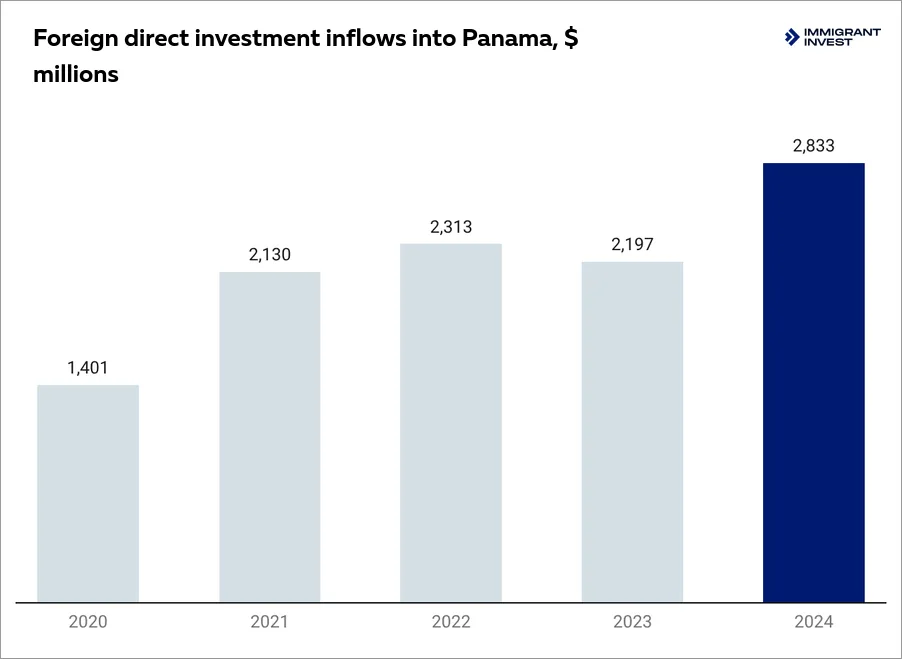
Panama has consistently attracted international capital over the past two decades, with investment flows showing cyclical rather than linear dynamics.
Foreign direct investment data reflects this pattern. After a net capital outflow during the COVID‑19 period, inflows recovered quickly and stabilised in the following years, with moderate annual variation. This indicates a return to normal investment activity rather than a one-off rebound.
Preliminary data for 2025 confirms continued volatility in investment flows. For example, Panama recorded a net capital outflow of around $887 million in the second quarter of 2025, followed by an inflow of approximately $676 million in the third quarter[1]. Such fluctuations are typical for economies with exposure to global capital markets and large-scale investment projects.
Overall, Panama’s investment profile is defined by stable long-term inflows combined with short-term variability, reflecting normal capital cycle dynamics rather than structural instability.
Regulatory framework for investors
When investing in Panama, individuals interact with the following government bodies:
- Superintendency of Banks of Panama[2] — oversight of the banking system;
- Securities Market Superintendency[3] — oversight of the Panama Stock Exchange and licensed brokers;
- Ministry of Commerce and Industry[4] — certifies investments for the Qualified Investor Visa;
- National Migration Service[5] — processes and approves residency applications;
- ProPanama[6] — government investment promotion agency providing market intelligence and facilitation services.
Some categories of investors might be eligible for residence permits in Panama. For instance, those who invest $300,000+ in real estate or $500,000+ in securities can obtain the Panama Qualified Investor Visa granted for life.

Why are global investors turning to Panama in 2026?
Panama’s appeal to global investors is rooted in long-term macroeconomic stability. Supported by a USD-denominated economy, Canal-driven revenues, and consistent international capital inflows, the country offers a stable foundation for long-term investment planning.
Strategic location and time zone
Panama’s strategic location between North and South America has turned the country into one of the main logistics and financial platforms in Latin America. Tocumen International Airport, often called the ‘Hub of the Americas’, connects Panama City with more than 80—90 destinations across the Americas and Europe and ranks among the most connected airports in Latin America.
Panama’s time zone aligns with US East Coast business hours while remaining compatible with Latin American markets. This allows companies and investors to operate efficiently across multiple jurisdictions in real time.
Panama Canal as a macroeconomic anchor
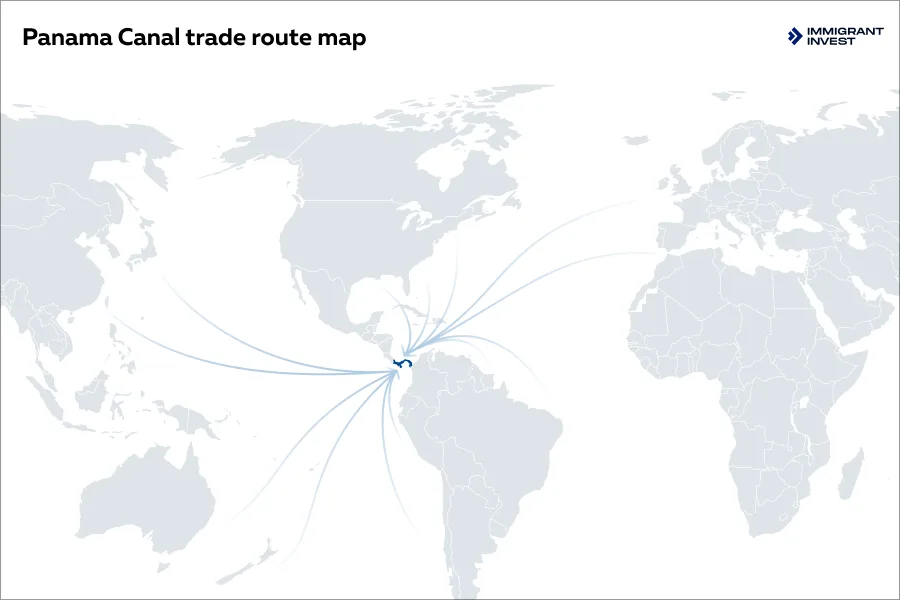
The Panama Canal is one of the world’s most important maritime trade routes, which links the Atlantic and Pacific Oceans and carries about 5—6% of global seaborne trade. Connecting 180 shipping routes across 170 countries, it underpins Panama’s economic model and strengthens the country’s role as a gateway for international commerce and investment.
The expansion of the Canal through the Neopanamax locks allows transit of large LNG tankers and high-capacity container vessels, reinforcing its long-term relevance. Canal revenues provide a stable source of national income and support overall economic resilience.
USD-denominated economy
Panama has used the US dollar as legal tender since 1904. The country’s official currency is the balboa, which is pegged to the US dollar at a 1:1 rate. This eliminates foreign exchange risk for dollar-based investors and simplifies cross-border transactions, capital transfers, and financial planning.
For international investors, this provides a level of currency stability that is uncommon in Latin America and reduces exposure to exchange rate volatility.
Territorial taxation
Panama’s territorial tax system means that only income sourced within Panama is subject to Panamanian income tax at the progressive rate of 0 to 25%[7]. Foreign-sourced income, including dividends, capital gains, rental income from abroad, and business profits generated outside Panama, is fully exempt.
This framework makes Panama particularly attractive for international structuring, allowing investors to separate local operations from global income streams.
Business-friendly environment
Panama offers a business-friendly environment supported by relatively simple company registration procedures and relatively moderate taxation: 25% corporate tax[8] and 7% VAT[9]. Foreign investors enjoy the same ownership rights as local citizens, with no restrictions on holding shares or assets.
In addition, special economic zones such as the Colón Free Trade Zone and Panama Pacifico provide tax incentives, customs benefits, and simplified administrative procedures for internationally oriented businesses. These may include exemptions from import duties on re-exported goods, tax relief on re-export income, and reduced requirements for commercial licensing and registration.
Developed banking sector
Panama has a well-established financial system, with over 70 international banks operating in the country. This creates a mature private banking infrastructure supporting wealth management, international transactions, and corporate banking needs.
The presence of global and regional banks facilitates multi-currency operations, cross-border payments, and access to financial products. Key banks include:
- American Citibank;
- Canadian Scotiabank;
- French BNP Paribas;
- Colombian Davivienda;
- Panamanian Banco General, Banco Nacional de Panamá, Global Bank, and Caja de Ahorros.
Eligibility for permanent residence
Foreigners investing in Panama may be eligible for the Qualified Investor Visa that grants permanent residence in exchange of $300,000+ investment. Three options are available:
- $300,000 — in real estate;
- $500,000 — in securities listed on the Panama Stock Exchange;
- $750,000 — in fixed-term bank deposit from.
The process is relatively fast, with residence usually granted within 3+ months, provided all Due Diligence and documentation requirements are met. Investors can also include family members, which allows extending benefits to spouses, children, and parents.
Panama does not impose strict physical presence requirements to maintain status. This makes the country particularly attractive for investors who do not plan to relocate full-time but want a stable Plan B residency.